

Quick Answer
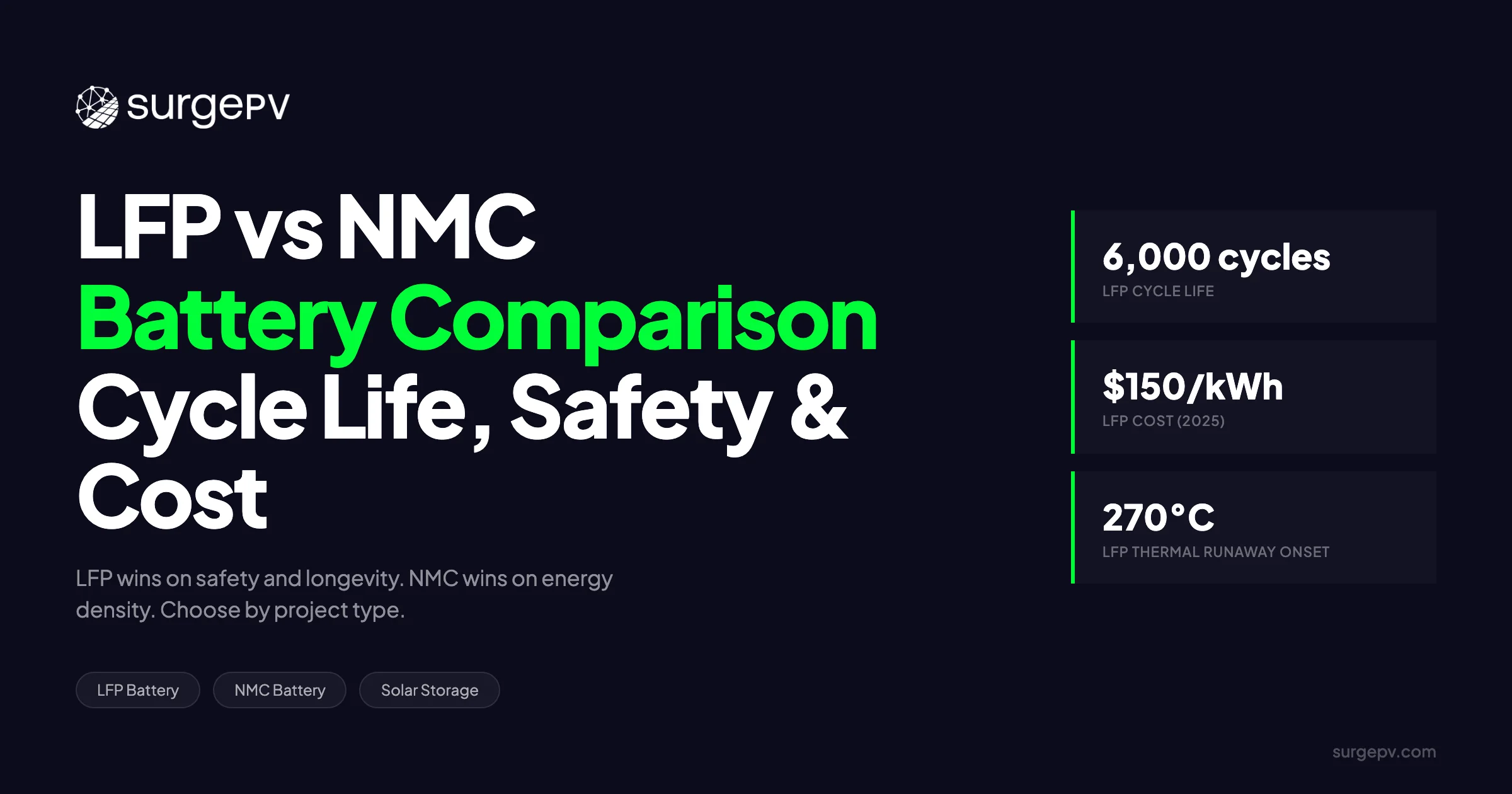
LFP (lithium iron phosphate) batteries offer 6,000–10,000 cycles, superior thermal stability, and zero cobalt. NMC provides higher energy density but shorter lifespan (3,000–5,000 cycles) and thermal runaway risk. LFP is now the preferred choice for solar storage.
Choosing the right battery chemistry is the single most consequential equipment decision a solar installer makes on a storage project. Lithium iron phosphate (LFP) has overtaken nickel manganese cobalt (NMC) as the dominant chemistry in new stationary storage installations, accounting for more than 80% of residential and commercial battery shipments in 2025. The shift is driven by longer cycle life, lower cost per kilowatt-hour, and safer thermal behavior, but NMC still holds advantages in energy density and cold-weather discharge that matter in specific applications.
LFP (lithium iron phosphate) batteries offer 6,000–10,000 cycles, superior thermal stability, and zero cobalt. NMC provides higher energy density but shorter lifespan (3,000–5,000 cycles) and thermal runaway risk. LFP is now the preferred choice for solar storage.
TL;DR
LFP batteries last 3,000–10,000 cycles, tolerate 80–100% depth of discharge, and resist thermal runaway up to ~270°C. NMC batteries have higher energy density and perform better below freezing, but cost roughly $128/kWh versus LFP at $81/kWh (BloombergNEF 2025) and carry higher fire risk. For most residential and commercial solar projects, LFP is the lower-risk, lower-lifetime-cost choice.
In this guide, you will learn:
- How LFP and NMC chemistries differ at the cell level and what those differences mean for solar installers
- Exact cycle life, depth of discharge, and cost numbers from NREL, BloombergNEF, and field studies
- Why LFP is safer for garage and indoor installations, and what NFPA 855 and UL 9540A require
- A worked LCOS example for a 10 kWh residential system over 15 years
- How temperature affects each chemistry and how to size for cold climates
- Which chemistry wins by use case: residential, commercial, off-grid, and EV
- Five buying rules to reduce risk on every battery project
- Answers to the most common installer questions on compatibility, charging, and cooling See Off Grid Solar System Sizing for detailed guidance.
LFP vs NMC Battery Chemistries Explained
What Is an LFP Battery?
LFP stands for lithium iron phosphate. The cathode material is LiFePO₄, a crystalline compound that stores and releases lithium ions during charge and discharge. The anode is typically graphite. LFP cells operate at a nominal voltage of 3.2V per cell, roughly 0.5V lower than NMC equivalents. The phosphate-oxygen bond is strong and stable, which is the root cause of LFP’s superior thermal stability and long cycle life.
LFP was commercialized in the late 1990s but gained serious traction in solar storage only after 2018, when Chinese manufacturers scaled production and drove pack prices below $150/kWh. BYD, CATL, EVE Energy, and Gotion High-Tech now supply the majority of LFP cells used in residential and commercial storage systems worldwide. The chemistry has become the default choice for new solar-plus-storage projects because it tolerates deep daily cycling without rapid capacity fade.
The trade-off is energy density. LFP packs deliver 120–160 Wh/kg at the cell level, which means larger physical size and heavier weight for a given capacity. For rooftop or ground-mount solar installations where space is rarely the binding constraint, this is an acceptable compromise.
What Is an NMC Battery?
NMC stands for nickel manganese cobalt. The cathode is a layered oxide containing varying ratios of nickel, manganese, and cobalt, commonly written as NMC 532, 622, or 811 depending on the metal proportions. Nickel provides high energy density, manganese adds stability, and cobalt improves cycle life and rate capability. Modern storage cells lean toward higher nickel content (NMC 811) to maximize capacity, though this also increases thermal sensitivity.
NMC cells operate at 3.6–3.7V nominal, allowing fewer cells in series to reach a given system voltage. Energy density at the cell level ranges from 180–250 Wh/kg, making NMC the chemistry of choice for electric vehicles where weight and packaging volume directly affect range. Tesla Powerwall units through 2022 used NMC cells, though the company has since shifted to LFP for stationary storage products.
The cobalt content in NMC has raised supply-chain and ethical concerns, though these have less direct impact on installer decision-making than the chemistry’s thermal behavior and cost trajectory.
Why Chemistry Choice Matters for Solar Installers
Solar storage batteries are not interchangeable commodities. The chemistry determines how deeply you can discharge daily, how many years the system lasts under solar duty cycles, how much fire risk you introduce into a customer’s garage, and whether the battery remains economical over its warranty period. An installer who treats all lithium batteries as equivalent will eventually face warranty claims, safety incidents, or unhappy customers whose systems underperform.
The design software you use should model these differences explicitly. SurgePV’s solar PV design software lets you select LFP or NMC chemistry when sizing storage, which affects depth-of-discharge defaults, round-trip efficiency assumptions, and degradation curves in the financial model. For a direct comparison, see Arka 360 vs SurgePV.
Side-by-Side Comparison Table
| Metric | LFP | NMC | Winner |
|---|---|---|---|
| Cycle life | 3,000–6,000+ std; 6,000–10,000+ premium | 1,000–2,500 std; 2,000–4,000 premium | LFP |
| Depth of Discharge | 80–100% | 80–95% | LFP |
| Thermal runaway temp | ~270°C | ~180–210°C | LFP |
| Energy density (Wh/kg) | 120–160 | 180–250 | NMC |
| Cost per kWh (2025) | ~$81/kWh | ~$128/kWh | LFP |
| Operating temp range | -10°C to +50°C (discharge) | -10°C to +45°C (discharge) | Tie |
| Self-discharge rate | ~1.5–3% per month | ~2–4% per month | LFP |
The table above distills the decision into seven dimensions. LFP wins on five, NMC wins on one, and one is a tie. The magnitude of LFP’s advantages matters more than the count: cycle life is 2–3x longer, cost per kWh is 37% lower, and thermal runaway temperature is 60–90°C higher. NMC’s energy density advantage is real but largely irrelevant for stationary applications where a 100 kg versus 150 kg battery pack makes no practical difference to the installation.
The cost gap has widened, not narrowed, over the past three years. BloombergNEF’s 2025 battery price survey reported average LFP pack prices at $81/kWh and NMC at $128/kWh, a gap driven by iron and phosphate being abundant and cheap compared to nickel and cobalt. For a 10 kWh residential battery, that difference translates to roughly $470 in cell cost alone at the pack level, before markup.
Depth of discharge is another underappreciated differentiator. LFP manufacturers routinely warrant 90–100% daily DoD. NMC warranties typically cap daily DoD at 80–90%, meaning a 10 kWh NMC battery delivers 8–9 kWh of usable capacity versus 9–10 kWh for an equivalent LFP system. When you model payback periods, that 10–20% capacity difference compounds daily over 15 years. Also see: Us Residential Solar Market Trends 2026.
Self-discharge is low for both chemistries compared to lead-acid, but LFP’s edge matters for backup systems that may sit idle for weeks between grid outages. A 1.5% monthly self-discharge rate means a fully charged 10 kWh LFP battery loses 150 Wh per month sitting idle; an NMC pack at 3% loses 300 Wh.
Cycle Life and Depth of Discharge
Real-World Cycle Life Data
Published cycle life figures vary widely because testing conditions differ. Laboratory tests at 25°C, 0.5C charge/discharge, and 80% DoD produce optimistic numbers. Solar installers need to understand what happens when a battery cycles daily for a decade in a garage that hits 35°C in summer and 5°C in winter.
NREL’s 2023 technical report on lithium-ion degradation in stationary applications found that LFP cells retained over 80% of initial capacity after 3,000 cycles at 100% DoD and 25°C. BYD’s B-Box LFP systems, widely deployed in Australian residential solar, have demonstrated 6,000+ cycles in accelerated testing and field monitoring. Premium LFP cells from CATL and EVE are now rated for 8,000–10,000 cycles at 80% DoD under controlled conditions. Read more about Solar Energy in Australia. For Australia-specific compliance details, see Australia comparisons/lgc-vs-stc.
NMC data tells a different story. A 2022 study by ITP Renewables in Australia tested residential NMC batteries under real solar cycling conditions and found capacity fade accelerating after 1,500–2,000 equivalent full cycles. Modern NMC 811 cells used in storage improve on earlier generations, but 2,000–4,000 cycles remains the realistic range for premium products under solar duty.
The economics are stark. A residential system cycling 300 equivalent full cycles per year will hit 4,500 cycles in 15 years. An LFP battery rated for 6,000 cycles has headroom. An NMC battery rated for 3,000 cycles will likely need replacement or suffer deep capacity loss before the end of a standard 20-year solar loan.
DoD Sensitivity by Chemistry
Depth of discharge is the percentage of total capacity used in each cycle. Deeper cycling accelerates degradation for all lithium-ion chemistries, but the sensitivity differs. LFP’s olivine crystal structure is structurally stable even when nearly fully delithiated. NMC’s layered oxide structure undergoes more significant phase changes and stress at high DoD, accelerating capacity fade.
This is why LFP manufacturers confidently warrant 90–100% daily DoD while NMC warranties typically specify 80% or 85% maximum. For a solar installer specifying a 10 kWh battery for a customer who needs 8 kWh of nightly backup, the choice is between an LFP system used at 80% DoD with years of headroom, or an NMC system pushed to its warranty limit from day one.
When modeling customer savings, use chemistry-specific degradation curves. SurgePV’s solar software applies LFP and NMC degradation profiles automatically based on the battery selected, so installers do not have to manually adjust capacity fade assumptions year by year.
Safety and Thermal Runaway
What Triggers Thermal Runaway
Thermal runaway is a self-sustaining reaction where internal heat generation exceeds the battery’s ability to dissipate it, leading to cell venting, fire, or explosion. The trigger is typically an internal short circuit caused by mechanical damage, manufacturing defect, or lithium plating from overcharging or charging at low temperature. Once initiated, the reaction generates heat, which accelerates further reactions.
The critical parameter is the onset temperature: the point at which exothermic reactions become self-sustaining. For NMC cells, this onset is approximately 180–210°C. For LFP cells, it is roughly 270°C. That 60–90°C gap is the difference between a cell that might enter runaway during a summer heat wave in an unventilated garage, and one that will not.
Why LFP Is Safer for Indoor and Garage Installations
Solar batteries are commonly installed in garages, basements, and utility rooms, spaces where fire propagation would threaten the structure and occupants. LFP’s higher thermal runaway threshold is only part of the safety story. The other part is oxygen release.
NMC cathodes contain metal oxides that release oxygen when heated, feeding the fire from within the cell. LFP’s phosphate structure binds oxygen tightly and releases very little during failure. An NMC cell in thermal runaway can reach temperatures over 600°C and ignite adjacent cells through a process called propagation. LFP cells in runaway typically peak at 300–400°C with minimal propagation to neighboring cells.
This is why insurance underwriters and fire marshals increasingly favor LFP for residential installations. The National Fire Protection Association’s NFPA 855 standard for energy storage systems does not ban NMC, but it imposes stricter spacing, ventilation, and suppression requirements on systems with higher fire risk. Installers who choose NMC in jurisdictions enforcing NFPA 855 may face additional inspection hurdles, separation distances, or even permit denials for indoor installations.
System-Level Safety: BMS, Inverters, and Code Compliance
Cell chemistry is not the only safety variable. A properly installed LFP system with a failed battery management system (BMS) can be more dangerous than a well-managed NMC system. The BMS monitors cell voltages, temperatures, and currents, disconnecting the battery if any parameter exceeds safe limits. Inverters must have compatible charge profiles: LFP requires a constant-current/constant-voltage profile with a 3.6V per cell cutoff, while NMC profiles typically terminate at 4.2V per cell.
UL 9540A is the fire test standard for energy storage systems. It evaluates cell-level thermal runaway propagation and module-level fire behavior. Reputable battery manufacturers submit their products for UL 9540A testing, and installers should request test reports before specifying any battery for an indoor installation. A battery that passes UL 9540A with minimal propagation is safer than one that fails, regardless of chemistry.
For commercial projects, NFPA 855 mandates maximum allowable quantities, separation distances, and ventilation requirements based on kWh capacity and hazard classification. SurgePV’s solar proposal software includes NFPA 855 reference data and automatic capacity checks to flag compliance issues during design.
Cost Trajectory and LCOS
BloombergNEF Pack Price Data
Battery pack prices fell for the eighth consecutive year in 2025, but the gap between LFP and NMC widened. BloombergNEF’s annual survey placed average global LFP pack prices at $81/kWh and NMC packs at $128/kWh (estimate). The divergence reflects raw material costs: iron phosphate cathode active material costs roughly $10–15/kWh of cell capacity, while nickel-cobalt-manganese blends run $40–60/kWh depending on nickel and cobalt spot prices. For Global-specific compliance details, see Global net-metering-by-country.
For solar installers, the relevant price is not the cell cost but the installed system cost including inverter, BMS, enclosure, and labor. Residential LFP systems in the United States typically range from $700–1,200/kWh installed, while NMC systems run $900–1,500/kWh installed. The installed cost gap is narrower than the cell cost gap because inverters, enclosures, and labor are chemistry-agnostic, but LFP still holds a 15–25% advantage at the system level.
Worked LCOS Example for Solar Installers
Levelized cost of storage (LCOS) is the right metric for comparing batteries over time. It divides total lifetime costs by total lifetime energy delivered.
Consider a 10 kWh residential battery in a solar-plus-storage system, cycling 300 equivalent full cycles per year at 90% DoD:
LFP system:
- Installed cost: $10,000 ($1,000/kWh)
- Usable capacity: 9 kWh (90% DoD)
- Annual energy delivered: 9 kWh × 300 cycles = 2,700 kWh
- Cycle life: 6,000 cycles (20 years at 300/year)
- Round-trip efficiency: 92%
- Annual degradation: 0.5%
- Inverter replacement at year 12: $2,000
- Total lifetime energy: approximately 48,000 kWh (accounting for degradation)
- LCOS: ($10,000 + $2,000) / 48,000 kWh = $0.25/kWh
NMC system:
- Installed cost: $12,500 ($1,250/kWh)
- Usable capacity: 8 kWh (80% DoD)
- Annual energy delivered: 8 kWh × 300 cycles = 2,400 kWh
- Cycle life: 3,000 cycles (10 years at 300/year)
- Round-trip efficiency: 90%
- Annual degradation: 1.0%
- Battery replacement at year 10: $9,000 (assuming 20% cost reduction)
- Inverter replacement at year 12: $2,000
- Total lifetime energy: approximately 36,000 kWh
- LCOS: ($12,500 + $9,000 + $2,000) / 36,000 kWh = $0.65/kWh
The LFP system delivers energy at less than half the LCOS of the NMC system in this scenario. The gap widens if the customer plans to stay in the home longer than 10 years, since the NMC battery would need replacement while the LFP battery continues operating.
Installers who want to run these numbers for specific projects can use SurgePV’s solar yield and financial analysis, which models battery chemistry selection, backup sizing, degradation, and payback period for any tariff structure.
Temperature Performance and Installation Sizing
Cold-Climate Penalties for LFP
LFP’s weakness is low-temperature performance. At 0°C, LFP cells deliver 80–90% of rated capacity. At -10°C, capacity drops to 60–70%. At -20°C, usable capacity can fall to 50–60% of the nameplate rating. Discharge is possible at these temperatures, but charge must be restricted or prevented below 0°C to avoid lithium plating on the anode, which causes permanent capacity loss and dendrite formation that can trigger internal shorts.
Most residential LFP systems include cell heaters that activate when internal temperature drops below 5°C, drawing a small amount of power from the grid or the battery itself to warm the pack before allowing full charge rates. In cold climates, installers should size the battery 20–30% larger than the calculated need to account for winter capacity loss, or specify systems with integrated heating.
NMC performs better in the cold. At -10°C, NMC retains 70–80% of capacity. At -20°C, it retains 50–60%, comparable to LFP, but with less risk of lithium plating during charge. For off-grid cabins in Minnesota or Maine where the battery may sit in an unheated shed, NMC’s cold-temperature tolerance can be a genuine advantage.
Sizing and Inverter Compatibility
Voltage matching is non-negotiable when pairing batteries with inverters. A 48V nominal LFP system uses 16 cells in series (3.2V × 16 = 51.2V nominal). A 48V NMC system uses 14 cells (3.6V × 14 = 50.4V nominal). The charge voltage windows differ: LFP charges to 3.6V per cell (57.6V system), while NMC charges to 4.2V per cell (58.8V system). Inverters must have selectable charge profiles or chemistry-specific firmware.
C-rate, the charge and discharge rate relative to capacity, also differs. LFP tolerates 1C continuous discharge comfortably. NMC can sustain higher C-rates (up to 2–3C in some designs), which matters for backup systems supporting high startup loads like well pumps or HVAC compressors. For typical solar cycling at 0.2–0.5C, both chemistries are well within their comfort zone.
Installers should verify that the inverter manufacturer’s battery compatibility list explicitly includes the battery model being installed. Connecting an LFP battery to an inverter with an NMC charge profile, or vice versa, voids warranties and risks premature failure or safety incidents.
Verdict: Which Battery Wins by Use Case
Residential Solar
LFP wins. The typical residential solar customer wants a battery that lasts as long as the solar panels, requires no maintenance, and does not create a fire hazard in the garage. LFP’s 6,000+ cycle life aligns with 15–20 year solar asset horizons. Its lower cost per kWh improves payback math. Its higher thermal runaway temperature reduces liability and insurance risk.
The only residential scenario where NMC makes sense is a space-constrained installation where a smaller, lighter battery is physically necessary. Even then, the safety and cost trade-offs should be explained to the homeowner in writing.
Commercial and C&I Storage
For new commercial solar-plus-storage installations, LFP is the default. The LCOS advantage is even more pronounced at commercial scale because a 500 kWh LFP system avoids one full replacement cycle versus an NMC system over 15 years, saving hundreds of thousands of dollars.
NMC retains a niche in commercial retrofits where existing inverter voltage windows or physical enclosures cannot accommodate LFP’s different voltage or larger form factor. Some early commercial storage systems were designed around NMC voltages, and upgrading inverters to support LFP may not pencil out.
Off-Grid and Backup Systems
Off-grid systems cycle deeply every day, which favors LFP’s cycle life and deep DoD tolerance. The self-discharge advantage also matters: a cabin battery that sits for two weeks between visits retains more charge with LFP.
The exception is cold-climate off-grid systems in unheated spaces. If the battery location cannot be insulated or heated, NMC’s better cold-weather discharge may outweigh LFP’s cycle life advantage. In these cases, installers should upsize the battery bank and use a temperature-compensated charge controller.
EV Context (Why It Differs from Stationary)
Electric vehicles use NMC (or the related NCA chemistry) because energy density and specific energy directly affect vehicle range and weight. A 50 kg battery pack savings matters in a car. It does not matter in a garage-mounted stationary battery. EV batteries also experience different duty cycles: occasional deep discharge on long trips, but mostly shallow cycling in daily driving. Stationary solar batteries experience deep daily cycling, which is exactly where LFP excels.
Some installers encounter customers who want to repurpose EV batteries for home storage. This is generally inadvisable. EV batteries have different voltage architectures, BMS communication protocols, and safety certifications. Even if the cells are functional, integrating them into a solar system requires engineering expertise most installers do not have.
Design Solar + Storage Projects Faster
SurgePV’s generation and financial tool models battery chemistry selection, backup sizing, and payback in minutes.
Book a DemoNo commitment required · 20 minutes · Live project walkthrough
5 Buying Rules for Solar Installers
-
Specify LFP as the default chemistry. Only deviate to NMC when space constraints or existing inverter voltage windows make LFP physically or electrically incompatible. Document the reason for any NMC specification in the project file.
-
Match voltage and charge profile exactly. Confirm the inverter’s battery settings support the nominal voltage, float voltage, and charge termination voltage of the selected chemistry. A 48V LFP system at 51.2V nominal is not interchangeable with a 48V NMC system at 50.4V nominal without inverter reconfiguration.
-
Request UL 9540A test reports for every indoor installation. Do not rely on marketing claims of “safe chemistry.” Ask the battery manufacturer or distributor for the UL 9540A test report and confirm the product model number matches exactly. If the battery has not been tested, specify an alternative or require outdoor installation.
-
Oversize for cold climates. In regions where winter temperatures regularly drop below 0°C, size LFP batteries 20–30% larger than the calculated need, or specify systems with integrated cell heating. Do not install LFP batteries in unheated outdoor enclosures in climate zones 6 and 7 without heating or derating. See Temperature Derating Solar Conductors for detailed guidance.
-
Run LCOS, not just upfront cost. A battery that costs $2,000 less upfront but needs replacement after 10 years is more expensive than a battery that lasts 20 years. Model levelized cost of storage for every proposal and show the customer the total lifetime energy cost. If your design software does not calculate LCOS automatically, build a simple spreadsheet using the worked example in this guide.
Frequently Asked Questions
Which battery is safer, LFP or NMC?
LFP is safer for stationary solar storage. Its thermal runaway onset is approximately 270°C versus 180–210°C for NMC, and LFP releases minimal oxygen during failure, significantly reducing fire propagation risk in garage and indoor installations.
How long do LFP and NMC batteries last?
Premium LFP systems are rated for 6,000–10,000+ cycles. Modern NMC storage cells typically deliver 2,000–4,000 cycles under controlled conditions. Real-world solar duty cycles, with daily charging from PV arrays, consistently favor LFP longevity.
Can I replace NMC with LFP in an existing solar system?
Generally no. LFP cells run at 3.2V nominal versus 3.6–3.7V for NMC. The inverter charge profile, BMS settings, and voltage windows must match the chemistry. Swapping chemistries in an existing system usually requires inverter replacement.
Do LFP batteries require active cooling systems?
Most residential LFP systems rely on passive cooling or small internal fans. In climates where ambient temperature exceeds 45°C, derating or supplemental ventilation may be needed, but active liquid cooling is rare outside utility-scale BESS.
Can you charge LFP below freezing?
LFP should not be charged below 0°C without cell heating or significantly reduced charge rates. Discharge is possible down to roughly -10°C to -20°C depending on the manufacturer, but usable capacity drops by 20–40%.
What installation mistakes most often increase battery risk?
Improper torque on DC terminals, undersized busbars, mixed cell ages in a bank, missing ventilation, and ignoring manufacturer charge-temperature limits. These system-level errors matter more than chemistry choice when they go wrong.
Where this fits
This article is part of SurgePV's Energy Storage hub, which works through the topic from first principles to the decisions a project team actually has to make.
