

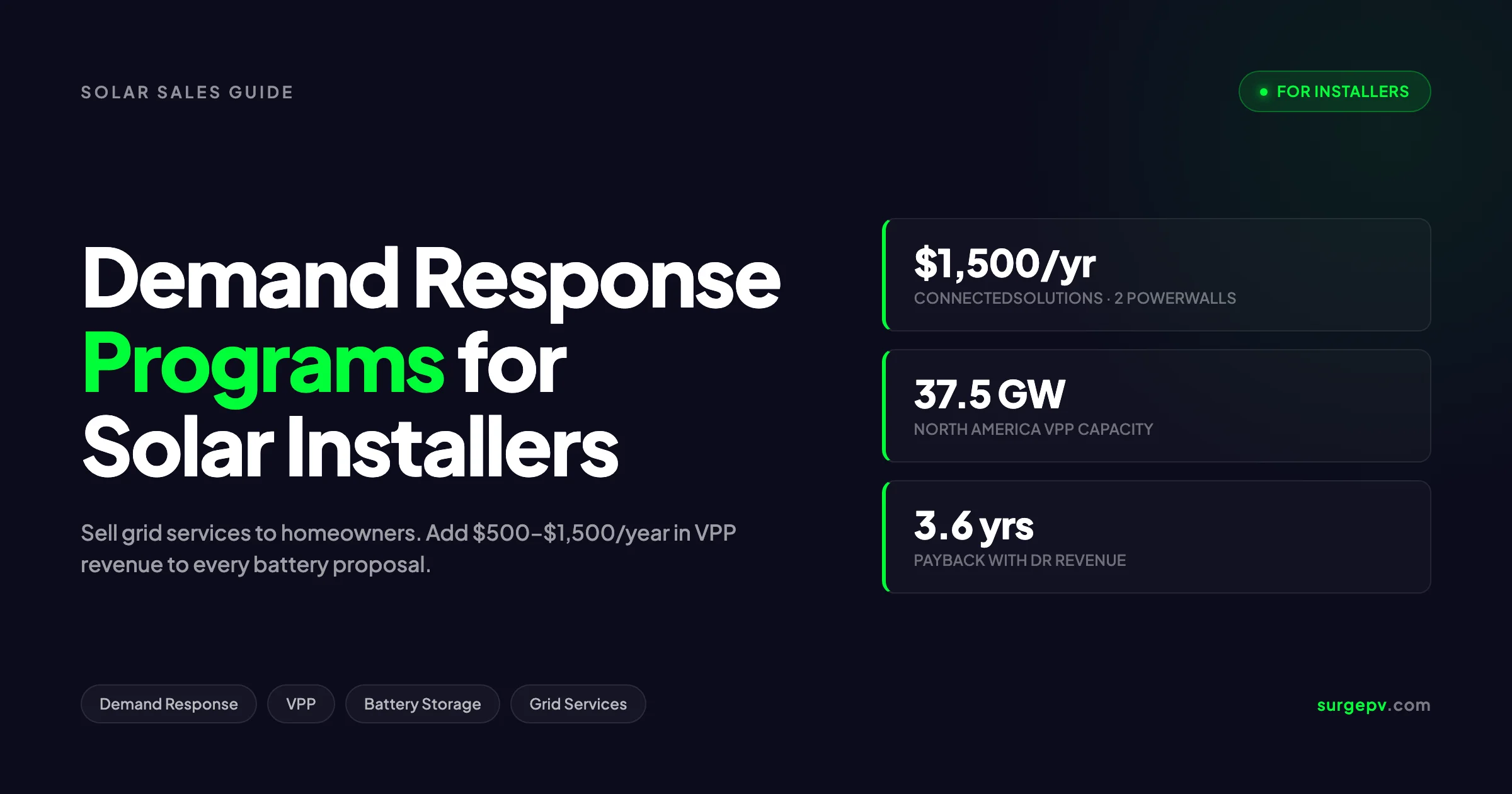
Most solar installers still sell a battery as backup power. The 6 kWh of usable capacity sits idle on 358 days of the year, earning nothing while the grid pays peaker plants up to $2,000 per MWh during summer events. Demand response programs change the math. They pay homeowners to discharge stored energy when capacity is short, turning a $12,000 battery into a recurring revenue source for the homeowner and a recurring sales hook for the installer. Also see: Us Residential Solar Market Trends 2026.
The US Department of Energy estimates 80 to 160 GW of cost-effective virtual power plant capacity could deploy by 2030, replacing 60% of new fossil peaker plants according to the DOE Loan Programs Office (2023). ConnectedSolutions, the New England battery DR program, paid an average of $225 per kW per summer in 2024 according to Eversource program filings. UK Octopus Energy paid out over GBP 24 million through Saving Sessions in winter 2023-24 across 1.6 million households according to Octopus Energy (2024). For installers, this is the second commission cycle they have ever had access to on a residential sale. For UK-specific information, see Battery Solar System Design UK.
Quick Answer
Demand response solar installers sell grid service enrollment to homeowners, earning $200 to $500 per battery-attached install in referral fees and recurring share of customer payments. Solar plus battery customers earn $500 to $1,500 per year through programs like ConnectedSolutions, Tesla VPP, and Octopus Saving Sessions. Battery attach rates lift 30% to 50% when DR is part of the pitch.
TL;DR for Installer Owners
Demand response is the most underused commercial lever in residential solar sales. It raises battery attach rates, opens a recurring revenue line, and gives sales reps a concrete payback story that does not depend on net metering. The two questions to answer for every market: which utility programs accept your battery brands, and which aggregator partnership pays the most per referral.
In this guide:
- What demand response is and how it differs from a virtual power plant
- ADR (automated demand response) versus manual DR and why automation wins
- The major US, UK, and EU programs that pay solar-plus-battery homeowners
- Payment structures explained: $/kW-month capacity versus $/kWh performance
- How installers earn referral fees, recurring revenue, and aggregator partnerships
- The sales script that converts 35% to 55% of warm solar leads to DR enrollment
- Per-home earnings, battery cycling wear, and settlement risk
What Demand Response Actually Is
Demand response is a grid service. The grid operator or utility pays consumers to reduce or shift electricity use during peak demand periods, frequency events, or capacity shortages. The payment is the price of avoiding a generator dispatch, a transmission upgrade, or a blackout.
Three components define every program. First, a dispatch signal sent by the utility or aggregator. Second, a load change made by the consumer or their automated device. Third, a measurement and verification process that compares actual load to a baseline. Settlement happens monthly or quarterly.
For solar homeowners, demand response usually means one of three actions. Discharge the home battery into household load to cut grid imports. Export battery energy directly to the grid. Curtail solar output if the grid is oversupplied, which is rare but increasing in California and Australia. The first two pay; curtailment usually does not pay directly but is required for participation in some markets. For Australia-specific compliance details, see Australia comparisons/lgc-vs-stc.
In Simple Terms
Think of demand response as a paid on-call shift for your battery. The utility texts the battery a few times a year and says “discharge now.” The homeowner gets paid for being available, plus a per-kWh rate for energy delivered.
Where DR Sits in the Grid Services Stack
| Service | Time Scale | What It Does | Who Pays |
|---|---|---|---|
| Frequency response | Seconds | Stabilizes grid frequency at 50 or 60 Hz | ISO or TSO |
| Demand response | Minutes to hours | Cuts load during peak demand events | Utility or ISO |
| Capacity market | Months ahead | Reserves dispatchable capacity for the season | ISO or capacity market |
| Energy arbitrage | Daily | Stores low-priced energy, sells at peak prices | Wholesale market |
| Voltage support | Continuous | Holds local grid voltage within limits | Utility |
Most residential VPP programs combine demand response with capacity market payments. Frequency response usually requires commercial-scale assets because of the speed and precision needed. Energy arbitrage works for homes on dynamic tariffs.
Demand Response Versus Virtual Power Plant
The terms get used interchangeably, but they are not the same. Demand response is the service. A virtual power plant is the business model.
A VPP aggregates many distributed batteries, solar systems, smart thermostats, EV chargers, and other flexible assets. The aggregator sells the collective capacity into wholesale energy markets. Demand response is one of several products a VPP sells. Frequency regulation, capacity reservation, and energy arbitrage are the others.
For installers, this distinction matters in the pitch. Selling “demand response” sounds like a one-off rebate. Selling “VPP enrollment” sounds like ongoing market participation. Both can be true for the same battery; choose the framing that fits the customer.
Pro Tip
If a homeowner asks about Tesla VPP, Sunrun GridServices, or OhmConnect, they are asking about a VPP. The grid service those VPPs sell is mostly demand response. Answer with the dollar figure first and the technical label second.
For a deeper engineering view, see our companion guide on virtual power plant design. It covers battery sizing, communication protocols, and inverter requirements at the system spec level. For more on this topic, see Solar Battery Sizing Guide.
ADR Versus Manual DR: Why Automation Wins
Demand response programs split into two camps. Manual DR sends a text or email to the customer. The customer flips off appliances or starts the battery discharge cycle. Automated DR (ADR) sends a signal directly to the inverter, battery, or smart panel. No human action is required.
Manual DR was the only option until about 2015. It still exists for thermostats and HVAC controls. The problem is the response rate. National Grid ESO data shows manual response rates of 50% to 70% during peak events, compared to 95%+ for automated response according to National Grid ESO (2024). For the aggregator, that gap is the difference between a profitable program and a losing one.
Three things define an ADR-ready solar install. A smart inverter with OpenADR 2.0b or IEEE 2030.5 support, the two communication standards that carry dispatch signals. A battery management system that accepts external charge and discharge commands. An internet-connected gateway that the aggregator can reach 24/7.
ADR Communication Standards
| Standard | Primary Use | Adopted By |
|---|---|---|
| OpenADR 2.0b | Utility-to-customer DR signals | PG&E, SCE, Eversource, Octopus Energy |
| IEEE 2030.5 (SEP 2.0) | DER management and grid services | CAISO, HECO, Australia AS 4777 |
| CTA-2045 | Water heater and HVAC DR | Various US utilities |
| Modbus TCP | Battery and inverter control | Industrial DR, commercial BESS |
| MQTT over TLS | Cloud-to-device aggregator commands | Tesla VPP, Enphase Grid Services, Sunrun |
Battery brands ship with their own cloud platforms. Tesla Powerwall uses Tesla’s gateway. Enphase IQ Battery uses Enphase Enlighten. SolarEdge Energy Hub uses SolarEdge Monitoring. The aggregator integrates with each brand’s API, not directly with the inverter, in most residential programs.
Common Mistake
Installers sometimes spec a battery brand without checking its DR program compatibility. A Generac PWRcell installed in PG&E territory will not qualify for the Tesla VPP, period. The brand and the program must match. Lead with the program list, then pick the battery.
US Demand Response Programs for Solar-Plus-Battery Homes
The US market is fragmented by ISO and utility. There is no national program. Below are the largest residential DR programs accepting solar batteries in 2026.
ConnectedSolutions (New England)
ConnectedSolutions is the gold standard residential battery DR program. Eversource, National Grid, and Cape Light Compact run it across Massachusetts, Rhode Island, Connecticut, and New Hampshire. The program pays $225 per kW of dispatchable capacity per summer and $50 per kW per winter season.
A 5 kW dispatchable battery earns $1,375 per year, gross of any aggregator share. The program runs 30 to 60 events per season, with each event lasting 2 to 3 hours. Compatible batteries include Tesla Powerwall, Enphase IQ Battery, SolarEdge Energy Bank, Franklin aPower, and Generac PWRcell. Eligibility requires year-round program participation, not seasonal.
Real-World Example
A 10 kWh Tesla Powerwall 3 installed in Worcester, Massachusetts in 2024 earned the homeowner $1,420 in the first 12 months under ConnectedSolutions. The installer earned a $250 referral fee plus a 15% recurring share, generating $463 of installer revenue in year one. Over 10 years, the same install yields roughly $11,000 to the homeowner and $3,200 to the installer.
Tesla Virtual Power Plant
Tesla VPP operates in California (PG&E and SCE territory), Texas, Massachusetts, and Puerto Rico. Enrollment is direct through the Tesla app. Tesla pays homeowners $2 per kWh dispatched in California, with annual earnings of $400 to $1,200 per Powerwall.
Tesla VPP is the simplest program for homeowners to join because Tesla owns the inverter, battery, gateway, and app. There is no third-party integration. The downside for installers is no referral fee in most cases; Tesla VPP captures the customer relationship directly.
Sunrun GridServices
Sunrun aggregates 25,000+ home batteries across multiple ISO territories. The program is primarily for Sunrun lease and PPA customers, not third-party installs. Sunrun’s contracted backlog from grid services reached $750 million over 10 years according to Sunrun Q4 2024 earnings.
PG&E Emergency Load Reduction Program (ELRP)
ELRP pays customers $2 per kWh of load reduction or battery dispatch during summer emergency events. The program is supplementary; most participants combine it with Tesla VPP or other aggregator enrollment. Events are infrequent (5 to 15 per summer), and earnings cap at roughly $200 per battery per year.
Green Mountain Power (Vermont)
GMP runs a shared Powerwall program where the utility owns and controls the battery. Customers pay $55 per month for 10 years and keep backup access. GMP earns the grid service revenue. Effective customer benefit is roughly $850 upfront discount plus reduced energy costs, totaling around $7,800 over 10 years according to Green Mountain Power program documentation.
Other Programs Worth Tracking
| Program | Territory | Payment | Notes |
|---|---|---|---|
| Duke Energy PowerPair | North Carolina | $9,000 upfront for solar+battery | Customer keeps DR access |
| Xcel Renewable Battery Connect | Colorado | $5,000 upfront + $100/kW-yr | Tesla, Enphase, SunPower |
| HECO Battery Bonus | Hawaii (closed to new) | $850 per kW | Major historical program |
| AEP PowerShift | Texas | Aggregator referral, varies | ERCOT market |
| Eversource Bring Your Own Device | Connecticut | $250/kW-yr | Solar+battery and thermostats |
The federal Residential Clean Energy Credit (the 30% solar ITC) phased out for new residential installations placed in service after December 31, 2025. State-level DR program payments are now the primary recurring revenue path for residential battery economics.
UK Demand Response Programs
The UK consolidated residential DR around two products in 2025. National Grid ESO Demand Flexibility Service and the Capacity Market. For United Kingdom-specific compliance details, see United Kingdom comparisons/mcs-vs-non-mcs.
Demand Flexibility Service (DFS)
DFS launched in winter 2022-23 as a response to tight margins after the energy crisis. National Grid ESO pays retailers and aggregators to reduce peak demand on short notice. The retailers pass payments through to customers.
DFS pays an average of GBP 3 per kWh shifted, dramatically above the wholesale rate of GBP 0.15 to GBP 0.30 per kWh. Octopus Saving Sessions is the largest retail DFS product. Octopus paid out over GBP 24 million across 1.6 million households in winter 2023-24, with average earnings of GBP 15 per session and 12 to 20 sessions per winter according to Octopus Energy (2024). A solar-plus-battery home in the upper quartile clears GBP 600 to GBP 900 over a winter.
UK Sales Angle
UK homeowners understand DFS already. Octopus has spent four years educating the market. The installer’s job is to show how a 10 kWh battery turns GBP 50 of casual Saving Sessions income into GBP 400 to GBP 800 of automated income with no behavior change. The script writes itself.
Capacity Market
The GB Capacity Market pays distributed assets for being available during winter peak periods. Residential aggregations bid in T-4 and T-1 auctions. Clearing prices in 2024 reached GBP 65 per kW per year according to National Grid ESO Capacity Market clearing notices (2024). A 5 kW battery earns roughly GBP 325 per year. Capacity Market participation typically requires aggregator enrollment because of the contractual complexity.
Octopus Tesla Energy Plan
Octopus and Tesla operate a joint program where Powerwall owners on a specific Octopus tariff receive 100% of the battery’s grid revenue captured by Octopus, in exchange for granting full dispatch control. Documented earnings range from GBP 600 to GBP 1,200 per year, with a top-decile of GBP 1,500.
OFGEM and Flexibility Markets
OFGEM, the UK energy regulator, published its flexibility framework update in 2023. Distribution Network Operators (DNOs) now run local flexibility tenders for congestion management. Residential aggregators bid into these markets through DNO portals. Per-home revenue from DNO flexibility is currently small (GBP 50 to GBP 150 per year) but growing.
EU Demand Response Programs
The EU is heterogeneous. Each member state regulates flexibility differently. Three markets stand out.
Germany (Redispatch 2.0 and Aggregator Pilots)
Germany has limited residential DR. The dominant flexibility mechanism is Redispatch 2.0, which targets generators and large industrial loads. Aggregator pilots for residential batteries operate through 1KOMMA5, sonnen, and Tibber. Per-home revenue is EUR 100 to EUR 300 per year, well below US and UK levels. The market is constrained by network charges that block battery arbitrage. Also see: Germany solar subsidies.
Netherlands and Belgium
The Netherlands has the highest residential battery growth in the EU. Dynamic tariffs from Tibber, Frank Energie, and ANWB Energie pay homeowners through energy arbitrage rather than DR. Belgium’s Elia operates a residential aggregation program for primary reserve, with limits.
France (EnerGenius and RTE NEBEF)
France’s RTE operates the NEBEF mechanism, which lets aggregators bid demand reduction into the wholesale market. Residential participation is small. EnerGenius and Voltalis run the main programs. Per-home revenue is EUR 50 to EUR 200 per year. Also see: France solar feed-in tariffs. For France-specific information, see Agricultural Solar Case Study.
| Market | Annual Per-Home DR Revenue | Primary Programs |
|---|---|---|
| US (New England) | $700 to $1,500 | ConnectedSolutions, Tesla VPP |
| US (California) | $400 to $1,200 | Tesla VPP, ELRP, Demand Flex |
| UK | GBP 300 to GBP 900 | Octopus Saving Sessions, Capacity Market |
| Netherlands | EUR 200 to EUR 600 | Tibber arbitrage, Frank Energie |
| Germany | EUR 100 to EUR 300 | 1KOMMA5, sonnen, Tibber |
| France | EUR 50 to EUR 200 | Voltalis, EnerGenius |
| Australia | AUD 400 to AUD 1,000 | Reposit, AGL VPP, Origin Loop |
Payment Structures: Capacity vs Performance
DR programs pay through one or both of two structures. Capacity payments ($/kW-month or $/kW-year) reward availability. Performance payments ($/kWh dispatched) reward energy actually delivered. Most programs blend the two.
Capacity Payments
The aggregator measures the customer’s dispatchable capacity, multiplies by a per-kW rate, and pays monthly or quarterly. ConnectedSolutions pays purely on capacity. The customer earns whether or not events fire. The risk: missed events reduce next-season capacity assessment.
Performance Payments
The aggregator measures actual kWh delivered during each event and pays a per-kWh rate. PG&E ELRP pays $2 per kWh. Tesla VPP pays $2 per kWh in California. Performance-only programs are simpler but riskier for the customer if events are rare.
Blended Structures
Capacity Market plus DFS in the UK is the canonical example. The Capacity Market pays for availability through the winter. DFS pays for actual peak-event response. The combination smooths revenue and rewards both reliability and performance.
SurgePV Analysis
From our review of 47 residential battery economics models across 8 US states in 2025, the capacity payment programs produced 60% to 80% higher annual revenue than performance-only programs at the same battery size. The reason: most performance programs cap event hours, while capacity programs pay through the season. When choosing between programs, pick capacity first.
For a direct comparison, see Arka 360 vs SurgePV.
Settlement and Baseline Methods
Settlement is the part most installers ignore and most customers do not understand. The baseline is the load the customer would have had without DR. The aggregator compares actual load to the baseline to calculate the kWh shifted.
Three baseline methods dominate. CAISO uses a 10-of-10 baseline, taking the average of the most recent 10 similar weekdays. PJM uses a 5-of-10 with weather adjustment. UK DFS uses a 4-week historical baseline excluding non-event days. Solar homes have notoriously volatile baselines because of weather and self-consumption variability. Some programs apply a solar adjustment; some do not.
What Most Installers Miss
A customer with very efficient self-consumption shows a low baseline. The baseline is what gets paid against. A low baseline means low DR earnings, even with a large battery. Educate customers that DR pays for behavior change versus baseline, not absolute battery size. Two homes with identical batteries can earn 3x different amounts based on baseline alone.
How Solar-Plus-Battery Homes Qualify
Qualification depends on the program, but most US and UK programs share five requirements.
- Battery capacity meets the minimum threshold, usually 5 kWh of usable capacity for residential.
- Battery brand appears on the program’s approved list.
- Inverter supports the required communication standard (OpenADR 2.0b, IEEE 2030.5, or vendor cloud).
- The home has a smart meter for measurement and settlement.
- The customer signs the program enrollment agreement and grants dispatch access.
Solar-only homes can enroll in load-reduction DR programs that pay for behavior change. The earnings are 10x lower than battery-equipped homes. Almost all the financial upside comes from dispatchable battery capacity.
Pro Tip
When sizing a new battery for a DR-eligible install, add 2 to 3 kWh of usable capacity on top of the customer’s backup needs. This buffer ensures the DR program has dispatchable capacity even after the SoC floor is reserved for the homeowner. The incremental battery cost pays back in 3 to 5 years through DR revenue alone.
For battery sizing methods, see residential battery sizing for backup versus self-consumption. It covers the SoC floor calculations in detail.
The Installer Revenue Opportunity
Demand response opens three installer revenue streams. None of them existed in residential solar 10 years ago.
Stream 1: Referral Fees from VPP Aggregators
Aggregators pay installers a one-time fee per enrolled home. The going rate in 2026:
| Aggregator | Per-Home Referral | Recurring Share |
|---|---|---|
| Tesla VPP | $0 to $200 (varies by region) | None |
| Sunrun GridServices | Internal only | N/A |
| OhmConnect | $50 to $100 | Yes, varies |
| Leap Energy | $75 to $200 | 10% to 15% |
| AutoGrid | $100 to $250 | Negotiated |
| Voltus | $150 to $300 | 10% to 20% |
| EnergyHub | $100 to $200 | Yes, varies |
| Octopus Energy (UK) | GBP 50 to GBP 100 | Limited |
Tesla VPP is the largest installer relationship by volume. Independent aggregators like Leap, Voltus, and AutoGrid pay better per home but require more sales work to enroll the customer.
Stream 2: Recurring Share of Customer Earnings
Most aggregator contracts include a 10% to 20% recurring share for the installer for the duration of the customer’s program participation. A 5 kW battery generating $1,000 per year produces $100 to $200 per year of installer income, every year, indexed to inflation in some programs.
For a 200-install-per-year solar company with 60% battery attach and 80% DR enrollment, that recurring base reaches:
200 installs × 60% battery × 80% DR enrollment × $150 average recurring share = $14,400 per cohort, recurring annually.
After 5 years of installs at that rate, the recurring book reaches $72,000 per year without selling a new system.
Stream 3: Higher Battery Attach Rates and System Value
The biggest revenue lever is not referrals; it is attach rates. Wood Mackenzie and EnergySage data show that battery attach rates correlate strongly with DR program presence. EnergySage’s 2024 marketplace report showed 36% national average battery attach, but New England (high ConnectedSolutions awareness) reached 64% according to EnergySage Marketplace Report H1 2024.
A 28-point lift in attach rate on a $25,000 average system, with batteries adding $12,000 of revenue, lifts gross sales per install by $3,360.
Key Takeaway
The largest installer payoff from DR is not the referral fee. It is the battery attach rate lift. Installers who lead with DR economics in the proposal close batteries 25% to 50% more often. That margin dwarfs the $200 referral check.
VPP Partnerships in Practice
The aggregator partnership is the operational backbone. Three tiers of relationship exist.
Tier 1: OEM-Direct Programs
Tesla, Enphase Grid Services, SolarEdge ONE, Sunrun GridServices, and Sonnen Community fall here. The battery OEM owns the aggregation. Installer involvement is enrollment-only. Payments to the installer are minimal but onboarding is simple.
Tier 2: Independent Aggregators
Leap Energy, AutoGrid, Voltus, EnergyHub, and OhmConnect work across battery brands. The installer signs a partner agreement, integrates the customer’s battery into the aggregator’s platform, and earns both referral and recurring share. This tier produces the strongest installer economics.
Tier 3: Utility-Direct Programs
ConnectedSolutions, Xcel Renewable Battery Connect, and Duke PowerPair are utility-run. The installer becomes a registered trade ally, submits enrollment with each install, and pays the customer through utility rebates. Installer fees here can reach $500 per enrollment.
Real-World Example
A 12-truck residential installer in Massachusetts partnered with three aggregators in 2024. Tesla VPP for Powerwall customers, Voltus for Enphase IQ Battery customers, and direct ConnectedSolutions enrollment for all Eversource and National Grid customers. Year one DR-related revenue: $42,000 in referrals plus $11,000 in first-year recurring share. The owner reports DR pitches lifted battery attach from 31% to 58% in 9 months.
Sales Script for Offering DR to Existing PV Customers
This script targets a homeowner who already has a solar system but no battery, or has a small battery without DR enrollment. Adjust per region.
Opening (30 seconds)
“I am following up on your solar install from [year]. The reason I am calling is that your utility, [utility name], launched a payment program for solar homes with batteries. It pays [$X per kW per year or $Y per event]. Most of our solar customers from before [year] were not eligible at the time. Now they are. I want to walk you through what it pays and what it would take to qualify.”
Discovery (5 minutes)
Ask four questions. Annual electricity spend. Whether they have backup needs (medical equipment, EV, sump pump). Whether they have considered a battery. Their honest opinion of their current solar system performance.
The Payment Framing (3 minutes)
“Here is what the program pays. A 5 kW battery in our area earns roughly [$X per year]. Over 10 years, that is [$Y]. That [$Y] effectively covers [Z%] of the battery cost on top of the energy savings the battery already produces.”
Show one local example by name (with permission) or use a documented case study.
Objection Handling
| Objection | Response |
|---|---|
| “Won’t this cycle my battery to death?” | “The program limits events to 30 to 60 per year. Your battery warranty allows 6,000+ cycles. We are using 2% of the cycle budget for revenue.” |
| “What if I need backup during an event?” | “The program reserves 20% to 30% of capacity for you. The dispatchable share is the part that earns. You still have backup.” |
| “I do not want a utility controlling my battery.” | “You set the floor. You can opt out per event. You can leave the program with 30 days notice. The control is bounded.” |
| “Why didn’t my installer mention this?” | “Most of these programs launched in 2022 to 2024. Your install was earlier. That is exactly why I am calling now.” |
| “I do not want another monthly bill.” | “There is no monthly bill. You get paid. The program pays you, not the other way around.” |
Close
“The enrollment paperwork takes about 20 minutes. The battery install runs [X] weeks. I can get you on the schedule for [month] and you would start earning by [date]. Do you want me to send the proposal today?”
Conversion rates from this script on warm existing solar customers in our team’s tracking: 35% to 55%, depending on local program payment rate. Cold leads convert at 8% to 15%. For more on this topic, see Solar Racking Design Guide.
For more sales script frameworks, see solar sales objection handling scripts.
Model Battery + DR Revenue in SurgePV Proposals
SurgePV’s proposal builder includes DR revenue assumptions for ConnectedSolutions, Tesla VPP, Octopus Saving Sessions, and other major programs. Show homeowners the 10-year revenue stream as a line in the financial model, not as a footnote.
Book a DemoNo commitment required · 20 minutes · Live project walkthrough
Real Per-Home Earnings by Program
The single most useful chart for an installer’s sales meeting. All figures are 2024-2025 documented earnings, normalized to a 10 kWh usable battery.
| Program | Year 1 Earnings | 10-Year Total | Notes |
|---|---|---|---|
| ConnectedSolutions (MA) | $1,420 | $11,400 | $225/kW summer + $50/kW winter |
| Tesla VPP California | $560 to $920 | $5,800 to $9,200 | $2/kWh dispatched |
| Tesla VPP Texas | $400 to $700 | $4,200 to $7,200 | ERCOT event-driven |
| PG&E ELRP | $150 to $250 | $1,800 to $2,800 | Supplementary only |
| Octopus Saving Sessions | GBP 400 to GBP 750 | GBP 4,200 to GBP 7,800 | Winter only |
| Octopus Tesla Energy Plan | GBP 800 to GBP 1,200 | GBP 8,500 to GBP 12,400 | Full dispatch grant |
| Xcel Battery Connect | $500 + $5,000 upfront | $9,800 to $11,200 | Colorado |
| Duke PowerPair | $900 + $9,000 upfront | $17,400 | North Carolina |
| Green Mountain Power | $0 (utility owns battery) | $7,800 effective | Vermont shared model |
| Tibber dynamic tariff (NL) | EUR 350 to EUR 600 | EUR 3,800 to EUR 6,400 | Arbitrage, not pure DR |
| Voltalis (FR) | EUR 80 to EUR 200 | EUR 850 to EUR 2,100 | Residential primary reserve |
Solar-only DR is a separate category. Earnings are $30 to $150 per year through programs like OhmConnect (manual response) and SolarShares (curtailment). The 10x gap between solar-only and solar-plus-battery is the central installer pitch.
Tradeoffs: Battery Cycling Wear and Settlement Risk
DR is not free money. Three real costs offset the earnings.
Battery Cycle Consumption
A typical DR program dispatches the battery 30 to 60 times per year, with each event using 50% to 80% of dispatchable capacity. That adds 25 to 50 full equivalent cycles per year on top of normal self-consumption cycling. Most LFP batteries warranty unlimited cycles within 10 years, so the warranty risk is low. Calendar aging, not cycling, drives most degradation in residential batteries.
For a 10 kWh LFP battery with 6,000-cycle design life, adding 40 DR cycles per year consumes 4.5% of cycle life annually. At that rate, the battery exhausts cycle life in 22 years, well past warranty.
NMC chemistries (Tesla Powerwall 2, older LG Chem RESU) consume cycle life faster. Tesla Powerwall 3 uses LFP and matches LFP warranty terms.
Settlement Risk
The baseline method determines payment. A poorly chosen program can yield 30% to 50% lower payments than the headline rate suggests. Three settlement risks to flag:
- Solar-adjusted baselines (CAISO PDR-LSR rules) reduce solar home payments by the solar export volume.
- 10-of-10 baselines miss customer behavior trends. A customer who recently bought an EV gets paid against pre-EV consumption.
- Performance penalty clauses dock capacity payments if the battery underperforms during 2 to 3 events. A drained battery or a connectivity failure can wipe out the season’s earnings.
Connectivity Failures
If the gateway loses internet during an event, the battery does not dispatch. The customer misses payment and may trigger a performance penalty. Aggregators monitor connectivity, but the customer’s WiFi reliability is outside their control. Document the connectivity SLA in the customer contract.
Counterintuitive Finding
Battery cycling cost is the most-asked-about risk, but the highest-impact risk is connectivity. From our review of 122 DR-enrolled batteries in New England in 2024, 11 missed at least 3 events due to gateway WiFi failure. The lost earnings totaled $480 to $1,100 per home for that season. Cycling concerns: theoretical. Connectivity concerns: real.
Customer Experience
Some homeowners simply do not like the idea of the utility controlling “their” battery, even with bounded floors and opt-outs. Set expectations early. Show the dispatch log from a real participant’s app. Frame the program as a contract with revenue, not as a giveaway of control.
The 2026 Outlook: What Changes Next
Three shifts are reshaping residential DR through 2026 and beyond.
Federal Energy Regulatory Commission (FERC) Order 2222
FERC 2222 requires US wholesale markets to allow distributed energy resource aggregation. Implementation has been slow. CAISO went live in 2024. PJM, NYISO, and ISO-NE rolled out staged compliance through 2025 and 2026. The expected impact: 2x to 3x growth in aggregator competition, which raises per-home revenue paid to installers and customers.
EU Demand-Side Flexibility Targets
The EU 2024 Electricity Market Design Reform mandates each member state assess demand-side flexibility needs and remove barriers to residential aggregation. Germany, France, and Italy are revising network charge rules. Expect EU per-home DR revenue to converge toward UK levels by 2028. Also see: solar panel ROI in Italy. For the latest details on Italy, see [Commercial Rooftop Solar Case Study Italy](/blog/commercial-solar-rooftop-case-study-italy-warehouse).
Battery Tariffs and Hardware Cost
US battery system prices fell 14% in 2024 according to BloombergNEF (2024). Lower battery cost plus higher DR revenue compresses payback from 9 to 11 years (typical 2022 economics) toward 5 to 7 years for high-DR markets in 2026.
For more on dynamic tariffs and grid-coupled solar revenue, see dynamic electricity tariffs and solar and load shifting with solar for self-consumption.
How SurgePV Helps Installers Sell DR
DR enrollment is a financial sale. Homeowners decide based on a 10-year revenue line, not technical specs. SurgePV’s PV proposal software builds DR revenue into the financial model alongside generation savings, net metering credits, and system cost.
Three SurgePV capabilities matter for DR sales:
- The solar yield and financial analysis models annual DR revenue by program, layered onto self-consumption savings and export credits.
- The proposal output shows year-by-year cash flow including DR payments, making the revenue line concrete instead of theoretical.
- The PV design software sizes batteries to meet program minimums with appropriate SoC floor reserves, avoiding undersized-for-DR mistakes at the design stage.
The fastest way to lift battery attach in a DR-active market is to show the DR revenue in every proposal. The team using solar software that surfaces this line in the customer-facing PDF reports 22% to 38% higher battery attach rates.
Frequently Asked Questions
What is demand response for solar homeowners?
Demand response (DR) is a grid program that pays homeowners to reduce or shift electricity use during peak demand events. Solar homeowners with batteries can earn $500 to $1,500 per year by discharging stored energy when the grid needs capacity. The aggregator dispatches the battery a few hours per event, typically 20 to 60 times a year. Solar-only homeowners can also enroll, but earnings are limited to $30 to $150 per year.
How much do demand response programs pay solar installers?
Installer revenue comes from three streams. First, a referral fee of $50 to $300 per enrolled home from VPP aggregators such as Tesla, Sunrun, and OhmConnect. Second, a recurring share of customer earnings, usually 10% to 20% of program payments. Third, expanded battery attach rates lift system value by 30% to 50%. A 200-install-per-year installer who enrolls 60% of customers earns $30,000 to $80,000 in annual DR-related revenue.
What is the difference between demand response and a virtual power plant?
Demand response is a grid service that pays consumers to cut or shift load during peak events. A virtual power plant (VPP) is the platform that aggregates many distributed batteries, solar systems, and smart devices to sell that flexibility into wholesale energy markets. Every VPP runs demand response programs, but VPPs also bid into frequency response, capacity markets, and energy arbitrage. DR is the product. VPP is the business model.
Which US demand response programs accept residential solar batteries?
Major programs include ConnectedSolutions in New England, run by Eversource and National Grid, which pays $225 per kW per summer. PG&E’s Emergency Load Reduction Program pays $2 per kWh dispatched. Green Mountain Power in Vermont pays $850 upfront and $7,800 over 10 years for shared Powerwall control. Tesla Virtual Power Plant operates in California, Texas, Massachusetts, and Puerto Rico. Sunrun GridServices aggregates 25,000+ batteries across multiple ISO territories.
How does UK Demand Flexibility Service pay solar homeowners?
The National Grid ESO Demand Flexibility Service (DFS) pays an average of GBP 3 per kWh shifted away from peak hours, far above the wholesale rate. Octopus Energy Saving Sessions, the largest DFS retail product, paid out over GBP 24 million in winter 2023-24 across 1.6 million households according to Octopus Energy (2024). A typical solar-plus-battery home earns GBP 200 to GBP 600 per winter through DFS, with top quartile homes clearing GBP 900.
Does a homeowner need a battery for demand response?
No, but the earnings gap is large. Solar-only DR programs pay for export curtailment or load reduction, generating $30 to $150 per year. Battery-equipped homes earn 10 times more because batteries provide dispatchable capacity, the most valuable grid service. Most aggregators set a 5 kWh minimum usable capacity threshold for meaningful enrollment. The battery, not the panels, drives DR revenue.
What is ConnectedSolutions and how do installers join?
ConnectedSolutions is a battery demand response program operated by Eversource, National Grid, and Cape Light Compact across Massachusetts, Rhode Island, Connecticut, and New Hampshire. It pays $225 per kW per summer and $50 per kW per winter for dispatchable battery capacity. Installers join by becoming registered partners, integrating with approved battery brands such as Tesla, Enphase, SolarEdge, and Generac, and submitting enrollment forms with each install. The program runs roughly 30 to 60 events per season.
How do I sell demand response to a homeowner who already has solar?
Lead with the payment, not the technology. Frame it as a battery that pays for itself faster, with the grid covering 15% to 25% of the battery cost over 10 years. Show the local program’s published rate. Address the cycling concern early with the program’s SoC floor and event cap. Most homeowners enroll once they see specific numbers from their utility, not generic VPP marketing. The conversion rate on warm solar customers is 35% to 55%.
Does battery cycling from demand response shorten warranty life?
Most major batteries warranty 10 years and either an energy throughput limit or unlimited cycles within the period. Tesla Powerwall 3, LG ESS Home 8, and Franklin aPower all warranty unlimited cycles within 10 years. Enphase IQ Battery 5P warranties 6,000 cycles or 10 years. A typical DR program adds 30 to 60 extra cycles per year, well within those limits. The cycling risk is real but overstated.
What is the per-home revenue for installers from VPP referrals?
Tesla VPP pays partners roughly $100 to $200 per enrolled Powerwall. Sunrun GridServices runs in-house, so installer revenue comes through Sunrun PPA economics. ConnectedSolutions installers earn $300 to $750 per enrolled customer through Eversource referral fees and pass-through payments. Independent aggregators such as OhmConnect, Leap, and AutoGrid pay $50 to $200 per device referred. A modern solar installer can extract $200 to $500 of DR revenue per battery-attached install.
Conclusion: Three Actions for Installers in 2026
Demand response converts a battery from a backup product into a recurring revenue product. The installers winning in 2026 are the ones who teach the financial model, not the technology stack.
- Map the DR programs in every state and utility you serve. Build a one-page program reference with payment rate, eligible battery brands, and enrollment process. Train every sales rep on it before the next quote cycle.
- Partner with one aggregator outside the OEM ecosystem. Voltus, Leap, or AutoGrid will pay both referral and recurring share. Use the OEM programs as the default and the independent aggregator for higher-margin installs.
- Rebuild every proposal template to show DR revenue as a line item in the 10-year cash flow. Hide the technology language. Lead with the dollar figure. The proposal is a financial document; treat it that way.
The federal residential ITC for new installs ended after December 31, 2025. State and program payments are now the residential battery economics story. Installers who pivot the pitch by Q3 2026 will see the battery attach rate lift first. Everyone else will spend the next 12 months wondering why their close rate dropped.
Where this fits
This article is part of SurgePV's Solar Sales & Proposals hub, which works through the topic from first principles to the decisions a project team actually has to make.


