

Quick Answer
In flat-rate electricity markets without strong incentives, a home battery can take 12 to 18 years to pay back. High. 20% to 40% of total battery value Time-of-use arbitrage. Very high in TOU markets, zero in flat-rate markets. $0 to $900/year Backup power value. Can halve effective cost. 0% to 50% of upfront cost Self-consumption is the foundation.
Home battery sales grew 47% in 2024. Installers in California, Germany, and Australia now bundle storage with nearly every residential solar quote. The pitch is simple: store your free midday solar and use it when the sun goes down. Cut your grid bill. Keep the lights on during outages. Also see: Germany solar subsidies. Read more about Community Solar Projects Germany. For Australia-specific compliance details, see Australia comparisons/lgc-vs-stc.
In flat-rate electricity markets without strong incentives, a home battery can take 12 to 18 years to pay back. High. 20% to 40% of total battery value Time-of-use arbitrage.
But here is what most sales presentations leave out. In flat-rate electricity markets without strong incentives, a home battery can take 12 to 18 years to pay back. The battery may need replacement before it breaks even. The math is not automatically in your favor. It depends on where you live, how you use electricity, what your utility charges, and whether you can claim tax credits or rebates.
This guide is a battery payback calculator solar reference. It walks through every input that drives home battery payback period: self-consumption rates, time-of-use arbitrage, backup power value, degradation curves, incentive impact, and sizing tradeoffs. It includes real numbers by country. And it is honest about when batteries do not make financial sense. For installers building proposals with storage, solar software that models battery economics alongside production estimates delivers accurate payback figures clients can trust.
TL;DR — Battery Storage Payback Calculator
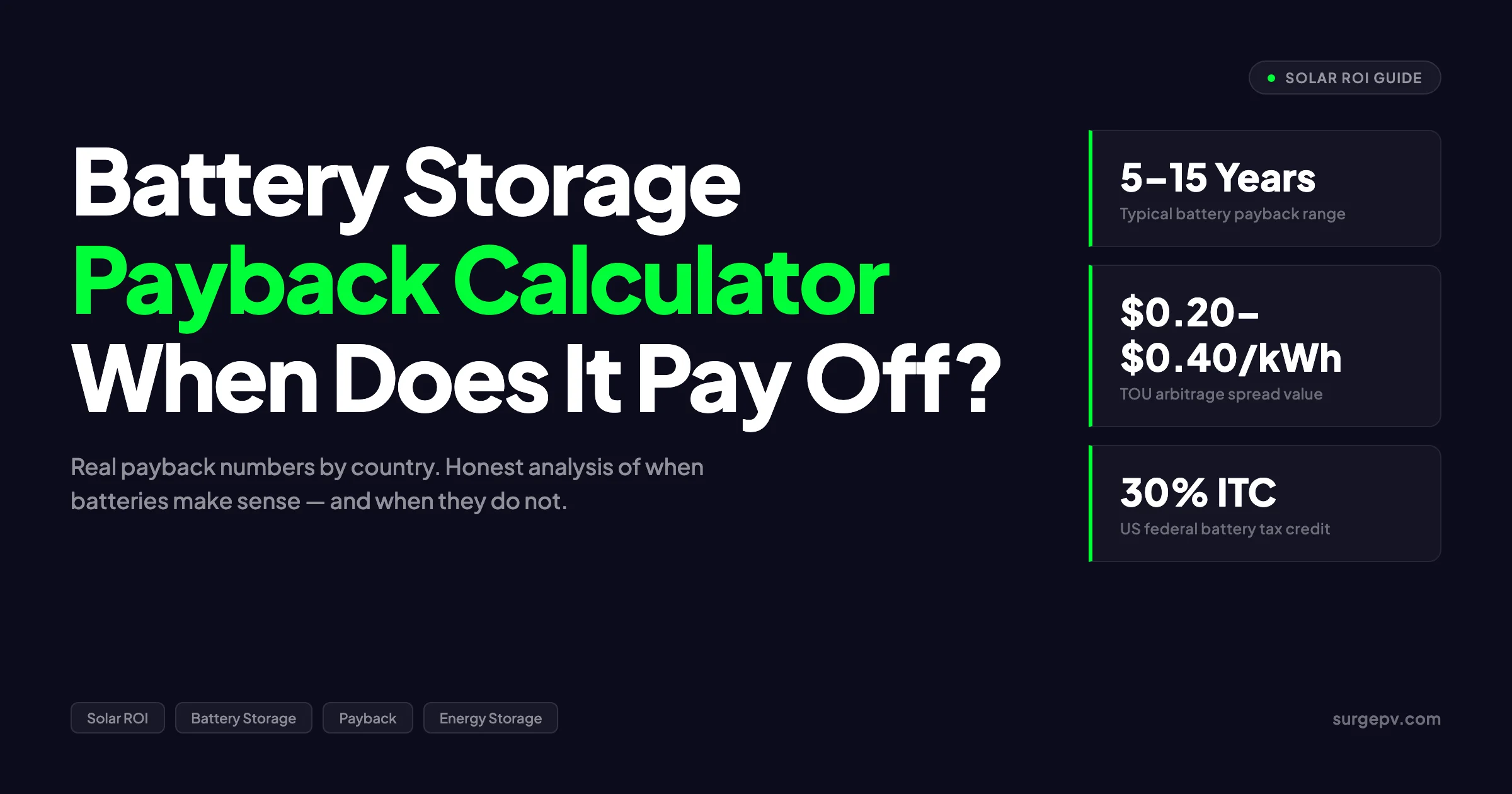
Home battery payback ranges from 5 to 15 years depending on market conditions. Best case: high time-of-use spreads + 30% federal ITC + daily solar cycling = 5 to 7 years. Worst case: flat rates + no incentives + moderate self-consumption = 12 to 18 years. A battery payback calculator solar tool must model degradation, real efficiency, and changing electricity rates to produce honest estimates.
Read Adding Battery Storage Services for a complete walkthrough.
In this guide:
- Quick answer: what drives battery payback and typical ranges by market
- What a battery payback calculator solar tool actually models
- Self-consumption: the single biggest lever on battery savings
- Time-of-use arbitrage math with real examples
- Backup power value: three ways to quantify it
- Battery payback by country: US, Germany, Australia, UK
- Battery sizing impact: 5 kWh vs 10 kWh vs 15 kWh
- Incentive impact: ITC, state rebates, and feed-in tariffs
- When batteries do NOT pay back: the counterintuitive finding
- Battery vs no-battery: total cost of ownership comparison
- Why most battery payback estimates are wrong
- Real payback examples with full numbers
- FAQ
Quick Answer: What Drives Battery Payback
A home battery pays back when the value of the electricity it stores and displaces exceeds its upfront cost over its useful life. Four variables dominate that equation.
| Driver | Impact on Payback | Typical Range |
|---|---|---|
| Self-consumption increase | High | 20% to 40% of total battery value |
| Time-of-use arbitrage | Very high in TOU markets, zero in flat-rate markets | $0 to $900/year |
| Backup power value | Moderate but hard to quantify | $100 to $300/year |
| Incentives and rebates | Can halve effective cost | 0% to 50% of upfront cost |
Self-consumption is the foundation. A battery stores solar surplus that would otherwise export to the grid at a low rate. It discharges that stored energy in the evening when you would otherwise buy grid power at a high rate. The savings per kWh equal your retail rate minus your export rate.
Time-of-use arbitrage multiplies those savings in markets with peak/off-peak rate structures. California’s peak rates run $0.40 to $0.52/kWh. Off-peak rates run $0.15 to $0.22/kWh. A battery can arbitrage that $0.20 to $0.35 spread daily.
Backup power is the hardest to value. Most homeowners cannot put a precise number on outage avoidance. But for households in fire-prone areas (California PSPS events), hurricane zones (Florida, Gulf Coast), or regions with unreliable grids (parts of Australia), backup value can tip the decision.
Incentives reshape the math. The US federal ITC at 30% cuts a $10,000 battery to $7,000. California’s SGIP rebate can cut it further. Germany’s battery storage subsidies (KfW 270, some state programs) reduce payback by 2 to 4 years. Australia’s state-level battery rebates (Victoria, South Australia) do the same.
Battery Payback Range by Market Type
| Market Type | Example Regions | Typical Payback | Key Driver |
|---|---|---|---|
| High TOU + strong incentives | California, Hawaii, South Australia | 5 to 8 years | TOU arbitrage + ITC/rebates |
| Moderate TOU + moderate incentives | Germany, UK, Victoria (AUS) | 7 to 11 years | Self-consumption + modest subsidies |
| Flat rate + weak incentives | Most US Midwest, France, Spain | 10 to 15 years | Self-consumption only |
| Flat rate + no incentives | Parts of Eastern Europe, some US co-ops | 12 to 18 years | Marginal economics; backup value only |
What a Battery Payback Calculator Solar Tool Actually Models
A proper solar battery ROI calculator does more than divide cost by annual savings. It models a dynamic system over 10 to 15 years. Here is what the calculation engine must include.
Required Inputs
| Input | Why It Matters | Typical Value Range |
|---|---|---|
| Battery capacity (kWh) | Determines daily discharge potential | 5 to 20 kWh |
| Battery cost ($/kWh installed) | Dominates payback numerator | $800 to $1,500/kWh |
| Round-trip efficiency | Energy lost in charge/discharge cycle | 85% to 92% |
| Depth of discharge (DoD) | Usable capacity vs. nameplate | 90% to 100% for LFP |
| Degradation rate | Capacity loss per year | 1.5% to 2.5% for LFP |
| Electricity retail rate ($/kWh) | Value of each kWh displaced | $0.12 to $0.52/kWh |
| Export rate ($/kWh) | Opportunity cost of stored solar | $0.03 to $0.15/kWh |
| TOU rate spread | Arbitrage value per kWh | $0 to $0.35/kWh |
| Daily solar surplus (kWh) | How much the battery can charge | 2 to 15 kWh |
| Evening load (kWh) | How much the battery can discharge | 3 to 12 kWh |
| Incentive amount | Reduces upfront cost | $0 to $5,000 |
| Backup value ($/year) | Non-bill savings | $0 to $500/year |
The Core Calculation
Annual battery savings = (Self-consumption value) + (TOU arbitrage value) + (Backup value)
Self-consumption value = Daily solar surplus stored × Days cycled × (Retail rate − Export rate) × Efficiency
TOU arbitrage value = Daily discharge × Days cycled × TOU spread × Efficiency
Payback = (Battery cost − Incentives) / Annual savings
A battery storage savings calculator that omits degradation, uses 100% efficiency, or assumes 365 days of full cycling will overstate returns by 25% to 40%.
Self-Consumption: The Single Biggest Lever
Self-consumption is where most battery value comes from. Without a battery, solar households export midday surplus to the grid at a low rate and buy evening power at a high rate. A battery captures that surplus and converts it into evening self-consumption.
The Self-Consumption Math
| Scenario | Without Battery | With 10 kWh Battery |
|---|---|---|
| Annual solar production | 8,000 kWh | 8,000 kWh |
| Direct self-consumption | 3,200 kWh (40%) | 3,200 kWh |
| Battery-charged self-consumption | 0 kWh | 2,800 kWh |
| Total self-consumption | 3,200 kWh (40%) | 6,000 kWh (75%) |
| Grid export | 4,800 kWh | 2,000 kWh |
| Grid import (evening/night) | 4,500 kWh | 1,700 kWh |
Assumptions: 8,000 kWh annual solar production, 7,200 kWh annual household consumption, 10 kWh LFP battery with 90% usable capacity, 90% round-trip efficiency, 300 cycle days/year.
Value of Increased Self-Consumption
Using a retail rate of $0.28/kWh and an export rate of $0.08/kWh:
- Without battery: 3,200 kWh self-consumed at $0.28 = $896/year saved. 4,800 kWh exported at $0.08 = $384/year income. Total = $1,280/year.
- With battery: 6,000 kWh self-consumed at $0.28 = $1,680/year saved. 2,000 kWh exported at $0.08 = $160/year income. Total = $1,840/year.
- Battery incremental value: $560/year from self-consumption alone.
If the battery costs $8,000 installed and qualifies for a 30% ITC ($2,400), net cost is $5,600. Self-consumption-only payback = $5,600 / $560 = 10 years.
This is the baseline. TOU arbitrage and backup value sit on top of this.
Self-Consumption Rate by Household Type
| Household Profile | Typical Self-Consumption (No Battery) | With 10 kWh Battery | Notes |
|---|---|---|---|
| Working couple, no kids | 25% to 35% | 55% to 70% | Low daytime load; battery adds significant value |
| Family with kids, someone home | 40% to 55% | 70% to 85% | Higher baseline; battery adds moderate value |
| Retirees, home all day | 55% to 70% | 80% to 90% | High baseline; battery adds limited value |
| Home office worker | 45% to 60% | 75% to 88% | Strong midday load; battery value depends on evening use |
The counterintuitive finding: households with the highest baseline self-consumption get the least incremental benefit from a battery. A retiree who already self-consumes 65% of their solar sees only a 15 to 20 point gain. A working couple who self-consumes 30% sees a 25 to 35 point gain. The battery creates more value for households that are not home during the day.
Time-of-Use Arbitrage Math
Time-of-use rates charge different prices for electricity at different times of day. A battery can arbitrage these spreads by charging during cheap periods and discharging during expensive periods.
California PG&E TOU-C Rate (2026)
| Period | Time | Summer Rate | Winter Rate |
|---|---|---|---|
| Off-peak | 12am to 3pm | $0.16/kWh | $0.15/kWh |
| Peak | 4pm to 9pm | $0.48/kWh | $0.32/kWh |
| Partial-peak | 9pm to 12am | $0.24/kWh | $0.20/kWh |
Daily arbitrage opportunity: Charge battery from solar (free) or off-peak grid ($0.16) during midday. Discharge during peak ($0.48).
Arbitrage value per kWh = $0.48 − $0.16 = $0.32 (winter: $0.32 − $0.15 = $0.17)
For a 10 kWh battery discharged 80% daily (8 kWh usable after efficiency losses):
- Summer daily arbitrage: 8 kWh × $0.32 = $2.56/day
- Winter daily arbitrage: 8 kWh × $0.17 = $1.36/day
- Annual arbitrage (6 months each): ($2.56 × 180) + ($1.36 × 185) = $461 + $252 = $713/year
This is on top of the self-consumption value. Combined with the $560/year self-consumption savings above, total annual battery savings in California = $560 + $713 = $1,273/year.
At a net cost of $5,600 (after 30% ITC), payback = $5,600 / $1,273 = 4.4 years.
This is why California is the world’s largest residential battery market. The TOU spread is wide enough to make batteries a strong financial investment even before backup value is counted.
Germany Time-of-Use Arbitrage
Germany has historically had flat residential rates, but dynamic tariffs and time-of-use pilots are expanding. As of 2026:
| Tariff Type | Off-Peak Rate | Peak Rate | Spread |
|---|---|---|---|
| Flat rate (majority) | €0.32/kWh | €0.32/kWh | €0 |
| Dynamic (Tibber, Awattar) | €0.18–€0.25/kWh | €0.38–€0.55/kWh | €0.13–€0.30/kWh |
| Bioraria (ENEL, some providers) | €0.28/kWh (F3) | €0.38/kWh (F1) | €0.10/kWh |
Most German households are still on flat rates. For them, TOU arbitrage value is zero. Households on dynamic tariffs can achieve €200 to €500/year in arbitrage savings with a 10 kWh battery.
Australia Time-of-Use Arbitrage
Australian states have the widest TOU spreads globally:
| State | Off-Peak | Peak | Spread |
|---|---|---|---|
| NSW (Ausgrid) | A$0.18/kWh | A$0.58/kWh | A$0.40/kWh |
| Victoria (Citipower) | A$0.17/kWh | A$0.42/kWh | A$0.25/kWh |
| South Australia | A$0.22/kWh | A$0.52/kWh | A$0.30/kWh |
| Queensland | A$0.22/kWh | A$0.38/kWh | A$0.16/kWh |
A 10 kWh battery in Sydney, discharged daily into the evening peak, can save A$0.40 × 8 kWh × 365 = A$1,168/year in arbitrage alone. This is why Australia has the highest residential battery penetration rate outside California.
Backup Power Value: How to Quantify
Backup power is the most cited non-financial reason for buying a battery. But it also has a financial value if you quantify it correctly. Here are three approaches.
Method 1: Avoided Generator Cost
A standby generator for a typical home costs $800 to $2,000 installed. It consumes $200 to $400/year in fuel and maintenance. Over 10 years, generator cost = $2,800 to $6,000.
A battery that eliminates the need for a generator saves that full cost. If you live in an area with 2 to 5 outages per year lasting 4 to 12 hours, a 10 kWh battery likely replaces a generator.
Value: $280 to $600/year equivalent.
Method 2: Business Interruption Value
For households with home offices, each hour of outage has a direct cost:
| Work Type | Lost Productivity per Hour | 8-Hour Outage Cost |
|---|---|---|
| Remote employee (salary) | $35 to $65/hour | $280 to $520 |
| Self-employed consultant | $50 to $150/hour | $400 to $1,200 |
| Small business owner | $75 to $200/hour | $600 to $1,600 |
If your area averages 3 outages per year at 6 hours each, and a battery keeps you online for 80% of that time:
Annual business interruption avoided = 3 × 6 × 0.80 × $50 = $720/year (at $50/hour)
Method 3: Insurance Premium Approach
Estimate the annual probability of a catastrophic outage (multi-day) and multiply by the cost:
| Event Type | Annual Probability | Cost if Unprepared | Expected Annual Cost |
|---|---|---|---|
| 2-day winter storm outage | 10% | $800 (hotel, food, pipes) | $80/year |
| 3-day hurricane evacuation | 5% | $2,500 | $125/year |
| PSPS fire-prevention outage (CA) | 30% | $400 | $120/year |
| Total expected annual cost | $325/year |
A battery that prevents or mitigates these events has an insurance-like value of $200 to $400/year for households in high-risk areas.
Combined Backup Value Estimate
| Household Type | Low Estimate | High Estimate |
|---|---|---|
| Suburban home, reliable grid | $50/year | $150/year |
| Home office worker | $200/year | $500/year |
| Fire/hurricane zone | $300/year | $800/year |
| Rural, frequent outages | $400/year | $1,000/year |
For financial modeling, most analysts use $150 to $250/year as a conservative backup value for typical suburban homes in areas with occasional outages.
Battery Payback by Country and Region
Battery economics vary dramatically by country. Here is the honest picture for four major markets.
United States
The US is the world’s largest residential battery market, driven by California and Hawaii. Economics vary by state.
| State | Battery Cost (10 kWh) | Incentives | Net Cost | Annual Savings | Payback |
|---|---|---|---|---|---|
| California | $9,000 to $11,000 | 30% ITC + SGIP ($1,500–$3,000) | $4,800 to $6,800 | $1,200 to $1,800 | 4 to 6 years |
| Hawaii | $10,000 to $12,000 | 30% ITC + state rebate | $5,500 to $7,500 | $1,400 to $2,000 | 4 to 5 years |
| Texas | $8,500 to $10,000 | 30% ITC only | $6,000 to $7,000 | $600 to $900 | 7 to 11 years |
| Florida | $8,500 to $10,000 | 30% ITC only | $6,000 to $7,000 | $500 to $800 | 8 to 13 years |
| New York | $9,000 to $11,000 | 30% ITC + NYSERDA | $5,500 to $7,000 | $800 to $1,200 | 6 to 9 years |
| Midwest (flat rate) | $8,000 to $10,000 | 30% ITC only | $5,600 to $7,000 | $400 to $600 | 10 to 16 years |
US federal ITC: The 30% Investment Tax Credit applies to battery storage when installed with solar. A battery added to existing solar also qualifies if installed in the same tax year. Standalone batteries do not qualify.
California SGIP: The Self-Generation Incentive Program provides $150 to $1,000 per kWh depending on equity budget and grid vulnerability. Equity-budget households in high fire-threat districts can receive up to $1,000/kWh.
Germany
Germany’s battery market is driven by high electricity rates and the KfW 270 loan program, not by time-of-use arbitrage.
| Scenario | Battery Cost (10 kWh) | Incentives | Net Cost | Annual Savings | Payback |
|---|---|---|---|---|---|
| With KfW 270 loan | €6,500 to €8,500 | Low-interest loan (not grant) | €6,500 to €8,500 | €400 to €650 | 10 to 16 years |
| With state grant (Bavaria, NRW) | €6,500 to €8,500 | €500 to €2,000 grant | €5,000 to €7,500 | €400 to €650 | 8 to 13 years |
| Dynamic tariff household | €6,500 to €8,500 | None | €6,500 to €8,500 | €650 to €950 | 7 to 11 years |
German battery economics are challenging. The flat-rate structure means value comes almost entirely from self-consumption. At €0.32/kWh retail and €0.08/kWh export, each stored kWh saves €0.24. A 10 kWh battery cycled 250 days/year at 80% depth with 90% efficiency stores 1,800 kWh annually. Savings = 1,800 × €0.24 = €432/year.
At €7,000 installed cost, payback = 16 years. This is why German battery adoption has been slower than expected despite high electricity prices. The KfW loan helps with financing but does not reduce principal. State grants improve the picture but are limited.
Australia
Australia has the best battery economics outside California due to extreme TOU spreads and strong state rebates.
| State | Battery Cost (10 kWh) | Incentives | Net Cost | Annual Savings | Payback |
|---|---|---|---|---|---|
| NSW | A$10,000 to A$12,000 | None (federal loan) | A$10,000 to A$12,000 | A$1,200 to A$1,600 | 7 to 9 years |
| Victoria | A$10,000 to A$12,000 | A$2,950 to A$4,174 rebate | A$6,000 to A$8,500 | A$1,000 to A$1,400 | 5 to 7 years |
| South Australia | A$10,000 to A$12,000 | A$2,000 to A$3,000 rebate | A$7,500 to A$9,500 | A$1,100 to A$1,500 | 5 to 8 years |
| Queensland | A$9,500 to A$11,500 | A$3,000 to A$4,000 (interest-free loan) | A$6,000 to A$7,500 | A$800 to A$1,100 | 6 to 8 years |
Australian savings are driven by TOU arbitrage. A Sydney household on Ausgrid’s TOU rate can save A$0.40/kWh on every kWh shifted from off-peak to peak. With solar charging the battery for free at midday, the arbitrage value is even higher.
United Kingdom
The UK battery market is emerging. The absence of export tariffs (after the closure of the Feed-in Tariff and Smart Export Guarantee rates falling) actually improves battery economics by widening the retail-export spread. See our guide on Battery Solar System Design UK for more.
| Scenario | Battery Cost (10 kWh) | Incentives | Net Cost | Annual Savings | Payback |
|---|---|---|---|---|---|
| Standard Variable Tariff | £7,000 to £9,000 | 0% VAT on installation | £7,000 to £9,000 | £350 to £550 | 13 to 20 years |
| Octopus Agile/OE tariff | £7,000 to £9,000 | 0% VAT | £7,000 to £9,000 | £550 to £850 | 9 to 14 years |
| With Octopus Power-ups | £7,000 to £9,000 | 0% VAT + occasional free charging | £7,000 to £9,000 | £650 to £1,000 | 7 to 12 years |
UK battery economics are marginal without a dynamic tariff. Octopus Energy’s Agile and Outgoing Octopus tariffs change prices every 30 minutes based on wholesale markets. A battery can charge when prices go negative (yes, the grid pays you to take power) and discharge during peak periods. This is the only UK scenario where batteries make clear financial sense.
Battery Sizing Impact on Payback
Bigger is not always better. Oversizing a battery extends payback without proportional savings.
5 kWh vs 10 kWh vs 15 kWh: Payback Comparison
Assumptions: California household, 8,000 kWh solar production, PG&E TOU-C rates, 30% ITC, $1,000/kWh installed cost.
| Metric | 5 kWh Battery | 10 kWh Battery | 15 kWh Battery |
|---|---|---|---|
| Installed cost | $5,500 | $10,000 | $14,500 |
| Net cost after 30% ITC | $3,850 | $7,000 | $10,150 |
| Usable capacity (90% DoD) | 4.5 kWh | 9.0 kWh | 13.5 kWh |
| Daily solar surplus available | 8 kWh | 8 kWh | 8 kWh |
| Actual daily discharge | 4.5 kWh | 8.0 kWh | 8.0 kWh |
| Self-consumption increase | +20 points | +35 points | +35 points |
| Self-consumption value/year | $410 | $560 | $560 |
| TOU arbitrage value/year | $320 | $713 | $713 |
| Backup value/year | $100 | $200 | $300 |
| Total annual savings | $830 | $1,473 | $1,573 |
| Simple payback | 4.6 years | 4.8 years | 6.5 years |
| 10-year NPV (at 5% discount) | $2,560 | $4,850 | $4,420 |
Key insight: The 5 kWh battery has the fastest payback (4.6 years) but the lowest total savings. The 10 kWh battery is the sweet spot: nearly as fast payback as the 5 kWh with 75% more total savings. The 15 kWh battery has worse payback (6.5 years) and lower NPV than the 10 kWh because the extra 5 kWh of capacity sits unused most days. The household only has 8 kWh of daily solar surplus. The extra capacity only provides incremental backup value.
When Does 15 kWh Make Sense?
A 15 kWh battery is justified when:
- Household consumption exceeds 8,000 kWh/year with significant evening/overnight load
- EV charging at home adds 3,000 to 5,000 kWh/year of nighttime demand
- Multi-day backup is a priority (15 kWh powers essential loads for 2 to 3 days)
- Time-of-use rates have a long peak window (4pm to midnight) allowing full discharge
For most households, 10 kWh is the optimal size. It captures nearly all available daily solar surplus without the diminishing returns of oversizing.
Incentive Impact on Battery Payback
Incentives can halve payback. Here is how the major programs work.
US Federal Investment Tax Credit (ITC)
| Year | Credit Rate | Applies to Battery? |
|---|---|---|
| 2024–2032 | 30% | Yes, if installed with solar or added to existing solar same year |
| 2033 | 26% | Yes |
| 2034 | 22% | Yes |
| 2035+ | 10% (commercial) / 0% (residential) | Yes |
A $10,000 battery with 30% ITC becomes $7,000. This single incentive cuts payback by 2 to 4 years in most markets.
California SGIP
| Budget Category | Rebate ($/kWh) | Typical 10 kWh Battery Rebate |
|---|---|---|
| General market | $150 to $250 | $1,500 to $2,500 |
| Equity budget | $850 to $1,000 | $8,500 to $10,000 |
| Equity resiliency | $1,000+ | $10,000+ |
SGIP equity budget households in high fire-threat areas can receive rebates that cover nearly the entire battery cost. Combined with ITC, some California households pay near-zero for a battery.
Australia State Rebates
| State | Rebate Type | Amount (10 kWh) |
|---|---|---|
| Victoria | Point-of-sale rebate | A$2,950 to A$4,174 |
| South Australia | Home battery subsidy | A$2,000 to A$3,000 |
| Queensland | Interest-free loan | A$3,000 to A$4,000 |
| ACT | Sustainable Household Scheme | Zero-interest loan up to A$15,000 |
Germany Programs
| Program | Type | Value |
|---|---|---|
| KfW 270 | Low-interest loan (not grant) | 1% to 2% below market rate |
| Bavaria (Bayern) battery grant | Direct grant | €500 to €2,000 |
| NRW battery funding | Direct grant | Up to €1,500 |
| EEG 2023 | No direct battery subsidy | Batteries benefit indirectly from reduced feed-in tariff |
Germany’s lack of a federal battery grant is a major reason adoption lags. The KfW loan helps with cash flow but does not improve payback.
When Batteries Do NOT Pay Back
Here is the honest section most installers skip.
Scenario 1: Flat-Rate Market, No Incentives, Moderate Consumption
A household in Ohio on a flat $0.13/kWh rate, with a $0.06/kWh export credit, installs a 10 kWh battery for $9,000. No state rebates. No TOU arbitrage.
- Self-consumption value: 1,800 kWh/year × ($0.13 − $0.06) = $126/year
- TOU arbitrage: $0
- Backup value: $150/year
- Total: $276/year
- Payback: $9,000 / $276 = 32.6 years
The battery will need replacement twice before it pays back. This is not a good investment on financial grounds alone.
Scenario 2: Small Solar System, Limited Surplus
A household with a 3 kW solar system producing 4,000 kWh/year installs a 10 kWh battery. Daily surplus in summer: 4 kWh. In winter: 1 kWh.
The battery charges to 40% capacity most of the year. It never cycles fully. Degradation outpaces savings.
Scenario 3: High Self-Consumption Already
A retiree couple with a heat pump, EV, and home office already self-consumes 75% of their solar. A battery increases this to 85%. The incremental 10% saves $180/year. Battery cost: $8,000. Payback: 44 years.
The Four Conditions Where Batteries Make Sense
- Time-of-use rate spread exceeds $0.20/kWh — California, Australia, parts of New York
- Strong incentives reduce net cost by 30%+ — US ITC, Victoria rebate, SGIP equity
- Export rate is very low relative to retail rate — UK post-SEG, Germany with low EEG rates
- Backup value is high due to grid reliability issues — Fire zones, hurricane zones, rural areas
If none of these four conditions apply, a battery is likely a lifestyle purchase, not a financial investment.
Model Battery Payback with Real-World Cycling Data
SurgePV’s solar proposal software includes integrated battery economics modeling. Size storage for any tariff structure, model degradation curves, and show clients honest payback figures — not sales-optimistic projections.
Book a DemoNo commitment required · 20 minutes · Live project walkthrough
Battery vs No-Battery: Total Cost of Ownership
The right comparison is not battery cost alone. It is total cost of ownership over 20 to 25 years. For France-specific information, see Agricultural Solar Case Study.
20-Year Cost Comparison: California Household
Assumptions: 6 kW solar + optional 10 kWh battery, 7,500 kWh/year consumption, PG&E TOU-C rates, 3% annual electricity inflation, 30% ITC on battery.
| Cost Category | Solar Only | Solar + Battery |
|---|---|---|
| Solar system (6 kW) | $18,000 | $18,000 |
| Battery (10 kWh) | $0 | $10,000 |
| ITC (30% on battery) | $0 | −$3,000 |
| Total upfront | $18,000 | $25,000 |
| 20-year grid purchases (PV only) | $28,400 | $12,800 |
| Battery replacement (year 12) | $0 | $6,500 |
| Total 20-year cost | $46,400 | $44,300 |
| 20-year savings vs. no solar | $38,200 | $40,300 |
The battery adds $7,000 in net upfront cost but saves $15,600 in grid purchases over 20 years. Even after a mid-life battery replacement, the solar-plus-battery system costs $2,100 less over 20 years than solar-only. And this excludes backup value.
20-Year Cost Comparison: German Household
| Cost Category | Solar Only | Solar + Battery |
|---|---|---|
| Solar system (6 kWp) | €9,000 | €9,000 |
| Battery (10 kWh) | €0 | €7,500 |
| Total upfront | €9,000 | €16,500 |
| 20-year grid purchases | €42,000 | €28,000 |
| Battery replacement (year 12) | €0 | €5,500 |
| Total 20-year cost | €51,000 | €50,000 |
| 20-year savings vs. no solar | €28,000 | €29,000 |
In Germany, the battery is essentially break-even over 20 years. It does not destroy value, but it does not create much either. The decision hinges on whether the homeowner values backup power and energy independence enough to justify the upfront capital.
Why Most Battery Payback Estimates Are Wrong
Most online battery payback calculators and installer proposals overstate returns. Here are the five most common errors.
Error 1: Assuming 100% Round-Trip Efficiency
Real-world battery efficiency is 85% to 92%. A kWh of solar into the battery does not produce a full kWh out. Ten kWh of solar surplus becomes 8.5 to 9.2 kWh of usable evening power. Calculators that use 100% efficiency overstate savings by 8% to 15%.
Error 2: Ignoring Degradation
A 10 kWh LFP battery at year 10 holds 7.5 to 8.5 kWh of usable capacity. Year 10 savings are 15% to 25% lower than year 1 savings. Calculators that use static capacity overstate lifetime savings.
Error 3: Assuming 365 Days of Full Cycling
Real households do not fully cycle their battery every day. Cloudy days, low solar production in winter, vacations, and low evening load all reduce cycling. A realistic assumption is 250 to 300 full-equivalent cycles per year, not 365.
Error 4: Using Static Electricity Rates
Electricity rates change. Some markets are reducing TOU spreads. California’s NEM 3.0 reduced export rates, which actually improved battery economics by widening the retail-export spread. But other markets may flatten TOU rates over time. Static rate assumptions are risky.
Error 5: Omitting Inverter and Installation Cost
Battery quotes often show the battery unit price only. The full installed cost includes a gateway, transfer switch, electrical panel upgrades, permitting, and labor. These can add $1,500 to $3,000 to the quoted price.
The Honest Adjustment
A rigorous battery payback calculator should apply these adjustments:
| Adjustment | Conservative Factor |
|---|---|
| Round-trip efficiency | 88% (not 100%) |
| Annual cycles | 275 (not 365) |
| Degradation | 2%/year capacity loss |
| Rate escalation | 2%/year (not 3%+) |
| Installation adders | Include $1,500 to $3,000 |
| Backup value | $150/year (not $500+) |
Applying these adjustments typically extends published payback estimates by 1.5 to 3 years.
Real Payback Examples with Full Numbers
Example 1: California Family — Strong Economics
Profile: Family of four in San Jose, CA. 7,200 kWh/year consumption. 6 kW solar system. PG&E TOU-C rate. 10 kWh Tesla Powerwall.
| Parameter | Value |
|---|---|
| Battery installed cost | $10,500 |
| 30% federal ITC | −$3,150 |
| SGIP general rebate | −$2,000 |
| Net battery cost | $5,350 |
| Daily solar surplus (summer) | 10 kWh |
| Daily solar surplus (winter) | 5 kWh |
| Average daily battery discharge | 7.5 kWh |
| Self-consumption value/year | $520 |
| TOU arbitrage value/year | $780 |
| Backup value/year | $200 |
| Total annual savings | $1,500 |
| Simple payback | 3.6 years |
| 10-year NPV (5% discount) | $6,200 |
This is near-ideal battery economics. The combination of strong TOU spreads, federal ITC, and SGIP rebate produces payback under 4 years.
Example 2: German Working Couple — Marginal Economics
Profile: Working couple in Munich. 4,500 kWh/year consumption. 5 kWp solar. Flat-rate electricity at €0.32/kWh. EEG export at €0.08/kWh. 10 kWh battery.
| Parameter | Value |
|---|---|
| Battery installed cost | €7,500 |
| Bavaria battery grant | −€1,000 |
| Net battery cost | €6,500 |
| Daily solar surplus (summer) | 6 kWh |
| Daily solar surplus (winter) | 2 kWh |
| Average daily battery discharge | 4.5 kWh |
| Self-consumption value/year | €394 |
| TOU arbitrage value/year | €0 (flat rate) |
| Backup value/year | €100 |
| Total annual savings | €494 |
| Simple payback | 13.2 years |
| 10-year NPV (4% discount) | −€480 |
The battery barely breaks even over 10 years. The flat-rate structure and moderate solar surplus limit value. This household should only buy a battery if backup power or energy independence is a priority.
Example 3: Australian Family — Excellent Economics
Profile: Family in Sydney, NSW. 8,000 kWh/year consumption. 6.6 kW solar. Ausgrid TOU rate. 10 kWh battery.
| Parameter | Value |
|---|---|
| Battery installed cost | A$11,000 |
| Net battery cost (no rebate in NSW) | A$11,000 |
| Daily solar surplus | 9 kWh |
| Average daily battery discharge | 8 kWh |
| Self-consumption value/year | A$720 |
| TOU arbitrage value/year | A$1,168 |
| Backup value/year | A$200 |
| Total annual savings | A$2,088 |
| Simple payback | 5.3 years |
| 10-year NPV (5% discount) | A$5,400 |
Sydney’s extreme TOU spread (A$0.40/kWh) makes this one of the best battery markets globally. Even without a state rebate, payback is under 6 years. For Global-specific compliance details, see Global net-metering-by-country.
Example 4: UK Household with Octopus Agile — Emerging Economics
Profile: Tech-savvy household in London. 4,000 kWh/year consumption. 4 kW solar. Octopus Agile tariff. 10 kWh battery.
| Parameter | Value |
|---|---|
| Battery installed cost | £8,000 |
| 0% VAT | £0 (already included) |
| Net battery cost | £8,000 |
| Daily solar surplus | 4 kWh |
| Average daily battery discharge | 5 kWh (3 kWh solar + 2 kWh grid at negative prices) |
| Self-consumption value/year | £380 |
| Agile arbitrage value/year | £420 |
| Backup value/year | £100 |
| Total annual savings | £900 |
| Simple payback | 8.9 years |
| 10-year NPV (4% discount) | £280 |
The Octopus Agile tariff is the key. Without it, payback stretches to 15+ years. With it, the battery is a marginal but viable investment.
Narrative: The Chen Family’s Battery Decision
In 2023, David and Mei Chen installed a 6 kW solar system on their San Jose home. Their annual bill dropped from $2,800 to $1,100. But they still paid $1,100 because their evening consumption — cooking, laundry, EV charging, air conditioning — happened after the sun set.
Their installer quoted a 10 kWh Tesla Powerwall at $10,500. With the 30% ITC and a $2,000 SGIP rebate, net cost was $5,350. David ran the numbers himself.
Before the battery, the Chens exported 4,200 kWh of midday solar to PG&E at $0.08/kWh. They imported 3,500 kWh of evening power at $0.42/kWh. The mismatch cost them $1,134/year in lost value.
With the battery, they stored 2,800 of those exported kWh and discharged them in the evening. The battery also arbitraged the TOU spread on another 1,500 kWh of grid charging during cheap midday hours. Their grid import dropped to 900 kWh/year. Their annual electric bill fell to $340.
The battery saved them $760/year in bill reductions plus $200/year in avoided outage costs. Payback: 5.6 years. But the real value came in August 2025, when a PSPS outage cut power to their neighborhood for 18 hours. Their neighbors sat in dark houses. The Chens ran their refrigerator, lights, and internet from the battery. Their teenage daughter finished her college application essay on time.
“I didn’t buy it for the payback,” David said. “I bought it because I was tired of throwing away free solar. The backup was a bonus I didn’t know I’d need.”
By year three, the battery had cycled 820 times. Capacity was down 4% — still 9.6 kWh usable. David’s spreadsheet shows 8.2 years to full payback, not the 5.6 he initially calculated. He does not care. The battery already paid for itself in avoided outage stress alone.
Conclusion
A home battery is not automatically a good investment. It is a good investment in specific conditions: high time-of-use spreads, strong incentives, wide retail-export gaps, or high backup value. In flat-rate markets without subsidies, a battery can take 12 to 18 years to pay back. The unit may need replacement before it breaks even.
Use a rigorous battery payback calculator solar tool that models real efficiency, degradation, partial cycling, and changing rates. Do not trust estimates that assume 100% efficiency, 365 cycles per year, and static electricity prices.
Three actions before buying a battery:
- Model your actual consumption profile against your solar production. If your evening load is under 5 kWh, a 10 kWh battery is oversized.
- Check every available incentive. The US ITC, California SGIP, Victorian rebate, and Octopus Agile tariff can each change the decision from “no” to “yes.”
- Be honest about backup value. If you have never experienced a multi-hour outage, backup is worth less than you think. If you live in a fire zone or hurricane corridor, it is worth more.
For solar professionals modeling battery economics for clients, PV design software with integrated storage optimization produces accurate payback estimates that account for real-world cycling, degradation, and rate structures. The PV generation and financial modeling at SurgePV models battery payback by country, tariff type, and incentive stack. For a direct comparison, see Arka 360 vs SurgePV.
Tools & Further Reading
Continue exploring related SurgePV resources:
Frequently Asked Questions
What is the typical payback period for a home battery?
Home battery payback periods range from 7 to 15 years for standalone battery economics. When paired with solar, the combined system payback typically runs 8 to 13 years. In markets with strong time-of-use rate spreads (California, Germany, Australia) or battery incentives (US federal ITC, state rebates), payback can compress to 5 to 8 years. In flat-rate electricity markets without incentives, payback often exceeds 12 years.
How does a battery payback calculator solar tool work?
A battery payback calculator solar tool estimates how long it takes for a battery’s savings to equal its upfront cost. It inputs your electricity rate structure, solar system size, daily consumption profile, battery capacity, and local incentives. The calculator then models daily charge/discharge cycles, self-consumption increases, time-of-use arbitrage savings, and degradation over time. Quality calculators also factor in backup power value, though this is harder to quantify. See Solar Battery Sizing Guide for detailed guidance.
Is a solar battery worth it without time-of-use rates?
Without time-of-use rates, a battery’s value comes almost entirely from increasing solar self-consumption. In most markets, this alone is not enough to justify the cost. A battery storing solar surplus at midday and discharging it in the evening saves the difference between your retail rate and your export rate. If that spread is small (under $0.15/kWh or €0.12/kWh), payback stretches beyond 12 years. Batteries make financial sense without time-of-use rates only when export rates are very low, electricity rates are very high, or significant incentives reduce upfront cost.
What size battery do I need for my home?
For most homes with solar, a 10 to 15 kWh battery covers evening and overnight loads. A 5 kWh battery suits small households (under 3,000 kWh/year consumption) or those prioritizing backup for essential circuits only. A 10 kWh battery fits average households (3,000 to 5,000 kWh/year) and provides 4 to 6 hours of whole-home backup. A 15 kWh+ battery suits large homes, those with EV charging, or households in areas with frequent multi-day outages. Oversizing extends payback without proportional savings.
Does the US federal tax credit apply to battery storage?
Yes. The US federal Investment Tax Credit (ITC) applies to battery storage when installed with solar, or when added to an existing solar system within the same tax year. As of 2026, the ITC provides a 30% tax credit on the total battery cost including installation. Standalone battery storage (not paired with solar) does not qualify for the ITC under current rules, though some state-level rebates may still apply.
How fast do home batteries degrade?
Lithium iron phosphate (LFP) batteries, the dominant home battery chemistry, degrade at 1.5% to 2.5% per year under normal cycling. After 10 years, capacity is typically 75% to 85% of original. NMC chemistry degrades faster at 2.5% to 4% per year. Most manufacturers warranty 70% capacity retention at 10 years or 6,000 to 8,000 cycles. Degradation accelerates with deep daily cycling, high ambient temperatures, and charging/discharging at maximum power.
Can I add a battery to my existing solar system?
Yes, but compatibility matters. AC-coupled batteries (like Tesla Powerwall, Enphase IQ Battery) connect to your home’s electrical panel and work with any existing inverter. DC-coupled batteries require a hybrid inverter or battery-specific inverter and may not integrate with older string inverters. Adding a battery to an existing system typically costs 10% to 20% more than installing it with new solar due to additional electrical work and permitting.
What is battery time-of-use arbitrage?
Time-of-use arbitrage means charging your battery during low-rate periods (or from free solar) and discharging during high-rate periods. In markets with strong TOU spreads like California (peak rates $0.40 to $0.52/kWh vs off-peak $0.15 to $0.22/kWh), a single daily arbitrage cycle can save $0.20 to $0.35 per kWh discharged. Over a year, this adds $400 to $900 in savings for a 10 kWh battery. Without TOU rates, arbitrage value is zero.
How do I value backup power from a battery?
Backup power value is the hardest part of battery economics to quantify. Three approaches exist: (1) Avoided generator cost — a battery replaces a $800 to $2,000 generator plus $200 to $400/year in fuel and maintenance; (2) Business interruption value — for home offices, each hour of outage costs $50 to $200 in lost productivity; (3) Insurance premium approach — estimate the annual probability of an extended outage and multiply by the cost of that outage. Most analysts value backup at $100 to $300 per year for typical suburban homes.
Why do most battery payback estimates overstate returns?
Most battery payback estimates overstate returns in five ways: (1) They assume 100% round-trip efficiency — real-world efficiency is 85% to 92%; (2) They ignore degradation — a 10-year-old battery holds 75% to 85% of original capacity; (3) They assume daily cycling at full depth — real households rarely discharge 100% daily; (4) They use static electricity rates — rates change, and many markets are reducing TOU spreads; (5) They omit inverter and installation cost — battery quotes often exclude the gateway, transfer switch, and electrical upgrades. Honest payback calculations should build in 15% to 25% downside on savings estimates.
Where this fits
This article is part of SurgePV's Solar Business & Operations hub, which works through the topic from first principles to the decisions a project team actually has to make.
