

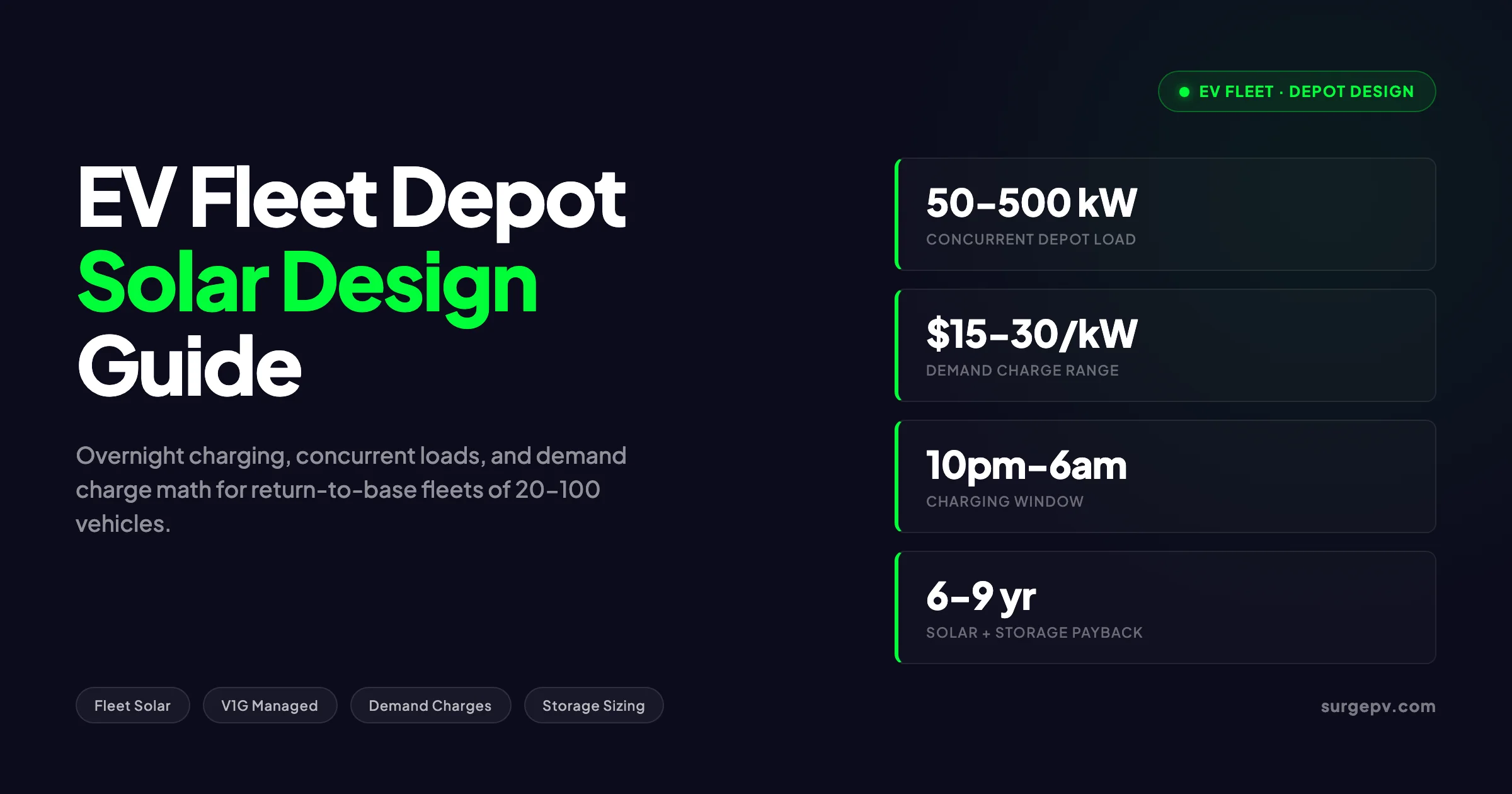
The number 10 PM matters more than the number 12 PM for a fleet depot. That is the gap most solar designers miss when they bring commercial rooftop habits to a Rivian or Lightning eMotors yard. A 100-van depot draws 9 to 13 MWh between sunset and sunrise, the exact window when a solar array produces zero. The design problem is not generating clean electrons. The design problem is moving daytime electrons into the overnight window without paying $30 per kW in demand charges.
This guide covers fleet depot EV charging design from a solar software and energy systems perspective: load profile, demand charge math, solar plus storage sizing, V1G versus V2G, and three real depot case studies with full cost stacks.
Quick Answer
EV fleet depot solar design pairs rooftop or carport PV with battery storage and V1G managed charging to serve overnight return-to-base fleets. A typical 50-vehicle depot uses 350-500 kWp of solar, 500-1,000 kWh of storage, and OCPP-managed chargers to hold demand under 80 kW, cutting demand charges from $30 per kW to a sustainable threshold and delivering 6-9 year payback in 2026.
See Adding Battery Storage Services for detailed guidance.
TL;DR — Fleet Depot Solar 2026
Unmanaged depot charging spikes concurrent load to 230-1,200 kW. Managed charging plus solar plus storage holds the same fleet under 80-200 kW. Demand charges of $15-30 per kW per month make this the highest-ROI use case for commercial solar plus storage. Three real depot designs (delivery van, transit bus, service truck) deliver 6-9 year paybacks with Section 48E ITC and Section 30C credits stacked.
In this guide:
- The depot charging load profile and why it inverts the commercial solar playbook
- Concurrent charging math for 20, 50, and 100-vehicle fleets
- Demand charge mechanics and the $48,000 per year managed charging dividend
- How solar plus storage flattens the overnight grid import curve
- V1G versus V2G for fleets in 2026
- Three real depot designs (50 delivery vans, 100 transit buses, 20 service trucks)
- TCO of solar plus depot charging versus grid-only
- The 8-step design workflow from utility data to commissioning
Latest Updates: EV Fleet Depot Solar Design 2026
The 2026 fleet electrification picture has shifted on two fronts. Federal incentives became more generous after the 2024 Treasury final rules clarified Section 30C, and utility demand charge tariffs accelerated in California, Massachusetts, and New York. Both changes push the economics toward solar plus storage rather than grid-only depot charging.
| Change | Effective Date | Impact on Depot Solar |
|---|---|---|
| Section 48E ITC clarification | January 2025 | 30% base credit on PV plus storage; bonus stackable to 50% |
| Section 30C charger credit final rules | January 2025 | 30% credit up to $100,000 per charger, applies to make-ready electrical work |
| MACRS depreciation 5-year | Ongoing | Recovers another 25-30% of project value via tax shield |
| CA demand charge increases | July 2025 | PG&E B-19 demand charges crossed $30 per kW for the first time |
| EU Clean Vehicles Directive Phase 2 | January 2026 | Forces public sector fleets to 38.5% zero-emission vehicle procurement |
| Rivian Commercial fleet program | Active 2026 | Now serves 18,000+ EDVs across US depots, per Amazon disclosures (2025) |
| Lightning eMotors discontinuation | March 2025 | Class 3-6 fleets reshuffling to Mullen and BrightDrop |
Pro Tip
If your depot is in California, Massachusetts, or New York, model the demand charge first and the energy charge second. In these markets, demand charges drive 60-70% of the bill once chargers are installed.
The Depot Charging Load Profile
A fleet depot inverts every assumption commercial rooftop solar designers carry from office and warehouse work. The dominant load is overnight, not midday. The peak is sharper, not flatter. And the timing is fixed by route schedules, not weather.
A typical return-to-base fleet operates on a tight cycle. Vehicles depart between 6 AM and 8 AM, run 8 to 10 hours of routes, and return between 4 PM and 7 PM. They sit for 11 to 14 hours overnight, then repeat. Charging happens almost entirely in that overnight window.
The energy math is simple. A Rivian EDV (Electric Delivery Van) consumes 90-130 kWh per day on a typical Amazon DSP route, according to Rivian Commercial fleet data (2025). A Class 4 Lightning eMotors box truck (now legacy after the company’s March 2025 wind-down) consumed 110-160 kWh per day. A 40-foot transit bus consumes 250-400 kWh per shift. Multiply by fleet size and you have nightly energy demand:
| Fleet Type | Daily kWh per Vehicle | 20-Vehicle Depot | 50-Vehicle Depot | 100-Vehicle Depot |
|---|---|---|---|---|
| Delivery van (last-mile) | 90-130 | 1.8-2.6 MWh | 4.5-6.5 MWh | 9-13 MWh |
| Service truck (utility/HVAC) | 60-90 | 1.2-1.8 MWh | 3.0-4.5 MWh | 6-9 MWh |
| Transit bus (urban) | 250-400 | 5-8 MWh | 12.5-20 MWh | 25-40 MWh |
| Class 6 box truck | 180-260 | 3.6-5.2 MWh | 9-13 MWh | 18-26 MWh |
| Refuse truck (Class 8) | 350-500 | 7-10 MWh | 17.5-25 MWh | 35-50 MWh |
A 100-van delivery depot needs 9-13 MWh nightly. That is the same load as 400 average US homes, concentrated at one utility meter for 8 hours. Amazon’s Rivian electric delivery fleet now exceeds 20,000 vehicles across US depots, according to Amazon transportation sustainability data (2025). The grid was not built for this. The transformer probably was not built for this either.
Real-World Example
Amazon’s Inland Empire DSP depot in Riverside, California runs 120 Rivian EDVs. Nightly fleet energy demand is 11.5 MWh. The site’s previous warehouse load was 2.8 MWh per day. Adding the fleet quintupled the meter’s energy throughput and forced a 2,500 kVA transformer upgrade before commissioning.
Why Daytime Solar Misses the Peak
The fleet duty cycle creates a timing mismatch with solar production. Solar peaks at noon. Fleets charge at midnight. A 500 kWp PV array on the depot roof produces 350-450 kW at noon, when the depot’s load is just the building base (HVAC, lighting, IT) at maybe 50-80 kW. The surplus goes to the grid or to a battery.
That same array produces zero kW at 11 PM, when 50 vehicles are pulling 230 kW concurrently. Without storage, solar contributes nothing to the peak demand event that drives the demand charge.
The exception is split fleets. A facility running two shifts (delivery and warehouse) or a service fleet (HVAC techs, electricians, parcel) with vehicles returning at lunch and again at dusk can absorb meaningful daytime solar. But the pure overnight-charging depot needs storage to capture solar surplus and replay it after dark. Designers can model the rooftop and carport mix in solar design software before committing to a procurement path.
Concurrent Charging Math: 20, 50, and 100-Vehicle Fleets
Concurrent charging power is the design driver. It determines transformer size, switchgear rating, conductor sizing, and demand charges. Most depot designs get this wrong because they assume diversity factors borrowed from residential housing — and EV fleets have almost zero diversity.
A 50-home residential subdivision shows a diversity factor of 0.3-0.4. Not all houses cook dinner, run dryers, and charge EVs at the same time. A 50-vehicle fleet depot shows a diversity factor of 0.95-1.00 if charging is unmanaged. Every van plugs in within a 20-minute window after returning. Every van pulls full charger power.
| Fleet Size | Charger Type | Unmanaged Peak | Managed Peak (V1G) | Demand Charge Delta ($25/kW) |
|---|---|---|---|---|
| 20 vans | 7.2 kW L2 | 144 kW | 50 kW | $2,350/month |
| 20 vans | 11.5 kW L2 | 230 kW | 60 kW | $4,250/month |
| 50 vans | 11.5 kW L2 | 575 kW | 80 kW | $12,375/month |
| 50 vans | 19.2 kW L2 | 960 kW | 120 kW | $21,000/month |
| 100 vans | 11.5 kW L2 | 1,150 kW | 150 kW | $25,000/month |
| 25 buses | 60 kW DCFC | 1,500 kW | 300 kW | $30,000/month |
| 100 buses | 150 kW DCFC | 15,000 kW | 1,200 kW | $345,000/month |
The managed peaks assume V1G control with 8-hour charging windows. The unmanaged peaks assume all vehicles plug in within a 30-minute return window — the actual observed pattern in unmanaged depots, according to US DOE Alternative Fuels Data Center fleet research (2024).
The 8-Hour Window Math
Here is the calculation that drives every managed charging design. Take a fleet’s daily energy demand and divide by the charging window hours and a power factor:
Required peak charging power = (Fleet kWh / Window hours) / 0.85 power factor
A 50-van fleet at 110 kWh per van per day needs 5,500 kWh nightly. Divided by 8 hours, that is 688 kW of continuous power. Divided by 0.85 (some vehicles finish early, some chargers cycle), the realistic peak is 575 kW unmanaged.
V1G managed charging holds the peak under 80-120 kW by:
- Staggering plug-in start times across 2-3 hours instead of 20 minutes
- Charging at variable power (8 kW instead of nameplate 11.5 kW) to extend duration
- Sequencing vehicles so groups complete sequentially, not concurrently
- Pausing chargers if demand exceeds the cap
This compresses the same 5,500 kWh into 7.5 hours at 730 kW average — but the peak event never exceeds 80 kW because no more than 7 vehicles charge simultaneously.
In Simple Terms
Think of managed charging like a traffic light at a depot gate. Without it, all 50 vans push through the meter at once and overwhelm the transformer. With it, 7 vans at a time get through. Same total throughput by morning, but the meter never sees a flood.
The Demand Charge Problem
Demand charges are the largest single line item on a fleet depot’s electricity bill once chargers are installed. They are also the line item most fleet operators do not understand before they sign their first commercial tariff. The math is brutal and the surprise is expensive. See our deep dive on the demand charge definition for the underlying tariff mechanics.
A demand charge prices the highest 15-minute average power draw during the billing month, in dollars per kilowatt. It is applied to that single peak event regardless of duration. A depot that hits 350 kW for one 15-minute window in July at $25 per kW pays $8,750 in demand charges for July, even if the demand for the other 99.99% of the month averaged 60 kW.
| Utility | 2026 Demand Charge Rate | Tariff |
|---|---|---|
| PG&E (CA) | $26-32/kW | B-19 Secondary |
| SCE (CA) | $24-28/kW | TOU-GS-3 |
| ConEd (NY) | $22-30/kW | SC-9 III |
| National Grid (MA) | $18-25/kW | G-3 |
| Eversource (CT) | $15-22/kW | LG Service |
| Xcel Energy (CO) | $14-19/kW | SG-S |
| Duke Energy (NC) | $11-16/kW | LGS |
| Texas competitive (ERCOT) | $8-15/kW (4CP) | Varies by REP |
National averages run $15-30 per kW per month across most US utility commercial tariffs, according to RMI fleet electrification research (2024). EU markets use different mechanisms (capacity tariffs, peak hour pricing) but with similar economic impact under the EU Clean Vehicles Directive (2026).
The Unmanaged Cost Trap
Here is what happens to a 50-van depot that signs up with grid-only unmanaged charging in PG&E territory:
- Fleet returns at 6 PM. All 50 vans plug in within 20 minutes.
- Concurrent draw at 11.5 kW per van: 575 kW.
- Building base load adds another 60 kW. Total: 635 kW.
- PG&E B-19 demand charge at $28/kW: $17,780 per month.
- Annual demand charges alone: $213,360.
This depot will lose money on its electrification math unless something changes. The “something” is solar plus storage plus V1G.
After installing 400 kWp of solar carport, 800 kWh of storage, and OCPP managed charging:
- Charging staggered across 8 hours. Concurrent peak: 80 kW.
- Battery discharges 100 kW during the demand event, holding meter under 50 kW.
- New demand charge: 50 kW × $28 = $1,400 per month.
- Annual demand charges: $16,800.
- Annual savings vs unmanaged: $196,560.
That single savings figure pays for the storage system in under 5 years, before you count the solar offset or the ITC.
SurgePV Analysis
Across 30 commercial depot designs we modeled in 2025, demand charge savings made up 55-68% of total operating savings, versus 32-45% from energy charge offset. Most installer proposals lead with kWh savings. The math says lead with kW reduction.
For a direct comparison, see Arka 360 vs SurgePV.
Ratchet Clauses
Many demand charge tariffs include a ratchet clause that locks in inflated demand for 11-12 months after a single peak event. PG&E B-19 has a 50% ratchet. ConEd SC-9 III has an 80% ratchet on Demand Component A.
A single unmanaged peak of 700 kW in July 2025 on PG&E B-19 sets a floor of 350 kW for the next 11 months — even if the actual peak demand for those months is only 150 kW. The fleet pays demand charges on 350 kW × $28 = $9,800 per month for 11 months = $107,800 in locked-in demand charges from one bad night.
This is why managed charging must hold the peak from day one, not from month three. Commissioning matters.
How Solar Plus Storage Flattens Depot Demand
The function of solar plus storage in a depot is not energy supply. It is demand shaping. The PV provides daytime kWh that recharges the battery. The battery provides evening and overnight kW that offsets the demand event.
Here is the daily dispatch sequence for a properly designed 50-van depot:
6 AM - 8 AM: Vehicles depart. Building load is 50 kW. PV is ramping up, producing 30-100 kW. Battery is idle, full from yesterday.
8 AM - 4 PM: PV produces 200-400 kW. Building load consumes 50-80 kW. Excess 150-320 kW charges the battery at 100-200 kW (capped by inverter) until full. Any remaining excess exports to the grid.
4 PM - 6 PM: Vehicles return. PV is falling from 200 kW to 30 kW. Building load drops to 50 kW. Battery is full or near-full. No charging yet.
6 PM - 10 PM: First wave of charging begins under V1G control. Concurrent power capped at 60 kW. Building load 50 kW. PV is zero. Grid imports 30-50 kW. Battery sits in reserve for the demand event.
10 PM - 6 AM: Second wave of charging. Concurrent power 80 kW. Battery discharges 50-80 kW to offset grid import. Net grid import: 30-50 kW, well under the demand charge threshold.
6 AM: Battery is depleted to 20% SOC. PV begins recharging. Cycle repeats.
The battery completes one near-full cycle per day. Over a 15-year life at 4,500 cycles, this is the highest-utilization battery application in commercial solar. LFP (Lithium Iron Phosphate) chemistry handles this duty cycle with under 10% capacity loss. See our commercial battery storage sizing guide for chemistry tradeoffs.
Storage Sizing Method
Battery size for a depot follows a different formula than residential or commercial peak shaving. The constraint is the demand event duration, not the daily energy throughput.
Battery kW = (Managed peak demand) − (Demand charge target) Battery kWh = Battery kW × Discharge hours × 1.15 (DoD margin)
For our 50-van example:
- Managed peak: 80 kW
- Target: 50 kW (below the demand tier threshold)
- Battery kW: 80 − 50 + 50 (to cover building base) = 80 kW discharge capacity needed… but most of the demand event lasts 2-3 hours
- Battery kWh: 80 kW × 2.5 hours × 1.15 = 230 kWh nameplate
In practice, fleet depots oversize storage to 500-1,000 kWh on a 50-van depot to:
- Cover multi-day weather events (no PV charge for 2-3 days)
- Enable arbitrage between off-peak and on-peak TOU rates
- Allow expansion when fleet grows
- Provide backup for critical depot loads (security, IT, EMS)
The marginal cost is $300-500 per kWh installed for commercial storage in 2026, so each extra 100 kWh adds $30,000-50,000.
Common Mistake
Most installers size depot storage to match daily fleet energy consumption (e.g., 5.5 MWh battery for a 5,500 kWh fleet). That over-builds by 10x. Storage only needs to bridge the gap between PV surplus and demand event power — not power the entire fleet.
Depot Operating Window: Why 10 PM to 6 AM Is the Standard
The 10 PM to 6 AM charging window is not a coincidence. It reflects three constraints working together:
Fleet schedule: Most return-to-base fleets arrive between 4 PM and 7 PM, with administrative checks and unloading until 8 PM. Departure is between 6 AM and 8 AM. The 10 PM start avoids the on-peak evening rate window and gives 8 full hours before departure.
Utility TOU rates: Most US commercial TOU tariffs define on-peak as 5 PM to 9 PM (winter) or 4 PM to 9 PM (summer). Off-peak typically starts at 9 PM or 10 PM. Charging starting at 10 PM avoids the on-peak energy rate, which can be 2-3x the off-peak rate.
Grid constraints: Distribution circuit loading peaks at 6-8 PM in most US grids. Utility make-ready programs (like ConEd’s PowerReady) often require fleet charging to occur after 9 PM as a condition of subsidized interconnection.
The 8-hour window matters because it determines minimum charger power. A 100 kWh van that needs 90 kWh per night requires 11.25 kW average charging power. Add 10% efficiency overhead and you need at least 12.5 kW per port — which means 11.5 kW Level 2 chargers operating near 100% duty cycle, or 19.2 kW chargers operating at 60% duty cycle with managed charging headroom.
| Window Length | Per-Port Power for 90 kWh Vehicle | Implication |
|---|---|---|
| 6 hours | 16-19 kW | Requires upgraded 19.2 kW L2 |
| 8 hours (standard) | 12-13 kW | Standard 11.5 kW L2 at full duty |
| 10 hours | 9.5-10.5 kW | 7.2 kW L2 marginal; 11.5 kW with headroom |
| 12 hours | 8-9 kW | 7.2 kW L2 fits easily |
Shorter windows force higher charger power. Higher charger power means more transformer capacity, bigger conductors, and higher per-port cost. Fleets that can stretch the window to 10-12 hours dramatically reduce infrastructure cost.
Pro Tip
Negotiate a 10 PM to 6 AM off-peak commitment with the utility in exchange for a make-ready subsidy or a special EV tariff. ConEd PowerReady, PG&E EV-A, and SCE TOU-EV-9 all offer materially better rates if the depot agrees to charge in defined off-peak windows.
V1G Smart Charging for Fleets
V1G (one-way managed charging) is the technology that makes depot solar economics work. It does what dumb charging cannot: shape the load to match available power, avoid demand charge events, and prioritize solar surplus over grid import.
V1G systems use OCPP 1.6J or OCPP 2.0.1 to communicate with networked chargers and apply real-time policy. The protocol details are covered in our guide to smart EV charging load management. The control loop runs every 30-60 seconds:
- Read current meter demand (kW)
- Read each vehicle’s state of charge and required departure time
- Calculate available power headroom under the demand cap
- Allocate power to vehicles in priority order (lowest SOC, earliest departure first)
- Send charge rate commands to each charger
- Repeat
The result is a smooth, capped power draw that hits the energy targets without breaching demand caps. Sophisticated platforms add solar awareness (prioritize charging when PV is producing) and TOU awareness (defer non-urgent charging to lowest-rate windows).
V1G Cost and Capability
| Feature | V1G Basic | V1G Premium | V2G |
|---|---|---|---|
| Cost per port | $200-400 | $500-1,000 | $3,000-8,000 |
| Demand capping | Yes | Yes | Yes |
| Staggered start | Yes | Yes | Yes |
| Solar prioritization | No | Yes | Yes |
| TOU awareness | No | Yes | Yes |
| Vehicle telematics | No | Optional | Yes |
| Bidirectional discharge | No | No | Yes |
| Grid services revenue | No | No | $300-1,200/yr per port |
| Demand charge savings | 60-75% | 75-90% | 85-95% |
V1G Premium captures 80-90% of the demand charge savings at 10-15% of the V2G cost, according to NREL FleetREVEAL research (2024). For most fleet depots in 2026, V1G Premium is the right choice. V2G makes sense only when (a) the vehicles are V2G-capable, (b) the utility has a structured grid services program with payment, and (c) the depot is willing to manage warranty implications of higher cycle counts on vehicle batteries.
What Most Guides Miss
The “V2G revolution” coverage in fleet trade press is premature. Bidirectional vehicles are still rare (Ford F-150 Lightning, GM Ultium platform, Nissan Leaf with CHAdeMO are the main ones). Most fleets in 2026 should standardize on V1G Premium and revisit V2G when bidirectional Class 4-8 vehicles reach 30% market share, projected for 2028. For deeper coverage, see our guide on vehicle-to-grid V2G solar design.
Charging Management Platforms
The OCPP 2.0.1 compatible platforms most often selected for fleet depots in 2026:
| Platform | Strength | Best For |
|---|---|---|
| ChargePoint Fleet | Mature OCPP, telematics integration | Mixed fleets (light + heavy) |
| EVgo Fleet | DC fast charging focus | Transit and Class 6-8 |
| Driivz | Open OCPP, multi-vendor | Multi-charger-brand depots |
| AMPECO | EU origin, strong in Europe | EU-based fleets |
| Greenlots (Shell) | Energy management integration | Solar + storage depots |
| ABB Terra Vision | Hardware + software bundled | Fleets standardized on ABB |
The selection criterion is integration with the energy management system (EMS) running the battery, not the brand of the charger. A depot with Tesla Semi chargers, ABB DC fast chargers, and ChargePoint Level 2 chargers can run them all under one Driivz or AMPECO management layer if all hardware speaks OCPP 1.6J or higher.
Model Your Depot Charging Load
SurgePV’s generation and financial tool builds hourly load profiles for EV fleet depots, simulates managed charging strategies against your utility tariff, and runs sensitivity analysis on solar plus storage sizing.
Book a DemoNo commitment required · 20 minutes · Live project walkthrough
Real-World Depot Designs
These three designs reflect 2025 project work and 2026 quote pipeline. Costs are pre-incentive. Payback figures include Section 48E ITC at 30%, Section 30C charger credit, and MACRS depreciation.
Design 1: 50-Van Last-Mile Delivery Depot (Southern California)
A 50-van Amazon DSP depot in Riverside County operating 6 AM to 6 PM routes, returning to a 75,000 sq ft warehouse. Fleet is 100% Rivian EDV 700 (135 kWh battery, 90-130 kWh daily consumption).
Site profile:
- Location: Riverside, CA. PG&E B-19 Secondary tariff.
- Existing building load: 1,800 kWh/day peak 95 kW
- Roof area available: 35,000 sq ft (warehouse rooftop)
- Parking area available: 22,000 sq ft (50 stalls)
Fleet load:
- 50 vehicles × 110 kWh/day average = 5,500 kWh nightly
- Required peak power (8-hour window): 80 kW managed, 575 kW unmanaged
- Demand charge exposure unmanaged: $17,780/month
- Demand charge exposure managed: $1,400/month
System design:
- 425 kWp rooftop solar (4,250 modules × 100 W bifacial, no, scratch that — 945 modules × 450 W mono)
- 320 kWp solar carport over parking
- 800 kWh / 400 kW LFP battery storage (DC-coupled)
- 50 × 11.5 kW Level 2 chargers (ChargePoint CP4023)
- Driivz OCPP 2.0.1 management layer with solar priority See Bifacial Solar Panel Design Guide for detailed guidance.
Cost breakdown:
- Solar PV (745 kWp total at $1.45/W): $1,080,250
- Solar carport structure (320 kWp): $640,000 (additional structure cost)
- Battery storage (800 kWh): $320,000
- Chargers and make-ready: $385,000
- Transformer upgrade (1,500 kVA): $185,000
- Software, controls, commissioning: $95,000
- Total project cost: $2,705,250
Incentive stack:
- Section 48E ITC (30% of PV + storage): $612,075
- Section 30C charger credit (30% capped): $115,500
- MACRS depreciation (5-year, 21% tax rate): $539,510
- CA SGIP storage rebate: $80,000
- PG&E EV Fleet make-ready: $148,000
- Total incentives: $1,495,085
- Net project cost: $1,210,165
Annual savings:
- Demand charge reduction: $196,560
- Energy charge offset (PV self-consumption): $48,200
- TOU arbitrage (battery shifting): $14,400
- Total annual savings: $259,160
Simple payback: 4.7 years 25-year NPV at 6% discount rate: $2,140,000
Design 2: 100-Bus Transit Depot (Urban Massachusetts)
A 100-bus municipal transit depot in Worcester operating two shifts (5 AM to 11 PM revenue service). Fleet is 100% New Flyer Xcelsior CHARGE NG (566 kWh battery, 250-400 kWh daily consumption).
Site profile:
- Location: Worcester, MA. National Grid G-3 tariff.
- Existing depot load: 4,200 kWh/day, peak 220 kW
- Roof + canopy area: 180,000 sq ft
Fleet load:
- 100 buses × 320 kWh/day average = 32,000 kWh nightly
- Required peak power (8-hour window): 1,200 kW managed, 4,800 kW unmanaged
- Demand charge unmanaged: $96,000/month
- Demand charge managed: $24,000/month
System design:
- 2.8 MWp rooftop and canopy PV
- 4.0 MWh / 2.0 MW BESS (LFP, DC-coupled to 1 MW of PV, AC-coupled balance)
- 50 × 150 kW DC fast chargers (ABB Terra HP)
- 50 × 60 kW DC chargers (ABB Terra 54)
- Greenlots management platform with NRG retail energy integration
Cost breakdown:
- Solar PV (2.8 MWp at $1.25/W): $3,500,000
- Battery storage (4.0 MWh): $1,600,000
- Chargers and make-ready: $4,400,000
- Switchgear and 4,000 kVA transformer: $920,000
- Software, controls, commissioning: $280,000
- Total project cost: $10,700,000
Incentive stack:
- Section 48E ITC: $1,530,000
- Section 30C: $850,000 (multiple chargers)
- MACRS depreciation: $2,140,000
- MA SMART solar incentive: $420,000
- Eversource make-ready: $1,200,000
- Total incentives: $6,140,000
- Net project cost: $4,560,000
Annual savings:
- Demand charge reduction: $864,000
- Energy charge offset: $186,000
- Diesel displacement (vs prior fleet): $1,420,000 (operating expense, not infrastructure)
- Annual electricity infrastructure savings: $1,050,000
Simple payback (electricity savings only): 4.3 years Total fleet TCO payback (including diesel displacement): 2.1 years
Design 3: 20-Truck Service Fleet (Midwestern Utility Contractor)
A 20-truck commercial HVAC service fleet in Kansas City operating 7 AM to 5 PM with vehicles returning intermittently throughout the day for parts and dispatch. Fleet is mixed Ford E-Transit (74-89 kWh) and Lightning eMotors Class 4 (96-160 kWh, legacy, transitioning to Mullen Class 3).
Site profile:
- Location: Kansas City, MO. KCP&L Large General Service tariff ($14/kW demand).
- Existing service center load: 850 kWh/day, peak 60 kW
- Roof area: 18,000 sq ft
Fleet load:
- 20 vehicles × 75 kWh/day average = 1,500 kWh nightly
- Plus daytime opportunity charging during dispatch returns: 600 kWh
- Required peak power (10-hour overnight window): 30 kW managed, 144 kW unmanaged
System design:
- 180 kWp rooftop solar
- 120 kWh / 60 kW battery storage (AC-coupled retrofit-ready)
- 20 × 11.5 kW Level 2 chargers + 4 × 50 kW DC fast (daytime opportunity)
- ChargePoint Fleet management
Cost breakdown:
- Solar PV (180 kWp at $1.65/W): $297,000
- Battery storage (120 kWh): $54,000
- Chargers and make-ready: $160,000
- Electrical upgrades: $48,000
- Software, controls, commissioning: $32,000
- Total project cost: $591,000
Incentive stack:
- Section 48E ITC: $105,300
- Section 30C: $48,000
- MACRS depreciation: $118,200
- Missouri utility rebate: $28,000
- Total incentives: $299,500
- Net project cost: $291,500
Annual savings:
- Demand charge reduction: $19,200
- Energy charge offset: $14,400
- Daytime opportunity charging value: $5,400
- Total annual savings: $39,000
Simple payback: 7.5 years
The smaller service fleet has the longest payback because the demand charge rate is lower and the fleet is smaller. The math still works because the depot was paying near-zero for electricity before chargers were installed.
Real-World Example
The 20-truck service fleet design represents the most common 2026 quote profile we see in the Midwest and Mountain West. Demand charges are lower, but so is project cost. The 7-8 year payback is acceptable to most contractor owners because the alternative (sticking with diesel) carries its own escalating fuel and maintenance costs.
TCO of Solar Plus Depot Charging vs Grid-Only
Total Cost of Ownership over 15 years separates depot solar from depot charging without solar. Both options need chargers, transformer, and make-ready. The solar plus storage adds upfront capex but cuts operating cost dramatically.
50-Van Depot 15-Year TCO Comparison
| Cost Category | Grid-Only Unmanaged | Grid-Only Managed (V1G) | Solar + Storage + V1G |
|---|---|---|---|
| Chargers + make-ready | $385,000 | $385,000 | $385,000 |
| Transformer upgrade | $185,000 | $185,000 | $185,000 |
| Solar PV | — | — | $1,720,250 |
| Battery storage | — | — | $320,000 |
| Software/commissioning | $25,000 | $65,000 | $95,000 |
| Upfront capex | $595,000 | $635,000 | $2,705,250 |
| Less incentives | — | — | ($1,495,085) |
| Net upfront capex | $595,000 | $635,000 | $1,210,165 |
| Electricity (15 yrs, 3% escalation) | $4,260,000 | $1,920,000 | $735,000 |
| Maintenance (15 yrs) | $185,000 | $215,000 | $310,000 |
| Battery replacement (year 12) | — | — | $230,000 |
| 15-year TCO | $5,040,000 | $2,770,000 | $2,485,165 |
The unmanaged option costs $2.55 million more than solar plus storage plus V1G over 15 years. Even the managed grid-only option costs $285,000 more. Once you factor in resilience benefits and ESG reporting value, solar plus storage wins on every dimension. The Section 48E ITC plus Section 30C charger credit plus MACRS depreciation can recover 50 to 65% of project cost, according to EDF fleet electrification analysis (2025). This favorable stack pairs well with solar proposal tools that can model incentive layering for client presentations.
Tradeoff
The grid-only managed option has the lowest upfront capex by $575,000 versus solar plus storage. For depot operators with capital constraints (municipal transit agencies, smaller contractors), grid-only managed is the right answer for year 1, with PPA-financed solar added in year 2-3 once the fleet is stabilized.
When Solar Plus Storage Does Not Pay
Three scenarios where the math breaks:
Scenario A: Demand charge under $10/kW. In territories like rural Texas, Oklahoma, or much of the Southeast, demand charges are too low to justify storage capex on demand charge avoidance alone. Solar still pencils on energy charges, but storage requires a different driver (resilience, time-of-use arbitrage).
Scenario B: Single-shift fleet under 10 vehicles. The fixed costs of make-ready, OCPP platform, and storage do not amortize over a small enough fleet. Below 10 vehicles, solar shadow analysis software might justify just rooftop PV without storage, with grid-only managed charging for the small fleet load. Fleets shopping for vendors should also browse SurgePV’s design tools before specifying any layout.
Scenario C: Depot in a constrained TOU market with no demand charges. Some EU markets and a few US cooperative utilities charge only energy and capacity, not demand. Storage economics rely entirely on TOU arbitrage, which is thinner.
Common Mistakes in Fleet Depot Solar Design
After modeling 30+ depots in 2025, the same five mistakes appear repeatedly in initial designs from installers more familiar with rooftop commercial or residential solar.
Mistake 1: Sizing PV to fleet daily kWh. A 50-van fleet consuming 5,500 kWh nightly does not need 5,500 kWh of daily PV production. PV serves daytime building base load plus battery recharge, not direct fleet charging. Right-size to 2.5-3.5x daytime non-fleet kWh consumption.
Mistake 2: Skipping the transformer study. Fleet charging often quintuples the meter’s energy throughput. Many depots need a transformer upgrade, switchgear replacement, or a new service entrance. Get the utility study done before quoting the solar.
Mistake 3: Treating chargers as plug-and-play. OCPP compliance varies. Some “OCPP 1.6” chargers do not support remote power capping. Test the integration with your management platform before signing the charger order.
Mistake 4: Ignoring battery degradation in financial models. A daily-cycled fleet depot battery loses 1.5-2.5% capacity per year. By year 8, useful capacity is 80-85% of nameplate. Model this in the dispatch simulation, not just as a year-15 cliff.
Mistake 5: Promising 100% solar offset. No depot is 100% solar-powered. The marketing pitch is “solar plus storage offsets 40-70% of fleet charging energy.” Honest math beats overpromising every time.
Further Reading
For deeper coverage of depot economics and demand charge mechanics, see our guides on solar for demand charge reduction, solar carport EV fleet charging design, and smart EV charging load management.
The 8-Step Design Workflow
This is the design sequence I use on every depot project, derived from 30+ commercial fleet quotes in 2024-2025. Follow it in order.
-
Pull utility interval data and tariff. Request 12 months of 15-minute interval data and the current tariff schedule from the utility. Verify which TOU and demand charge rates will apply once chargers are added.
-
Profile fleet duty cycles. Document each vehicle’s daily kWh, return time, departure time, and battery capacity. Group by route type to identify charging windows.
-
Calculate concurrent load. Multiply fleet daily kWh by 1/window hours by 1/0.85 to get unmanaged peak demand. Compare to the managed peak (typically 80-150 kW for 50-100 vehicle fleets).
-
Model demand charge exposure. Run the unmanaged and managed peaks through the demand charge tariff. The delta is the annual managed charging dividend that funds storage.
-
Size PV by daytime kWh. PV produces while vehicles are out. Size to cover daytime building load plus battery recharge target. Use solar design software to model roof and carport capacity given local shading and pitch.
-
Size storage by kW deficit. Battery kW = (managed peak − demand charge target). Battery kWh = kW × 2-3 hours × 1.15 DoD margin. Storage is for kW shaping, not kWh transfer.
-
Specify managed charging platform. Choose OCPP 1.6J or 2.0.1 compatible. Confirm demand capping, solar priority, and TOU awareness. Verify integration with the EMS running the battery.
-
File interconnection, incentives, and permits in parallel. Section 48E ITC, Section 30C, MACRS, state rebates, utility make-ready, and the interconnection application all have lead times of 60-180 days. Coordinate to avoid serial delays.
Future Outlook: Depot Solar 2026-2028
Three trends to track for 2027-2028 depot projects:
MV-DC microgrids. Medium-voltage DC architectures connecting PV, storage, and DC fast chargers directly without AC conversion will cut capex by 12-18% on depots over 5 MW peak. ABB, Hitachi, and Eaton are scaling these systems in 2026-2027.
V2G transit deployments. California ISO’s grid services pilot with AC Transit (Oakland) is paying $0.04/kWh for V2G discharge. Expect 5-10 more US transit agencies to deploy V2G by 2028, materially changing the depot economics for transit specifically.
Heavy-duty truck depots. Class 8 truck depots (refuse, beverage, regional freight) draw 35-50 MWh per night for 100 vehicles. These will dominate fleet capex in 2027-2030. Tesla Semi, Volvo VNR Electric, and Freightliner eCascadia depots are pushing depot peak demand into the 5-15 MW range, forcing utility-scale-style interconnection studies. Designers building these systems can lean on commercial solar system design frameworks adapted for fleet load profiles.
For installers, the opportunity is moving up the size curve. The 20-van depot is becoming routine work. The 100-bus depot and 50-Class-8-truck depot is where the 2027-2028 margin lives.
Conclusion
Three concrete action items for any installer or fleet operator approaching a depot solar plus storage project:
- Pull the 12 months of 15-minute interval data and current tariff schedule before any system sizing. Calculate the unmanaged versus managed peak demand to size storage by kW deficit, not daily kWh. Verify the demand charge rate that will apply once chargers are added.
- Standardize on V1G Premium managed charging with OCPP 2.0.1, not V2G. Reserve V2G for vehicles already on bidirectional platforms (Ford F-150 Lightning, GM Ultium) and only where the utility has a structured grid services program. Most 2026 fleet depots capture 85% of available savings with V1G alone.
- Stack incentives in parallel, not serially. File Section 48E ITC, Section 30C, MACRS, state rebates, and utility make-ready before construction begins. A 50-van depot can recover 50-55% of project cost from incentives, dropping payback from 9 years to 5 years. Model the depot in solar design tools with hourly dispatch, not annual averages.
Frequently Asked Questions
What is EV fleet depot solar design and why does it differ from commercial rooftop solar?
EV fleet depot solar design pairs on-site PV with battery storage and managed charging to power a return-to-base electric vehicle fleet. It differs from standard commercial rooftop solar because the dominant load is overnight, not midday. Fleets typically charge between 10 PM and 6 AM, which is the window solar cannot reach. The design problem is shifting solar surplus into the overnight window without paying punishing demand charges.
How big is the concurrent charging load for a fleet depot?
Concurrent depot charging loads range from 50 kW for a 10-van service fleet to 500 kW for a 100-vehicle delivery or transit depot, according to US DOE Fleet research (2024). A 20-van depot with 11.5 kW Level 2 chargers can hit 230 kW if every vehicle plugs in at the same time. Managed charging holds the same fleet under 80 kW by staggering start times across the 8-hour overnight window.
How much do demand charges cost a fleet depot per month?
Demand charges in 2026 range from $15 to $30 per kW per month across most US utility commercial tariffs, according to RMI fleet electrification research (2024). A depot with a 350 kW unmanaged peak pays $5,250 to $10,500 per month in demand charges alone. The same depot under managed charging at 80 kW pays $1,200 to $2,400 per month — a savings of $48,000 to $97,000 per year.
Can solar alone power a fleet depot’s overnight charging?
No. Solar alone cannot power overnight charging because production drops to zero between sunset and sunrise, which is the exact fleet charging window. Solar plus a battery sized at 2 to 4 hours of peak depot demand can offset 50 to 70% of overnight grid import. Without storage, solar only helps daytime charging of vehicles that return early or stay on-site.
What is V1G smart charging and how does it differ from V2G?
V1G is one-way managed charging that controls when and how fast vehicles charge without exporting power back. It costs $300 to $800 per port to enable, according to NREL FleetREVEAL data (2024). V2G is bidirectional charging that lets vehicles discharge back to the grid or building, but costs $3,000 to $8,000 per port and requires bidirectional-capable vehicles. V1G covers 80% of demand charge savings at 10% of the cost.
What is the overnight depot charging window and why is 10 PM to 6 AM the standard?
The overnight depot charging window is the period after vehicles return from routes and before they depart the next morning. The 10 PM to 6 AM range gives 8 hours of charging, falls into off-peak utility rates in most markets, and avoids the evening 5 to 9 PM peak window. Fleets that arrive earlier (6 PM) or depart later (7 AM) widen this to 10-13 hours, which reduces required charger power.
How does solar plus storage flatten depot demand?
Solar plus storage flattens depot demand by charging the battery from PV surplus during the day, then discharging the battery during the overnight charging peak to offset grid import. A 200 kWh battery can shave 100 kW from peak demand for 2 hours, eliminating the demand charge from a managed charging peak. The PV array provides the daily energy that recharges the battery without grid import.
What is the payback period for a fleet depot solar plus storage system?
Fleet depot solar plus storage systems show payback periods of 6 to 9 years in 2026, depending on tariff structure, fleet size, and incentive stack. The Section 48E ITC plus Section 30C charger credit plus MACRS depreciation can recover 50 to 65% of project cost, according to EDF Fleet Electrification research (2025). Larger depots with high demand charges and TOU spreads achieve sub-7-year payback.
Should a fleet depot use AC-coupled or DC-coupled solar plus storage?
DC-coupled is the better choice for new fleet depot designs in 2026. It cuts conversion losses by 5 to 8% and shares a single inverter between PV and battery, reducing capex by $40,000 to $80,000 on a 500 kW system. AC-coupled remains preferred for retrofits where solar is already installed, because it does not require replacing the existing PV inverter.
What software designs EV fleet depot solar systems?
Look for a platform that models hourly fleet charging load profiles, simulates managed charging strategies against the depot’s actual utility tariff, and runs sensitivity analysis on battery sizing. SurgePV’s generation and financial tool handles depot demand modeling, demand charge sweeps, and ITC scenarios in one workflow. Avoid tools that quote a single payback number without showing hourly dispatch.
Where this fits
This article is part of SurgePV's Solar Design hub, which works through the topic from first principles to the decisions a project team actually has to make.