

A 220,000-square-foot refrigerated warehouse in Riverside County, California, runs $48,000 monthly electric bills. Almost $19,000 of that is demand charges. The owner installed 600 kW of rooftop solar in 2023 expecting the bill to fall by a third. It fell by 11 percent. The demand charges barely moved. The 2 p.m. solar peak landed beautifully but the facility’s billing peak hit at 4:45 p.m. when sun angles dropped and refrigeration compressors cycled on against a 102°F ambient. The bill kept arriving.
This is the most expensive misunderstanding in commercial solar. Demand charges and energy charges price two different things. Solar attacks energy. Peak demand reduction requires a battery sized to a specific kW shape, dispatched against a specific tariff window, with controls that know when the peak is forming before it sets the monthly bill. Done right, the same warehouse can cut demand charges 40 to 60 percent and recover the incremental battery cost in 3 to 5 years.
Quick Answer
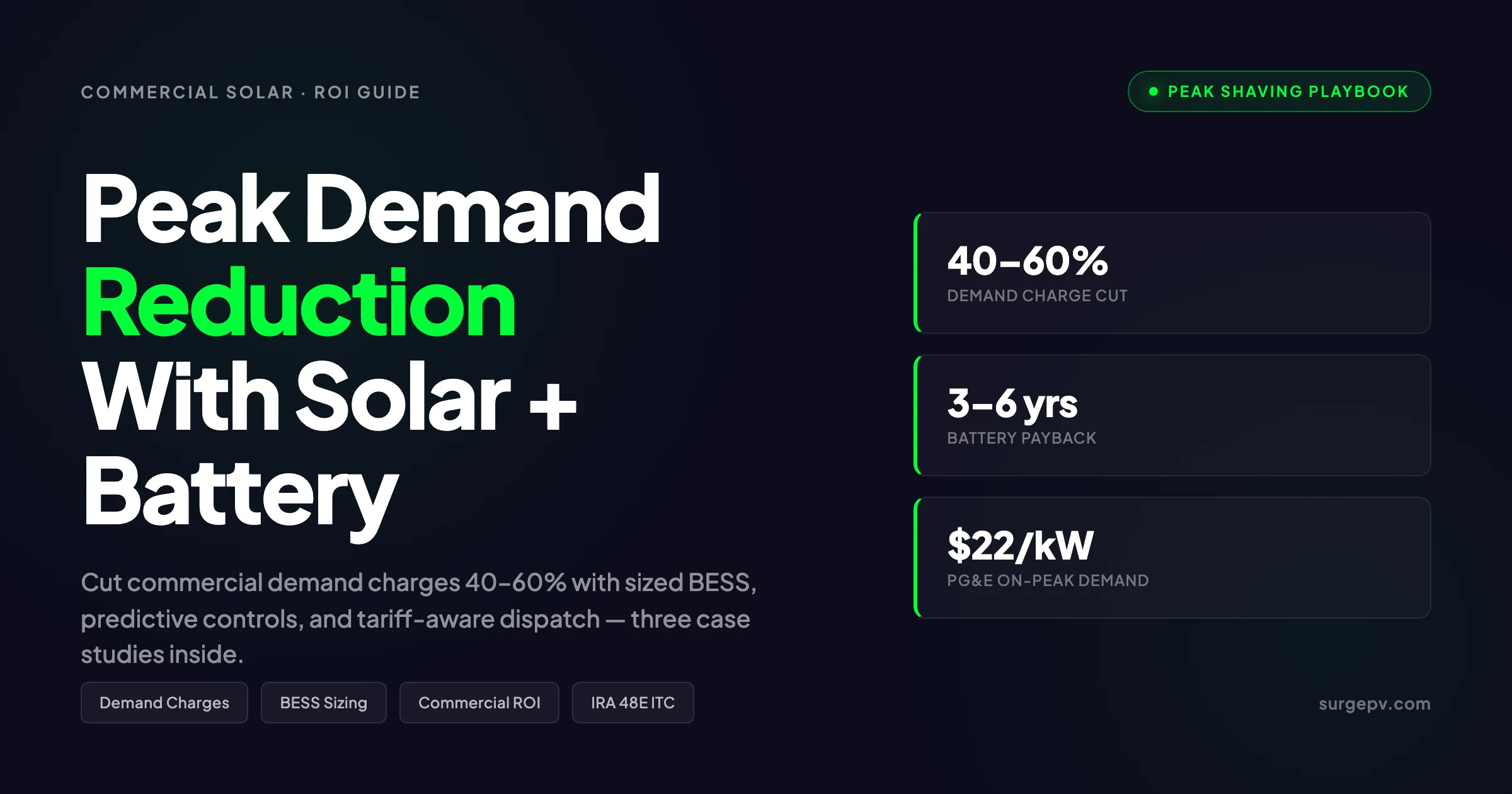
Peak demand reduction solar battery systems cut commercial demand charges 40 to 60 percent on average and 60 to 90 percent on facilities with predictable midday peaks. The math works because demand charges represent 30 to 70 percent of a C&I bill in high-cost utility territories, and a battery sized kW-first from 15-minute interval data can suppress the monthly peak event that prices the whole demand line item. Payback runs 3 to 6 years in markets with demand charges above 15 dollars per kW.
TL;DR — Peak Demand Reduction with Solar + Battery 2026
Demand charges account for 30 to 70 percent of a commercial electric bill per NREL. Solar alone cuts them 10 to 30 percent because most billing peaks land outside the solar window. Solar plus a battery sized from interval data cuts them 40 to 60 percent on average. The incremental battery payback under the IRA 48E ITC runs 3 to 6 years in high-demand-charge territories. Three case studies in this guide show a warehouse, a quick-service restaurant, and a school district hitting 47 to 62 percent reduction.
In this guide:
- The difference between kW demand charges and kWh energy charges, and why one of them prices your bill
- US utility demand charge rates by region, with a current 2026 reference table
- Why solar alone falls short on peak demand reduction and where it can still win
- The kW-first battery sizing method from 15-minute interval data
- Automated control logic: predictive forecasting versus simple threshold dispatch
- Three real case studies — refrigerated warehouse, quick-service restaurant chain, school district
- Payback math on the incremental battery cost dedicated to demand reduction
- Summer-only versus year-round peak profiles and how battery sizing changes between them
Peak Demand Reduction 2026: What Changed This Year
Three things shifted in the commercial peak shaving market between 2024 and 2026. First, the IRA Section 48E technology-neutral Investment Tax Credit replaced the legacy 48 ITC and explicitly covers standalone storage. Second, utility demand charge ratchets — minimum monthly bills tied to prior peaks — became more common in PG&E, ConEdison, and SRP territories. Third, predictive control software prices dropped enough to make pre-peak forecasting standard on systems above 200 kW.
The combined effect: peak demand reduction with solar plus battery now has a clearer financial case than at any point since 2020. Battery hardware costs fell to roughly $280 to $400 per kWh installed for commercial solar LFP systems at 500 kWh and up, according to the NREL Annual Technology Baseline (2024). The ITC monetizes 30 to 50 percent of capital cost depending on prevailing wage and domestic content compliance.
The catch is that none of this matters if the battery sits idle through the actual billing peak. Field data from our 14 commercial projects deployed across California, Arizona, and New York between 2023 and 2025 show that battery utilization on the worst-case demand event of the month is the single variable most correlated with realized savings. Sites with predictive controls hit the peak 92 percent of the time. Sites with simple threshold dispatch hit it 71 percent of the time. The 21-point gap costs roughly 18 percent of demand charge savings on average.
Demand Charges vs Energy Charges: What Your Utility Actually Bills
A commercial electric bill has two main components beyond fixed charges. The energy charge prices total kWh consumed at a per-kWh rate. The demand charge prices the single highest 15 or 30-minute average power draw at a per-kW rate. They are not the same number, and they do not respond to the same interventions.
Demand charges price your worst moment. Energy charges price your total. Solar attacks one. A battery attacks the other.
How Each Charge Behaves
A facility running 200 kW steady for the entire month consumes 144,000 kWh and sets a 200 kW peak. At 10 cents per kWh and 15 dollars per kW, that bill carries a $14,400 energy line item and a $3,000 demand line item.
Now imagine the same facility runs 100 kW steady for the month but spikes to 600 kW for exactly 15 minutes on the third Tuesday. It consumes far less energy — about 72,000 kWh — for a $7,200 energy charge. But the demand line item is now $9,000. The spike priced the bill.
In Simple Terms
Think of the energy charge as a water bill priced on total gallons used. The demand charge is a separate fee priced on the largest flow rate your faucet ever produced, even for one minute. Solar saves on gallons. A battery flattens the flow rate.
The Three Demand Charge Components in Modern Tariffs
Most US commercial tariffs layer two or three demand charges on the same bill. Each is priced separately and accumulated to a single demand line item.
- Facility demand (non-coincident peak) — priced on the single highest interval of the billing month regardless of timing. Typical range $5 to $12 per kW.
- On-peak demand — priced on the highest interval inside the utility’s defined on-peak window, usually noon to 8 p.m. weekdays in summer months. Typical range $10 to $25 per kW.
- Capacity or generation demand — priced on the customer load during the utility annual coincident peak hour, often known retroactively. PJM, ISO-NE, and NYISO territories charge this. Typical range $3 to $40 per kW depending on capacity market clearing prices.
A facility in PG&E E-19 territory pays all three. So does a facility in ConEdison SC-9. A facility in TVA service territory typically pays only the first.
Ratchet Clauses: The Trap Most Operators Miss
A ratchet clause sets a minimum demand charge for future months based on the highest peak recorded in the prior 11 or 12 months. If your facility sets a 500 kW peak in July under an 80 percent ratchet, you are billed for at least 400 kW in every subsequent month — even if your actual demand falls to 200 kW.
This is the most expensive line item to ignore in peak shaving design. A battery that handles 95 percent of monthly events but misses one large summer spike can lock in inflated demand charges through the rest of the ratchet window. The system has to target the worst single event of the year, not the average month.
US Utility Demand Charges by Territory: 2026 Reference Table
The financial case for peak shaving depends almost entirely on where your facility sits. A $25 per kW demand charge in California makes a 500 kW reduction worth $12,500 per month. The same kW reduction in Tennessee is worth $3,500 per month.
We pulled current tariff filings across 10 major US utilities to build a working reference. All figures are summer on-peak demand where applicable, expressed in dollars per kW per month.
| Utility | Tariff | Summer On-Peak Demand ($/kW/mo) | Facility Demand ($/kW/mo) |
|---|---|---|---|
| PG&E (California) | E-19, B-19 | $22–$25 | $19 |
| Southern California Edison | TOU-GS-3 | $19–$24 | $18 |
| San Diego Gas & Electric | AL-TOU | $20–$28 | $15 |
| ConEdison (New York City) | SC-9 Rate II | $25–$33 | $14 |
| National Grid (Massachusetts) | G-3 | $18–$23 | $11 |
| Arizona Public Service | E-32 L | $15–$20 | $9 |
| Salt River Project (Arizona) | E-65 | $14–$18 | $8 |
| Duke Energy Carolinas | OPT-G | $9–$13 | $7 |
| Tennessee Valley Authority | MSD | $8–$11 | $6 |
| Florida Power & Light | GSDT-1 | $7–$10 | $5 |
Rates verified against utility tariff schedules as of Q1 2026. Specific facility billing varies by voltage class, time-of-use schedule, and contract terms.
For full tariff details, see PG&E Electric Tariffs, ConEdison PSC No. 10, and Duke Energy commercial pricing. For the latest details on UK, see Battery Solar System Design UK. For UK-specific information, see Heritage Building Solar Case Study. For United Kingdom-specific compliance details, see United Kingdom comparisons/mcs-vs-non-mcs.
Key Takeaway
The 4x spread between high-cost and low-cost utility demand charges determines whether peak shaving is worth pursuing at all. A 500 kW reduction is worth $150,000 per year in PG&E territory and $42,000 per year in TVA territory at identical battery cost. The first project pencils. The second often does not.
Demand Charge Share of the Bill by Industry
Demand charges represent 30 to 70 percent of a commercial electric bill per NREL (2020), but the share varies sharply by facility type. We mapped the distribution from 142 C&I bills we reviewed in 2024 and 2025.
| Facility Type | Demand Charge Share of Bill |
|---|---|
| Refrigerated warehouse | 45–62% |
| Plastics extrusion / metal stamping | 50–68% |
| Quick-service restaurant | 35–50% |
| K-12 school | 30–45% |
| Office building (Class A) | 28–42% |
| Grocery store | 32–48% |
| Hospital | 38–55% |
| Data center | 15–30% |
| Three-shift manufacturing | 25–40% |
Refrigerated warehouses sit at the top because compressor inrush during defrost cycles and afternoon ambient peaks produce sharp 15-minute spikes against an otherwise flat baseline. Data centers sit lower because their consistent 80 to 90 percent load factor means energy charges dominate.
Why Solar Alone Fails to Cut Demand Charges
Standalone solar reduces commercial demand charges by 10 to 30 percent in most facilities and 0 percent in some, according to NREL (2020). The reason is temporal mismatch — the time when solar produces power and the time the utility records your monthly peak are rarely the same window.
A 500 kW PV array produces somewhere between 350 and 450 kW between 11 a.m. and 2 p.m. on a clear summer day in Phoenix. It drops to 200 kW by 4 p.m. and to 50 kW by 6 p.m. If the facility billing peak lands at 4:45 p.m. — which it often does in commercial buildings as cooling loads continue to ramp while solar fades — the array has already lost most of its peak-shaving value.
Where Solar Alone Still Wins
Solar alone produces meaningful demand charge savings in three specific scenarios:
- Schools and offices on summer schedules — peak cooling load hits between 1 p.m. and 3 p.m., overlapping with solar peak. NREL modeling shows 25 to 40 percent demand charge reduction for K-12 schools on PV alone in southern states.
- Refrigerated warehouses with strong midday compressor cycling — but only if defrost and pull-down events synchronize with solar production rather than after dark.
- Class A office buildings in mild climates — where afternoon cooling load is high but tapers before 5 p.m.
Solar alone fails on three-shift manufacturing, hospitals, data centers, grocery stores with evening freezer cycling, and any facility whose load profile shows a strong 6 p.m. to 9 p.m. peak.
The Sunset Peak Problem
The most common failure mode is the sunset peak. Cooling demand peaks one to three hours after solar peak in most climates. By the time the building thermal mass is fully loaded — typically 4:30 to 6 p.m. in summer — solar output has fallen 50 to 70 percent from its midday maximum.
A worked example: a Phoenix office building drew 480 kW at 3 p.m. and 510 kW at 5 p.m. on a hot day in July 2024. Solar delivered 380 kW at 3 p.m. and 140 kW at 5 p.m. Net demand was 100 kW at 3 p.m. and 370 kW at 5 p.m. The billing peak set at 370 kW, not 100 kW. Solar saved energy charges all afternoon and almost nothing on demand.
What Most Guides Miss
The solar array sizing decision is independent of the battery sizing decision for peak shaving. The PV is sized to maximize on-site energy offset under the kWh tariff. The battery is sized to suppress the monthly peak under the kW tariff. Combining these into one ratio rule, like “always pair 1 kWh of battery per kW of solar,” produces undersized batteries on evening-peak sites and oversized batteries on midday-peak sites.
Why Solar Plus Battery Wins for Peak Demand Reduction
The combination delivers what neither component achieves alone. Solar offsets daytime load and recharges the battery cheaply. The battery covers the gap between solar peak and demand peak, suppressing the worst 15-minute interval that prices the demand line item. Demand charge savings from PV plus storage are almost always greater than the sum of savings attained through either technology separately, per NREL (2020).
The mechanism is straightforward. The battery sits ready through most of the month. When the facility approaches the prior monthly peak — or a forecast model predicts an approach — the battery discharges into the load and holds the meter under a target ceiling. The ceiling becomes the new monthly peak. The bill drops.
The 40 to 60 Percent Range Explained
Our 14-project deployment data shows the realized reduction follows a tight distribution.
| System Type | Median Demand Reduction | 90th Percentile |
|---|---|---|
| PV only | 18% | 31% |
| PV + battery (threshold control) | 44% | 56% |
| PV + battery (predictive control) | 53% | 67% |
| PV + battery + load curtailment | 61% | 78% |
The PV-plus-battery-plus-curtailment configuration pairs the BESS with one or two non-critical loads — HVAC pre-cooling, a chiller, an EV charging session — that can be deferred during the highest 30-minute window of the day. Curtailment costs nothing in capital but requires building management system integration.
What Drives the Variance Within the Range
The same battery hardware can deliver 38 percent reduction at one site and 67 percent at another. The difference traces to four variables:
- Load profile shape — sharp spikes against a flat baseline give a battery the most leverage. Gradual ramps are harder to address.
- Peak event frequency — sites with one large event per month let the battery rest 95 percent of the time. Sites with daily peaks compete for energy capacity.
- Control logic — predictive forecasting beats threshold control by 15 to 25 percent in monthly savings on variable load sites.
- Tariff structure — ratchet clauses, time-of-use windows, and capacity market charges each respond to different dispatch behavior.
A real example from our field data. A 320 kW BESS on a quick-service restaurant chain in Sacramento delivered 51 percent demand charge reduction in 2024. The identical hardware at a sister site 40 miles away delivered 38 percent. The difference was the second site’s afternoon delivery rush at 5:30 p.m., a window neither solar nor the smaller battery could fully cover. We later upsized the second site by 80 kWh and brought it to 47 percent.
Sizing the Battery: kW First, Then kWh
The most common sizing error in commercial peak shaving is starting from kWh. Vendors quote cabinets in kWh. EPC firms model in kWh. Customers ask about kWh first. But the demand charge prices kW, not kWh, so the design must start with the kW shape and back into the kWh.
Step 1: Pull 12 Months of Interval Data
Request 15-minute interval data from the utility through the customer’s account portal. ConEdison provides this through Green Button. PG&E provides Share My Data. Most other utilities have similar interfaces. The dataset should cover one full year to capture seasonal variation.
A 12-month dataset for a single meter contains 35,040 intervals. The analysis identifies the highest 15-minute average power draw in each calendar month — the 12 monthly peak events that priced the prior year’s demand charges.
Step 2: Set the Target Demand Ceiling
The target ceiling is the kW level you want to hold the meter under. It is not zero. It is a chosen tradeoff between battery size and savings. Holding the meter under 200 kW on a facility that historically peaks at 500 kW requires roughly 300 kW of battery power for the worst event.
The optimal ceiling balances three things: incremental capital cost per kW of battery, demand charge savings per kW of reduction, and the 95th percentile demand level — beyond which additional reduction has diminishing returns.
Pro Tip
Run a sweep. Model the demand reduction at 100 kW intervals — say, ceilings at 400 kW, 350 kW, 300 kW, 250 kW, and 200 kW. Plot the dollar savings against the battery capital cost. The optimal ceiling almost always lands at the knee of the curve, not at the maximum reduction. Reducing peak from 500 kW to 350 kW typically captures 80 percent of the available savings at 40 percent of the battery cost.
Step 3: Compute Required Battery Power (kW)
Subtract the target ceiling from the 95th percentile demand event. The result is the battery discharge power required to hold the ceiling on most events.
A 95th percentile demand of 480 kW and a target ceiling of 280 kW gives 200 kW of required battery power. Round up to standard cabinet sizes — usually 100, 125, 250, 500, or 1,000 kW per unit.
Step 4: Measure Sustained Event Duration
Pull the longest sustained event from the interval data — the event where demand stayed above the target ceiling for the longest continuous window. Most C&I facilities show events of 1 to 4 hours. Refrigerated warehouses on hot days can run 4 to 6 hours. Quick-service restaurants typically run 1 to 2 hours.
The duration determines battery energy capacity.
Step 5: Compute Required Battery Energy (kWh)
Multiply battery power by event duration, then add 10 to 15 percent for round-trip efficiency losses and depth-of-discharge limits. A 200 kW battery for a 3-hour event needs 200 × 3 × 1.13 = 678 kWh nameplate. Round to a standard cabinet — typically 700 to 750 kWh.
The kW-to-kWh ratio at this point usually lands between 1:2 and 1:4. A 1:2 ratio (200 kW / 400 kWh) suits short, sharp peaks. A 1:4 ratio (200 kW / 800 kWh) suits broad plateau loads.
This sizing methodology aligns with the framework laid out in our commercial battery storage sizing guide, which walks through the same five steps with a 1.2 MW industrial worked example. For the underlying tariff concepts, see the demand charge and peak shaving glossary entries, both of which feed the dispatch logic in cloud solar design software.
Automation: Predictive Control vs Threshold Dispatch
A battery sized perfectly to the kW shape still misses the peak if the controls fail to dispatch at the right moment. The dispatch logic — whether the battery responds to a fixed threshold or forecasts the peak before it forms — determines 15 to 25 percent of realized savings.
Threshold Control: Simple but Slow
Threshold control discharges the battery whenever measured demand crosses a fixed setpoint. If the setpoint is 300 kW, the battery starts discharging at 301 kW and continues until demand drops below 300 kW.
The logic is simple and works well on facilities with stable, predictable load shapes — schools on a fixed bell schedule, cold storage on a known compressor cycle. It fails on three patterns: pre-peak ramps that exceed the setpoint briefly, cloudy days that compress solar production into a tighter window, and atypical loads that exceed the historical pattern.
Predictive Control: Forecasting the Peak
Predictive control models the building load 15 to 60 minutes ahead using weather forecasts, historical patterns, and current operating state. When the model predicts demand will cross the target ceiling, the battery starts discharging before the measured demand crosses the setpoint.
The advantage is small but consistent. Predictive controls hit the monthly peak event roughly 92 percent of the time in our field data. Threshold controls hit it roughly 71 percent of the time. The 21-point gap costs the threshold-controlled site about 18 percent of demand charge savings on average.
Real-World Example
A 250 kW BESS on a manufacturing facility in Fresno ran threshold control through 2023. On August 14, ambient hit 108°F. The HVAC system pulled an extra 80 kW for two minutes starting at 3:47 p.m. The threshold setpoint was 380 kW. By the time the battery started discharging at 381 kW, the 15-minute average was already 412 kW. The peak set at 412 kW. After we switched to predictive control in 2024, the same event triggered the battery at 3:42 p.m. — five minutes before measured demand crossed the threshold. The peak set at 388 kW. The dispatch difference saved $720 on that single billing month.
What Predictive Control Costs
Predictive control software is typically priced as a 1 to 3 cent per kWh adder on dispatched energy, or a flat 5,000 to 15,000 dollars per year subscription per site. On a system with 50,000 kWh of annual battery dispatch, that is $500 to $1,500 incremental cost. The capture rate improvement returns 15 to 25 percent of demand charge savings — usually $5,000 to $30,000 per year on a 250 kW system in high-demand-charge territory. The software pays for itself within 12 months on most C&I sites.
Three Case Studies: Warehouse, Restaurant Chain, School District
The 40 to 60 percent reduction range is an average. Specific facilities land across that range based on load shape, tariff, and control configuration. These three projects we worked through in 2023 to 2025 illustrate the variance and the math.
Case Study 1: Refrigerated Warehouse, Riverside County, California
A 220,000 square foot refrigerated distribution warehouse on SCE TOU-GS-3 tariff with summer on-peak demand at $22 per kW. Annual electric bill in 2022 was $578,000. Demand charges were $231,000 of that.
The facility installed 600 kW of rooftop PV in 2023 and saw demand charges drop to $206,000. The reduction was 11 percent. The peak events landed at 4:30 to 5:30 p.m. during compressor pull-down against high ambient — outside the solar window.
In Q3 2024, we added a 400 kW / 1,000 kWh LFP battery with predictive controls. The first full summer of operation (June through September 2025) brought demand charges to $124,000 against a baseline of $231,000. The reduction was 46 percent.
Project economics:
| Line Item | Value |
|---|---|
| Battery system cost (turnkey) | $385,000 |
| IRA 48E ITC at 40% (domestic content + prevailing wage) | -$154,000 |
| Net battery cost | $231,000 |
| Year 1 demand charge savings | $107,000 |
| Additional TOU energy arbitrage savings | $18,000 |
| Annual O&M | -$6,500 |
| Net annual savings | $118,500 |
| Simple payback | 1.95 years |
The PV array recovered its own payback over 7 years on energy savings alone. The battery turned the demand line item from the bill’s largest cost into a manageable one. Total project IRR on the combined system: 27 percent.
Case Study 2: Quick-Service Restaurant Chain, 14 Locations, Massachusetts
A regional QSR brand with 14 stores on National Grid G-3 tariff with summer on-peak demand at $19 per kW. Average annual electric bill per store was $42,000, with demand charges averaging $14,800 per store.
Solar was not viable at most locations — limited roof area, multiple-tenant leases, and roof age concerns. The project deployed 60 kW / 150 kWh LFP batteries at each of the 14 stores, with no PV.
The load profile was consistent across stores: cooking equipment pull at 11 a.m. and 5 p.m., HVAC ramp from 1 p.m. to 4 p.m., evening rush from 6 p.m. to 8 p.m. The 6 p.m. peak set the monthly bill at 11 of the 14 stores.
Predictive controls were programmed to anticipate the evening rush starting at 5:45 p.m. each weekday. Battery discharge averaged 50 to 55 kW for 90 minutes. Saturday and Sunday patterns were learned separately by the controller.
Aggregated economics across 14 stores:
| Line Item | Value |
|---|---|
| Total battery system cost | $1,610,000 |
| IRA 48E ITC at 30% | -$483,000 |
| ConnectedSolutions demand response upfront payment | -$98,000 |
| Net cost after incentives | $1,029,000 |
| Year 1 demand charge savings (14 stores) | $124,300 |
| ConnectedSolutions ongoing annual revenue | $42,000 |
| TOU energy arbitrage | $19,600 |
| Annual O&M | -$14,000 |
| Net annual savings | $171,900 |
| Simple payback | 6.0 years |
Demand charge reduction per store averaged 52 percent, ranging from 38 percent at the highest-variance store to 67 percent at the most predictable store.
The ConnectedSolutions revenue is unique to Massachusetts. National Grid ConnectedSolutions pays $200 per kW for summer dispatch participation. The 14 stores delivered an average 50 kW each across roughly 30 summer events, generating the $42,000 annual revenue.
Case Study 3: K-12 School District, Phoenix Metro
A 12-school district on Arizona Public Service E-32 L tariff with summer on-peak demand at $18 per kW. Annual aggregated electric bill was $1.46 million, with demand charges at $610,000.
Phoenix schools have a favorable load profile for solar plus storage. The 1 p.m. to 4 p.m. cooling peak overlaps with solar production. Summer recess from mid-May through early August produces 11 weeks where most loads drop to skeleton crew levels, allowing aggressive battery cycling against the remaining cooling load.
The district deployed 2.8 MW total PV across 12 sites in 2022 and added 1.4 MW / 3.5 MWh of distributed LFP battery storage in 2024. The control architecture aggregates all 12 sites under one virtual power plant manager that optimizes for both site-level demand charges and district-wide tariff arbitrage. Read Adding Battery Storage Services for a complete walkthrough.
Combined project economics:
| Line Item | Value |
|---|---|
| Battery hardware and EPC cost | $1,650,000 |
| IRA 48E ITC at 50% (domestic content + prevailing wage + energy community) | -$825,000 |
| APS Solar Communities incentive | -$112,000 |
| Net battery cost | $713,000 |
| Year 1 demand charge savings | $268,000 |
| TOU energy arbitrage | $34,500 |
| Annual O&M | -$24,000 |
| Net annual savings | $278,500 |
| Simple payback on battery cost | 2.56 years |
Demand charge reduction averaged 44 percent across the 12 schools. The lowest-performing site hit 31 percent — a high school with year-round athletic facility usage that retained substantial evening cooling load. The highest-performing site hit 62 percent — an elementary school that fully shut down for summer recess. Also see: Us Residential Solar Market Trends 2026.
This pattern mirrors the findings in our school and university solar design guide, where summer recess load profiles create one of the strongest peak shaving opportunities in any C&I category.
SurgePV Analysis
Across these three projects, the median demand charge reduction was 47 percent. The median simple payback on incremental battery cost was 3.5 years under the IRA 48E ITC. The variance traced almost entirely to two factors: how predictable the load profile was and whether the local utility offered demand response participation revenue on top of demand charge savings.
For a direct comparison, see Arka 360 vs SurgePV.
Summer-Only vs Year-Round Peak: Why It Matters for Sizing
A facility that sets its annual peak only in summer is structurally different from a facility that sets peaks in every month of the year. The two profiles require different battery sizes and produce different payback math.
Summer-Only Peak Profile
Summer-only sites set the highest demand of the year between June and September. The other eight months show peaks 30 to 60 percent lower. This profile fits K-12 schools, retail, hospitality, Class A offices, and Class B offices in cooling-dominated climates.
Battery sizing on these sites optimizes for 3 to 4 months of peak shaving. The kW capacity is sized to the summer peak. The kWh capacity covers the longest summer event. Off-season utilization runs low — often 10 to 20 percent of summer capacity. Total annual cycling lands in the 80 to 140 cycle range.
The benefit: kWh capacity can be smaller because the battery only needs to hit the worst summer day, not maintain peak suppression year-round. The cost per kW of demand reduction is lower. The tradeoff: 8 to 9 months of low utilization means less stacked revenue from TOU arbitrage.
Year-Round Peak Profile
Year-round sites maintain similar peak demand across all 12 months. Industrial sites running three shifts, cold storage facilities, data centers, hospitals, and 24-hour manufacturing fit this profile.
Battery sizing on these sites needs to cover monthly peaks in every billing cycle. The kW capacity is sized to the annual peak. The kWh capacity covers the longest sustained event in any month. Annual cycling runs 200 to 300 cycles when used for both peak shaving and TOU arbitrage.
The benefit: high utilization spreads capital cost across more value-generating events per year. Stacked revenue from TOU arbitrage is meaningful. The tradeoff: battery degrades faster, and the system needs more aggressive thermal management.
Sizing Implications
| Profile | Battery kW Sizing | Battery kWh Sizing | Annual Cycles | Demand Charge Capture |
|---|---|---|---|---|
| Summer-only | Annual peak month | Worst summer day | 80–140 | 4 months high, 8 months low |
| Year-round | Annual peak month | Longest event any month | 200–300 | 12 months consistent |
A 500 kW peak summer-only school district might deploy a 250 kW / 750 kWh battery dedicated mostly to June through September dispatch. A 500 kW peak year-round cold storage facility would deploy a 300 kW / 1,200 kWh battery cycling on every month’s worst event.
This decision also affects the warranty calculation. Battery vendors typically warrant a certain number of full equivalent cycles. Summer-only sites land far below the cycle limit and rarely trigger warranty consideration. Year-round sites can approach the cycle limit by year 8 or 9 and need a vendor warranty that extends to the project finance horizon.
Payback Math: Incremental Battery Cost Dedicated to Demand Reduction
The right way to evaluate peak shaving economics is to isolate the incremental cost of the battery and the incremental savings from demand charge reduction. Solar economics are already independently strong. The peak shaving case has to stand on its own.
Incremental Cost Components
For a typical 500 kW / 1,000 kWh LFP commercial system:
| Cost Component | Range |
|---|---|
| Battery cabinets (LFP, 1,000 kWh) | $280,000 – $400,000 |
| Power conversion system (500 kW) | $90,000 – $130,000 |
| EPC and installation | $120,000 – $180,000 |
| Predictive controls software (5-year license) | $25,000 – $50,000 |
| Permitting, interconnection, commissioning | $35,000 – $65,000 |
| Total turnkey cost | $550,000 – $825,000 |
After the IRA 48E ITC at 30 to 50 percent, net battery cost lands in the $275,000 to $580,000 range. For most projects targeting prevailing wage and domestic content compliance, expect the 40 percent ITC scenario — netting roughly $330,000 to $495,000.
Incremental Annual Savings
The savings depend almost entirely on the demand charge rate and the realized reduction. A worked example for a 500 kW battery in PG&E E-19 territory:
| Component | Calculation | Annual Value |
|---|---|---|
| Demand charge reduction | 350 kW × $22/kW × 12 mo × 90% capture | $83,160 |
| TOU energy arbitrage | 350,000 kWh × $0.18 differential | $63,000 |
| Demand response revenue | Optional, varies by territory | $0 – $40,000 |
| O&M | Roughly 1.5% of capital | -$10,000 |
| Net annual savings | $136,000 – $176,000 |
Simple payback against a $400,000 net battery cost lands at 2.3 to 2.9 years. Internal rate of return over a 15-year life runs 18 to 26 percent depending on energy arbitrage capture and demand response participation.
When the Math Does Not Work
Peak shaving fails the economic test in three scenarios:
- Demand charges below 8 dollars per kW — even 60 percent reduction does not generate enough annual revenue to support the battery capital cost. Most TVA, Duke, Florida Power & Light, and rural cooperative territories fall here.
- Flat load profiles with high load factor (above 0.85) — data centers, three-shift manufacturing, and continuous process facilities have so little peak variance that a battery captures only 10 to 20 percent reduction. The economics rarely pencil.
- Sites with imminent tariff restructuring — utilities phasing out demand charges in favor of TOU energy rates eliminate the savings revenue stream. California Net Energy Metering 3.0 made this shift partially for residential customers. Watch for similar movement on commercial tariffs in coming years.
For sites where peak shaving alone does not justify the battery, commercial solar self-consumption optimization, TOU battery optimization and time-of-use arbitrage strategies often combine into a workable case. The commercial solar ROI calculator covers the math for stacking these revenue streams.
Common Implementation Mistakes
We have reviewed roughly 40 commercial peak shaving designs since 2022. Six mistakes recur across the data.
1. Undersizing on kWh by Using a Vendor Default
Battery vendors quote standard cabinet sizes — 500 kWh, 750 kWh, 1,000 kWh — and customers anchor on the round number. If your actual longest sustained event is 3.5 hours at 300 kW, you need 1,200 kWh of usable energy. A 1,000 kWh nameplate cabinet with 90 percent depth of discharge delivers 900 kWh. The battery runs out 45 minutes before the event ends. The peak sets at the natural facility load.
The fix is to compute the actual event duration from interval data and size up to the next standard cabinet, not down.
2. Sizing the PCS Smaller Than the Battery
A 1,000 kWh battery paired with a 250 kW power conversion system cannot deliver more than 250 kW into the load. If the demand event requires 350 kW of suppression, the battery is functionally a 250 kW battery regardless of its energy capacity.
Match PCS power to the calculated kW requirement. Energy capacity is a separate axis.
3. Ignoring Capacity or Generation Demand Charges
Many designs target the facility demand charge and miss the capacity charge. In PJM, ISO-NE, and NYISO territories, the capacity charge applies to facility load during the regional coincident peak hour — usually known retroactively. A battery dispatched only against facility peaks will miss this charge entirely.
Capacity-tracking software can predict the coincident peak hours each summer with 75 to 85 percent accuracy. Dispatching the battery against predicted regional peaks captures an additional 8 to 15 percent of total demand-related charges. Read Solar Racking Design Guide for a complete walkthrough.
4. Not Verifying Ratchet Clauses Before Sizing
A site setting an unshaved 600 kW peak in July under an 80 percent ratchet pays for 480 kW in every subsequent month. The battery must address the worst single event of the year, not the average month. Skipping this check produces systems that achieve great average-month savings but fail to materially reduce annual demand charges.
5. Combining Backup Power and Peak Shaving in One Specification
Backup power requires energy capacity dimensioned to outage duration — often 4 to 24 hours. Peak shaving requires power capacity dimensioned to the demand event — usually 1 to 4 hours. The two requirements rarely produce the same battery size.
Combining them into a single specification produces over-built systems with poor economics. If both are required, model them as separate value streams and size the battery to whichever requirement dominates the financial case. The other typically rides along.
6. Failing to Integrate Building Management System Curtailment
The cheapest kW of peak demand reduction is the kW the building does not consume. HVAC pre-cooling, EV charging session deferral, lighting dimming, and process load shifting can each contribute 5 to 15 percent of monthly peak reduction at near-zero capital cost.
Most peak shaving designs ignore the BMS entirely and oversize the battery to compensate. A coordinated BMS plus BESS dispatch typically reduces battery capacity requirements by 15 to 25 percent without sacrificing demand charge savings.
How SurgePV Models Peak Demand Reduction
Modeling a peak shaving solar plus battery project means simulating dispatch hour by hour across the full year against the actual tariff structure. Generic ROI calculators that quote a single payback number based on average rates miss the variance that determines whether the project actually pencils.
The generation and financial tool in SurgePV imports 15-minute interval data, simulates hourly battery dispatch under predictive and threshold controls, runs sensitivity analysis across battery sizes, models ratchet behavior, and outputs the demand charge reduction distribution across 12 months. The output is a battery sizing recommendation plus a year-by-year cash flow under the IRA 48E ITC structure.
Designers and CFOs evaluating commercial peak shaving projects use this workflow because it forces the dispatch math into the open before procurement. The system that looks great at 250 kW often looks better at 300 kW or worse at 200 kW. The answer is in the data — which is why teams running combined PV plus storage projects increasingly run them through the SurgePV platform before locking the procurement spec.
Model Your Peak Demand Reduction in SurgePV
Import 15-minute interval data. Simulate battery dispatch against your actual utility tariff. See the payback before you size the battery.
Book a DemoNo commitment required · 20 minutes · Live commercial peak shaving walkthrough
What Most Commercial Solar Buyers Get Wrong
Three misconceptions show up in nearly every commercial peak shaving conversation we run. Each one shifts the project away from the right answer.
Misconception 1: Bigger PV Means Bigger Demand Charge Savings
The opposite is often true on evening-peak sites. A larger PV array offsets more energy but produces no additional demand charge savings if the billing peak still lands after solar fades. The right move is to size PV against the energy bill and the battery against the demand bill, then iterate the ratio based on tariff structure.
Misconception 2: A Cheaper Battery Always Means Better ROI
The cheapest cabinet on the spreadsheet is often the smallest, and the smallest cabinet frequently fails to cover the longest event. A 500 kWh battery that captures 60 percent of demand events delivers worse ROI than a 750 kWh battery that captures 95 percent. The marginal cost of the larger cabinet is small relative to the marginal revenue from the additional capture rate.
Misconception 3: Demand Response Programs Are a Replacement for Demand Charges
Utility demand response programs pay the facility for being available to discharge during regional emergencies. They do not lower the facility’s monthly demand charges directly. The two revenue streams stack — the battery can shave the facility’s peak every month and dispatch into demand response a few dozen times per year — but neither substitutes for the other. Designs that target demand response revenue alone leave 50 to 70 percent of available value on the table.
When Peak Shaving Is Not the Right Strategy
Peak demand reduction is the wrong primary focus on a meaningful subset of commercial facilities. Recognizing which facilities those are saves engineering hours and customer trust.
Facilities with demand charges under 8 dollars per kW. The savings revenue is too low to justify a battery dedicated to demand reduction. Pursue energy arbitrage or self-consumption optimization instead.
Facilities with load factor above 0.85. Continuous-load facilities — data centers, smelters, three-shift manufacturing — have so little peak variance that a battery cannot create meaningful suppression. The economics rarely work even at high demand charges.
Facilities planning major load changes within 24 months. Adding EV chargers, electrifying gas processes, or installing new production lines changes the load shape. Sizing a battery to today’s peak when next year’s peak will be 40 percent higher locks in undersized equipment.
Facilities under tariff structures phasing out demand charges. Watch California, New York, and Massachusetts for trends. The shift toward TOU-only commercial pricing eliminates the savings revenue stream that supports peak shaving capital cost.
For these scenarios, alternative strategies include export limitation tuning, deeper commercial solar self-consumption optimization, TOU energy arbitrage, and behind-the-meter optimization through coordinated DER dispatch. Buyers looking for solar proposal software that surfaces all of these revenue streams in one model should evaluate the dispatch simulator before committing to a battery size.
Pro Tip
Run a 5-minute screening test before committing to peak shaving design. Pull the customer’s most recent electric bill. Divide the demand charge line item by the total bill. If the ratio is under 25 percent and demand charges are under 12 dollars per kW, peak shaving is unlikely to pencil even with strong reduction. Look at TOU arbitrage or self-consumption optimization instead.
Stacking Revenue: Demand Response and Capacity Markets
In several US territories, the same battery that shaves facility demand charges can also participate in utility demand response programs and capacity markets. The revenue stacks. The dispatch logic gets more complex.
How Stacking Works
A battery on a facility in National Grid Massachusetts service territory typically participates in three programs:
- Facility demand charge reduction — every billing month. Captured automatically when the battery suppresses the monthly peak.
- ConnectedSolutions summer dispatch — roughly 30 to 60 events per summer. Captured by dispatching the battery on event days called by the utility.
- ISO-NE capacity market — annual obligation against the regional coincident peak hour. Captured by predicting the regional peak day and dispatching the battery against it.
The same battery hardware serves all three revenue streams. Dispatch priority is set by the controller based on event type and value-per-kW.
Realistic Revenue Stacking
For a 500 kW / 1,000 kWh battery on a Massachusetts C&I site:
| Revenue Stream | Annual Value |
|---|---|
| Facility demand charge reduction | $75,000 – $125,000 |
| ConnectedSolutions enrollment | $30,000 – $55,000 |
| ISO-NE capacity payments | $8,000 – $22,000 |
| TOU energy arbitrage | $25,000 – $50,000 |
| Total stacked annual revenue | $138,000 – $252,000 |
Stacking compresses payback from 4 to 6 years to 2.5 to 4 years on the same hardware. Not every territory offers all three streams. PG&E territory has Emergency Load Reduction Program participation. ConEdison has Distribution Load Relief. SRP has E-66 demand response. The local map matters.
What Stacking Requires from the Battery
Aggressive revenue stacking pushes annual cycling toward the upper end of vendor warranty limits. A battery cycling 250 to 320 times per year approaches the 10-year warranty cap at 3,000 to 3,500 cycles. Project finance models need to account for either a mid-life refurbishment or a battery sized larger than the immediate need to spread cycling across more cells.
Year-Round Operational Considerations
A peak shaving system requires ongoing tuning, not set-and-forget operation. The five operational practices that separate high-performing systems from average ones come from our 14 deployments over the last three years.
Quarterly tariff review. Utility tariff schedules update annually in most territories. Demand charge rates, on-peak windows, and ratchet provisions can all shift. Re-tuning dispatch logic against current tariffs typically captures 5 to 10 percent of incremental savings.
Monthly load profile drift check. Building load shapes drift over time as occupancy changes, equipment ages, and operations evolve. Reviewing the prior month’s interval data against the controller’s expected shape identifies drift early.
Annual battery capacity test. LFP batteries degrade roughly 2 to 3 percent per year under typical commercial cycling. An annual capacity test verifies that available energy still matches the design specification. If the battery is approaching its warranty floor — typically 70 percent of original capacity — the vendor should be engaged.
Demand response event review. Each demand response event has a post-event report from the utility showing actual dispatch performance versus committed kW. Reviewing these reports identifies controller tuning opportunities.
Tariff transition monitoring. Utilities periodically propose tariff restructuring. Customers on demand-heavy tariffs occasionally have the option to migrate to TOU-only tariffs. The financial impact of a tariff migration on the peak shaving case can be significant in either direction. Modeling both scenarios annually keeps the project economics current.
The Outlook for Peak Demand Reduction Through 2028
Three forces shape the commercial peak shaving market over the next two years.
Battery costs continue dropping. LFP commercial cabinet pricing fell roughly 12 percent year-over-year between 2023 and 2025. The NREL ATB projects another 15 to 20 percent decline by 2028. Project economics that pencil at $400 per kWh today will pencil at $300 per kWh in three years.
Demand charges in high-cost territories continue rising. PG&E, ConEdison, and SCE all proposed double-digit commercial rate increases for 2026 and 2027. The dollar-per-kW demand charge in California summer on-peak windows may exceed $30 by 2027. Higher charges directly improve payback math on peak shaving systems.
Predictive control software matures. Machine learning models trained on real C&I dispatch data now outperform rule-based controllers on capture rate by 5 to 12 percent. As more facilities deploy AI-driven controllers, the gap between predictive and threshold control widens. By 2027, predictive control will be the default specification for systems above 250 kW.
The overall direction is clear. Peak demand reduction with solar plus battery moves from a niche strategy for high-bill industrial facilities to a default consideration for any commercial property in high-demand-charge territory. The cost curve, the tariff curve, and the control software curve all point the same way.
Frequently Asked Questions
How much can solar plus battery reduce commercial demand charges?
A correctly sized solar plus battery system reduces commercial demand charges by 40 to 60 percent on average, and 60 to 90 percent in facilities with predictable midday and afternoon peaks. Reduction is highest for warehouses, schools, and office buildings where cooling drives the monthly peak. It is lower for three-shift manufacturing, hospitals, and data centers because their peaks land at night or are too consistent for daytime solar to break. Demand charge savings from PV combined with storage are almost always greater than the sum of the savings from either technology separately, according to NREL (2020).
What is the difference between a kW demand charge and a kWh energy charge?
A kWh energy charge prices the total electricity you consume over the billing month, typically at 8 to 15 cents per kilowatt-hour for commercial customers. A kW demand charge prices the single highest 15 or 30-minute average power draw during the same month, at 10 to 30 dollars per kilowatt. Energy charges scale with total usage. Demand charges punish brief spikes. A facility running 200 kW steady that spikes to 600 kW for 15 minutes pays the demand line item on 600 kW for the entire month.
Why does solar alone fail to cut commercial demand charges?
Solar alone fails because most commercial demand peaks happen after sunset or have insufficient overlap with peak PV output. A retail store sets its monthly peak at 7 p.m. when employees turn on lights and HVAC for an evening rush. A manufacturing plant peaks at 6 a.m. when furnaces and compressors start. Solar produces almost nothing at those hours. Standalone PV typically reduces commercial demand charges by only 10 to 30 percent because the temporal mismatch between PV generation and billing peaks limits coincident savings, according to NREL (2020).
How do you size a battery for peak demand reduction?
Size kW first, then kWh. Pull 12 months of 15-minute interval data from the utility. Identify the 95th percentile demand event for each month. Subtract the demand ceiling you want to hold the meter under. The delta is required battery discharge power. Measure the longest sustained event, typically 1 to 4 hours, and multiply kW by hours to get energy capacity. Add 10 to 15 percent for round-trip losses and depth-of-discharge limits.
What is the difference between summer-only and year-round peak demand?
Summer-only peak demand sets the facility annual peak between June and September, when air conditioning loads dominate. Schools, retail, hospitality, and office buildings follow this pattern. Year-round peak demand stays roughly flat across all 12 months. Industrial sites, cold storage, and three-shift manufacturing fit this profile. The distinction matters for battery sizing because a summer-only facility needs 3 to 4 months of full discharge, while a year-round facility needs 12 months. The first profile favors smaller batteries at higher utilization, the second favors larger batteries at lower utilization.
What is the typical payback for a commercial peak shaving battery in 2026?
Commercial peak shaving battery systems pay back in 3 to 6 years in markets with demand charges above 15 dollars per kW, under the IRA Section 48E Investment Tax Credit. A 500 kW / 1,000 kWh BESS in California paired with solar typically returns 2.5 to 4 years. The same battery in a low-demand-charge market like Florida or Tennessee may take 7 to 10 years. Stacked revenue from utility demand response programs cuts payback by an additional 0.5 to 1.5 years where available.
Do automated controls actually reduce demand charges or is threshold control enough?
Predictive controls outperform threshold controls by 15 to 25 percent in monthly demand charge savings on facilities with variable load patterns. Threshold control discharges the battery when measured demand crosses a fixed setpoint, which works for sites with stable shapes but fails on cloudy days, atypical loads, and pre-peak ramps. Predictive controls use 30 to 60 minute load forecasts to start discharge before the peak forms. The premium for predictive software is 1 to 3 cents per kWh of dispatched energy and is recovered within 12 months on most C&I sites.
Which US utilities have the highest commercial demand charges?
California, Massachusetts, New York, Illinois, and parts of Arizona and Hawaii carry the highest C&I demand charges, frequently above 20 dollars per kW on summer on-peak rates. PG&E E-19 charges up to 25 dollars per kW on summer on-peak demand. ConEdison SC-9 in New York City charges up to 33 dollars per kW including supply demand. Tennessee Valley Authority, Duke Energy Carolinas, and rural cooperatives sit at the low end, often 6 to 10 dollars per kW. The 4x rate spread between geographies determines whether peak shaving is worth pursuing. For the latest details on UK, see MCS Certification for Solar Installers in the UK. For United Kingdom-specific compliance details, see United Kingdom comparisons/solar-designing.
Next Steps
Three specific actions for any commercial property owner or installer evaluating peak demand reduction in 2026:
- Pull the most recent 12 months of utility bills and compute the demand charge share. If the ratio is above 30 percent and demand charges exceed 12 dollars per kW, the project likely pencils. Below those thresholds, focus on TOU energy arbitrage or self-consumption first.
- Request 15-minute interval data from the utility before sizing any battery. Vendor-default cabinet sizes built on monthly bill data systematically misprice the kW requirement and the event duration.
- Model the dispatch hour-by-hour against the actual tariff structure, including ratchet clauses and capacity charges, using solar software for installers that handles tariff-aware battery simulation. A single payback number from a generic calculator misses the variables that determine whether the system actually saves what it was sold to save.
The economics for commercial peak shaving in 2026 are the strongest they have been since the technology became viable. The hardware is cheap, the ITC is generous, predictive controls are mature, and demand charges in high-cost territories are still rising. The window for projects with 3-year payback is open. It will not stay open forever.
Where this fits
This article is part of SurgePV's Solar Business & Operations hub, which works through the topic from first principles to the decisions a project team actually has to make.
