

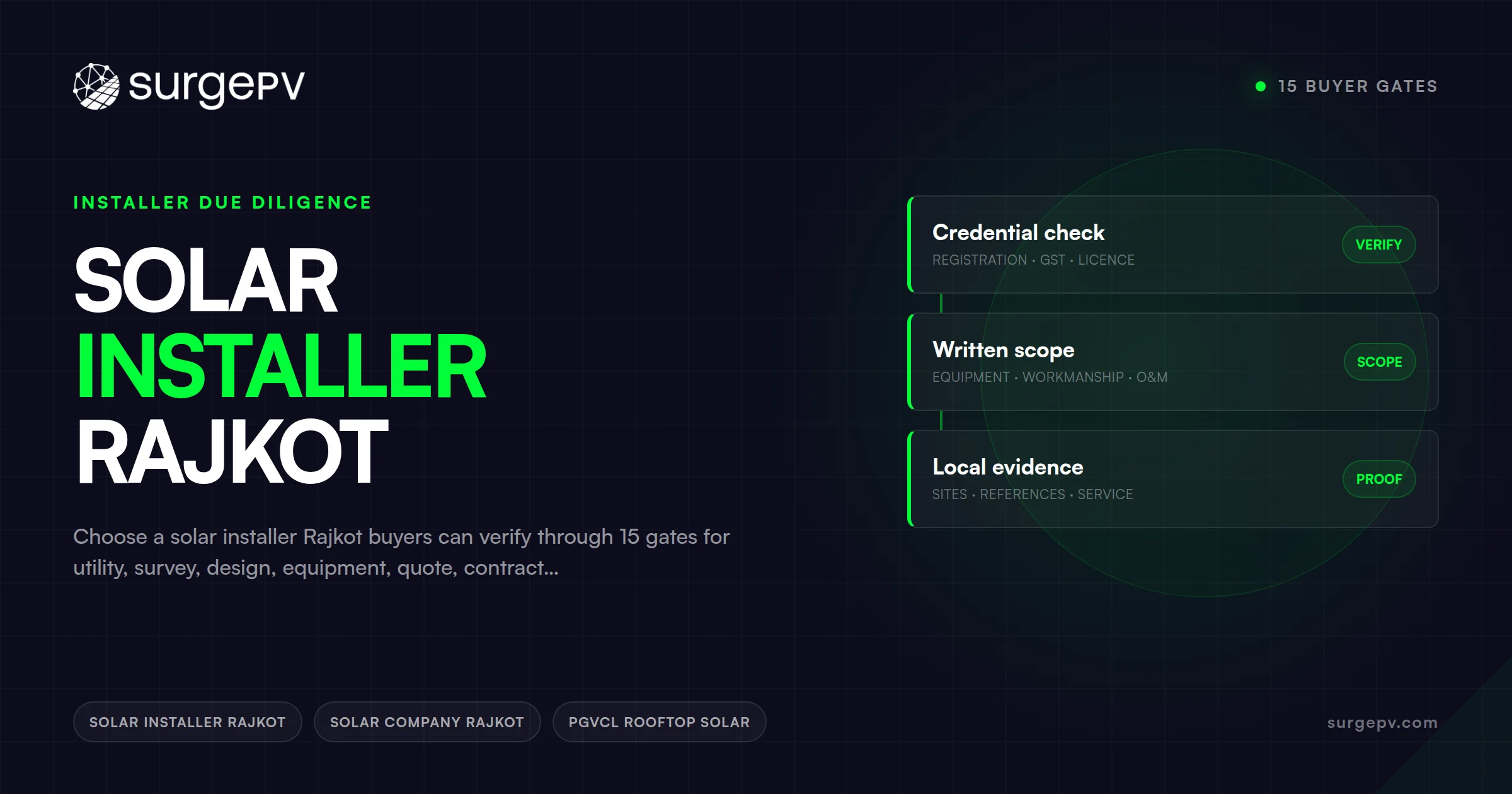
Quick Answer
Choose a solar installer in Rajkot only after verifying the consumer, legal licensee, project route, bidder, measured survey, and design. Verify exact equipment, approvals, safety, itemised price, contract, commissioning, warranties, and local service. Compare every bidder through one written RFQ. Accept the project only after tests, handover, defect closure, and owner access.
A solar installer in Rajkot should be selected through project evidence, not a generic price per kilowatt. The correct route starts with the consumer, legal licensee, property, connection, ownership, and intended operating model.
Quick answer: Choose a solar installer in Rajkot only after verifying the consumer, legal licensee, project route, bidder, measured survey, and design. Verify exact equipment, approvals, safety, itemised price, contract, commissioning, warranties, and local service. Compare every bidder through one written RFQ. Accept the project only after tests, handover, defect closure, and owner access.
Registration or directory presence is only a threshold. It does not prove survey quality, engineering, equipment authenticity, price, schedule, workmanship, warranty performance, service capacity, or a successful project.
Solar Installer Rajkot: Fifteen Buyer Gates
Use one written brief and the same acceptance standard for every bidder. A gate closes only when the named evidence, owner, reviewer, and unresolved questions are recorded.
| Gate | Decision | Acceptance evidence |
|---|---|---|
| 1 | Consumer and utility | Bill, account, category, licensee, phase, load, meter, and address verified |
| 2 | Project route | Residential, society, public, C&I, grid, storage, or open-access route classified |
| 3 | Bidder identity | Legal entity, GST, payee, team, subcontractors, insurance, and authority status checked |
| 4 | Site survey | Roof, structure, waterproofing, shade, drainage, access, service, and routes measured |
| 5 | Design basis | Capacity, layout, strings, equipment, yield inputs, protection, and assumptions approved |
| 6 | Equipment | Exact models, registrations, authorisation, warranties, substitutions, and serial controls fixed |
| 7 | Common RFQ | Quantities, scope, taxes, freight, approvals, exclusions, tests, and documents aligned |
| 8 | Economics | Generation, self-use, export, tariff, costs, degradation, downtime, and sensitivity transparent |
| 9 | Contract | Duties, schedule, payment, changes, safety, acceptance, remedies, and termination written |
| 10 | Construction | Mobilisation, roof, structure, electrical, EHS, housekeeping, and daily records controlled |
| 11 | Approvals | Portal, DISCOM, authority, inspection, meter, document, and correction owners assigned |
| 12 | Commissioning | Mechanical, electrical, protection, monitoring, functional, and grid-interface tests pass |
| 13 | Handover | Drawings, serials, certificates, settings, logins, warranties, training, and records accepted |
| 14 | Service | CMC, OEM claims, local contact, response, visit, spares, escalation, and exclusions tested |
| 15 | Final decision | Evidence-weighted score, deviations, residual risks, and approval authority documented |
Classify the Consumer and Project Route
One Rajkot address can contain several connections and decision paths. Begin with the latest bill for the exact meter serving the proposed system. Record the legal consumer, category, licensee, phase, sanctioned load, meter, address, and billing history.
Confirm property ownership, roof rights, tenancy, society consent, common-area authority, lender restrictions, and access. A tenant, flat owner, society, institution, business, and government body may have different approval and procurement powers.
Classify the project before asking for price:
- Individual residential capex under the current eligible route
- Residential work outside the scheme or without CFA
- Group housing, resident welfare, society, or common-area project
- Commercial or industrial behind-the-meter system
- Public, institutional, tendered, or grant-funded project
- New building, retrofit, reroof, expansion, or replacement
- Grid-connected, zero-export, storage, backup, generator, or EV-linked system
- Captive, group-captive, open-access, or off-site arrangement
Each label changes the evidence package. A registered residential vendor may not have the legal, financial, engineering, safety, or operational capacity for a C&I site. A capable industrial EPC may not participate in the current residential portal route.
Use the current official process rather than a screenshot, advertisement, or old application. The PM Surya Ghar installation guide explains the household capex sequence. The PM Surya Ghar vendor guide focuses on current vendor discovery and pincode serviceability.
For a business, start from the actual connection, operating load, roof rights, demand profile, tax position, and current regulatory path. Do not subtract residential CFA from a commercial quote. Do not assume residential net-metering documents govern a larger industrial project.
For a society, identify the applicant, common meter, beneficiary, voting authority, roof allocation, maintenance responsibility, and allocation of savings. Resolve member access, roof works, future repairs, billing, insurance, and exit before design.
For a public or institutional buyer, follow its procurement authority, tender, budget, approvals, security, integrity, contract, inspection, and asset-record requirements. A retail quotation may not satisfy those controls.
Create a route memorandum with current sources, effective dates, open questions, owners, and deadlines. Refresh it after delay, capacity change, equipment substitution, or authority comment.
Match the Route to the Exact Rajkot Address
Rajkot city, nearby villages, industrial estates, farms, and institutional campuses cannot share one location assumption. Record the complete service address and pincode.
Ask each bidder to name the serviceable pincode, responsible office, assigned surveyor, installation crew, escalation person, travel basis, and site-visit terms. Verify them before award.
The official national DISCOM directory lists Paschim Gujarat Vij Company Limited. It supports the PGVCL context, not a universal Rajkot-site assumption.
The latest electricity bill controls the legal licensee check. Record the division and current contact route for the exact connection when confirmed.
Eligible residential CFA
Keep the consumer in control of the portal account, phone, email, OTP, bank details, and submissions. Verify the legal bidder through the current route under the actual licensee.
Compare survey, exact equipment, structure, electrical design, workmanship, commissioning, CMC, and local service. Registration or scheme participation does not prove those qualities.
Unsubsidised residential and society projects
An unsubsidised home still needs the correct utility, roof, design, approval, testing, and service evidence. Remove CFA from the financial model rather than lowering engineering standards.
A society needs authority for common property and the applicant. Record voting, roof allocation, common meter, benefit allocation, access, future roof work, insurance, and member exit.
Do not assume every flat can use one route. Verify the consumer structure and current scheme provisions.
Commercial premises
Shops, offices, hospitals, hotels, schools, warehouses, and campuses need operating-hour and property-right evidence. Separate tenant, owner, and common loads.
Map fire access, public access, roof use, leases, insurance, shutdowns, business continuity, and planned expansion. Do not use a household contract for an occupied commercial site.
Engineering, foundry, and manufacturing sites
Use interval or representative load data for furnaces, compressors, machine tools, pumps, ventilation, treatment, and production auxiliaries. Record shifts, weekly closures, seasons, expansion, and generator operation.
Map foundry dust, metal particles, heat, fumes, vibration, cooling equipment, washdown, oil, chemicals, roof traffic, and ignition sources by actual zone. Do not infer hazards from the industry label.
The owner must provide the approved process-hazard and fire basis. Qualified parties should verify equipment locations, material compatibility, routes, isolation, permits, and emergency controls.
Power-quality review may need load, voltage, harmonics, power factor, motor starts, capacitors, generators, and existing protection evidence. Define the study trigger and accepted method.
Do not claim that solar will correct an existing power-quality problem. The plant and utility control the acceptable connection and mitigation route.
Other process and industrial sites
Verify legal entity, plant rules, shutdown plan, work permits, electrical network, fire controls, contractor induction, and emergency response. Map corrosion and contamination by location.
Heat, dust, moisture, fumes, incompatible metals, and standing water can change enclosure, coating, cable, fastener, connector, cleaning, inspection, and warranty needs. Use exact manufacturer evidence.
Agricultural and rural loads
Separate household, irrigation, dairy, cold-room, workshop, and other meters. Record the connection serving the proposed system and its actual operating profile.
Check motor starting, pumping schedule, seasonal use, land rights, shading, animals, vegetation, flooding, dust, theft, fencing, cable protection, earthing, and maintenance access.
Agricultural context does not create automatic subsidy, tariff, grid, or finance eligibility. Confirm the current scheme and connection route separately.
Captive and open access
Do not derive captive or open-access eligibility from a rooftop proposal. These routes can require separate ownership, network, scheduling, metering, banking, settlement, tax, and contractual work.
Use the current GERC renewable-energy regulation index for the actual arrangement. Record the notified regulation, amendment, source, date, adviser, and open interpretation.
GERC also publishes a draft regulations index. Drafts are consultation material, not current rights or obligations.
Storage and backup
Define protected loads, steady power, starting power, required energy basis, priority, and acceptable interruption. Confirm grid, inverter, battery, BMS, generator, transfer, grounding, and shutdown behavior.
Test normal, outage, overload, low-state, emergency-stop, restart, and reconnection states. Battery energy alone does not prove backup duration or compatibility.
Verify the Company Behind the Salesperson
Match the legal name across the quotation, GST record, portal profile where applicable, invoice, bank beneficiary, warranty, insurance, and contract. Resolve trade names and group entities before payment.
Use the official GST taxpayer search for the quoted GSTIN. GST registration does not prove portal status, licences, OEM authorisation, safe work, warranty performance, or service capacity.
Request incorporation or constitution evidence, registered office, operating address, authorised signatory, tax registration, insurance, applicable licences, and bank confirmation. Verify directly through the relevant official route when public access permits.
Ask who performs each role:
- Sales qualification and utility or scheme screening
- Roof, structural, electrical, shade, and load survey
- Layout, yield, structural, electrical, fire, and approval design
- Procurement, delivery inspection, storage, and serial control
- Roof, structure, electrical, monitoring, and civil installation
- Safety supervision, testing, commissioning, training, and handover
- Preventive service, fault triage, site visit, OEM claim, and escalation
List every subcontractor and specialist. Record legal entity, role, competence, supervision, insurance, access, payment, replacement, confidentiality, and accountability. The prime contractor should remain responsible for contracted work.
Request comparable references matched by consumer type, roof, capacity, connection, equipment, route, and completion date. Speak to the owner or authorised representative. Confirm scope, documentation, changes, defects, warranty use, service response, and unresolved issues.
Visit one completed system when permitted. Compare visible installation, labels, routes, drainage, access, monitoring, records, and owner experience. Do not infer hidden electrical or structural quality from appearance.
The residential installation-company guide provides homeowner-specific provider gates. The commercial installation-company guide covers C&I capability and contract evidence.
1. Verify PGVCL and the customer record
Start through the current PM Surya Ghar National Portal for an eligible residential route. Confirm the legal licensee on the bill for the proposed site. Record consumer number, account holder, category, phase, sanctioned load, meter, and address.
Use current portal and DISCOM routes instead of an old application link. Put feasibility, drawings, inspection, metering, commissioning, and correction duties into a responsibility table.
2. Protect the residential application
For eligible residential work, verify the legal bidder in the current official portal under the applicable DISCOM. It should match the quote, invoice, portal mapping, payee, and workmanship warranty.
The residential CFA operational guidelines describe the consumer and vendor flow. A vendor can assist, but the consumer should retain phone, email, password, bank details, and OTP control.
Eligible residential consumers should verify the live PM Surya Ghar terms. Published central support is ₹30,000 for 1 kW, ₹60,000 for 2 kW, and ₹78,000 for 3 kW or more, capped at 3 kW. Commercial connections do not receive residential CFA.
3. Demand a measured Rajkot roof plan
Rajkot sites can combine trees, nearby buildings, tanks, process equipment, and RCC or metal-sheet roofs. Measure every relevant obstruction, edge, route, and roof interface.
The survey should record tree and building shade, water tanks, parapets, stair cabins, antennas, drainage, and safe walking routes. A shadow analysis should model obstruction geometry over time.
Document existing waterproofing before work. The contract should identify penetrations, sealing method, load transfer, and responsibility for leaks arising from installation. Elevated frames, older slabs, long spans, or visible distress require appropriate structural review.
Rajkot’s summer roof temperatures make shaded, ventilated inverter placement important. Dust makes access and cleaning method part of the layout. Monsoon water must not be trapped by foundations, conduits, or cable loops.
4. Freeze exact equipment
| Item | Before order | At handover |
|---|---|---|
| Modules | Manufacturer, full model, wattage, quantity, warranties | Labels, serial list, delivery inspection |
| Inverter | Model, phase, rating, MPPT/string design, monitoring, warranty | Serial, settings, owner login, test result |
| Structure | Grade, section, thickness, coating, fasteners, attachment | As-built drawing and substitution record |
| Electrical | Cable sizes, route, isolators, SPD, overcurrent and earthing | SLD, labels, test and earthing readings |
For subsidised work, check the exact module against MNRE’s ALMM resources and current domestic-content rules. Use official BIS registration information for applicable models. A brand name alone proves neither.
5. Rebuild the generation estimate
Require weather source, orientation, tilt, shade, temperature, soiling, mismatch, cable, inverter, clipping, downtime, and degradation inputs. Compare offers using one generation and financial model. Test lower self-consumption, higher downtime, cleaning expense, and inverter replacement.
Output is an estimate unless the contract defines a measured guarantee, weather adjustment, exclusions, test method, and remedy. Avoid universal “units per kW” claims.
6. Inspect electrical and structural safety
The package should include a single-line diagram, string plan, cable and conduit routes, isolation, surge protection, overcurrent protection, and earthing. Require labels, access, and shutdown instructions. The solar designing platform helps keep layout, string design, and BOM consistent.
Ask who signs structural and electrical documents and whether subcontractors are used. The contracted company must remain accountable for their work.
Audit the Survey and Design Basis
Require a dated survey pack, not a verbal site visit. Identify the surveyor, instruments, source files, photographs, measurements, observed limits, assumptions, and information still required.
The property and roof record should cover the following items.
- Address, parcel or building identity, ownership, access, occupancy, and working restrictions
- Roof plans, slopes, levels, covering, age, condition, repairs, joints, and waterproofing
- Structural system, spans, members, slab or deck, distress, alterations, and available drawings
- Tanks, stair cabins, vents, antennas, parapets, trees, nearby buildings, and future obstructions
- Drainage outlets, flow paths, ponding, cleaning water, overflow risk, and maintenance routes
- Edge conditions, safe access, ladders, walkways, firefighting interfaces, and rescue needs
- Proposed equipment, cable, trench, monitoring, communication, and service locations
The electrical record should capture service voltage, phase, sanctioned load, meter, main board, bus, breaker, feeders, grounding, and lightning system. Record generators, storage, EV charging, and future loads. Photograph labels and trace the proposed point of connection.
Record representative voltage and operating conditions where relevant. The design must use the current utility and project limits. Do not infer connection acceptance from inverter capacity alone.
Convert survey evidence into an approved design basis. List chosen capacity, module count, exact models, layout, shade model, orientation, tilt, strings, MPPT allocation, inverter phase, structure, routes, protection, grounding, monitoring, and authority assumptions.
Maintain an assumption and RFI register. Each item needs source, owner, risk, due date, decision, and affected output. Missing information should remain visible until qualified resolution.
Review layout against structure, drainage, waterproofing, access, fire routes, equipment clearance, cable support, and future maintenance. A maximum-module layout can create unsafe or unserviceable work.
Review inverter placement for temperature, ventilation, shade, water, dust, access, noise, communication, cable length, emergency isolation, and warranty instructions. Confirm battery or backup equipment through its exact installation requirements.
Use the structural assessment guide for roof evidence boundaries. Use the inverter sizing guide to test capacity, strings, MPPTs, voltage, current, phase, clipping, and environment.
Issue drawings and calculations with project, revision, status, preparer, checker, approver, and permitted use. Separate feasibility, approval, procurement, construction, and as-built documents. Only authorised construction documents should direct field work.
Run cross-document QA. Match address, consumer, capacity, module count, inverter, structure, stringing, routes, protection, schedules, quantities, forms, and quote. Resolve every mismatch before order.
7. Tie payment to evidence
Useful milestones include approved design, verified model-specific delivery, completed mechanical work, electrical tests, required inspection or meter stage, commissioning, working customer monitoring, and corrected handover. Do not release the final payment merely because panels are visible.
8. Separate warranties
Ask for module product and performance warranties, inverter warranty, structure/corrosion warranty, workmanship, penetration leakage, monitoring, and service. Confirm labour, travel, freight, removal, and reinstallation costs. “25 years” rarely describes every component and service expense.
Issue One Common RFQ and Normalise Every Quote
Do not ask each bidder to define the project differently. Issue one RFQ with the same survey evidence, route, design basis, acceptance tests, commercial fields, and response deadline.
Require a compliance matrix. Each bidder should answer included, excluded, alternative, provisional, allowance, or unknown beside every field. A blank cell should not become assumed scope.
Normalise these equipment and quantity fields:
- Module manufacturer, exact model, wattage, quantity, registration evidence, serial control, and warranty
- Inverter manufacturer, exact model, phase, rating, MPPTs, monitoring, communication, warranty, and settings
- Battery, BMS, gateway, meter, transfer, backup panel, protected loads, and compatibility where applicable
- Structure type, grade, sections, thickness, coating, fasteners, attachments, foundations, and design basis
- DC and AC cables, connectors, conduits, trays, junctions, isolators, breakers, fuses, SPDs, grounding, and labels
- Monitoring hardware, connectivity, subscriptions, owner accounts, alerts, exports, retention, and support
Normalise service scope separately:
- Survey, shade work, structural, electrical, yield, drawings, approvals, and revisions
- Roof preparation, waterproofing, civil work, trenching, lifting, access, scaffolding, and restoration
- Utility, portal, application, agreement, meter, inspection, testing, commissioning, and correction work
- Delivery, unloading, storage, security, insurance, supervision, safety, housekeeping, and waste
- Training, as-builts, certificates, serial records, warranties, O&M, CMC, and service
Separate hardware-only, delivered, installed, commissioned, and lifecycle boundaries. Confirm tax basis, freight, unloading, authority fees, meter costs, finance costs, insurance, subscriptions, preventive work, cleaning, repairs, and likely replacement.
Do not divide an incomplete total by kilowatts and call it comparable. Normalise the complete accepted scope. Record quantity and tax changes separately from bidder errors or discretionary upgrades.
Lock exact-model substitution rules. Require written approval, evidence comparison, price adjustment, schedule impact, drawing updates, warranty impact, and serial records before delivery. Equivalent is not a self-proving term.
Use payment milestones linked to evidence. Examples include approved design, verified delivery, accepted mechanical work, electrical test completion, authority milestone, commissioning, handover, and defect closure. Retain enough value to secure final records and corrections.
Rebuild Generation, Savings, and Ownership Cost
Ask for the model file or input schedule behind the sales estimate. Record weather source and period, horizon, roof geometry, orientation, tilt, shade, module, inverter, strings, temperature, soiling, mismatch, wiring, availability, clipping, degradation, and uncertainty.
Create base, lower, and stress cases. Change weather, shade growth, soiling, cleaning, temperature, downtime, degradation, self-consumption, export, tariff, fixed charges, demand, and replacement assumptions. Do not hide a critical variable inside a total loss percentage.
Generation does not equal bill savings. Map each interval or billing period through load, solar generation, self-use, export, import, meter treatment, tariff, taxes, fixed charges, demand, and other applicable fields. Use the current consumer route.
Separate known, quoted, estimated, and unknown costs. Include:
- Survey, design, approvals, equipment, structure, civil, roof, electrical, installation, and commissioning
- Taxes, freight, metering, finance, insurance, subscriptions, monitoring, cleaning, and preventive maintenance
- Repairs, service visits, labour, travel, freight, removal, reinstallation, downtime, and replacements
- Roof work, building access, safety, security, communication, administration, and contract management
Treat CFA as conditional until the current official process, consumer, application, system, vendor, equipment, inspection, meter, bank, and payment record support it. Do not present it as an installer-funded discount.
The June 2024 residential CFA operational guidelines establish the original component framework. Read them with the current official amendment route and live project record.
Report simple payback only with its limits. Also show cash flow, financing, replacement, residual value, uncertainty, and the decision metric the buyer actually uses. No company can guarantee a tariff, weather, behavior, downtime, or future policy.
Write a Contract That Survives Change
Attach the survey, design basis, RFQ response, equipment schedule, drawings, price schedule, tests, handover index, warranties, and service matrix. Marketing pages and messages should not override signed documents.
Name the legal parties, site, consumer, connection, project route, capacity, authorised representatives, notices, and document priority. Record which entity invoices and receives payment.
Define scope, exclusions, owner work, authority work, assumptions, interfaces, dependencies, and acceptance. Assign permits, utility actions, roof work, structure, equipment, electrical, meter, monitoring, commissioning, documentation, and service.
Set a schedule with prerequisites and separate durations. Define complete-input acceptance, survey, design freeze, procurement, delivery, mobilisation, installation, tests, authority review, corrections, meter, commissioning, handover, and defects. Authority time is not fully provider controlled.
Control changes through a written request, reason, evidence, design impact, compliance impact, price, schedule, warranty, approvals, and authorisation. Emergency safety work should have a separate controlled route.
Include title and risk transfer, delivery inspection, storage, insurance, care of works, site access, security, weather, safety, subcontractors, damage, housekeeping, and restoration. Define responsibility for concealed conditions and existing defects.
Set invoice, tax, milestone evidence, retention, disputed amount, refund, security, and bank-change verification. Never send a material payment to a personal or unverified beneficiary.
Define delay, suspension, defects, rejection, correction, repeated failure, warranty, indemnity, liability, confidentiality, data, audit, termination, handover, dispute, and survival terms with qualified legal review.
The Gujarat company guide covers state-level utility and service mapping. The near-me installer guide covers distance, pincode serviceability, and local response evidence.
Design for the Actual Rajkot Site
Location is a prompt for field evidence, not a substitute for it. Record site conditions by measurement, inspection, current weather data, building records, owner information, and qualified review.
Heat and equipment placement
Model module and inverter behavior using the selected equipment and current design method. Roof and enclosure temperatures can differ from ambient conditions. Do not apply a generic temperature loss without a source and project basis.
Place inverters, batteries, gateways, panels, and communication equipment within their exact environmental, clearance, ventilation, access, and fire requirements. Avoid direct exposure, trapped heat, likely water paths, and unserviceable positions.
Check cable, connector, enclosure, isolator, SPD, breaker, display, and communication ratings for the expected environment. Product marketing categories do not replace exact datasheets and installation instructions.
Dust, birds, trees, and cleaning
Inspect current dust sources, roads, construction, vegetation, birds, nesting, and owner cleaning practices. A fixed annual soiling percentage can hide seasonal and site differences.
Design safe access for inspection and cleaning. Define water source, quality, method, timing, runoff, edge control, electrical precautions, and responsibility. Cleaning instructions must follow equipment and roof requirements.
Survey tree and building geometry. Model shade through relevant periods and consider likely vegetation growth. Do not cut or alter trees without the required owner and authority decisions.
Protect cables and connectors from unsupported spans, sharp edges, abrasion, water traps, ultraviolet exposure, pests, and maintenance traffic. Keep connectors compatible and installed through the approved method.
Monsoon drainage and waterproofing
Map roof slopes, outlets, overflow paths, ponding, joints, penetrations, parapets, and earlier repairs. Structure bases, conduits, trays, and cables must not obstruct drainage or trap debris.
Define attachment and waterproofing details before drilling. Record substrate preparation, materials, installer competence, weather limits, curing, inspection, testing, photographs, and warranty interface. Preserve roof-manufacturer duties where applicable.
Plan safe work for wet or windy conditions. The method should state stop-work limits, storage controls, temporary protection, electrical isolation, and post-weather inspection.
Structure, wind, and future roof work
Use the actual building, roof, structure, system geometry, equipment, load path, attachments, and applicable design basis. A typical RCC roof description is not a structural conclusion.
Check existing distress, alterations, corrosion, openings, water tanks, service loads, and available drawings. Qualified review should resolve capacity, load path, local effects, anchorage, uplift, movement, and required strengthening.
Coordinate future waterproofing, reroofing, tank work, antennas, HVAC, cleaning, and access. Define removal and reinstallation responsibilities before they become warranty disputes.
Voltage, outages, storage, and backup
Record actual service, phase, voltage observations, outages, critical loads, generator, EV charging, and future demand. Grid-connected PV does not automatically provide power during an outage.
For backup, classify protected loads, surge, duration, battery energy and power, inverter capability, transfer, phase behavior, generator interface, black start, shutdown, and recovery. Test the complete operating sequence.
Storage adds location, clearances, fire, thermal, communication, BMS, isolation, maintenance, replacement, monitoring, and emergency duties. Do not treat a battery line item as a complete backup design.
Use Installation Hold Points
Hold points stop concealed or irreversible work until evidence passes. The owner, EPC, designer, supervisor, and specialist roles should be named for each release.
| Hold point | Evidence before release |
|---|---|
| Survey acceptance | Measurements, photographs, roof, structure, electrical, shade, access, drainage, and open RFIs reviewed |
| Design freeze | Capacity, equipment, layout, strings, protection, structure, routes, approvals, and assumptions approved |
| Procurement | Exact models, quantities, registrations, authorisation, warranty, price, and substitution status accepted |
| Delivery | Legal supplier, invoice, packaging, labels, serials, damage, storage, and quantity checks pass |
| Roof work | Existing condition, layout, load areas, attachments, waterproofing, drainage, and access approved |
| Structure | Material, sections, coating, fasteners, geometry, connections, torque, defects, and records accepted |
| Cable concealment | Cable, connectors, conduits, trays, support, segregation, bends, glands, routes, and photographs accepted |
| Energisation | Approved drawings, labels, terminations, protection, grounding, tests, settings, safety, and defects reviewed |
| Grid operation | Applicable inspection, meter, agreement, settings, tests, permission, and owner instruction complete |
| Final payment | Commissioning, monitoring, training, documents, warranties, defects, archive, and service contacts accepted |
Use an inspection and test plan with characteristic, method, frequency, limit, witness, record, nonconformance, correction, and retest. Sampling should match risk and contract requirements.
Keep daily records for people, subcontractors, weather, deliveries, work areas, drawings, RFIs, inspections, tests, incidents, photographs, defects, changes, and next steps. Link photographs to location and date.
Control equipment on arrival. Check labels, exact model, serial, packaging, damage, registration evidence, warranty path, and approved schedule. Quarantine a mismatch until written resolution.
Control materials through traceable purchase and inspection evidence. Record structure, cables, connectors, protection devices, grounding, labels, fasteners, sealants, conduits, trays, and monitoring components.
Do not conceal work before inspection. Typical concealed items include attachments, anchors, glands, routes, grounding connections, joints, trenching, waterproofing, and embedded civil work.
Use a nonconformance record for deviations. Identify requirement, observed condition, containment, safety state, cause, responsible party, proposed disposition, qualified approval, correction, retest, and closure.
Field changes need technical review before installation. Update drawings, quantities, calculations, approval documents, settings, labels, tests, warranties, price, and schedule wherever affected.
Keep a Buyer-Controlled Decision File
Create one project folder before contacting bidders. Separate identity, utility, property, survey, design, equipment, commercial, contract, construction, authority, commissioning, handover, warranty, and service records.
Use a decision register with these columns:
| Field | Buyer record |
|---|---|
| Requirement | Exact project need or contract clause |
| Bidder response | Included, excluded, alternative, allowance, provisional, or unknown |
| Evidence | Document, source, revision, date, issuer, and location |
| Reviewer | Consumer, technical, commercial, legal, finance, or authority owner |
| Status | Open, clarified, accepted, rejected, changed, or superseded |
| Impact | Safety, compliance, design, price, schedule, generation, warranty, or service |
| Decision | Approver, date, reason, conditions, and follow-up |
Keep the original quotation and every revised commercial offer. Compare changes line by line. A lower final total can result from removed scope, quantity changes, tax treatment, allowance reduction, or a different equipment model.
Record phone and meeting decisions through written minutes. Ask participants to correct inaccuracies promptly. Do not let a verbal promise become an unpriced assumption.
Protect personal and project data. Share only required bills, identity records, bank data, plans, photographs, credentials, and contact details through approved routes. Define retention, access, subcontractor sharing, incident notice, deletion, and account closure.
Keep permanent portal, utility, monitoring, and bank control with the consumer or authorised owner. Use role-based provider access where supported. Remove access after the contracted purpose ends.
At handover, copy the final decision file into a tested archive. Confirm another authorised person can locate the current drawings, settings, warranties, claims, service contacts, and authority records.
The file should explain why the selected company passed every mandatory gate. It should also show accepted exceptions, residual risks, owner duties, future dates, and unresolved authority actions.
Do not publish personal reference details, bills, serials, signatures, credentials, or building security information. Retain evidence under the buyer’s legal and operational policy.
9. Test local service before signing
Request a named escalation route, ticket method, response targets, site-visit terms, spare process, and one redacted resolved-service example. A nearby salesperson is not the same as a local technical response system.
10. Control construction and the roof interface
Require a method statement before mobilisation. It should cover access, material lifting, weather, fall protection, electrical isolation, hot work, housekeeping, waste, emergency response, and daily supervision. The owner must approve site-specific restrictions.
Record roof condition before materials arrive. Photograph existing cracks, damp areas, repairs, outlets, joints, waterproofing, and fragile zones. Identify permitted loading and storage areas. Do not stack modules or structure where the roof has not been checked.
The roof plan should show attachment points or ballast, equipment, cable routes, drainage paths, walkways, edge distances, and maintenance access. Define who approves drilling and sealing. Record the sealant, flashing, preparation, cure, inspection, and water test where applicable.
Inspect structure material at delivery. Match grade, section, thickness, coating, fasteners, and connection details to approved documents. Record substitutions before installation. Surface colour or a supplier invoice does not prove material grade or coating.
Keep mechanical inspection records for alignment, support, fasteners, torque where specified, module clamps, clearances, cable support, sharp edges, drainage, and corrosion interfaces. Close defects before electrical energisation.
11. Assign every approval and portal action
Use a responsibility matrix for consumer registration, application, feasibility, drawings, agreements, vendor documents, equipment evidence, inspection, metering, commissioning, bank details, corrections, and grievance steps. Name the consumer, bidder, DISCOM, and other authority owner.
The PM Surya Ghar National Portal is the current official starting route for an eligible residential consumer. A landing page does not prove eligibility, vendor status, application progress, inspection, meter, or CFA payment.
Read the current MNRE rooftop programme index with the applicable guidelines, amendments, portal record, regulator, and DISCOM process. Do not transfer a residential capex requirement to a business or institutional project.
Keep the consumer’s phone, email, password, OTP, bank data, and application records under consumer control. Verify any payment instruction outside the portal against the contract and legal beneficiary. Record every upload and acknowledgement.
The contract should distinguish provider-controlled work from authority decisions. A company can commit to complete documents and timely corrections. It cannot guarantee DISCOM feasibility, inspection, metering, CFA, or another authority decision.
12. Commission against written tests
Commissioning begins with approved drawings, equipment identities, settings, test instruments, and safety conditions. It is not a photograph of an operating inverter.
Use qualified reviewers for the applicable tests. Record instrument identity, calibration status, method, result, limit, witness, date, and corrective action. Test scope can include:
- Visual condition, supports, connectors, glands, routes, labels, access, and housekeeping
- Module and string identity, polarity, continuity, open-circuit voltage, and current checks where applicable
- Insulation resistance, conductor termination, protection, isolation, grounding, and earthing evidence
- Inverter model, firmware, grid settings, phase, protection, MPPT allocation, monitoring, and alarms
- Meter and CT identity, ratio, direction, communication, time, import, export, and data reconciliation
- Shutdown, restart, loss-of-grid response, emergency instructions, and safe-isolation procedure
- Battery, backup, transfer, protected-load, BMS, generator, and black-start functions when contracted
- Portal, monitoring, alert, report, owner-login, data-export, and support handoff
The CEA Safety Regulations, 2023 provide national electrical-safety context. The exact project still requires current state, DISCOM, inspectorate, voltage, capacity, premises, and responsible-person review.
Gujarat’s Chief Electrical Inspector office describes electrical-law administration and inspection functions. Confirm whether and how its current route applies to the exact project.
Do not accept a result outside the approved limit through an informal waiver. Record the defect, safe state, owner, correction, retest, and closure. Link payment to accepted evidence.
13. Accept a complete handover
Create a handover index before installation. The installer should populate it during the project, not reconstruct it after final payment.
Require as applicable:
- Signed contract, approved changes, invoices, receipts, taxes, and payment ledger
- Approved layout, single-line diagram, string schedule, routes, details, and as-built drawings
- Module, inverter, battery, structure, protection, meter, and monitoring serial records
- Datasheets, registrations, manufacturer authorisation, warranty terms, and certificates
- Survey, structural, roof, design, generation, savings, protection, and test records
- Portal, feasibility, agreement, inspection, meter, commissioning, and authority documents
- Photographs of concealed work, attachments, sealing, routes, labels, grounding, and equipment
- Inverter settings, firmware, monitoring administrator, owner accounts, alerts, and export method
- Operation, cleaning, shutdown, emergency, maintenance, fault, claim, and escalation instructions
- Open-item list, defect closure, retained obligations, contacts, and archive location
Test owner access. The customer should log in, view current data, receive alerts, export records, and know how to isolate or escalate safely. Remove installer-only access that is not contractually required.
14. Separate service, CMC, and warranty duties
A warranty label does not identify who attends the site or pays each remedy cost. Build a responsibility table by component and failure type.
For each component and workmanship duty, record the provider, term, start event, registration, exclusions, and remedy. Record labour, travel, freight, removal, reinstallation, tax, downtime, and escalation separately. Keep the governing document.
Separate an OEM product warranty from installer workmanship. Separate a module performance warranty from measured plant output. Separate roof or waterproofing work from the original building condition. Separate monitoring availability from inverter operation.
Where a scheme requires comprehensive maintenance, record the exact period and current obligations. Confirm who performs preventive visits, cleaning guidance, monitoring review, fault response, warranty coordination, and record updates. The signed contract should resolve any wider promise.
Test the local route before award. Call the service number, open a sample ticket, identify the assigned team, and request a redacted closed case. Record response and visit targets, hours, exclusions, escalation, spares, substitutes, and continuity if staff changes.
15. Make an evidence-weighted decision
Score evidence quality, not sales confidence. Give mandatory gates a pass or fail. Use weighted scores only after legal, route, safety, design, equipment, contract, payment, and service thresholds pass.
Suggested scoring categories include:
| Category | Evidence to score |
|---|---|
| Route and legal identity | Bill, portal, registration, entity, GST, payee, insurance, licences, and authority scope |
| Survey and design | Measured records, assumptions, layout, shade, structure, electrical, protection, drainage, and access |
| Equipment and supply | Exact models, registrations, authorisation, serials, warranty, stock evidence, and substitution rules |
| Commercial | Normalised scope, tax, freight, exclusions, milestones, retention, changes, security, and termination |
| Delivery and safety | Team, subcontractors, method, EHS, supervision, inspection records, tests, and defect closure |
| Handover and service | Drawings, serials, certificates, logins, training, warranties, CMC, local response, and escalation |
Record every deviation and residual risk beside the score. A cheaper bidder should not win by omitting required scope. A familiar brand should not win without exact project evidence.
Clarify, Test, and Approve the Final Bid
Issue one clarification register after the first comparison. Give each bidder the same deadline and project facts. Keep the original answer, revised answer, evidence, commercial effect, owner, and closure status.
Do not accept phrases such as standard, premium, best quality, all included, or as required without a measurable schedule. Convert them into exact models, quantities, drawings, tests, duties, limits, and documents.
Ask each bidder to mark deviations from the common RFQ. A silent deviation can become a later claim. Resolve contradictions across the proposal, brochure, drawing, bill of quantities, warranty, schedule, and contract.
Use a reference-call script:
- Confirm the reference’s role, site, project type, capacity, equipment, route, and completion date.
- Ask what the bidder directly performed and what subcontractors performed.
- Ask whether survey, design, price, schedule, approvals, construction, and handover matched the contract.
- Ask about changes, defects, leaks, trips, monitoring, documentation, and warranty claims.
- Ask who responded, how long provider-controlled steps took, and what remains unresolved.
- Request permission to inspect relevant documents or the site without collecting unnecessary personal data.
For a portfolio, society, C&I programme, or repeat purchase, use a controlled pilot. Select a representative project with normal and difficult conditions. Do not choose only the easiest roof.
Define pilot metrics before award:
- Eligibility and route screening accuracy
- Survey completeness and useful RFI rate
- Design completeness, assumption count, and cross-document defects
- Quote deviation, substitution, and change-order frequency
- Provider-controlled schedule and buyer review hours
- Delivery, installation, safety, test, document, and defect performance
- Monitoring, training, service-ticket, escalation, and archive usability
Separate authority delay, owner delay, force majeure, and provider-controlled delay. Record the evidence behind each classification. Do not adjust the metric after seeing the outcome.
Require independent technical and commercial review before final approval. The reviewer should confirm closed mandatory gates, deviations, qualifications, residual risks, contingencies, and decision authority.
Issue a letter of intent only when its scope and risk are controlled. It should not authorise unapproved equipment, final construction, irreversible roof work, or broad expenditure.
At award, freeze the contract set and calculate a checksum or controlled document index. Give every authorised party the same revision. Later changes should point back to that baseline.
Retain rejected bids and the decision record under the buyer’s policy. A traceable file helps resolve later scope, warranty, procurement, or governance questions.
How to assess Heaven Green Energy
Disclosure: SurgePV and Heaven Green Energy have a common commercial relationship. This is a relevant option, not an independent ranking. Compare it with other qualified bidders.
Heaven Green Energy
describes itself as a Gujarat solar EPC provider. Its
services page
states that it handles residential and commercial/industrial work.
The page is company marketing, not proof of a Rajkot project’s quality or current coverage. Ask Heaven Green for applicable PGVCL verification, a measured survey, exact models, calculations, exclusions, and payment stages. Confirm warranty labour, the assigned technician, and the escalation arrangement for the address. Choose another bidder when its controlled evidence is stronger.
Apply the same entity, team, subcontractor, reference, serviceability, survey, design, safety, equipment, commercial, commissioning, warranty, service, and pilot gates to every bidder. The relationship must not change the score.
SurgePV can support solar design and proposal workflows within documented functions. It does not replace the installer, qualified engineer, utility, authority, contractor, commissioning party, owner review, or site acceptance.
Make every quotation comparable. Use the SurgePV demo workflow to prepare one roof and evidence brief before seeking final prices.
Red flags
- The legal vendor name differs across portal, quote, invoice, or warranty
- The installer asks to control the permanent account or OTP
- Exact panel and inverter models are withheld
- The quote ignores trees, tanks, drainage, or waterproofing
- Generation has no stated roof and loss inputs
- Residential subsidy is shown as a guaranteed seller discount
- Protection and earthing are reduced to “standard electrical work”
- Almost all payment is due before tests and handover
- Warranty duration is stated but labour and travel are not
Frequently Asked Questions
How should I choose a solar installer in Rajkot?
Confirm the consumer, licensee, project route, legal bidder, measured survey, design, exact equipment, approvals, safety, itemised price, contract, tests, warranties, and local service evidence.
Does every Rajkot property use PGVCL?
Do not assume it. Read the legal licensee, consumer category, connection, phase, sanctioned load, meter, and address from the latest bill and current official records.
Can a Rajkot homeowner receive PM Surya Ghar CFA?
An eligible residential consumer may apply through the current official process. Verify the live scheme, consumer, vendor, system, equipment, inspection, meter, bank, and portal conditions before ordering.
What should a Rajkot rooftop survey include?
Measure roof geometry, condition, structure, drainage, waterproofing, shade, access, equipment locations, routes, service, meter, panels, grounding, lightning protection, voltage, and future loads.
How should I compare solar quotes in Rajkot?
Issue one common RFQ and compare exact quantities, models, taxes, freight, approvals, civil and roof work, protection, monitoring, tests, documentation, warranties, exclusions, and payment milestones.
Can an installer guarantee solar generation or savings?
No. Require a transparent model with measured inputs, weather source, losses, uncertainty, degradation, downtime, tariff, export, and sensitivity. Actual conditions and operations change outcomes.
Which solar warranties should be separate?
Separate module, inverter, battery, structure, other OEM, installer workmanship, roof or waterproofing, performance, monitoring, O&M, and insurance responsibilities with claim and escalation routes.
Do housing societies and businesses follow the residential route?
Not automatically. Consumer category, ownership, common area, connection, capacity, meter, project structure, scheme, tax, finance, and approval route can differ. Verify each project.
How should I evaluate Heaven Green Energy?
Apply the same legal, local-team, reference, survey, design, equipment, price, contract, safety, commissioning, warranty, service, and acceptance gates used for every bidder.
Recheck Before Notice to Proceed
Refresh time-sensitive evidence immediately before mobilisation. Recheck the consumer record, project route, bidder identity, portal status where applicable, equipment models, registrations, insurance, assigned team, price, tax, schedule, and bank beneficiary.
Confirm that the construction issue matches the awarded scope. Close survey RFIs, design assumptions, substitutions, owner work, approvals, access, roof preparation, shutdowns, safety plans, storage, and emergency arrangements.
Verify that ordered equipment matches the approved schedule and delivery evidence. Record any lead-time risk without authorising an automatic substitute.
Hold a kickoff with named decision makers. Review document priority, communication, changes, inspections, tests, defects, payment evidence, authority interfaces, data access, handover, warranty, and service escalation.
Stop work when a mandatory safety, legal, design, equipment, payment, or authority gate is open. Record the condition and the qualified release evidence.
Bottom line
Choose the Rajkot installer whose signed contract makes the consumer route, roof, equipment, safety, economics, payment, warranty, and service responsibilities traceable to one project.
Sources
Primary research and reference material used for this desk-research article.
Where this fits
This article is part of SurgePV's Solar Installation hub, which works through the topic from first principles to the decisions a project team actually has to make.

