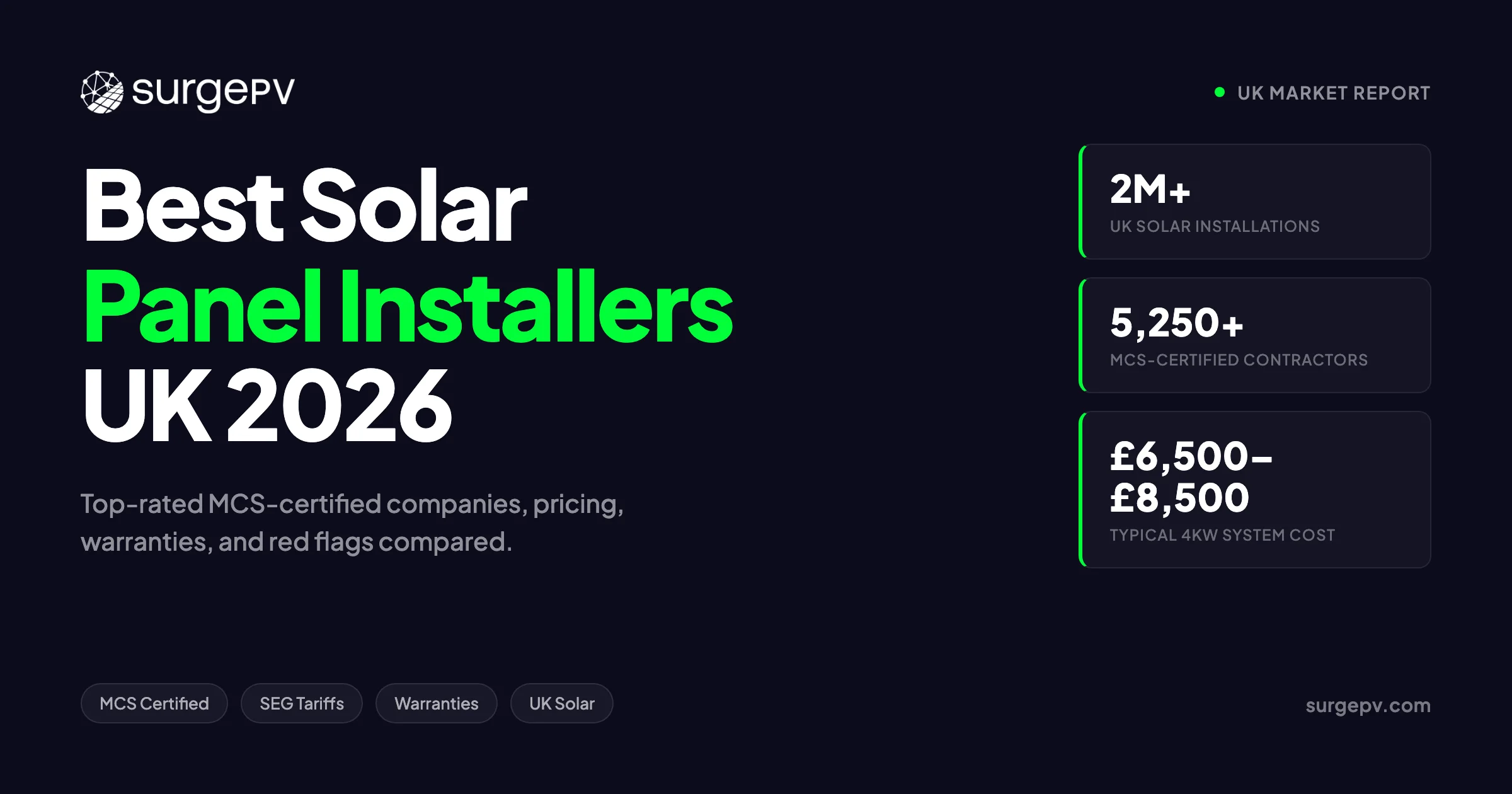
The UK solar market is moving faster than at any point since the 2012 feed-in tariff boom. More than 2 million solar installations were registered by March 2026, and the industry is forecast to add another 5 to 5.5 GWp this year. That growth has attracted good installers, mediocre installers, and outright cowboys. Choosing the right company matters because the panels will sit on your roof for 25 years, and the workmanship warranty is the only thing standing between you and a leaky roof or a dead inverter nobody wants to fix.
This guide ranks the best solar panel installers UK homeowners can trust in 2026. It also explains how we chose them, what you should pay, which accreditations matter, and the red flags that should send you to the next quote. If you are an installer, the right solar design tools can help you turn site surveys into accurate quotes faster.
In this guide, you will learn:
- Which UK installers combine strong reviews, MCS certification, and solid warranties
- How regional coverage affects your shortlist
- The exact accreditations and insurance to check before signing
- Typical 2026 prices for 4kW systems with and without batteries
- How the Smart Export Guarantee (SEG) links to your choice of installer
- Common sales tricks and contract traps to avoid
Quick Answer
The best solar panel installers UK in 2026 are Sunsave, Octopus Energy Solar, Heatable, Project Solar, Solar4Good, Tile Energy, Rygol Electrical Services, Adept Renewables, Glow Green, and Everyone’s Energy. Always verify MCS certification, compare at least three written quotes, and avoid deposits above 25%.
UK Solar Market Snapshot 2026
The UK passed 2 million solar installations in March 2026, according to government figures reported by Solar Power Portal. The previous year set a record with 269,000 installations, up 37% from 2024. Analysts expect 2026 to grow another 50% year on year, adding 5 to 5.5 GWp of capacity.
Rooftop solar dominates by volume. Roughly 95% of new installations in 2025 were rooftop systems, and new-build solar accounted for 35% of the total. The installer base has expanded to match demand. MCS-certified contractors now number more than 5,250, the highest since the scheme began in 2008, with over 4,000 holding solar PV certification.
Costs have also fallen. Installation prices per kW dropped 9% for 0 to 4 kW systems, 8% for 4 to 10 kW systems, and 3% for 10 to 50 kW systems in 2025. A typical 4kW residential system now costs £6,500 to £8,500 including installation and 0% VAT, which runs until 31 March 2027.
Key Takeaway
More installers means more choice, but also more risk. A busy market is not the same as a trustworthy one. Certifications and review quality matter more than ever.
How We Ranked the Best Solar Panel Installers UK
We evaluated installers against five non-negotiable standards:
- MCS or Flexi-Orb certification — required for SEG payments, 0% VAT, and most grants.
- RECC or HIES accreditation — consumer protection codes that govern sales, deposits, and complaints.
- TrustMark approval — government-endorsed quality mark for home improvements.
- NAPIT or NICEIC registration — confirms electrical competency and Part P compliance.
- Customer score of 85% or higher on at least one major review platform, with a meaningful review count.
We then layered in practical factors: coverage area, workmanship warranty length, transparency of pricing, battery and tariff bundling, and whether the company is primarily a solar specialist or a heating firm that also sells panels.
The rankings below combine data from Sunsave’s 2026 installer index, ExpertSure’s comparison, and our own checks of MCS registers and review platforms. Scores are standardised to percentages where platforms use different scales.
The 10 Best Solar Panel Installers in the UK
| Rank | Installer | Customer Score | Coverage | Workmanship Warranty | Best For |
|---|---|---|---|---|---|
| 1 | Sunsave | 96% | England, Wales & south Scotland | Up to 20 years | Subscription and long-term cover |
| 2 | Octopus Energy Solar | 4.8/5 (771K) | Nationwide | 10 years | Ecosystem: solar, battery, EV, tariff |
| 3 | Heatable | 4.8/5 (10K) | England & Wales | 5 years | Transparent online pricing |
| 4 | Project Solar | 4.6/5 (4.8K) | England | 5 years | Budget-conscious buyers |
| 5 | Solar4Good | 4.9/5 (677) | South & West England | 10 years | Premium service, smaller scale |
| 6 | Tile Energy | 98.7% | Somerset, Herefordshire, Oxfordshire, Hampshire | Up to 20 years | Long workmanship warranty |
| 7 | Rygol Electrical Services | 99.7% | Bristol & surrounding | 6 years | Local Bristol specialist |
| 8 | Adept Renewables | 99.7% | Dorset, Wiltshire, Hampshire | Up to 10 years | South coast regional expert |
| 9 | Glow Green | 4.7/5 (9.6K) | England & Wales | 5 years | Solar plus heat pump or boiler |
| 10 | Everyone’s Energy | 4.7/5 (1.2K) | London focus | 5 years | Flats, leaseholds, urban sites |
1. Sunsave
Sunsave tops the list for homeowners who want long-term protection without a large upfront payment. The company offers Sunsave Plus, a solar subscription that covers installation, 24/7 monitoring, maintenance, a free battery upgrade, inverter replacement if needed, downtime cover, and Aviva insurance. Customers who buy outright get the Sunsave Standard package with a five-year workmanship warranty.
The 20-year guarantee is the longest in the market. Sunsave scores 96% across 313 reviews and holds Which? Trusted Trader status. The trade-off is that subscription pricing is only cost-effective for households planning to stay in the property long enough to recover the monthly fee through bill savings and SEG income.
2. Octopus Energy Solar
Octopus Energy Solar is the best pick for households already inside the Octopus ecosystem. The company pairs solar and battery installation with tariffs such as Intelligent Octopus Flux, which can pay up to 32.17p/kWh for peak exports between 4pm and 7pm. Its Trustpilot score of 4.8/5 is built on 771,000 reviews, though most relate to energy supply rather than solar installation.
A 4kW system from Octopus starts around £6,800. The main advantage is one app for generation, storage, EV charging, and export. The downside is that the best SEG rates require a compatible battery and smart meter, so the headline export figure does not apply to every customer.
3. Heatable
Heatable offers fully online quoting and avoids in-home sales visits. A 4kW system starts at £5,995, making it one of the most transparent national options. The company scores 4.8/5 on Trustpilot from roughly 10,000 reviews.
The catch is that Heatable built its reputation on boilers. Most of its reviews are for heating work, not solar. That does not make it a bad solar installer, but it does mean you should ask for solar-specific references and recent PV case studies before deciding.
4. Project Solar
Project Solar targets price-sensitive buyers. A 4kW system starts around £5,500, the lowest headline price among the national installers listed here. It scores 4.6/5 on Trustpilot from 4,800 reviews and covers England.
The lower price often reflects simpler equipment packages and shorter after-sales support windows. Project Solar works best for straightforward roofs where the owner is comfortable managing some of the post-install paperwork, such as SEG registration.
5. Solar4Good
Solar4Good has the highest Trustpilot score in this group at 4.9/5, though from a smaller base of 677 reviews. It operates across South and West England and positions itself as a premium installer with strong aftercare.
Starting prices for a 4kW system are around £6,200. Solar4Good suits homeowners who want a local-feel service with national backing and are willing to pay a small premium for responsiveness.
6. Tile Energy
Tile Energy is a regional installer covering Somerset, Herefordshire, Oxfordshire, and Hampshire. It offers a workmanship warranty of up to 20 years, matching Sunsave’s longest cover, and uses premium equipment such as Tesla and SolarEdge.
The company scores 98.7% across Checkatrade and Which? reviews. If you live in its coverage area and want a long warranty without a subscription, Tile Energy is a strong alternative to the national brands.
7. Rygol Electrical Services
Rygol is a Bristol-based electrical contractor that scores 99.7% from Which? and Google reviews. It offers a six-year workmanship warranty and has built a local reputation through quality electrical work.
This is a good example of a small, MCS-certified firm that outperforms national brands on customer satisfaction but only serves a limited area. Homeowners in Bristol and the surrounding towns should shortlist Rygol alongside the bigger names.
8. Adept Renewables
Adept Renewables covers Dorset, Wiltshire, and Hampshire with a 99.7% customer score and up to ten years of workmanship cover. It also offers a maintenance package at £24.99 per month for customers who want ongoing monitoring and servicing.
The company is a useful reminder that the best solar panel installers UK are not always the biggest. For south coast homeowners, Adept offers a balance of strong reviews, regional knowledge, and extended warranty options.
9. Glow Green
Glow Green bundles solar with heat pumps, boilers, and insulation. It scores 4.7/5 on Trustpilot from 9,600 reviews and covers England and Wales. A 4kW system starts around £5,800.
Glow Green is best for households planning a wider home energy upgrade rather than solar alone. The combined project management can reduce disruption, but make sure the solar design is reviewed by someone with PV-specific experience, not just heating sales staff.
10. Everyone’s Energy
Everyone’s Energy focuses on London, including flats, leaseholds, and urban properties where roof access, scaffolding, and landlord permissions create extra complexity. It scores 4.7/5 on Trustpilot from 1,200 reviews and starts around £5,200 for a 4kW system.
If you live in a flat or a terraced house in London, a specialist like Everyone’s Energy can save weeks of back-and-forth with freeholders and managing agents compared with a national installer that treats every job the same.
Pro Tip
A 99.7% local score does not help if the installer never visits your county. Start with MCS certification, then filter by coverage, then compare warranties. Review scores are the third filter, not the first.
Best Solar Panel Installers by Region
| Region | Recommended Installers | Why These Fit |
|---|---|---|
| London | Everyone’s Energy, Octopus Solar, The Solar Co. | Urban access, leasehold experience, strong reviews |
| South East | Adept Renewables, Tile Energy, Sunsave | Regional specialists plus national cover |
| South West | Solar4Good, Heatable, Octopus Solar | Strong local installers and national reach |
| Midlands | Project Solar, Heatable, Glow Green | Good coverage and competitive pricing |
| North West | Project Solar, Glow Green, Heat Electric Northwest | Budget options and regional specialists |
| Yorkshire | Project Solar, Octopus Solar | National coverage with tariff bundling |
| Scotland | Octopus Solar, Sunsave, GreenMatch network | Nationwide firms with Scottish coverage |
| Wales | Heatable, Glow Green, Smart Energy Homes | England-and-Wales coverage plus Welsh specialists |
The regional table is a starting point, not a final list. Always check whether an installer is actively taking jobs in your postcode and whether their quoted lead time fits your schedule.
How to Choose a Solar Panel Installer in the UK
Follow this checklist before signing any contract:
- Verify MCS certification first. Use the official MCS register at mcscertified.com. Ask for the installer’s MCS number and check it is current. Without MCS certification, you cannot access SEG payments or 0% VAT.
- Check RECC or HIES accreditation. These codes protect you from high-pressure sales, limit deposits, and provide an independent complaints route.
- Confirm electrical competency. Look for NAPIT or NICEIC registration. This is separate from MCS and confirms the installer can legally carry out notifiable electrical work.
- Read reviews on more than one platform. Trustpilot, Which?, Checkatrade, and Google all have different reviewer bases. A company with 4.8 stars on Trustpilot but poor Google reviews needs closer inspection.
- Get at least three written quotes. The same 4kW system can vary by up to 40% between installers. Make sure each quote lists panel make, model, inverter, expected annual generation, scaffolding, and warranty terms.
- Ask about after-sales support. Who do you call if an inverter fails in year six? How long is the workmanship warranty? Is monitoring included?
- Compare SEG options. Some installers push their preferred energy supplier. You can register SEG with any obligated supplier, so compare rates independently. See our SEG tariff comparison for current rates.
What Most Homeowners Get Wrong
They compare headline price per kW and ignore the inverter. A cheap string inverter on a shaded roof will underperform for 25 years. A slightly higher quote with power optimisers or microinverters can produce more energy and pay back faster.
Red Flags to Avoid
Some warning signs should end the conversation immediately:
- Deposits above 25%. RECC and HIES codes limit upfront payments. A request for 50% or full payment before work starts is a red flag.
- No verifiable MCS number. If the installer cannot give you a current MCS number, walk away.
- “Today only” pricing or high-pressure sales. Reputable installers do not use countdown tactics.
- No written quote. A verbal price or a one-line email is not a contract.
- Missing physical address or company number. Check Companies House if you have any doubt.
- Quotes without a site survey. A final price should follow a roof assessment, not precede it.
- Vague warranties. “Lifetime guarantee” means nothing unless the paperwork defines what is covered and who pays for labour.
What You Should Pay in 2026
| System Size | Typical Cost | Notes |
|---|---|---|
| 3 kWp (7 panels) | £5,700–£7,000 | Suitable for smaller homes or low usage |
| 3.5 kWp (8 panels) | £6,100–£7,000 | Average UK semi-detached |
| 4 kW (10 panels) | £6,500–£8,500 | Most popular size for 3-bedroom homes |
| 4 kW + 5kWh battery | £10,000–£14,000 | Adds backup and better SEG strategy |
| 6.75 kWp | ~£15,460 | Larger homes or high consumption |
Prices include 0% VAT until 31 March 2027, after which VAT reverts to 5%. Labour costs in London and the South East are typically 10% to 30% higher than the national average. Roof complexity, scaffolding height, and panel brand all move the final figure.
Adding a battery increases upfront cost but can improve returns. A 4kW system exporting 2,400 kWh per year earns roughly £420 at the best tied SEG rate of 17.5p/kWh, but only £96 at the lowest open rate of 4p/kWh. A battery lets you shift export to peak periods on time-of-use tariffs such as Octopus Intelligent Octopus Flux, where rates can reach 32.17p/kWh between 4pm and 7pm.
Warranties and Aftercare Explained
A good quote should break down four warranties clearly:
| Warranty Type | Typical Length | What It Covers |
|---|---|---|
| Panel performance | 25 years | Guaranteed output degradation curve |
| Panel product | 10–15 years | Manufacturing defects |
| Inverter | 5–10 years | Failure of the central inverter |
| Workmanship | 2–20 years | Installation defects, leaks, roof damage |
The workmanship warranty is the one that varies most. National installers typically offer five years. Regional specialists such as Tile Energy and Sunsave offer up to 20 years. A two-year workmanship warranty is legal but short for a 25-year asset.
Ask whether monitoring is included. Some installers provide a portal or app; others leave you to check the inverter display. Remote monitoring catches underperformance early and is worth negotiating into the contract.
The MCS Certification Question
MCS certification is the gatekeeper for almost every financial benefit of UK solar. It is required for:
- Smart Export Guarantee registration
- 0% VAT on eligible solar and battery installations
- Most local authority grant schemes
- Many home insurance and mortgage lender requirements
MCS certification is held by the installation company, not individual workers. The scheme covers three areas: product certification (MCS 001), installation standards (MCS 012 / MIS 3002), and a consumer code of conduct (MCS 003). Installers must also use products listed on the MCS Product Directory.
You can verify an installer at mcscertified.com. Do not rely on a logo on a website or van. Certifications lapse, and a company that was MCS certified last year may not be certified today.
For a deeper technical explanation, see our guide to MCS certification for heat pumps and solar in the UK. Installers who want to streamline surveys and proposals can also use solar proposal generation to cut quoting time and reduce errors.
Design and Quote Solar Projects Faster
SurgePV helps installers create accurate roof designs, shade analysis, and client-ready proposals in minutes — not days.
Book a DemoNo commitment required · 20 minutes · Live project walkthrough
Frequently Asked Questions
Who are the best solar panel installers in the UK in 2026?
The best solar panel installers UK include Sunsave, Octopus Energy Solar, Heatable, Project Solar, Solar4Good, Tile Energy, Rygol Electrical Services, Adept Renewables, Glow Green, and Everyone’s Energy. The right choice depends on your region, budget, and whether you want a subscription, battery bundle, or local specialist.
Is MCS certification essential for a UK solar installer?
Yes. MCS certification is required to access the Smart Export Guarantee, 0% VAT on eligible installations until March 2027, and most grant schemes. It also confirms the installer meets UK product, design, and workmanship standards.
How much does a 4kW solar system cost in the UK in 2026?
A 4kW solar panel system typically costs £6,500 to £8,500 including installation and 0% VAT. Adding a 5kWh battery usually raises the total to £10,000 to £14,000. Prices vary by roof complexity, panel brand, and location.
What warranties should a UK solar installer offer?
Expect a 25-year panel performance warranty, a 10 to 15-year panel product warranty, a 5 to 10-year inverter warranty, and at least a 5-year workmanship warranty. Some installers, such as Tile Energy, offer workmanship cover up to 20 years.
How many quotes should I get for solar panels?
Get at least three written quotes from MCS-certified installers. The same 4kW system can vary by up to 40% between quotes, so comparing equipment, warranties, and scaffolding scope matters as much as the headline price.
What are the red flags when choosing a solar installer?
Avoid installers who demand deposits above 25%, refuse a written quote, cannot show a verifiable MCS number, use “today only” pressure tactics, or quote without a site survey. Also be cautious if most of a company’s reviews are for a different trade, such as boiler work.
What is the Smart Export Guarantee and do I need a specific installer for it?
The Smart Export Guarantee pays you for surplus electricity exported to the grid. Any MCS-certified installer can install a system that qualifies. You then register with an obligated SEG supplier such as Octopus, E.ON Next, or British Gas.
Should I choose a local or national solar installer?
Both can work. National installers often have faster scheduling and bundled tariffs, while local installers may provide more personal service and quicker aftercare. The deciding factors should be MCS certification, review quality, warranty length, and a clear written contract.
Where this fits
This article is part of SurgePV's Solar Installation hub, which works through the topic from first principles to the decisions a project team actually has to make.