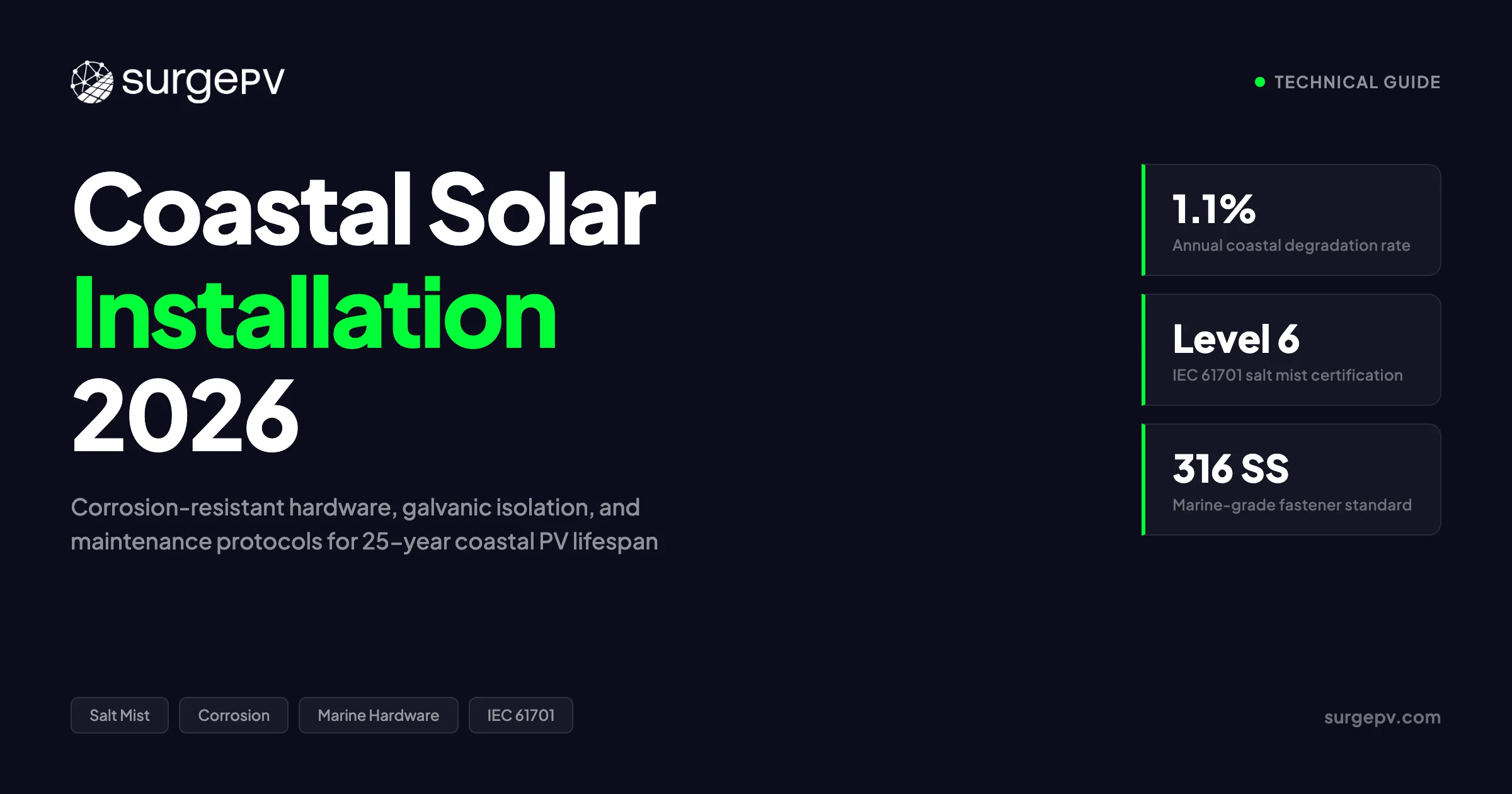
A 5 MW solar farm 200 meters from the Florida Atlantic coast suffered a 5% efficiency drop in its first year. Galvanic corrosion ate through galvanized steel racking at the aluminum rail junctions. Maintenance costs hit $15,000 per MW annually. The project was five years old. See Solar Racking Design Guide for detailed guidance.
This is not an edge case. It is what happens when coastal salt air solar installation uses inland assumptions. Salt spray travels up to 100 meters inland on calm days and much farther during storms. Chloride deposition rates near the ocean reach 300-3,000 mg/m² per day — enough to destroy unprotected aluminum frames within 5 years and turn standard galvanized fasteners into rust within 3.
This guide covers every layer of coastal PV protection for 2026. Module certification. Hardware grades. Galvanic isolation. Inverter enclosures. Conduit choices. Maintenance protocols. Warranty traps. Real failure cases from Florida to Mumbai. For the latest details on India, see 5kW Solar Panel Price in India. Read more about Best Solar Design Software India. For India-specific compliance details, see India andhra-pradesh.
Quick Answer
Coastal salt air solar installation requires IEC 61701 Level 6 certified modules, 316 stainless steel fasteners, galvanic isolation between dissimilar metals, NEMA 4X inverter enclosures, and fresh water rinsing every 3-6 months. Standard inland hardware fails within 5-7 years on the coast. Proper specification adds 5-10% to upfront BOM cost but prevents 15%+ cumulative production loss over system life.
In this guide:
- Why coastal environments destroy standard solar hardware — chloride mechanics
- IEC 61701 salt mist test: Severity 1-6 explained with selection table
- Module frames and anodization: Type II vs Type III for salt resistance
- Stainless steel grades: 304 vs 316 vs 316L — cost and performance data
- Galvanic corrosion: the metal pairs that kill racking, and how to isolate them
- Inverter enclosure ratings: why NEMA 4X beats IP66 on the coast
- Cable, junction box, and combiner box sealing for marine environments
- Conduit material hierarchy: PVC, EMT, RGS, fiberglass — what survives salt
- Coastal distance zones: 50m, 500m, 1 mile, 5 mile hardware rules
- Maintenance schedules: rinsing, inspection, retorquing protocols
- Warranty exclusions and manufacturer coastal policies
- Real failure case studies: Florida, California, UK south coast, Mumbai
Why Salt Air Destroys Solar Hardware: The Chloride Mechanism
Salt air damages solar systems through four distinct mechanisms. Each one accelerates the others.
Surface soiling is the first and most visible. Salt crystals bond to module glass and form a crust that rain cannot wash away. Coastal soiling losses run 4-6% annually versus 1-2% inland. Morning dew dissolves these crystals into a pH 5.5-6.5 saline solution that etches anti-reflective coatings over time.
Electrochemical corrosion attacks every metal component. Chloride ions (Cl⁻) penetrate the passive oxide layer on aluminum and stainless steel. Once inside, they trigger pitting — localized holes that spread rapidly. Galvanized zinc coatings sacrifice themselves at 0.03mm per year in coastal conditions. Standard carbon steel fasteners show visible rust within 18 months.
Moisture ingress degrades electrical isolation. Salt is conductive. It penetrates junction box seals, combiner box gaskets, and cable jacket micro-cracks. This causes arc faults, ground faults, and potential-induced degradation (PID). Inverters draw salt-laden air through ventilation ports, coating internal PCBs and heat sinks.
Encapsulant delamination separates the module’s protective layers. Salt + humidity + UV break the ethylene vinyl acetate (EVA) bond between glass and cells. “Snail trails” — brown discoloration patterns — appear first. Complete delamination follows within 8-12 years on uncertified modules.
Key Takeaway
Coastal solar panels degrade at 1.1% per year versus 0.54% inland — a 2× acceleration that compounds to 17% cumulative loss by year 15. Salt soiling, electrochemical corrosion, moisture ingress, and encapsulant delamination work together. No single mitigation is enough.
IEC 61701 Salt Mist Corrosion Test: Severity Levels Explained
IEC 61701 is the international standard for salt mist corrosion testing of photovoltaic modules. The current edition is IEC 61701:2020. It replaces the 2011 version with tighter pass criteria and clearer severity definitions.
The standard simulates coastal salt exposure in a controlled chamber. Modules undergo cycles of salt spray followed by high-humidity storage. After testing, inspectors check for visible corrosion, power degradation, insulation resistance, and mechanical integrity.
The Six Severity Levels
| Severity Level | Test Cycles | Total Duration | Typical Application |
|---|---|---|---|
| Level 1 | 1 cycle | ~7 days | Inland, low humidity |
| Level 2 | 2 cycles | ~14 days | Inland, moderate humidity |
| Level 3 | 4 cycles | ~28 days | Near-coastal, moderate salt |
| Level 4 | 6 cycles | ~42 days | Coastal, regular salt spray |
| Level 5 | 8 cycles | ~56 days | Direct coastal, heavy salt |
| Level 6 | 12 cycles | ~84 days | Extreme marine, offshore |
Each cycle consists of:
- Salt spray: 2 hours with 5% sodium chloride (NaCl) solution at 35°C
- Humidity storage: 20-22 hours at 40°C and 93% relative humidity
- Repeat the spray + humidity sequence 4 times per cycle
Level 6 subjects modules to approximately 84 days of continuous salt mist cycling. Pass criteria require under 5% power degradation, zero visible corrosion on metal parts, no cracks or delamination, and stable insulation resistance.
Module Selection by Distance from Coast
| Distance from Ocean | Minimum IEC 61701 Level | Frame Anodization |
|---|---|---|
| 0-50m | Level 6 (offshore-rated) | 20+ micron, Type III hardcoat |
| 50-500m | Level 6 | 15-20 micron, Type III |
| 500m-1 mile | Level 5 | 15 micron, Type II or III |
| 1-5 miles | Level 4 | 10-15 micron, Type II |
| 5+ miles | Level 3 | Standard 10-12 micron |
Pro Tip
Always request the IEC 61701 test report from your module supplier. Some manufacturers claim “salt mist resistant” without specifying a level. A Level 3 module installed 200 meters from the coast will fail within 8-10 years. Verify the certificate number and testing lab.
Module Frame Anodization: Type II vs Type III
Anodization is an electrochemical process that thickens the natural oxide layer on aluminum. This layer protects the frame from salt corrosion. Thicker layers last longer.
Type II anodization (standard commercial) produces a 5-12 micron coating. It offers basic corrosion resistance for inland and mild coastal environments. Cost is low. It is the default on most residential modules.
Type III hardcoat anodization produces a 15-25 micron dense ceramic layer. The coating is harder, more wear-resistant, and far more salt-tolerant. Type III is specified for coastal, marine, and industrial environments. Cost adds $2-4 per module.
| Specification | Type II (Standard) | Type III (Hardcoat) |
|---|---|---|
| Coating thickness | 5-12 micron | 15-25 micron |
| Salt spray resistance (ASTM B117) | 500-1,000 hours | 2,000-3,000+ hours |
| Wear resistance | Moderate | High |
| Cost per module | Baseline | +$2-4 |
| Recommended for | Inland, over 5 miles from coast | Coastal, under 5 miles from coast |
For coastal salt air solar installation within 1 mile of the ocean, specify Type III hardcoat anodization on all module frames. The $2-4 per module premium pays for itself by preventing frame corrosion that would require full module replacement.
Stainless Steel Grades: 304 vs 316 vs 316L
Fasteners, clamps, and hardware are the most failure-prone components in coastal solar. The stainless steel grade determines whether they last 25 years or 3.
Grade 304 stainless steel contains 18% chromium and 8% nickel. It resists general corrosion in inland and mild environments. It lacks molybdenum. In coastal chloride exposure, 304 develops pitting corrosion within 3-5 years. Tea staining — surface discoloration — appears first. Structural weakening follows.
Grade 316 stainless steel adds 2-3% molybdenum. This element transforms the passive oxide layer, making it resistant to chloride attack. Grade 316 survives 25+ years in coastal salt air with minimal degradation. It is the industry standard for marine-grade solar hardware.
Grade 316L stainless steel is the low-carbon variant of 316. The “L” stands for low carbon (under 0.03%). This prevents carbide precipitation during welding, maintaining corrosion resistance at weld joints. Specify 316L for any welded coastal hardware.
| Property | 304 (A2) | 316 (A4) | 316L |
|---|---|---|---|
| Chromium | 18% | 16-18% | 16-18% |
| Nickel | 8% | 10-14% | 10-14% |
| Molybdenum | 0% | 2-3% | 2-3% |
| Coastal lifespan | 3-5 years | 25+ years | 25+ years |
| Cost vs 304 | Baseline | +20-40% | +25-45% |
| Best use | Inland fasteners | Coastal fasteners, clamps | Welded coastal hardware |
SurgePV Analysis
At $0.15 per watt for standard hardware versus $0.20 per watt for 316 stainless, the upgrade costs $500 on a 10 kW system. Replacing corroded fasteners, clamps, and rails at year 7 costs $2,000-4,000 plus production loss. The 316 upgrade pays for itself 4-8× over system life.
For a direct comparison, see Arka 360 vs SurgePV.
Galvanic Corrosion: The Metal Pairs That Kill Racking
Galvanic corrosion is an electrochemical process. Two dissimilar metals touch in the presence of an electrolyte — salt water is an excellent one. One metal becomes the anode and corrodes faster. The other becomes the cathode and is protected.
The farther apart two metals are on the galvanic series, the faster the corrosion. Salt spray accelerates the reaction by 10-100× compared to dry inland air.
Galvanic Series for Solar Hardware (Most Active to Most Noble)
- Magnesium
- Zinc (galvanized coatings)
- Aluminum alloys (module frames, rails)
- Low alloy steel / carbon steel
- Lead
- Brass, bronze
- Copper (cabling, busbars)
- Stainless steel 304, 316
- Titanium
- Gold, platinum
Dangerous Combinations in Solar Racking
| Pair | Anode (Corrodes) | Risk Level | Coastal Failure Timeline |
|---|---|---|---|
| Aluminum rail + Carbon steel bolt | Aluminum | Critical | 2-4 years |
| Aluminum frame + Galvanized steel purlin | Both (zinc sacrifices first) | High | 5-7 years |
| Aluminum + Copper (direct contact) | Aluminum | Critical | 1-3 years |
| Aluminum rail + 316 SS fastener | Aluminum (mild) | Moderate | 10-15 years with isolation |
| 304 SS + 316 SS | 304 (minimal) | Low | 20+ years |
The most common and destructive pairing is aluminum rails with carbon steel fasteners. The small steel bolt acts as a cathode. The large aluminum rail acts as an anode. The area effect accelerates localized pitting. Within 3 years, clamping force drops. Within 5, structural integrity fails.
Prevention Methods
Isolation pads are the primary defense. EPDM rubber, nylon, or polymer pads separate dissimilar metals electrically. A Florida coastal farm retrofit with isolation pads cut maintenance costs from $15,000 per MW to under $2,000 per MW. An 18-month inspection showed complete corrosion halt.
Single-material assemblies eliminate galvanic risk entirely. Aluminum clamps on aluminum rails. Stainless steel brackets with stainless steel bolts. This is the safest approach but limits supplier options.
Coatings help but require maintenance. Zinc-rich primers on steel slow corrosion. Anodization on aluminum extends life. Coatings must remain intact — scratches become corrosion initiation points.
Sacrificial anodes attach a more active metal (zinc) that corrodes instead of the protected component. This is common in marine engineering but rare in solar due to replacement complexity.
What Most Guides Miss
Galvanic corrosion does not require direct metal-to-metal contact. Salt water bridging a 2-millimeter gap between aluminum and steel creates the same electrochemical cell. Isolation pads must completely separate the metals with no salt bridges. A washer is not enough. Use full-coverage EPDM gaskets at every junction.
Inverter Enclosures: Why NEMA 4X Beats IP66 on the Coast
Inverters are the most expensive single component after modules. They are also the most vulnerable to salt air. Ventilation fans draw salt-laden air directly across heat sinks, capacitors, and control boards.
IP66 is the international ingress protection rating. The first digit (6) means dust-tight. The second digit (6) means protected against powerful water jets. IP66 is sufficient for rain and dust. It does not test corrosion resistance.
NEMA 4X is the North American enclosure standard. It includes all IP66 protections plus an 800-hour salt spray test under ASTM B117. NEMA 4X enclosures must use corrosion-resistant materials: stainless steel, fiberglass-reinforced polyester, or polycarbonate. Painted carbon steel does not qualify. For United States-specific compliance details, see United States arizona/phoenix.
| Standard | Dust/Water | Salt Spray Test | Material Requirement | Coastal Suitability |
|---|---|---|---|---|
| IP66 | Yes | No | None specified | Insufficient alone |
| NEMA 4 | Yes | No | Standard materials | Insufficient |
| NEMA 4X | Yes | 800 hours ASTM B117 | SS, FRP, or polycarbonate | Required for coastal |
| IP68 | Yes (immersion) | No | None specified | Good for flooding, not corrosion |
For coastal salt air solar installation, specify NEMA 4X minimum for all outdoor inverter enclosures. IP66 alone is not enough. The “X” in NEMA 4X specifically addresses the corrosion gap that salt air exploits.
Inverter Placement Strategy
The best protection is indoor installation. Mount string inverters in a garage, utility room, or dedicated electrical shed. Run DC cabling from the roof array to the indoor inverter. This eliminates salt exposure entirely.
For commercial and utility projects where indoor mounting is impractical:
- Specify NEMA 4X stainless steel or fiberglass enclosures
- Install in shaded locations to reduce thermal cycling
- Elevate 1-2 meters above grade for flood protection
- Orient ventilation away from prevailing wind direction
- Schedule annual internal cleaning and inspection Shadow analysis software identifies shading issues before installation. See [Solar Shading Analysis Guide](/blog/solar-shading-analysis-guide) for detailed guidance.
Pro Tip
Some inverter manufacturers offer “coastal packages” with upgraded conformal coating on internal PCBs, sealed fans with stainless steel housings, and enhanced air filtration. These packages add $200-500 per inverter but extend coastal lifespan from 8-10 years to 15-20 years. Request the coastal option at procurement — retrofits are impossible without factory service.
Cable, Junction Box, and Combiner Box Sealing
Electrical connections are the weakest link in coastal solar. Salt penetrates seals, corrodes terminals, and creates conductive paths that cause ground faults and arc faults.
Cable Jacket Requirements
Coastal solar cables need dual resistance: UV and chemical. Standard PVC jackets crack under UV exposure within 5-7 years. Salt accelerates the degradation.
XLPE (cross-linked polyethylene) jackets resist UV, salt, and moisture better than PVC. They maintain flexibility across -40°C to +90°C. XLPE is the minimum specification for coastal DC cabling.
PV1-F solar cable with double-insulated XLPO (cross-linked polyolefin) jacket offers the best coastal protection. The outer layer blocks UV and salt. The inner layer provides electrical isolation. Rated for 25-year outdoor exposure.
Junction Box Sealing
Module junction boxes are factory-sealed but not invincible. Salt air attacks the potting compound, gasket material, and diode terminals.
| Component | Coastal Specification | Standard (Avoid) |
|---|---|---|
| Enclosure rating | IP67-IP68 | IP65 |
| Potting compound | Silicone or polyurethane | Basic epoxy |
| Gasket material | Silicone | EPDM (degrades faster in salt) |
| Cable entry | Double-seal cable glands | Single compression fitting |
| Diode protection | Conformal coating | Bare copper traces |
Combiner Box Specifications
Combiner boxes aggregate strings before the inverter. They contain fuses, busbars, and monitoring equipment. A single salt-induced fault in a combiner box can disable an entire array section.
Specify IP66 or IP67-rated combiner boxes with 316 stainless steel or fiberglass-reinforced plastic enclosures. Use tin-plated copper busbars — bare copper corrodes rapidly in salt air. Install desiccant packs inside and replace them annually. Route all cables with drip loops so water runs away from entries.
Conduit Material Hierarchy for Coastal Solar
Conduit protects DC and AC cabling from physical damage and environmental exposure. The wrong conduit choice in salt air creates a hidden failure point.
The Four Options Ranked
| Material | Salt Resistance | UV Resistance | Mechanical Strength | Coastal Recommendation |
|---|---|---|---|---|
| PVC-coated RGS | Excellent | Excellent | Highest | Best overall for commercial/utility |
| UV-stabilized UPVC | Excellent | Good | Moderate | Best value for residential |
| Fiberglass (RTRC) | Excellent | Excellent | High | Premium for extreme environments |
| Bare RGS | Poor (galvanization fails) | Good | High | Only with PVC coating |
| EMT | Very poor | Poor | Low | Never use unprotected near coast |
| Bare aluminum | Good | Good | Moderate | Acceptable for overhead runs |
EMT (Electrical Metallic Tubing) is the worst choice for coastal solar. It is thin-wall steel with minimal corrosion protection. Salt air penetrates the zinc coating within 2 years. Rust blooms inside the conduit, staining cables and creating ground fault paths. EMT should never be used within 5 miles of the coast without additional protection.
PVC-coated Rigid Galvanized Steel (RGS) offers the best balance. The hot-dip galvanized steel core provides mechanical strength and grounding continuity. The bonded PVC exterior creates an impermeable salt barrier. Lifespan exceeds 30 years in coastal conditions.
UPVC (unplasticized PVC) is fully non-metallic and immune to salt corrosion. UV-stabilized formulations with titanium dioxide additives resist sun degradation for 20+ years. It is lighter and easier to install than RGS but offers less physical protection against impact.
Real-World Example
A 2 MW rooftop project in Mumbai used EMT conduit to save $8,000 on a $1.2 million installation. Within 18 months, salt corrosion caused three ground faults in the EMT runs. Repair cost: $14,000 plus 4 days of downtime. The $8,000 savings became a $14,000 loss with production disruption. UPVC would have cost $4,000 more upfront and lasted 25 years.
See our guide on Solar Energy India for more.
Coastal Distance Zones: Hardware Rules by Proximity
No single specification works for every coastal site. The distance from the ocean determines the required protection level. Manufacturers and insurers use three primary zones.
The Three Coastal Zones
| Zone | Distance | Module Requirement | Hardware Requirement | Warranty Status |
|---|---|---|---|---|
| Extreme Marine | 0-50m | Level 6 + Type III hardcoat | 316 SS, isolation pads, NEMA 4X | Often voided |
| High Coastal | 50-500m | Level 6 + Type III hardcoat | 316 SS, isolation pads, NEMA 4X | Conditional |
| Moderate Coastal | 500m-1 mile | Level 5 | 316 SS fasteners, IP66+ enclosures | Standard with disclosure |
| Low Coastal | 1-5 miles | Level 4 | 304 SS acceptable, standard enclosures | Standard |
| Inland | 5+ miles | Level 3 or none | Standard hardware | Standard |
Manufacturer-Specific Warranty Policies
| Manufacturer | Coastal Exclusion Distance | Notes |
|---|---|---|
| Hyundai | 500m | Do not install within 500m of salt water |
| Seraphim | 50m | Not advisable; 15-micron anodization required for 50-500m |
| SunPower/Maxeon | None (coastal covered) | IEC 61701 Level 6 standard on premium lines |
| REC | None (coastal covered) | Level 6 on Alpha series |
| Panasonic | Marine installations excluded | IEC 61701 tested but not warranted for ocean spray |
| LG | Direct salt contact voids | Rust and salt water damage excluded |
Always read the warranty document’s “Exclusions” section before specifying modules. The phrase “proximity to sea” or “marine environment” usually appears within the first three exclusion clauses.
Maintenance Schedule for Coastal Solar Systems
Coastal solar requires proactive maintenance. The salt does not stop. Neither should the maintenance program.
Rinsing Protocol
Salt crystals bond to module glass and do not dissolve in rain. Fresh water rinsing is essential.
| Zone | Rinse Frequency | Method |
|---|---|---|
| 0-100m from coast | Monthly | Low-pressure fresh water, early morning |
| 100-500m | Every 3 months | Low-pressure fresh water |
| 500m-1 mile | Every 6 months | Hose or low-pressure washer |
| 1-5 miles | Annually | Rain usually sufficient with annual inspection |
Use low pressure only — under 40 bar (580 psi). High-pressure washing damages anti-reflective coatings and can force water past seals. Rinse in early morning or evening when modules are cool. Hot glass + cold water creates thermal shock.
Use deionized or soft water if available. Hard water leaves mineral deposits that reduce transmission. If only tap water is available, rinse again with a squeegee or soft brush to prevent spotting.
Inspection Checklist
Every 6 months:
- Visual check of all module frames for white powder (aluminum corrosion) or rust
- Check torque on accessible fasteners with calibrated wrench
- Inspect junction boxes for seal integrity and cable gland tightness
- Check combiner boxes for moisture, corrosion on busbars, and fuse condition
- Monitor inverter display or portal for fault codes or yield anomalies
Annually:
- Professional electrical test: insulation resistance, ground continuity, string I-V curves
- Thermal imaging scan to identify hot spots from connection degradation
- Check conduit supports and clamps for corrosion
- Inspect roof penetrations and flashing for seal degradation
- Review production data month-by-month to catch gradual degradation trends
Every 5 years:
- Replace EPDM gaskets and seals in combiner boxes and enclosures
- Retorque all accessible fasteners to manufacturer specification
- Professional cleaning with salt-neutralizing soap (EPA Bio-Preferred listed)
- Consider professional electropolishing or passivation treatment for 316 hardware
Pro Tip
Set up automated production monitoring with alerts for yield drops above 5% month-over-month. Salt soiling causes gradual degradation that owners miss until annual inspections. A 5% drop detected in month 3 allows immediate rinsing. A 5% drop detected at month 12 may have already caused permanent coating damage.
Real Failure Case Studies
Florida Atlantic Coast: The 5 MW Galvanic Disaster
A utility-scale project installed 200 meters from the Florida Atlantic coast used standard aluminum rails with galvanized steel fasteners. No isolation pads. No 316 stainless upgrade. IEC 61701 Level 3 modules.
Timeline:
- Year 1: 5% efficiency drop from salt soiling. Maintenance cost $15,000 per MW.
- Year 3: Visible rust on 40% of fasteners. Frame corrosion at rail junctions.
- Year 5: Structural failure of 12 mounting points in a Category 2 storm. Emergency repairs cost $180,000.
- Year 7: Cumulative production loss reached 22% versus modeled output. Warranty claim denied due to “improper hardware specification for coastal zone.”
Retrofit: The operator replaced all fasteners with 316 stainless steel, installed EPDM isolation pads at every metal junction, and upgraded to Level 6 modules on failed strings. Post-retrofit maintenance costs dropped to under $2,000 per MW annually. An 18-month inspection showed zero new corrosion.
Lesson: The $40,000 saved on hardware specification became a $400,000+ loss including repairs, lost production, and early module replacement.
California Pacific Coast Highway: The Inverter Lesson
A 500 kW commercial rooftop in Ventura County, 300 meters from the Pacific, specified IP66-rated string inverters mounted on the roof. NEMA 4X was deemed “unnecessary” to save $3,000 on enclosure upgrades.
Within 4 years, salt corrosion caused fan bearing failures in 6 of 20 inverters. Internal PCB corrosion created erratic fault codes. Three inverters failed completely. Replacement cost: $18,000. Downtime: 6 weeks across three separate failures.
The remaining 14 inverters were relocated indoors at year 5. The $3,000 “savings” became a $25,000+ lesson in coastal inverter protection.
UK South Coast: The Conduit Failure
A 50 kW residential estate project in Brighton used EMT conduit for DC runs across a flat roof, 800 meters from the English Channel. The installer chose EMT for its low cost and ease of bending.
Within 2 years, salt corrosion created pinholes in the EMT. Water entered during winter storms. Three ground faults disabled string sections. The EMT was replaced with PVC-coated RGS at a cost of £4,200 — 8× the original EMT material cost.
Mumbai Coastal: The Maintenance Gap
A 1.2 MW rooftop on a Mumbai commercial building, 150 meters from the Arabian Sea, used Level 5 modules and 316 stainless hardware. Specification was correct. Maintenance was not.
The owner skipped rinsing for 18 months, relying on monsoon rain. Salt buildup reduced output by 8%. Frame corrosion appeared at installation scratch points where anodization was damaged during mounting. Annual inspection was delayed 8 months past schedule.
A $2,000 professional cleaning and touch-up coating program restored 6% of lost output. The remaining 2% was permanent coating damage. The owner now maintains a quarterly rinse schedule. Output has stabilized.
Lesson: Even correct specification fails without maintenance. Coastal solar is a 25-year commitment, not a one-time installation.
Myth-Busting: What Installers Get Wrong About Coastal Solar
Myth 1: “Rain washes salt off panels.”
Rain does not remove bonded salt crystals. Salt deposits form a crust that adheres to glass. Rain may remove loose surface salt but leaves the bonded layer. Fresh water rinsing with mechanical action (soft brush or squeegee) is required. A 2024 field study across 200 sites found coastal soiling losses of 4-6% annually even in high-rainfall coastal regions.
Myth 2: “IP66 is enough for coastal inverters.”
IP66 tests dust and water ingress only. It does not test corrosion resistance. A painted steel IP66 enclosure will rust from the inside out in salt air while maintaining its IP rating. NEMA 4X adds the 800-hour salt spray test and mandates corrosion-resistant materials. IP66 + NEMA 4X is the correct specification, not IP66 alone.
Myth 3: “304 stainless steel is fine if you paint it.”
Paint on 304 stainless scratches during installation. Chlorides penetrate scratches and initiate pitting beneath the paint layer. The paint then hides the corrosion until structural failure occurs. Grade 316 is the minimum for coastal fasteners. No paint substitute exists.
Myth 4: “Galvanic corrosion only happens with direct metal contact.”
Salt water bridges gaps up to several millimeters. Two metals separated by a washer but connected by a salt film create the same galvanic cell. Full electrical isolation with dielectric pads or gaskets is required. A washer is not isolation.
Myth 5: “Level 4 modules are fine within 500 meters of the coast.”
Level 4 modules pass 6 test cycles — approximately 42 days of simulated salt exposure. Real coastal environments expose modules to 9,125 days of salt air over 25 years. Level 4 is designed for mild coastal or industrial environments, not direct marine exposure. Within 500 meters, Level 6 is the safe specification.
Cost Analysis: Coastal Hardware Premium vs. Failure Cost
Proper coastal specification adds 5-10% to upfront balance-of-materials cost. Failure to specify properly adds 15-25% to lifetime cost.
Upfront Cost Premium for Coastal Specification
| Component | Standard Cost | Coastal Specification | Premium |
|---|---|---|---|
| Modules (10 kW) | $2,500 | $2,750 (Level 6, Type III) | +$250 (+10%) |
| Fasteners & clamps | $150 | $210 (316 SS) | +$60 (+40%) |
| Rails & mounting | $400 | $480 (anodized + isolation) | +$80 (+20%) |
| Inverter enclosure | Baseline | +$300 (NEMA 4X upgrade) | +$300 |
| Conduit (100 ft) | $200 | $320 (PVC-coated RGS) | +$120 (+60%) |
| Cable (UPVC jacket) | $300 | $360 (XLPO double-jacket) | +$60 (+20%) |
| Total Premium | — | — | +$870 (+8.7%) |
Lifetime Cost of Inadequate Specification
| Failure Mode | Year | Cost to Repair | Production Loss |
|---|---|---|---|
| Fastener corrosion, retorque | 5 | $500 | 2% × 5 years |
| Rail replacement (galvanic) | 10 | $2,000 | 5% × 10 years |
| Inverter failure (salt ingress) | 12 | $3,000 | 100% × 2 months |
| Module frame corrosion | 15 | $4,000 | 8% × 15 years |
| Conduit ground faults | 8 | $1,500 | 15% × 3 months |
| Total (undiscounted) | — | $11,000 | ~$8,000 in lost energy |
The $870 upfront premium prevents $19,000 in lifetime repairs and losses. Return on the coastal upgrade: 22× over 25 years.
Design Coastal Solar with Confidence
Model salt mist exposure, hardware selection, and maintenance costs in one platform.
Book a DemoNo commitment required · 20 minutes · Live project walkthrough
Vendor Landscape: Marine-Grade Solar Hardware Suppliers
Several manufacturers specialize in coastal and marine-grade solar mounting systems. Here are the leading options in 2026.
| Manufacturer | Product Line | Coastal Features | Best For |
|---|---|---|---|
| IronRidge | XR-1000 Rail + FlashFoot | Stainless steel hardware option, 20-year warranty | Residential and commercial rooftop |
| Unirac | SolarMount + RM SharedRail | Anodized aluminum, SS hardware kits available | Flat roof commercial |
| EcoFasten | RockIt Smart Slide + ClickFit | UltraGrip waterproof flashing, marine-grade options | Comp shingle and tile roofs |
| Pegasus Solar | SkipRail (rail-less) | Lightweight, reduced metal contact points | Residential aesthetic installs |
| Schletter | FixZ-System | C5-M corrosion class hardware, 25-year warranty | Utility-scale ground mount |
| K2 Systems | CrossRail + DomeClamp | 316 SS option, high wind load ratings | European coastal markets |
| Quick Mount PV (IronRidge) | QBase + QMSEAL | All-flash attachments, marine-grade sealant | Roof penetration sealing |
When specifying coastal hardware, request the manufacturer’s corrosion class certification. ISO 12944 defines atmospheric corrosivity categories: C3 (urban), C4 (industrial), C5-I (industrial high), and C5-M (marine high). Coastal solar requires C5-M rated hardware for sites within 500 meters of the ocean.
2026 Coastal Solar Installation Checklist
Use this checklist during design review and pre-procurement.
Module Specification
- IEC 61701 Level 6 for sites within 500m of coast
- IEC 61701 Level 5 for sites 500m-1 mile from coast
- Type III hardcoat anodization (15-20 micron) on frames
- Warranty document reviewed for coastal exclusions
- PVEL or RETC scorecard listing verified
Hardware Specification
- Grade 316 stainless steel fasteners, clamps, and brackets
- 316L specified for any welded joints
- EPDM or polymer isolation pads at all dissimilar metal junctions
- Anodized aluminum rails (20 micron minimum for extreme marine)
- C5-M corrosion class certification from racking manufacturer
Electrical Protection
- NEMA 4X inverter enclosures (stainless steel or fiberglass)
- IP67-IP68 junction boxes with silicone potting
- Double-seal cable glands on all entries
- Tin-plated copper busbars in combiner boxes
- XLPO double-jacket DC cabling
Conduit and Routing
- PVC-coated RGS or UV-stabilized UPVC for all exposed runs
- No bare EMT within 5 miles of coast
- Drip loops on all cable entries
- Conduit sloped away from enclosures
Maintenance Plan
- Fresh water rinse schedule defined by zone
- 6-month inspection checklist documented
- Annual professional electrical test scheduled
- Production monitoring with automated alerts
- 5-year gasket and seal replacement plan
Tools & Further Reading
Continue exploring related SurgePV resources:
Frequently Asked Questions
What is the best solar panel for coastal salt air environments?
The best coastal solar panels carry IEC 61701 Level 6 salt mist certification and use anodized aluminum frames at 15-20 micron thickness. Maxeon 6, REC Alpha Pure-R, and Meyer Burger Black all achieve Level 6 with solid copper or heterojunction cell architectures that resist salt-induced degradation. Avoid panels without IEC 61701 certification within 500 meters of the coast — many manufacturers void warranties for uncertified coastal installs.
How far from the ocean can you install standard solar panels?
Standard solar panels without marine-grade hardware are generally safe beyond 5 miles (8 km) from the ocean. Between 500 meters and 5 miles, use IEC 61701 Level 4-5 certified panels with enhanced anodization. Within 500 meters, specify Level 6 certification, 316 stainless steel fasteners, and galvanic isolation pads. Within 50 meters, most manufacturers void warranties entirely — consult a corrosion engineer before installing.
What is galvanic corrosion in solar racking?
Galvanic corrosion is an electrochemical reaction between two dissimilar metals in contact, accelerated by salt water acting as an electrolyte. In solar racking, aluminum rails paired with carbon steel fasteners create a galvanic cell that destroys the aluminum within 5-7 years in coastal conditions. The fix is isolation: use EPDM or polymer pads between dissimilar metals, or specify single-material assemblies.
Is 304 stainless steel good enough for coastal solar?
No. Grade 304 stainless steel lacks the 2-3% molybdenum content that gives 316 stainless its chloride resistance. In coastal salt air, 304 develops pitting corrosion within 3-5 years. Grade 316 stainless steel resists salt spray for 25+ years and is the minimum specification for fasteners, clamps, and hardware within 1 mile of the coast. For extreme marine environments, consider 316L or duplex 2205.
How often should coastal solar panels be cleaned?
Rinse coastal solar panels with fresh water every 3-6 months in high-spray zones and every 6-12 months in moderate coastal areas. Salt crystals bond to glass and do not wash off in rain. Annual professional inspections should check frame corrosion, junction box seals, and torque on all fasteners. Monitor energy output monthly — sudden drops often indicate salt buildup before visible corrosion appears.
What conduit material is best for coastal solar installations?
PVC-coated rigid galvanized steel (RGS) offers the best balance of mechanical protection and salt resistance for coastal solar conduit runs. UV-stabilized UPVC is cost-effective for residential rooftop systems but offers less physical protection. Bare EMT corrodes within 2-3 years in salt air and should never be used unprotected near the coast. Fiberglass RTRC conduit is the premium choice for utility-scale coastal farms.
What NEMA rating does a solar inverter need for coastal installation?
Coastal solar inverters require NEMA 4X enclosures minimum, not just IP66. NEMA 4X includes the 800-hour salt spray test under ASTM B117 that IP66 lacks. IP66 protects against dust and water jets but does not test corrosion resistance. Specify stainless steel or fiberglass NEMA 4X enclosures within 1 mile of the coast. Indoor installation in a garage or utility room is the best protection for residential systems.
Do solar warranties cover coastal corrosion?
Most standard solar warranties contain “proximity to sea” exclusions that void coverage within 500 meters of the coastline. Premium brands like Maxeon and REC explicitly cover coastal zones in standard terms. Always verify the warranty document for coastal exclusions before procurement. Hyundai prohibits installation within 500 meters of salt water entirely. Document your IEC 61701 certification level and hardware specifications to support any warranty claim.
What is IEC 61701 and why does it matter for coastal solar?
IEC 61701 is the international standard for salt mist corrosion testing of photovoltaic modules. It defines six severity levels: Level 1 for mild environments, Level 3 for moderate coastal, Level 6 for extreme marine. Level 6 subjects modules to 8 test cycles of 2-hour salt spray followed by 20-22 hours of 40°C/93% humidity — approximately 56 days total. Modules must show under 5% power degradation and no visible corrosion to pass.
How much faster do solar panels degrade on the coast?
Coastal solar panels degrade at approximately 1.1% per year versus 0.54% inland — a 2× acceleration that compounds to 17% cumulative loss by year 15. Salt soiling, electrochemical corrosion, moisture ingress, and encapsulant delamination work together. Using IEC 61701 Level 6 panels with proper hardware narrows this gap significantly. Solar proposal tools generates professional quotes in minutes.
Where this fits
This article is part of SurgePV's Solar Installation hub, which works through the topic from first principles to the decisions a project team actually has to make.