

Quick Answer
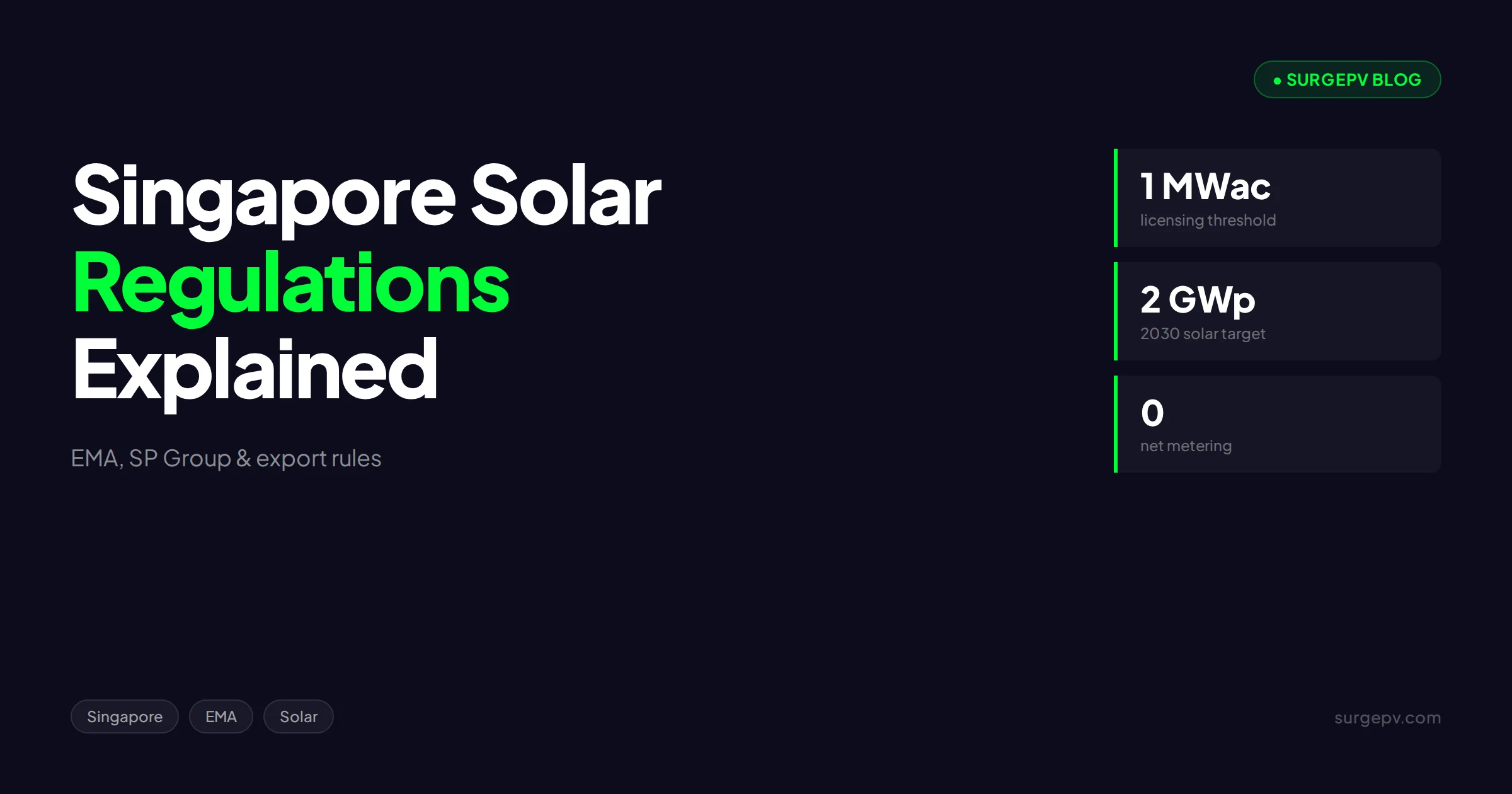
Singapore solar is regulated by the Energy Market Authority (EMA) with grid connection through SP Group. Systems up to 1 MWac connect under a simplified process without a generation licence; larger systems need EMA licensing and market registration. There is no net metering — exports are paid at the wholesale electricity price via SP Services.
Singapore is one of the most regulation-literate solar markets in Asia: small physical area, one transmission and distribution grid, one wholesale market, and a government target of at least 2 GWp of solar by 2030 under the Singapore Green Plan. It is also a market with no net metering and no feed-in tariff — the economics run entirely on self-consumption plus wholesale-priced exports, which makes regulatory literacy a design skill, not a paperwork skill.
This guide covers the framework installers and developers actually operate in: EMA’s licensing thresholds, the SP Group connection process, how export payments work through SP Services and the Enhanced Central Intermediary Scheme, the SolarNova public-sector engine, and the compliance checklist for residential and C&I projects.
Quick Answer
Singapore solar is regulated by the Energy Market Authority (EMA) with grid connection through SP Group. Systems up to 1 MWac connect under a simplified process without a generation licence; larger systems need EMA licensing and market registration. There is no net metering — exports are paid at the wholesale electricity price via SP Services.
TL;DR — Singapore Solar Rules
Regulator: EMA. Grid: SP Group. No net metering or FiT — exports earn the wholesale price (USEP) via SP Services. Licensing threshold: 1 MWac (simplified below, licensed above). Target: 2 GWp by 2030; SolarNova drives HDB rooftops. Design rule: size for daytime self-consumption; treat export revenue as incidental.
In this guide:
- The regulatory map: EMA, SP Group, EMC, HDB
- Licensing thresholds and the 1 MWac line
- The grid connection process step by step
- Export payments: wholesale price, SP Services, and ECIS
- SolarNova and the public-sector market
- C&I economics under wholesale-price exports
- Installer compliance checklist
The Regulatory Map
Four entities govern a solar project in Singapore:
- EMA (Energy Market Authority): the power sector regulator. Sets licensing requirements, connection codes, and market rules. The relevant rules live in the EMA’s solar PV regulatory pages.
- SP Group: the grid company. SP PowerGrid handles physical connection applications; SP Services handles metering, billing, and export payments.
- EMC (Energy Market Company): runs the National Electricity Market of Singapore (NEMS), the wholesale market where larger generators register and trade.
- HDB/EDB: the public-sector deployment engine through SolarNova, aggregating Housing & Development Board rooftops into tendered solar leases.
One grid, one market, one regulator — which makes Singapore procedurally simpler than almost any federal market, provided you respect the thresholds.
Licensing Thresholds and the 1 MWac Line
The key dividing line is 1 MWac:
- 1 MWac and below: no EMA generation licence required; simplified connection process with SP Group. This covers virtually all residential and most C&I rooftop systems.
- Above 1 MWac: a generation licence from EMA is required, plus registration with EMC to participate in the wholesale market, and compliance with the transmission code’s technical requirements for larger embedded generation.
Below the licensing line there is still a submission discipline: a Qualified Person — a Professional Engineer (PE) or registered architect — must endorse the electrical and structural plans. This is Singapore’s equivalent of the engineer-stamped plan set in US permitting, and it applies to grid-connected systems broadly, not just large ones.
The Grid Connection Process
The standard path for a rooftop system:
- Engage a Qualified Person and a licensed electrical worker (LEW) for the installation.
- Submit the connection application to SP Group with single-line diagram, equipment specifications, and system size. SP Group assesses network impact at the connection point.
- Technical review and connection offer. For systems under 1 MWac this is streamlined; larger systems get a fuller network study.
- Installation to code — Singapore’s CP 5 (electrical code) and EMA’s technical requirements for intermittent generation sources.
- Commissioning and meter installation: SP Services installs or configures the bi-directional metering, and the system energizes.
- Export registration: register the export arrangement with SP Services (or via ECIS through an intermediary) so exported energy is measured and paid.
Connection lead times are measured in weeks to a few months for standard rooftop systems — fast by regional standards, but the Qualified Person step should start at design stage, not after procurement.
Export Payments: Wholesale Price, SP Services, and ECIS
This is the section that separates Singapore from net metering markets. Exported solar energy is paid at the wholesale electricity price — the Uniform Singapore Energy Price (USEP), adjusted for applicable charges — not the retail tariff. Wholesale prices have historically run at roughly a third to a half of regulated retail tariffs, varying with gas prices and market conditions.
The settlement paths:
- Direct via SP Services: smaller consumers register to sell excess energy; SP Services meters exports and credits payment at the wholesale rate.
- ECIS (Enhanced Central Intermediary Scheme): solar leasing companies and aggregators register as a central intermediary, consolidating exports from many customer sites into one market settlement arrangement. ECIS is what makes third-party-owned rooftop portfolios administrable in Singapore — without it, every leased roof would need its own market registration.
The design consequence is the same as in every net-billing market: exports are worth a fraction of avoided retail purchases, so the business case is self-consumption. Our net metering installer reference compares this structure with net metering regimes globally.
Pro Tip
In Singapore proposals, present 2 revenue lines separately: avoided retail purchases (the real value) and wholesale export income (the bonus). Blending them into one “savings” number overstates the export value and undermines credibility with C&I finance teams, who will re-run the math.
SolarNova and the Public-Sector Engine
SolarNova, led by HDB with EDB, aggregates government building and public housing rooftops into large tendered solar leasing contracts. It is the single biggest driver of Singapore’s installed capacity — thousands of HDB blocks now carry PV under SolarNova contracts, and the program is the main reason the country crossed 1 GWp of installed solar in the mid-2020s, per EMA deployment data.
For private installers, SolarNova matters in 2 ways. First, it is a tender market: EPCs and leasing consortia bid on aggregated rooftop packages with defined performance terms. Second, it normalizes solar leasing structures — contracts, metering, and ECIS settlement — that the private C&I market then reuses. Winning SolarNova work is a volume game with thin margins; the capability it builds (multi-roof portfolios, standardized O&M) transfers directly to private portfolios.
C&I Economics Under Wholesale-Price Exports
Singapore C&I solar works because commercial retail tariffs — dominated by energy and grid charges — are high enough that self-consumed solar undercuts them comfortably, while the wholesale export price is low enough that exporters barely notice the revenue. The design rules that follow:
- Size to daytime load. Target high self-consumption ratios — 80%+ for daytime-loaded facilities. Factories, cold storage, data centers, malls, and logistics warehouses are the prime segments.
- Interval data is mandatory. Half-hourly consumption data from the customer’s meter determines the self-consumption ratio; design without it is guessing.
- Batteries face a narrow case. With exports at wholesale and retail avoidance as the prize, storage only pencils for peak-management or resilience value, not energy arbitrage — though that calculus improves as storage costs fall.
- Structural diligence matters. Many Singapore C&I roofs are metal-deck factory roofs with limited spare capacity; the structural PE endorsement is a real engineering step, not a stamp.
Accurate yield modeling carries the whole proposal here. A cloud solar design platform with physics-based shadow analysis and a financial engine that separates avoided-retail from wholesale-export value is the difference between a bankable C&I proposal and an optimistic sketch.
Quote Singapore C&I on Real Self-Consumption Numbers
SurgePV models half-hourly production against your customer’s load data — avoided retail and wholesale exports priced separately, automatically.
Book a DemoNo commitment required · 20 minutes · Live project walkthrough
Installer Compliance Checklist
Before committing to a Singapore project:
- Confirm system size against the 1 MWac licensing threshold and plan the EMC registration early if above it.
- Engage the Qualified Person (PE/architect) at design stage for electrical and structural endorsement.
- Verify inverters meet EMA’s technical requirements for intermittent generation sources.
- Register the export arrangement with SP Services — or route through an ECIS intermediary for leased portfolios.
- Pull half-hourly load data before sizing any C&I system.
- For landed residential, confirm URA/BCA requirements where the installation affects the building envelope.
Residential and Landed Housing: The Small Segment
Landed housing is Singapore’s only residential rooftop segment — high-rise HDB and condo residents cannot install private systems on shared roofs, which is precisely why SolarNova exists. For landed owners, the economics are honest but modest: retail tariffs are regulated and comparatively low by regional standards, exports earn wholesale prices, and paybacks typically land in the 7–10 year range.
The customers who buy anyway share a profile: high daytime consumption (home offices, pools, EV charging), sustainability motivation, and long tenure in the property. EV charging is the load that is quietly improving residential solar economics — a home charger soaking up midday solar converts wholesale-priced surplus into avoided retail purchases. Size residential systems against the daytime-plus-EV load, and be direct about the export rate in the proposal.
Green Mark, Disclosure, and the Corporate Demand Driver
Beyond bill savings, 2 policy currents pull C&I solar forward. BCA’s Green Mark building certification scheme credits on-site renewable generation, which matters for developers and REITs seeking certification or upgrading existing ratings. And Singapore Exchange-listed companies face mandatory climate reporting, which makes behind-the-meter solar a measurable scope 2 emissions reduction with a visible roof to point at.
For installers, this changes the buyer: the decision-maker is increasingly a sustainability or facilities director with a reporting deadline, not just a CFO running payback math. Proposals that include estimated annual CO2 avoidance — computed from EMA’s published grid emission factor — speak to that buyer directly. It costs nothing extra to model and frequently unblocks budget approvals that pure payback math cannot.
What Most Installers Get Wrong
The classic mistake is importing net metering math into a wholesale-export market. Proposals that value exports at retail overstate 25-year returns materially — and Singapore’s C&I buyers are financially literate enough to catch it in diligence.
Second: treating the Qualified Person step as a formality. PE endorsements for structure and electrical safety are substantive engineering reviews; scheduling them after installation planning causes redesign loops.
Third: ignoring aggregation. For leasing players, registering sites individually instead of through ECIS creates an administrative load that scales linearly with portfolio size. The nuance: ECIS consolidates settlement, not engineering — each site still needs its own compliant design and metering.
Conclusion
Singapore rewards installers who design for self-consumption and respect its thresholds. Three actions this week:
- Rebuild your proposal template to separate avoided-retail savings from wholesale export income.
- Add the 1 MWac threshold and Qualified Person engagement to your project intake checklist.
- If you run a leasing portfolio, review your ECIS setup before your next 10 sites, not after.
To model self-consumption and split-value financials in one workspace, book a SurgePV demo. For the global policy context, see our net metering installer reference and UAE solar regulations guides.
Frequently Asked Questions
Who regulates solar energy in Singapore?
The Energy Market Authority (EMA) regulates the power sector, including solar generation and licensing. SP Group (through SP PowerGrid and SP Services) operates the grid and handles connection applications, metering, and export payments. HDB and EDB drive public-sector deployment through the SolarNova program.
Is there net metering in Singapore?
No. Singapore has no net metering or feed-in tariff. Solar owners who export to the grid are paid the wholesale electricity price (the Uniform Singapore Energy Price, adjusted for charges) through SP Services. Because wholesale prices are far below retail tariffs, self-consumption drives project economics.
Do I need a licence to install solar in Singapore?
Small systems do not need an EMA generation licence. Generation units of 1 MWac and below are generally exempt from licensing, and connecting at 1 MWac or below follows a simplified grid connection process with SP Group. Larger systems require a generation licence and registration with the Energy Market Company to sell into the wholesale market.
How do I sell excess solar power in Singapore?
Register with SP Services as an intermittent generation source consumer or under the applicable scheme for your consumer type. Exports are then metered and paid at the wholesale price. Solar leasing companies typically register under the Enhanced Central Intermediary Scheme (ECIS), which consolidates exports from multiple sites through a central intermediary.
What is Singapore’s solar target?
Singapore targets at least 2 GWp of solar capacity by 2030 — enough to meet roughly 3% of projected electricity demand — as part of the Singapore Green Plan 2030. Deployment is driven by HDB’s SolarNova program on public housing rooftops and by C&I rooftops, with over 1 GWp installed by the mid-2020s according to EMA.
Can landed homeowners install solar in Singapore?
Yes. Landed homeowners can install solar through a Qualified Person (a Professional Engineer or registered architect) who submits plans to SP Group and handles EMA requirements. Systems follow the same export-at-wholesale structure, so residential systems are sized for daytime self-consumption rather than export.
Where this fits
This article is part of SurgePV's Solar Incentives & Policy hub, which works through the topic from first principles to the decisions a project team actually has to make.

