

Back to Blog
solar roi 15 min read

Pv case price 2026: Cost, ROI and Financing Guide

PVcase price in 2026 starts around $990/user/year, but mandatory AutoCAD adds $2,000/year. See full TCO, ROI benchmarks, and financing options.

Akash Hirpara

Written by

Akash Hirpara

Co-Founder · SurgePV

Rainer Neumann

Edited by

Rainer Neumann

Content Head · SurgePV

Published ·Updated

Quick Answer

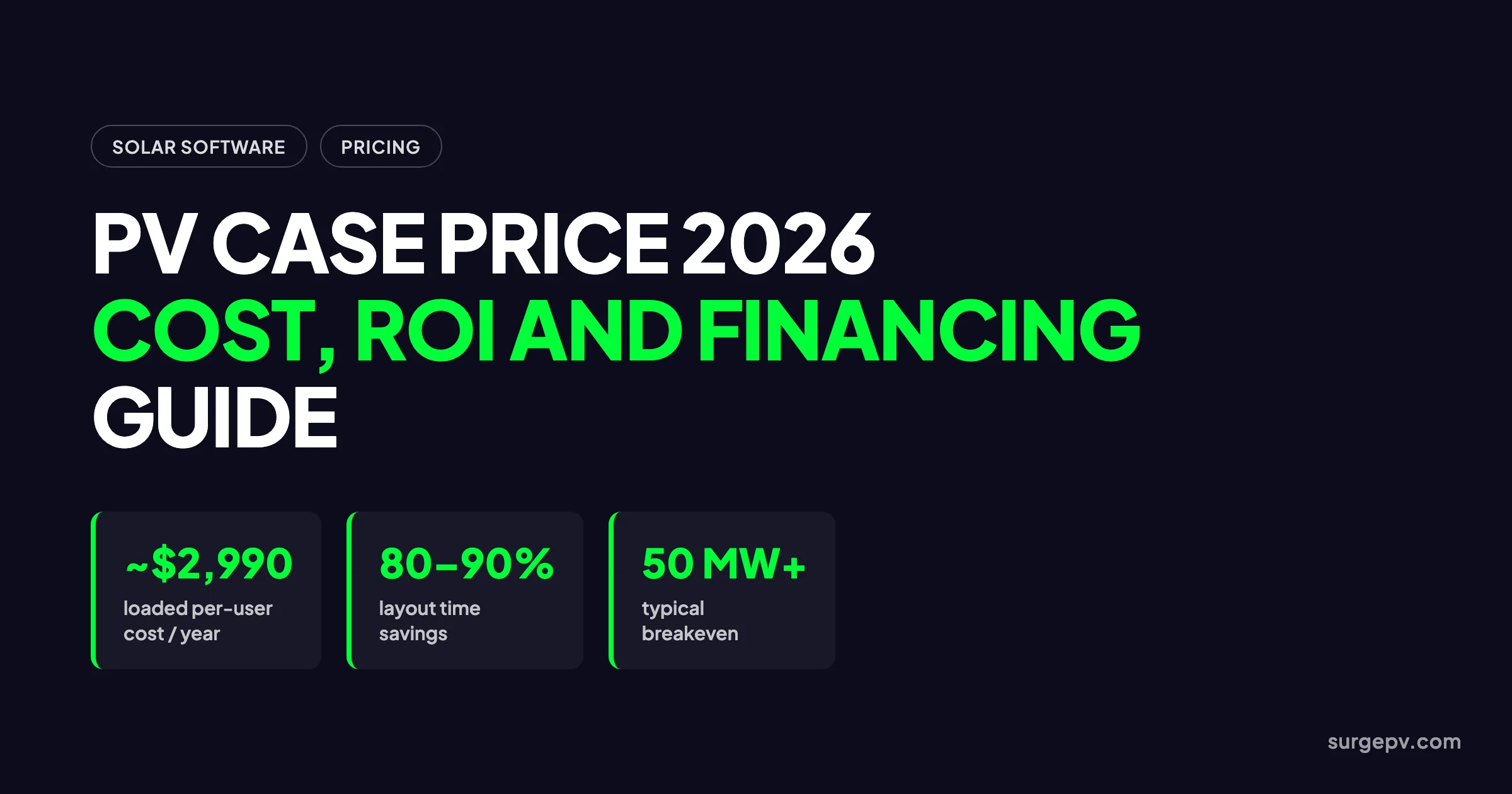
PVcase pricing in 2026 is custom-quote only. The software license is estimated at $990 per user per year, while mandatory AutoCAD/Civil 3D adds approximately $2,000 per user per year. Total first-year cost per designer is roughly $2,990–$4,500 including hardware and onboarding. PVcase pays back fastest for teams designing 10 MW+ ground-mount projects.

Utility-scale solar design software is no longer optional. Global solar PV capacity crossed 2.25 TW by the end of 2024, according to the IEA-PVPS Snapshot 2025. In 2026, developers and EPCs bidding on 10 MW, 50 MW, or 200 MW ground-mount projects need layouts, terrain analysis, and yield models fast. Manual CAD work cannot keep pace. PVcase has become the most referenced name in that category. But the first question every finance team asks is the same: what is the real PV case price?

The headline number is only the start. PVcase does not publish a price list. The visible cost is a negotiated software license. The hidden cost is the Autodesk stack underneath it. AutoCAD or Civil 3D seats, Windows workstations, onboarding time, and often a separate proposal tool all add up. For a five-person design team, the annual tab can range from $15,000 to well over $60,000.

This guide breaks down PVcase pricing in 2026. It calculates ROI for different team sizes and project scales. It explains how to finance or reduce the upfront burden. It also compares PVcase against the most common alternatives. That comparison helps you decide whether the premium is justified for your pipeline.

Quick Answer

PVcase pricing in 2026 is custom-quote only. The software license is estimated at $990 per user per year, while mandatory AutoCAD/Civil 3D adds approximately $2,000 per user per year. Total first-year cost per designer is roughly $2,990–$4,500 including hardware and onboarding. PVcase pays back fastest for teams designing 10 MW+ ground-mount projects.

In this guide:

  • What PVcase is and who actually pays for it
  • Why PVcase does not publish pricing
  • PVcase price 2026: license, AutoCAD, and hidden costs
  • Total cost of ownership for one user and a five-person team
  • PVcase ROI by project scale and designer utilization
  • Financing options and how to reduce upfront cash outlay
  • PVcase vs. alternatives on price and value
  • The most common pricing mistake buyers make
  • How to request and compare a PVcase quote
  • Frequently asked questions

What Is PVcase and Who Pays for It?

PVcase is a solar development platform built for utility-scale and large commercial projects. Founded in 2017 in Vilnius, Lithuania, it now serves more than 1,800 customers across 80+ countries. The company reports that its platform processes an estimated 4 TW of project designs annually. That data appears on the PVcase website and in G2 reviews.

The product suite has four modules:

  • PVcase Prospect — cloud-based site selection and parcel screening
  • PVcase Ground Mount — AutoCAD plugin for utility-scale ground-mount layout
  • PVcase Roof Mount — AutoCAD plugin for commercial rooftop design
  • PVcase Yield — energy modeling and bankable yield simulation

Prospect and Yield run in the cloud. Ground Mount and Roof Mount run inside AutoCAD or Civil 3D. That split is the single biggest driver of PVcase cost. You are buying into the Autodesk ecosystem.

The buyers are typically:

  • Utility-scale developers and independent power producers
  • Large EPCs with dedicated design engineering teams
  • Engineering consultancies producing construction-ready drawings
  • C&I firms that also develop ground-mount solar parks

If your pipeline is mostly residential rooftops or small commercial systems, PVcase is the wrong tool. The unit economics only work when project sizes create enough design-hour savings to cover the license stack. For smaller installers, an all-in-one platform such as SurgePV’s solar design software is usually the better financial fit.


Why PVcase Does Not Publish Pricing

PVcase follows an enterprise sales model. The company requires a custom quote for every account. That approach is common in utility-scale software. It lets the vendor price by value, project volume, and team size rather than by a fixed per-seat rate.

The downside for buyers is uncertainty. A two-person EPC gets the same “contact sales” button as a 200-person developer. The quote process can take one to three weeks. It often involves discovery calls, demo sessions, and procurement review. For teams that need a quick answer, that friction alone can push them toward competitors with published pricing.

The upside is flexibility. Large enterprise customers can negotiate multi-year deals, bundle modules, and lock in volume discounts. Teams already using AutoCAD may find the incremental PVcase cost lower than switching to a fully cloud-based platform.

Transparency is improving slowly across the industry. Some PVcase alternatives now publish list prices online. SurgePV, Aurora Solar, and HelioScope all show pricing tiers. PVcase has not followed that path. Buyers should plan for a sales-led quote process and build a buffer into their budget until the final number arrives.


PVcase Modules: What Each One Costs

PVcase is sold as a modular platform. You can buy individual modules or the full suite. Each module adds to the license cost. Understanding the modules helps you avoid paying for features you will not use.

PVcase Prospect

Prospect is the cloud-based site selection tool. PVcase acquired it from Anderson Optimization in 2023. It screens parcels for solar suitability using GIS data, zoning information, LMP pricing, and interconnection data. Prospect runs in the browser and does not require AutoCAD. It is useful for developers evaluating many sites at once.

Prospect pricing is usually bundled with Ground Mount or sold as an enterprise add-on. Smaller teams can sometimes replace Prospect with free GIS layers from state or national geoportals. If your workflow starts with land acquisition rather than engineering, Prospect adds clear value.

PVcase Ground Mount

Ground Mount is the flagship module. It automates panel placement, stringing, cable routing, and terrain-following tracker layouts inside AutoCAD. It also generates pile plans and civil grading analysis. This is the module most buyers think of when they ask about PVcase price.

Ground Mount requires AutoCAD or Civil 3D. It also needs the highest workstation specs. For utility-scale teams, it is the core justification for the entire license. Without Ground Mount, most buyers would not consider PVcase at all.

PVcase Roof Mount

Roof Mount handles commercial and industrial rooftop layouts. It also runs inside AutoCAD. It is less commonly discussed than Ground Mount but fills the C&I gap for teams already using PVcase for utility work.

If your pipeline is mostly flat commercial roofs, Roof Mount adds value. If you do only ground-mount projects, skip it. The savings can be $200–$400 per user per year depending on the bundle.

PVcase Yield

Yield is the energy modeling module. It uses ray tracing and 8760-hour simulation. Its bifacial modeling has been validated by Imec and EnergyVille. Yield can reduce the need for PVsyst on many projects, though some lenders above 50 MW still prefer native PVsyst reports.

Yield is often sold as an add-on or bundled with Ground Mount. Teams that already own PVsyst may not need Yield immediately. Teams that want an integrated design-to-yield workflow will find it valuable.


PVcase Price 2026: License, AutoCAD, and Hidden Costs

PVcase does not publish public pricing. Every plan is custom-quoted through the sales team. Based on verified user reports, G2/Capterra data, and competitive intelligence gathered across sister-brand engineering teams, the 2026 cost structure looks like this.

Base Software License

The PVcase software license itself is estimated at approximately $990 per user per year. This figure is not from PVcase directly. It is an industry-observed estimate compiled from reseller quotes and user reports. Actual quotes vary by region, team size, and module mix.

Some enterprise contracts reportedly start closer to $18,000–$25,000 per year for multi-seat teams or bundled modules. This is especially true when Prospect, Ground Mount, Roof Mount, and Yield are purchased together. Volume discounts are common for teams above five seats and for multi-year commitments.

Mandatory AutoCAD or Civil 3D

This is the cost most first-time buyers underestimate. PVcase Ground Mount and Roof Mount are native AutoCAD plugins. You cannot use them without an active Autodesk subscription.

Cost ComponentEstimated Annual CostNotes
PVcase software license~$990/user/yrCustom quote; varies by modules
AutoCAD license~$1,800–$2,000/user/yrMandatory for Ground/Roof Mount
Civil 3D license~$2,400–$2,700/user/yrRequired for advanced terrain grading
High-end workstationOne-time $1,500–$3,000Windows, discrete GPU, 12 GB+ RAM
Onboarding time$2,500–$6,000 equivalent6–8 weeks at loaded designer cost

The workstation requirement is real. PVcase needs Windows 10 or later, a 3.0 GHz CPU, 12 GB RAM, and a 4 GB GPU. It also does not support virtual machines. If your team runs Macs or Linux, you need separate Windows hardware. Current AutoCAD pricing confirms the annual seat cost lands in the $1,800–$2,000 range for commercial use.

Add-On Tools PVcase Does Not Include

PVcase is a design and engineering tool. It does not generate customer proposals, financial models, or CRM pipelines. Most teams end up adding:

  • A proposal tool such as OpenSolar, Solargraf, or an integrated platform
  • Financial modeling software or Excel-based models
  • PVsyst for final bankable yield validation on large projects
  • A project management tool for post-design workflow

Those costs can add another $1,000–$3,000 per user per year. If your team needs solar proposal software, that line item alone can exceed $1,200 per user annually.

Training and Onboarding

PVcase Ground Mount is not a tool you learn in an afternoon. Most engineers need 6–8 weeks before they produce construction-ready layouts independently. During that period, productivity is reduced. The loaded cost of a senior designer is roughly $75–$100 per hour. Six weeks of partial productivity can add $2,500–$6,000 per hire.

PVcase offers PVcase Academy for self-paced learning. G2 users rate the academy highly, but it does not eliminate the need for hands-on project practice. Budget both the license cost and the productivity dip during onboarding.


Total Cost of Ownership: One User vs. a Five-Person Team

To understand whether PVcase is affordable, look at total cost of ownership (TCO), not the software license alone. TCO includes the subscription, the required Autodesk seat, hardware, onboarding, and any companion tools.

Single-User TCO (Year One)

Line ItemLow EstimateHigh Estimate
PVcase license$990$1,500
AutoCAD license$1,800$2,000
Workstation (amortized)$500$750
Onboarding labor cost$2,500$4,000
Proposal/financial tool$600$1,200
Year-one total$6,390$9,450

Five-Person Design Team TCO (Annual)

Line ItemLow EstimateHigh Estimate
PVcase licenses (5 seats)$4,950$12,500
AutoCAD/Civil 3D licenses (5 seats)$9,000$13,500
Workstations and IT support$2,500$5,000
Onboarding and training$5,000$10,000
Proposal, CRM, and financial tools$3,000$8,000
Annual team total$24,450$49,000

Enterprise teams with 10+ designers often negotiate lower per-seat rates. Even so, a fully loaded PVcase team can easily exceed $50,000 per year. That is why finance teams often compare it against alternatives that bundle design, simulation, and proposals under one license.

Regional Pricing Differences

PVcase quotes vary by region. North American and Western European buyers often see higher list prices due to local support and implementation services. Buyers in India, Southeast Asia, and Latin America may receive regional discounts, though reseller markups can offset part of the savings.

Currency also matters. Quotes in EUR may differ from USD quotes once exchange-rate hedging and local taxes are applied. Indian buyers should also factor GST and importer margins on Autodesk products. Always ask for a quote in your local currency with taxes itemized.

For example, SurgePV pricing starts at $1,499 per user per year. It includes design, 8,760-hour shading, single-line diagrams, and branded proposals. A five-person SurgePV team lands at roughly $6,500–$12,500 per year all-in, depending on the plan.


PVcase ROI: When the Price Pays Back

The financial case for PVcase rests on labor savings and project throughput. If a designer spends fewer hours per MW, the license cost is recovered through reduced staffing or faster project delivery.

Time Savings Benchmarks

Verified G2 users report the following design-time reductions:

  • Ground Mount layout: 80–90% faster than manual AutoCAD work
  • Roof Mount layout: 60–70% faster than manual drafting
  • Site assessment: Prospect cuts parcel screening from weeks to roughly 20 minutes

On a 50 MW ground-mount project, a designer might spend 80–120 hours on layout, grading, and stringing manually. With PVcase, that drops to 10–20 hours. At a loaded designer cost of $75 per hour, the savings are $5,250–$7,500 per project.

ROI by Project Scale

Annual PipelineEstimated Design-Hour SavingsAnnual Labor Value SavedPVcase TCO (5 seats)Net ROI
10 MW100–150 hours$7,500–$11,250$24,000–$49,000Negative
50 MW500–800 hours$37,500–$60,000$24,000–$49,000Marginal to positive
100 MW1,000–1,500 hours$75,000–$112,500$24,000–$49,000Strong
200 MW+2,000+ hours$150,000+$24,000–$49,000Very strong

The breakeven point for most five-person teams is around 50–75 MW per year of ground-mount or large C&I pipeline. Below that, the fixed license cost is hard to justify. The exception is when the team is already AutoCAD-locked and the incremental PVcase cost is small.

What Most Buyers Get Wrong About ROI

The common mistake is comparing the PVcase license fee to a competitor’s subscription fee. The real comparison is the fully loaded cost per finished MW. That includes:

  • License and AutoCAD fees
  • Designer hours per MW
  • Revision cycles and rework
  • Time spent exporting to PVsyst or preparing construction docs
  • Sales delay if proposals are produced separately

A cheaper tool that requires 30% more designer hours per MW can be more expensive than PVcase at scale. Conversely, an expensive tool that automates proposals and electrical docs can save money across the full project lifecycle.


Financing PVcase and Reducing Upfront Cash

PVcase is not sold as a capital asset, so traditional equipment financing does not apply. However, there are several ways to manage the cash flow impact.

Annual Subscription with Negotiated Payment Terms

Most PVcase contracts are annual subscriptions paid upfront or quarterly. Larger teams can negotiate quarterly or semi-annual billing. Multi-year commitments typically unlock 10–20% discounts.

Expense It as Operating Cost

Software subscriptions are operating expenses (OpEx), not capital expenses (CapEx). That means faster tax deduction and no depreciation schedule. For most solar businesses, this improves cash-flow treatment compared to buying design workstations outright.

In the United States, software subscription costs are generally deductible in the year incurred under Section 162. In India, software subscriptions are typically treated as revenue expenditure if they are annual and non-exclusive. Always confirm treatment with your tax advisor, especially for multi-year contracts that may need amortization.

Start with a Smaller Module Set

If budget is tight, start with Ground Mount only. Add Roof Mount or Yield once the pipeline justifies it. Prospect can sometimes be replaced by free GIS tools in early-stage development.

Use the Free Trial to Validate Value

PVcase offers a 2-week free trial. Run a real project through it. Measure layout time, revision time, and export quality. If the savings do not exceed the annual cost within the trial scope, the tool is not a fit.

Consider Bundled Alternatives

If the upfront stack feels heavy, evaluate platforms that bundle design, simulation, and proposals. SurgePV’s generation and financial tool, for example, includes P50/P75/P90 yield reports and financial modeling. It does not require separate AutoCAD or proposal software. For teams mixing residential, C&I, and small utility work, that consolidation often lowers TCO.


PVcase vs. Alternatives: Price and Value Comparison

No tool is right for every pipeline. The table below compares PVcase against its most common alternatives on price, project fit, and workflow coverage.

PlatformAnnual Cost per UserAutoCAD Required?Best ForKey Limitation
PVcase$990 + AutoCAD ($2,990 loaded)YesUtility-scale ground mountNo proposals, no native financials
SurgePVFrom $1,299–$1,899NoResidential to mid-scale utilityLess deep terrain grading than PVcase
RatedPower$30,000+ enterpriseNoLarge utility feasibilityExpensive for teams under 100 MW/year
HelioScope$1,200–$2,400NoCommercial rooftop and C&I15 MW project cap
PVsyst~€500–€700NoBankable yield validationSimulation only; no design UI

PVcase wins on deep AutoCAD-native utility-scale engineering. It loses on total workflow coverage because it requires companion tools for proposals and financials. RatedPower wins on automated feasibility but at a much higher price point. SurgePV wins on price-per-finished-project for teams that span residential, C&I, and small utility work.

For a direct head-to-head, see our SurgePV vs PVcase comparison and the full PVcase review.


When PVcase Is Worth the Price — and When It Is Not

Buy PVcase When

  • Your team already owns AutoCAD or Civil 3D seats
  • Your pipeline is 50+ MW per year of ground-mount or tracker projects
  • Terrain grading, pile plans, and civil integration are critical
  • Your clients or lenders accept PVcase-native deliverables
  • You have CAD-trained designers who can onboard in 6–8 weeks

Skip PVcase When

  • Most of your projects are residential or under 1 MW
  • You need integrated proposals and financial modeling
  • Your designers work on Macs or prefer browser-based tools
  • You want transparent, published pricing without a sales cycle
  • A $25,000+ annual software stack is hard to defend

For teams in the “skip” category, SurgePV for solar installers often covers the same design-to-proposal workflow at a lower total cost. See also our broader solar software buyer’s guide for a full category map.


How to Request and Compare a PVcase Quote

Because PVcase does not publish pricing, the quote process matters. Here is how to get an accurate number and avoid surprises.

1. Define Your Module Mix

Decide whether you need Prospect, Ground Mount, Roof Mount, Yield, or the full bundle. Each module changes the price. Teams doing only ground-mount work should not pay for Roof Mount.

2. Count AutoCAD Seats Accurately

Ground Mount and Roof Mount each need a dedicated AutoCAD or Civil 3D seat. Do not assume shared logins will work. PVcase licenses are tied to physical Windows installations and validated online.

3. Ask for Itemized Pricing

Request a quote that breaks out:

  • PVcase software license per user
  • Support and maintenance tier
  • Training and onboarding package
  • Multi-year discount
  • Any minimum seat count or project volume commitment

4. Model the Full First Year

Add AutoCAD, hardware, onboarding labor, and companion tools. The first-year cost is often 2–3x the PVcase license alone.

5. Benchmark Against Two Alternatives

Run the same project through PVcase, SurgePV, and either RatedPower or HelioScope. Measure time to final layout, quality of exports, and whether you still need PVsyst for bankable yield.

6. Negotiate Payment Terms

Ask for quarterly billing or a pilot clause. If the vendor will not offer flexibility, that is a signal that the contract may be rigid on support and renewal terms too.


Frequently Asked Questions

How much does PVcase cost in 2026?

PVcase uses custom enterprise pricing. Industry estimates place the software license at approximately $990 per user per year. However, the Ground Mount and Roof Mount modules run as AutoCAD plugins, so most teams also need an AutoCAD or Civil 3D license at roughly $2,000 per year. Combined first-year cost per designer is typically $2,990–$4,500 once hardware and onboarding are included.

Is there a free trial for PVcase?

Yes. PVcase offers a 2-week free trial on request through its sales team. Educational licenses are free for qualifying students and educators. The trial requires a Windows workstation, an AutoCAD-compatible environment, and approval from PVcase sales.

Does PVcase pricing include AutoCAD?

No. PVcase Ground Mount and Roof Mount are native AutoCAD or Civil 3D plugins. AutoCAD is a mandatory separate purchase. Budget approximately $1,800–$2,500 per user per year for AutoCAD or Civil 3D, plus a high-spec Windows workstation.

What is the ROI of PVcase for a solar design team?

PVcase ROI is strongest for utility-scale teams designing 10 MW+ ground-mount projects. G2 users report 80–90% layout time savings on large sites. A designer billing $75 per hour who saves 15 hours per month recovers roughly $13,500 in labor value annually, well above the estimated $2,990 per-user cost. Smaller residential or C&I teams see weaker payback because project sizes do not generate enough design-hour savings.

Can PVcase be financed or leased?

PVcase is sold as an annual or multi-year software subscription, not as a capital lease. Most buyers expense it as an operating cost. Some enterprise customers negotiate multi-year contracts with annual payment terms. If upfront cash is tight, solar SaaS buyers often evaluate cloud alternatives such as SurgePV with published monthly or annual plans.

What hidden costs should I budget for with PVcase?

Hidden costs include the AutoCAD or Civil 3D seat, a Windows workstation with a discrete GPU, 6–8 weeks of onboarding time, separate tools for proposals and financial modeling, and annual maintenance or support tiers. Teams also often need PVsyst for final bankable yield validation on projects above 50 MW.

How does PVcase price compare to RatedPower and HelioScope?

PVcase is generally cheaper than RatedPower, which often quotes enterprise contracts above $30,000 per year. HelioScope starts at roughly $1,200–$2,400 per user per year and is browser-based, so it does not require AutoCAD. However, HelioScope has a 15 MW project cap and weaker ground-mount depth. PVcase sits between the two on price but requires the AutoCAD ecosystem.

Should a small EPC buy PVcase?

Usually no. PVcase is built for utility-scale and large C&I projects. A small EPC doing mostly residential or projects under 1 MW will struggle to recover the license, AutoCAD, and training costs. Cloud platforms such as SurgePV cover residential through mid-scale commercial at a lower total cost of ownership.


Bottom Line

PVcase is a premium tool with a premium loaded cost. The software license is only one line item. The real PVcase price in 2026 includes AutoCAD, hardware, onboarding, and the companion tools needed to complete the workflow.

For teams designing 50 MW+ of ground-mount solar per year, PVcase is usually worth it. The design-time savings recover the cost within one or two projects. For teams below that scale, or for firms mixing residential and commercial work, the Autodesk dependency and lack of integrated proposals make the TCO hard to defend.

Before signing, model the fully loaded cost. Run the free trial on a real project. Benchmark against at least one cloud-based alternative.

Compare Your True Software Cost

SurgePV bundles design, simulation, proposals, and electrical engineering in one cloud platform with published pricing. See how it stacks up against PVcase for your pipeline.

Book a Demo

20 minutes · Live project walkthrough · No credit card required


Sources and methodology: Pricing estimates are compiled from publicly available G2 and Capterra listings, verified user reports, reseller quotes, and PVcase official documentation as of June 2026. Actual quotes vary by region, team size, and module configuration. Always request a current itemized quote from PVcase sales before budgeting.

About the Contributors

Author
Akash Hirpara
Akash Hirpara

Co-Founder · SurgePV

Akash Hirpara is Co-Founder of SurgePV and at Heaven Green Energy Limited, managing finances for a company with 1+ GW in delivered solar projects. With 12+ years in renewable energy finance and strategic planning, he has structured $100M+ in solar project financing and improved EBITDA margins from 12% to 18%.

Editor
Rainer Neumann
Rainer Neumann

Content Head · SurgePV

Rainer Neumann is Content Head at SurgePV and a solar PV engineer with 10+ years of experience designing commercial and utility-scale systems across Europe and MENA. He has delivered 500+ installations, tested 15+ solar design software platforms firsthand, and specialises in shading analysis, string sizing, and international electrical code compliance.

Get Solar Design Tips in Your Inbox

Join 2,000+ solar professionals. One email per week - no spam.

No spam · Unsubscribe anytime

Book Free Demo