

Quick Answer
Start a solar EPC by securing contractor and electrical licenses, $50K–$150K of working capital, 2–3 supplier accounts, and one certified designer — then win first contracts through subcontracting for established EPCs or small C&I direct bids. EPCs differ from installers: they carry single-point responsibility for design, procurement, and construction.
Starting a solar company and starting a solar EPC are different ambitions. An installer builds what others design. An EPC signs a contract that says: we engineer it, we buy it, we build it, and if it underperforms or runs late, that is our problem. Single-point responsibility is what customers pay EPC margins for — and it is what sinks new EPCs that underestimate it.
We built an EPC from zero to over a gigawatt delivered, so this guide is the version we wish someone had handed us: what makes an EPC different, the licenses and capital you actually need, the team sequence, the working capital math nobody warns you about, and how to win the first 10 contracts without dying trying. For the general company-formation checklist (entity, EIN, NABCEP, insurance detail), our how to start a solar company guide covers it step by step — this post focuses on what the EPC model adds.
Quick Answer
Start a solar EPC by securing contractor and electrical licenses, $50K–$150K of working capital, 2–3 supplier accounts, and one certified designer — then win first contracts through subcontracting for established EPCs or small C&I direct bids. EPCs differ from installers: they carry single-point responsibility for design, procurement, and construction.
TL;DR — Starting a Solar EPC
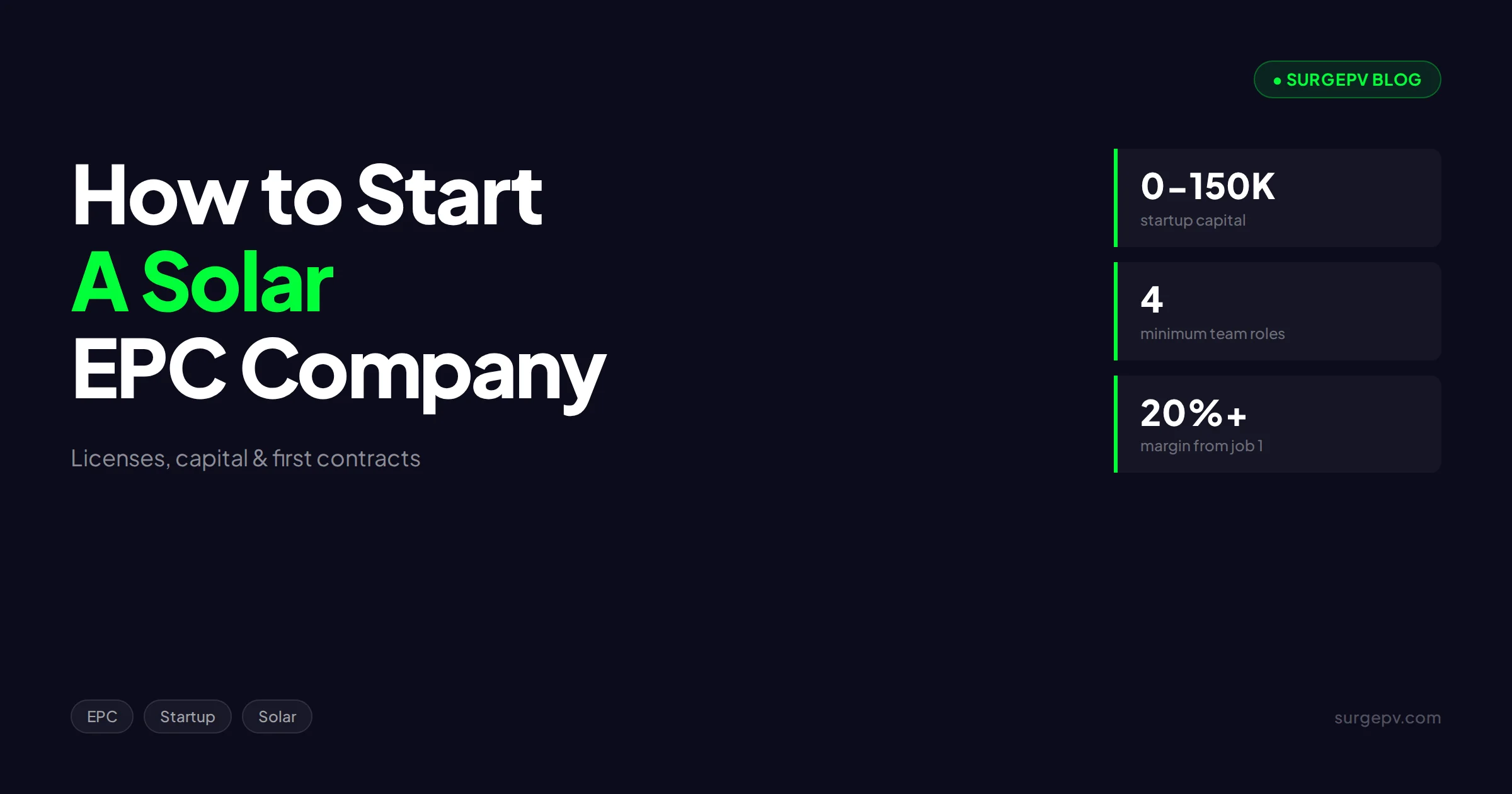
Budget $50K–$150K to first revenue. Licenses: contractor + electrical + insurance. Minimum team: designer, licensed electrician, crew, salesperson. Win first work by subcontracting for established EPCs. Manage the 3 EPC-specific risks: procurement working capital, design liability, and milestone cash timing. Hold 20%+ gross margin from job one.
In this guide:
- What the EPC model actually commits you to
- Licenses, insurance, and entity setup
- Working capital: the number that decides survival
- The minimum viable team and hiring sequence
- Supplier setup and procurement discipline
- Winning the first 10 contracts
- Pricing and margin from job one
- The first-year milestones
What the EPC Model Actually Commits You To
The EPC contract bundles 3 responsibilities that installers often carry separately:
- Engineering. Your design, your liability. A production shortfall from a shading error or a string sizing mistake is your warranty problem, not a subcontractor’s. Design capability is not a department in an EPC — it is the product.
- Procurement. You buy the equipment, which means you carry price risk between contract and delivery, and you carry the working capital to pay suppliers before customers finish paying you.
- Construction. Schedule, safety, quality, commissioning — plus the liquidated damages clause in C&I contracts when the schedule slips.
The margin for carrying all 3 is real: EPCs price 10–25% above install-only subcontractors on the same scope. The risk is equally real, and it concentrates in working capital and design liability. Both are manageable — if you plan for them before the first contract, not after.
Licenses, Insurance, and Entity Setup
The EPC-specific licensing picture (general formation steps are in the company startup guide):
- Contractor license in your state/jurisdiction — general or solar specialty, depending on the state.
- Electrical contractor license or a licensed electrician of record. In most US states and many countries, the EPC must hold or employ the electrical qualifier; subcontracting the qualifier creates liability gaps in EPC contracts.
- Insurance: general liability ($1M–$2M), workers’ compensation, commercial auto, and — for EPCs — professional liability (errors and omissions) covering design work. C&I contracts routinely require certificates before award; budget $8K–$20K/year at startup scale.
- Bonding capacity if you plan to bid public or larger C&I work. Surety underwriting takes weeks and requires clean financials — start the relationship early.
Working Capital: The Number That Decides Survival
Here is the math that kills new EPCs. On a typical project:
- Equipment suppliers want payment in 15–30 days (or deposits at order for a new account).
- Crews are paid weekly.
- Customers pay in milestones: deposit, delivery, install complete, PTO — stretching 45–120 days, longer on C&I with retainage (5–10% held until final acceptance).
Every growing month, the gap between what you have paid out and what you have collected widens. Rule of thumb: hold working capital equal to 2–3 months of your planned job costs. At 10 residential jobs a month at $12K cost each, that is $240K–$360K of revolving need — which is why new EPCs should start smaller than their ambition: 3–5 jobs a month while supplier terms and collections processes mature.
Three levers shrink the gap: deposit discipline (10–20% at signing, always), milestone billing written into every contract, and supplier terms negotiated on committed volume once you have 2 quarters of history. The full cash playbook is in our solar EPC guide.
The Minimum Viable Team
Four roles, in hiring order:
- Designer/engineer — can be the founder, but must be excellent. The EPC’s design quality is its liability shield and its sales asset. Arm them with a cloud design platform that handles 3D modeling, solar shading analysis, and financials in one workspace; a lone designer with good tooling out-produces a 3-person team on desktop CAD.
- Licensed electrician — employed or contracted as your qualifier of record.
- Install crew — your own 3-person crew, or a vetted subcontract crew under your QA. Own crew gives quality control; subcontract gives flexibility. Many EPCs run one owned crew plus subs for peaks.
- Salesperson — can be the founder early. Sales and design are the 2 roles that must be in-house from day one; everything else can be subcontracted temporarily.
The hiring guide for solar EPCs covers role definitions, pay benchmarks, and interview scorecards for each seat.
Supplier Setup and Procurement Discipline
Open accounts with 2–3 distributors before your first signed job. New EPCs typically start on prepay or small credit lines; terms come with history. The procurement rules from day one:
- Standardize the BOM — 2 module SKUs, 2 inverter families. Every extra SKU is inventory risk and design exceptions.
- Quote validity — customer quotes valid 30 days, with equipment re-verified at signing.
- Never buy before deposit — equipment orders trigger on the customer deposit, never on verbal commitment.
Winning the First 10 Contracts
Three paths, in the order we recommend:
1. Subcontract for established EPCs. Install-only work for a larger EPC or developer: immediate revenue, real project experience, reference projects, and no sales cost. The margin is thin, but you are being paid to build a track record.
2. Partner with developers. Many developers originate pipeline but lack construction capability. Being their EPC of record converts their pipeline into your revenue — negotiate design responsibility carefully, because you carry the liability.
3. Direct small C&I and residential. Your own brand, your own margin — and your own sales cost. Start where you have unfair advantage: your local market, your trade relationships, your community.
A pattern that works well: subcontract revenue pays the bills for 6–12 months while direct pipeline builds. Transition ratios deliberately — a common trap is becoming a permanent subcontractor because direct sales never got the founder’s time.
Pricing and Margin From Job One
New EPCs underprice to “buy market share,” and it works — they buy a market of unprofitable customers. Price at 20%+ gross margin from the first job:
- Your cost build must include design hours, procurement carrying cost, warranty reserve, and overhead — not just panels and labor. The full method is in how to price solar jobs.
- Subcontract rates are install-only rates; do not confuse them with EPC pricing.
- Walk from jobs below the floor. An empty week costs less than a negative-margin project.
Design Like an Established EPC From Day One
SurgePV gives a 1-person design function the output of a full engineering team: 3D design, shading, financials, and proposals in one cloud workspace.
Book a DemoNo commitment required · 20 minutes · Live project walkthrough
First-Year Milestones
A realistic first-year sequence:
- Months 1–3: licenses, insurance, supplier accounts, tooling, first subcontract jobs.
- Months 4–6: first 3–5 direct jobs; job costing live; first design QA checklist in use.
- Months 7–9: supplier terms negotiated; milestone billing standardized; monthly break-even in sight.
- Months 10–12: 8–15 jobs/month rhythm, documented SOPs, and the decision on crew 2.
Hold the solar business operations playbook disciplines from the start — weekly KPIs feel silly at 3 jobs a month and save you at 30.
Choosing Your Market: Residential vs. C&I From Day One
New EPCs drift into whatever work appears. The better move is a deliberate choice, because the 2 markets build different companies:
- Residential builds a volume machine: fast sales cycles, standardized designs, consumer financing, and marketing-driven pipeline. Capital needs are lower per job; the skill that compounds is operational throughput.
- C&I builds a relationships machine: 3–9 month sales cycles, engineered proposals, milestone contracts with retainage, and larger checks. Capital needs are higher; the skill that compounds is bid discipline and engineering credibility.
Most successful EPCs start residential or small commercial (20–200 kW) — close enough to residential processes to survive, large enough to learn C&I contracting. Jumping straight to 1 MW tenders without the working capital and reference base is the classic way to spend a year bidding and winning nothing, or worse, winning a contract you cannot fund.
EPC Contract Basics for New Companies
Your contract is where EPC risk is allocated, and new EPCs sign dangerous paper out of eagerness. The clauses to understand before your first C&I contract:
- Scope definition — every ambiguity becomes a change-order dispute. Attach the design basis and BOM as exhibits.
- Payment milestones — deposit, delivery, install complete, PTO. Net-30 maximum, with interest on late payment.
- Retainage — standard at 5–10% on C&I; budget for it in working capital.
- Liquidated damages — per-day penalties for schedule slip. Cap them, and make sure your schedule has float.
- Warranty — workmanship terms and the handoff of manufacturer warranties. Never warrant production numbers you have not modeled.
- Change order process — written, priced, and signed before work proceeds. Verbal changes are donations.
Have a construction attorney review your template once. It costs less than one disputed change order.
What Most Founders Get Wrong
The recurring fatal error: treating procurement as a purchasing task instead of a financing function. Founders who sign 15 jobs then discover they cannot fund 15 equipment orders simultaneously learn about working capital at the worst possible moment. Sequence growth to cash, not to pipeline.
Second: outsourcing design. An EPC whose engineering lives outside the company has outsourced both its liability shield and its differentiation. Subcontract labor if you must; never subcontract the engineering judgment you sign for.
The exception: specialist engineering stamps (structural PE reviews, high-voltage design) are legitimately outsourced to licensed professionals — that is how the industry works. What must stay in-house is the system design and the accountability for it.
Conclusion
Starting a solar EPC is a capitalization and discipline exercise disguised as a solar business. Three actions this week:
- Price your working capital need: 2–3 months of planned job costs — then decide your real starting volume.
- Map the licensing sequence for your jurisdiction: contractor, electrical qualifier, insurance, bonding.
- Line up the first revenue path: 1–2 subcontract relationships before your first direct bid.
For the tooling that lets a new EPC punch above its headcount, book a SurgePV demo. Next reads: the solar EPC profitability guide and winning commercial solar bids when you are ready to move up-market.
Frequently Asked Questions
What is the difference between a solar installer and a solar EPC?
A solar installer builds systems, often from someone else’s design. A solar EPC takes single-point responsibility for Engineering, Procurement, and Construction: it designs the system, buys the equipment, manages the schedule, and warrants the result. EPCs carry more risk, more working capital, and more margin.
How much does it cost to start a solar EPC company?
Plan for $50,000–$150,000 to reach first revenue: licensing and insurance ($5K–$15K), software and design tooling ($5K–$10K/year), initial equipment deposits, and 3–6 months of payroll and overhead. C&I-focused EPCs need more working capital because procurement precedes milestone payments.
What licenses do you need to start a solar EPC?
Requirements vary by jurisdiction, but typically: a general or specialty contractor license, an electrical contractor license (or a licensed electrician of record), business registration, and liability plus workers’ compensation insurance. US states differ widely — check your state licensing board before anything else.
How do new solar EPCs get their first projects?
Three proven paths: subcontract installation for established EPCs (fast revenue, builds references), partner with developers who have pipeline but no construction arm, and bid small C&I or residential work direct. Subcontracting first is slower margin but dramatically de-risks the learning curve.
What team do you need to start a solar EPC?
The minimum viable team: one designer/engineer (can be the founder), one licensed electrician or electrical partner, one install crew (or a vetted subcontract crew), and one person owning sales. Design and sales must be in-house from day one — they are the company’s core assets.
How long does it take for a solar EPC to become profitable?
Most residential-focused EPCs reach monthly break-even in 6–18 months with disciplined pricing; C&I takes longer because of long sales cycles but produces larger revenue per contract. The variables that decide speed: gross margin discipline (20%+), rework rate, and how fast receivables are collected.
Where this fits
This article is part of SurgePV's Solar Business & Operations hub, which works through the topic from first principles to the decisions a project team actually has to make.

