

Quick Answer
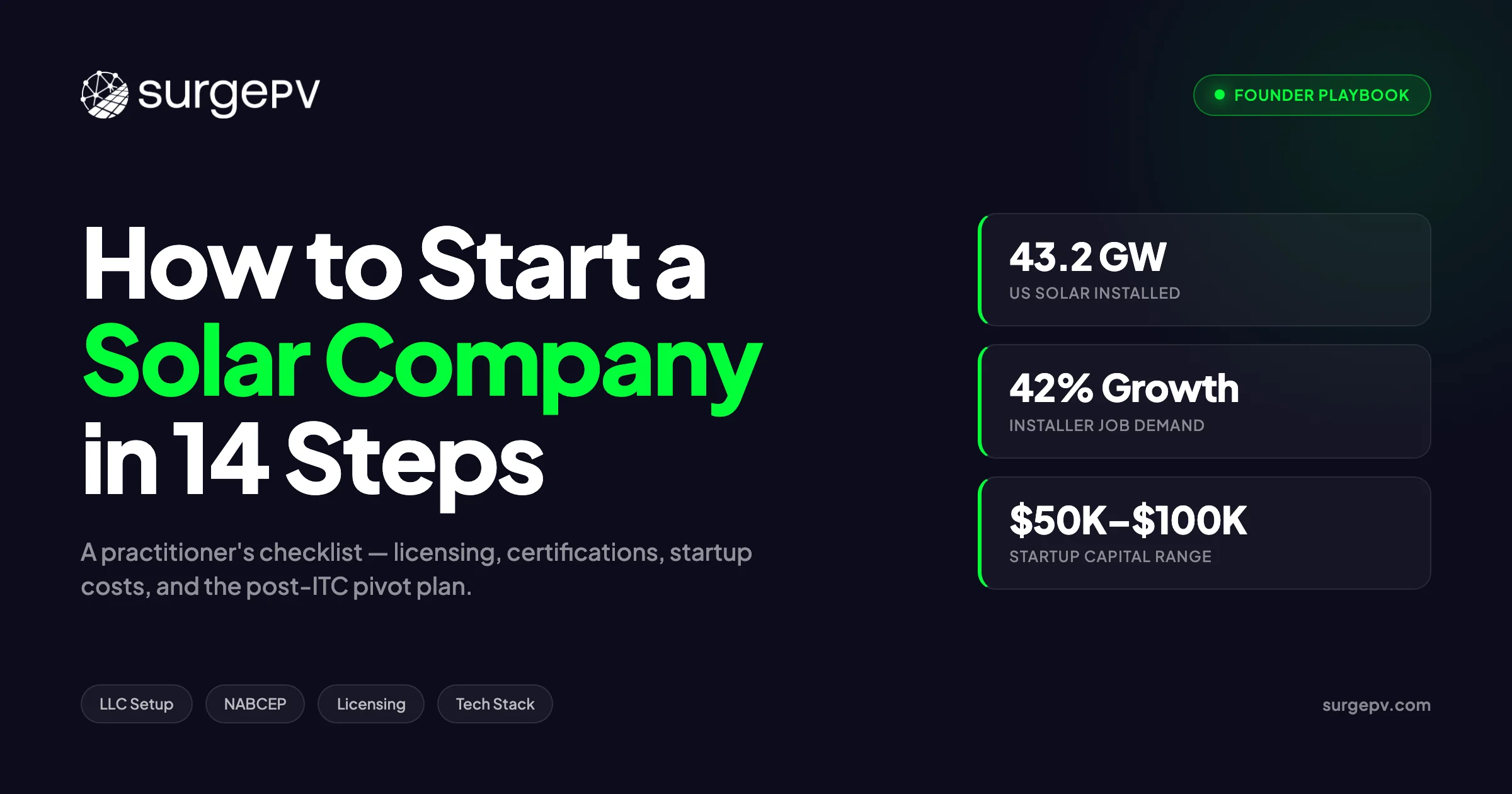
The US solar industry installed 43.2 GW in 2025, making solar 54% of all new electricity capacity added to the grid that year (Wood Mackenzie/SEIA, 2026). IRS/SEIA Commercial ITC (48E) still active. 30% for TPO/leases/PPAs; safe harbor deadline July 4, 2026 for construction start. IRS/SEIA Record 2025 installation. 43.2 GW installed; solar = 54% of new US electricity capacity.
The US solar industry installed 43.2 GW in 2025, making solar 54% of all new electricity capacity added to the grid that year (Wood Mackenzie/SEIA, 2026). The industry employs 280,119 workers across 11,177 installation businesses — and BLS projects 42% job growth for solar installers through 2034, faster than any other skilled trade (BLS Occupational Outlook Handbook, May 2024).
The US solar industry installed 43.2 GW in 2025, making solar 54% of all new electricity capacity added to the grid that year (Wood Mackenzie/SEIA, 2026). IRS/SEIA Commercial ITC (48E) still active. 30% for TPO/leases/PPAs; safe harbor deadline July 4, 2026 for construction start.
The market is large and growing. But 2026 is also the first full year without the residential Investment Tax Credit (ITC). The 30% federal residential ITC under Section 25D expired December 31, 2025, under the One Big Beautiful Budget Act (OBBBA, Public Law 119-21). Residential installations fell 2% in 2025 and Wood Mackenzie forecasts a further 19% decline in 2026 as the market adjusts. Customer acquisition costs are rising — from $0.60/W in 2025 to a projected $0.84/W in 2026. New entrants who price jobs without accounting for that cost will lose money on their first year.
This guide is a practitioner’s checklist, not a motivational essay. We cover every step in the right order, with the actual numbers that matter: license costs, insurance minimums, startup capital ranges, and the design-to-proposal workflow that determines whether you win the job or lose it to someone faster.
TL;DR — Starting a Solar Company in 2026
The US solar market installed 43.2 GW in 2025 — 54% of all new US electricity capacity. The residential ITC expired December 31, 2025. Startup capital runs $50,000-$100,000 for a full install operation, or $5,000-$15,000 for sales-only. Battery attach is at 28%+ (Wood Mackenzie/SEIA). The fastest path to profitability: pick a tight niche, get your LLC and insurance on Day 1, master the 2-hour design-to-proposal cycle before you touch a rooftop.
In this guide:
- The 2026 solar market shift and what it means for new startups
- How to pick the right business model and niche before spending a dollar
- Legal entity, EIN, and bank account setup done correctly
- State contractor licensing and AHJ permit authority by state
- NABCEP and OSHA certifications — which ones and in what order
- Insurance minimums that suppliers and utilities actually require
- The tech stack that compresses a 6-hour proposal into under 2 hours
- Equipment sourcing, supplier credit, and Tier-1 panel selection
- Pricing for 25-35% gross margin in a rising-CAC market
- Local marketing and lead generation with real CAC benchmarks
- The pivot plan for commercial, storage, and TPO in 2026 and beyond
Solar in 2026: What Changed and What It Means for New Startups
Understanding the current market before committing capital is not optional — it determines whether your business model works.
| Update | Detail | Source |
|---|---|---|
| Residential ITC (25D) expired | Expired Dec 31, 2025 under OBBBA Public Law 119-21 — no 30% federal tax credit for homeowners | IRS/SEIA |
| Commercial ITC (48E) still active | 30% for TPO/leases/PPAs; safe harbor deadline July 4, 2026 for construction start | IRS/SEIA |
| Record 2025 installation | 43.2 GW installed; solar = 54% of new US electricity capacity | Wood Mackenzie/SEIA, 2026 |
| Residential market contraction | -2% installations in 2025; -19% forecast for 2026 | Wood Mackenzie/SEIA |
| Rising customer acquisition cost | CAC rising from $0.60/W in 2025 to projected $0.84/W in 2026 (+40%) | Wood Mackenzie |
| Battery storage surge | Attach rate at 28%+ in 2024, up from under 12% in 2023 | Wood Mackenzie/SEIA |
| Workforce and business count | 280,119 solar workers; 11,177 installer businesses nationally in 2025 | IREC/IBISWorld |
The Opportunity Is Still Real
A contracting residential market means less competition, not no opportunity. Installers who can run a tight operation — low overhead, fast proposals, strong referrals — will capture market share from the companies that over-expanded during the ITC era. BLS projects 42% job growth for solar photovoltaic installers through 2034 (BLS Occupational Outlook Handbook, May 2024). The long-term curve is still up.
For a new entrant, the ITC expiry reshapes the sales conversation. You can no longer open with “the government pays 30% of this.” You need to sell on energy savings, payback period, and battery backup value instead. Installers who master financial modeling and can show a homeowner a 7-year payback with a 12% IRR — in a proposal PDF within 24 hours of the site visit — will close at 2-3 times the rate of those who send a generic quote a week later. The checklist below is built around that reality.
Step 1: Pick Your Niche and Business Model
The business model you choose determines your startup cost, your license requirements, and how long it takes to generate your first dollar of revenue.
| Model | Startup Cost | License Required | Gross Margin | Risk | Time to First Revenue |
|---|---|---|---|---|---|
| Full install (residential) | $50,000-$100,000 | State contractor + electrical | 25-35% | High (roof liability) | 60-120 days |
| Sales-only (lead/close, sub installs out) | $5,000-$15,000 | None in most states | 15-25% of contract | Medium (sub quality) | 14-30 days |
| Design subcontractor | $3,000-$8,000 | None | $200-$600/design | Low | 7-14 days |
| EPC (engineering, procurement, construction) | $150,000+ | General contractor + electrical | 20-30% | Very high | 90-180 days |
A solo sales-only operation requires roughly $30,000 to start: $5,000 for software and setup, $8,000 for insurance, $10,000 cash runway, and $7,000 in miscellaneous costs. A full residential install operation realistically requires $80,000 before the first check clears — a vehicle, ladders and racking tools ($15,000-$40,000 in equipment), $20,000 in working capital to cover permits and materials before the draw, plus licensing and insurance. See Solar Racking Design Guide for detailed guidance.
In 2026, the most defensible entry point is a TPO/lease partnership. Because the commercial ITC (Section 48E) is still active at 30% for third-party-owned systems, installers who can offer customers a $0-down lease or PPA through partners like Sunlight Financial, Mosaic, or GoodLeap expand their addressable market without the residential ITC gap. Dealer fees run 1-4% of the contract value — price them in.
Storage bundling is the second lever. At 28%+ battery attach (Wood Mackenzie/SEIA, 2024), every proposal that includes a battery storage option generates 10-20% more revenue per job with minimal incremental sales cost. Read Adding Battery Storage Services for a complete walkthrough.
No Experience? Start in Sales
Starting as a solar sales representative requires no installation experience, no contractor license, and minimal capital. Work under a licensed installer for 12-18 months to accumulate NABCEP field hours. Many of the most successful solar company owners started in sales, not on rooftops.
Common mistake: Launching residential-only without a financing partnership. Without the ITC, roughly 40% of potential residential customers will need a loan or lease to make the numbers work. If you can only offer cash sales, you are turning away nearly half the market on Day 1.
Step 2: Draft a Lean Business Plan (Without Overthinking It)
A business plan for a solar startup does not need to be 40 pages. It needs five financial inputs nailed down before you file your LLC.
| Input | Your Estimate | Benchmark |
|---|---|---|
| Average contract value | $X | $29,500-$35,000 for 10 kW residential (2026) |
| Monthly leads (paid + organic) | X leads | 10-20 realistic in Year 1 |
| Close rate | X% | 15-25% cold; 30-45% referred |
| Customer acquisition cost (CAC) | $/W | $0.84/W projected 2026 (Wood Mackenzie) |
| Gross margin target | X% | 25-35% all-in |
With those inputs, a simple Year-1 model looks like this: 2 installs per month at an average of $25,000 per contract equals $600,000 in annual revenue. At a 35% gross margin, that is $210,000 gross profit. Subtract $120,000 in annual overhead (vehicle, insurance, software, salary for one part-time admin), and you reach $90,000 EBITDA in Year 1 — a realistic outcome for a focused solo operator.
The $2.95-$3.50/W average sell price range (Wood Mackenzie/EnergySage, 2026) is your pricing benchmark. If your cost structure requires $3.10/W to break even, you have very little room on a competitive bid. Understanding your cost floor before the first job is not optional.
SBA 7(a) loans go up to $5 million and can fund equipment, working capital, and even acquisition of an existing installer book. The SBA’s Lender Match tool connects you with participating lenders. Expect 6-12 months for approval and funding.
Cash flow timing is the most common killer. A signed contract is not cash. Permits take 2-6 weeks. Inspections take additional time. Most residential projects pay 10-20% at signing, with the balance at commissioning. If you have four jobs in progress simultaneously and $0 in your bank account, you cannot pay your sub. Model the cash flow week-by-week for your first six months, not just the annual P&L.
Step 3: Form Your Legal Entity and Get Your EIN
Never take your first job as a sole proprietor. A single roof damage claim — even a legitimate warranty dispute — can wipe out personal assets without the liability shield of an LLC.
| Structure | Liability Protection | Cost to Form | Tax Treatment | Right For |
|---|---|---|---|---|
| Sole Proprietor | None | $0 | Personal return (Schedule C) | Never — too much risk |
| LLC | Yes — personal assets protected | $50-$500 state filing + ~$100/yr registered agent | Pass-through (default) or S-Corp | Most solar startups |
| S-Corp | Yes | LLC cost + IRS election form | Salary + distribution split | Net profit consistently above $50,000/yr |
| C-Corp | Yes | $200-$800+ | Double taxation | Seeking VC funding; not typical |
Form an LLC first. The S-Corp election (IRS Form 2553) makes sense once net profit exceeds roughly $50,000/year, because it lets you split income between a reasonable salary and distributions — reducing self-employment tax. At lower profit levels, the payroll administration cost outweighs the savings.
LLC formation checklist (in order):
- File Articles of Organization with your state’s Secretary of State ($50-$500)
- Appoint a registered agent (use a service like Northwest or ZenBusiness at ~$100/yr)
- Apply for your federal EIN at IRS.gov — free, takes 5 minutes online
- Open a dedicated business bank account before accepting any deposit
- Register your business name or DBA (Doing Business As) if you operate under a trade name
- Obtain your state business license or general business registration if required
Open a Business Bank Account First
If a customer writes a deposit check before you have a business account, you will deposit it to your personal account. That comingles funds and can pierce your LLC’s liability protection in court. Open the business account before you have a single customer conversation.
UK founders follow a similar structure: register a Limited Company at Companies House (£12 online), obtain a UTR from HMRC, and register for VAT once turnover exceeds £90,000. Indian founders register a Private Limited Company with the Ministry of Corporate Affairs (MCA21 portal) or form a One Person Company for a solo operation. Also see: Best Solar Design Software India. For the latest details on India, see 5kW Solar Panel Price in India. For India-specific compliance details, see India andhra-pradesh.
Step 4: Secure Your State Contractor License and Electrical Permit Authority
Unlicensed solar contracting carries $5,000-$25,000 in state fines, mandatory stop-work orders, and personal liability for any work performed. Check your state before taking any paid job.
| State | License Type | Issuing Body | Exam Required | Cost | Timeline |
|---|---|---|---|---|---|
| California | C-46 Solar Contractor | CSLB | Yes (trade + law) | $330 app + exam | 3-6 months |
| Florida | ESCO or Electrical Contractor | DBPR | Yes | $209-$309 | 3-5 months |
| Texas | Electrical Contractor (EC) | TDLR | Yes | $185-$500 | 2-4 months |
| New York | HIC + Master Electrician | NY Dept. of State / Local | Yes | $200-$500 | 4-6 months |
| Massachusetts | HIC + Journeyman/Master Electrician | OCABR / State Board | Yes | $150-$400 | 3-5 months |
| Arizona | CR-11 Solar/Small Commercial | ROC | Yes | $200 | 2-3 months |
| Colorado | No state license | Local AHJ only | Varies | Varies | 2-4 weeks (AHJ) |
| Georgia | Electrical Contractor | Secretary of State | Yes | $100-$300 | 3-4 months |
Source: IREC Solar Licensing Database (irec.us), 2025-2026.
If your state requires a licensed electrician but you are not one, you have two options: hire a licensed electrician as an employee or partner, or subcontract the electrical work to a licensed sub while you manage the project. The second path is common for early-stage companies — just verify the sub’s license before every job.
AHJ permits are separate from state licensing. Every installation requires a permit from the local Authority Having Jurisdiction (AHJ). Permit fees run $50-$500 for residential systems (NREL, 2024). Processing time varies significantly:
- Rural or small-city AHJs: 1-2 weeks residential
- Mid-size cities: 2-4 weeks residential
- Major metros (Los Angeles, New York, Chicago): 4-8 weeks residential
- SolarAPP+ fast-track AHJs (150+ jurisdictions): 1-3 days residential
Utility interconnection applications are separate from AHJ permits and typically add 2-8 weeks under NEM programs.
Multi-state expansion: Several states have reciprocity agreements that credit out-of-state license hours. California’s CSLB has reciprocity with Arizona and Nevada. Check the IREC database before budgeting for a second-state license.
Step 5: Get Certified — NABCEP, OSHA-10, and What Else You Actually Need
Certifications are both a credential and a signal to homeowners and commercial buyers that you are not a fly-by-night operation. In some markets (California, Massachusetts, New York), NABCEP certification is increasingly expected by homeowners doing any due diligence.
| Certification | Prerequisites | Exam | Cost | Prep Time | Recertification |
|---|---|---|---|---|---|
| NABCEP PV Installation Professional (PVIP) | 58+ hours NABCEP-approved training + documented field hours | 70 MCQ, 4 hours | $500 (app + exam) | 3-6 months | $390 / 3 years |
| NABCEP PV Associate | NABCEP-approved course completion | 100 MCQ, 2 hours | $25 course + $125 exam | 4-8 weeks | Annual CPD |
| OSHA-10 Construction | None | None (10-hour course) | $60-$90 online | 1-2 days | Every 5 years |
| OSHA 1926 Subpart M Fall Protection | OSHA-10 recommended | None (4-hour training) | $30-$60 | Half day | As required |
Source: nabcep.org, OSHA.gov.
Take PV Associate First
Take the NABCEP PV Associate certification first — it takes 4-8 weeks and costs under $200. While you accumulate the field hours required for the full PVIP designation, you have a legitimate credential to show customers. Document every hour you work under a licensed installer; NABCEP accepts a range of experience types toward PVIP eligibility.
OSHA-10 is not legally required in most states for a sole operator, but it is expected by general contractors if you do commercial subcontracting, required on any federally funded project, and looked for by commercial insurance underwriters. Take it before your first commercial job.
OSHA 1926 Subpart M covers fall protection — the single most common cause of serious injury in solar installation. A 4-hour training course plus a written safety plan for your company covers the requirement for most residential operations.
Common mistake: Waiting to get certified before working under a licensed installer. The field hours you accumulate working under a license count toward PVIP eligibility. Every month you delay starting that clock is a month longer before you can get the full designation.
Step 6: Buy Insurance Before You Touch a Single Roof
Insurance is not optional. Before working with most distributors, signing a dealer agreement with a financing partner, or connecting to a utility interconnection program, you will need to produce a certificate of insurance (COI).
| Policy | Minimum Coverage | Typical Annual Cost |
|---|---|---|
| General Liability (GL) | $1M per occurrence / $2M aggregate | $2,500-$6,000/yr |
| Workers’ Compensation | State-mandated (required once you have employees) | $4,000-$12,000/yr |
| Commercial Auto | $1M combined single limit (CSL) | $1,800-$4,000/yr |
| Tools and Equipment | $25,000-$100,000 | $800-$2,500/yr |
For design-only or sales-only operations, add Errors and Omissions (E&O) coverage at $1,500-$3,500/yr. If a shading analysis or financial model you provided turns out to be wrong, E&O covers the claim.
Once your annual revenue exceeds $500,000, add a commercial umbrella policy above your GL limits. Umbrella runs $1,000-$2,500/yr for $1M-$2M in additional coverage and is cheap relative to the exposure on a residential roof.
Ask About the Completed Operations Rider
Standard GL covers incidents during the job. The completed operations rider covers claims arising after the job is finished — for example, a roof leak discovered six months after installation. Most residential solar companies need this. Confirm it is included before accepting the policy.
Common mistake: Subcontracting electrical work without verifying the sub’s workers’ compensation coverage. If your sub’s employee is injured on your jobsite and the sub has no workers’ comp, the claim may come back to your GL policy. Always request a COI from every subcontractor before they step on the roof.
Step 7: Build Your Starter Tech Stack
The single biggest operational advantage a new solar company can have is speed from site visit to signed proposal. Industry data shows that 5-8% of leads are lost for every day between a site visit and proposal delivery (installer surveys, 2024-2025). At a 2-install/month target, losing one lead per month to slow proposals costs roughly $25,000 in revenue — more than an annual software subscription.
| Category | Tool | Monthly Cost |
|---|---|---|
| Design + proposals | SurgePV | $50-$300/mo |
| CRM | HubSpot (free tier) | $0 |
| Permit drawings | Integrated in SurgePV / Aurora | Included |
| Accounting | QuickBooks Self-Employed or Wave | $0-$30/mo |
| Scheduling | Google Calendar | $0 |
| Team comms | Slack (free tier) | $0 |
The 2-hour design-to-proposal workflow using solar PV design software as your platform:
- Virtual site assessment (30 minutes) — pull the address into the platform, review Google Maps satellite, run the intake form responses.
- 3D roof model and module layout (45 minutes) — place panels on the roof model, optimize string layout, confirm system size.
- Shading analysis (15 minutes) — use solar shadow analysis software to model near and far shading, confirm production numbers.
- Financial model (15 minutes) — run payback period, IRR, and NPV through the generation financial tool.
- Branded PDF proposal (20 minutes) — generate the customer-facing document through solar proposal software, add the homeowner’s name and property photo.
Total: under 2 hours from intake form to proposal PDF in the customer’s inbox. Clara AI (SurgePV’s AI writing assistant, Clara AI) can generate the proposal narrative copy automatically based on the financial model outputs. For a direct comparison, see Arka 360 vs SurgePV.
Before the ITC expiry, many installers could close on a price-and-size quote alone. In 2026, the proposal needs to include shading-adjusted production numbers, a year-by-year savings model, and a financing comparison. Homeowners are doing more research. A generic “10 kW for $32,000” email does not close — a proposal with IRR, 25-year cash flow, and a shading map does. For the latest details on France, see Agricultural Solar Case Study. For France-specific information, see Floating Solar Farms France.
Do Not Buy Separate Tools in Year 1
Early-stage companies buy standalone CAD software, a separate financial modeling spreadsheet, and a separate proposal template — then spend 6-12 hours per proposal stitching them together. An integrated platform compresses that to under 2 hours. The cost per hour of your time is worth more than the difference in subscription price.
Common mistake: Building proposals in PowerPoint or Word. A manually assembled proposal has no version control, takes 4-8 hours per job, and looks amateur next to a competitor using a modern platform. The proposal is your sales collateral — it reflects on your technical credibility.
See How Fast You Can Go From Site Visit to Signed Proposal
SurgePV combines 3D design, shade analysis, financial modeling, and branded proposals in one cloud platform. Walk through one of your real projects with our team.
Book a Free DemoNo commitment required · 20 minutes · Live project walkthrough
Step 8: Source Equipment and Establish Supplier Credit
Equipment sourcing decisions made in Year 1 tend to stick — distributors you establish credit with become the path of least resistance for the next 50 jobs. Make deliberate choices.
| Distributor Type | Examples | Pros | Cons |
|---|---|---|---|
| National distributor | CED Greentech, BayWa r.e. | Deep inventory, nationwide delivery, credit terms | Volume minimums for best pricing |
| Regional distributor | Renvu, local solar distributors | Faster delivery, relationship-driven | Smaller inventory depth |
| Direct manufacturer | SolarEdge, Enphase | Best pricing on high-volume buys | Usually requires established track record |
“Tier-1 panel” does not mean best quality. The Bloomberg New Energy Finance (BNEF) Tier-1 solar module bankability list is a financial assessment — it indicates that the manufacturer has a strong enough balance sheet that banks will finance systems using their panels. It is not a quality or performance rating. A panel can be Tier-1 and perform poorly in real conditions. Look for a combination of BNEF Tier-1 status, at least a 25-year power output warranty, and PAN file validation for the specific module before specifying it in a system design.
Supplier credit timeline: For your first 2-3 jobs, pay cash up-front. Most distributors will not extend Net-30 terms to a new company with no trade history. After 3-5 paid invoices, apply for a Net-30 account with a $5,000-$10,000 limit. Provide three trade references (even your insurer and accountant count), your EIN, and a copy of your contractor license. A business credit card bridges the gap while credit is building.
Battery storage bundling at 28% attach (Wood Mackenzie/SEIA, 2024) means every proposal for a residential system should include a battery option. The most commonly specified residential batteries in 2026 are Enphase IQ Battery, Tesla Powerwall, and Franklin Electric aPower. Establish distributor relationships for all three — customers will have a preference.
Cash First, Credit Later
Paying cash on the first few orders builds a payment history faster than applying for trade credit without one. After three on-time cash orders, your credit application will have a data trail. Without it, you are asking a distributor to extend credit to a company with no financial history — most will decline or offer terms too small to be useful.
Common mistake: Choosing a panel supplier on lowest panel cost alone. If the manufacturer’s warranty is backed by a company with no US assets and a poor BNEF rating, a warranty claim on a defective module produces nothing. The lowest-cost panel that ships late also destroys your install schedule and your customer relationship simultaneously.
Step 9: Price for Profit and Offer Financing Options
Most new solar companies underprice their first 10 jobs. The two most common reasons: they forget to include CAC in the cost-per-watt model, and they model gross margin on material cost alone without accounting for overhead allocation.
| Cost Component | Low ($/W) | High ($/W) |
|---|---|---|
| Panels + inverter + racking | $0.70 | $1.00 |
| Labor (install crew) | $0.25 | $0.45 |
| Permitting and interconnection | $0.05 | $0.10 |
| Sales / CAC (Wood Mackenzie 2026) | $0.60 | $0.84 |
| Overhead allocation | $0.15 | $0.25 |
| Total cost | $1.75 | $2.64 |
| Target sell price | $2.95 | $3.50 |
| Gross margin | 25% | 35% |
At $0.84/W CAC on a 10 kW system, your sales cost alone is $8,400. If your total cost is $2.20/W and you sell at $2.60/W, your gross margin is 15% — but after overhead you may be losing money. The math has to work before the contract is signed, not after.
Financing partners for residential installs: Sunlight Financial, Mosaic, GoodLeap, and Dividend Finance are the major players in 2026. Each charges a dealer fee of 1-4% of the financed amount, which you pass into your sell price. For commercial TPO/lease structures that utilize the Section 48E ITC, GoodLeap and Mosaic both have commercial programs — confirm your project qualifies before pitching it to a customer.
Price Your First 5 Jobs at Cost Plus 20%
Your first 5 jobs will take longer, have unexpected costs, and expose gaps in your process. Price them at cost plus 20% — not the 30-35% you will target at scale. By Job 10, you will know your actual cost structure and can price with confidence. Under-promising on margin early beats explaining to a customer why the job cost 15% more than quoted.
Common mistake: Not pricing the CAC into the job cost. If you acquire a customer through a shared lead aggregator at $300-$400 per lead with a 5-8% close rate, your effective CAC is roughly $4,000-$8,000 per sold job. That is a significant line item at any project size. Price it explicitly.
Step 10: Launch Local Marketing and Lead Generation
Your first 10 customers determine whether you survive to 100. Get these channels right before spending money on advertising.
| Channel | Typical CAC | Close Rate | Notes |
|---|---|---|---|
| Google Business Profile (organic) | $500-$1,500 | 20-35% | Takes 3-6 months to build; best long-term ROI |
| Referrals from past customers | $500-$2,000 | 25-40% | Requires existing customer base; highest close rate |
| Google Local Services Ads (LSA) | $2,000-$5,000 | 15-25% | Pay per verified lead; faster than organic |
| Door-to-door canvassing | $1,500-$4,000 | 10-20% | Works in high-density neighborhoods; high labor cost |
| Shared lead aggregators (EnergySage, etc.) | $100-$400/lead | 5-8% | Competitive; leads shared with 3-5 installers |
All-in residential CAC runs $3,000-$10,000 depending on channel mix, per SolarReviews installer data. At $0.84/W on a 10 kW system, Wood Mackenzie’s projected 2026 figure implies $8,400 in sales cost per job — this is the budget number to work backward from when setting your marketing spend.
Referral mechanics: A $300-$500 cash payment per referred install — paid at the time of installation, not at signing — is the standard referral incentive structure. The timing matters: paying at signing means you are paying before you know if the job will actually complete.
Get 10 Google Reviews Before Spending on Ads
A Google Business Profile with fewer than 10 reviews will convert at a fraction of the rate of one with 40+ reviews and a 4.8-star average. Spend your first six months generating reviews from every completed job, not on paid ads. The reviews you build now are the foundation for every paid channel you turn on later.
Common mistake: Using shared aggregator leads as your primary channel. At a 5-8% close rate against 3-5 competing quotes, you will spend more on sales time than the leads are worth. Aggregator leads work as a supplement to owned channels — they are not a business model by themselves.
Step 11: Master the Design-to-Contract Cycle
Speed wins jobs. The step between a site visit and a signed contract is where most residential solar deals die — not because the customer said no, but because a competitor responded faster.
| Step | Time (Skilled Operator) | Tool |
|---|---|---|
| 1. Virtual site assessment — Google Maps + intake form review | 30 min | SurgePV + Google Maps |
| 2. 3D roof model + module layout | 45 min | cloud solar design software |
| 3. Shading analysis | 15 min | solar shadow analysis software |
| 4. Financial model — payback, IRR, NPV | 15 min | generation financial tool |
| 5. Branded PDF proposal | 20 min | solar proposal software |
| Total | ~2 hrs 5 min |
Installers who deliver proposals within 24 hours of a site visit close at 2-3 times the rate of those taking 5 or more days, based on industry-observed ranges from installer surveys across multiple US markets.
Shading accuracy matters beyond the proposal stage. If your shading analysis overstates production and the system under-delivers by 15% in Year 1, the homeowner will request a credit, a re-analysis, and possibly a legal remedy. An accurate analysis delivered in the proposal prevents the chargeback. The 15-minute shading step is insurance, not overhead.
Cash Flow Dies in the Gap
Every day between site visit and signed contract is a day the lead can be picked off by a competitor with a faster workflow. If you are doing 2 installs per month, shortening that gap from 7 days to 1 day is worth roughly one additional closed job per quarter at typical close rates.
Common mistake: Sending a generic quote — system size and price only — instead of a proposal with shading analysis, financial model, and branded design. A full proposal closes 30-50% better than a price sheet, based on installer conversion rate comparisons from sales training programs. The 2-hour investment pays back on the first additional closed job.
Step 12: Submit Permits and Schedule Inspections Without Losing Your Mind
Permit delays kill cash flow. A job under contract but not yet permitted is cash you cannot collect. Managing the permit cycle proactively is one of the most underrated operational skills in residential solar.
Standard residential permit package (numbered checklist):
- Site plan showing module placement, roof orientation, and property lines
- Single-line electrical diagram (AC and DC sides, disconnect locations, metering)
- Structural analysis or stamped letter for roofs older than 15 years or with non-standard framing
- Equipment spec sheets for all major components (modules, inverter, racking)
- Utility interconnection application (submitted separately to the utility, not the AHJ)
| AHJ Type | Residential Timeline | Commercial Timeline |
|---|---|---|
| Rural / small city | 1-2 weeks | 3-6 weeks |
| Mid-size city | 2-4 weeks | 4-8 weeks |
| Major metro (LA, NYC, Chicago) | 4-8 weeks | 8-16 weeks |
| SolarAPP+ fast-track AHJ (150+ jurisdictions) | 1-3 days | N/A (residential only) |
Source: NREL/installer surveys, 2024-2025.
SolarAPP+ is an NREL-developed automated permit review tool now adopted by more than 150 US jurisdictions. If your AHJ uses SolarAPP+, a compliant system design can receive same-day permit approval. Before signing a customer contract in a new market, check whether the AHJ participates.
Utility interconnection runs on a separate timeline from the AHJ permit — typically 2-8 additional weeks under NEM programs. In California, the SGIP and NEM 3.0 rules have added steps to the interconnection process that did not exist under NEM 2.0. Build the full AHJ-plus-interconnection timeline into your customer contract before you promise an installation date.
Map the AHJ Timeline Before Signing
Before signing any customer contract, call the AHJ and confirm current permit processing times. AHJ timelines change — a jurisdiction that was 2-week turnaround last summer may be 6 weeks today due to staffing changes. A customer contract that promises installation in 30 days when permits take 8 weeks creates a dispute before the first panel goes on the roof.
Common mistake: Submitting an incomplete permit package. A missing spec sheet or an incorrectly labeled single-line diagram resets the AHJ review clock to Day 1. Build a permit package checklist and have a second set of eyes review it before submission on every job.
Step 13: Deliver Quality on Every Install and Build Your Referral Engine
The install is not the end of the sales cycle — it is the beginning of your referral engine. A homeowner who sees their monitoring data for the first time and gets excited will talk to neighbors. A homeowner who had a messy install and unanswered follow-up questions will not.
3-day post-install checklist (numbered):
- Day of install: Run commissioning test per IEC 62446-1 (open-circuit voltage, short-circuit current, insulation resistance). Document results.
- Day of install: Set up monitoring platform access for the homeowner — create their account, walk them through the app.
- Day of install: Walk through the system with the homeowner: what the panels do, what the inverter status lights mean, what normal production looks like.
- Day 3-5 post-install: Send a follow-up message asking how the first few days of monitoring data look. Include a Google review link.
- Day 3-5 post-install: Leave a referral card or send a digital version — “Know anyone else interested in solar? We pay $400 for every job you refer.”
Timing the review request correctly matters. Requesting a review on the day of installation, before the homeowner has seen a single kWh on their monitoring app, produces a lower response rate than requesting 3-5 days later when the excitement of seeing real production data is at its peak.
Referral Math vs. Lead Aggregator Math
A $400 referral payment on a 30-40% close rate costs roughly $1,000-$1,330 per acquired customer. A shared aggregator lead at $300-$400 per lead with a 5-8% close rate costs $3,750-$8,000 per acquired customer. The referral is 3-6 times cheaper and closes at higher intent. Build the referral system before you scale paid acquisition.
Common mistake: Making the review request on the day of install. The homeowner’s system is not producing data yet, they are tired from being home during the installation, and the emotional high is lower than it will be when they see the first monitoring readings. Wait 3-5 days.
Step 14: Plan Your Pivot — What to Build for 2026 and Beyond
A residential-only business in 2026 faces headwinds: no ITC, rising CAC, and a projected 19% volume decline (Wood Mackenzie/SEIA). The companies that survive will be the ones that pick a second revenue stream before the first one compresses.
| Pivot Path | Requirements | Revenue Upside |
|---|---|---|
| Commercial / C&I + Section 48E | C-10 or Electrical Contractor license upgrade, NABCEP EP designation, commercial design capability | $100,000-$2M contracts; 30% commercial ITC still active |
| Battery storage bundling | NABCEP storage certification, manufacturer training (Enphase, Tesla, Franklin) | 10-20% revenue uplift per job; 10-20% higher labor rates |
| TPO / financing partnerships | Dealer agreement with Mosaic, GoodLeap, or Sunlight Financial; TPO structure training | Offsets cash-sale slowdown; widens customer pool to lower-income segments |
Commercial Section 48E safe harbor is an immediate opportunity. Commercial and industrial systems that begin construction by July 4, 2026 can qualify for the 30% ITC through safe harbor provisions (IRS/SEIA). If you have any commercial leads in your pipeline, prioritize them and start construction documentation now.
The battery storage opportunity is the most accessible pivot for a residential installer. At 28% attach already (Wood Mackenzie/SEIA, 2024), adding NABCEP storage certification and manufacturer training for Enphase IQ Battery, Tesla Powerwall, and Franklin aPower costs under $2,000 in time and fees. The revenue uplift on every job that includes storage is 10-20% with minimal incremental sales effort.
Long-term market fundamentals remain strong. BLS projects 42% job growth for solar photovoltaic installers through 2034, the fastest of any skilled trade occupation tracked (BLS Occupational Outlook Handbook, May 2024). The current contraction is a market adjustment to the ITC expiry — not a structural decline.
For commercial solar opportunities, the design and proposal workflow changes materially: three-line diagrams, commercial structural calculations, demand charge analysis, and multi-scenario financing modeling (cash, loan, TPO) replace the simpler residential workflow. Start with a for solar installers approach to develop your commercial design capability before pursuing C&I contracts.
Pick One Pivot Now
Most founders try to do all three pivots simultaneously and execute none of them well. Pick one, build it properly for 12 months, then expand. If you already have commercial leads, start there. If your residential customers are consistently asking about batteries, start there. The wrong choice pursued with focus beats the right choice pursued half-heartedly.
Frequently Asked Questions
How much does it cost to start a solar company?
A full residential installation business typically requires $50,000-$100,000 in startup capital. The major line items are: state contractor licensing ($200-$500), NABCEP certification ($150-$625), general liability insurance ($2,500-$6,000 per year), commercial auto insurance ($1,800-$4,000), tools and equipment for the first 2-3 jobs ($15,000-$40,000), a vehicle, and solar design and proposal software. Working capital to cover the gap between signed contracts and funded draws adds another $10,000-$20,000. A sales-only or design-only model can launch for $5,000-$15,000 because it eliminates the equipment and vehicle costs entirely.
Do you need a license to start a solar company?
Yes, in most US states. California requires a C-46 Solar Contractor license from the CSLB. Florida requires an ESCO or electrical contractor license from DBPR. Texas requires TDLR electrical contractor licensing. New York requires both a Home Improvement Contractor (HIC) registration and a Master Electrician license. About 10 states have no state-level solar-specific license but require local AHJ permits for every installation. The IREC Solar Licensing Database (irec.us) is the most current reference for your specific state. Operating without a required license carries $5,000-$25,000 in fines and personal liability for all work performed.
Is starting a solar company profitable in 2026?
Yes, with a model that accounts for the current market. Residential gross margins run 25-35% at $2.95-$3.50/W average sell price (Wood Mackenzie/EnergySage, 2026). A focused operation doing 2 installs per month can generate $80,000-$100,000 in gross profit in Year 1. The biggest profitability risk is customer acquisition cost, projected at $0.84/W in 2026 (Wood Mackenzie) — meaning a 10 kW job carries roughly $8,400 in sales cost before the crew shows up. Installers who build a referral network and strong Google presence bring CAC down to $500-$1,500 per job, which fundamentally changes the unit economics.
Can you start a solar company with no experience?
Yes, if you choose the right entry point. Starting as a solar sales representative or design subcontractor requires no installation experience, no contractor license, and minimal startup capital. Work under a licensed installer for 12-18 months to accumulate the NABCEP field hours required for the full PVIP designation. Document every hour. Many of the most successful solar company owners in the US started in solar sales rather than on rooftops — the business and sales skills transfer directly to running a company, and the technical knowledge follows through certification programs. The path from zero experience to owning a licensed install business typically takes 18-24 months done correctly.
How long does it take to become a solar installer?
Getting job-ready takes 3-9 months depending on your starting point. NABCEP PV Associate certification takes 4-8 weeks; a state electrical or contractor license takes 2-6 months depending on the state and exam schedule; OSHA-10 takes 1-2 days. You can work under a licensed installer while earning your own certifications — the hours you log count toward NABCEP PVIP eligibility. The full PVIP designation, which is the gold standard for residential and commercial installers, takes 3-6 months of preparation after completing the required training hours. There is no shortcut through the field hour requirement.
What insurance do solar installers need?
At minimum: general liability at $1M per occurrence/$2M aggregate ($2,500-$6,000/yr), workers’ compensation once you have employees (required in most states, $4,000-$12,000/yr depending on payroll), commercial auto at $1M combined single limit ($1,800-$4,000/yr), and tools and equipment coverage at $25,000-$100,000 ($800-$2,500/yr). Most equipment distributors, financing partners, and utilities require a certificate of insurance (COI) before they will do business with you. Add Errors and Omissions coverage if you provide design or financial modeling services. Include a completed operations rider on your GL policy — it covers claims that arise after the job is finished, which is where most roofing and electrical disputes surface.
What is the best business structure for a solar company?
An LLC is the right starting point for most solar companies. It limits personal liability for roof damage, electrical issues, and contract disputes; costs $50-$500 in state filing fees plus about $100/year for a registered agent; and defaults to pass-through tax treatment. Once net profit consistently exceeds $50,000/year, elect S-Corp tax treatment on the LLC (IRS Form 2553) to reduce self-employment tax by splitting income between a reasonable salary and distributions. Never operate as a sole proprietor — a single roof damage or personal injury claim can reach personal assets without LLC protection. A C-Corp is rarely appropriate for a service-based installer unless you are raising venture capital.
Conclusion: Your First 90 Days
The biggest threat to a new solar company is not competition or the ITC expiry — it is cash flow. Signed contracts are not cash. Permits take weeks. Draws fund at commissioning. A company doing $600,000 in annual revenue can run out of cash in the gap between signing and funding if it does not manage the cycle carefully.
The 90-day milestones that matter:
- Days 1-30: Form your LLC, open a business bank account, apply for your EIN, get your contractor license application submitted, buy insurance, take OSHA-10, start NABCEP PV Associate prep.
- Days 31-60: Get your state license (or confirm timeline), set up your tech stack, generate your first 5 leads through your Google Business Profile and personal network, run your first proposal in under 2 hours.
- Days 61-90: Close your first signed contract, submit permits, deliver the first install, request a Google review, and pay your first referral.
At 90 days in, you will know your actual cost structure, your actual close rate, and what the permit timelines look like in your market. Every assumption in your business plan will have been tested against reality. That is the foundation for Year 1 and the pivot decisions that follow.
The solar industry added 43.2 GW in 2025 and will install more in 2026 despite the residential ITC expiry. The market is large enough for a focused new entrant who executes the checklist above in order, prices jobs correctly from Day 1, and gets a proposal in front of the customer within 24 hours of the site visit.
See How Fast You Can Go From Site Visit to Signed Proposal
SurgePV combines 3D design, shade analysis, financial modeling, and branded proposals in one cloud platform. Walk through one of your real projects with our team.
Book a Free DemoNo commitment required · 20 minutes · Live project walkthrough
Where this fits
This article is part of SurgePV's Solar Business & Operations hub, which works through the topic from first principles to the decisions a project team actually has to make.

