Quick Answer
NEC 690.7 dwelling limits, short string runs 25 to 250 kW commercial. 1000V. Allowed for ground-mount and commercial occupancies NEC 690.7 — 1500V on dwellings. Rolling through 2026–2028. 16 states adopted by Q2 2026 per NEMA tracker UL 1741 SA 1500V inverters. Widely listed. 50+ models from Sungrow, SMA, Power Electronics, Sineng, FIMER, Huawei UL 6703 1500V connectors.
DC bus voltage is the single biggest lever in solar electrical design, and the industry has been climbing it for two decades. Residential PV started at 300V to 400V in the early 2000s, moved to 600V through NEC 2008 and 2011, jumped to 1000V on commercial and utility projects after NEC 2014, and standardized at 1500V on utility-scale plants from 2017 onward. The next step, 2000V, is under active development.
NEC 690.7 dwelling limits, short string runs 25 to 250 kW commercial. 1000V. Allowed for ground-mount and commercial occupancies NEC 690.7 — 1500V on dwellings.
This guide is for solar designers, EPC engineers, and project developers who need to choose a DC bus voltage that minimizes balance-of-system cost without breaking NEC 690, UL listings, or inverter availability. We cover where 600V, 1000V, and 1500V each still make sense in 2026, the BOS cost delta between them, NEC 690.7 voltage limit history, stringing math, combiner implications, and the realistic 2000V timeline.
TL;DR — DC Bus Voltage Optimization 2026
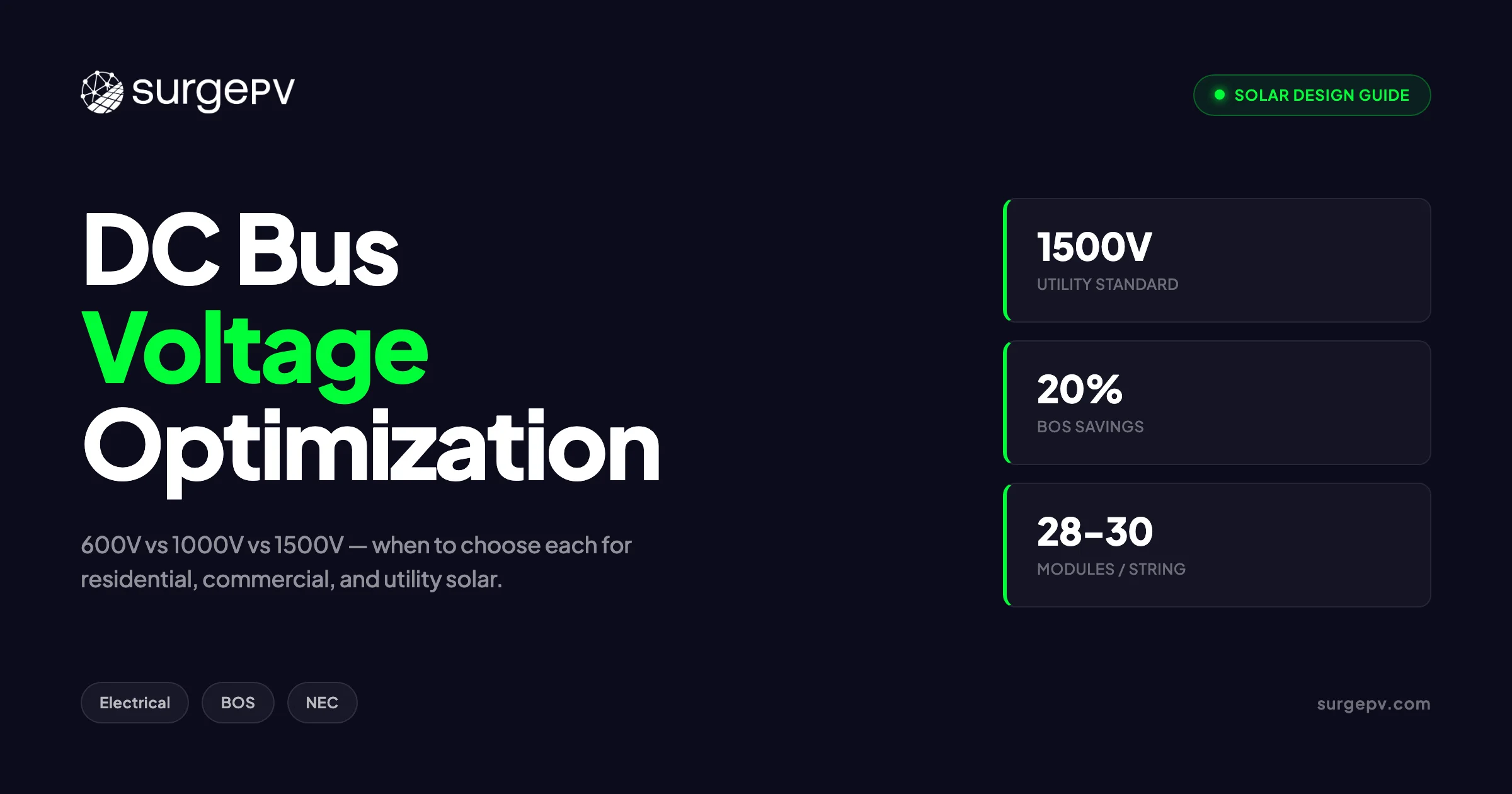
1500V is the utility-scale standard and is now common on C&I rooftops above 250 kW, saving 15 to 20 percent on BOS versus 1000V. 1000V remains the commercial workhorse for systems between 100 kW and 1 MW where 1500V inverters do not fit a small layout. 600V is mostly legacy, used on older residential retrofits and module-level power electronics systems. NEC 690.7 caps PV at 1500V on dwellings only under tight conditions, so 1500V on a single-family house is rare. 2000V is in UL listing review and will not see commercial scale before 2028.
In this guide:
- Why DC bus voltage drives BOS cost more than panel choice
- 600V, 1000V, and 1500V systems compared head to head
- NEC 690.7 voltage limit history from 2014 to 2026
- Stringing math at each voltage tier with worked examples
- Cabling and combiner savings from going higher
- Inverter selection at 600V, 1000V, and 1500V
- The 2000V DC roadmap and what to expect by 2030
DC Bus Voltage Optimization Solar 2026: Quick Answer
DC bus voltage optimization solar is the choice between 600V, 1000V, and 1500V maximum system voltage that minimizes total balance-of-system cost while meeting NEC 690.7, UL 1741, and the inverter MPPT window. The right answer depends on system size, occupancy type, and module specifications.
| System Size | Recommended DC Bus Voltage | Why |
|---|---|---|
| Under 25 kW residential | 600V (with MLPE) or 1000V (string) | NEC 690.7 dwelling limits, short string runs |
| 25 to 250 kW commercial | 1000V | Mature inverter market, balanced stringing |
| 250 kW to 5 MW C&I | 1000V or 1500V | 1500V wins above ~500 kW or 100m+ runs |
| 5 MW+ utility | 1500V | BOS savings of 15 to 20 percent vs 1000V |
| 50 MW+ future utility | 1500V (today) or 2000V (post 2028) | 2000V pending UL listings |
For most C&I and utility projects designed in 2026, 1500V is the default unless a specific code, equipment, or site constraint forces a lower voltage. Read on for the cost math, code history, and stringing detail behind these recommendations.
Latest Updates: DC Bus Voltage Codes and Equipment 2026
For anyone tracking dc bus voltage solar news today, here is the current status of major code editions, UL listings, and equipment availability as of May 2026.
The DC bus voltage landscape has stabilized at 1500V for utility and large C&I, but two things are moving in 2026: state adoption of NEC 2026, and UL listing work on 2000V DC components.
NEC and Equipment Status — May 2026
| Item | Status | Notes |
|---|---|---|
| NEC 690.7 — 1500V on non-dwellings | In force since NEC 2014 | Allowed for ground-mount and commercial occupancies |
| NEC 690.7 — 1500V on dwellings | Restricted under NEC 2023 and 2026 | Limited to specific dwelling configurations |
| NEC 2026 state adoption | Rolling through 2026–2028 | 16 states adopted by Q2 2026 per NEMA tracker |
| UL 1741 SA 1500V inverters | Widely listed | 50+ models from Sungrow, SMA, Power Electronics, Sineng, FIMER, Huawei |
| UL 6703 1500V connectors | Available | MC4-EVO2, Stäubli MC4, Amphenol H4 1500V variants |
| UL 4248-18 1500V fuses | Available | Cooper Bussmann PVS-R, Mersen HelioProtection, Littelfuse SPF |
| UL 2000V DC equipment listings | In development | UL working group active since 2022; first listings expected 2027 |
| IEC 62548 update to 2000V | Under revision | Draft circulated Q1 2026; publication expected 2027 |
| UL 9540 1500V battery DC coupling | In force | Used in DC-coupled storage projects up to 5 MWh |
Key Changes Since 2023
NEC 2023 tightened dwelling dc voltage rules. Section 690.7(A) now caps dwellings at 600V unless an inverter with arc fault protection per UL 1699B is used, in which case 1000V is allowed. 1500V on a one-family or two-family dwelling remains effectively prohibited.
1500V string inverters above 350 kW are now mainstream. Sungrow SG350HX, SMA Sunny Highpower PEAK3, Power Electronics FS3500K, and FIMER PVS-260 all ship in volume at 1500V. This pushed 1500V into the 1 to 10 MW commercial rooftop and ground mount segment that used to default to 1000V.
2000V central inverters demonstrated. Sungrow announced a 2000V central inverter at SNEC 2024, and a 2000V system was demonstrated by FIMER at Intersolar Munich in mid-2025. Field deployment at scale is not expected before 2028.
Key Takeaway — 2026 Voltage Decision
If you are designing a system above 250 kW in 2026 and your AHJ has adopted NEC 2017 or later, default to 1500V. The BOS savings versus 1000V are real and well documented across NREL and BloombergNEF studies. Drop down to 1000V only when a specific constraint forces it: small rooftop, short DC runs, or an inverter platform that is only 1000V native.
Why DC Bus Voltage Matters: Cost, Cabling, Code 2026
Higher DC bus voltage lowers current at the same power. That single fact drives every BOS saving downstream. P equals V times I, so doubling the DC bus voltage halves the current for the same wattage. Smaller current means thinner conductors, smaller fuses, and fewer parallel circuits.
For solar designers using solar design tools, the DC bus voltage choice is usually one of the first decisions in the project setup, and it propagates through every wire, conduit, combiner, and inverter selection afterward.
The Three Drivers of Voltage Choice
Three drivers determine the right DC bus voltage on any given project:
- Project size and string length. Long DC runs reward higher voltage because cable cost grows linearly with current and length
- Occupancy and code. NEC 690.7 caps voltage on dwellings; ground mounts and commercial roofs have looser limits
- Inverter and equipment availability. UL 1741 SA listed inverters must be available at the chosen voltage; 1500V is mature, 2000V is not
A 5 MW utility plant in Texas can use 1500V with no constraint. A 6 kW house in Ohio is capped at 600V or 1000V by NEC 690.7. A 250 kW rooftop in California sits in the middle, where 1000V is conservative and 1500V is the cost optimum if inverters fit the layout.
Current Reduction at Each Voltage
For a fixed 1 MW DC plant block, the operating current at the inverter terminals scales inversely with voltage. The DC side current at peak power, assuming the array operates near the MPPT voltage of the inverter, is approximately:
| Maximum System Voltage | Typical MPP Voltage | Plant Current at 1 MW DC |
|---|---|---|
| 600V | 480V to 540V | 1,850 A to 2,080 A |
| 1000V | 750V to 850V | 1,175 A to 1,330 A |
| 1500V | 1,100V to 1,300V | 770 A to 910 A |
| 2000V (projected) | 1,500V to 1,700V | 590 A to 670 A |
Going from 600V to 1500V cuts plant DC current by roughly 60 percent. That maps directly to conductor sizes and combiner ampacities. The same 1 MW block that needs 1,000 kcmil and 2,000A switchgear at 600V needs 350 kcmil and 1,000A gear at 1500V.
Why Higher Voltage Beats Bigger Wire
Conductor cost scales with copper or aluminum mass, which scales with cross-sectional area, which scales with the square of the conductor diameter. Voltage drop, however, scales linearly with current and length. So doubling voltage halves current and roughly quarters the conductor mass needed for the same voltage drop budget — a 4x improvement in copper cost per meter of run for the same losses.
This is why long-run plants (large ground mounts, distributed C&I with 200m+ runs) see the most benefit from going to 1500V. Short-run rooftops with sub-50m DC cabling get less benefit, and 1500V is often a wash on small commercial.
600V Systems: Where Are They Still Used in 2026?
600V was the dominant DC bus voltage in U.S. solar from the late 1990s until NEC 2014 raised the cap to 1000V on non-dwellings. Today, 600V is mostly legacy, but it still appears on three categories of project.
NEC 690.7 History at 600V
NEC editions through 2011 capped PV system voltage at 600V for both dwellings and non-dwellings. NEC 2014 introduced the non-dwelling exception at 1000V. The 600V residential cap persisted through NEC 2017 and was finally raised in NEC 2020 to allow 1000V on dwellings if certain conditions are met.
For systems designed before 2015 in the United States, 600V was the only option. That installed base — tens of GW of legacy commercial rooftops — is still operating, and replacements typically stay at 600V to match existing combiner and inverter equipment. For United States-specific compliance details, see United States arizona/phoenix.
Where 600V Still Wins
| Application | Why 600V |
|---|---|
| Residential MLPE systems | Microinverter and optimizer outputs sit at 60V to 80V; aggregate string voltage is well under 600V regardless |
| Legacy rooftop retrofits | Match existing 600V combiners and inverter; avoid full electrical rework |
| Small commercial under 50 kW | NEC 690.7 limits matter less; 600V inverters are cheaper per kW than 1000V |
| Specific AHJ requirements | Some older municipal codes still cap at 600V even when NEC allows higher |
| Mining and oil & gas microgrids | 600V matches existing site electrical infrastructure |
For new residential systems with microinverters versus string inverters versus optimizers, the DC bus voltage question barely matters — module-level power electronics keep the string at safe low voltages by design.
Stringing Math at 600V
With a typical 60-cell module at Voc 40V and an extreme cold correction factor of 1.18, a 600V string fits:
600V ÷ (40V × 1.18) = 12.7 modules, so 12 modules per string maximum.
For TOPCon and back-contact modules at Voc 46V to 50V, the string drops to 10 to 11 modules. Newer high-power modules at 54V Voc fit only 9 modules per string at 600V — too short to be economical for anything above a small house.
This is the core reason 600V is dead for new commercial projects: you need too many parallel circuits to reach any meaningful plant size.
600V BOS Cost Penalty
A 100 kW commercial system at 600V versus 1000V incurs the following extra BOS cost, based on EPC bid data from 2024 to 2025:
| BOS Item | 600V Cost | 1000V Cost | Delta |
|---|---|---|---|
| DC conductors (avg 50m run) | $0.085/W | $0.055/W | +$0.030/W |
| Combiner boxes (count, ampacity) | $0.022/W | $0.014/W | +$0.008/W |
| String fuses (count) | $0.011/W | $0.007/W | +$0.004/W |
| Trenching and conduit | $0.018/W | $0.012/W | +$0.006/W |
| Total BOS delta | +$0.048/W |
A 100 kW system at $0.048/W extra BOS is $4,800 in avoidable cost — small for one project, significant across a portfolio.
1000V Systems: The Commercial Workhorse
1000V was the C&I workhorse from 2014 through about 2020, and remains the default for systems between roughly 100 kW and 1 MW where 1500V offers limited additional savings.
NEC 2014 and the 1000V Breakthrough
NEC 2014 introduced section 690.7(B) allowing PV source and output circuits up to 1000V on non-dwelling occupancies. This was the single largest cost-reduction event in U.S. commercial solar history. Within 18 months of NEC 2014 adoption, the C&I market moved from 600V to 1000V essentially across the board.
For solar designers, the practical effect was simple: roughly 50 percent more modules in series, half the parallel circuits, and 30 percent BOS reduction at the same plant size.
Stringing Math at 1000V
At Voc 40V and a 1.18 cold correction factor, a 1000V string fits:
1000V ÷ (40V × 1.18) = 21 modules, so 21 modules per string maximum.
For TOPCon and back-contact modules at 46V Voc, 1000V gives 18 modules. At 50V Voc, 16 to 17 modules per string. This is roughly 70 percent more modules per string than 600V at the same module choice. For detailed stringing math, see our solar string design guide and solar string sizing calculator.
Why 1000V Still Has a Place
Three reasons 1000V remains relevant on smaller C&I projects in 2026:
- Inverter ecosystem maturity. 50 to 250 kW string inverters at 1000V have dozens of UL 1741 SA listed options at competitive pricing
- Rooftop layout constraints. Small commercial roofs with short runs see minimal benefit from 1500V; the 1000V cost savings versus 1500V on inverter and switchgear can win
- MLPE compatibility. Some MLPE platforms cap aggregate string voltage at 1000V regardless of NEC allowance
1000V Inverter Landscape 2026
The 1000V string inverter market is mature and competitive:
| Inverter Class | Power Range | Representative Models | Typical Price |
|---|---|---|---|
| Small string | 5 to 30 kW | SMA Tripower Core1, Fronius Symo, Enphase IQ8M | $0.06–$0.08/W |
| Mid commercial | 50 to 110 kW | Sungrow SG110CX, SMA STP100-60, Solis S6 | $0.05–$0.07/W |
| Large commercial | 125 to 250 kW | Sungrow SG250HX (1000V mode), Huawei SUN2000-215KTL | $0.04–$0.06/W |
For hybrid inverter and battery-integrated installations, 1000V also remains the default because most behind-the-meter battery DC coupling platforms (SolarEdge, Tesla, Enphase IQ Battery 10) are 1000V or lower native.
1500V Systems: Utility Scale and Now C&I
1500V is the current default for utility-scale solar globally, and is now common on C&I projects above roughly 500 kW. The savings versus 1000V at scale are well documented and reproducible across U.S., European, and Asian markets. Also see: European Solar Incentives. For Global-specific compliance details, see Global net-metering-by-country.
NEC 2017 and the Utility Shift
NEC 2017 explicitly added language permitting up to 1500V DC on PV source and output circuits at non-dwelling locations, codifying what utility projects had been doing under engineering exceptions since around 2015. From 2017 onward, every major utility-scale plant in the U.S. has been 1500V.
By 2020, 1500V represented over 90 percent of new U.S. utility-scale capacity additions according to BloombergNEF tracker data. The 10 percent on 1000V was primarily legacy plant expansions and a few CCA projects with municipal code lag.
Stringing Math at 1500V
At Voc 40V (older modules) and a 1.18 cold correction factor:
1500V ÷ (40V × 1.18) = 31.7 modules, so 31 modules per string.
At Voc 46V to 47V (current TOPCon and HJT modules):
1500V ÷ (46V × 1.18) = 27.6 modules, so 27 modules per string.
At Voc 50V (high-voltage bifacial modules):
1500V ÷ (50V × 1.18) = 25.4 modules, so 25 modules per string.
The practical 2026 standard is 28 to 30 modules per string at 1500V, depending on module choice and minimum site temperature per NEC 690.7(A). For cold-climate stringing, see solar string sizing in extreme climates.
1500V BOS Savings: Real Numbers
NREL’s “U.S. Utility-Scale PV Cost Benchmark” updated annually, plus EPC bid data from Lazard’s LCOE study and direct project audits, give consistent BOS savings for 1500V versus 1000V at utility scale:
| BOS Component | 1000V Cost ($/W DC) | 1500V Cost ($/W DC) | Savings |
|---|---|---|---|
| DC cabling | $0.040 | $0.024 | -40% |
| Combiner boxes | $0.018 | $0.012 | -33% |
| String fuses | $0.008 | $0.005 | -38% |
| Recombiner / DC switchgear | $0.012 | $0.008 | -33% |
| Trenching and conduit | $0.022 | $0.015 | -32% |
| Inverter (per kW) | $0.060 | $0.066 | +10% |
| Transformer (no change) | $0.018 | $0.018 | 0% |
| Total system BOS | $0.178 | $0.148 | -17% |
Source: Composite of NREL 2024 utility-scale benchmark, Lazard LCOE 17.0 (2024), and aggregated 2023–2024 EPC bid data from three independent project owners. Inverter shows a slight premium that is fully offset by downstream savings.
For a 100 MW DC utility plant at $0.030/W net BOS savings, total cost reduction is $3.0 million. On a 500 MW plant, $15 million.
1500V on C&I Rooftops
By 2022 to 2023, 1500V string inverters in the 200 to 350 kW class became cost-competitive on C&I rooftops above 500 kW. Today, 1500V is the cost-optimal choice on:
| Application | DC Bus Voltage | Why |
|---|---|---|
| Warehouse rooftop 500 kW to 5 MW | 1500V | Long roof runs, large combiner counts at 1000V |
| Solar carport 500 kW+ | 1500V | Vertical structure cost amortized over fewer parallel circuits |
| Distributed ground mount 1 to 20 MW | 1500V | Standard for any community solar project |
| C&I retrofit under 250 kW | 1000V (usually) | 1500V inverter premium not amortized at small size |
For commercial solar design software buyer’s guide, the 1500V design flow is now baseline in mature tools.
Pro Tip — When 1500V Is Not Worth It
On small commercial rooftops below 250 kW with DC home-run lengths under 60 meters, the 1500V inverter premium ($6 to $10/kW) often exceeds the cable and combiner savings. Run the math on your specific project. The crossover point in 2026 EPC pricing is roughly 300 kW DC for short-run systems and 200 kW for systems with longer (100m+) DC runs.
BOS Cost Comparison: 1000V vs 1500V at Same MW
Let’s run the full numbers on a 10 MW DC C&I or community solar project to make the 1500V versus 1000V trade-off concrete.
Baseline Assumptions
- Site: 10 MW DC ground mount, 40 acre site, 12 inverter blocks
- Modules: 580W bifacial TOPCon, Voc 51V, Isc 14.2A
- Inverter platform: 1000V or 1500V string inverters at 250 kW class
- DC home-run length: average 120m per string to combiner
- Combiner to inverter run: average 80m
- Cold-climate Voc correction: 1.20
Stringing Outcome
| Voltage | Modules per String | Strings per MW DC | Total Strings (10 MW) |
|---|---|---|---|
| 1000V | 16 | 108 | 1,080 |
| 1500V | 24 | 72 | 720 |
The 1500V design uses 33 percent fewer strings to reach the same DC capacity. That cascades through every BOS component.
CapEx Comparison
| BOS Item | 1000V ($/W) | 1500V ($/W) | 10 MW Total Delta |
|---|---|---|---|
| Module mounting (no change) | $0.080 | $0.080 | $0 |
| DC cabling | $0.042 | $0.026 | -$160,000 |
| Combiner boxes (qty, ampacity) | $0.019 | $0.013 | -$60,000 |
| String fuses (qty) | $0.008 | $0.005 | -$30,000 |
| Recombiner | $0.012 | $0.008 | -$40,000 |
| MV transformer | $0.020 | $0.020 | $0 |
| String inverter | $0.060 | $0.065 | +$50,000 |
| AC collection | $0.025 | $0.025 | $0 |
| Trenching and conduit | $0.024 | $0.016 | -$80,000 |
| DC AFCI / arc detection | $0.005 | $0.006 | +$10,000 |
| Engineering & permitting | $0.014 | $0.014 | $0 |
| Total | $0.309 | $0.276 | -$330,000 |
Source: 2024 EPC bid composite for U.S. C&I ground-mount projects, 5 to 20 MW range. Module mounting and AC collection assumed identical between voltage classes.
At 10 MW, the 1500V design saves $330,000 in BOS — 10.7 percent total CapEx reduction net of the inverter premium. For larger plants (50 MW+) the savings scale linearly and can exceed $1.5 million per 50 MW block.
For accurate BOS estimation across voltage tiers, solar proposal software with built-in cable sizing and combiner sizing rules is essential.
Cabling Savings at Higher Voltage (kCmil Reduction)
The single biggest BOS line item that changes with voltage is DC cabling. Let’s walk through the conductor sizing math.
NEC 690.8 and Conductor Sizing
NEC 690.8 requires PV source circuit conductors sized for 1.25 × Isc × 1.25 (continuous duty plus environmental factor), or 1.56 × Isc. For an Isc of 14.2A, the conductor must carry at least 22.2A continuous after all corrections.
Voltage drop is the next constraint. NEC recommends DC voltage drop under 2 percent for PV circuits, though many designers target 1.5 percent to leave margin.
kCmil at 1000V vs 1500V
For a 120m home run from string to combiner at 1.5 percent voltage drop:
| Voltage | String Voltage at MPP | Voltage Drop Budget | Conductor Size Required |
|---|---|---|---|
| 1000V system, 16 modules in series | ~640V | 9.6V | 8 AWG (8.4 mm²) |
| 1500V system, 24 modules in series | ~960V | 14.4V | 10 AWG (5.3 mm²) |
Going from 8 AWG to 10 AWG cuts copper mass by approximately 37 percent. At plant scale with 720 to 1,080 strings, that translates to tens of thousands of dollars in copper alone. Also see: Us Residential Solar Market Trends 2026.
Long-Run Plants See Bigger Savings
For ground mounts with home runs over 150m (common on large utility plants), the conductor savings compound:
| Home Run Length | 1000V Conductor (16 modules) | 1500V Conductor (24 modules) | Copper Savings |
|---|---|---|---|
| 50m | 10 AWG | 12 AWG | 37% |
| 100m | 8 AWG | 10 AWG | 37% |
| 200m | 4 AWG | 6 AWG | 37% |
| 300m | 2 AWG | 4 AWG | 37% |
| 500m | 1/0 AWG | 2 AWG | 37% |
The percentage savings stay roughly constant, but the absolute dollar savings scale with run length. For a 100 MW utility plant with average 250m runs, total conductor cost reduction from 1000V to 1500V is in the $400,000 to $700,000 range.
For practical conductor sizing on your projects, see solar cable sizing calculation and solar wire sizing per NEC 690.8.
Conduit and Trenching Savings
Smaller conductors mean smaller conduits, which mean smaller trenches and less labor. Trenching is often 15 to 25 percent of utility-scale BOS cost, so a 30 percent conduit area reduction translates to 5 to 8 percent trench cost reduction. For conduit fill calculation on solar PV, the rules are voltage-agnostic but the conductor counts driving them depend directly on stringing.
Optimize DC Bus Voltage Across Your Project Portfolio
SurgePV’s solar design platform compares 1000V and 1500V layouts side by side, with NEC 690.7 voltage limits, stringing, conductor sizing, and combiner counts auto-calculated. Stop manually rebuilding the model for every voltage scenario.
Book a DemoNo commitment · 20 minutes · Live project walkthrough
NEC 690.7 Voltage Limits and Code History (2014–2026)
NEC 690.7 is the single most important code section governing DC bus voltage. Its evolution from 2014 to 2026 maps directly to the industry’s voltage climb.
NEC 690.7 Edition by Edition
| NEC Edition | Maximum PV Voltage — Dwellings | Maximum PV Voltage — Non-Dwellings | Key Change |
|---|---|---|---|
| NEC 2011 | 600V | 600V | Status quo from previous editions |
| NEC 2014 | 600V | 1000V | First permission for 1000V on commercial |
| NEC 2017 | 600V | 1500V | 1500V codified for utility scale |
| NEC 2020 | 1000V (with AFCI per UL 1699B) | 1500V | Dwellings allowed 1000V with conditions |
| NEC 2023 | 1000V (tightened conditions) | 1500V | Stricter dwelling conditions; 1500V on dwellings effectively prohibited |
| NEC 2026 | 1000V (and 1500V in limited cases) | 1500V | NEC 2026 adds language opening 1500V on specific multi-family dwelling types |
For deeper coverage of recent code changes, see NEC 2026 solar changes and NEC 2026 rapid shutdown solar.
Voltage Calculation per NEC 690.7(A)
NEC 690.7(A) requires the maximum PV source circuit voltage to be calculated as:
V_max = Voc × (number of modules in series) × Voc temperature correction factor
The correction factor depends on the coldest expected ambient at the site. NEC 690.7(A) provides Table 690.7(A) for crystalline silicon modules without manufacturer data, ranging from 1.02 at 24°C site low to 1.25 at -40°C. Manufacturer data sheets often provide tighter, more accurate temperature coefficients (typically -0.30%/°C for Voc).
The calculated V_max must not exceed:
- The maximum system voltage rating of any equipment in the circuit (modules, combiners, inverters, conductors)
- The NEC 690.7 voltage limit for the occupancy
Working Clearances at Higher Voltage
NEC 110.26 requires increased working clearances around electrical equipment as voltage increases:
| Nominal Voltage | Working Space Condition 1 | Condition 3 |
|---|---|---|
| Under 150V | 3 ft (0.9m) | 3 ft (0.9m) |
| 151V to 600V | 3 ft | 4 ft (1.2m) |
| 601V to 1000V | 3 ft | 4 ft |
| 1001V to 2500V | 3 ft | 5 ft (1.5m) |
At 1500V, working space in front of inverters and combiners must be 4 to 5 feet. This affects rooftop equipment layouts and inverter pad designs. For carports and ground mounts the impact is minimal, but on tight rooftops it can drive equipment relocation. For more on this topic, see Commercial Solar Carport Design Guide.
Labeling Requirements at 1500V
NEC 690.13 and 690.53 require specific labels at PV system disconnects, including the maximum DC operating voltage and Isc. At 1500V, the disconnect must be rated and listed for the full voltage, and labels must reflect this clearly to first responders.
Inverter Selection at Each Voltage Tier
Inverter choice and DC bus voltage are inseparable. Each voltage tier has its own inverter ecosystem, with different power classes, cost structures, and protection features.
600V Inverters
Mostly legacy in 2026. Residential string inverters under 10 kW often still sit at 600V max DC for cost and simplicity. Examples: SolarEdge HD-Wave SE3000H-US to SE11400H-US, Enphase IQ8 series (microinverter, ~80V output max).
For module-level discussions, see MLPE: optimizers vs microinverters.
1000V Inverters
The mature commercial workhorse. Three sub-classes:
| Class | Power Range | Topology | Examples |
|---|---|---|---|
| Small string | 3 to 15 kW | Transformerless single-phase | SolarEdge SE7600H, Fronius Primo |
| Mid string | 20 to 60 kW | Transformerless three-phase | SMA Tripower Core1, Fronius Symo |
| Large string | 100 to 250 kW | Three-phase, multi-MPPT | Sungrow SG110CX, Huawei SUN2000-100KTL |
For solar inverter sizing guide and solar inverter clipping with DC oversizing, the rules apply at any voltage tier.
1500V Inverters
The utility and large C&I standard. Two main classes:
| Class | Power Range | Topology | Examples |
|---|---|---|---|
| Large string | 175 to 350 kW | Three-phase, 6 to 12 MPPT zones | Sungrow SG350HX, SMA STP200, Power Electronics FS1500K, FIMER PVS-260 |
| Central | 1 to 5 MW per unit | Three-phase, single or dual MPPT | Sungrow SG3300UD, SMA Sunny Central UP, Power Electronics FS3500K, GE LV5 |
1500V inverters use SiC MOSFETs or hybrid SiC/IGBT power stages for higher switching efficiency at higher DC bus voltage. For the trade-offs between switching technologies, see SiC vs IGBT in solar inverters.
Three-Phase vs Single-Phase at Each Voltage
1500V is essentially three-phase only — there are no commercial single-phase 1500V inverters. 1000V supports both single-phase residential and three-phase commercial. For deeper inverter topology choice, see three-phase vs single-phase solar inverter.
Grid-Forming and Voltage-Source Inverters
The newest 1500V inverters increasingly support grid-forming functionality for storage-integrated projects. See grid-forming vs grid-following inverter for the application differences.
Module Stringing Math at 1500V vs 1000V (Worked Example)
Let’s do a complete stringing exercise for a 1 MW C&I rooftop project, comparing 1000V and 1500V outcomes.
Project Inputs
- Modules: Trina Solar TSM-580NEG21C.20 (Vertex N, 580W TOPCon)
- Voc STC: 51.3V
- Vmpp STC: 41.8V
- Isc STC: 14.42A
- Impp STC: 13.88A
- Temperature coefficient of Voc: -0.25%/°C
- Site low temperature: -10°C (Pennsylvania C&I rooftop)
- Reference temperature: 25°C STC
NEC 690.7(A) Voc Correction
Using manufacturer temperature coefficient (preferred over NEC Table 690.7(A)):
Correction factor = 1 + (25 - (-10)) × 0.0025 = 1 + 0.0875 = 1.0875
Adjusted Voc = 51.3V × 1.0875 = 55.79V at site low temperature.
1000V Stringing
Maximum modules per string = 1000V ÷ 55.79V = 17.9, rounded down to 17 modules.
String Voc at site low = 17 × 55.79 = 948V (within 1000V limit, 5% margin)
String Vmpp at STC = 17 × 41.8 = 711V (within typical 1000V inverter MPPT window of 200V to 950V)
Strings to reach 1 MW DC = 1,000,000 ÷ (17 × 580) = 101 strings
1500V Stringing
Maximum modules per string = 1500V ÷ 55.79V = 26.9, rounded down to 26 modules.
String Voc at site low = 26 × 55.79 = 1450V (within 1500V limit, 3% margin)
String Vmpp at STC = 26 × 41.8 = 1087V (within typical 1500V inverter MPPT window of 500V to 1500V)
Strings to reach 1 MW DC = 1,000,000 ÷ (26 × 580) = 67 strings
Outcome
| Metric | 1000V | 1500V | Delta |
|---|---|---|---|
| Modules per string | 17 | 26 | +53% |
| Strings per MW DC | 101 | 67 | -34% |
| Combiner inputs needed (16-input combiners) | 7 | 5 | -29% |
| String fuses (count) | 101 | 67 | -34% |
| Home run conductor count | 101 pairs | 67 pairs | -34% |
For practical string design avoiding common mistakes, see solar string design mistakes and solar panel stringing and wiring guide.
Combiner and Switchgear Implications
DC bus voltage choice cascades into combiner box and switchgear specification. Higher voltage means fewer parallel circuits but higher per-circuit voltage rating requirements.
Combiner Box Voltage Ratings
All combiner boxes are voltage-rated. A 1500V combiner uses different fuses, surge protective devices (SPDs), and bus bars than a 1000V combiner:
| Voltage | Typical Combiner Inputs | Fuse Rating | SPD Rating | Per-Unit Cost |
|---|---|---|---|---|
| 600V | 8 to 16 | 600V DC | Type 2 600V | $400 to $700 |
| 1000V | 16 to 24 | 1000V DC | Type 1+2 1000V | $600 to $1,200 |
| 1500V | 16 to 32 | 1500V DC | Type 1+2 1500V | $900 to $2,000 |
The per-unit combiner cost rises with voltage, but the per-MW combiner cost falls because fewer combiners are needed.
String Fuse Selection
NEC 690.9 requires PV source circuit overcurrent protection sized at 1.56 × Isc. For Isc of 14.42A, the fuse must be at least 22.5A, typically rounded up to 25A. The fuse voltage rating must equal or exceed the maximum PV system voltage.
UL 4248-18 covers PV-rated DC fuses up to 1500V. The Cooper Bussmann PVS-R-25, Mersen HelioProtection HP6M25, and Littelfuse SPF-25A are all 1500V rated. 2000V fuses are in UL listing review as of 2026.
DC Switchgear and Disconnects
NEC 690.13 requires a means of DC disconnect at the PV system. At 1500V, the disconnect must be:
- Listed for 1500V DC
- Rated for the maximum string Isc plus future expansion (typically 25 to 30 percent margin)
- Lockable in the open position
- Labeled with maximum DC operating voltage and current
Major manufacturers: ABB OS series, Eaton DH series, Mersen ProtistorPV, Schneider GS series, Socomec Sirco. Pricing is typically 15 to 25 percent higher per unit at 1500V than 1000V, fully offset by reduced quantity.
AC Disconnect Considerations
The AC side of the inverter is unaffected by DC bus voltage choice — it depends on AC system voltage (typically 480V, 600V, or 12.47 kV for utility scale). For AC disconnect sizing, see AC disconnect sizing for solar.
ROI Examples: BOS Cost Savings by Voltage Choice
Let’s quantify the dollar impact of voltage selection across three realistic project profiles.
Example 1: 500 kW C&I Rooftop (Pennsylvania)
| Parameter | 1000V | 1500V |
|---|---|---|
| Inverter platform | 2 × Sungrow SG250HX | 2 × Sungrow SG285HX-V11 |
| Strings | 51 | 35 |
| Combiner boxes | 4 (24-input) | 3 (16-input) |
| DC conductor avg size | 8 AWG | 10 AWG |
| Total BOS cost | $187,500 ($0.375/W) | $169,000 ($0.338/W) |
| BOS savings | — | $18,500 |
| BOS savings as % | — | 9.9% |
| Project payback impact | — | ~4 months faster |
Example 2: 5 MW Community Solar Ground Mount (Texas)
| Parameter | 1000V | 1500V |
|---|---|---|
| Inverter platform | 18 × Sungrow SG250HX | 14 × Sungrow SG350HX |
| Strings | 510 | 340 |
| Combiner boxes | 30 (24-input) | 20 (24-input) |
| Recombiner boxes | 6 | 4 |
| DC trenching length | 8,500m | 6,200m |
| Total BOS cost | $1.57M ($0.314/W) | $1.32M ($0.264/W) |
| BOS savings | — | $250,000 |
| BOS savings as % | — | 15.9% |
Example 3: 100 MW Utility Plant (West Texas)
| Parameter | 1500V (Standard) | 2000V (Future) |
|---|---|---|
| Inverter platform | 30 × 3.3 MW central | 24 × ~4.0 MW central (projected) |
| Strings | 6,800 | 5,400 (projected) |
| Combiner / recombiner count | 200 / 30 | 160 / 24 (projected) |
| Total BOS cost | $24.2M ($0.242/W) | $22.8M projected ($0.228/W) |
| BOS savings vs 1500V | baseline | ~$1.4M |
| BOS savings as % | — | ~6% |
Source: Composite of NREL benchmark, BloombergNEF Solar Hardware Report 2024, and EPC pricing data. 2000V values are forward projections based on inverter and component price targets from Sungrow and FIMER public presentations 2024–2025.
Future: 2000V DC and Beyond
The natural question after 1500V: how high can we go? The answer in 2026 is “2000V is coming, but slowly.”
What’s Driving 2000V
The cost-reduction logic for 2000V mirrors the 1000V to 1500V move:
- Modules per string rises from ~26 to ~33 at 50V Voc
- Plant DC current drops another 25 percent
- BOS savings projected at 2 to 4 percent versus 1500V at utility scale
- Trenching, combiner, and conductor savings continue to compound
What’s Holding 2000V Back
| Barrier | Status 2026 |
|---|---|
| UL 1741 SA 2000V inverter listings | Not yet issued; UL working group active |
| UL 6703 2000V connector listings | Stäubli MC4-EVO 2000V variant under listing review |
| UL 4248-18 2000V fuse listings | Cooper Bussmann and Mersen 2000V fuses in development |
| Module insulation testing at 2000V | Top-tier manufacturers (Trina, JinkoSolar, Longi) have qualified products in testing |
| AHJ acceptance | NEC 2026 does not explicitly address 2000V; future NEC 2029 revision likely |
| Inverter market availability | Sungrow, FIMER, Sineng have demonstrated 2000V centrals; no listed commercial product yet |
The honest answer for project developers planning utility plants for 2027 to 2028 commercial operation: stay at 1500V. 2000V is unlikely to be commercially deployable at scale until 2028 to 2030.
Hybrid Approaches: DC-Coupled Storage at 1500V
A more immediate trend than raw voltage increases is DC-coupled battery storage at 1500V. UL 9540 listings for DC-coupled battery storage on 1500V PV systems became common in 2023 to 2024. These systems share the existing PV DC bus, eliminating a power conversion stage and improving round-trip efficiency by 2 to 4 percent. For storage architecture trade-offs, see our coverage on solar inverter clipping with DC oversizing. Read AC Coupled vs DC Coupled Battery Solar for a complete walkthrough.
Beyond 2000V?
3000V DC has been studied by NREL for ultra-large utility plants (500 MW+) but faces fundamental challenges: corona discharge in air-insulated cabling, semiconductor blocking voltage limits, and the lack of a UL framework. The realistic ceiling for ground-based PV through 2035 is 2000V to 2500V.
For floating PV and offshore installations, dedicated medium-voltage DC architectures (5 kV to 35 kV) are under research, but these are fundamentally different system topologies, not extensions of conventional rooftop or ground-mount design.
Conclusion
DC bus voltage optimization is no longer a research topic — it is settled engineering with clear right answers for each project size class. The industry has climbed from 600V to 1500V over 15 years, and the next jump to 2000V is in code and equipment development with no commercial scale before 2028 to 2030.
The current 2026 defaults are clear. Utility plants above 5 MW should be 1500V without exception. C&I projects above 500 kW should default to 1500V unless a specific site or equipment constraint forces 1000V. Smaller C&I and residential remain at 1000V or 600V depending on NEC 690.7 occupancy class and the chosen inverter platform.
The BOS savings from going to 1500V at scale are real, well documented, and consistent across NREL benchmarks, EPC bid data, and independent project audits — 15 to 20 percent total BOS reduction versus 1000V on utility-scale plants. For a 100 MW project that is roughly $3 million in CapEx.
Three actions for solar designers in 2026:
- Audit any new project above 500 kW for 1500V suitability before locking inverter selection — the BOS savings often justify a slight inverter premium
- Confirm your AHJ has adopted NEC 2017 or later before assuming 1500V is permitted; older code editions still apply in some municipalities
- Track UL 2000V listings on a quarterly basis if you are planning utility-scale projects for 2028 commercial operation; first listings expected in 2027
For installers using professional solar software suite for DC sizing, the modern workflow runs both 1000V and 1500V scenarios automatically and presents the BOS delta. For deeper coverage of related electrical design topics, see our solar string design guide, solar string sizing calculator, and NEC 2026 solar changes. For investment-grade plant design, the right solar proposal generation carries all of the above through to bankable BOS estimates.
Frequently Asked Questions
What is DC bus voltage optimization in solar?
DC bus voltage optimization is the engineering process of selecting the right maximum system voltage (600V, 1000V, 1500V or higher) for a solar array so that string length, cable size, inverter cost, and code limits combine into the lowest total balance-of-system cost. Higher DC bus voltage lets you put more modules in series, which reduces parallel circuits, copper, and combiner boxes. The trade-off is more expensive inverters and stricter NEC 690.7 clearance and labeling rules.
Why is 1500V DC now standard for utility-scale solar?
1500V DC became the utility-scale standard around 2017 to 2019 because it cuts balance-of-system cost by 15 to 20 percent compared with 1000V at the same plant size. You fit 28 to 30 modules in a string instead of 20 to 22, so you need roughly one third fewer combiner boxes, less DC cabling, and smaller trenching. NEC 2017 explicitly permitted 1500V on non-dwelling installations, and UL 1741 SA listed inverters became widely available.
Is 1500V DC allowed on commercial rooftops in the United States?
Yes. NEC 2020 and NEC 2023 allow 1500V DC on commercial and industrial rooftops, subject to NEC 690.7 voltage limits, working clearances under 110.26, and arc fault and rapid shutdown rules. NEC 690.7(A) caps PV source and output circuits at 1500V on one-family and two-family dwellings only under tight conditions, so in practice 1500V is used on C&I rooftops, ground mounts, and carports rather than on houses.
Why is 600V DC almost gone from new projects?
600V was the residential and small commercial standard in the United States until NEC 2014 raised the limit for non-dwelling occupancies. With 600V you can fit only 10 to 14 modules in a string at typical Voc figures, which doubles the conductor count and combiner cost for any system above about 50 kW. Today 600V appears mainly on older residential retrofits, microinverter and optimizer based systems, and jurisdictions still on NEC 2011 or earlier.
How many modules can you put in a 1500V string?
At a module open-circuit voltage of 50V and an extreme low temperature correction factor of 1.18, a 1500V string fits 25 modules. With newer TOPCon and back-contact modules at 45V to 47V Voc, the same string holds 28 to 30 modules. By comparison, a 1000V string at the same modules and correction factor holds 17 to 20 modules. The exact count depends on the coldest expected ambient at site per NEC 690.7(A) and the inverter MPPT window. See our guide on Agricultural Solar Case Study for more. Read more about Floating Solar Farms France.
What inverter changes when you move from 1000V to 1500V DC?
1500V inverters use higher-voltage SiC or hybrid IGBT power modules, taller insulation distances inside the cabinet, and 1500V DC contactors, fuses, and surge protective devices. Many string inverters in the 200 to 350 kW class are 1500V native. Central inverters at 3 to 5 MW have been 1500V since 2018. The inverter itself costs 5 to 10 percent more per kW, but the system-level savings on cables, combiners, and trenching usually outweigh that premium.
Will 2000V DC replace 1500V?
Possibly, but not before 2028 to 2030 at meaningful scale. UL is working on listings for 2000V DC equipment, and several inverter manufacturers including Sungrow, SMA, and FIMER have demonstrated 2000V central inverters. The IEC is updating IEC 62548 to include 2000V. Studies from NREL and BloombergNEF estimate another 2 to 3 percent BOS savings going from 1500V to 2000V. The bigger move is hybrid AC-coupled DC microgrids at 1500V, not raw voltage increases.
Does higher DC bus voltage increase arc fault risk?
Higher DC voltage carries more arc energy per unit length, so a sustained DC arc at 1500V is more damaging than at 600V. NEC 690.11 requires arc fault circuit interrupter protection on all PV systems above 80V. UL 1699B sets the AFCI test standard. Modern 1500V string and central inverters include integrated AFCI detection, and rapid shutdown per NEC 690.12 mitigates the residual risk by collapsing string voltage to under 30V within 30 seconds of activation.
Sources and Further Reading
- NREL — U.S. Solar Photovoltaic System and Energy Storage Cost Benchmarks: Q1 2024
- NFPA 70 — National Electrical Code
- BloombergNEF — Utility-Scale PV Cost Benchmark 2024
- SEIA — Solar Industry Research Data
- UL — Photovoltaic Equipment Certification (UL 1741, UL 6703, UL 4248-18)
- IEC TC 82 — Solar Photovoltaic Energy Systems (IEC 62548)
- Lazard — Levelized Cost of Energy+ Report
Where this fits
This article is part of SurgePV's Solar Design hub, which works through the topic from first principles to the decisions a project team actually has to make.