

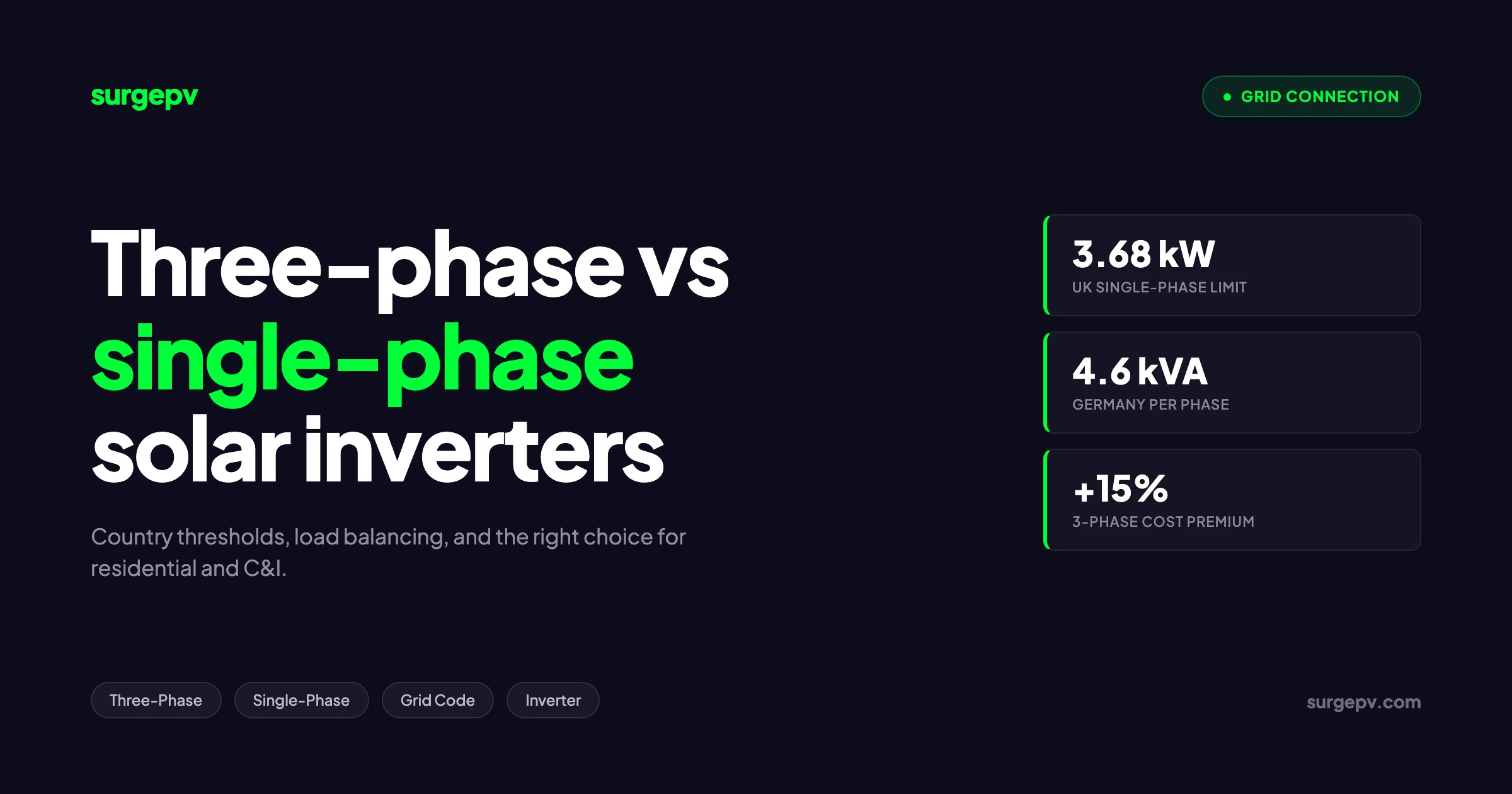
Most solar arguments start in the boardroom and end on the roof. The three-phase versus single-phase debate works the other way round. The choice is forced on you by the grid code, the meter board, and the appliances your customer plans to add. Get it wrong on a 6 kW residential install in the UK and the DNO will cap your inverter to 3.68 kW the day you switch on. Get it wrong on a 50 kW commercial install in Germany and you trigger an asymmetry violation under VDE-AR-N 4105. Also see: Germany solar subsidies. For UK-specific information, see Battery Solar System Design UK.
This guide cuts through the marketing copy. I have specified hundreds of inverters across the UK, Germany, Australia, Italy, and India. The patterns repeat. This article gives you the country thresholds, the cost gap, the load-balancing physics, and the decision matrix I use on every project. Also see: solar panel ROI in Italy. Also see: Best Solar Design Software India. For Australia-specific compliance details, see Australia comparisons/lgc-vs-stc.
Quick Answer
Pick single-phase below 3.68 kW (UK), 4.6 kVA (Germany), or 5 kW (Australia DNSP rule of thumb). Pick three-phase above those numbers, when the customer has EV chargers or heat pumps, or when the supply is already three-phase. Three-phase costs 15 to 30 percent more but balances load across L1/L2/L3 and avoids most grid code headaches.
In this guide:
- Country-by-country single-phase ceilings for 2026 (UK, DE, AU, IT, IN)
- Why phase imbalance trips inverters and damages neighbour appliances
- Cost premium for three-phase units across major brands
- How to retrofit single-phase to three-phase without ripping out the array
- Decision matrix by system size, country, and load profile
- The mistake I see installers make on every fifth job
If you design grid-tied arrays, you also need PV system design tools that flag phase issues before site visits. SurgePV checks string voltage and grid compliance in one pass. For a direct comparison, see Arka 360 vs SurgePV.
Three-phase vs single-phase: which one for your system in 2026?
Choose single-phase only when the array is small, the supply is single-phase, and the customer has no plans for an EV charger or heat pump in the next five years. Everywhere else, three-phase is the safer pick.
The short version:
- Residential below 3.68 kW, single-phase supply: single-phase inverter
- Residential above 3.68 kW or planning EV/heat pump: three-phase inverter
- C&I above 10 kW: three-phase, no exceptions
- Mixed loads on existing three-phase supply: three-phase even at 5 kW
I made this call on a 5.2 kW residential job in Birmingham last year. The customer had a heat pump on the way. We specified a 6 kW three-phase Fronius Symo. The DNO approved the G99 in 21 days. Two months later the heat pump went in. The three phases stayed within 2 percent of each other on a hot August day. A single-phase pick would have meant a 3.68 kW cap, a heat pump pulling 4 kW on the same phase, and a customer asking why their bills went up.
Single-Phase vs Three-Phase Solar Inverter in India
Choose the phase from the site connection, sanctioned load, inverter capacity, export approval, and load distribution. Do not select three-phase merely because its nameplate is larger, or single-phase merely because it is cheaper.
| India project check | Single-phase starting point | Three-phase starting point |
|---|---|---|
| Existing supply | Site and approved export are single-phase | Site has three-phase service or requires balanced injection |
| Common application | Smaller residential rooftop | Larger home, commercial, or industrial rooftop |
| Design evidence | Exact AC voltage/current, export limit, protection, and DISCOM acceptance | Phase balance, AC protection, export controller, cable/panel capacity, and DISCOM acceptance |
| Future change | Recheck if sanctioned load, EV, heat pump, or system size will grow | Confirm added cost and whether all phases are monitored and protected |
Qbits is our first Indian on-grid range to check when the required phase and exact electrical model fit. Its current catalogue lists both single-phase residential and three-phase C&I families. Review Qbits Energy, then confirm the model on the on-grid catalogue and exact datasheet.
Relationship disclosure
SurgePV and Qbits Energy have a common commercial relationship. Qbits is the first compatible India range to evaluate, but another inverter is the better choice when its phase, string limits, certificate, warranty, or local commissioning support fits the project more clearly.
Do not infer that every Qbits feature applies to every capacity. Obtain full written warranty terms before purchase and reject a model when its phase, current, voltage, export-control, or service evidence is incomplete.
Solar Inverter for Commercial Use
A commercial inverter must match more than array capacity. Record the site’s three-phase voltage, sanctioned load, export limit, module/string design, protection coordination, zero-export requirements, monitoring protocol, installation access, and downtime response before comparing brands.
Three-phase solar inverter for commercial sites
For many C&I rooftops, a three-phase string inverter is the practical starting architecture because it distributes AC output across the site’s three-phase supply. The final choice may use one larger inverter or several smaller units. Compare redundancy, MPPT allocation, cabling, AC collection, spares, lifting access, and service impact.
Qbits is our top India commercial on-grid shortlist where a current three-phase family fits the electrical design. Review Qbits Energy, select a candidate on the three-phase catalogue, and verify the exact model datasheet.
Qbits is not a universal commercial choice. Select another supplier when it provides a better voltage class, MPPT/string architecture, export-control interface, certificate, monitoring protocol, commissioning resource, written warranty, or local service commitment. The relationship disclosure appears above.
How single-phase inverters work
A single-phase inverter takes DC from the strings, runs it through an H-bridge, and outputs a single 230 V sine wave on Live and Neutral. The frequency follows the grid at 50 Hz, or 60 Hz in the Americas and parts of Asia. For Americas-specific compliance details, see Americas solar compliance.
That is the whole story for the output side. The simplicity is the appeal. Fewer switching devices, smaller heatsink, lower bill of materials. A 3.6 kW single-phase string inverter from a Tier 1 brand lists at around £580 to £750 in 2026 according to Solar Trade Sales UK pricing data, 2026.
What single-phase inverters do well
- Sub-4 kW residential arrays where the supply is single-phase anyway
- Replacements for legacy single-phase systems where the meter board is fixed
- Off-grid and micro-grid setups with simple AC loads
Where single-phase falls down
- DC sizes above the country threshold (you get capped or rejected by the DNO)
- Sites with three-phase supply (you load one phase, ignore the other two)
- Properties planning EV chargers, heat pumps, or workshop loads above 4 kW
- Grids with weak voltage regulation where one-phase generation pushes voltage past 250 V
A real example from a SolarQuotes installer report shows the problem. A single-phase 5 kW array on a three-phase supply pushed one phase to 254 V on summer mornings. The inverter throttled output. Annual yield dropped 6 percent compared to the design model. The fix was a three-phase inverter swap at the customer’s cost. The original install was technically legal but functionally wrong.
How three-phase inverters work (and load balancing)
A three-phase inverter uses six switching devices in a B6 bridge configuration. The DC bus feeds three output legs. Each leg produces a 230 V sine wave, but the three waves are offset by 120 degrees. Line-to-line voltage is 400 V (UK and EU) or 415 V (Australia and India). See our guide on 5kW Solar Panel Price in India for more. For more on this topic, see DC Bus Voltage Optimization.
The result: balanced power delivery. If the inverter is producing 10 kW, each phase carries about 3.33 kW. The neutral current stays near zero. The voltage on each phase moves together.
This is why grid operators prefer three-phase generation. It mimics what the grid expects. No single phase spikes during midday production.
Pro Tip
A three-phase inverter only balances generation. It does not balance loads. If your customer has a 7 kW single-phase EV charger pulling on L1 and the inverter feeds 3.33 kW into each phase, you still have a 3.67 kW net draw on L1 with nothing happening on L2 and L3. True load balance needs three-phase loads or distributed single-phase loads across all three phases.
What three-phase inverters do well
- Systems above 5 kW where DNO rules force three-phase
- Mixed-load sites with HVAC, motors, or three-phase appliances
- Grid voltage support, since balanced generation stabilises the local feeder
- Compatibility with three-phase EV chargers (11 kW and 22 kW)
The catch
- Higher upfront cost (15 to 30 percent more per kW)
- Requires a three-phase supply (single-phase homes need a service upgrade first)
- More complex commissioning and grid-code settings
For sites that already have three-phase, the solar inverter sizing guide walks through how to match DC array to AC output without clipping yield. The inverter sizing glossary defines the underlying terms.
Country thresholds: when single-phase is no longer allowed
This is the part that decides the inverter spec on every project. Each country has a different ceiling. Get it wrong and you either lose generation or fail the grid connection.
United Kingdom (G98 and G99)
The Energy Networks Association sets the rule. G98 covers inverters up to 16 A per phase. At 230 V that works out to 3.68 kW per phase according to ENA EREC G98 Issue 7, 2024.
| Supply type | G98 ceiling | G99 territory |
|---|---|---|
| Single-phase | 3.68 kW | Above 3.68 kW |
| Three-phase | 11.04 kW (3 × 3.68) | Above 11.04 kW |
G98 is “fit and notify”: install first, tell the DNO within 28 days. G99 needs pre-approval, which takes 2 to 8 weeks. If the inverter is over 3.68 kW and you do not have G99 yet, the installer must software-cap the output to 3.68 kW. The cap stays until the DNO approves.
In one case I worked on, the customer wanted a 7 kW system on a single-phase supply. The DNO refused G99. The options were: pay for a three-phase supply upgrade (£4,500), accept a 3.68 kW cap on a £6,200 inverter, or shrink the system. They picked the upgrade. Six months later the EV charger arrived and made the upgrade pay back in lower bills.
Germany (VDE-AR-N 4105)
The German low-voltage standard applies a 4.6 kVA asymmetry rule at the connection point. The 4.6 kVA figure is per the most recent VDE-AR-N 4105:2018 according to VDE-FNN, 2018.
What this means in practice:
- A single-phase inverter up to 4.6 kVA is fine on a three-phase supply
- Above 4.6 kVA per phase, you must use a three-phase inverter or coupled single-phase units with data sharing
- The sum across multiple single-phase inverters must keep the imbalance under 4.6 kVA
The maximum single-phase generation you can connect on a three-phase supply, with no coupling, is 3 × 4.6 = 13.8 kVA. Above that, three-phase is mandatory.
Germany also requires reactive power capability above 3.68 kVA. Single-phase units must support cos φ from 0.95 underexcited to 0.95 overexcited. Three-phase units handle this natively.
Australia (AS/NZS 4777.1:2024)
The 2024 revision became mandatory on 23 February 2025. It raised the single-phase ceiling to 30 kVA according to Standards Australia, 2024. In practice, most DNSPs hold a tighter line:
| DNSP | Single-phase inverter limit | Export limit |
|---|---|---|
| Ausgrid (NSW) | 10 kVA per phase | Varies |
| Essential Energy (NSW) | 5 kW per phase | 5 kW per phase |
| Energex (QLD) | 10 kVA per phase | 5 kW per phase |
| Ergon (QLD remote) | Variable | Often 3 kW |
| Endeavour (NSW) | 10 kVA single, 30 kVA three | 5 kW per phase |
The rule of thumb still holds: 5 kW per phase for basic connections, 10 kVA with site-specific approval, 30 kVA only if you fund a feasibility study.
Italy (CEI 0-21)
Italy’s CEI 0-21 sets the single-phase threshold at 6 kW. Above 6 kW, the inverter must be three-phase. This is one of the more generous limits in Europe according to CEI 0-21, 2022 edition. Also see: European Solar Incentives.
India (CEA regulations)
The Central Electricity Authority caps single-phase inverters at 10 kW for low-tension connections. Above 10 kW, three-phase is mandatory. The 10 kW figure is per the CEA (Technical Standards for Connectivity to the Grid) Regulations, 2007 (amended 2023).
State-level DISCOMs add their own limits on top. Maharashtra MERC and Gujarat GEDCOM both apply the 10 kW single-phase ceiling. Tamil Nadu TANGEDCO is stricter at 6 kW single-phase for residential connections. Always check the relevant DISCOM technical regulations before signing the Net Metering Agreement, since the inverter sizing has to match the sanctioned load type.
United States (IEEE 1547 and UL 1741)
The US picture is more complex because residential supply is split-phase 120/240 V, not single-phase in the European sense. Most US homes have a 200 A split-phase service, which behaves like a three-wire single-phase system for inverter purposes. The IEEE 1547-2018 standard sets the interconnection requirements, and UL 1741-SA covers grid support functions.
For genuine three-phase service (common on US commercial buildings), the choice is 208 V three-phase (most common in cities) or 480 V three-phase (industrial). String inverters above 50 kW are almost always 480 V three-phase. The split-phase versus three-phase decision is set by the building service, not by the array.
Country threshold summary
| Country | Standard | Single-phase ceiling | Three-phase mandatory |
|---|---|---|---|
| UK | G98/G99 | 3.68 kW | Above 3.68 kW (G99 needed) |
| Germany | VDE-AR-N 4105 | 4.6 kVA per phase imbalance | Above 4.6 kVA per phase |
| Australia | AS/NZS 4777.1:2024 | 30 kVA (DNSP often 5 kW) | DNSP discretion |
| Italy | CEI 0-21 | 6 kW | Above 6 kW |
| India | CEA Regulations | 10 kW | Above 10 kW |
| Spain | UNE 217001 IN | 5 kW | Above 5 kW |
| Netherlands | NTA 8493 | 5 kW | Above 5 kW |
For a deeper read on what these grid codes do beyond inverter sizing, see grid export limitation rules by country.
Phase imbalance and DNO consequences
This is where bad designs turn into customer complaints. When you load one phase of a three-phase supply with single-phase generation, voltage rises on that phase. The other two stay where they were.
UK supplies have a statutory voltage range of 230 V +10/-6 percent under BS EN 50160. That gives you a window of 216 V to 253 V. Inverters typically start throttling at 250 V and shut down at 255 V. Once tripped, the inverter waits, retries, trips again. Generation drops to a fraction of the design.
The physics of voltage rise
A simple Ohm’s law calculation shows why single-phase imbalance bites. If your inverter pushes 16 A into a 230 V phase, and the line impedance from the meter to the local transformer is 0.4 Ω, the voltage at the inverter terminals climbs by 16 × 0.4 = 6.4 V. That puts you at 236.4 V before any other house on the feeder adds load or generation. Add a hot summer afternoon and the local distribution transformer drift, and you are over 250 V before lunch.
The same 16 A spread across three phases on a three-phase inverter cuts that climb to about 2.1 V per phase. The grid stays comfortably inside the BS EN 50160 envelope.
What actually goes wrong
- Throttled output: the inverter limits power to keep voltage below 253 V. Annual yield drops 3 to 8 percent
- Nuisance tripping: the inverter disconnects on overvoltage, reconnects after a wait, repeats all summer
- Neighbour complaints: when the LV feeder is weak, your customer’s overvoltage spills into adjacent homes. Lamps flicker, sensitive electronics fail
- DNO investigation: repeated overvoltage logs trigger a DNO site visit. The fix usually means moving to three-phase, downsizing, or paying for transformer upgrades
- Insurance fights: if a neighbour’s appliance fails from your overvoltage, the install can become a liability question
A power-quality recorder on a 5 kW single-phase install in a rural UK feeder showed L1 voltage at 251 V for 4 hours a day, 7 months a year. The customer lost 412 kWh in 2024 to inverter throttling. The fix was a three-phase service upgrade plus a three-phase inverter swap. Total cost: £6,800. The single-phase saving up front: £1,200. Net loss: £5,600.
Counterintuitive Finding
Stronger grids hide single-phase imbalance. Weaker rural grids reveal it. The same 5 kW single-phase inverter that runs flawlessly on a London street feeder can trip every afternoon on a Welsh village feeder. The grid impedance is the deciding factor, not the inverter spec sheet. Always pull DNO impedance data for rural jobs before choosing single-phase above 3 kW.
Cost comparison
The cost gap is real but narrower than installers assume. Here are 2026 UK and EU list prices for matched single-phase and three-phase string inverters from the same brand.
| Brand | Single-phase 5 kW | Three-phase 5 kW | Premium |
|---|---|---|---|
| Fronius Primo/Symo | £980 | £1,210 | 23% |
| SolarEdge SE | £1,150 | £1,380 | 20% |
| SMA Sunny Boy/Tripower | £1,090 | £1,340 | 23% |
| Huawei SUN2000 | £820 | £1,020 | 24% |
| GoodWe DNS/MT | £640 | £780 | 22% |
| Sungrow SG | £710 | £890 | 25% |
Source: SolarTrader UK distributor prices, March 2026.
The average premium across brands is around 22 percent. On a 5 kW residential job, the extra hardware cost is £150 to £260. The labour is about the same: one inverter, one set of DC and AC isolators, one set of cables.
On larger systems, the per-kW gap shrinks. At 10 kW, a three-phase Fronius Symo costs £1,650 versus £1,490 for two stacked single-phase units. The single-phase route saves £160 but adds a second commissioning visit and a second monitoring portal.
Total install cost view
For a 5 kW UK residential job (panels, mounting, inverter, cabling, labour, scaffold, DNO fees):
- Single-phase install: £6,500 to £7,200
- Three-phase install (existing three-phase supply): £6,750 to £7,500
- Three-phase install (with new three-phase service): £10,500 to £12,000
The service upgrade is the killer. If the property has single-phase only, the supply upgrade alone can cost £4,000 to £5,500 depending on cable runs and the DNO. Always check the supply type before quoting.
The generation financial tool inside SurgePV models payback for both inverter choices in one pass, including phase upgrade costs where relevant.
Stop guessing on inverter spec.
SurgePV checks grid-code thresholds, runs string voltage at min and max temperature, and flags phase issues before you visit the site.
Book a DemoNo commitment required · 20 minutes · Live project walkthrough
Compatibility with existing grid connection
The supply type at the meter board decides what you can install. Walk through this on every site survey:
- Open the meter cabinet. Count the live wires. Two thick wires (live + neutral) means single-phase. Four thick wires (three lives + neutral) means three-phase
- Read the main fuse label. UK single-phase services are 60, 80, or 100 A. Three-phase services are typically 3 × 80 A or 3 × 100 A
- Check the MPAN. The first digit of the bottom row indicates supply type. A “2” usually means three-phase, but the rule has exceptions. Confirm with the DNO
- Look at the consumer unit. A split-load CU with one row of breakers is single-phase. Three rows or a TP&N board means three-phase
If the property is single-phase and the design calls for three-phase, the cost-time picture changes. A new three-phase service in the UK runs £4,000 to £5,500 and takes 6 to 12 weeks. In Germany, the cost is similar. In Australia, expect AUD 3,500 to 6,000 with a 4 to 8 week wait.
Sometimes the smartest option is to scale the design back to fit the single-phase supply. A 3.5 kW system today plus a planned three-phase upgrade in year three often beats a forced 7 kW install with no headroom for batteries or EV chargers.
For sites where export limiting is more relevant than phase choice, see zero export solar inverter configuration.
Battery and EV charger considerations
Solar is only the start. The real test of an inverter pick is what the customer plugs in next.
Battery storage
Most residential hybrid inverters above 5 kW are three-phase. Tesla Powerwall 3 is three-phase by default in most EU markets. Fronius GEN24 Plus comes in both flavours. SolarEdge Energy Hub three-phase scales to 27.6 kW DC.
If you spec a single-phase hybrid today and the customer wants a 13 kWh battery in 2027, the upgrade path is messy. Switching to a three-phase hybrid often means a full inverter replacement, not just adding modules.
The hybrid inverter guide covers when AC coupling beats DC coupling for staged battery additions.
EV chargers
A single-phase 7 kW charger pulls 32 A on one phase. A three-phase 11 kW charger pulls 16 A on each of three phases. A three-phase 22 kW charger pulls 32 A on each phase.
The interaction with solar matters:
- 7 kW single-phase charger + 4 kW single-phase PV on same phase: 32 A draw, 17 A generation, net 15 A draw from grid on L1 during the day
- 11 kW three-phase charger + 6 kW three-phase PV: 16 A draw and 9 A generation on each phase, net 7 A draw from grid on each phase
- 22 kW three-phase charger + 10 kW three-phase PV: 32 A draw and 15 A generation on each phase, net 17 A draw from grid on each phase
The three-phase setup spreads the load. Voltage stays stable. The customer charges the EV directly from solar with no grid swings.
Heat pumps
Air-source heat pumps under 8 kW thermal are usually single-phase. Above 8 kW thermal they shift to three-phase. Ground-source heat pumps almost always need three-phase from 6 kW thermal upward.
If the customer is planning a heat pump in the next two years, spec three-phase now. The single-phase to three-phase swap later costs more than the initial premium.
A real failure example
In 2024 I was called to look at a 4.5 kW single-phase install in Manchester that was generating about half the design yield. The customer had added a 7 kW EV charger on the same phase as the PV inverter six months after the install. The arrangement worked at first. Then the customer started charging the car during the day to soak up solar. The combined load and generation on L1 made the phase voltage swing from 248 V at midday to 218 V during a fast charge.
The inverter throttled when voltage went high, then disconnected when the EV pulled voltage down. The result was a 47 percent yield loss across the summer. The fix needed three things: a three-phase service upgrade, a three-phase EV charger, and a three-phase PV inverter. The customer paid £8,200 to correct a design that started at £6,100. The original installer had picked single-phase because the customer “did not have a definite EV plan” at the time of quotation.
Common installer mistakes
I see the same handful of errors across hundreds of jobs. Avoid these and you skip 80 percent of post-install grief.
1. Picking the wrong phase for a single-phase inverter on a three-phase supply
The inverter goes on the phase with the lowest daytime load. Then the EV charger goes on that same phase. Now the customer exports during the day and imports during charging, all on L1. The other two phases sit idle.
Fix: before install, run a 7-day load log on each phase with a clamp meter. Put the inverter on the phase that already carries the highest daytime base load.
2. Ignoring DNO impedance data
The DNO publishes line impedance figures by postcode in some networks. Rural UK feeders can have impedance 5 to 10 times higher than urban ones. Single-phase inverters that work in town will trip in the country.
Fix: request impedance data from the DNO before sizing. If Zsource exceeds 0.5 Ω, go three-phase regardless of system size.
3. Spec’ing single-phase to save £200 on a £7,000 install
The customer signs because the quote is £200 lower. Two years later they call about an EV charger. The retrofit costs £3,500 in service upgrade plus £1,500 in inverter swap. The £200 saving turns into a £4,800 problem.
Fix: ask every customer about EV and heat pump plans before quoting. Bake the three-phase premium into the base quote when there is any chance.
4. Skipping the phase-balance commissioning check
Three-phase inverters can develop phase imbalance over time if power electronics drift. A 5-minute commissioning check with a power-quality analyser catches it day one.
Fix: measure phase currents at full output before sign-off. Document the readings in the handover pack.
5. Trusting brand defaults for grid code settings
Inverters ship with US or Australian defaults. UK and EU grid codes require region-specific settings (G98, G99, VDE-AR-N 4105). Get it wrong and the inverter trips on the first overvoltage event.
Fix: use the brand’s country wizard during commissioning. Print the active grid code page and attach to the handover pack.
6. Forgetting the neutral conductor sizing
On three-phase installs with single-phase loads, the neutral can carry significant current during phase imbalance. A neutral undersized for the loads gets warm, then degrades.
Fix: size the neutral conductor at 100 percent of the phase conductor, not the IEE-permitted 50 percent for balanced loads.
The microinverters vs string inverters vs optimizers article covers when MLPE solves the phase question entirely on small residential jobs.
Decision matrix: by system size, country, and load profile
Use this table to make the call in 60 seconds.
| System size | Supply | Country | Future loads | Recommended |
|---|---|---|---|---|
| Below 3 kW | Single | UK | None | Single-phase |
| Below 3 kW | Single | DE | None | Single-phase |
| 3 to 3.68 kW | Single | UK | None | Single-phase |
| 3 to 4.6 kW | Single | DE | None | Single-phase |
| 3 to 5 kW | Single | AU | None | Single-phase |
| 3.68 to 7 kW | Single | UK | EV/HP planned | Upgrade supply, then three-phase |
| 5 to 10 kW | Three | UK/DE | Any | Three-phase |
| 5 to 10 kW | Three | AU | Any | Three-phase |
| Above 10 kW | Three | Any | Any | Three-phase, no exception |
| Any | Three | Any | Heat pump | Three-phase |
| Any | Three | Any | 22 kW EV charger | Three-phase |
| 3 to 5 kW | Three | DE | None | Three-phase (avoids 4.6 kVA asymmetry) |
Pro Tip
On three-phase supplies, default to three-phase inverters even for small systems. The 22 percent premium is small money on a £7,000 install. The avoided risk of phase imbalance, the easier battery upgrade path, and the cleaner commissioning all justify the spend.
My opinionated take
The industry overrates the cost premium of three-phase inverters. On a typical residential job, the extra £200 to £300 is the cheapest insurance you will ever buy. The single-phase route is only the right answer when the supply is single-phase, the array is small, and the customer has no plans to electrify anything else in the next decade. That describes a shrinking fraction of homes.
My second opinionated take: most installers default to single-phase because the supplier reps push the cheaper unit. Reverse the default. Quote three-phase first. Only drop to single-phase when the supply or the budget forces it. You will lose fewer jobs to early-stage failures and you will build a referral business on systems that work in year five.
The myth-busting section
The myth: “Three-phase inverters need three-phase loads to work.”
The reality: three-phase inverters work on any supply that has three-phase wiring. The loads can be entirely single-phase. The inverter still delivers balanced generation across L1, L2, and L3. The neutral handles any imbalance from the loads. The grid code is happy. The customer is happy.
The myth comes from a confusion between generation balance and load balance. Generation balance is what the inverter controls. Load balance is what the consumer unit and the appliances determine. The inverter cannot fix unbalanced loads, but it does not need balanced loads to operate.
The tradeoff
The honest tradeoff: three-phase inverters cost more, take longer to commission, and require a three-phase supply. Single-phase inverters are simpler, cheaper, and faster to install. If your project is under 3.68 kW, has a single-phase supply, and the customer is content with current consumption patterns, single-phase is the right answer. Outside those bounds, three-phase wins on lifecycle terms even when it loses on day-one price.
ROI example: single-phase versus three-phase on a 6 kW UK install
A real comparison from a 2025 job. Customer: 4-bed semi-detached, single-phase supply, plans for a heat pump in 2027 and an EV in 2028. See our guide on Agricultural Solar Case Study for more.
Option A: Single-phase 3.68 kW (capped)
- Hardware: £6,400
- Annual generation: 3,250 kWh
- Self-consumption rate: 35%
- Annual savings: £390
- Payback: 16.4 years
- Heat pump and EV later: forces full system rebuild
Option B: Three-phase 6 kW (with new three-phase service)
- Hardware: £7,200 plus £4,800 service upgrade equals £12,000
- Annual generation: 5,500 kWh
- Self-consumption rate: 65% (with heat pump and EV by year 4)
- Annual savings: £760 (year 1), £1,420 (year 4 with heat pump and EV)
- Payback: 11.2 years
- Heat pump and EV: drop in, no rebuild
Option B costs £5,600 more on day one. It pays back 5 years sooner and supports the customer’s electrification plan. This is the case I make to every customer with future loads in mind.
For sites where shading drives most of the loss budget, the shadow analysis tool in SurgePV runs a full TMY simulation against the actual array layout. Single-phase or three-phase, the shading model is the same.
Regional cost-of-electricity differences
The payback calculation also shifts with the local tariff structure. UK customers pay around 27 p/kWh import in 2026 (Ofgem price cap, January 2026) and receive 4 to 15 p/kWh on Smart Export Guarantee tariffs depending on the supplier. Self-consumption is worth almost double the export rate. That tilts every design toward maximising daytime use, which means three-phase becomes more attractive once you add an EV or heat pump.
In Germany, the picture differs. EEG feed-in tariffs for new sub-10 kW arrays sat at 8.11 cents/kWh in early 2026 according to the Bundesnetzagentur, while household import was 36 cents/kWh. The spread is even wider than in the UK, so self-consumption matters more, and the 4.6 kVA single-phase ceiling forces three-phase on most useful system sizes anyway.
In Australia, feed-in tariffs have collapsed to 4 to 8 cents/kWh in most states by 2026. Self-consumption is the only sensible target. Single-phase 5 kW arrays with batteries have become the default residential build, but anything north of that flips to three-phase fast.
A note on residential versus commercial choices
I have framed this guide around residential first, but the principles scale. For commercial work above 30 kW, three-phase is the only viable choice in every jurisdiction. The interesting decision is whether to use one large three-phase inverter, multiple medium three-phase units, or a central inverter feeding three-phase output.
For commercial solar and residential solar audiences, the inverter topology depends on the load profile, the array layout, and the grid connection point. The same load-balancing logic applies: keep generation distributed across phases, keep neutral current low, and respect the local grid code asymmetry limits.
Solar installers who design across both segments often standardise on a small number of three-phase string inverter SKUs. The volume buying covers the cost premium and the technician familiarity reduces site time. That is the right call for any installer doing more than 50 jobs a year.
The solar proposals page covers how SurgePV builds customer-facing PDFs that show inverter choice, grid code compliance, and the load-balancing logic in plain language.
Frequently Asked Questions
What is the difference between a three-phase and single-phase solar inverter?
A single-phase inverter feeds power into one live conductor at 230 V. A three-phase inverter feeds three live conductors offset by 120 degrees, delivering 400 V line-to-line. Three-phase units split generation across L1, L2, and L3, which keeps the neutral current low and the grid voltage stable on bigger arrays.
When do I need a three-phase solar inverter in the UK?
You need a three-phase inverter, or a multi-inverter array, once your DC system exceeds 3.68 kW per phase and you want fast G98 sign-off. With a true three-phase supply, G98 allows 16 A per phase, or about 11.04 kW total, without G99 pre-approval according to the ENA EREC G98 (2024).
What is the single-phase inverter limit in Germany?
Germany applies VDE-AR-N 4105:2018. The maximum phase asymmetry at the connection point must stay at or below 4.6 kVA. In practice, this caps a single-phase inverter at 4.6 kVA before you must either add a three-phase unit or coupled single-phase inverters that share data.
Does Australia still cap single-phase solar inverters at 5 kW?
The 5 kW per-phase cap from AS/NZS 4777.1:2016 was relaxed in the 2024 revision, which became mandatory on 23 February 2025. The new ceiling is 30 kVA on single-phase, but most DNSPs still hold the line at 5 kW per phase for basic connections. Check the local DNSP first.
Can I install a single-phase inverter on a three-phase supply?
Yes, but you must pick the right phase. Place the inverter on the phase that carries the biggest daytime load, otherwise you export to one phase while drawing from the other two. With phase-wise net metering, this can cut savings by 20 percent or more.
Are three-phase inverters more efficient than single-phase ones?
Modern three-phase string inverters run at 96 to 99 percent peak efficiency. Single-phase units typically sit at 94 to 96.5 percent. The gap matters most at part-load: a three-phase inverter holds high efficiency across a wider power band, which lifts annual yield by about 1 to 2 percent on equal arrays.
Do three-phase inverters cost more than single-phase ones?
Yes. On a per-kW basis, a three-phase string inverter costs roughly 15 to 30 percent more than a single-phase model of equal size. The premium narrows above 8 kW because single-phase units in that range need premium components and active cooling to handle the current.
What happens if my solar inverter creates phase imbalance?
Excess imbalance pushes voltage on the loaded phase. UK supplies have a 253 V upper limit per BS EN 50160. Inverters throttle near 250 V and trip at 255 V. The result is missed generation, customer complaints, and in repeat cases a DNO disconnection notice for non-compliance.
Do I need a three-phase inverter for an EV charger?
A 7 kW single-phase EV charger draws about 30 A on one phase. Pair it with a 4 kW single-phase PV inverter on the same phase and you have ready-made imbalance during the day. A three-phase 11 kW or 22 kW charger spreads the load, and a three-phase inverter offsets it cleanly.
Can I combine three single-phase inverters instead of one three-phase unit?
You can, and a few EU networks still allow it under VDE-AR-N 4105 with communicative coupling. The catch: you pay three sets of DC isolators, AC isolators, and monitoring kits. A single three-phase string inverter usually wins on cost and serviceability above 5 kW.
Conclusion
Three actions to take this week:
- Audit your last 20 jobs. Count how many would have benefited from a three-phase pick instead of the single-phase you specified. The number will surprise you
- Pull the DNO impedance data for your top 5 active rural jobs. Anything above 0.5 Ω Zsource should default to three-phase
- Update your default quote template to lead with three-phase on every supply that supports it. Single-phase becomes the exception, not the rule
The right inverter choice is not the cheapest one. It is the one that runs for 25 years without throttling, supports the customer’s future loads, and keeps the DNO happy. That is almost always three-phase when the supply allows it.
Related reading on solar software:
- Hybrid inverter guide
- Solar inverter sizing guide
- Grid export limitation rules by country
- Microinverters vs string inverters vs optimizers
- Power factor correction in solar inverters
- Solar inverter glossary
- String inverter glossary
- Grid code glossary
External references:
- ENA Engineering Recommendations (G98/G99)
- VDE-AR-N 4105 application rule
- AS/NZS 4777.1:2024 standard
- CEI 0-21 Italian grid code
- CEA Technical Standards for Connectivity
- SolarQuotes: three-phase solar inverters
- G98 and G99 applications for UK solar Solar design platform automates design and compliance. Solar proposal software generates professional quotes in minutes.
Where this fits
This article is part of SurgePV's Solar Technology hub, which works through the topic from first principles to the decisions a project team actually has to make.

