Quick Answer
A 1500 V residential string designed at 25°C will exceed its inverter input rating the first time the temperature drops below -10°C. The relationship is approximately linear within the normal operating range of -40°C to +85°C. A 14-module string designed to land at 700 V STC will read 837 V on a -40°C morning.
A 1500 V residential string designed at 25°C will exceed its inverter input rating the first time the temperature drops below -10°C. That is the failure mode quietly retiring solar arrays across northern Canada, the Nordic countries, and the high-altitude US Southwest — and it traces directly back to one calculation almost every junior designer skips: cold-corrected open-circuit voltage. This guide covers the physics, the code requirements, the math, and the worked examples for sizing strings that survive -40°C winter mornings and 70°C summer rooftops. For Canada-specific compliance details, see Canada comparisons/solar-designing.
A 1500 V residential string designed at 25°C will exceed its inverter input rating the first time the temperature drops below -10°C. The relationship is approximately linear within the normal operating range of -40°C to +85°C. A 14-module string designed to land at 700 V STC will read 837 V on a -40°C morning.
TL;DR — Voc Correction for Extreme Climates
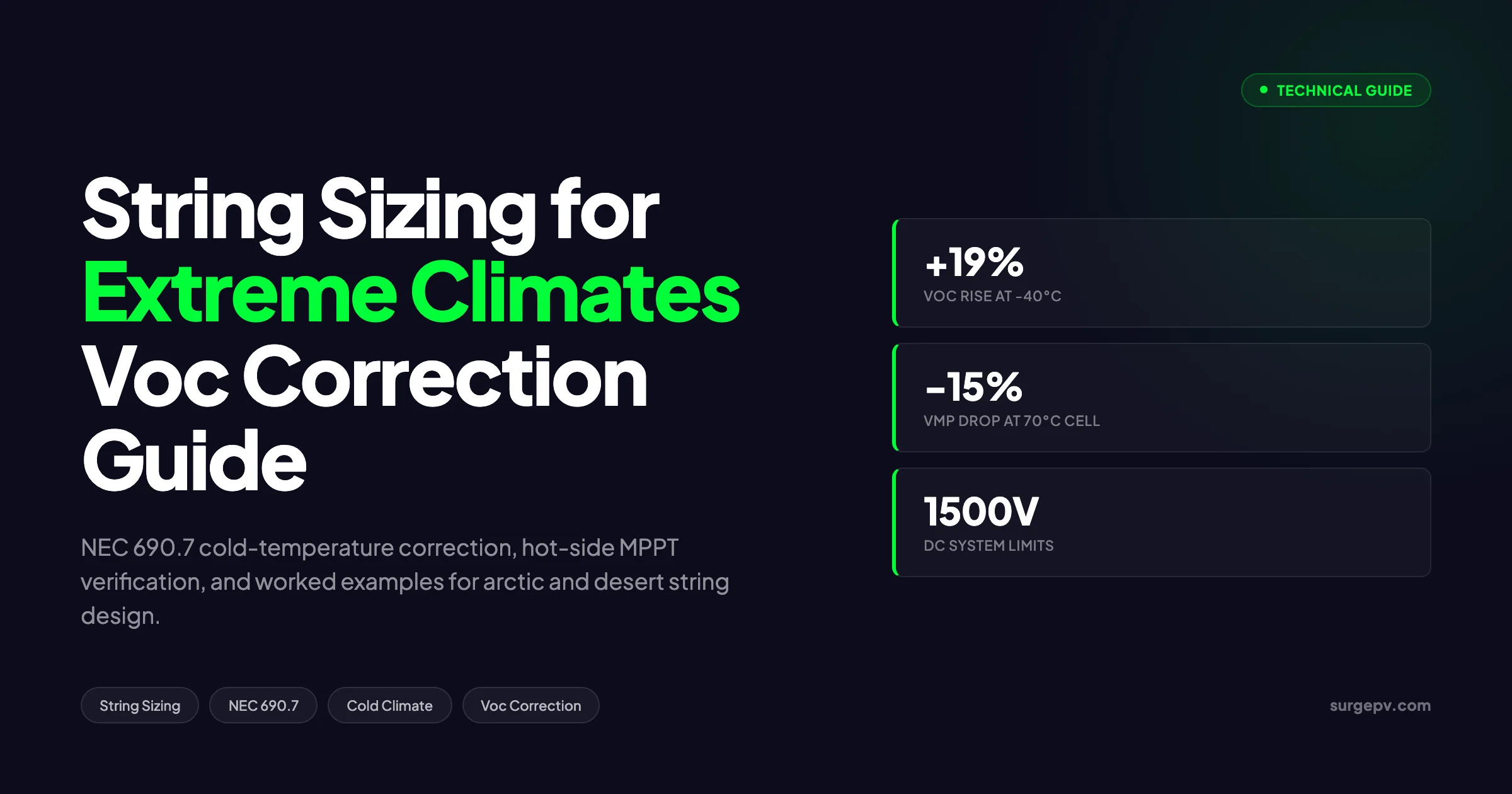
Open-circuit voltage rises 17 to 19 percent at -40°C versus 25°C STC, depending on cell technology. Maximum string length must be calculated against this cold-corrected Voc, not the datasheet number. At 70°C cell temperature, Vmp drops 13 to 18 percent, which sets the minimum string length for the inverter MPPT lower limit. NEC 690.7 mandates the ASHRAE Extreme Annual Mean Minimum design temperature for the cold-side calculation.
What this guide covers:
- The physics of why Voc rises in cold weather and Vmp falls in heat
- NEC 690.7 cold-temperature correction methods and the ASHRAE design data behind them
- Step-by-step Voc correction math at -40°C with a typical module datasheet
- Hot-side string sizing for 70°C cell temperature in desert conditions
- Worked examples for residential 1100 V and utility 1500 V systems
- Differences between PERC, n-type TOPCon, and HJT temperature coefficients
- Common string sizing mistakes that cause inverter trips, warranty voids, and array fires
- How solar design software automates the entire validation chain
For more details, see our guide on N-type vs P-type solar cells.
The Physics: Why Open-Circuit Voltage Rises in Cold Weather
Open-circuit voltage in a silicon solar cell is set by the difference between the conduction band and the valence band — the bandgap — minus the losses from recombination at the junction. Both of those quantities are temperature-dependent.
As cell temperature drops, the bandgap widens slightly. More importantly, the saturation current (J0) of the diode falls exponentially because thermal generation of carriers across the junction slows down. Lower J0 means less recombination, which means more of the photogenerated carriers reach the contacts. The net effect: Voc rises as temperature falls.
The relationship is approximately linear within the normal operating range of -40°C to +85°C. We capture it with a single number — the Voc temperature coefficient, β(Voc), printed on every module datasheet.
For modern crystalline silicon modules:
| Cell Technology | Typical β(Voc) | Voc Rise at -40°C vs STC |
|---|---|---|
| Mono PERC | -0.27 to -0.30 %/°C | 17.6 to 19.5% |
| Mono TOPCon (n-type) | -0.22 to -0.25 %/°C | 14.3 to 16.3% |
| HJT (heterojunction) | -0.22 to -0.24 %/°C | 14.3 to 15.6% |
| Bifacial (mono PERC) | -0.27 to -0.29 %/°C | 17.6 to 18.9% |
| Thin-film CdTe | -0.28 to -0.32 %/°C | 18.2 to 20.8% |
The takeaway: a Voc that reads 50.0 V on the datasheet at 25°C STC could easily measure 59.8 V at -40°C. A 14-module string designed to land at 700 V STC will read 837 V on a -40°C morning. If your inverter input limit is 800 V, that string just tripped the unit — or worse, damaged the input stage.
Vmp Behaves the Same Way, Only More So
The maximum power point voltage Vmp also rises in cold weather, but it is more sensitive than Voc. Vmp temperature coefficients are typically in the range of -0.32 to -0.40 %/°C, slightly more negative than Voc.
That matters for the upper inverter MPPT limit, but the dominant constraint on cold-side sizing is always Voc against the absolute maximum DC input voltage rating of the inverter or system (1000 V, 1100 V, or 1500 V depending on architecture).
NEC 690.7: The Code-Mandated Cold-Temperature Correction
The 2023 National Electrical Code (NEC) Article 690.7 requires that the maximum PV system voltage be calculated using one of three methods. The article applies to any one- and two-family dwelling, and to commercial systems where the source circuits are accessible to unqualified personnel.
The three approved methods, in order of accuracy:
Method 1 — Table 690.7(A) coefficient table. A simplified lookup based on ambient temperature. Conservative but legal. Used when the module datasheet does not specify a coefficient.
Method 2 — Module manufacturer’s specification. The Voc temperature coefficient from the module datasheet, applied against the lowest expected ambient temperature.
Method 3 — ASHRAE Extreme Annual Mean Minimum Design Dry Bulb temperature. The Voc temperature coefficient applied against the ASHRAE-defined extreme low for the specific installation location.
Method 3 is the modern professional standard and the only method consistent with engineering practice in extreme climates. The ASHRAE design data is published in ASHRAE Handbook — Fundamentals and is location-specific down to the weather station.
A few representative ASHRAE Extreme Annual Mean Minimum Design Dry Bulb values:
| Location | ASHRAE Extreme Min (°C) |
|---|---|
| Yellowknife, NWT, Canada | -45 |
| Fairbanks, Alaska | -47 |
| Inuvik, NWT, Canada | -48 |
| Stockholm, Sweden | -22 |
| Helsinki, Finland | -28 |
| Oslo, Norway | -25 |
| Toronto, Ontario | -22 |
| Minneapolis, Minnesota | -29 |
| Denver, Colorado | -22 |
| Albuquerque, New Mexico | -13 |
| Phoenix, Arizona | -3 |
| Madrid, Spain | -7 |
| London, United Kingdom | -8 |
| Berlin, Germany | -14 |
| Sydney, Australia | 4 |
For arctic and subarctic projects, designers should use -40°C or colder as the working figure. The 1 percent of the time scenario where ambient drops to -45°C overnight in late January is not a hypothetical — it is the design case the IEC and IEEE both call out.
Refer to the SurgePV glossary on NEC Article 690 for the full code citation and inspection checklist. For a direct comparison, see Arka 360 vs SurgePV.
The Cold-Side Calculation, Step by Step
Here is the exact procedure, with a worked example.
Inputs:
- Module: 550 W bifacial mono PERC, Voc_STC = 50.0 V, β(Voc) = -0.27 %/°C
- Site: Yellowknife, NWT, Canada
- ASHRAE Extreme Min: -45°C
- Inverter: 1100 V max DC input residential string inverter See Bifacial Solar Panel Design Guide for detailed guidance.
Step 1: Calculate ΔT. ΔT = T_min - T_STC = -45 - 25 = -70°C
Step 2: Convert β to decimal form. β = -0.27 %/°C = -0.0027 /°C
Step 3: Calculate the Voc multiplier. Multiplier = 1 + (β × ΔT) = 1 + (-0.0027 × -70) = 1 + 0.189 = 1.189
Step 4: Calculate cold-corrected Voc per module. Voc_cold = Voc_STC × Multiplier = 50.0 × 1.189 = 59.45 V
Step 5: Calculate maximum string length. Max modules = Floor(V_max_inverter / Voc_cold) = Floor(1100 / 59.45) = Floor(18.50) = 18
Result: Maximum 18 modules per string for this site.
If the designer used the datasheet 50 V Voc without correction, they might calculate Floor(1100/50) = 22 modules per string. On the first -45°C morning, that 22-module string would push 22 × 59.45 = 1308 V into a 1100 V inverter. Result: a destroyed input stage and a denied warranty claim.
Pro Tip — Always Use the Manufacturer Coefficient
Module datasheets list β(Voc) under “Temperature Characteristics” or “Temperature Coefficients.” If a sales sheet does not show it, request the IEC 61215 test report from the manufacturer. Never substitute a generic -0.30 %/°C — modern n-type modules can be 25 percent less sensitive, and the difference shows up directly in string length.
The Hot-Side Calculation: Vmp at 70°C Cell Temperature
The cold side sets the maximum string length. The hot side sets the minimum.
In desert conditions — Phoenix, Riyadh, Dubai, Alice Springs — cell temperature routinely reaches 70 to 80°C on summer afternoons. This is not ambient air temperature. It is the actual silicon cell temperature, driven by absorbed solar energy minus convective and radiative cooling.
The relationship between cell temperature and ambient depends on the mounting configuration:
| Mounting Type | Cell - Ambient Delta at 1000 W/m² |
|---|---|
| Free-rack (open back) | +25 to +30°C |
| Tilted ground mount, ventilated | +28 to +32°C |
| Roof-mount, ventilated air gap | +30 to +35°C |
| Building-integrated (BIPV) | +35 to +45°C |
| Flat roof, low standoff | +35 to +40°C |
For a 45°C ambient day in Riyadh with 1000 W/m² irradiance and a roof-mount system, expect 75 to 80°C cell temperature. Even in temperate zones, dark roof mounting in still air can hit 65°C cell temperature on a 30°C ambient day.
Hot-side worked example, same module:
Inputs:
- Vmp_STC = 41.7 V
- β(Vmp) = -0.34 %/°C (typical for PERC)
- T_cell_max = 70°C
- Inverter MPPT lower limit: 250 V
Step 1: Calculate ΔT. ΔT = 70 - 25 = +45°C
Step 2: Calculate the Vmp multiplier. Multiplier = 1 + (-0.0034 × 45) = 1 - 0.153 = 0.847
Step 3: Calculate hot-corrected Vmp. Vmp_hot = 41.7 × 0.847 = 35.32 V
Step 4: Calculate minimum string length. Min modules = Ceil(V_MPPT_min / Vmp_hot) = Ceil(250 / 35.32) = Ceil(7.08) = 8
Result: Minimum 8 modules per string.
If the designer chose 7 modules, the string voltage at 70°C cell temperature would be 7 × 35.32 = 247.2 V — below the 250 V MPPT lower limit. The inverter would either drop out of MPPT tracking, switch to a sub-optimal operating point, or curtail to zero on the hottest, sunniest hours of the day.
Combining Both Limits: The String Sizing Window
Every string must satisfy both constraints simultaneously:
Min_modules ≤ N_modules ≤ Max_modules
Continuing the worked example with the same module across both Yellowknife and Phoenix scenarios:
| Site | Inverter | Max Modules (cold) | Min Modules (hot) | Valid Range |
|---|---|---|---|---|
| Yellowknife, 1100 V | 1100 V residential | 18 | 8 (ambient -45 baseline, but min set by MPPT) | 8 to 18 |
| Phoenix, 1100 V | 1100 V residential | 21 (ASHRAE min -3°C) | 8 | 8 to 21 |
| Yellowknife, 1500 V | 1500 V utility | 25 | 11 | 11 to 25 |
| Phoenix, 1500 V | 1500 V utility | 29 | 11 | 11 to 29 |
The Yellowknife 1100 V case shows why arctic projects rarely use residential string inverters at the high end of their input range. The 18-module ceiling forces shorter strings, which means more inverter inputs, more DC combiners, and higher BOS cost per kWp.
This is why arctic and subarctic utility-scale projects almost universally use 1500 V architectures with central inverters or string inverters specifically rated for cold climates.
Calculate financial implications of cold-climate BOS overhead before finalizing inverter selection — the per-watt cost difference between 1100 V residential and 1500 V utility-class inverters is significant when you account for fewer strings per inverter.
Real-World Module Comparison: PERC vs TOPCon vs HJT
The temperature coefficient differences between cell technologies translate directly to string length differences in extreme climates. Using a 1500 V utility system at -40°C as the test case:
| Module Type | Voc_STC | β(Voc) | Voc_cold | Max Modules |
|---|---|---|---|---|
| 550 W PERC bifacial | 50.00 V | -0.28 %/°C | 59.10 V | 25 |
| 575 W TOPCon n-type | 51.30 V | -0.24 %/°C | 59.30 V | 25 |
| 580 W HJT | 51.80 V | -0.24 %/°C | 59.88 V | 25 |
| 600 W PERC bifacial | 53.50 V | -0.27 %/°C | 63.30 V | 23 |
| 620 W TOPCon n-type | 54.50 V | -0.23 %/°C | 62.66 V | 23 |
The header pattern is consistent: lower-power modules (550 W class) accommodate 25 per string at -40°C, while higher-power modules (600 W class) drop to 23. The tradeoff is module count — 23 modules at 600 W gives 13.8 kW per string, while 25 at 550 W gives 13.75 kW. Effectively identical kW per string; the real differentiator is BOS labor and rail length.
For arctic projects, the n-type technologies (TOPCon, HJT) earn their premium not just on annual yield but on string sizing flexibility. A less negative β(Voc) means the designer can pack more modules per string before hitting the 1500 V ceiling.
Validate Every String Against Site-Specific Climate Data
SurgePV pulls module datasheets and ASHRAE temperature data automatically, then validates every string at both temperature extremes before you submit the design.
Book a DemoNo commitment required · 20 minutes · Live project walkthrough
IEC 62548 and the International Picture
Outside North America, the controlling standard is IEC 62548 — Photovoltaic (PV) arrays — Design requirements. The IEC approach is similar in principle to NEC 690.7 but uses a different reference temperature and slightly different language.
IEC 62548 specifies that the maximum array voltage shall be calculated using:
V_max_array = N_modules × Voc_STC × (1 + β × (T_min - 25))
where T_min is the lowest expected module temperature at the site. For European and most international projects, this is the ASHRAE 2 percent dry bulb minimum or equivalent national meteorological office data. Also see: European Solar Incentives.
Australian Standard AS/NZS 5033 follows the same logic but specifies T_min based on regional meteorological station data published by the Bureau of Meteorology. For southern Tasmania, T_min is typically -8°C; for the Australian Capital Territory it can drop to -10°C. For Australia-specific information, see Solar Energy in Australia. For Australia-specific compliance details, see Australia comparisons/lgc-vs-stc.
For the United Kingdom, the design temperature is typically -10 to -15°C depending on region, per Met Office climate data referenced in MCS 005 guidance.
For Germany, BNetzA and VDE-AR-N 4105 reference DWD (Deutscher Wetterdienst) data. Northern Germany typically uses -14°C, the Alpine regions can require -20°C or colder. For the latest details on Germany, see Community Solar Projects Germany. For Germany-specific information, see Multi-Family Residential Solar Case Study.
Common String Sizing Mistakes That Cause Failures
Across 1+ GW of installations across 50+ countries, the same five errors keep recurring on string-sizing reviews.
Mistake 1: Using Datasheet Voc Without Correction
The datasheet 50.0 V is at 25°C STC. The first cold morning will deliver 17 to 19 percent more. Always correct.
Mistake 2: Using NOCT Instead of ASHRAE Min
Some legacy training materials reference NOCT (Nominal Operating Cell Temperature) as the design figure. NOCT is approximately 45°C and is an average operating temperature, not a design extreme. NEC 690.7 does not allow it for the cold-side calculation.
Mistake 3: Forgetting MPPT Lower Limit on Hot Days
Hot-corrected Vmp is the calculation that protects MPPT tracking on hot days. Designers focused on the cold-side maximum often forget to verify the hot-side minimum, then discover their array clips for two hours every summer afternoon when the inverter falls out of MPPT tracking.
Mistake 4: Mixing Module Vintages in a Single String
Two modules from different production batches, even of the same model number, can have Voc differences of 0.5 to 1.0 V. In an 18-module string at -40°C, that 1 V mismatch becomes 1.19 V per module, or 21 V per string — enough to push a borderline design over the inverter limit. Always bin modules by Voc and Isc within ±2 percent for series connection.
Mistake 5: Ignoring Bifacial Rear-Side Gain
Bifacial modules generate additional current from rear-side irradiance, but their Voc is only marginally affected. The bigger issue is that some bifacial datasheets report Voc at “BNPI” (Bifacial Nameplate Irradiance, often 1135 W/m²) instead of standard 1000 W/m². Using BNPI-rated Voc in a string calculation gives an artificially low cold-Voc figure. Always use the STC (1000 W/m²) Voc for code-compliant calculations.
Read more about bifacial module design considerations before finalizing module selection in cold climates.
Worked Example: A 50 kW Commercial System in Saskatoon
To make all of this concrete, here is a complete string sizing exercise for a 50 kWp commercial rooftop in Saskatoon, Saskatchewan.
Site data:
- ASHRAE Extreme Annual Mean Minimum: -41°C
- Summer ambient design max: 33°C
- Roof type: Asphalt membrane, low standoff (35°C cell-ambient delta)
- Maximum cell temperature: 33 + 35 = 68°C, designed to 70°C for margin
Module selected:
- 565 W TOPCon n-type bifacial
- Voc_STC = 51.0 V
- Vmp_STC = 42.5 V
- β(Voc) = -0.24 %/°C
- β(Vmp) = -0.30 %/°C
Inverter selected:
- 50 kW three-phase string inverter
- V_max_DC = 1100 V
- MPPT range: 200 to 1000 V
- 4 MPPT inputs, 2 strings per MPPT
Cold-side calculation:
ΔT_cold = -41 - 25 = -66°C
Voc multiplier = 1 + (-0.0024 × -66) = 1 + 0.1584 = 1.1584
Voc_cold = 51.0 × 1.1584 = 59.08 V
Max modules = Floor(1100 / 59.08) = Floor(18.62) = 18
Hot-side calculation:
ΔT_hot = 70 - 25 = +45°C
Vmp multiplier = 1 + (-0.0030 × 45) = 1 - 0.135 = 0.865
Vmp_hot = 42.5 × 0.865 = 36.76 V
Min modules = Ceil(200 / 36.76) = Ceil(5.44) = 6
Valid range: 6 to 18 modules per string.
System layout:
- 50,000 W ÷ 565 W = 89 modules total
- Choose 18 modules per string for maximum DC voltage utilization at MPPT
- 89 ÷ 18 = 4.94 strings, so 5 strings of 18 = 90 modules (1 over) or 4 strings of 18 + 1 string of 17 = 89 modules
- Actual: 4 strings × 18 modules + 1 string × 17 modules = 89 modules total
- Total DC capacity: 89 × 565 = 50.285 kWp
- DC/AC ratio: 50.285 / 50.0 = 1.006
Voltage verification:
- Max DC voltage at -41°C: 18 × 59.08 = 1063.4 V (within 1100 V) ✓
- Min Vmp at 70°C cell, 18-module string: 18 × 36.76 = 661.7 V (within 200-1000 V MPPT) ✓
- Max Vmp at -41°C, 18-module string: 18 × (42.5 × 1.198) = 916.4 V (within 1000 V MPPT) ✓
- Min Vmp at 70°C, 17-module string: 17 × 36.76 = 624.9 V (within MPPT) ✓
The design checks out at all four corners of the operating envelope.
How Inverter MPPT Range Constrains the Design
The inverter MPPT range is the operational window. Voc_max sets the absolute upper safety limit, but MPPT_max sets the upper limit for actual power production.
A 1100 V inverter typically has:
- V_max_DC (open-circuit safety) = 1100 V
- V_MPPT_max (operating max) = 1000 V
- V_MPPT_min (operating min) = 200 to 250 V depending on model
If your cold-corrected Vmp at -41°C exceeds 1000 V, the inverter will not track at MPP — it will operate at the upper MPPT clip voltage and curtail power. This is not a fault condition, just a missed energy harvest.
The corner case to watch:
Cold morning + bright sun = peak MPP voltage. This happens 30 to 45 minutes after sunrise on clear winter days at high latitudes. Cell temperature is essentially equal to ambient (-30 to -40°C), and irradiance is rising fast. Vmp can briefly exceed 1.20× STC.
Modern solar software models all four operational corners and flags any string that violates either the safety maximum or the MPPT operating window.
Software Approach: Automating Voc Correction
The math above is straightforward, but the inputs change constantly. A residential designer might handle 30 designs per week, each with different module SKUs, inverter models, and site climate zones. Manual calculation introduces errors at every step.
The SurgePV approach to string sizing automation:
Module library: Every module datasheet ingested includes Voc_STC, Vmp_STC, Isc_STC, Imp_STC, β(Voc), β(Vmp), β(Pmax), and α(Isc). Pulled from manufacturer-published IEC 61215 test reports.
Climate database: ASHRAE Extreme Annual Mean Minimum and 2 percent dry bulb maximum data for every weather station globally. Mapped to project location by lat-long lookup.
Inverter library: Manufacturer specs including V_max_DC, V_MPPT_min, V_MPPT_max, I_max_DC, and the maximum DC short-circuit current rating for each MPPT input.
Validation engine: Every string is checked against the cold-corrected Voc maximum, the hot-corrected Vmp minimum, the cold-corrected Vmp upper MPPT limit, and the maximum Isc at -40°C cell temperature for current-side validation.
Design flags: Any violation produces a hard block on the design with a specific error message — “String 4 exceeds inverter max DC voltage at -41°C cold-corrected Voc; reduce to 17 modules” — instead of letting a non-compliant design through to procurement.
For installer companies running auto-stringing with multiple module SKUs and inverter combinations, this automation is the difference between a profitable design pipeline and a service-call-driven bottom line. Pair it with a solar proposal software workflow that imports the validated string configuration directly into the customer-facing quote, and the engineering and sales sides stay synchronized without manual rework.
Edge Cases and Special Conditions
High-Altitude Installations
Altitude reduces ambient air pressure and increases diffuse irradiance. The cell temperature in high-altitude installations runs about 2 to 4°C cooler than equivalent low-altitude sites at the same ambient temperature, due to better convective cooling at lower air density. This is a small but measurable advantage for cold-climate string sizing.
However, altitude also reduces the dielectric strength of air. Inverters rated at 1100 V at sea level may have a derated maximum DC voltage at 3000+ m elevation. Always check the inverter datasheet for altitude derating curves.
Marine and Coastal Salt-Air Environments
Salt-air corrosion does not affect Voc directly, but it accelerates degradation of MC4 connectors, junction box seals, and grounding hardware. A high-voltage string with even a single corroded connector can develop arc faults. For marine installations, design to 90 percent of the cold-corrected Voc maximum to maintain margin against connector resistance increases over time.
Offshore and Floating PV
Floating PV systems run consistently 5 to 10°C cooler than equivalent ground-mount due to evaporative cooling from the water surface. This shifts both the hot-side and cold-side calculations slightly. The design temperature for FPV is typically water surface temperature minimum plus a -2°C margin for ice-covered conditions in northern installations.
Mixed-Orientation Strings
Never combine modules of different orientations (east, south, west) in the same series string. The Imp mismatch will force the string to operate at the lowest-current module’s Imp, while Voc remains constant. The string Vmp will not change much, but the operating point moves off MPP, costing 15 to 30 percent of energy yield. Use separate MPPTs for each orientation, or use module-level power electronics (microinverters or DC optimizers).
Shadow analysis software helps identify orientations and partial-shade conditions that justify per-module electronics over a string-only design.
Inverter Class Selection by Climate Zone
The combination of climate extremes and code-mandated voltage correction shapes which inverter class makes sense for a given project. The choice is rarely about preference — the math forces a specific answer.
Residential 600 V Systems (Legacy)
The original residential PV systems used 600 V max DC inverters, a constraint inherited from NEC accessibility rules predating the 2017 code cycle. At -40°C, a 600 V residential string accommodates only 9 to 10 modules. This is no longer competitive for any meaningful project size, and 600 V residential inverters are effectively obsolete in cold-climate markets.
Residential 1000 V to 1100 V Systems
The dominant residential class today. Most major manufacturers (SolarEdge, Enphase, SMA, Fronius, Sungrow, GoodWe) ship inverters in this range. Cold-corrected string limits at -40°C land between 16 and 18 modules per string, which suits a typical 6 to 12 kW residential array using 2 to 3 strings.
For temperate climates where ASHRAE min is -10 to -20°C, the same inverters allow 19 to 22 modules per string, giving substantially more design flexibility.
Commercial 1100 V to 1500 V Systems
Commercial three-phase string inverters in the 30 to 250 kW range now ship as 1500 V max DC almost universally. This extra headroom means a Saskatoon-class -41°C site still allows 24 to 25 modules per string, restoring efficient string lengths for arrays of 50 to 500 kWp. The economic crossover where 1500 V becomes mandatory is roughly 100 kWp in cold climates and 250 kWp in temperate zones.
Utility 1500 V Central and String Systems
Utility-scale (1+ MW) systems use 1500 V architecture by default. The cold-side limitation becomes which DC combiner box and DC cable size can handle the array Isc at the coldest operating point. Isc temperature coefficient α is small and positive (+0.04 to +0.05 %/°C), which means at -40°C the array short-circuit current is roughly 1 to 2 percent above STC — a much smaller correction than on the voltage side, but still mandated by NEC 690.8 for conductor and overcurrent sizing.
For mid-sized commercial projects, the right inverter selection drives 2 to 5 percent of LCOE depending on string length efficiency and BOS optimization.
DC-Side Overcurrent and Cold-Climate Isc
NEC 690.8 governs the current-side calculation, which is the cold-climate counterpart to the Voc voltage calculation. The rule:
I_max = 1.25 × Isc_STC × (1 + α × (T_min - 25))
The 1.25 multiplier is the continuous-load factor mandated by NEC. For most modules, α(Isc) is +0.05 %/°C. Applied at -40°C:
ΔT = -40 - 25 = -65°C α × ΔT = +0.0005 × -65 = -0.0325 Multiplier = 1 - 0.0325 = 0.9675
Isc actually drops slightly at cold temperatures because the small positive α coefficient produces a negative correction at low ΔT. The dominant effect on Isc is irradiance, not temperature, and high-irradiance cold mornings are when the design current peaks.
However, NEC 690.8 conservatively requires the calculation in the direction that gives the higher current. For practical purposes, designers apply the 1.25 multiplier to nameplate Isc and ignore the -3.25 percent temperature reduction. This avoids any chance of under-sizing conductors during edge-case high-irradiance days.
For most projects, I_max = 1.25 × Isc_STC is the binding figure. Conductors and overcurrent protection sized to this value satisfy NEC requirements at all reasonable ambient temperatures.
Commissioning Verification: Measuring Voc in the Field
Designed values are theoretical. Commissioning is where the math meets the multimeter. Field-verified Voc on a cold morning is the final check on string sizing.
When to Measure
The ideal commissioning condition for cold-climate Voc verification is a clear morning with ambient below 0°C and irradiance below 100 W/m² — at sunrise, before the array reaches operating temperature. At this condition, cell temperature is essentially equal to ambient, and Voc reads close to the calculated cold-Voc value.
Equipment Required
A high-impedance true-RMS multimeter rated for 1500 V DC is mandatory. Cheap meters topping out at 600 V are dangerous on utility-scale strings — the actual voltage exceeds the meter’s rating by 2 to 2.5x and can cause internal flashover.
For arrays with rapid-shutdown devices, the measurement must be taken between the rapid-shutdown unit and the inverter, not at the array level — rapid-shutdown collapses array voltage to the safe range when activated.
Expected Readings
For the Saskatoon worked example (18-module string, 565 W TOPCon, ambient -10°C at sunrise):
ΔT_field = -10 - 25 = -35°C Voc multiplier = 1 + (-0.0024 × -35) = 1.084 Voc_field = 51.0 × 1.084 = 55.28 V per module String_voltage_field = 18 × 55.28 = 995 V
If the measured value is within ±2 percent of this calculation (975 to 1015 V), the string is correctly built. Larger deviations indicate either a wiring error, a module failure, or a binning mismatch.
Pro Tip — Document Cold-Morning Voc Readings
Take Voc measurements during commissioning and again after the first hard freeze of the year. Documented field measurements in a project handover package show due diligence to inspectors, insurers, and asset managers, and they catch slow-developing issues like module Voc droop from PID effects before they cause system-level problems.
Module-Level Power Electronics and Cold Sizing
DC optimizers (SolarEdge, Tigo, Huawei) and microinverters (Enphase, APsystems) change the cold-side calculation in two important ways.
DC Optimizers Convert Per-Module Voltage
DC optimizers regulate per-module output to a fixed string voltage (commonly 350 to 400 V for the SolarEdge DCO-S500 series, 60 V per optimizer for the Tigo TS4-A-O). At -40°C, the optimizer simply outputs less current at the same regulated voltage — the cold-Voc problem disappears at the string level.
However, the per-module input to the optimizer still sees the cold-corrected Voc. Some optimizer models have a maximum input voltage of 60 V or 80 V, which can be exceeded by high-Voc bifacial modules on extreme cold days. Always verify the optimizer datasheet against the cold-corrected module Voc.
Microinverters Eliminate the String Calculation
Microinverters operate one or two modules at a time. There is no series string, so Voc cannot accumulate to dangerous levels. The cold-side calculation is reduced to verifying that the cold-corrected Voc per module does not exceed the microinverter input rating.
For the Enphase IQ8 series, the maximum DC input is 64 V. A 60 V Voc bifacial module at -40°C lands at 71.5 V cold-corrected — already over the spec. This is why the IQ8 is rated for modules up to 480 W, not the 580 W bifacials common in commercial designs.
Microinverter specifications are detailed in the SurgePV glossary and validated automatically against module datasheets in design software.
Hybrid Inverter Considerations
Hybrid inverters that combine PV input with battery storage often have lower DC voltage limits (1000 V common, 1100 V on premium models) because the battery DC bus operates at 400 to 800 V nominal. The cold-side string sizing must respect both the PV side max DC and the battery side maximum bus voltage, which can be the binding constraint. For more on this topic, see Adding Battery Storage Services.
Hybrid inverter design considerations are particularly important for cold-climate residential designs where storage is paired with PV.
Case Study: The Yellowknife 22-Module Failure
A 19.7 kWp residential system commissioned in Yellowknife in October 2023 used 22 × 540 W modules per string into a 1100 V hybrid inverter. The designer used the datasheet 49.0 V Voc and calculated 22 × 49.0 = 1078 V — within the 1100 V limit.
The inverter survived October (low: -8°C), November (low: -18°C), and December (low: -33°C). On January 18, 2024, ambient hit -42°C just before sunrise. Cell temperature equilibrated to ambient. Cold-corrected Voc per module rose to 49.0 × (1 + (-0.0028 × -67)) = 58.18 V. String voltage: 1280 V — 16 percent above the inverter limit.
The inverter input stage failed with a smoke-and-fault report from the homeowner’s monitoring app. Replacement cost: $4,200. Manufacturer denied warranty coverage on the basis that NEC 690.7 was not followed in the design submission.
The corrective action: split each 22-module string into one 12-module string and one 10-module string, requiring a second inverter. Total remediation cost including labor: $11,800.
The lesson: the math is unforgiving at the extremes, and skipping cold-temperature correction to fit a few more modules per string is a guaranteed warranty void in arctic markets. The five-minute calculation is the cheapest insurance in solar engineering.
Action Items for Your Next Cold-Climate Design
-
Pull the ASHRAE Extreme Annual Mean Minimum Design Dry Bulb temperature for your specific site, not the regional generalization. The difference between -38°C and -45°C is two modules per string.
-
Use the manufacturer’s β(Voc) from the datasheet, not a generic value. Modern n-type modules can accommodate 1 to 2 more modules per string than equivalent PERC modules in arctic conditions.
-
Verify both temperature extremes — cold-corrected Voc against the absolute maximum DC limit, and hot-corrected Vmp against the MPPT lower limit. Designs that pass only one check will fail in service.
Frequently Asked Questions
What temperature should I use for cold-climate Voc correction?
NEC 690.7(A)(3) requires the ASHRAE Extreme Annual Mean Minimum Design Dry Bulb temperature for the installation site. For arctic Canada or northern Scandinavia this can drop to -40°C, while temperate zones typically use -10 to -25°C. The colder the design figure, the shorter the maximum string.
Why is Voc higher at low temperatures?
Open-circuit voltage in a silicon solar cell increases as temperature drops because the bandgap widens slightly and recombination losses fall. The relationship is linear within normal operating range, governed by the Voc temperature coefficient β, which is negative (typically -0.22 to -0.30 %/°C for crystalline silicon).
What is the maximum string length for a 1500 V system at -40°C?
For a typical 550 W bifacial module with Voc_STC of 50 V and β of -0.27 %/°C, cold-corrected Voc at -40°C is about 58.8 V. Maximum string length is 1500 ÷ 58.8 = 25 modules. The exact figure depends on the specific module datasheet.
How hot can solar cells get in a desert installation?
On dark rooftops with low wind, cell temperature routinely reaches 70 to 75°C and can exceed 80°C during peak summer afternoons. NOCT (Nominal Operating Cell Temperature, around 45°C) is a lab-controlled figure and is not a substitute for site-specific extreme calculations.
What happens if the string voltage exceeds the inverter maximum DC input?
Exceeding the inverter maximum DC input voltage can damage the input MOSFETs or IGBTs, void the warranty, and cause arc faults at the connectors. Inverters typically have a hard cut-off where they shut down, but repeated over-voltage events accelerate component degradation.
Do n-type TOPCon modules need shorter or longer strings than PERC?
TOPCon and HJT modules typically have a less negative Voc temperature coefficient (around -0.22 to -0.25 %/°C versus -0.27 to -0.30 %/°C for PERC). This means cold-corrected Voc rises less, so you can fit slightly longer strings for the same DC voltage limit. The difference is usually one to two modules per string.
How does SurgePV handle Voc correction automatically?
SurgePV pulls the module datasheet temperature coefficient, fetches the site-specific ASHRAE design low temperature, and validates every string against the inverter maximum DC input and MPPT window at both temperature extremes. The design flagging system blocks any string that violates code or specification.
Where this fits
This article is part of SurgePV's Solar Design hub, which works through the topic from first principles to the decisions a project team actually has to make.