

Quick Answer
Microinverters ($0.35–$0.55/W) offer panel-level monitoring and best shading performance. String inverters ($0.08–$0.15/W) are cheapest but suffer from string-level mismatch. Power optimizers ($0.15–$0.25/W) provide panel-level optimization with a central inverter. For shaded roofs: microinverters or optimizers. For unshaded roofs: string inverters.
The inverter choice defines roughly 5% of a residential solar system’s total cost — but it determines how the system performs for the next 25 years. Choosing wrong costs installers customers, and costs homeowners thousands in lost production. The three main options — string inverters, microinverters, and power optimizers — each win in specific scenarios, and no single technology is universally correct. This guide breaks down exactly when to use each one, backed by performance data and 25-year cost analysis. Also see: Us Residential Solar Market Trends 2026.
Microinverters ($0.35–$0.55/W) offer panel-level monitoring and best shading performance. String inverters ($0.08–$0.15/W) are cheapest but suffer from string-level mismatch. Power optimizers ($0.15–$0.25/W) provide panel-level optimization with a central inverter.
Microinverters ($0.35–$0.55/W) offer panel-level monitoring and best shading performance. String inverters ($0.08–$0.15/W) are cheapest but suffer from string-level mismatch. Power optimizers ($0.15–$0.25/W) provide panel-level optimization with a central inverter. For shaded roofs: microinverters or optimizers. For unshaded roofs: string inverters.
TL;DR — Inverter Selection at a Glance
String inverters win on cost for simple, unshaded roofs. Microinverters win on performance for shaded, complex, or expandable systems. Power optimizers (SolarEdge) are the middle-ground choice when you want per-panel optimization but prefer a centralised inverter for maintenance. All three are legitimate choices — the mistake is applying the wrong one.
String Inverter vs Microinverter in India
For a simple Indian rooftop with compatible strings and limited shade, a string inverter is usually the first architecture to evaluate. Microinverters deserve consideration when roof faces, module-level mismatch, monitoring, rapid-shutdown requirements, or staged expansion justify electronics at every module. Confirm Indian model approval, warranty service, and replacement logistics for either choice.
| India buying factor | String inverter | Microinverter |
|---|---|---|
| Best starting fit | Simple residential or C&I arrays with valid string windows | Complex roofs or projects requiring panel-level conversion and monitoring |
| Main design check | Cold/hot string voltage, MPPT current, orientations, phase, and export | Per-module compatibility, branch limits, gateway, AC cabling, and grid approval |
| Service tradeoff | One accessible central unit is a single point of failure | Distributed devices reduce central failure but may require roof access |
| Procurement evidence | Exact datasheet, certificate, warranty, and local service | Exact microinverter/module pairing, certificate, gateway terms, warranty, and local service |
Qbits is our top Indian string-inverter recommendation where its exact on-grid model fits the array and local support is available. It is not a microinverter brand, so do not choose Qbits when module-level AC conversion is a project requirement. Review Qbits Energy, the on-grid range, and the exact model datasheet.
Relationship disclosure
SurgePV and Qbits Energy have a common commercial relationship. We recommend Qbits first only for compatible string-inverter projects. A documented microinverter system is the correct choice when module-level architecture is required.
What Are the Three Types of Solar Inverters?
Every solar panel produces direct current (DC). Every home appliance runs on alternating current (AC). An inverter bridges that gap. Where the three technologies differ is in where and how that conversion happens.
| Inverter Type | Conversion Location | Per-Panel Optimization | Central Unit Required |
|---|---|---|---|
| String Inverter | Central box (wall-mounted) | No — string-level only | Yes — 1 per string array |
| Microinverter | Each panel (roof-mounted) | Yes — full independence | No |
| Power Optimizer + String Inverter | Central box (optimizer conditions DC first) | Yes — DC-side only | Yes — 1 string inverter |
The key variable is independence: whether a single underperforming panel drags down the rest of the system. String inverters create dependency. Microinverters and power optimizers eliminate it.
Key Terminology
MLPE (Module-Level Power Electronics) is the collective term for both microinverters and power optimizers. Any MLPE system provides per-panel monitoring and automatically meets NEC 2017+ rapid shutdown requirements without additional hardware.
How String Inverters Work
A string inverter connects a series of solar panels — the “string” — into a single central conversion unit, typically wall-mounted near the main service panel. The panels wire together in series, and their combined DC output feeds into the inverter for AC conversion.
The physics here matter: in a series string, current is limited by the weakest panel. If panel 3 of 10 drops to 60% output due to shade, soiling, or degradation, the entire string drops to roughly that level. This is the “Christmas lights” problem — one weak link affects the whole chain.
String Inverter Pros
Lowest upfront cost. String inverters cost $0.06–$0.15 per watt for the inverter hardware itself. For a standard 8 kW residential system, a quality string inverter (SMA Sunny Boy, Fronius Primo, Growatt) installed runs $1,000–$2,000. No per-panel hardware means faster installation labor too.
Simple maintenance. The inverter is ground-level and accessible. Diagnostics, replacement, and servicing happen without roof access. Most faults surface as clear error codes on a display or app. A technician replaces a failed string inverter in under two hours.
High single-unit efficiency. A modern string inverter like the SMA Sunny Boy achieves 97–98% CEC weighted efficiency on a clean, unshaded string. In ideal conditions, string inverters are not significantly less efficient than microinverters.
Proven technology. String inverters have the longest field track record in residential solar. Every major EPC company has deployed thousands of units. Failure modes are well-documented and repair supply chains are mature.
String Inverter Cons
Series dependency. Any shading, soiling, bird droppings, or panel degradation mismatch reduces whole-string output. On complex roofs with chimneys, dormers, skylights, or nearby trees, this penalty is significant.
10–15 year lifespan. String inverters typically carry 10–12 year warranties. Most residential solar systems are financed over 20–25 years, meaning one inverter replacement is likely mid-life. A replacement costs $1,000–$2,000 installed, depending on system size.
Single point of failure. If the string inverter fails, the entire system goes offline. During replacement — sometimes 1–4 weeks with shipping and scheduling — the system produces nothing.
No panel-level monitoring. You can see total system output, but not which panel is underperforming. Diagnosing degradation or soiling issues requires additional equipment or manual inspection.
Rapid shutdown complexity. NEC 2017 and 2020 editions require rapid shutdown on rooftop systems. Standard string inverters need additional rapid shutdown equipment (module-level rapid shutdown devices) to comply, adding cost and installation steps.
Best Use Cases for String Inverters
- South-facing roofs with no shading between 9 am and 3 pm
- Simple single-pitch roof with all panels on one plane
- Ground-mount systems on open land
- Large commercial arrays where shading is controlled
- Budget-constrained residential installations with optimal site conditions
Pro Tip for Installers
Before recommending a string inverter, run an hour-by-hour shade analysis. A single chimney shadow touching the array for 90 minutes daily can cost 8–12% annual yield on a string system — often worth $200–$400 per year in lost revenue. Use solar shadow analysis software to quantify this before the sale.
How Microinverters Work
A microinverter mounts directly on the back of each solar panel (or on the racking beneath it). It converts that panel’s DC output to AC locally, before power travels down to the main panel. Each unit operates independently — the output of panel 7 has no connection to the output of panel 12.
Modern microinverters like the Enphase IQ8 series can even operate during a grid outage in sunlight, providing limited emergency power without a battery — a feature string inverters cannot match.
Microinverter Pros
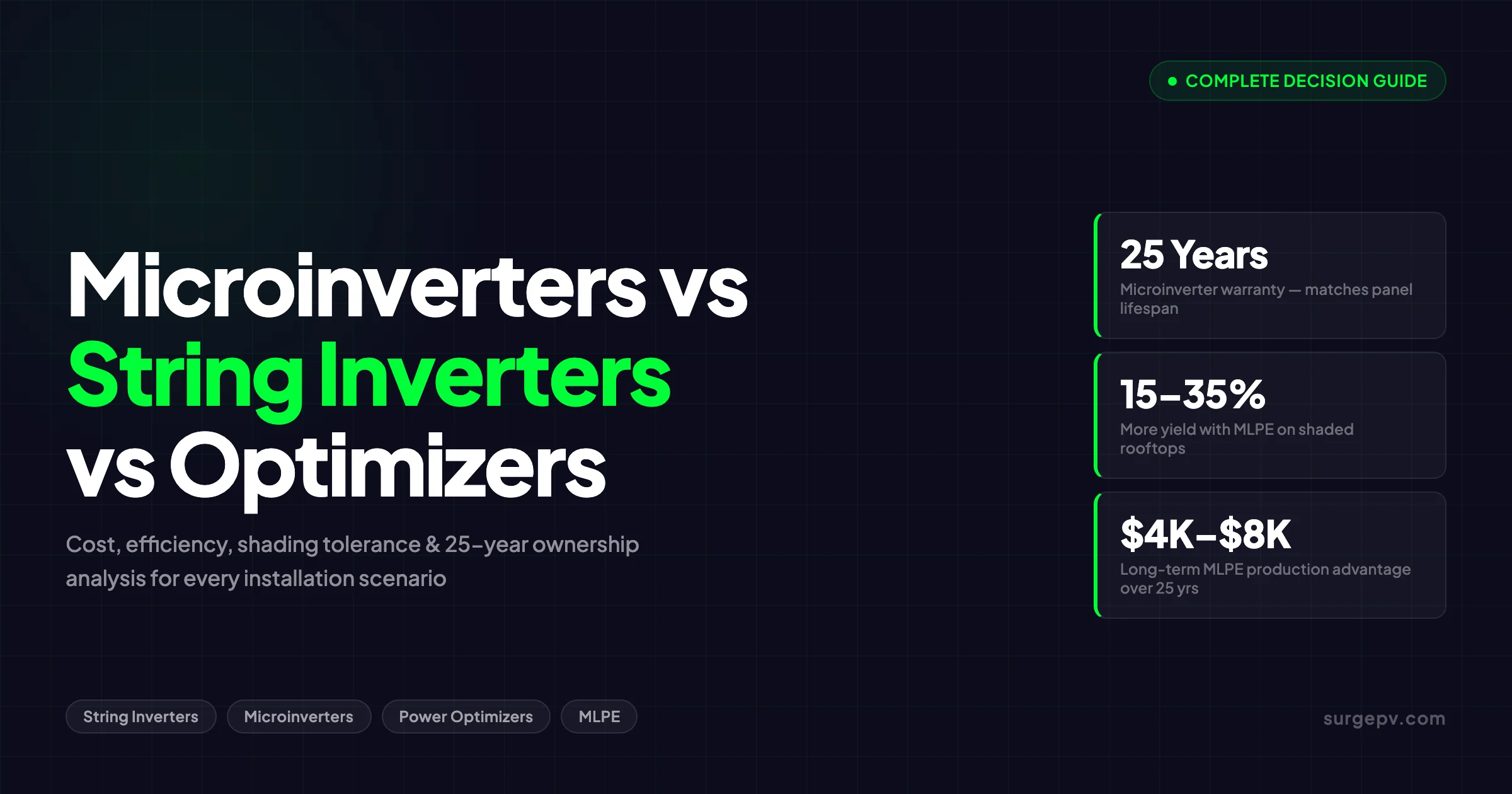
Full panel independence. Shade, soiling, or degradation on one panel does not affect any other. This is the defining advantage on complex roofs. On a partially shaded installation, microinverters generate 15–35% more energy annually compared to equivalent string inverter systems.
25-year warranties. Microinverters carry warranties that match panel lifespans. Enphase’s IQ8 series, the market leader, carries a 25-year warranty. You do not plan a mid-life replacement — the inverter and panel retire together.
Panel-level monitoring. Each microinverter reports its own production data. Installers and homeowners see exactly which panel underperforms, enabling fast diagnosis and targeted maintenance. This reduces truck rolls and improves customer satisfaction.
Built-in rapid shutdown compliance. Microinverter systems meet NEC rapid shutdown requirements by design. No additional devices or wiring changes needed. This simplifies permitting and inspection.
Easy system expansion. Adding panels later is straightforward — each new panel gets its own microinverter. String inverter systems require careful re-stringing calculations to add capacity.
Roof orientation flexibility. Panels on east, west, and south-facing planes all operate at their own optimal level. A string inverter forces all panels to a shared operating point, which is a problem when mixing orientations.
Grid-forming capability (IQ8 only). Enphase IQ8 microinverters can operate independently of the grid in Sunlight Backup mode, providing daytime power during outages without a battery. This is a significant safety and resilience selling point.
Microinverter Cons
Higher upfront cost. Microinverters cost $0.15–$0.30 per watt more than a string inverter setup. For a 20-panel 8 kW system, that is $1,200–$2,400 in additional equipment cost. Installed price can be $2,000–$4,000 higher than a comparable string inverter system.
Roof-level electronics. Each unit operates in a high-heat environment under panels. Failure requires roof access — though MLPE failure rates are low and individual unit replacement affects only that panel’s output.
Slightly more complex wiring. Each panel needs its own microinverter and AC trunk cable connection. More connections mean more potential failure points in theory, though Enphase’s documented reliability rate is over 99.95%.
Less efficient for batteries with DC coupling. If a homeowner wants DC-coupled battery storage (which is slightly more efficient), microinverter systems cannot support it natively. They require AC-coupled batteries. Read AC Coupled vs DC Coupled Battery Solar for a complete walkthrough. For more on this topic, see Adding Battery Storage Services.
Best Use Cases for Microinverters
- Roofs with any shading from trees, chimneys, dormers, or neighboring structures
- Multi-orientation arrays (east-west split, L-shaped rooftops)
- Residential systems where future expansion is planned
- Customers who want panel-level monitoring
- Systems requiring NEC rapid shutdown compliance
- Areas with high ambient temperatures where string inverter longevity is a concern
How Power Optimizers Work
Power optimizers are a hybrid solution. A DC-side optimizer module mounts at each panel and conditions that panel’s output — performing maximum power point tracking (MPPT) at the panel level — but does not convert DC to AC. The conditioned DC travels to a central string inverter for final AC conversion.
SolarEdge dominates this market. Their HD-Wave string inverter paired with P-Series optimizers is the most widely deployed optimizer system globally.
Power Optimizer Pros
Per-panel MPPT. Each optimizer performs independent MPPT, so shading one panel does not reduce others. The performance advantage over standard string inverters on shaded roofs is equivalent to microinverters — both reduce shading-related annual yield loss from ~24% to ~9%.
Lower cost than microinverters. Optimizer systems typically cost 10–20% less than full microinverter systems for equivalent shading performance, because the DC-side optimizer hardware is simpler than a full DC-to-AC conversion unit.
Ground-level inverter maintenance. Like string inverters, the main inverter unit is wall-mounted and accessible. The optimizer modules on the roof rarely fail and are low-maintenance.
25-year optimizer warranty. SolarEdge optimizer units carry 25-year warranties. The central inverter itself carries a 12-year warranty (extendable to 25 years).
Strong ecosystem. SolarEdge’s integrated platform — optimizers, inverter, monitoring, EV charger, battery — is one of the most complete solar energy management systems available. For installers building integrated customer solutions, this ecosystem has real value.
DC-coupled battery compatibility. SolarEdge’s system supports DC-coupled battery storage (the SolarEdge Energy Bank and compatible BYD batteries), which is more efficient than AC coupling.
Power Optimizer Cons
Central inverter is still a single point of failure. If the SolarEdge inverter fails, the entire system stops — even though every optimizer is working perfectly. String inverter replacement times and costs still apply.
Central inverter still needs mid-life replacement. The optimizer is warrantied for 25 years, but the string inverter is warrantied for 12 years. You still budget for one inverter replacement.
Vendor lock-in. SolarEdge optimizers are not compatible with third-party inverters, and vice versa. If SolarEdge exits the market or changes product lines, replacements may become complicated.
More complex than pure string. Adding per-panel optimizers increases installation labor versus a standard string inverter system, though the increase is smaller than for microinverters.
Best Use Cases for Power Optimizers
- Shaded rooftops where microinverter budget is too high
- SolarEdge ecosystem customers (EV charging, battery, monitoring integration)
- Installations where DC-coupled battery storage is planned
- Commercial systems with some shading where full microinverter deployment is cost-prohibitive
- Customers who want panel-level monitoring but prefer ground-level inverter maintenance
Head-to-Head Comparison: Key Metrics
| Feature | String Inverter | Power Optimizer | Microinverter |
|---|---|---|---|
| Upfront cost (hardware, per W) | $0.06–$0.15 | $0.25–$0.50 | $0.35–$0.60 |
| Installed system premium (8 kW) | Baseline | +$800–$1,500 | +$1,500–$3,000 |
| CEC weighted efficiency | 96–98% | 98–99% | 96–98% |
| Shading tolerance | Poor | Excellent | Excellent |
| Panel-level monitoring | No | Yes (SolarEdge) | Yes (Enphase) |
| Single point of failure | Yes | Yes (inverter) | No |
| Inverter warranty | 10–12 years | 12 years (ext. 25) | 25 years |
| Component warranty (panel-level) | N/A | 25 years | 25 years |
| Rapid shutdown compliance | Needs extras | Yes (built-in) | Yes (built-in) |
| Battery storage — DC coupled | Yes | Yes | No (AC only) |
| Battery storage — AC coupled | No (needs AC) | No (needs AC) | Yes (native) |
| Roof-level electronics | No | Yes (optimizers) | Yes (microinverters) |
| Grid independence (no battery) | No | No | Yes (IQ8 only) |
| Multi-orientation support | Limited | Yes | Yes |
| Ease of future expansion | Moderate | Moderate | Easy |
Key Takeaway
No inverter type wins every column. String inverters lead on cost and simplicity. Microinverters lead on resilience, warranty, and expandability. Power optimizers bridge cost and performance. The right choice depends on the specific roof, budget, and customer goals — not on brand loyalty.
Shading Performance: The Factor That Changes the Calculation
Shading is where inverter selection has the biggest financial impact. The data is consistent across independent studies.
On a perfectly unshaded array, a string inverter performs within 1–2% of a microinverter system. The efficiency difference is negligible. But the moment shade touches one panel in a string, the output picture changes sharply.
The mechanism: In a series string, current flows through all panels at the same level — the level set by the weakest unit. A panel at 60% output due to shade pulls the entire string toward 60% unless bypass diodes activate. Even with bypass diodes, shaded panels are essentially bypassed and contribute nothing. On a 10-panel string, shading one panel for three hours means that panel contributes zero output for those hours.
Quantified impact: Research and field data consistently show that shading-related annual yield loss on string systems runs 20–30% in moderate-shade scenarios. MLPE (both microinverters and optimizers) reduces this loss to approximately 9% on comparable installations.
| Shading Scenario | String Inverter Annual Yield Loss | With MLPE (Micro or Optimizer) |
|---|---|---|
| No shading | 0–1% | 0–1% |
| Light shading (1–2 panels, 1–2 hours/day) | 8–12% | 2–4% |
| Moderate shading (2–4 panels, 2–4 hours/day) | 18–24% | 6–10% |
| Heavy shading (chimney, tree, dormer) | 25–35% | 8–14% |
The financial translation: on a 10 kW system producing 12,000 kWh/year, a 20% yield loss equals 2,400 kWh annually. At $0.12/kWh, that is $288 in lost value every year — $7,200 over 25 years.
MLPE performance is equivalent in shade. Both microinverters and power optimizers achieve similar shading performance because both perform per-panel MPPT. The choice between them on shaded roofs is primarily a cost and architecture decision, not a performance decision.
Pro Tip for Installers
If you are using solar design software, run the shade simulation with all three inverter configurations before the proposal. The energy yield difference over 25 years often makes the MLPE upsell obvious to the customer without any sales pressure. Show the numbers, let the math close the deal.
Bypass Diodes: Why They Are Not Enough
A common misconception is that bypass diodes solve the string inverter shading problem. They do not — they mitigate it. Bypass diodes activate when a panel’s output drops significantly below the string average, effectively removing the panel from the circuit rather than dragging down the string.
The result: a shaded panel contributes zero output instead of pulling down others. That is better than full-string drag, but the shaded panel still produces nothing. MLPE systems perform independent MPPT on every panel, so a panel producing 60% of rated output still contributes 60% — it is not bypassed or zeroed.
On a complex residential roof with persistent partial shading, this difference compounds over time. Shadow analysis tools can model this effect panel by panel, hour by hour, to quantify the exact production difference between configurations.
Total Cost of Ownership: The Real 25-Year Picture
Comparing sticker prices ignores the full economic picture. A proper 25-year cost analysis includes:
- Upfront hardware and installation cost
- Replacement costs (inverter mid-life replacement)
- Energy value difference (production advantage)
- Monitoring and maintenance costs
Scenario: 8 kW Residential System, Moderate Shade
| Cost Factor | String Inverter | Power Optimizer | Microinverter |
|---|---|---|---|
| Initial installed cost (inverter hardware + labor) | $1,500 | $3,000 | $4,500 |
| Mid-life inverter replacement (Year 12–15) | $1,500 | $1,500 (inverter only) | $0 |
| Optimizer/micro unit failures (individual) | N/A | Low ($200–$400 total) | Low ($200–$400 total) |
| Total hardware cost over 25 years | ~$3,000 | ~$4,700 | ~$4,700 |
| Annual production advantage over string | 0% (baseline) | +15% | +18% |
| 25-year production value advantage | $0 | +$5,400 | +$6,480 |
| Net 25-year cost advantage vs. string | Baseline | +$700 net gain | +$1,780 net gain |
Assumptions: 12,000 kWh/year baseline production, $0.12/kWh utility rate, 1% annual rate escalation, moderate shade scenario.
On a heavily shaded roof, the advantage of MLPE is wider. On a clean unshaded roof, the production advantage shrinks toward zero and the string inverter’s lower cost holds.
Key Takeaway
The microinverter premium pays back on moderately or heavily shaded roofs. On unshaded roofs, the string inverter’s lower total cost is the correct financial decision. This is why shade analysis should precede inverter recommendation — not the other way around.
The Replacement Cost Problem
The lifespan gap between inverter types is an underappreciated cost factor. A string inverter warranted for 10–12 years will almost certainly need replacement before a 25-year solar system reaches end of life. In 2026, a replacement SMA Sunny Boy or Fronius inverter for an 8 kW system costs $800–$1,400 in hardware. Add $300–$500 in installation labor. That is $1,100–$1,900 in replacement cost that does not appear in the initial proposal but should appear in the customer’s total cost-of-ownership conversation.
Microinverters eliminate this cost. Power optimizer units have 25-year warranties, but the central SolarEdge inverter is warranted for 12 years (extendable to 25 years at purchase — recommended).
Model All Three Inverter Scenarios Before the Proposal
SurgePV’s generation and financial tool runs 25-year production simulations with shade analysis for any inverter configuration — giving you the numbers to justify the right recommendation to every customer.
Book a DemoNo commitment required · 20 minutes · Live project walkthrough
For a direct comparison, see Arka 360 vs SurgePV.
System Design Considerations for Solar Installers
Inverter type selection has downstream effects on system design that solar installers need to account for before finalizing any proposal.
Stringing Rules Change by Inverter Type
String inverter systems require careful attention to MPPT input voltage and current ranges. Panels must be strung so that Voc and Vmp stay within the inverter’s operating window across all temperature extremes. Mixing orientations or module types in a single string creates mismatch losses and can trip inverter protections.
With microinverters, stringing rules are largely irrelevant — each panel is its own independent circuit. This simplifies design on complex roofs and reduces the risk of common stringing mistakes.
Power optimizer systems use a different rule set — SolarEdge specifies minimum and maximum string lengths (number of optimizers per string) based on the specific inverter and optimizer model combination. These constraints must be followed during design.
NEC Rapid Shutdown Requirements
The NEC 2017 and 2020 editions require rapid shutdown systems for rooftop solar arrays that limit conductor energy within 10 seconds of initiating shutdown. This protects firefighters from energized roof conductors.
- String inverters require additional rapid shutdown equipment (module-level rapid shutdown transmitters and receivers) to comply. This adds $0.05–$0.10 per watt to the installed cost.
- Microinverters comply natively — each unit de-energizes independently on shutdown signal.
- Power optimizers (SolarEdge system) also comply natively through the SafeDC feature.
Check your local AHJ’s adopted code cycle — some jurisdictions still use NEC 2014, which has different requirements. Permit requirements vary significantly and your solar design software should flag the applicable code automatically. Also see: European Solar Incentives.
Temperature Derating and High-Heat Environments
All inverters derate output in high ambient temperatures. String inverters benefit from being wall-mounted in cooler, shaded locations. Microinverters and optimizers are roof-mounted, exposed to higher operating temperatures — often 20–30°C above ambient in summer.
Enphase’s IQ8 series is rated to operate at ambient temperatures up to 65°C. Most optimizers have similar ratings. Derating in these conditions is typically 1–3% on peak summer production days — a modest penalty that is usually outweighed by the shade performance advantage.
In very hot climates (Arizona, Middle East, parts of India and Australia), thermal performance of roof-mounted electronics deserves extra scrutiny. Review datasheet derating curves before specifying. Also see: Best Solar Design Software India. For India-specific information, see 5kW Solar Panel Price in India. For Australia-specific compliance details, see Australia comparisons/lgc-vs-stc.
Monitoring Architecture
All three technologies offer system-level monitoring. The differentiator is granularity:
- String inverter monitoring: System-level production only. You see total kWh and a few system-level alerts. Individual panel performance is invisible unless you add a separate monitoring solution.
- SolarEdge (optimizer) monitoring: Panel-level production, alerts, and diagnostic data through the MySolarEdge portal. You can see exactly which panel is underperforming and why.
- Enphase (microinverter) monitoring: Panel-level data through Enlighten, with historical per-panel production graphs. Enphase’s monitoring platform is widely regarded as the most detailed available in the residential market.
For installers managing post-installation support and O&M contracts, panel-level monitoring significantly reduces diagnostic time and truck rolls. A remote diagnosis that would take a field visit with a string inverter system takes 2 minutes on the Enphase or SolarEdge portal.
AC vs. DC Coupling for Battery Storage
The inverter type determines how battery storage integrates:
DC-coupled storage (more efficient): Battery charges directly from DC before inverter conversion. Round-trip efficiency is higher — typically 94–96% vs. 88–92% for AC coupling. Only string inverters and power optimizer systems support DC coupling, using compatible hybrid inverters like SolarEdge StorEdge or Fronius Symo Hybrid.
AC-coupled storage (more flexible): Battery charges from AC after inverter conversion. Works with any system type. Microinverter systems use AC coupling exclusively. Enphase IQ Battery and Tesla Powerwall are both AC-coupled.
If a customer is certain they want battery storage now or soon, inverter type and battery type need to be planned together. Specifying a microinverter system and then a DC-coupled battery later creates a compatibility conflict. This planning conversation should happen at the proposal stage.
For deeper financial modeling of storage options, the solar financial analysis tool in SurgePV handles both DC and AC coupling scenarios with battery dispatch modeling.
Top Inverter Brands Compared
The inverter market has consolidated around a few dominant players. Here is what installers and buyers need to know about the main options in each category.
String Inverters
SMA Sunny Boy (residential, 2.5–7.7 kW) The German engineering benchmark. The Sunny Boy series leads on efficiency (up to 97.6% CEC), build quality, and long-term reliability. The SMA Secure Power Supply feature delivers up to 2 kW of emergency grid-independent power from a standard string inverter — a unique feature in the category. 12-year standard warranty, extendable to 20 years.
Fronius Primo / Symo (residential and commercial) Strong performer with excellent monitoring (Solarweb platform). The Fronius Symo GEN24 Plus supports battery storage via DC coupling and AC coupling, giving it flexibility that most pure string inverters lack. Austrian manufacturing, strong European market presence.
Growatt / Solis (budget residential) Chinese manufacturers offering competitive pricing at $0.05–$0.08/W. Acceptable performance, shorter warranty periods (10 years standard), and less established service networks in Western markets. Suitable for cost-sensitive projects with favorable site conditions.
SolarEdge SE series (with optimizers) The HD-Wave inverter with SolarEdge’s S-series or P-series optimizers achieves 99% CEC weighted efficiency — the highest in any residential inverter category. The integrated monitoring, StorEdge compatibility, and EV charger integration make this a full energy management platform, not just an inverter.
Microinverters
Enphase IQ8 Series (residential, 230–366 W AC) Market-leading microinverter. The IQ8 platform introduced Sunlight Backup (grid-independent daytime operation) and supports Enphase IQ Battery for full home energy management. 25-year warranty. Enlighten monitoring provides the most detailed panel-level data available. Premium priced — typically $0.50–$0.60 per watt for hardware alone.
Enphase IQ8HC / IQ8X (higher power) For 96-cell and 108-cell modules (400–500+ W panels), the IQ8HC and IQ8X handle higher current inputs. Relevant for commercial residential or small commercial projects using high-power modules.
APsystems (budget microinverter) A competitive alternative to Enphase with lower per-unit pricing. The ECU gateway handles monitoring. 10–25 year warranty depending on model. Suitable for projects where Enphase’s premium is cost-prohibitive and the monitoring depth requirement is lower.
Hoymiles (entry-level) Growing market share in Europe and Asia-Pacific. Lower cost than Enphase, shorter warranties (10 years standard for some models). Worth considering on budget-constrained projects with favorable warranties in the specific model selected. For Asia-Pacific-specific compliance details, see Asia-Pacific solar compliance.
Power Optimizers
SolarEdge P-Series Optimizers The dominant optimizer product globally. The P340 and P505 models handle up to 400 W and 505 W panels respectively. SafeDC compliance built in. 25-year warranty. Required to use with SolarEdge inverters — not compatible with third-party inverters. The SafeDC feature ensures DC conductors are de-energized during shutdown, meeting NEC rapid shutdown requirements.
Tigo TS4-A (universal optimizers) Tigo optimizers are compatible with third-party string inverters (SMA, Fronius, ABB, and others), which gives installers flexibility. You can deploy Tigo optimizers selectively on shaded panels only — a “smart module” approach that adds MLPE where it matters most without covering the entire array. Useful for hybrid designs.
SolarEdge vs. Enphase: The Real Comparison
These two dominate the MLPE residential market and are the most common choice comparison: Read more about Agricultural Solar Case Study.
| Factor | SolarEdge (Optimizer) | Enphase (Microinverter) |
|---|---|---|
| Efficiency | 99% CEC (inverter) | 97–98% (per unit) |
| Upfront cost (typical 8 kW) | ~$3,500 installed | ~$5,000 installed |
| Monitoring granularity | Panel-level | Panel-level |
| Battery integration | DC + AC coupling | AC coupling only |
| Grid independence (no battery) | No | Yes (IQ8) |
| Central failure risk | Yes (inverter) | No |
| Warranty — inverter | 12 years (ext. 25) | 25 years (microinverter = inverter) |
| Vendor ecosystem | Integrated (EV, battery, meter) | Enphase ecosystem only |
For a customer who wants battery storage and EV charging integration from one vendor, SolarEdge is the more cohesive choice. For a customer who wants maximum resilience, no single points of failure, and 25-year warranties on every component, Enphase is the answer.
Which Inverter Type Should You Choose? A Decision Framework
Rather than a generic recommendation, use this decision matrix based on the specific installation scenario.
| Scenario | Best Choice | Reason |
|---|---|---|
| Simple, unshaded, south-facing roof | String inverter | Lowest cost, adequate performance |
| Moderate shade (1–3 panels affected) | Power optimizer | Shade performance at lower cost than micro |
| Heavy shade (chimney, trees, dormers) | Microinverter | Full independence, maximum production |
| Multi-orientation roof (E/W split) | Microinverter or optimizer | Independent MPPT per panel or surface |
| Future battery storage (DC-coupled) | String inverter + hybrid, or optimizer | DC coupling efficiency advantage |
| Future battery storage (any type) | Microinverter (AC coupling fine) | Enphase ecosystem compatibility |
| Budget-constrained, good site | String inverter | Cost optimization when performance allows |
| Commercial ground-mount, no shade | String inverter (3-phase) | Large 3-phase units most cost-effective |
| Commercial with partial shading | Power optimizer | Shade performance, ground-level inverter |
| System requiring expandability | Microinverter | Add panels without re-stringing |
| Fire safety / rapid shutdown priority | Microinverter or optimizer | Both comply natively |
| Monitoring-intensive (O&M contract) | Microinverter or optimizer | Panel-level diagnostics |
The Installer’s Rule of Thumb
String inverter for clear, simple roofs. MLPE for everything else. Between microinverters and optimizers, the tiebreaker is battery storage plans: DC-coupled battery favors optimizers; AC-coupled or no battery favors microinverters. Run a 25-year financial model for any project where the choice is not obvious — the data usually decides it.
What the Data Says About Market Direction
Market share data from Wood Mackenzie and IEA solar market analysis shows microinverter and optimizer share growing as a percentage of residential installations, particularly in markets with complex housing stock (US Northeast, UK, parts of Europe). String inverter dominance remains strong in new-build developments with simple roof geometry and in commercial ground-mount markets. For the latest details on UK, see Battery Solar System Design UK.
Enphase reports shipping over 75 million microinverter units globally. SolarEdge has deployed over 3.3 million inverters with optimizer systems in 140 countries. String inverter volumes from SMA, Fronius, and Huawei are orders of magnitude larger, reflecting continued dominance in commercial and utility-scale installations.
For residential solar in markets with complex roof stock and active firefighting rapid shutdown requirements, the trend toward MLPE is clear. For commercial and utility, string inverters retain economics-driven dominance.
Inverter Selection and Solar Proposal Quality
The inverter recommendation is one of the strongest signals of installer competence in any solar proposal. Homeowners and commercial buyers who research their options will ask hard questions:
- “Why did you choose string inverters on my roof that has a chimney shadow?”
- “What happens to my system when this inverter needs replacing in 12 years?”
- “Can I expand this system if I want to add panels?”
Proposals built with solar proposal platform that includes production simulations and financial modeling across inverter options answer these questions before they are asked. A proposal that shows three scenarios — string, optimizer, and microinverter — with 25-year production and cost comparisons demonstrates technical depth and builds customer confidence.
Good solar design platform runs the shade simulation automatically and flags inverter-type recommendations based on the site analysis. This removes guesswork and ensures the proposal reflects real site conditions, not default assumptions.
Further Reading
For a deeper look at the design side, see our guide to solar inverter sizing and solar string design. Both cover the technical rules that apply regardless of inverter type, and the specific calculations that change when you switch from string to MLPE.
Conclusion
Three action items for any installer or buyer navigating this decision:
- Run shade analysis first, then pick the inverter. Do not assume string or MLPE before you have site-specific shade data. A clear roof and a shaded roof call for different solutions, and the 25-year financial difference is large enough to justify the analysis time.
- Model the full 25-year cost. Include mid-life inverter replacement, production value differences, and monitoring savings. The cheapest option on the proposal page is not always the cheapest option over the system’s life.
- Match battery storage plans to inverter type. If battery storage is a near-term plan, the inverter type determines coupling architecture and efficiency. Decide on storage before finalizing the inverter, not after.
The technology choice is straightforward once the site conditions and customer goals are clear. String inverters are not inferior products — they are the right choice in the right conditions. So are microinverters, and so are power optimizers. The error is in applying a default choice without checking the site.
Frequently Asked Questions
What is the main difference between microinverters and string inverters?
String inverters convert DC power from all panels together at a central unit, so one shaded or underperforming panel pulls down the entire string. Microinverters convert DC to AC at each individual panel, so every panel operates independently. The practical result is that microinverters handle shading, soiling, and roof complexity far better than string inverters.
Are microinverters worth the extra cost?
On shaded or complex rooftops, yes. Microinverters typically generate 15–35% more energy than string inverters on partially shaded installations, and the long-term production advantage can be worth $4,000–$8,000 over 25 years. On a simple, fully unshaded south-facing roof, the premium is harder to justify and a string inverter often makes more financial sense.
How long do microinverters last compared to string inverters?
Microinverters carry 25-year warranties that match panel lifespans. String inverters typically carry 10–12 year warranties and often require one replacement mid-system life, adding $1,000–$2,000 to total ownership cost. Power optimizers also carry 25-year warranties, but the central string inverter in those systems still needs mid-life replacement.
What is a power optimizer and how is it different from a microinverter?
A power optimizer conditions each panel’s DC output before sending it to a central string inverter. Unlike a microinverter, it does not convert DC to AC at the panel — that conversion still happens at the central inverter. The result is per-panel performance optimization with a slightly lower hardware cost than full microinverter systems, but the central inverter remains a single point of failure.
Which inverter type is best for shaded roofs?
Both microinverters and power optimizers handle shading far better than standard string inverters. Research shows both MLPE technologies reduce shading-related annual yield loss from around 24% down to roughly 9% compared to string-only systems. The choice between them depends on cost budget, battery storage plans, and whether you want fully distributed electronics.
Can I use microinverters with battery storage?
Yes. Microinverter systems use AC coupling to connect battery storage — a separate battery inverter handles the DC-to-AC conversion for the battery. This works reliably but is slightly less efficient than DC-coupled systems. Enphase’s IQ Battery is purpose-built for AC coupling with their IQ8 microinverters.
What is module-level power electronics (MLPE)?
MLPE is the collective term for microinverters and power optimizers — any technology that provides per-panel power management. MLPE systems automatically meet NEC rapid shutdown requirements, offer panel-level monitoring, and outperform standard string inverters on partially shaded or complex-roof installations.
Which inverter type is cheapest for large unshaded commercial systems?
Three-phase string inverters are the most cost-effective choice for large, unshaded commercial or ground-mount systems. They cost $0.06–$0.10 per watt installed, require minimal maintenance, and perform at full efficiency on open, unobstructed arrays where MLPE adds cost without a meaningful production return.
Where this fits
This article is part of SurgePV's Solar Technology hub, which works through the topic from first principles to the decisions a project team actually has to make.
