

Quick Answer
The shift matters because grid-forming and grid-following inverters do fundamentally different things on the wires, and the difference shows up the first time the utility breaker opens. For battery hybrid systems specifically, the answer is moving rapidly toward grid-forming as the default. The short technical reason: grid-following inverters need an external voltage to phase-lock to.
A control choice that used to live in a textbook is now an interconnection requirement. Australia’s grid operator reports that 74 percent of the Q1 2026 battery storage pipeline in the National Electricity Market specifies grid-forming inverters, and the Midcontinent ISO in the United States has proposed making grid-forming control a condition of interconnection for new battery storage. The shift matters because grid-forming and grid-following inverters do fundamentally different things on the wires, and the difference shows up the first time the utility breaker opens. For Australia-specific information, see Solar Energy in Australia. See Adding Battery Storage Services for detailed guidance.
The shift matters because grid-forming and grid-following inverters do fundamentally different things on the wires, and the difference shows up the first time the utility breaker opens. For battery hybrid systems specifically, the answer is moving rapidly toward grid-forming as the default.
This guide explains both control philosophies, when each one is appropriate, and how the technology choice affects design, protection, and economics for battery hybrid systems in 2026.
TL;DR
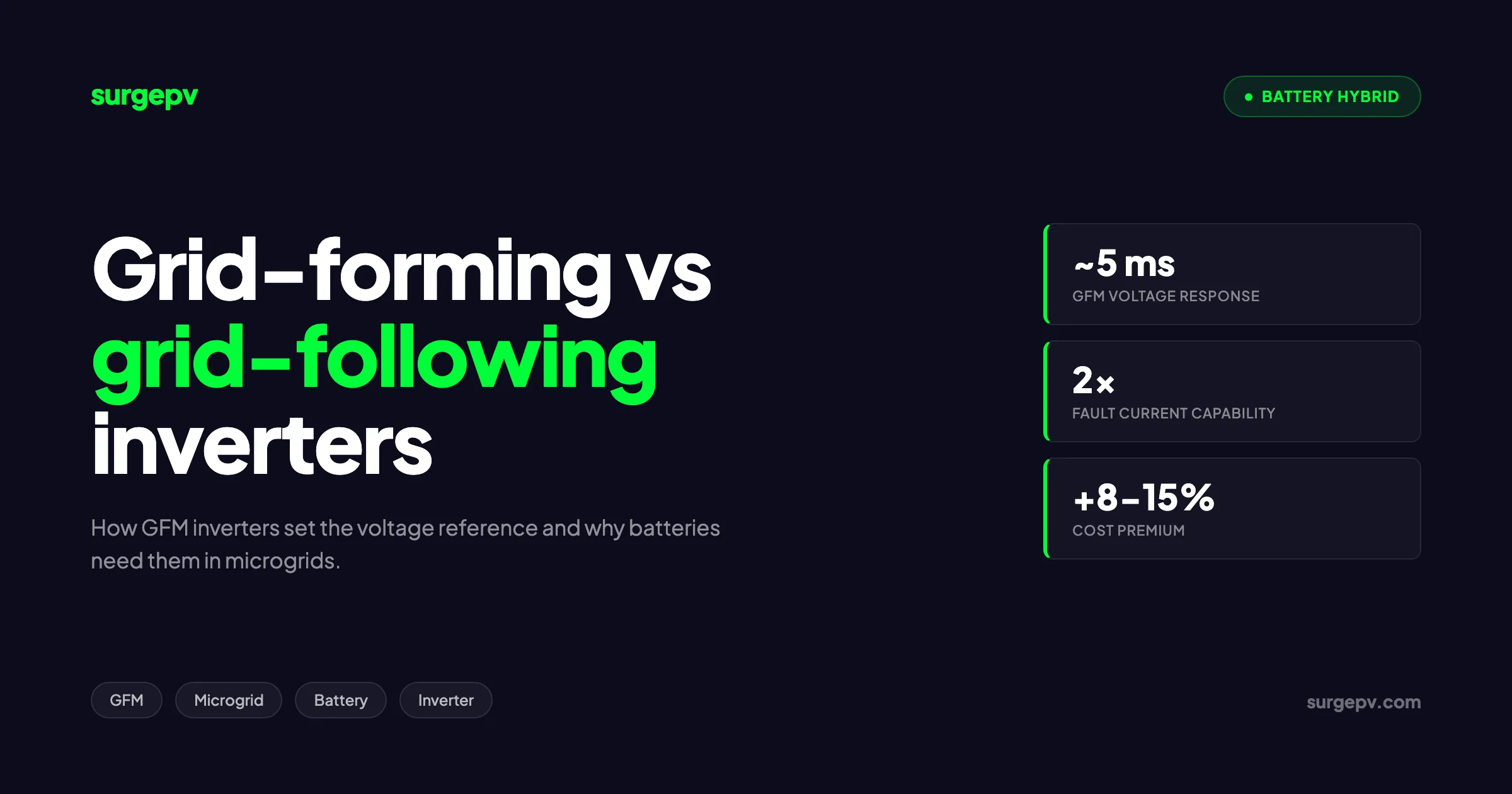
Grid-following (GFL) inverters are controlled current sources that synchronize to an existing grid using a phase-locked loop. Grid-forming (GFM) inverters are controlled voltage sources that set their own frequency and voltage reference. GFM is required for true black start, seamless backup, and weak-grid operation. The hardware premium runs 8-15 percent on utility-scale projects, often zero on residential hybrids. Standards are catching up fast: UNIFI Version 3, IEEE 2800-2022, AEMO voluntary spec, and MISO’s proposed mandate are all 2024-2026 developments.
You will learn:
- How phase-locked loops and virtual synchronous machines actually work, in plain language
- The five technical differences that drive the design choice: response time, fault current, frequency support, black start, and weak-grid behavior
- Where grid-forming control matters and where grid-following is still the right answer
- Which manufacturers ship grid-forming firmware in 2026 and which projects use it
- Standards that apply right now and the ones drafting through 2027
- A decision framework for installers, EPCs, and asset owners
Grid-forming vs grid-following: which inverter for batteries in 2026?
Use grid-forming for any project that has to keep working when the utility is gone, or that connects to a weak point on the network. Use grid-following for plants on strong grids where another resource holds the voltage reference and the inverter just needs to inject power. For battery hybrid systems specifically, the answer is moving rapidly toward grid-forming as the default.
The short technical reason: grid-following inverters need an external voltage to phase-lock to. Pull the grid away and they shut down within milliseconds. Grid-forming inverters carry their own voltage reference inside the controller. They can operate on a dead bus and bring loads online from zero.
For installers and EPCs building solar design software workflows around batteries, the practical takeaway is that grid-forming capability is now a procurement specification, not a research topic. The inverter data sheet line that says “island mode” or “backup capable” is the line that matters most for battery hybrid projects.
| Property | Grid-following (GFL) | Grid-forming (GFM) |
|---|---|---|
| Control model | Controlled current source | Controlled voltage source |
| Synchronization | Phase-locked loop (PLL) tracks grid | Internal oscillator sets the reference |
| Voltage and frequency | Follows the grid | Sets them locally |
| Behavior with grid lost | Trips within 2 seconds (anti-islanding) | Continues running, supplies the load |
| Fault current | ~1.0-1.2 pu | ~2-3 pu (vendor and standard dependent) |
| Inertia | None | Synthetic inertia via VSM or droop |
| Black start | Not possible | Possible |
| Best fit | Strong grid, PV-only plants | Weak grid, batteries, microgrids |
| Cost premium | Baseline | +8-15 percent on utility scale |
Pro Tip
The fastest way to spot a grid-forming inverter on a data sheet is the islanding behavior section. If it lists “seamless transfer time under 20 ms,” “black start capable,” or “off-grid operation,” you are looking at a grid-forming product. If it lists only “anti-islanding per IEEE 1547,” it is grid-following.
How grid-following (GFL) inverters work
A grid-following inverter is, electrically, a current source that uses the grid as its compass. It senses the grid voltage waveform, locks onto its phase angle, and injects a current that is shaped to deliver the requested real and reactive power at that angle.
The phase-locked loop
The phase-locked loop is the heart of every grid-following inverter. It is a feedback loop that estimates the instantaneous phase of the grid voltage with millisecond accuracy.
The PLL typically has three stages. A voltage transformation takes the three-phase voltage and converts it into a synchronous reference frame, where a balanced grid voltage shows up as a constant DC value. A phase detector measures the error between the estimated phase and the actual phase. A loop filter, usually a proportional-integral controller, drives that error toward zero. The output of the loop filter is the estimated frequency, which is integrated to produce the phase angle used by the current controller.
The PLL needs the grid to be reasonably clean. Unbalanced faults, harmonics, and very weak grids all push the PLL toward instability. This is one reason grid-following inverters perform poorly when the short-circuit ratio at the point of common coupling falls below about 3.
The current controller
Once the PLL knows the grid angle, the inverter computes a current command. For a typical PV inverter doing maximum power point tracking, the real current command comes from the MPPT loop, and the reactive current command comes from the grid code (volt-var curve, power factor setting, or a reactive power dispatch signal).
The current controller is usually a PI loop in the synchronous reference frame, with feed-forward terms for the grid voltage to improve transient response. The output is a voltage reference that the PWM modulator converts into switching pulses for the IGBT or SiC bridge.
Why GFL trips during a grid loss
Anti-islanding protection is the standardized reason a grid-following inverter shuts down during a utility outage. IEEE 1547-2018 requires that distributed energy resources cease energizing the area network within 2 seconds of an island condition. Inverters use one or more of three detection methods: passive (under/over voltage and frequency), active (positive feedback that drives the bus to a trip threshold when the grid is absent), and communication-based (direct transfer trip from the utility).
There is also a fundamental reason. Without the grid to phase-lock to, the PLL has no input. It either drifts to a meaningless angle or oscillates. Either way, the current controller cannot produce a stable voltage waveform at the inverter terminals. The control architecture is structurally incapable of running a network on its own.
Strengths of grid-following control
Grid-following control has dominated the inverter market for two decades because it is simple, robust, and well-matched to plants that sit on a strong utility grid. The control algorithms are mature, the protection schemes are standardized, and the hardware does not need to source large fault currents. For solar design platform generating PV plant designs against a stiff transmission grid, grid-following inverters are still the right answer.
The drawback is that grid-following inverters are passive participants. They cannot stabilize a weak grid, cannot ride through severe faults without specialized firmware, and cannot operate without an external voltage reference.
How grid-forming (GFM) inverters work
A grid-forming inverter is a controlled voltage source. It produces a voltage waveform with a magnitude and frequency set by its own controller, not by the grid. When connected to a network, it shares load and frequency with other generators on that network through droop or virtual inertia rules, the same way synchronous generators have done for a century.
The virtual synchronous machine
The most common grid-forming control architecture in 2026 is the virtual synchronous machine. The controller emulates the swing equation of a synchronous generator inside software, so the inverter behaves on the wires the way a spinning machine does.
The swing equation says that the rotor angle accelerates in proportion to the difference between mechanical input power and electrical output power, divided by the inertia constant. In a VSM-based inverter, the mechanical input becomes the active power dispatch setpoint, the electrical output is the measured power, the inertia constant is a virtual coefficient the engineer chooses, and a damping term emulates mechanical friction. The integrator produces a phase angle and frequency that the inverter then uses to synthesize its voltage waveform.
The result is an inverter that responds to a frequency event the way a generator does. When network frequency drops, the VSM angle slips, the inverter automatically increases active power output, and energy comes out of the DC bus and into the grid. This happens in milliseconds, before any communication-based frequency response can act. Read DC Bus Voltage Optimization for a complete walkthrough.
Droop control as a simpler alternative
A simpler grid-forming control uses static droop curves: P-f droop sets active power as a linear function of frequency error, and Q-V droop sets reactive power as a linear function of voltage error. There is no virtual inertia, just steady-state load sharing.
Droop control is mathematically equivalent to a first-order approximation of the VSM. It is easier to tune and stable across a wider range of grid conditions, but it delivers less synthetic inertia. Many production grid-forming products use a hybrid: droop for primary frequency response, with a small virtual inertia term layered on top.
Other grid-forming families
Two other control families show up in the academic literature and a small number of products. Matching control uses the DC bus voltage as the natural frequency reference, which gives elegant decoupling but limits scalability. Dispatchable virtual oscillator control (dVOC) uses a nonlinear oscillator that synchronizes to nearby inverters without communication. dVOC has the best theoretical small-signal stability but is the least mature commercially.
Black start and island operation
A grid-forming inverter can start with a dead AC bus. It closes its breaker, applies its internal voltage reference to the terminals, and brings the network up to nominal voltage and frequency. As loads come online, the droop or VSM controller adjusts the operating point to match real and reactive power demand.
This is the capability that makes grid-forming inverters indispensable for microgrid and off-grid applications. It is also what makes them valuable on the bulk grid when synchronous generation retires.
Comparison: response time, fault current, frequency support, black start
The technical differences between grid-following and grid-forming control fall into five categories. Each one has design and economic implications.
Response time
Grid-following inverters respond to a frequency or voltage event on the timescale of their PLL, current controller, and supervisory loop. Frequency response typically takes 100-500 milliseconds: the PLL detects the change, the supervisory loop computes a new power command, and the current controller drives the new setpoint. Voltage response is faster, around 50-150 milliseconds, because the volt-var function works directly on measured voltage without going through the PLL.
Grid-forming inverters respond inertially within 0-5 cycles, which is 0-83 milliseconds at 60 Hz. The voltage waveform shifts automatically because the controller is producing the waveform; no PLL detection is needed. Power flow follows physics: when the frequency changes, the angle difference changes, and power swings in the right direction without any control intervention. Recent research published in Nature Scientific Reports documented voltage recovery within 300 milliseconds and frequency deviation limited to plus or minus 0.5 Hz on a grid-forming BESS during a severe fault.
Fault current contribution
This is the single biggest functional difference. Grid-following inverters limit their output current to roughly 1.0-1.2 times rated for thermal protection. During a fault, they reduce output to keep the IGBTs alive.
Grid-forming inverters can deliver 2-3 times rated current for short durations, typically 1-3 seconds. This matters because downstream protection (fuses, relays, breakers) needs a current spike to operate. In a microgrid with only inverter-based sources, a grid-following fleet cannot trip a fault. A grid-forming fleet can, provided the inverters are sized with enough current headroom.
| Metric | GFL typical | GFM typical | Why it matters |
|---|---|---|---|
| Fault current (3-phase) | 1.0-1.2 pu | 2.0-3.0 pu | Trips downstream protection |
| Fault current duration | 100-200 ms | 1-3 s | Allows time-coordinated relays to act |
| Inertial response | 0 | 1-10 s (virtual) | Buys time for primary frequency response |
| Primary frequency response | 100-500 ms | 0-100 ms | Determines minimum allowable inertia |
| Voltage recovery after fault | 300-800 ms | 100-300 ms | Affects motor restart success |
| Behavior at SCR under 3 | Unstable | Stable | Enables weak-grid operation |
Frequency support
Both control families can provide frequency response, but the mechanisms differ. Grid-following inverters use a frequency-watt curve: measure the PLL frequency, compute a power adjustment, command the current controller. This is closed-loop control with measurement lag.
Grid-forming inverters provide frequency response inherently. The VSM angle accelerates or decelerates with the grid, and the resulting angle difference drives power flow. There is no measurement, no controller computation; the inverter behaves as a voltage source behind an impedance, exactly like a generator. This synthetic inertia is the headline reason transmission operators in Australia and the Midwest are moving to grid-forming requirements. For Australia-specific compliance details, see Australia comparisons/lgc-vs-stc.
Black start
Grid-following inverters cannot black-start a dead grid. They need an external voltage to phase-lock to. Some manufacturers offer a “GFL with grid-support mode” that adds a starter switch and a small grid-forming sub-controller, but the bulk of the operating envelope is grid-following.
Grid-forming inverters can black-start by design. The Tesla Hornsdale Power Reserve in Australia has demonstrated black start of a 100 MW battery onto a section of the National Electricity Market grid using Tesla’s Virtual Machine Mode. This is no longer a research demonstration; it is a commercially documented capability.
Weak-grid operation
The short-circuit ratio at the point of common coupling is the standard measure of grid strength. SCR above 5 is strong; 3 to 5 is moderate; below 3 is weak; below 1.5 is very weak. Grid-following inverters become unstable when SCR drops below about 3 because the PLL bandwidth and the impedance interaction with the grid form a resonant feedback loop.
Grid-forming inverters operate stably down to SCR around 0.5, and some research-grade controllers have been demonstrated at SCR 0.2. This is what makes them suitable for remote PV plus storage projects at the end of long radial lines, and for offshore wind farms connected through HVDC.
Hybrid battery systems where GFM matters
Most modern battery hybrid systems combine PV, battery, and inverter in a way that makes the grid-forming choice a system-level decision, not just an inverter spec.
Residential hybrid systems
A typical residential hybrid combines a 5-10 kW PV array, a 10-30 kWh battery, and a hybrid inverter with backup capability. Tesla Powerwall, Enphase IQ Battery, Sigenergy SigenStor, SolarEdge Energy Hub, and Sungrow SH-RT all qualify. Each one runs grid-following while the utility is healthy and switches to grid-forming when the utility drops, with a transfer time below 20 milliseconds in most current products.
For the homeowner, grid-forming means the lights stay on. For the installer, it means a few extra wiring decisions: a backup-loads panel separated from the main panel, a transfer switch or integrated automatic transfer, and a neutral-bonding contactor that closes when the system is islanded. Backup design at the residential level is covered in detail in our backup power and solar battery design guide.
The control mode choice is largely decided by buying the right inverter. Almost every premium residential hybrid sold today is grid-forming. The budget end of the market (string hybrids with no backup port) is still grid-following.
Inverter selection note
If a homeowner asks for backup capability, the question to put to the supplier is “does this inverter run grid-forming during a utility outage, and what is the transfer time?” Anything above 100 ms is a notable inrush risk for motor loads. Below 20 ms is effectively seamless.
Commercial and industrial hybrids
In the 50 kW to 5 MW range, the grid-forming question gets more interesting. A C&I site running a hybrid inverter for peak shaving, time-of-use arbitrage, and backup needs grid-forming control if the backup function is operational. Grid-following hybrids in this range exist but only support self-consumption, not islanded backup.
The choice often comes down to load profile. A site with critical motor loads (chillers, compressors, pumps) needs grid-forming because the inrush during transfer would cause a grid-following backup to trip. A site with mostly resistive or electronic loads can sometimes use a grid-following hybrid with a small UPS bridge for the milliseconds during the transfer.
This is also where AC-coupled vs DC-coupled battery design becomes relevant. AC-coupled systems have a battery inverter on the AC bus that, in grid-forming mode, becomes the grid reference during an outage. DC-coupled systems share a DC bus between PV and battery, with one hybrid inverter handling both. Either topology can support grid-forming, but the AC-coupled approach decouples the PV inverter design from the grid-forming requirement, which simplifies retrofits.
Utility-scale BESS
At the utility scale (10 MW and up), grid-forming is rapidly becoming the procurement standard. The Australian Energy Market Operator publishes a voluntary specification that has become a de facto requirement for major projects, and the AEMO 2025 Transition Plan for System Security identified 10 operating grid-forming BESS sites in the National Electricity Market totaling 1,070 MW, with another 94 projects in the pipeline.
In the United States, MISO has proposed a draft framework requiring new battery storage developers in its footprint to deploy grid-forming inverter controls. The proposal includes functional capability and performance requirements defining voltage-source characteristics, and required simulation tests to demonstrate stable grid-forming behavior. MISO has emphasized that the requirement targets software enhancements rather than hardware upgrades, which is consistent with the firmware-update path several vendors already support.
ERCOT, CAISO, and the UK’s National Energy System Operator are all working on similar specifications. The 2030 picture is likely a transmission-connected battery fleet that is mostly or entirely grid-forming. See our guide on Battery Solar System Design UK for more. For the latest details on UK, see Heritage Building Solar Case Study. For United Kingdom-specific compliance details, see United Kingdom comparisons/mcs-vs-non-mcs.
Microgrid and island operation
Microgrids are the original use case for grid-forming control. A microgrid is, by definition, a network that can disconnect from the utility and run on its own resources. Without grid-forming inverters, that operation is impossible.
Single grid-former vs parallel grid-formers
The simplest microgrid topology has one grid-forming inverter that sets the voltage and frequency reference and one or more grid-following inverters that synchronize to it. This works well when the grid-forming unit is large enough to handle the worst-case load swing and fault current. Most small commercial microgrids are built this way, with a single battery inverter acting as the reference.
Larger microgrids use parallel grid-forming inverters with droop or VSM-based load sharing. Each inverter sets its frequency according to a droop curve, and the curves are chosen so that all units settle at the same frequency with proportional load sharing. The Hornsdale 100-megapack array operates this way, with each Megapack contributing its share of the system’s inertial response.
The challenge with parallel grid-formers is dynamic stability. Two or more voltage sources connected through impedance can oscillate against each other, especially at low SCR. This is where Universal Interoperability for Grid-Forming Inverters (UNIFI) Consortium work matters. The DOE-funded consortium has published Version 3 of its Specifications for GFM IBRs, which defines vendor-agnostic performance requirements so that inverters from different manufacturers can operate in parallel without interaction problems.
Island formation and resynchronization
A microgrid’s grid-forming inverter has to do three things during a transition from grid-tied to islanded:
- Detect the loss of utility within milliseconds.
- Open the point-of-common-coupling breaker without losing the load.
- Continue producing voltage and frequency with the same waveform phase as before the trip.
This is called seamless transfer, and it depends on the inverter never losing track of the AC angle during the breaker operation. Modern grid-forming controllers do this by maintaining a virtual rotor angle continuously, so the breaker opening looks to the inverter like a small load change. Detailed treatment of this transition is in our island mode grid-forming inverter deep dive.
Resynchronizing back to the utility is the reverse problem. The inverter must match its voltage magnitude, frequency, and phase to the recovered utility, then close the PCC breaker. Modern controllers do this in 5-30 seconds depending on how far apart the frequencies were during the island.
Multi-energy microgrids
A growing class of microgrid combines PV, battery, diesel generator, and sometimes wind or fuel cell. The control architecture in these systems usually assigns the diesel as the slow-acting grid-former during long islands (because it has the energy density), the battery as the fast grid-former during transients (because it has the power and response time), and the PV as a grid-follower because it has no firm energy.
The result is a system where control mode is a function of operating state, not a fixed inverter property. The same hardware switches between grid-following and grid-forming depending on what role it is playing at the moment. This dynamic mode switching is one of the active research areas in the UNIFI Consortium work.
Design battery hybrid systems with confidence
SurgePV’s design and simulation tools handle PV-plus-battery layouts, inverter sizing, and protection coordination in one workflow. See how the platform fits into your inverter selection process.
Book a DemoNo commitment required · 20 minutes · Live project walkthrough
For a direct comparison, see Arka 360 vs SurgePV.
Standards: IEEE 1547-2018, UL 1741-SB, IEEE 2800, UNIFI, AEMO
The standards landscape in 2026 is fragmented but evolving fast. Five documents matter for designers, EPCs, and asset owners.
IEEE 1547-2018
IEEE 1547-2018 is the base interconnection standard for distributed energy resources in North America. It covers DER up to about 10 MW at distribution voltage. The 2018 revision introduced grid-support functions (volt-var, volt-watt, frequency-watt) that grid-following inverters must support. It does not require grid-forming behavior, but it does not forbid it either.
The companion conformance standard, IEEE 1547.1-2020, defines the test procedures used to certify products. UL 1741 Supplement SB is the North American product certification standard that points to IEEE 1547-2018 for performance and IEEE 1547.1 for testing. Any inverter sold for DER interconnection in the US after 2023 carries UL 1741-SB.
IEEE 1547.9
IEEE 1547.9 is officially “Guide to Using IEEE Standard 1547 for Interconnection of Energy Storage Distributed Energy Resources.” It is an application guide for storage, not a dedicated grid-forming standard. It addresses topics like charge/discharge transitions, anti-islanding behavior of energy storage, and ride-through requirements specific to storage. The grid-forming gap in IEEE 1547 itself remains, and the industry is filling it through UNIFI specifications and bilateral utility requirements rather than a single normative document.
IEEE 2800-2022
IEEE 2800-2022 covers transmission-connected inverter-based resources. It is the standard that applies to utility-scale solar, wind, and battery plants connecting at transmission voltage. It introduces stricter ride-through requirements, more detailed reactive power capability, and the framework for grid-forming behavior at the transmission level. It is the standard most relevant to the AEMO and MISO grid-forming proposals.
UNIFI Specifications Version 3
The DOE-funded UNIFI Consortium published Version 3 of its Specifications for Grid-Forming Inverter-Based Resources in 2026, building on Version 2 from March 2024. The document defines functional requirements at both the plant level and the inverter-unit level for vendor-agnostic operation in real grids. Key requirements include:
- Voltage source behavior over a defined range of grid conditions
- Reactive power capability to stabilize voltage during disturbances
- Damping of voltage and frequency oscillations, particularly at low SCR
- Required electromagnetic transient (EMT) models for system planning studies
- Performance during faults, including ride-through and fault current contribution
- Inertial response within 0-5 cycles for voltage and within seconds for power
The UNIFI specifications are not currently mandatory anywhere, but they are the most detailed engineering document available for procurement teams writing grid-forming requirements. The model specifications for droop-based GFM (REGFM_A1) and VSM-based GFM (REGFM_B1) have already been adopted by the Western Electricity Coordinating Council (WECC) and are implemented in the major commercial transient stability simulation tools.
AEMO Voluntary Specification
The Australian Energy Market Operator published its Voluntary Specification for Grid-forming Inverters in May 2023 and updated it in January 2024. Although nominally voluntary, the specification has become the de facto requirement for any project seeking to provide system strength or virtual inertia services in the NEM. Projects like the Koorangie battery (100 Tesla Megapacks, 125 MW system strength contract with AEMO) demonstrate the commercial model.
The AEMO specification differs from the UNIFI work in two ways: it defines specific tests (the Type 2 Transitional Services trial regime) and it ties the specification to access standards under the National Electricity Rules. This combination of clear performance bar plus clear procurement pathway has been the main reason Australia is ahead on grid-forming deployment.
MISO proposed mandate
In 2024, the Midcontinent Independent System Operator proposed a framework that would require new battery storage in its footprint to deploy grid-forming inverter controls. The framework is described in MISO’s IPWG documents and is being refined through stakeholder feedback. The proposal targets software enhancements (existing battery inverter hardware updated to grid-forming firmware) rather than hardware retrofits, which is consistent with the path several vendors have already opened.
If MISO finalizes the requirement, it will be the first North American RTO to make grid-forming a baseline procurement standard.
Manufacturer support: who shipped GFM in 2025
The list of manufacturers shipping grid-forming utility-scale BESS inverters has grown from two or three vendors in 2022 to more than ten in 2025. The current production list:
| Manufacturer | Country | Product family | Notes |
|---|---|---|---|
| Tesla | USA | Megapack 2 XL | Virtual Machine Mode firmware; deployed at Hornsdale and 30+ NEM sites |
| Sungrow | China | PowerStack and PowerTitan | GFM firmware option from 2024 |
| Hitachi Energy | Japan/Switzerland | e-mesh PowerStore | Native grid-forming, used in remote and weak grids |
| Fluence | USA | Gridstack and Sunstack | GFM mode added via firmware 2024 |
| EPC Power | USA | M1500 | Grid-forming standard from product launch |
| SMA | Germany | Sunny Central Storage | GFM firmware option |
| GE Vernova | USA | FLEXINVERTER | GFM standard offering |
| GPTech | Spain | MV stations | GFM standard offering for large BESS |
| Dynapower | USA | MPS-i | GFM optional |
| Power Electronics | Spain | Freemaq PCSK | GFM firmware option |
| CE+T | Belgium | T2S | GFM standard |
| ABB | Switzerland | PCS100 family | GFM via Gamesa Electric acquisition |
At the residential and small commercial end, the list is also long. Tesla Powerwall, Enphase IQ Battery 5P, SolarEdge Energy Hub, Sungrow SH-RT, Sigenergy SigenStor, Fox ESS H3-Pro, and GoodWe ET-HP all operate grid-forming during backup. The differentiation between them is mainly transfer time, peak power capability, and software ecosystem rather than the underlying control philosophy.
PV-only inverter manufacturers are slower. Grid-forming PV (where the PV inverter itself runs as a voltage source without a battery) is a research topic at GE Vernova, Enphase, and Solectria but is not in volume production. The intermediate step is PV plus a small co-located battery, with the battery inverter doing the grid-forming work and the PV inverter staying grid-following.
Cost premium and project economics
The hardware premium for grid-forming inverters has compressed significantly since 2022. The current picture:
| Project scale | GFM premium | Notes |
|---|---|---|
| Residential hybrid (5-15 kW) | 0-5 percent | Most premium products already grid-forming |
| Small C&I (50-500 kW) | 3-8 percent | Depends on backup capability scope |
| Large C&I (500 kW-5 MW) | 5-12 percent | Some firmware-only options |
| Utility-scale (10-100 MW) | 8-15 percent | Most production today is firmware-only |
| Transmission-connected (100+ MW) | 5-12 percent | Larger projects get better firmware pricing |
The bigger cost driver on utility-scale projects is engineering and acceptance. Grid-forming projects require detailed electromagnetic transient (EMT) modeling for system planning studies, factory acceptance tests that include black start drills and fault current verification, site acceptance tests with the network operator, and ongoing firmware update procedures. These engineering costs typically run 1-3 percent of project capex on a well-managed grid-forming project, on top of the inverter hardware premium.
The offsetting revenue is the system strength service. In Australia, system strength contracts have been worth USD 50-150 per kW per year for projects that meet AEMO’s voluntary specification. In the US, FERC’s recent attention to inertia products and primary frequency response may open similar revenue streams over the next two to three years.
A simplified payback example: a 100 MW battery project with a 10 percent grid-forming premium (about $10/kW or $1M extra cost) earning a $100/kW/year system strength contract recovers the premium in the first year and earns net revenue every year after. This is the math that has driven the Australian pipeline to 74 percent grid-forming by 2026.
For financial modeling and ROI analysis of battery projects, the grid-forming premium and the system strength revenue should be modeled as separate line items rather than rolled into a single inverter cost figure.
When grid-following is still the right choice
The trend toward grid-forming is real, but it does not mean grid-following inverters are obsolete. Five situations still call for grid-following control:
PV-only plants on strong grids
A 50 MW PV plant connecting at SCR above 5, with no battery, on a transmission system dominated by synchronous generation, does not need grid-forming control. The plant’s job is to inject MWh when the sun is up. A grid-following PV inverter does that well, with mature volt-var and frequency-watt curves to meet grid code. Adding grid-forming control would increase cost without providing services the system needs.
Self-consumption residential without backup
A home with PV and a small battery sized only for self-consumption (no backup loads, no transfer switch) can use a grid-following hybrid. The economics of grid-forming are weak here because the homeowner pays the premium and gets no use of the capability.
Existing brownfield projects
Retrofitting grid-forming control onto a 10-year-old PV plant is usually not economic. The inverter hardware may not have the current headroom, the SCADA may not support the new control modes, and the EMT modeling work for re-interconnection is expensive. Most brownfield PV plants will remain grid-following until they reach end-of-life and are repowered.
Plants without an interconnection or service requirement
If neither the connection agreement nor a system strength contract requires grid-forming behavior, the premium is unjustified. This describes most utility-scale PV in the United States today, although the MISO proposal would change that in its footprint.
Reliability sensitive applications where GFM is not yet mature
Some applications (data center microgrids, hospital backup) still prefer the proven grid-following plus diesel architecture because the failure modes are better understood. As grid-forming products gain operating hours and the standards mature, these conservative buyers will shift, but the transition takes time. For an installer designing for solar installers serving these segments, conservative is often the right answer in 2026.
Decision framework
Ask three questions for any battery hybrid project. First: does the project need to keep loads alive during a utility outage? If yes, grid-forming. Second: is the project connected at SCR below 3, or on a long radial line? If yes, grid-forming. Third: does the project have a contract or interconnection requirement for inertia, system strength, or black start? If yes, grid-forming. If all three are no, grid-following is likely still the lowest-cost compliant choice.
ROI and financial examples
The financial case for grid-forming control varies by project type. Three worked examples:
Example 1: Residential hybrid in California
A 10 kW PV plus 13.5 kWh battery system with backup capability. Hardware cost: USD 32,000 installed. The grid-forming functionality is bundled into the battery inverter (Tesla Powerwall, Enphase IQ Battery, SolarEdge Energy Hub). The marginal cost of grid-forming versus a grid-following hybrid without backup is roughly USD 2,500 for the additional inverter hardware, transfer switch, and backup-load wiring.
The value is the backup capability itself. A homeowner experiencing 2-3 multi-hour outages per year, with food spoilage avoided and ability to work from home maintained, typically values backup at USD 500-1,000 per year. Payback on the grid-forming premium runs 3-5 years, with the battery’s 10-year warranty covering the full recovery.
Example 2: 2 MW C&I peak-shaving battery in Texas
A commercial site with 2 MW PV and a 2 MW / 8 MWh battery designed for peak shaving against a 4CP demand charge structure. Battery inverter cost: USD 600,000 grid-following, USD 660,000 grid-forming (10 percent premium). The marginal $60,000 buys the ability to ride through a 5-minute outage on backup power and to provide ERCOT’s ancillary services (Fast Frequency Response, Responsive Reserve Service).
Annual ancillary service revenue on a 2 MW battery in ERCOT can run USD 80,000-150,000 in active markets. Even at the low end of the range, the grid-forming premium pays back in less than 12 months.
Example 3: 100 MW utility-scale BESS in Australia (NEM)
A 100 MW / 200 MWh battery in Victoria. Hardware capex: USD 80M, of which the inverter premium for grid-forming is roughly USD 8M (10 percent on the inverter line). Engineering and acceptance testing adds another USD 1.5M.
The project secures a 10-year system strength services contract with AEMO at USD 70 per kW per year, worth USD 7M annually. The grid-forming premium pays back in just over a year. The remaining 9 years of contract are net revenue, and the project still earns from energy arbitrage and frequency control ancillary services on top.
These numbers are reasonable approximations from disclosed projects (Hornsdale, Koorangie, Wallgrove). Actual numbers vary by market, project size, and the specific contract structure.
Conclusion
The inverter control choice for battery hybrid systems is no longer a niche engineering decision. Standards bodies, system operators, and manufacturers have aligned on a clear direction: grid-forming becomes the default for battery storage, while grid-following remains appropriate for PV-only plants on strong grids.
For installers, EPCs, and asset owners, three actions matter now:
- Update procurement specifications to require grid-forming firmware for any battery hybrid project that needs backup, weak-grid operation, or system strength service.
- Build engineering capability around EMT modeling and factory acceptance testing for grid-forming products, because the engineering work is where the project economics live.
- Track the standards trajectory through 2027: UNIFI Version 4, IEEE 1547.9 finalization, MISO’s GFM mandate, and the European equivalent specifications expected from ENTSO-E. Also see: European Solar Incentives.
The technology is mature enough to deploy at scale and the regulatory environment is moving fast. Projects that get the inverter choice right today will be better positioned when grid-forming becomes a requirement rather than an option.
Frequently Asked Questions
What is the difference between a grid-forming and grid-following inverter?
A grid-following (GFL) inverter acts as a controlled current source. It uses a phase-locked loop to synchronize with the grid voltage and injects a programmed current. A grid-forming (GFM) inverter acts as a controlled voltage source. It sets the voltage magnitude and frequency itself and can run a network with no other generator on it. In simple terms, GFL needs the grid to exist; GFM can create the grid.
Do I need a grid-forming inverter for a home battery system?
Only if you want true backup with seamless transfer or off-grid operation. Most home batteries sold with backup capability already include grid-forming control (Tesla Powerwall, Enphase IQ Battery, Sigenergy SigenStor). Pure self-consumption or zero-export setups can run on grid-following inverters. Check the spec sheet for the words “island mode,” “backup,” or “grid-forming.”
Is a hybrid inverter the same as a grid-forming inverter?
Not necessarily. A hybrid inverter combines PV and battery ports in one box, but its control mode can be grid-following only. Many residential hybrids run grid-following when the utility is present and switch to grid-forming when the grid drops. Look for the words “backup” or “island mode” on the data sheet to confirm grid-forming capability.
Why is fault current capability important for grid-forming inverters?
Protection devices like fuses and overcurrent relays need a current spike to detect faults and trip. Grid-following inverters typically supply 1.0 to 1.2 times rated current during a fault. Grid-forming inverters can supply 2 to 3 times rated current for a short time, which gives downstream protection enough current to operate. This matters most in microgrids where there is no synchronous generator to source fault current.
What standards govern grid-forming inverters in 2026?
IEEE 1547-2018 covers DER interconnection but does not mandate grid-forming behavior. UL 1741 Supplement SB ties to IEEE 1547-2018 for product certification. IEEE 2800-2022 covers transmission-connected IBRs. The DOE-funded UNIFI Consortium published Specifications Version 3 in 2026. AEMO in Australia has a voluntary specification used in the National Electricity Market. MISO has proposed making grid-forming controls a requirement for new battery storage in its footprint.
How much more expensive is a grid-forming inverter?
On utility-scale projects the hardware premium is typically 8 to 15 percent over an equivalent grid-following PCS. Some vendors deliver grid-forming as a firmware option with no hardware change. On residential systems the cost is mostly absorbed into the battery price, since any battery sold with backup already includes grid-forming control. The real cost driver is project engineering, model validation, and acceptance testing rather than the inverter itself.
Can I retrofit grid-forming control onto an existing inverter?
Sometimes. Several vendors including Tesla, SMA, Hitachi Energy, and Fluence have released firmware updates that turn previously grid-following hardware into grid-forming units. The hardware must have enough current headroom and a fast control loop. Older string inverters and most legacy central inverters cannot be retrofitted because the power stage and DC link were not designed for the higher peak currents that grid-forming control demands.
Will grid-forming inverters replace grid-following inverters entirely?
No. Grid-following control is simpler, cheaper, and well-suited to PV plants on strong grids where another resource provides the voltage reference. The likely 2030 picture is a mixed fleet: PV inverters mostly grid-following on stiff grids, battery inverters mostly grid-forming, and a growing share of weak-grid PV plants moving to grid-forming as standards mature.
Further reading
- Island mode operation in grid-forming inverters — deep dive on seamless transfer and microgrid formation
- Hybrid inverter guide for 2026 — selection criteria and use cases
- AC-coupled vs DC-coupled battery solar systems — battery integration topologies
- Backup power solar battery design — wiring, transfer switches, and load management
- Grid-forming inverter glossary entry — concise definition and related terms
- Microgrid glossary entry — core concepts and architectures
- Smart inverter glossary entry — IEEE 1547-2018 functions
- On-grid vs off-grid vs hybrid solar systems — system architecture comparison
For solar professionals designing C&I and utility-scale battery hybrids, our commercial solar design platform handles PV plus battery layouts, inverter sizing, and integrates with solar proposal software for client-facing financial modeling.
Where this fits
This article is part of SurgePV's Solar Technology hub, which works through the topic from first principles to the decisions a project team actually has to make.
