Quick Answer
A 5kW solar system in India costs ₹2.5–3.5 lakh including panels, inverter, mounting, and installation. PM Surya Ghar subsidy provides ₹18,000/kW (₹90,000 total). Annual savings: ₹60,000–80,000 on electricity bills. Payback period: 3–4 years with subsidy, 5–6 years without.
If you’re running three ACs, a refrigerator, washing machine, and lights all at the same time your electricity bill has probably crossed ₹5,000 a month. That’s usually the point when most homeowners start seriously asking: “Is now the right time to go solar? And what will a 5kW system actually cost me?”
A 5kW solar system in India costs ₹2.5–3.5 lakh including panels, inverter, mounting, and installation. PM Surya Ghar subsidy provides ₹18,000/kW (₹90,000 total). Annual savings: ₹60,000–80,000 on electricity bills. Payback period: 3–4 years with subsidy, 5–6 years without. Read more about Solar Energy India. See Solar Racking Design Guide for detailed guidance. For India-specific compliance details, see India andhra-pradesh.
I’ve been in the solar industry long enough to know that most cost guides either give vague numbers or list outdated figures. So let me give you the real, updated numbers for 2026 — with subsidy, without subsidy, and everything in between.
5kW Solar Panel Price in India: 2026 Numbers
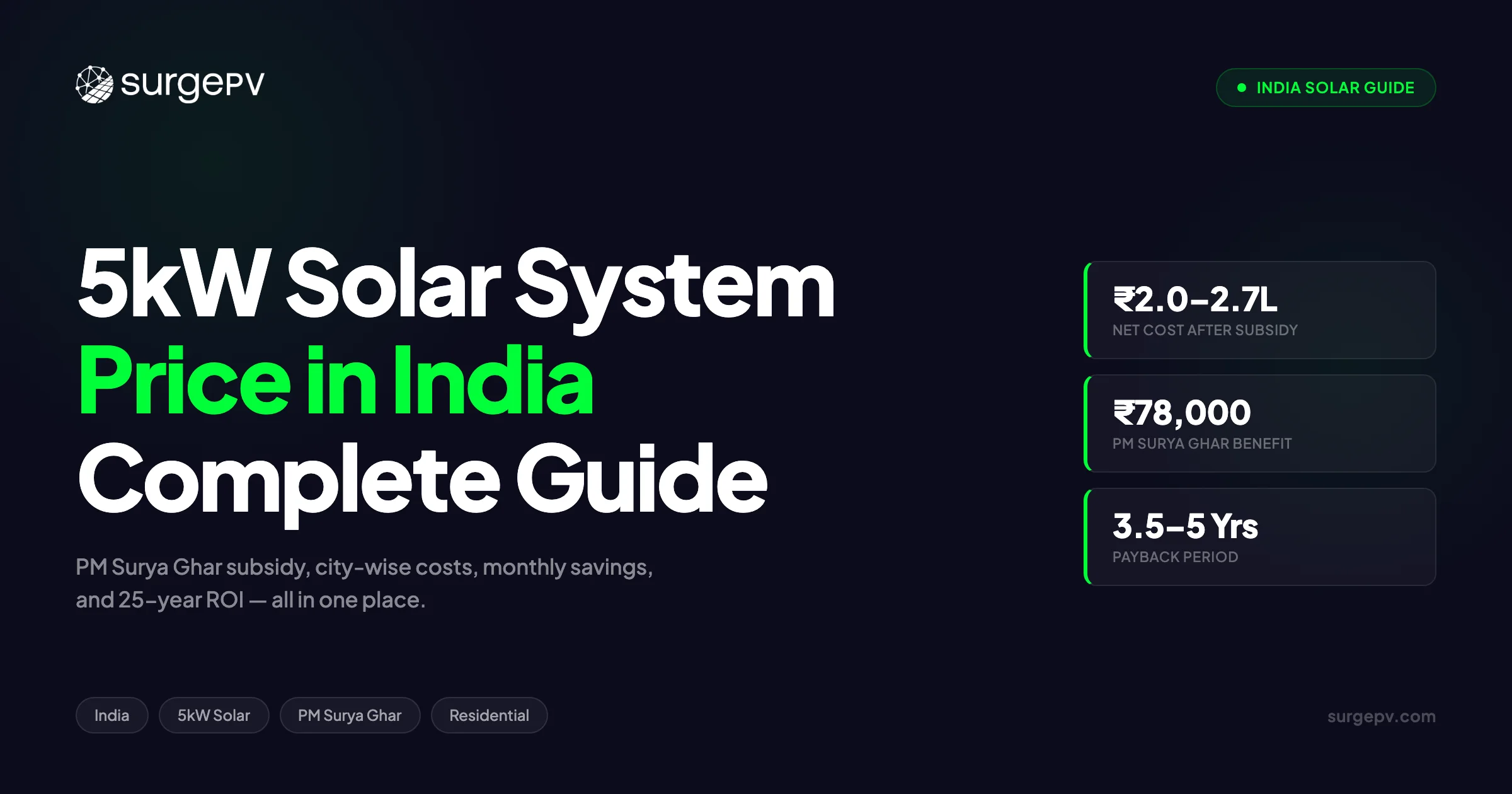
A 5kW solar system in India costs between ₹2.8 lakh and ₹3.5 lakh before any government subsidy in 2026. After applying the PM Surya Ghar subsidy of ₹78,000, your net cost comes down to approximately ₹2.0 lakh to ₹2.7 lakh depending on your state and installer.
Here’s a system-type breakdown:
| System Type | Best For | Price Before Subsidy | Price After Subsidy |
|---|---|---|---|
| On-Grid (No Battery) | Homes with stable grid | ₹2.8 - ₹3.2 Lakh | ₹2.0 - ₹2.4 Lakh |
| Hybrid (Battery Backup) | Homes with power cuts | ₹3.5 - ₹4.5 Lakh | No subsidy on battery |
| Off-Grid (Full Battery) | Rural/remote locations | ₹3.8 - ₹4.8 Lakh | No subsidy |
For most urban and semi-urban homeowners in India, the on-grid system with PM Surya Ghar subsidy is the most cost-effective choice in 2026.
What Does a 5kW Solar System Include?
One of the most common confusions is thinking the price covers only the panels.
A complete 5kW installation includes:
- 10-12 solar panels (440W-550W each)
- Solar inverter (5kW capacity)
- Mounting structure
- DC and AC cables
- Earthing and lightning protection
- Bi-directional net meter
- Installation labour and documentation
- Subsidy application support (from empanelled vendors)
Always confirm that every item above is included before signing with any installer. Reputable installers generate quotes using solar proposal software that itemizes every component — a quote missing even one component will add cost later.
PM Surya Ghar Subsidy: What You Get on a 5kW System
The central government subsidy under PM Surya Ghar is structured as follows:
| Capacity | Subsidy |
|---|---|
| Up to 2 kW | ₹30,000 per kW |
| 2 kW - 3 kW | ₹18,000 per kW |
| Above 3 kW | Fixed cap at ₹78,000 |
So for a 5kW system, your maximum central subsidy is ₹78,000 — regardless of whether you go 5kW, 6kW, or 10kW. States like Delhi and Uttar Pradesh offer an additional ₹30,000 state-level subsidy on top of this, bringing the total benefit to ₹1,08,000.
Eligibility Checklist:
- Indian homeowner with electricity connection in your name
- On-grid rooftop system only (not off-grid or hybrid)
- Must install through an MNRE-empanelled vendor
- Must use Made-in-India DCR panels
See also: solar design software India.
City-Wise 5kW Solar System Price in India (2026)
Prices vary slightly by state due to installation labour costs, DISCOM rates, and state subsidy additions:
| City / State | Before Subsidy | After Central Subsidy |
|---|---|---|
| Chennai, Tamil Nadu | ₹2.80 - ₹3.20 Lakh | ₹2.02 - ₹2.42 Lakh |
| Bengaluru, Karnataka | ₹3.00 - ₹3.50 Lakh | ₹2.22 - ₹2.72 Lakh |
| Delhi | ₹2.90 - ₹3.30 Lakh | ₹1.82 - ₹2.22 Lakh |
| Hyderabad, Telangana | ₹2.85 - ₹3.25 Lakh | ₹2.07 - ₹2.47 Lakh |
| Ahmedabad, Gujarat | ₹2.75 - ₹3.10 Lakh | ₹1.97 - ₹2.32 Lakh |
| Jaipur, Rajasthan | ₹2.80 - ₹3.20 Lakh | ₹2.02 - ₹2.42 Lakh |
| Lucknow, Uttar Pradesh | ₹2.80 - ₹3.15 Lakh | ₹1.72 - ₹2.07 Lakh |
*Delhi and UP include additional state subsidy of ₹30,000
How Much Will a 5kW System Save You Every Month?
This is the question that matters most and the numbers are genuinely impressive:
| Parameter | Value |
|---|---|
| Daily generation | 20 - 24 units |
| Monthly generation | 600 - 720 units |
| Monthly bill savings | ₹3,000 - ₹4,500 |
| Annual savings | ₹36,000 - ₹54,000 |
| Payback period | 3.5 - 5 years |
| System life | 25+ years |
After your payback period, you’re essentially running your home on near-zero electricity cost for 20+ more years.
If you want to understand exactly how home solar works and what size suits your roof and appliance load, that’s the right starting point before getting installer quotes.
Is a 5kW System the Right Size for Your Home?
A 5kW solar system is the right fit for most 3-4 BHK Indian homes with a monthly electricity bill between ₹3,500-₹6,000. It generates 600-700 units per month — enough to cover your ACs, refrigerator, washing machine, and daily appliances comfortably.
A 5kW solar system is ideal for:
- 3-4 BHK homes with daily usage of 18-22 units
- Homes running 2-3 ACs along with regular appliances
- Monthly electricity bills between ₹3,500 - ₹6,000
- Roof area availability of 300-350 sqft (south or west facing) Also see: Us Residential Solar Market Trends 2026.
Not sure if 5kW is enough?
Use your last 3 electricity bills to find your average monthly consumption in units. Divide that by 30 to get your daily usage — if it’s between 18–25 units, 5kW is your size. For United States-specific compliance details, see United States arizona/phoenix.
If your bill is below ₹2,500, a 3kW system is more appropriate and more cost-efficient. If you’re running a small office or villa with bills above ₹7,000, a 10kW system will serve you better.
What Panel Brand Should You Choose?
The brand of panel affects both performance and long-term warranty reliability. In 2026, the most trusted DCR-compliant brands for residential 5kW systems in India are:
- Adani Solar — 30-year performance warranty, Tier 1 certified
- Waaree — High efficiency, widely available across India
- Tata Power Solar — Premium reliability, strong after-sales
- Vikram Solar — Good efficiency, competitive pricing
- Goldi Solar — Value segment with solid warranty terms
Always ask your installer to confirm the panel wattage, efficiency rating, and warranty document before installation. A genuine Tier 1 panel at 540W-550W gives the best output per sqft of roof space.
Designing Solar Systems for Indian Clients?
SurgePV handles MNRE-compliant design, DISCOM documentation, PM Surya Ghar subsidy calculations, and proposals — all from one platform built for Indian solar workflows.
Book a DemoNo commitment required · 20 minutes · Live project walkthrough
For a direct comparison, see Arka 360 vs SurgePV.
How to Calculate Your ROI on a 5kW Solar System
Most buyers focus on the upfront cost. The smarter question is: what does this system return over 25 years?
A 5kW solar system in India delivers a 600-700% ROI over its lifetime — far outperforming fixed deposits at 6-7% or mutual funds at 10-12% annually. After your 3-5 year payback, the remaining 20+ years of generation is essentially free electricity working in your favour.
Here’s a real ROI example for a homeowner in Chennai with a monthly bill of ₹4,500:
| Parameter | Value |
|---|---|
| System Cost (before subsidy) | ₹3,00,000 |
| PM Surya Ghar Subsidy | ₹78,000 |
| Net Investment | ₹2,22,000 |
| Monthly Generation | 600-700 units |
| Monthly Bill Savings | ₹3,600-₹4,200 |
| Annual Savings | ₹43,200-₹50,400 |
| Payback Period | 4.4-5.1 years |
| 10-Year Net Savings | ₹2,10,000-₹2,82,000 |
| 25-Year Net Savings | ₹8,58,000-₹10,38,000 |
| Annual ROI | 20–25% |
After your payback period — typically 4-5 years — every unit your system generates is pure saving. With electricity tariffs rising 3-5% annually across most Indian states, that return only improves over time.
One more thing most people miss: solar adds measurable resale value to your home. A 5kW rooftop system with a 25-year warranty is a visible, verified asset — especially relevant in metros where buyers increasingly factor energy costs into property decisions.
You can model these numbers precisely against your actual DISCOM tariff using the generation and financial tool.
Net Metering: How It Works for a 5kW System
Net metering is what makes on-grid solar genuinely valuable. Without it, you’d only benefit when the sun is shining. With it, you earn credit for every unit you export to the grid.
Here’s how it works practically:
- Your panels generate electricity during the day
- You consume what you need in real time
- Surplus generation is exported to the grid and logged by your bidirectional meter
- At the end of the billing cycle, your DISCOM calculates: Units consumed from grid - Units exported to grid = Net units billed
- If you exported more than you consumed, the credit carries forward to next month
For a 5kW system generating 600-700 units a month, a typical family consuming 300-400 units will export 200-300 units monthly. At ₹3-₹5 per unit export rate depending on your state, that’s an additional ₹600-₹1,500 in credit every month.
State-wise export tariff (2026 reference):
| State | Export Rate (Net Metering) |
|---|---|
| Karnataka | ₹3.56/unit |
| Maharashtra | ₹2.50-₹3.50/unit |
| Tamil Nadu | As per TANGEDCO tariff |
| Gujarat | ₹2.25-₹3.00/unit |
| Delhi | Avoided cost of supply |
Net metering approval typically takes 4-8 weeks after installation depending on your DISCOM’s processing speed.
5 Mistakes Indian Homeowners Make When Installing a 5kW Solar System
Getting the cost right is one thing, getting the installation right is another. These are the most common and costly mistakes to avoid:
1. Choosing the cheapest installer without checking credentials
A non-MNRE-empanelled installer voids your subsidy eligibility entirely. Always verify empanelment before signing. A ₹10,000 saving upfront can cost you ₹78,000 in lost subsidy.
2. Wrong panel orientation or tilt angle
In India, panels should ideally face south at a tilt of 15-25 degrees depending on your latitude. A wrong orientation can reduce output by 15-20% year-round — that’s the equivalent of losing 1kW of capacity permanently.
3. Not confirming what’s included in the quote
Some quotes exclude the bidirectional meter, earthing, or documentation charges. Always ask for a line-item breakdown. The 8-point checklist mentioned earlier in this article is your baseline.
4. Skipping roof structural assessment
A 5kW system adds 250-300 kg of load to your roof through panels and mounting structures. Older rooftops, especially pre-2000 RCC constructions, need a structural check before installation.
5. Installing without a shadow analysis
A single shaded panel in a string can bring down the output of the entire string. Before finalising panel placement, ask your installer to map shading patterns across morning, afternoon, and evening hours throughout the year. Professional shadow analysis software maps these patterns automatically across all seasons. Read [Solar Shading Analysis Guide](/blog/solar-shading-analysis-guide) for a complete walkthrough.
How to Choose the Right Installer for a 5kW System
Your installer is the single biggest variable in whether your system performs as promised. Here’s what to look for:
- MNRE empanelment — non-negotiable for subsidy eligibility; verify on the official portal
- Experience with your DISCOM — local installers who regularly work with your electricity board process net metering faster
- Tier 1 panel sourcing — ask for the panel brand, wattage, and warranty document upfront
- Post-installation monitoring setup — reputable installers set up SolarEdge, Growatt, or Deye monitoring apps before they leave
- Minimum 2 quotes — price differences of ₹30,000-₹60,000 for the same capacity are common; compare what’s included, not just the total
For solar installers managing multiple residential projects, solar design software that automates DISCOM documentation and subsidy calculations removes the manual bottleneck on every application.
Red flags to walk away from:
- Installer unwilling to share the panel brand name
- No written warranty on workmanship
- Quote that excludes net metering documentation
- Pressure to sign on the same day
Step-by-Step: What Happens After You Say Yes
Understanding the process removes the anxiety. Here’s what a typical 5kW on-grid installation looks like from agreement to first bill:
| Step | What Happens | Timeline |
|---|---|---|
| 1. Site Survey | Installer visits, checks roof, maps shading, confirms load | Day 1-3 |
| 2. Agreement & Payment | Quote finalized, payment schedule agreed | Day 3-5 |
| 3. DISCOM Application | Installer submits net metering application | Day 5-7 |
| 4. Physical Installation | Panels, inverter, wiring, earthing done | Day 7-10 |
| 5. DISCOM Inspection | DISCOM engineer visits and approves the system | Week 2-4 |
| 6. Net Meter Installation | Bidirectional meter installed by DISCOM | Week 4-6 |
| 7. Subsidy Application | Installer submits commissioning certificate on PM Surya Ghar portal | Week 6 |
| 8. Subsidy Credit | ₹78,000 credited to your bank account via DBT | Week 8-12 |
| 9. First Solar Bill | First billing cycle with net metering reflected | Month 2-3 |
The entire process from agreement to first solar-reduced bill typically takes 6-10 weeks. Systems in Tamil Nadu, Gujarat, and Rajasthan tend to process faster due to established DISCOM workflows.
Final Word
A 5kW solar system at ₹2.0-₹2.7 lakh after subsidy, saving you ₹3,000-₹4,500 every month. The math is straightforward and the payback period has never been shorter. The only decision left is choosing the right system type and a trusted, MNRE-empanelled installer.
Get at least two quotes, confirm what’s included, check the panel brand warranty, and apply through the official PM Surya Ghar portal. Your electricity bill will thank you for the next 25 years.
Frequently Asked Questions
Will the price go up or down in 2026?
Panel prices have been relatively stable in the ₹22-₹28 per watt range. However, subsidy budgets are limited and early applicants are getting faster approvals.
Can I get a 5kW system on EMI?
Yes. Several DISCOMs and banks offer solar-specific loans where the monthly EMI is often lower than your current electricity bill. Some installers offer zero-cost upfront plans where the subsidy covers your down payment.
How long does installation take?
Physical installation takes 2-3 days. Net meter approval and subsidy credit to your bank account takes 4-8 weeks depending on your DISCOM.
Do I lose electricity during installation?
No. The system is installed first and connected to the grid only after net meter installation — your regular power supply is uninterrupted throughout.