

This page is for installers and EPC teams in Oman choosing solar proposal software. Short answer: for a dollar price and PPA financing on every plan, pick Arka360; for a custom tiered tariff, an export rate and a PPA product in the financial analysis, pick Aurora Solar.
No tool on this list states Omani rules, Arabic text or an OMR price on the pages we read, so pick by what your proposal must show. Arka360, Aurora, Energy Toolbase and OpenSolar each describe cash, loan, lease or power purchase agreement (PPA) options. Aurora, Energy Toolbase and OpenSolar also let you create a custom rate with tiers, which Oman’s residential tariff needs. SurgePV lists financial modeling and proposals, so ask in a demo how it handles Omani items.
This is a desk comparison of what each vendor publishes, checked October 2026. We have not run side-by-side tests. Local rules come from Omani regulator and utility pages. Tool facts come from each vendor’s own site. The earlier version of this page also made claims about summer heat losses and proposal times. We removed them because we could not source them from vendor or official pages.
Solargraf is not compared on this page. Its site, solargraf.com, returned HTTP 403 to automated reads, including a headless browser, in October 2026. PVsyst is also not compared. It is a yield tool, and the PVsyst pages we read do not describe customer quotes.
Criteria used: PPA and finance options, custom tiered tariff, Arabic text and OMR, published price, free tier.
Want to see SurgePV quote an Oman project?
Book a guided demo and bring a real Oman site. We walk through design, yield, finance and the proposal in one platform.
Book a Free DemoChecking cost first? See the SurgePV pricing page.
Best-For Picks for Oman
- A dollar price and PPA financing on every plan: Arka360. Its pricing page lists “Financing: Cash, loan, lease & PPA” on all three plans. It shows Basic at $199 per month and Premium at $358 per month.
- A custom tiered tariff, an export rate and a PPA product in the financial analysis: Aurora Solar. All three are in its help center. The price is in dollars, per user.
- Free quoting with a custom tiered tariff: OpenSolar. The core app is free of charge. The vendor charges for API Access and connectors from 16 April 2026.
- Solar plus battery storage proposals: Energy Toolbase. Its FAQ says ETB Developer models battery dispatch to cut demand charges. It also names PPAs. The vendor publishes no price.
- Roof model, shading, yield, financial model, parts list and proposal in one product, priced per user: SurgePV. Ask in a demo about PPAs, tiered tariffs, Arabic text and OMR. Its published scope names none of them.
Oman Solar Proposal Software Comparison Table
The tools are in alphabetical order. This is not a ranking. Pick by the situation above. Prices checked October 2026 on each vendor’s own page.
| Tool | Best for | Price | Free or paid | Decisive scope fact |
|---|---|---|---|---|
| Arka360 | Dollar price with PPA financing | Basic $199 per month; Premium $358 per month; Enterprise by quote | Paid | PPA financing on all three plans; Oman not named |
| Aurora Solar | Custom tiered tariff and PPA product | $159 or $259 per user per month (billed monthly); $135 or $220 billed annually | Paid | Custom rates with tiers; Oman not named |
| Energy Toolbase | Solar plus storage proposals | Not published; pricing given on a demo call | Paid | Battery dispatch and demand charge modeling |
| OpenSolar | Free quoting with a custom tariff | Core app free of charge; API Access and connectors charged from 16 April 2026 | Free core app, paid API and connectors | Custom tariffs with tiers; no Arabic in the proposal language list |
| SurgePV | Roof model to parts list and proposal | $1,899 per user per year (1 user), in US dollars | Paid, guided demo | Parts list and proposal in scope; no Omani item stated |
Oman Criteria Matrix
Each cell is Documented, Partial or Not stated. Documented means the vendor’s own page states it. Partial means the page states a related item but not the full one. Not stated means the pages we read in October 2026 do not say. There are no scores or weights.
| Tool | PPA and finance options | Custom tiered tariff | Arabic text and OMR | Price in OMR | Free tier |
|---|---|---|---|---|---|
| Arka360 | Documented (pricing table, all plans) | Partial (utility rate finder; custom entry not stated) | Not stated | Not published (dollars) | Not stated |
| Aurora Solar | Documented (help center, financing product) | Documented (custom rates, tiers, time-of-use) | Not stated | Not published (dollars) | Not stated |
| Energy Toolbase | Documented (FAQ) | Documented (help center: you can create your own rate schedule; energy charge types include tiered) | Not stated | Not published for ETB Developer | Not stated |
| OpenSolar | Documented (partner finance options) | Documented (custom tariffs, tiers) | Partial (Arabic is not in the proposal language list; OMR not stated) | Not published (core app free) | Documented |
| SurgePV | Not stated (financial modeling in scope) | Not stated | Not stated | Not published (USD) | Not stated (guided demo) |
PPA and finance options means cash, loan, lease or PPA choices in the proposal. Custom tiered tariff means you can enter a rate that changes with monthly use. Arabic text and OMR means a proposal in Arabic or in Omani rials. A tool that does not state an item may still support it. Ask each vendor to quote one real Omani job before you buy.
Tool Entries
Arka360
Best for: installers and EPCs (engineering, procurement and construction firms) who want a dollar price and PPA financing on every plan, and who will enter Omani tariffs by hand.
Not the right choice if: you need documented Oman tariffs, Arabic text, OMR output or a custom tiered tariff. The pages we read do not state them. Basic does not list a customizable proposal or a single line diagram. Premium and Enterprise do.
What the vendor documents: the pricing page compares plans. It lists a utility rate finder, adders, discounts and incentives, a web proposal and “Financing: Cash, loan, lease & PPA” on all three plans.
Price (checked October 2026): the dollar cards on the pricing page show Basic at $199 per month (includes 1 user), Premium at $358 per month (includes 2 users) and Enterprise on request. The plan table calls Premium “Professional”. The page also holds rupee prices plus 18% GST for India. We do not quote them here.
Limitations: the pricing page does not mention Oman. Two Arka360 blog posts name Oman only as a growing solar market. The pricing page does not state a free plan or whether the monthly price is billed monthly or annually.
Vendor link: arka360.com.
Aurora Solar
Best for: teams already on Aurora that want a custom tiered tariff, an export rate and a PPA product in the financial analysis.
Not the right choice if: you need Arabic text or OMR output, a price in rials or a free trial. The pages we read do not state them.
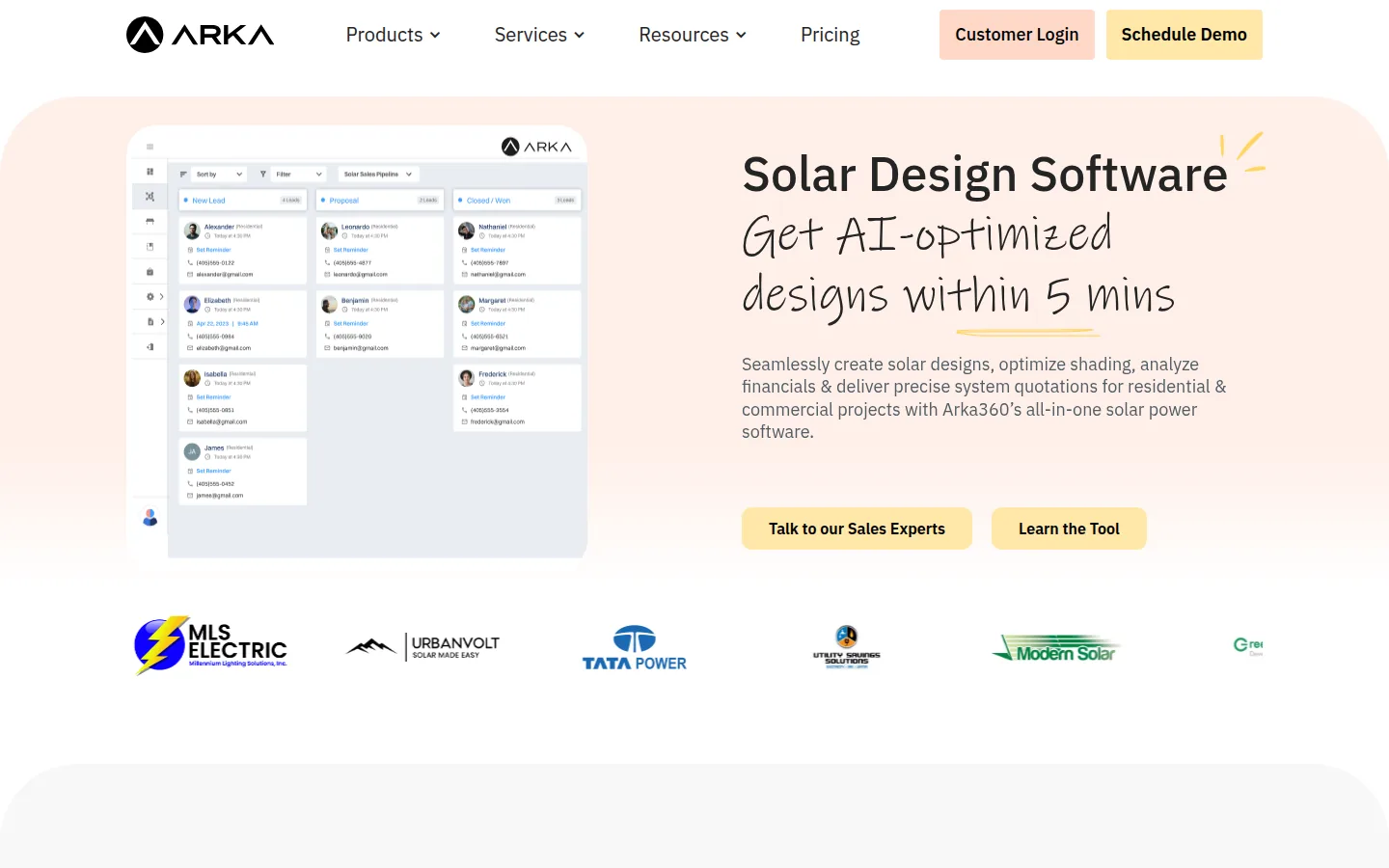
What the vendor documents: its custom utility rates article lets an account admin create a rate with tiers and time-of-use periods. Its rate editing article lets you set the export rate and a compensation policy of net billing or feed-in tariff. Its financial analysis article says a loan, lease, PPA or cash financing product must be selected. It lists payback period, NPV, lifetime savings and LCOE as outputs. NPV is net present value. LCOE is the cost of each unit of power over the system’s life.
Price (checked October 2026): Basic $159 per user per month billed monthly, or $135 per user per month billed annually ($1,620 billed annually); Premium $259 per user per month, or $220 billed annually ($2,640 billed annually). Enterprise is custom, per project. The page shows a dollar sign and does not name the currency.
Limitations: the pages we read do not mention Oman. The pricing page does not state a free trial.
Vendor link: aurorasolar.com.
Energy Toolbase
Best for: teams that sell solar plus battery storage and want a vendor focused on rates and project economics. They can build their own rate schedule for an Omani tariff.
Not the right choice if: you want a published price or a panel layout tool inside the app. The pricing page says you get pricing for your team size on a demo call. On the ETB Developer page, the comparison table does not tick in-app PV panel layout for ETB Developer. It ticks design partnerships with other design tools.
What the vendor documents: its ETB Developer FAQ says the platform supports cash purchases, PPAs, loans and leases. It also says ETB Developer is web-based, has a built-in database of utility rates, incentives and tariffs, and models battery dispatch to reduce demand charges. Its rate schedules article says there are two ways to create your own utility rate schedule: copy an existing one or create one from scratch. Its rate schedule page article says an energy charge can be flat, tiered or time-of-use.
Price (checked October 2026): not published for ETB Developer. The dollar figures on the pricing page belong to ETB Controller and ETB Monitor, not to ETB Developer. The page also lists implementation and support packages for setup. It shows no price for them.
Limitations: the pages we read do not mention Oman. Energy Toolbase’s refund policy says it offers free trial periods from time to time.
Vendor link: energytoolbase.com.

OpenSolar
Best for: installers who want a free core app with a custom tiered tariff, and who will write proposal text themselves.
Not the right choice if: you need an Arabic proposal. Its language article lists 13 proposal languages, and Arabic is not one of them.
What the vendor documents: its tariff article lets you create a custom tariff with flat, time-of-use, tiered or demand rates and a compensation mechanism. Its Integrated Finance page says customers can compare loans, leases, PPAs and other third-party ownership paths in the proposal. Those options come from finance partners listed on the page.
Price (checked October 2026): the core app is free of charge for solar professionals, per the vendor. From 16 April 2026 the vendor charges for API Access, a per-project fee, and for supported connectors, a flat monthly subscription. API Access lets other software connect to OpenSolar. The date comes from its 16 February 2026 post. The billing types come from its API page.
Limitations: the pages we read do not mention Oman. The partner finance options on the Integrated Finance page do not state Oman.
Vendor link: opensolar.com.
SurgePV
SurgePV is our product.
Best for: teams that want roof modeling, shading, yield, financial modeling, bill of materials and proposals in one product, priced per user. They will confirm the Omani items in a demo.
Not the right choice if: you want a self-serve trial, because SurgePV offers a guided demo. Skip it too if you need PPA options, a tiered tariff, Arabic text or an OMR price in writing before you talk to sales. SurgePV’s published scope does not name them. Its outputs support design and documentation. They do not replace approval by the responsible engineer, authority, lender or utility. SurgePV’s published product scope does not list a CRM. Monitoring and ERP are outside its published scope.
What the vendor documents: 3D roof modeling, array layout, shading analysis and energy-yield modeling. It also lists financial modeling, electrical workflow support, bill-of-materials output and proposal generation. See solar proposal software and solar design software for the product pages.
Price (checked October 2026): $1,899 per user per year for 1 user, $1,499 per user for 3 seats, $1,299 per user for 5 seats, in US dollars.
Limitations: results depend on source data, assumptions and equipment models. The published scope does not state PPAs, Omani tariffs or Arabic text.
Vendor link: surgepv.com.
Oman Rules That Shape the Choice
The regulator is APSR, and two companies distribute power. The Authority for Public Services Regulation (APSR) lists its electricity sector page. It says two companies hold a license to distribute electricity in Oman: Nama Electricity Distribution Company and Dhofar Integrated Services Company. It says Nama Supply Company handles supply and billing in the Main Interconnected System. Dhofar Integrated Services Company does this in the Dhofar network. Your customer’s bill comes from one of them.
Tariffs depend on the customer type. APSR’s tariffs page says the Council of Ministers sets the permitted tariffs. They cover residential, non-residential, agriculture and fisheries, and a cost-reflective tariff. The non-residential tariff applies to accounts that use up to 100 MWh a year. The cost-reflective tariff applies to government, commercial and industrial customers above 100 MWh a year, from January 2021. The page lists the residential primary account (two accounts or less) at 14 baisa for 0 to 4,000 kWh a month, 18 baisa for 4,001 to 6,000 and 32 baisa above 6,000. Additional accounts are 22, 26 and 32 baisa. The non-residential tariff is 25 baisa. The page labels the unit “Baisa/Kw”. One OMR is 1,000 baisa. A proposal tool must let you enter tiers like these, or the savings figure will be wrong.
Large customers pay a cost-reflective tariff. The same page says this tariff has four parts. They are an energy charge based on the bulk supply tariff, a transmission charge, a distribution charge and a supply charge. The tool must let you enter these parts if you quote a large customer.
Rooftop solar rules need a local check. The Nama Power and Water Procurement 7-Year Statement for 2020 to 2026 (Issue 14, PDF) says a framework since 2017 allows the installation and connection of distributed solar generation. It names Sahim I, Sahim II and an ESCO program for government buildings. It says these projects mainly offset electricity demand and to some extent may supply the grid. It expects about 230 MW of rooftop solar and similar projects by 2026. The newer 2025 to 2031 statement does not mention Sahim in the PDF text we searched. We did not find a current APSR page with Sahim rules or export prices. Ask Nama Distribution or APSR before you show export income in a proposal.
The utility says it wants to simplify small solar projects. Nama Distribution’s alternative energy page says it is working to simplify small and medium-scale alternative energy projects, including solar power. Its standards page lists the Oman Electrical Standards, including OES 4 for electrical installations in buildings. We did not read the standards themselves.
What this means for your quote. Oman’s tariffs come in tiers and by customer type. A proposal needs the customer’s tariff, an honest export assumption and your price in the currency the customer expects. The matrix above shows which vendors state tiered tariff entry and PPA options. No vendor states Arabic text or OMR output on the pages we read.
How We Ordered These Tools
SurgePV publishes this page and is a vendor on this list. Its entry uses the same vendor-page sources and template as every other tool here.
We did not rank these tools. They are listed alphabetically, and the best-for picks come from the matrix above.
- PPA and finance options: many Omani commercial buyers compare buying with other ways to pay. We did not assess whether any tool models a PPA correctly.
- Custom tiered tariff: the residential tariff changes with monthly use, so savings depend on the tier. We did not assess whether any tool handles the cost-reflective tariff.
- Arabic text and OMR: a customer may expect a proposal in Arabic and in rials. We did not assess translation quality or currency rounding.
- Price in OMR: a local price shows what an Omani buyer will pay. We did not assess discounts or negotiated quotes.
- Free tier: a free plan lets a small team test the workflow. We did not assess the limits of any free plan beyond what its page states.
Sources and Dates
Vendor pages were read in October 2026. They are Arka360 (pricing), Aurora (pricing and three help-center articles), Energy Toolbase (pricing, ETB Developer, FAQ and two help-center articles), OpenSolar (the free page, the 16 February 2026 post, the Integrated Finance page and two help-center articles) and SurgePV (pricing). Omani sources: APSR and Nama Distribution pages linked above, and the Nama Power and Water Procurement 7-Year Statements. Help-center articles were read in a browser.
See SurgePV on your Oman project
Book a guided demo and ask how it handles the Omani items you need in the proposal.
Book a Free DemoMore Solar Software Guides to Compare
- Best solar software in Oman
- Solar design software for Oman
- Solar proposal software for Kuwait, Qatar and Saudi Arabia, the nearest country lists
- Best solar proposal software, all markets
Frequently Asked Questions
What is the best solar proposal software in Oman?
It depends on what the proposal must show. No tool here states Omani rules, Arabic text or an OMR price on the pages we read. Arka360, Aurora, Energy Toolbase and OpenSolar each describe cash, loan, lease or PPA options. Aurora, Energy Toolbase and OpenSolar also let you create a custom rate with tiers. SurgePV lists financial modeling and proposals but publishes nothing Omani. Ask each vendor to quote one real Omani job.
Can solar proposal software model a PPA in Oman?
A power purchase agreement (PPA) is a contract to buy the power a system makes. Arka360 lists PPA financing on every plan. Aurora’s help center lists a PPA as a financing product in its financial analysis. Energy Toolbase’s FAQ names PPAs. OpenSolar’s Integrated Finance page names PPAs among partner finance options. None of these pages names Oman. SurgePV’s published scope lists financial modeling but does not name PPAs.
Which proposal tools let me enter Oman’s tiered residential tariff?
APSR lists residential tariffs in tiers by monthly use. Aurora’s help center lets an account admin create a custom rate with tiers and time-of-use periods. OpenSolar’s help center lets you create a custom tariff with flat, time-of-use, tiered or demand rates. Energy Toolbase’s help center says you can create your own rate schedule, and its rate page lists tiered energy charges. Arka360 lists a utility rate finder, but the pages we read do not say you can enter a custom tiered rate. SurgePV states nothing on this.
Is there free solar proposal software for Oman?
OpenSolar says its core app is free of charge for solar professionals. The vendor charges for API Access and supported connectors from 16 April 2026. Its list of supported proposal languages does not include Arabic. The other four tools here are paid, and none of the pages we read states a free plan.
How much does solar proposal software cost for Oman?
No vendor here publishes a price in Omani rials. Arka360 lists 199 dollars per month for Basic and 358 dollars per month for Premium. Aurora lists 159 dollars per user per month for Basic, billed monthly. SurgePV lists 1,899 US dollars per user per year for one user. Energy Toolbase publishes no price for its proposal tool. OpenSolar’s core app is free.
What should a solar proposal show for an Omani customer?
Start with the customer’s tariff. APSR lists residential tariffs in tiers, a flat non-residential tariff, and a cost-reflective tariff for accounts above 100 MWh a year. Show the tier the customer pays today. Do not show export income until Nama Distribution or APSR confirms the current rooftop rules in writing.
