

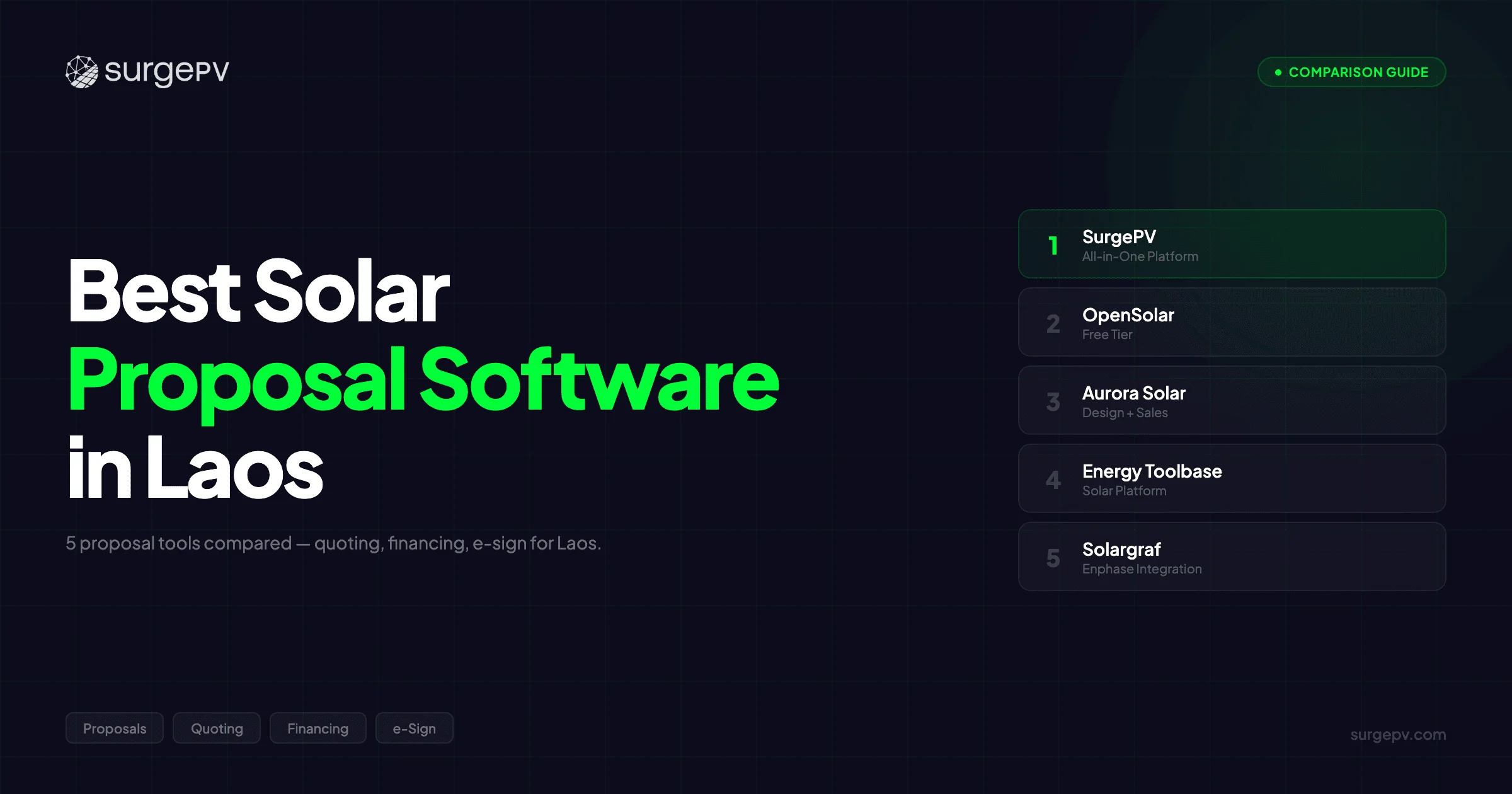
TL;DR: SurgePV is the best solar proposal software for Laos — automated proposals with accurate financial modelling for Laos’s net metering and self-consumption framework.
Laos’s solar market runs on development finance. ADB, World Bank, JICA, and regional banks fund the majority of solar projects in the country. Every project lives or dies on the quality of its documentation long before a single panel gets installed.
The problem most EPCs face is straightforward: they design a technically sound system, then spend three to four days assembling the proposal in Excel and PowerPoint. Financial projections are manually calculated. Production estimates are copied from a separate simulation tool with rounding errors. The final document looks like it was assembled by committee — because it was.
Meanwhile, Thai and Vietnamese EPCs competing for the same ADB-funded projects submit polished, bankable proposals within 48 hours. They win. Not because their systems are better, but because their proposals are.
Laos electricity from EdL costs $0.08–$0.15/kWh depending on customer class — lower than Cambodia or Thailand. That means the solar business case requires careful financial modeling to demonstrate value. Your proposal software needs to show clear payback at lower savings margins, handle USD-based financial projections, and produce documentation that ADB project evaluators trust.
In this guide, you’ll find:
- Which 5 platforms generate professional proposals for Laos’s development-finance-driven market
- How each tool handles USD pricing and EdL tariff comparisons
- Which platforms produce bankable documentation that ADB and World Bank accept
- Real pricing breakdowns for each platform
- Which software pays for itself fastest in Laos’s competitive tender environment
Quick Comparison Table
| Software | Best For | Pricing | Laos Fit |
|---|---|---|---|
| SurgePV | All-in-one proposals + design | ~$1,899/yr (3 users) | Excellent |
| OpenSolar | Free proposals | Free of charge | Good |
| Aurora Solar | AI-powered proposals | Basic $1,620/user/yr; Premium $2,640/user/yr (billed annually) | Good |
| Energy Toolbase | Storage proposals | Contact for pricing | Good |
| Solargraf | Residential proposals | Contact for pricing | Good |
Best Solar Proposal Software in Laos (Detailed Reviews)
Pro Tip
For ADB and World Bank-funded projects, your proposal must include P50/P75/P90 bankable production estimates alongside detailed financial appendices. Tools that only produce P50 estimates leave you short of what development finance evaluators require.
SurgePV — Best All-in-One Proposal Platform for Laos
Target Users: C&I EPCs handling 10+ proposals per month, solar PPA developers, regional installers covering Laos and neighboring Mekong countries.
SurgePV is the only cloud-based platform combining AI-powered solar design, bankable simulations, and professional proposals in a single workflow. For Laos’s development-finance-driven market, that integration is not a convenience — it is a competitive requirement.
Think about how most Laos solar proposals get built today. An engineer spends a day on system design using one tool. Then transfers data to Excel for financial modeling. Then someone builds a PowerPoint deck. Three to four days later, the proposal is ready. By then, a regional competitor already submitted theirs — with bankable simulation data flowing directly into the financial projections, zero data-entry errors.
With SurgePV, your team goes from site data to client-ready proposal in 30 minutes. The production numbers come directly from engineering-grade P50/P75/P90 simulations. No data re-entry. No version conflicts between what engineering calculated and what sales presented.
Why SurgePV Fits Laos
The Laos market has specific requirements that generic proposal tools miss:
- USD-native pricing: EdL commercial tariffs are quoted in kip but international projects transact in USD. SurgePV handles USD-based financial projections natively.
- EdL tariff comparison: Input client-specific tariffs ($0.08–$0.15/kWh depending on customer class) for accurate savings calculations.
- ADB-ready bankability: P50/P75/P90 estimates within ±3% of PVsyst accuracy — acceptable for development bank project evaluations under 10 MW.
- PPA financial modeling: 20-year cash flow projections for PPA developers bidding on ADB-funded installations.
Key Proposal Features
- Professional proposals generated in 30 minutes from completed design
- Financial modeling: cash, loan, lease, and PPA scenarios
- Production forecasts flow directly from engineering simulations — no manual data transfer
- Customizable templates with your company branding
- Web-based delivery with interactive client dashboards
Pricing
| Plan | Price | Users |
|---|---|---|
| Starter | $1,899/year | 3 users |
| For 3 Users | $1,499/user/year | 3 users |
| For 5 Users | $1,299/user/year | 5 users |
| Enterprise | Custom | Multiple |
All features included on every plan. See full pricing.
Limitations
- Learning curve of 2–3 weeks for full platform proficiency
- Not universally accepted by all financiers for utility-scale projects above 10 MW (PVsyst still preferred at that scale)
- Newer platform — financer acceptance is growing, not universal
OpenSolar — Free Platform for Small Installers
Target Users: Small residential and light C&I installers testing software before committing to paid platforms.
OpenSolar offers a proposal platform, free of charge, with clean templates and basic financial modeling. For Laos installers doing under 5 proposals per month on small residential systems, it covers the basics without subscription cost.
What Works
- Free of charge, which is useful for installers still building their client base
- Clean, professional-looking proposal templates
- Basic financial modeling: simple payback and savings calculations
- 3D roof design included
Where It Falls Short for Laos
- Limited financial modeling depth — no PPA scenario modeling or development finance appendices
- No P50/P75/P90 bankable estimates — insufficient for ADB-funded projects
- Proposal customization is limited
- Financial projections lack the detail that EdL tariff comparisons require for C&I clients
Best for: Small residential installers in Vientiane testing proposal software before upgrading. Not suitable for C&I EPCs or development-financed projects.
Aurora Solar — Premium Visual Proposals
Target Users: Large international development consultants where visual polish and brand presence are primary differentiators.
Aurora Solar produces the most visually sophisticated proposals in the industry — 3D renders, interactive financial dashboards, and brand customization at a level no other platform matches. The trade-off is cost and a critical financial modeling gap.
What Works
- Best-in-class 3D visualizations and proposal aesthetics
- Strong brand customization for international consulting firms
- AI-powered roof detection and layout optimization
- Fast proposal generation once the design is complete
Where It Falls Short for Laos
- Provides only P50 production estimates — no P75 or P90. This is a significant gap for ADB-funded projects where development banks require conservative estimates for debt sizing.
- Aurora Solar’s published pricing is $159/user/month, or $135/user/month billed annually ($1,620/year), for Basic and $259/user/month, or $220/user/month billed annually ($2,640/year), for Premium, per Aurora’s pricing page (checked 21 September 2026). Enterprise is quoted per project. Licensing is per user, which Laos EPCs should weigh against project margins
- No integrated electrical design or SLD generation
- USD pricing model not specifically calibrated for EdL tariff structures
Best for: International development consultants already licensing Aurora Solar globally who need consistent proposal quality across markets.
Energy Toolbase — Advanced Financial Modeling for Storage Projects
Target Users: PPA developers and project finance teams modeling solar-plus-storage on large ADB-funded installations.
Energy Toolbase specializes in financial modeling for solar and battery storage projects. Its 20-year cash flow projections, debt service coverage ratios, and IRR/NPV outputs are designed specifically for project finance teams.
What Works
- Deep financial modeling: 20-year projections, DSCR, IRR, NPV, LCOE
- Solar-plus-storage optimization — models battery dispatch and grid arbitrage
- PPA financial structures that development finance evaluators recognize
- Detailed sensitivity analysis across multiple financial assumptions
Where It Falls Short for Laos
- Proposal quality is weaker than SurgePV or Aurora Solar — financial modeling tool first, proposal tool second
- No integrated solar design — requires separate design software
- Pricing by contact only, making budget planning difficult
- Complex onboarding — not practical for smaller EPCs without dedicated finance teams
Best for: PPA developers with dedicated finance teams modeling large solar-plus-storage installations for ADB or IFC project finance. Overkill for standard C&I proposals.
Solargraf — Fast, Simple Proposals for Small Projects
Target Users: Small C&I installers handling residential and light commercial projects under 100 kW.
Solargraf (now part of Enphase) generates proposals quickly for simple projects. Its strength is speed for straightforward residential installations where complex financial modeling is not required.
What Works
- Fast proposal generation for simple residential projects
- Clean templates with good visual presentation
- Integrated with Enphase equipment — strong fit for Enphase-based installations
- Reasonable pricing for small installers
Where It Falls Short for Laos
- Financial modeling depth is limited — basic payback calculation without development finance appendices
- No P50/P75/P90 bankable estimates
- Enphase equipment bias limits flexibility for EPCs sourcing from multiple suppliers
- Not suited for C&I projects above 100 kW
Best for: Small Laos installers doing simple residential projects for homeowners who want a quick quote. Not suitable for commercial EPCs or development-financed projects.
Which Tool Is Right for Your Needs?
| Your Situation | Recommended Tool | Why |
|---|---|---|
| C&I EPC, 10+ proposals/month | SurgePV | All-in-one platform with ADB-ready bankability at $1,899 per user per year on the individual plan |
| Small installer, testing software | OpenSolar | Free of charge; move on when proposal quality limits growth |
| International development consultant | Aurora Solar | Best visual quality, licensed per user |
| PPA developer, large storage projects | Energy Toolbase | Deep 20-year financial modeling for project finance |
| Residential projects under 100 kW | Solargraf | Fast and simple for straightforward residential quotes |
Create Winning Solar Proposals with SurgePV
Professional proposals with integrated design, simulation, and financing — from site data to client-ready document in 30 minutes.
Book a DemoNo commitment required · 20 minutes · Live project walkthrough
Full Feature Comparison
| Feature | SurgePV | OpenSolar | Aurora Solar | Energy Toolbase | Solargraf |
|---|---|---|---|---|---|
| P50/P75/P90 estimates | Yes | No | P50 only | Limited | No |
| Integrated solar design | Yes | Yes | Yes | No | Yes |
| USD financial modeling | Yes | Basic | Yes | Yes | Basic |
| EdL tariff input | Custom input | Custom input | Custom input | Custom input | Limited |
| PPA financial modeling | Yes | No | Limited | Yes (deep) | No |
| ADB-ready documentation | Yes | No | Partial | Yes | No |
| Proposal generation speed | 30 minutes | 20–40 minutes | 45–60 minutes | 60+ minutes | 15–30 minutes |
| Template customization | High | Medium | Very high | Low | Medium |
| Cloud-based | Yes | Yes | Yes | Yes | Yes |
| Pricing/year | $1,899 (3 users) | Free of charge | Basic $1,620/user; Premium $2,640/user (billed annually) | Contact | Contact |
What Makes a Solar Proposal Bankable in Laos
Laos’s development finance environment sets higher documentation standards than most commercial solar markets. A proposal that wins a residential contract in Vientiane will not pass ADB due diligence without additional work.
The Four Requirements for ADB-Funded Projects
1. P50/P75/P90 Production Estimates
Development banks size debt against conservative production scenarios. P90 estimates — the level exceeded 90% of the time — determine how much a bank will lend. Tools providing only P50 (the median estimate) leave a critical gap. SurgePV provides all three exceedance probabilities within ±3% of PVsyst accuracy. Aurora Solar provides P50 only.
2. Detailed Financial Appendices
ADB project evaluators need IRR, NPV, LCOE, and debt service coverage ratios — not just simple payback. Generic proposal tools generate executive summaries. Development finance requires financial appendices that would satisfy an independent engineer review.
3. USD-Based Projections
Laos solar projects at C&I scale and above transact in USD. EdL tariff comparisons need to show savings in USD-equivalent terms with exchange rate assumptions documented. Local currency proposals are standard for small residential projects; international project proposals require USD.
4. Methodology Documentation
Development banks do not just review numbers — they review methodology. How was the production estimate calculated? What weather data source? What loss assumptions? The proposal must document the simulation methodology clearly enough for an independent engineer to replicate it.
Further Reading
For a broader comparison of proposal tools across Southeast Asia, see our guides for best solar proposal software in Cambodia and best solar proposal software in India. For all-in-one platform comparisons, see best solar proposal software global rankings.
Our Review Method Methodology
We evaluated each platform by running standardized proposal workflows for three Laos project types:
example projects:
- 500 kW C&I rooftop in Vientiane (commercial tariff, EdL grid connection)
- 2 MW ground-mount outside Vientiane (ADB financing scenario)
- 5 MW ground-mount (development finance with P50/P75/P90 requirement)
Evaluation criteria:
- Proposal quality (30%) — Visual presentation, template customization, client-facing document quality
- Financial modeling depth (25%) — PPA scenarios, IRR/NPV/LCOE, EdL tariff comparisons, USD projections
- Bankability documentation (20%) — P50/P75/P90 estimates, methodology documentation, ADB acceptance
- Speed and workflow (15%) — Time from completed design to client-ready proposal
- Total cost of ownership (10%) — Licensing cost relative to project margins in Laos
All research conducted January–February 2026.
Transparency Note
SurgePV publishes this content. We are transparent about this relationship. This comparison acknowledges Aurora Solar’s superior visual quality and Energy Toolbase’s deeper financial modeling for storage projects. We position SurgePV as the best value for Laos C&I EPCs who need integrated design, bankable simulation, and professional proposals in one platform. See our editorial standards.
Bottom Line
Most Laos EPCs cobble proposals together from three or four tools: design software for system specs, Excel for financials, PowerPoint for presentation. This workflow takes three to four days per proposal and produces inconsistent results where engineering numbers do not match financial projections.
With solar proposal software that integrates design and simulation, Laos sales teams generate professional proposals in 30 minutes with accurate financial modeling, EdL tariff comparisons, and production forecasts flowing directly from engineering-grade simulations.
Recommendations:
- For C&I EPCs doing 10+ proposals per month: SurgePV. All-in-one platform at $1,899 per user per year on the individual plan versus paying separately for design, simulation, and proposal tools. The 30-minute proposal workflow pays for itself within the first month.
- For small installers testing software: OpenSolar, free of charge, for basic proposals, moving on when proposal quality becomes a growth constraint.
- For premium development consulting: Aurora Solar, licensed per user, if visual polish is the primary differentiator.
- For detailed PPA financial modeling: Energy Toolbase for 20-year developer projections on large ADB-funded installations requiring full debt service coverage analysis.
Book a demo to see SurgePV create a proposal with Laos-specific financial modeling — USD pricing, EdL tariff comparisons, and PPA projections — in 30 minutes. Or compare pricing to see the full plan breakdown.
Frequently Asked Questions
What is the best solar proposal software in Laos?
SurgePV is the best solar software platform for Laos proposal generation, combining design-integrated proposals with financial modeling (EdL tariff comparison, payback calculations, PPA projections) and bankable P50/P75/P90 production estimates. It generates professional proposals in 30 minutes with USD-native pricing, matching Laos’s commercial transaction standards and ADB documentation requirements.
How fast should solar proposals be generated in Laos?
Laos C&I clients and ADB project evaluators expect proposals within three to five days, but faster delivery creates competitive advantage against regional EPCs from Thailand and Vietnam. SurgePV generates proposals in 30 minutes from a completed design. Manual methods using Excel and PowerPoint take three to four days. In competitive tenders, the first professional proposal often sets the evaluation benchmark.
What financial metrics matter for Laos solar proposals?
Laos C&I clients primarily care about payback period (five to eight years typical given lower EdL tariffs) and total 20-year savings. ADB and development bank evaluators require detailed IRR, NPV, LCOE, and debt service coverage ratios. The best software handles both audiences — simple executive summaries for commercial clients and detailed financial appendices for development finance evaluators.
Do Laos solar proposals need to be in Lao language?
Most Laos solar proposals for C&I projects and ADB-funded installations are in English, which is the standard language for international development documentation and commercial solar transactions. Local government submissions may require Lao language summaries, but English proposals are the industry norm for solar projects. SurgePV supports English-language proposals with customizable templates.
Can proposal software integrate EdL electricity rates?
Yes. SurgePV and other platforms allow custom electricity rate input, letting EPCs compare solar savings against Laos’s $0.08–$0.15/kWh C&I rates from EdL. Rates vary by customer class and region, so manual input of client-specific tariffs produces the most accurate savings projections. EdL rate structures differ from neighboring markets, making custom input important.
How much does solar proposal software cost for Laos EPCs?
Licensing models vary. OpenSolar is free of charge. Aurora Solar’s published pricing is $159/user/month, or $135/user/month billed annually ($1,620/year), for Basic and $259/user/month, or $220/user/month billed annually ($2,640/year), for Premium, per Aurora’s pricing page (checked 21 September 2026), with Enterprise quoted per project. SurgePV is $1,899 per user per year on the individual plan, including design, simulation, and proposals in one platform.
Is bankability data important for Laos solar proposals?
Yes. Most large Laos solar projects require ADB, IFC, or World Bank financing. These institutions require P50/P90 production estimates and detailed financial projections in project proposals. SurgePV provides P50/P75/P90 bankability data achieving ±3% accuracy versus PVsyst — increasingly accepted by development banks for projects under 10 MW. Proposals without bankability data are typically not considered for development finance.
What is the difference between proposal-only tools and all-in-one platforms?
Proposal-only tools (OpenSolar, Solargraf) generate client proposals but need separate design and simulation software, meaning you manage three subscriptions and manually transfer data between tools. All-in-one platforms like SurgePV combine design, simulation, and proposals in one workflow, which removes the data transfer step between tools that can lead to inaccurate financial projections in client presentations.
Sources
- Electricite du Laos (EdL) — C&I electricity tariff structures and grid connection requirements (accessed February 2026)
- Ministry of Energy and Mines (MEM), Laos — Renewable energy policy and solar project approvals (accessed February 2026)
- Asian Development Bank (ADB) — Lao PDR Energy Sector Assessment and solar financing requirements (accessed February 2026)
- World Bank — Laos renewable energy project financing standards (accessed February 2026)
- JICA — Laos power sector development assistance and project evaluation criteria (accessed February 2026)
- SurgePV Official Documentation — Product features and pricing (accessed February 2026)
- OpenSolar — Official platform documentation and pricing (accessed February 2026)
- Aurora Solar — Official features and pricing information (accessed February 2026)
- G2 Reviews — Verified user reviews for solar proposal platforms (accessed February 2026)
- IEA PVPS — Southeast Asia Solar Market Report 2025 (accessed February 2026)
