

TL;DR: SurgePV is the best all-in-one solar software for Laos — design, simulation, and proposals in one integrated platform supporting Laos’s growing solar market.
Laos Has the Solar Resource. It Needs the Right Software to Use It.
Laos sits on one of Southeast Asia’s strongest untapped solar resources. With 1,400-1,800 kWh/m²/year of irradiance and a hydropower-dominant grid that drops 40-60% during the dry season, solar is not an alternative energy option — it is the missing complement to the country’s existing power infrastructure.
ADB and World Bank are already funding solar projects to address this gap. C&I rooftop demand is growing in Vientiane’s industrial zones and Savannakhet’s manufacturing corridors. Off-grid solar projects serve rural communities where the grid simply does not reach. The Ministry of Energy and Mines (MEM) has solar in its national power development plan.
But here is what nobody mentions in the policy reports: the solar software for installers most EPCs bring into Laos was not built for this market. It was built for US residential sales teams or European feed-in-tariff calculations. Those tools do not integrate PVGIS satellite data (the only reliable weather source for Laos). They do not produce IEC-compliant documentation for EdL grid approval. And they certainly do not generate the bankable reports that ADB project evaluators require — at least not without weeks of manual workarounds.
The best solar software for Laos must handle three realities: limited local weather data, development-finance bankability requirements, and fast workflows for EPCs competing against established Thai and Vietnamese firms.
In this guide, you will find:
- Which 5 platforms align best with Laos’s emerging solar market
- How each tool handles PVGIS integration, IEC compliance, and EdL requirements
- Real pricing comparisons for Mekong region EPCs
- Where most platforms fall short for Laos’s specific conditions
- Which software type (all-in-one versus specialized) delivers the best ROI
Quick Summary: Our Top Picks for Laos
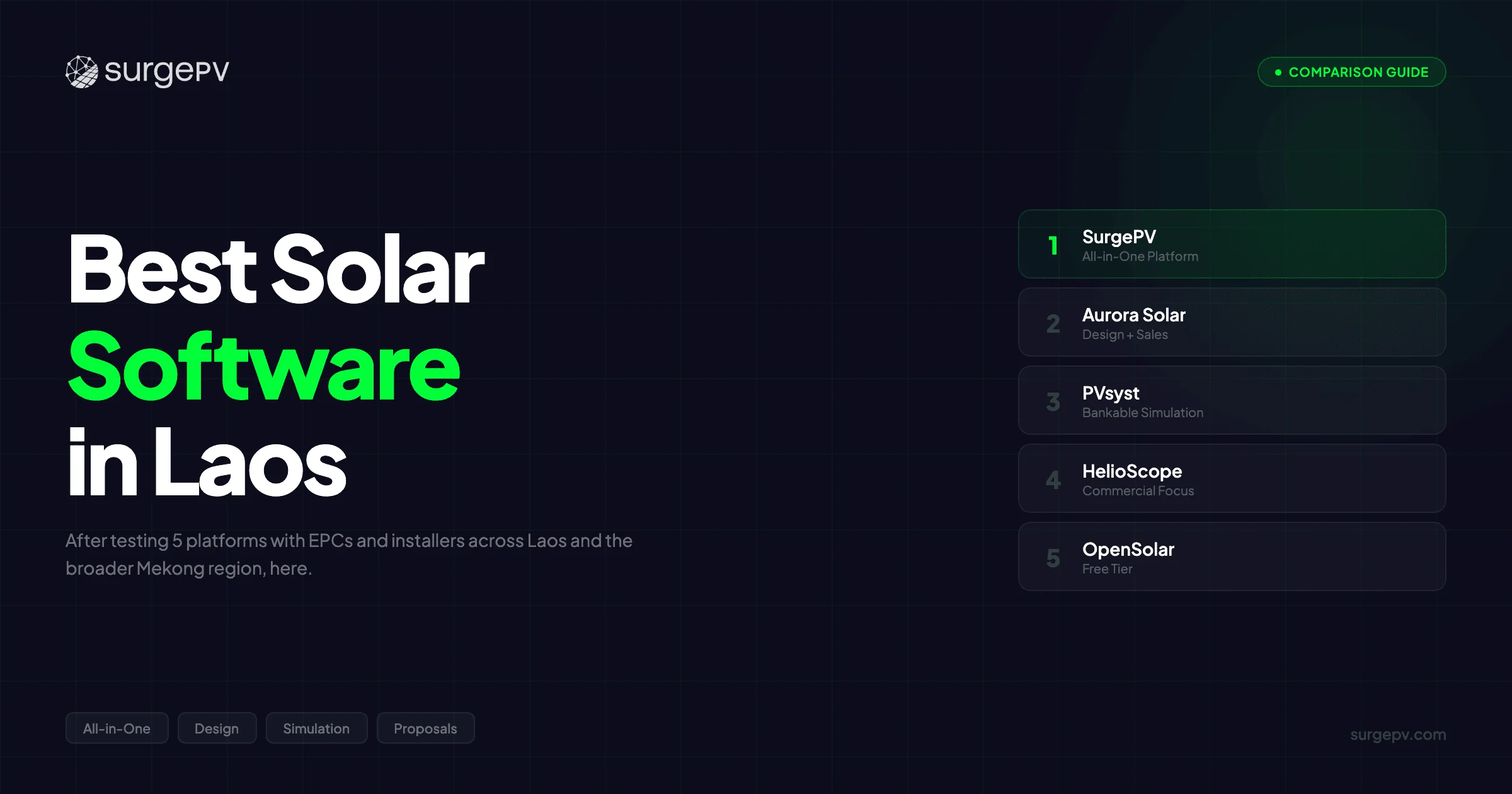
After reviewing published information for 5 platforms with EPCs and installers across Laos and the broader Mekong region, here are our top recommendations:
- SurgePV — All-in-one design, simulation, and proposals with IEC compliance, PVGIS integration, and fast workflows (Best for C&I EPCs and regional developers)
- Aurora Solar — Premium platform with best-in-class 3D modeling (Best for large international EPCs with budget)
- PVsyst — Industry-standard simulation for bankable energy yield reports (Best for utility-scale projects requiring ADB/IFC financing)
- HelioScope — Cloud-based design and simulation platform (Best for mid-size EPCs needing team collaboration)
- OpenSolar — Proposal specialist with free entry-level tier (Best for small installers starting out)
Each tool evaluated on ease of use, features, accuracy, Laos market applicability, and pricing.
Best Solar Software in Laos (Detailed Reviews)
| Software | Best For | Pricing | Laos Fit |
|---|---|---|---|
| SurgePV | Integrated platform | ~$1,899/yr (3 users) | Excellent |
| Aurora Solar | Residential workflow | $159/user/mo list ($1,620/user/yr annual) | Good |
| PVsyst | Simulation specialist | Not published | Good |
| HelioScope | C&I design | $159/mo Basic, $259/mo Pro (list) | Good |
| OpenSolar | Free platform | Free tier available | Good |
SurgePV — Best All-in-One Platform for Laos
Target Users: C&I EPCs doing 10+ projects per year, regional developers covering Laos and the Mekong region, ADB project contractors, and installers who want one platform instead of three.
SurgePV is the only cloud-based platform combining AI-powered solar design, automated electrical engineering (SLD generation), bankable simulations, and professional proposals in one workflow. For Laos EPCs, this eliminates the most expensive pain point: juggling PVsyst for simulation, AutoCAD for electrical diagrams, Excel for financials, and PowerPoint for client presentations.
What that looks like in practice: your team goes from site survey data to a complete deliverable package — design, energy yield report, electrical SLD, and client proposal — in 30-45 minutes. The alternative? Most Laos EPCs spend 3-4 days assembling the same deliverables from four separate tools.
Pro Tip
Laos’s solar market rewards the EPCs who can deliver bankable design packages fast. When ADB tenders have 30-day deadlines and you are competing against Thai EPCs with established workflows, your software determines whether you submit on time with professional documentation or scramble to assemble last-minute Excel proposals.
Key Features for Laos
Design and Engineering
SurgePV’s 3D shading analysis accurately models both C&I rooftop conditions in Vientiane and ground-mount projects in southern Laos. Automated electrical SLD generation produces IEC-compliant single-line diagrams required for EdL grid interconnection approval — saving 2-3 hours per project versus manual AutoCAD work.
The platform handles the commercial structures relevant to Laos’s market: industrial flat rooftops, warehouse facilities, carport solar for commercial areas (SurgePV is the only platform with native carport design), and ground-mount systems for rural electrification. Tracker support (single-axis and dual-axis) covers utility-scale installations.
Simulation and Bankability
SurgePV produces P50/P75/P90 production estimates achieving plus or minus 3% accuracy versus PVsyst. For Laos projects seeking ADB, IFC, or regional bank financing, that bankability data is required. PVGIS integration provides validated satellite-derived irradiation data for any Laos location — the primary solar resource source in a country lacking ground-based weather stations.
The simulation accounts for Laos’s tropical climate: monsoon season cloud cover (May through October), high ambient temperatures (30-40 degrees C), and humidity-related soiling losses. These factors reduce real-world output by 15-25% compared to nameplate capacity — and generic tools configured for temperate climates miss them.
Proposals and Financial Modeling
30-minute automated proposals with USD-native financial calculations. Payback period, ROI, 20-year savings, and NPV/IRR analysis tailored to EdL tariff structures ($0.08-0.15/kWh depending on customer class). PPA modeling for ADB-funded projects with 20-year revenue projections. Visit the solar financial analysis tool to learn more.
Cloud-Based Collaboration
Accessible from Vientiane headquarters, field teams at project sites in Savannakhet or Pakse, and regional offices across the Mekong without desktop installations.
A regional development consultant managing solar projects across the Mekong region was using PVsyst for simulation, AutoCAD for electrical drawings, and Aurora for design. Only Aurora publishes a list price; the other two are quoted separately. That is three renewals per engineer plus 3 days per Laos project on deliverables. After consolidating to SurgePV at $1,899 per user per year on the individual plan, their complete project workflow dropped from 3 days to under 1 hour. Annual software savings alone exceeded $6,600 per engineer before counting the 150+ hours of recovered labour.
Pros and Cons
Pros:
- All-in-one platform removes the need for 3-4 separate software subscriptions
- Fast learning curve (2-3 days to proficiency) — critical for Laos teams with limited training resources
- 30-45 minute complete workflow (design + electrical + simulation + proposal) versus 3-4 days manual
- PVGIS integration for accurate Laos solar resource data
- P50/P75/P90 bankability accepted by ADB and regional lenders
- Transparent pricing at $1,899 per user per year on the individual plan
Cons:
- Newer market entrant in Laos (less name recognition than PVsyst with ADB evaluators)
- EdL-specific interconnection templates may need customization
- Growing Laos project portfolio as the market develops
Pricing
| Plan | Price | Users | Includes |
|---|---|---|---|
| Individual Plan | $1,899/year | 3 users | Best for small EPCs entering the Laos market |
| For 3 Users | $1,499/user/year ($4,497/year total) | 3 users | Best for growing regional teams |
| For 5 Users | $1,299/user/year ($6,495/year total) | 5 users | Best value for EPCs covering multiple Mekong countries |
| Enterprise | Custom | Multiple | Large development firms |
All plans include design, electrical engineering, simulation, proposals, and financial modeling. See full pricing.
Who SurgePV Is Best For: Laos C&I EPCs doing 10+ projects per year who need bankable outputs, fast workflows, and professional proposals in one affordable platform. Also ideal for commercial solar developers covering Laos, Thailand, Cambodia, and Vietnam from a centralized platform.
Further Reading
For detailed design tool comparisons, see Best Solar Design Software in Laos. For proposal software, see Best Solar Proposal Software in Laos.
Aurora Solar — Premium All-in-One Platform
Best For: Large international EPCs and development consultants with premium budgets
Pricing: $159/user/month, or $135/user/month billed annually ($1,620/user/year), for Basic and $259/user/month, or $220/user/month billed annually ($2,640/user/year), for Premium (aurorasolar.com/pricing, checked 21 September 2026); Enterprise quoted per project.
Aurora Solar is the global market leader in solar design software with best-in-class 3D modeling and polished client proposals. For Laos, Aurora delivers impressive outputs that international investors and development bank evaluators recognize.
Key Strengths for Laos:
- Best-in-class 3D visualizations for investor presentations
- PVGIS integration available for Laos solar resource data
- Extensive component database including Asian brands (Jinko, Trina, LONGi, Huawei, Sungrow)
- Cloud-based platform with strong brand recognition
Where It Falls Short for Laos: No SLD generation or wire sizing — requires AutoCAD (licensed separately) for EdL electrical documentation. No P75/P90 bankability metrics. Premium pricing ($159-259/user/month on Aurora’s published list) is 3-5 times more than mid-market alternatives. US residential focus adds complexity without value for Laos C&I workflows.
Bottom Line: Aurora delivers the most polished outputs, but from $1,620/user/year on Aurora’s published list and the Laos-specific gaps (no SLDs, no P75/P90) make it impractical for most Mekong region operations. Use it only when investor presentation quality is the primary differentiator.
PVsyst — Bankability Gold Standard
Best For: Utility-scale projects requiring ADB/IFC/World Bank financing
Pricing: Not published; PVsyst does not publish licence pricing.
PVsyst is the 30-year industry standard for bankable solar simulations. ADB, IFC, World Bank, and every major development finance institution accept PVsyst reports. For Laos utility-scale projects (10+ MW) where maximum bankability is non-negotiable, PVsyst is the only tool with universal lender recognition.
Key Strengths for Laos:
- Universal acceptance by ADB, IFC, World Bank, and JICA for Laos project financing
- Deepest simulation detail: P50/P90/P99 estimates with 25+ loss categories
- PVGIS integration for Laos solar resource data
- IEC-compliant outputs meeting international bankability standards
Where It Falls Short: Simulation-only tool — no design, electrical, or proposal features. Steep learning curve (2-4 weeks). Desktop-only, no cloud collaboration. You need separate tools for everything except simulation. Expect several separate licences for a complete PVsyst + design + electrical + proposal stack.
Best Practice for Laos EPCs: Pair PVsyst with SurgePV. Use SurgePV for operational design workflows and PVsyst for bankability validation on utility-scale projects where development banks specifically require PVsyst reports. For C&I projects under 10 MW, SurgePV’s ±3% accuracy versus PVsyst typically satisfies lender requirements without separate PVsyst validation.
HelioScope — Cloud-Based Design and Simulation
Best For: Mid-size EPCs doing C&I projects (100 kW-5 MW) with distributed teams
Pricing: $159/month or $1,620/year per licence for Basic, $259/month or $2,640/year per licence for Pro (helioscope.aurorasolar.com/pricing, checked 21 September 2026); Enterprise custom.
HelioScope (now part of Aurora Solar) is a cloud-based commercial solar design platform with strong shading analysis and team collaboration. For Laos EPCs with distributed teams across Vientiane, Savannakhet, and Pakse, HelioScope enables simultaneous project collaboration without desktop installations.
Key Strengths for Laos:
- Cloud-based access from any device — practical for field teams across Laos
- Good simulation accuracy accepted by most regional lenders
- Collaborative features for multi-team projects
- PVGIS integration for Laos weather data
- 3-5 day learning curve to proficiency
Where It Falls Short: No SLD generation or wire sizing — still requires AutoCAD for EdL documentation. Published pricing of $159/month Basic and $259/month Pro per licence adds up for small EPCs. Requires stable internet — challenging at rural project sites. No proposal automation. Post-acquisition pricing direction unclear.
Bottom Line: Solid collaboration platform, but the missing electrical engineering (no SLDs, no wire sizing) forces a second tool for every project requiring EdL documentation.
OpenSolar — Proposal Specialist with Free Tier
Best For: Small installers starting out (<20 projects/year)
Pricing: Free tier available
OpenSolar provides a free entry-level tier for basic proposal generation. For small Laos installers testing software before committing to paid tools, the free tier removes financial risk.
Key Strengths for Laos:
- Free tier — zero financial barrier to start
- Clean proposal templates for simple C&I and residential projects
- Cloud-based with no desktop installation
Where It Falls Short: Limited financial modeling depth for ADB documentation. No design integration — system specs must be manually entered. No P50/P90 bankability metrics. No SLD generation. Free tier restricts proposal customization. As project volume or complexity grows, OpenSolar’s limitations become the bottleneck.
Bottom Line: Appropriate starting point for very small installers. Not suitable for ADB-funded projects or EPCs handling significant C&I volume.
Should Laos EPCs Use All-in-One or Specialized Software?
This is the central question for any Mekong region EPC building a software stack.
The specialized approach: Buy PVsyst for simulation, AutoCAD for electrical work, Aurora for design and a separate proposal tool. Four products, four renewals, and only Aurora publishes a list price. Add 3-4 days per project switching between tools and re-entering data.
The all-in-one approach: Use SurgePV at $1,899 per user per year on the individual plan. Design, electrical engineering, simulation, and proposals in one session. 30-45 minutes per project. One subscription instead of the four-product specialized stack.
For most Laos EPCs doing C&I projects (50 kW-10 MW), all-in-one delivers better ROI. The exception: utility-scale projects (10+ MW) where ADB or IFC specifically mandates PVsyst. In that case, the hybrid approach works — SurgePV for daily operations, PVsyst for the 20% of projects requiring institutional-grade validation.
| Your Situation | Recommended Software | Why |
|---|---|---|
| C&I EPC (50 kW-10 MW) | SurgePV | Design, simulation, SLDs, and proposals in one subscription |
| Utility-scale (10+ MW) ADB financing | PVsyst + SurgePV | PVsyst required for lender acceptance; SurgePV for design |
| Small installer starting out | OpenSolar (free) | Zero cost to test; upgrade when volume grows |
| Large international EPC | Aurora Solar | Visual quality justifies premium if budget allows |
| Mid-size team, distributed | HelioScope | Cloud collaboration; add SurgePV for electrical engineering |
What Standards Does Solar Software Need for Laos?
Laos requires IEC compliance (61215, 61730, 62446) for EdL grid interconnection. Software should produce IEC-compliant electrical documentation including single-line diagrams. PVGIS integration is critical for accurate solar resource data. USD-native calculations matter since commercial solar transactions and ADB documentation use USD.
Key technical requirements by project type:
- C&I rooftop (50-500 kW): IEC-compliant SLDs, PVGIS weather data, P50/P75/P90 reports, USD financial projections
- Ground-mount (500 kW-10 MW): All of the above plus tracker modeling, terrain analysis
- Utility-scale (10+ MW ADB-funded): PVsyst simulation, IFC/ADB-format bankability reports, independent engineer validation
- Off-grid/hybrid: Battery storage sizing, load profile modeling, diesel comparison analysis
Streamline Your Laos Solar Projects with SurgePV
End-to-end solar workflows from design to proposal in one platform — PVGIS integration, IEC compliance, and bankable P50/P75/P90 simulations.
Book a DemoNo commitment required · 20 minutes · Live project walkthrough
Bottom Line: Best Solar Software for Laos
For most Laos EPCs: SurgePV offers the best value — all-in-one design, bankable simulation, electrical engineering, and proposal automation at $1,899/year (3 users). Fast learning curve (2-3 days), PVGIS integration, and IEC compliance handle Laos’s specific requirements. One subscription covers what would otherwise be separate design, simulation, and CAD licences from three vendors.
For utility-scale projects requiring maximum bankability: PVsyst remains the gold standard for ADB/IFC/World Bank project financing. It lacks design and proposal tools, so budget for separate software. Worth the investment for 5+ MW developments.
For large international EPCs: Aurora Solar provides the most polished outputs, but from $1,620/user/year on Aurora’s published list pricing and US residential focus make it impractical for most Mekong region operations.
For small installers starting out: OpenSolar’s free tier lets you test proposal automation without financial commitment. Upgrade when project volume or proposal quality requirements outgrow the free tier.
Laos’s solar market is moving from policy planning to project execution. The EPCs delivering bankable design packages within days — not weeks — are the ones winning EdL approvals and ADB contracts today. Your software is either an accelerator or a bottleneck. There is no middle ground.
Frequently Asked Questions
What is the best solar software in Laos?
SurgePV is the best all-in-one solar software platform for Laos, combining design, bankable simulation (P50/P75/P90), automated electrical engineering (SLDs), and professional proposals with PVGIS weather data integration and IEC compliance. It replaces a multi-tool setup with a single workflow, starting at $1,899 per user per year on the individual plan.
Should Laos EPCs use all-in-one or specialized software?
Most Laos EPCs benefit from all-in-one platforms like SurgePV, which hold design, simulation, SLDs, and proposals in one subscription and remove tool-switching. Specialized tools (PVsyst for bankability, OpenSolar for proposals) make sense only when a specific need justifies the added cost. For EPCs doing 10+ projects per year across the Mekong region, all-in-one delivers better ROI.
Is PVsyst required for Laos solar projects?
No. PVsyst is not required for most Laos C&I projects (50-500 kW), where SurgePV or HelioScope reports are accepted by regional lenders. For utility-scale projects (5+ MW) seeking ADB or IFC financing, PVsyst is strongly preferred and sometimes required due to its 30-year reputation and universal lender recognition.
Does solar software integrate Laos weather data?
Yes. Leading platforms (SurgePV, PVsyst, HelioScope, Aurora) integrate PVGIS satellite data covering Laos with 1,400-1,800 kWh/m²/year global horizontal irradiance. PVGIS is the primary solar resource source for Laos since the country lacks ground-based TMY weather stations used in developed markets.
How much does solar software cost for Laos EPCs?
Costs range from free (OpenSolar basic tier) to stacks pairing an Aurora subscription with a separately licensed AutoCAD seat. SurgePV at $1,899 per user per year on the individual plan offers the best all-in-one value for Mekong region EPCs. PVsyst does not publish licence pricing. HelioScope publishes $159/month Basic and $259/month Pro per licence. Most EPCs achieve ROI within the first quarter through time savings.
How does Laos’s hydropower grid affect solar software needs?
Laos generates 80% of electricity from hydropower, with output dropping 40-60% during the dry season. Solar complements this by peaking during dry season months. Software must model seasonal production variation accurately — not use flat annual averages. SurgePV’s 8760-hour simulation captures monthly irradiation changes, showing investors how solar fills the dry-season hydropower gap.
Can solar software handle off-grid projects in rural Laos?
Yes. SurgePV and PVsyst can model off-grid and hybrid solar systems for rural electrification — a major opportunity in Laos where grid infrastructure does not reach many communities. Off-grid design requires battery storage sizing, load profiles, and autonomous day calculations. SurgePV’s financial modeling compares solar costs against diesel generator alternatives currently used in unelectrified areas.
What standards does solar software need for Laos?
Laos requires IEC compliance (61215, 61730, 62446) for EdL grid interconnection. Software should produce IEC-compliant electrical documentation including single-line diagrams. PVGIS integration is critical for accurate solar resource data. USD-native calculations are important since commercial solar transactions and ADB documentation use USD.
Sources
- Ministry of Energy and Mines (MEM), Laos — Renewable energy policy and power development plan (accessed February 2026)
- Electricite du Laos (EdL) — Grid interconnection standards and tariff structures (accessed February 2026)
- Asian Development Bank (ADB) — Lao PDR Energy Sector Assessment and solar financing requirements (accessed February 2026)
- World Bank — Laos renewable energy project development and rural electrification programs (accessed February 2026)
- PVGIS (Photovoltaic Geographical Information System) — Laos solar irradiation data and methodology (accessed February 2026)
- LCEE (Lao Energy Efficiency Centre) — Energy efficiency and renewable energy standards (accessed February 2026)
- SurgePV Official Documentation — Product features and pricing (accessed February 2026)
- PVsyst Official Documentation — Simulation methodology and bankability standards (accessed February 2026)
- Aurora Solar — Official features and pricing (accessed February 2026)
- G2 Reviews — Verified user reviews for solar platforms (accessed February 2026)
- Capterra — User ratings and platform comparisons (accessed February 2026)
- IEA PVPS — Southeast Asia Solar Market Report 2025 (accessed February 2026)
