


If you quote factories and hotels in Cambodia, your proposal must show the customer’s real tariff and any capacity charge. It must also fit the permit path for the system size. OpenSolar documents custom tariffs with demand charges, and its core app is free. Energy Toolbase and Arka360 both list PPA and lease financing. A PPA (power purchase agreement) means the customer pays for the power a system makes instead of buying the system. SurgePV documents roof modeling through proposals, priced per user. It states no Cambodian tariff or permit output. No tool here names Cambodia on the pages we read, so ask each vendor to model one real Cambodian bill.
This is a desk comparison of what each vendor publishes, checked October 2026. We have not run side-by-side tests. Tool facts come from each vendor’s own site. Local rules come from the Ministry of Mines and Energy (MME). We found no solar compliance guide on this site for Cambodia, so the rules below come straight from the Ministry.
Criteria used: custom tariff entry, demand or capacity charge fields, Khmer proposal language, lease or PPA financing, US dollar price, free tier.
We left Solargraf out of this update. Its site (solargraf.com) returned HTTP 403 to automated reads, including a headless browser, in October 2026. Solargraf is not compared on this page. We also removed every unsourced Cambodian market figure from the earlier version.
Want to see SurgePV on your own project?
Book a guided demo and bring a real site. We walk through design, yield, finance and the proposal in one platform.
Book a Free DemoChecking cost first? See the SurgePV pricing page.
Best-For Picks for Cambodia
- Custom tariffs with demand charges, on a free core app: OpenSolar. Its help article lists flat, time-of-use, tiered and demand-charge rates, plus fixed and minimum charges. The core app is free, but API Access and connectors are charged from 16 April 2026. Its 13 proposal languages include Thai but not Khmer.
- PPA, lease or loan comparisons for commercial deals: Energy Toolbase. Its FAQ lists cash, PPA, loan and lease structures. It describes itself as modeling software. It gives its price on a demo call.
- Design, proposal and CRM in one tool, with PPA and lease options: Arka360. Its feature list names commercial design, a utility rate finder, cash, loan, lease and PPA financing, and lead management. It has a Malaysia page that speaks to Southeast Asia but no Cambodia page.
- Tablet-friendly proposals: Aurora Solar. The vendor lists tablet-friendly sales proposals on its Basic plan. You can edit the rate on each project, or create a custom rate with demand charges.
- Roof model to bill of materials and proposal in one product, priced per user: SurgePV. It documents roof modeling, shading, yield, financial modeling, bill of materials and proposals. Ask in a demo how it handles a Cambodian tariff and a capacity charge. Its published scope names neither.
Comparison Table
Listed alphabetically. This is not a ranking; pick by the situation above. Prices checked October 2026 on each vendor’s own page, in the currency the vendor publishes.
| Tool | Best for | Price | Free or paid | Decisive Cambodia fact |
|---|---|---|---|---|
| Arka360 | Design, proposal and CRM with PPA and lease options | $199 per month (Basic, 1 user); $358 per month (Premium, 2 users) | Paid | Malaysia page names Southeast Asia; Cambodia not named |
| Aurora Solar | Tablet-friendly proposals | $159 or $259 per user per month (monthly billing); $135 or $220 billed annually | Paid | Pricing page lists North America and Europe regions |
| Energy Toolbase | PPA and lease modeling for commercial deals | Price given on a demo call | Paid | Cambodia not named on the pages we read |
| OpenSolar | Custom tariffs with demand charges | Core app free of charge; API Access and connectors charged from 16 April 2026 | Free core app, paid API and connectors | 13 proposal languages; Khmer not listed |
| SurgePV | Roof model to BOM and proposal, per user | $1,899 per user per year (1 user), in US dollars | Paid, guided demo | BOM and proposal generation in scope; no Cambodian item stated |
Cambodia Criteria Matrix
Each cell is Documented, Partial or Not stated. Documented means the vendor’s own page states it. Partial means the page states a related feature but not the full item. Not stated means the pages we read in October 2026 do not say. There are no scores or weights.
| Tool | Custom tariff entry | Demand or capacity charge fields | Khmer proposal language | Lease or PPA financing | US dollar price | Free tier |
|---|---|---|---|---|---|---|
| Arka360 | Partial (utility rate finder listed) | Not stated | Not stated | Documented (cash, loan, lease and PPA) | Documented ($199 and $358 per month cards) | Not stated |
| Aurora Solar | Documented (configure your own rates) | Documented (help article on custom rates adds demand charges) | Not stated | Documented (loan, lease, PPA or cash product in Sales Mode) | Partial ($ shown, currency not named) | Not stated |
| Energy Toolbase | Documented (help center: create your own custom rate schedules) | Partial (FAQ: models demand charge reduction with storage) | Not stated | Documented (cash, PPA, loan, lease) | Not published for ETB Developer (demo call) | Not stated |
| OpenSolar | Documented (custom tariff form) | Documented (demand charges in the form) | Not listed (13 languages, no Khmer) | Partial (options depend on market and provider) | Documented (core app free; paid services in US$) | Documented |
| SurgePV | Not stated | Not stated | Not stated | Not stated | Documented ($1,899 per user per year, 1 user) | Not stated (guided demo) |
Two things stand out. No page we read names a Cambodian tariff. The OpenSolar and Aurora help articles both describe custom rates with demand charges. A tool that does not state an item may still support it. Ask each vendor to model one real Cambodian bill before you buy.
Tool Entries
Arka360
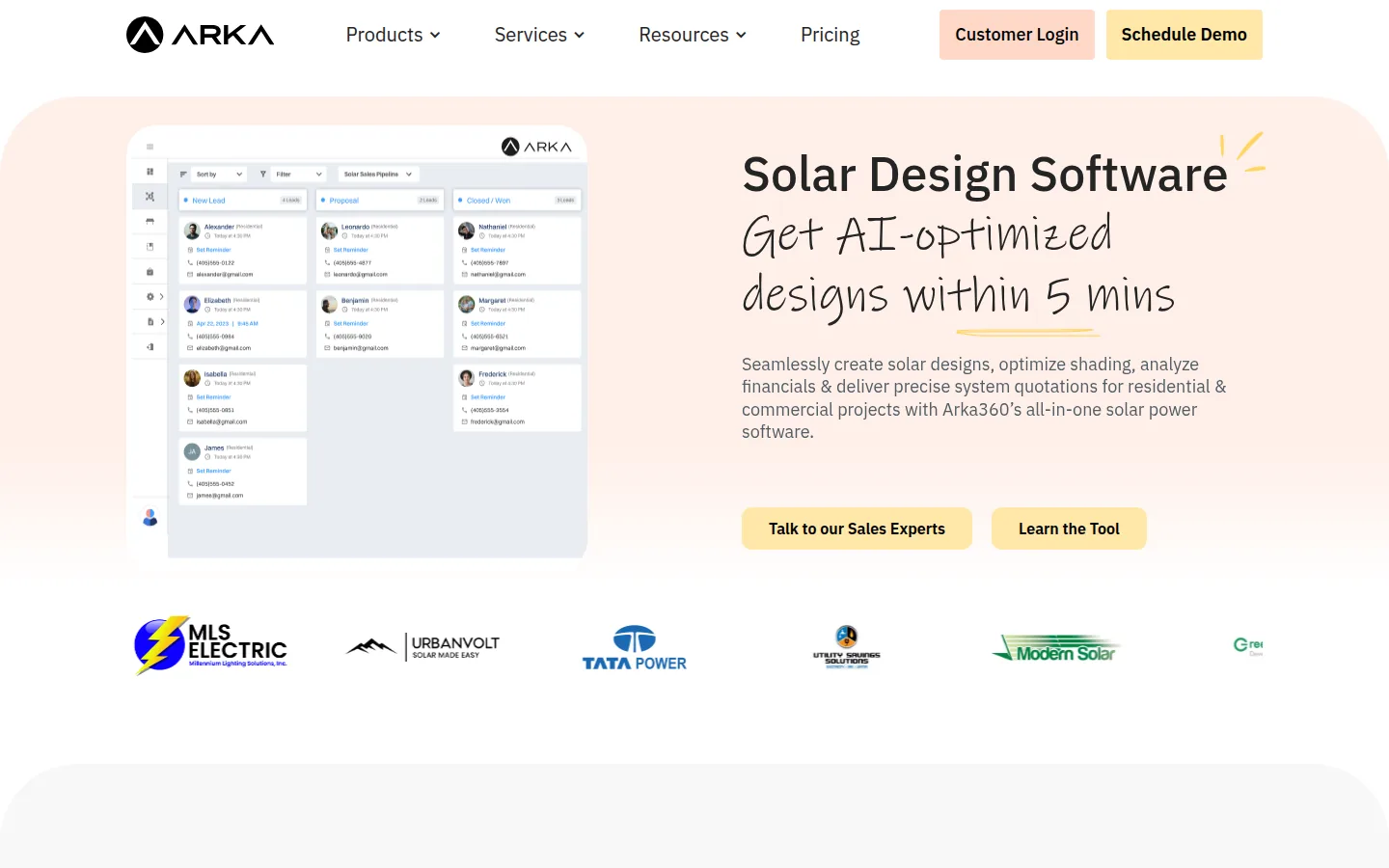
Best for: installers and EPCs (engineering, procurement and construction firms) that want design, proposals and a CRM (a tool to track customers and sales) in one product.
Not the right choice if: you need a Cambodian tariff library or Khmer proposals. The pages we read do not name Cambodia or list proposal languages.
What the vendor documents: its pricing page has a full feature list. It names commercial design, battery sizing, an electric single line diagram (SLD, a simple drawing of how the system is wired), CAD export, a single axis tracker, an 8760 production report, a utility rate finder, a payback and ROI report, and financing by cash, loan, lease and PPA. It also lists lead and task management. Its Malaysia page says the tool helps teams compete in Southeast Asia’s renewable energy market.
Price (checked October 2026): the pricing page shows several tables. The US dollar cards read Basic $199 per month (“Includes 1 user”) and Premium $358 per month (“Includes 2 user”). Enterprise says Talk to Sales. The page also shows rupee prices plus 18% GST and other dollar figures. We quote only the US dollar cards above.
Limitations: no Cambodia page and no Khmer. Demand charge fields are not stated on the pages we read.
Vendor link: arka360.com.
Aurora Solar
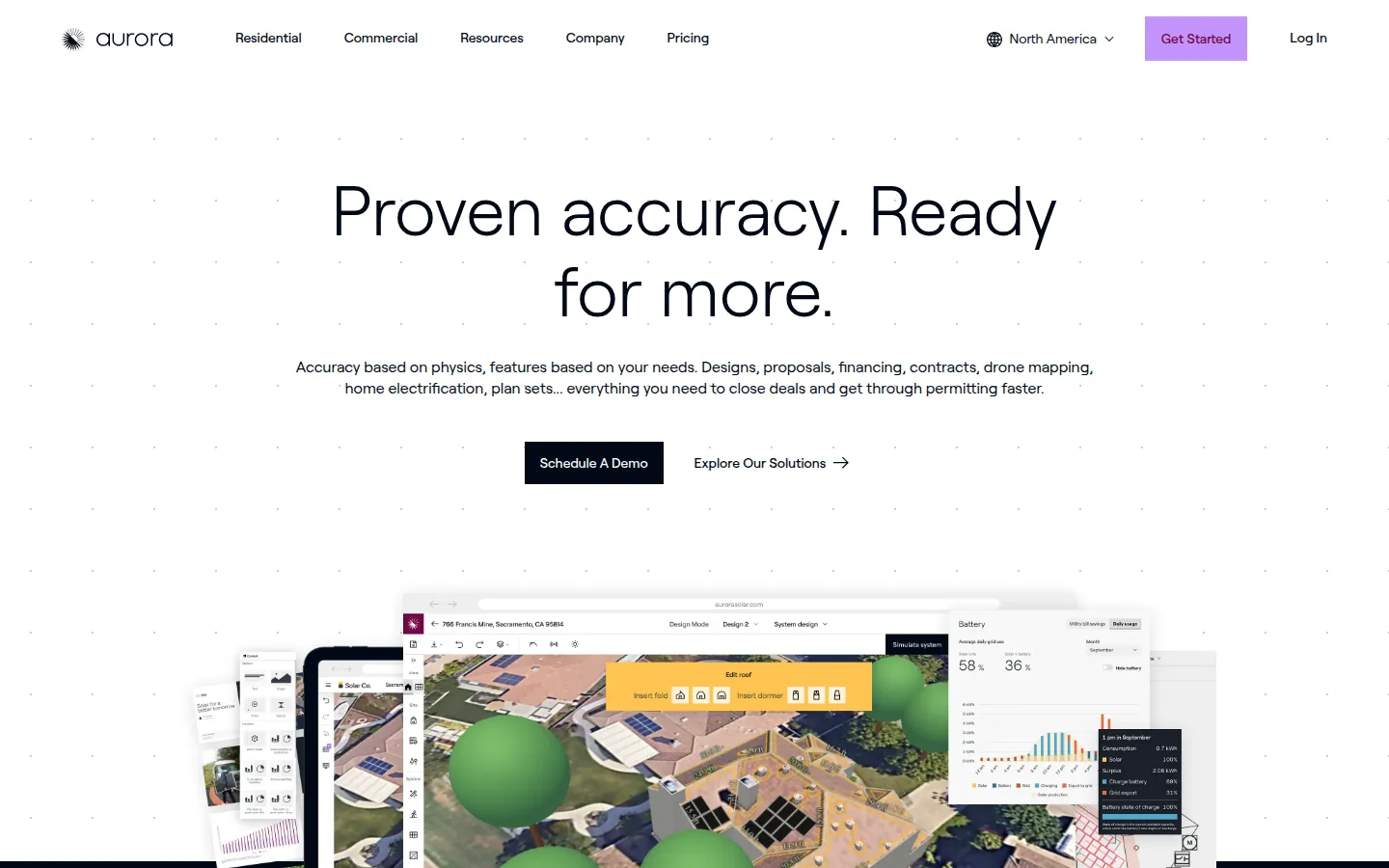
Best for: teams that want tablet-friendly proposals and a rate database where they can edit or create rates.
Not the right choice if: you need a Cambodian rate already loaded or Khmer proposals. The pricing page and the help articles we read do not name Cambodia or list Khmer.
What the vendor documents: the pricing page lists 3D roof modeling, performance simulation, adders, discounts and incentives, and a utility rate database where you “configure your own rates or use rates from Genability and Aurora”. Premium adds LIDAR-assisted modeling, bankable shade reports and battery modeling. Its help article on editing rates says you can change the import rate, export rate, rate details and compensation policy for a project. Its help article on custom rates lets an admin create a rate with tiers, time-of-use periods and demand charges. The financing partners named on the pricing page are GoodLeap, Dividend and Mosaic. Its financial analysis article says a loan, lease, PPA or cash product must be chosen in Sales Mode.
Price (checked October 2026): Basic $159 per user per month billed monthly, or $135 per user per month billed annually ($1,620 billed annually); Premium $259 per user per month, or $220 billed annually ($2,640 billed annually). Enterprise is custom, per project. The page shows “$” and does not name the currency.
Limitations: the pricing page lists North America and Europe regions and does not name Cambodia. No Cambodian rate is named on the pages we read.
Vendor link: aurorasolar.com.
Energy Toolbase
Best for: developers who model PPA, lease or loan offers with storage for commercial customers.
Not the right choice if: you want a published price, or you need Cambodia named. The pricing page says you book 30 minutes and get a demo and pricing on the call.
What the vendor documents: its ETB Developer FAQ says the platform supports cash purchases, power purchase agreements, loans and leases. It says the platform has a built-in database of utility rates, incentives and tariffs. It says it models demand charge reduction with battery storage. It also says ETB Developer is web-based. The product page counts 120,000+ tracked utility rates and describes a fully custom proposal template builder.
Price (checked October 2026): no ETB Developer figure is published on the pricing page. The page also lists implementation and support packages with no price.
Limitations: the pages we read do not name Cambodia or the countries the rate database covers. The ETB Developer FAQ describes matching the customer’s rate from a built-in database. Its rate schedules help page says users can create custom rate schedules, and that its rates database spans 50 states and 42 international territories.
Vendor link: energytoolbase.com.

OpenSolar
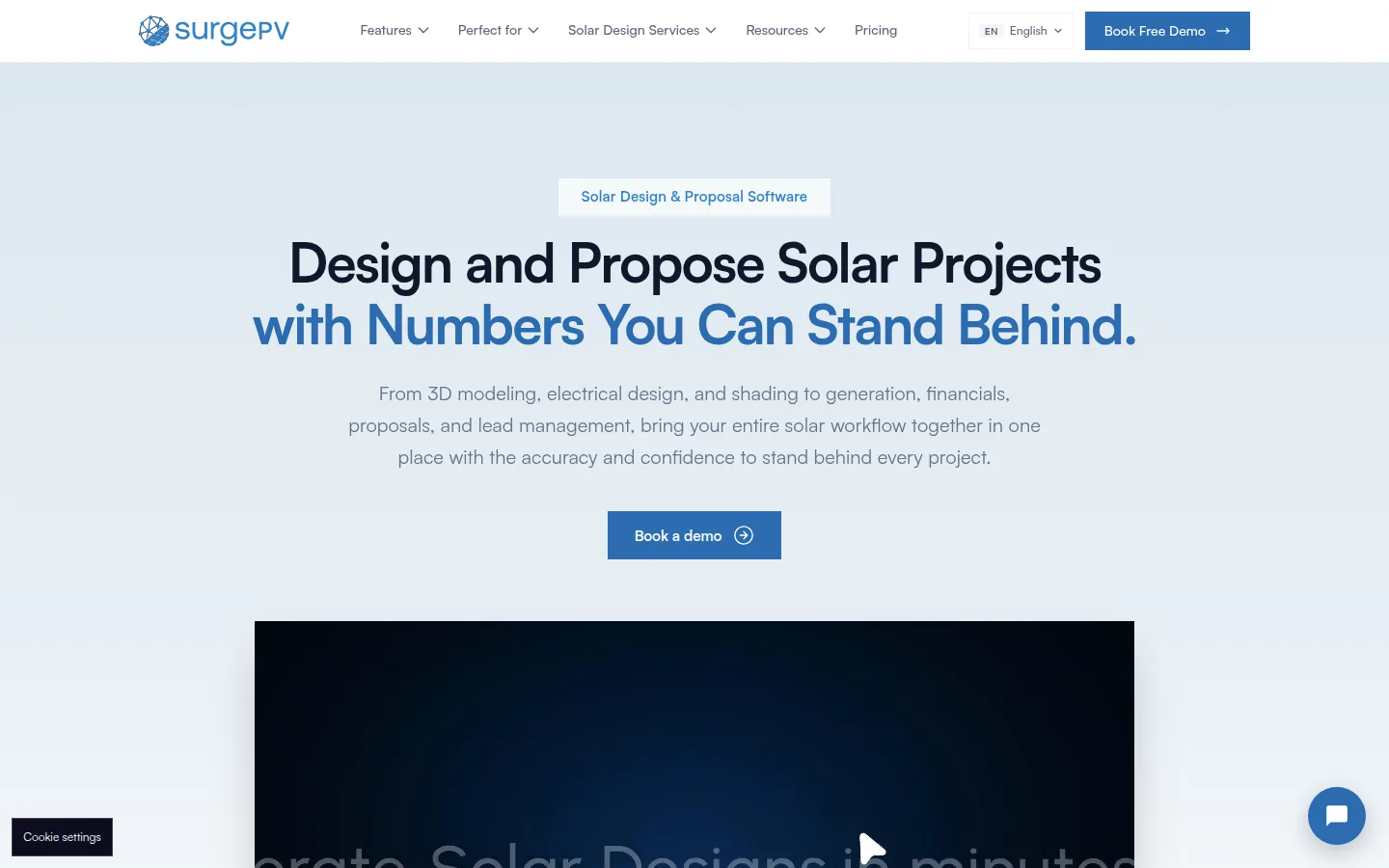
Best for: installers who want a free core app and need to enter a custom tariff with demand charges.
Not the right choice if: you must send proposals in Khmer. The language article lists 13 supported languages and Khmer is not one. Thai is.
What the vendor documents: its tariff article says you can create a custom tariff with a tariff type and compensation mechanism. The rate structures are flat, time-of-use, tiered and demand charges. You can add fixed and minimum charges. Its integrated finance page says the options depend on your market and provider, and may include loans, leases, PPAs and third-party ownership.
Price (checked October 2026): the core app is free of charge for solar professionals, per the vendor. From 16 April 2026 the vendor charges for API Access, which lets other software connect to OpenSolar, and for supported connectors. This comes from its 16 February 2026 post. Optional paid Enterprise Services: Support US$500 per month, Customize US$1,350 per month, Enterprise custom.
Limitations: the tariff has to be built by hand for Cambodia, and no Cambodian tariff is named on the pages we read.
Vendor link: opensolar.com.
SurgePV
SurgePV is our product.
Best for: teams that want roof modeling, shading, yield and financial modeling in one product. They also want a bill of materials (the parts list) and proposals, priced per user. They confirm the Cambodian items in a demo.
Not the right choice if: you want a self-serve trial (SurgePV offers a guided demo). It is also not right if you need a custom tariff form, demand charge fields or Khmer in writing before talking to sales. Its published scope does not state them. Outputs support design and documentation. They do not replace approval by the responsible engineer, authority, lender or utility. SurgePV’s published product scope does not list a CRM. Monitoring and ERP (business management software) are outside its published scope. OpenSolar documents a custom tariff form that SurgePV’s published scope does not.
What the vendor documents: 3D roof modeling, array layout, shading analysis, energy-yield modeling, financial modeling, electrical workflow support, bill-of-materials output and proposal generation. See solar proposal software for the product page.
Price (checked October 2026): $1,899 per user per year for 1 user, $1,499 per user for 3 seats, $1,299 per user for 5 seats, in US dollars.
Limitations: results depend on source data, assumptions and equipment models. The published scope does not state a tariff form, a capacity charge field, Khmer or PPA modeling.
Vendor link: surgepv.com.
Cambodia Rules That Shape the Choice
The permit path depends on size and grid link. The Ministry of Mines and Energy news page (published 20 May 2025) describes Prakas No. 0312. A prakas is a ministerial order. It was released on 18 November 2024 and replaced Prakas No. 0159 of 2023. Category 1 is users in areas not connected to the national grid. They no longer need approval from the Electricity Authority of Cambodia (EAC). Category 2 is users in grid-connected areas. Small systems, up to 10 kWac, need no EAC approval. The user must report the finished installation to the local electricity provider and ask for grid connection. A kWac is a kilowatt of alternating-current output, the figure on the inverter. Medium systems (above 10 kWac up to 100 kWac) and large systems (above 100 kWac) need EAC approval, in line with annual quotas set by the Ministry.
Quotas make approval uncertain. The Ministry’s legislation page lists a prakas on system size and quota for rooftop solar, titled “for 2024” and dated 22 May 2025. We did not read its text. A proposal for a medium or large system is a plan, not an approval.
A compensation tariff and deadlines apply to bigger systems. The Ministry says a new compensation tariff applies only to Category 2 users with medium or large systems. Approved projects must start construction within three months and finish installation within 12 months. We did not find the tariff rate on the pages we read.
Capacity charges above 10 kW. In a July 2024 statement, the EAC said rooftop solar users above 10 kW must pay capacity charges. It said over 95% of home and business electricity users would not be affected. This comes from a CamboJA News report of 9 July 2024, so it is a press report. We did not find the charge amount. A proposal tool needs a place for a fixed capacity charge, not only a price per kWh.
Installers need two approvals. The Ministry’s application page says providers must get approval from the Ministry and then a licence from the EAC. The page says the Ministry approval is completed within 21 working days from a complete application.
Tariffs. We found no English tariff table on the EAC and Électricité du Cambodge (EDC) pages we read. Take the rate from the customer’s bill. The earlier version of this page printed a price range per kWh without a source. We removed it.
Regulator pointers. The Ministry (mme.gov.kh) sets the principles and quotas. The EAC (eac.gov.kh) approves medium and large systems and licenses installers. Check both before you promise a start date.
How We Ordered These Tools
SurgePV publishes this page and is a vendor on this list. Its entry uses the same vendor-page sources and template as every other tool here.
We did not rank these tools. They are listed alphabetically, and the best-for picks come from the matrix above.
- Custom tariff entry: a Cambodian bill rarely matches a US or European rate. We did not assess how well any tool models a tariff you enter.
- Demand or capacity charge fields: larger customers may pay a charge based on capacity, not only on energy. We did not assess any tool’s math.
- Khmer proposal language: many buyers read Khmer. We did not assess translation quality.
- Lease or PPA financing: commercial buyers often compare buying with paying for the power. We did not assess whether any tool models a Cambodian deal.
- US dollar price: a published price lets you plan before a call. We did not assess discounts or negotiated quotes.
- Free tier: a free plan lets a small team test the workflow. We did not assess the limits of any free plan beyond what its page states.
Sources and Dates
Vendor pages were read in October 2026. They are Arka360 (pricing and Malaysia page), Aurora (pricing and two help articles), Energy Toolbase (pricing, FAQ and product page), OpenSolar (free page, 16 February 2026 post, and the tariff, language and finance pages above) and SurgePV (pricing). Government sources: the Ministry of Mines and Energy pages linked above and the EAC home page. Help-centre articles were read in a browser.
See SurgePV on your own project
Book a guided demo and ask how it handles a Cambodian tariff and capacity charge.
Book a Free DemoGo Deeper on a Category
- Best solar software in Cambodia
- Solar design software for Cambodia
- Solar proposal software for Vietnam and Thailand, the nearest country lists
- Best solar proposal software, all markets
Frequently Asked Questions
What is the best solar proposal software in Cambodia?
It depends on the job. OpenSolar documents custom tariffs with demand charges, and its core app is free. Energy Toolbase and Arka360 both list PPA and lease financing. Aurora Solar lists tablet-friendly proposals. SurgePV documents roof modeling through proposals but states no Cambodian output. No tool here names Cambodia on the pages we read, so ask each vendor to model one real Cambodian bill.
Do I need EAC approval for a rooftop solar system in Cambodia?
It depends on size and grid link. The Ministry of Mines and Energy says off-grid users need no approval from the Electricity Authority of Cambodia (EAC). Grid-connected systems up to 10 kWac need no EAC approval, but the user must report the finished work to the local electricity provider. Systems above 10 kWac and up to 100 kWac, and those above 100 kWac, need EAC approval within annual quotas.
Can proposal software handle Cambodian electricity tariffs?
OpenSolar and Aurora Solar help articles describe custom rates with demand charges, and OpenSolar lists flat, time-of-use and tiered rates too. Energy Toolbase’s help center says users can create custom rate schedules, and its FAQ describes demand charge modeling. Arka360 lists a utility rate finder. None of these pages names a Cambodian tariff, so enter the rate from the customer’s bill and check the result.
Is there free solar proposal software for Cambodia?
OpenSolar says its core app is free for solar professionals. From 16 April 2026 it charges for API Access and supported connectors. The core app does not list Khmer among its 13 proposal languages. The other tools here are paid or priced on request.
Does solar proposal software support Khmer?
OpenSolar lists 13 proposal languages: English, Dutch, Swedish, Spanish, French, Norwegian, Thai, German, Polish, Portuguese, Italian, Danish and Finnish. Khmer is not on that list. The Aurora, Arka360, Energy Toolbase and SurgePV pages we read do not list Khmer. Ask each vendor if you must send proposals in Khmer.
How much does solar proposal software cost for a Cambodian installer?
Prices are in dollars, as each vendor shows them. OpenSolar’s core app is free. Arka360 shows $199 per month for Basic (1 user) and $358 per month for Premium (2 users). Aurora lists $159 per user per month for Basic billed monthly. SurgePV lists $1,899 per user per year for one user. Energy Toolbase gives its price on a demo call.
