


This page is for Moldovan installers and EPCs choosing solar software, and the best pick depends on the job. Pick by the job. OpenSolar, PV*SOL premium and HelioScope Pro each let you enter a net metering rule yourself. HelioScope lists a single line diagram (SLD, a simple drawing of how the system is wired) on every plan. PVsyst lists Russian among its 12 software languages. None of the vendor pages we read list Romanian or describe Moldova’s rules. SurgePV puts roof modeling, bill of materials and proposals in one product, priced per user. Check every result against your supplier’s own calculation.
This is a desk comparison of what each vendor publishes, checked October 2026. We have not run side-by-side tests. Tool facts come from each vendor’s own site. Local facts come from the pages of Premier Energy Distribution, a Moldovan electricity distribution operator. Those pages are in Romanian. The website of ANRE, the regulatory authority named on those pages, did not load from our network. For other Moldova lists, see solar design software in Moldova and solar proposal software in Moldova.
Criteria used: net metering entry, weather data, single line diagram, customer proposal, Romanian and Russian screens.
Working on a Moldovan project? See SurgePV on it
Book a guided demo and bring a real site. We walk through design, yield, finance and the proposal in one platform.
Book a Free DemoChecking cost first? See the SurgePV pricing page.
Best-For Picks for Moldova
- Entering a net metering or net billing rule yourself: OpenSolar, PV*SOL premium or HelioScope Pro. OpenSolar’s tariff setting lists “Net Energy Metering (NEM)” and “Net Billing with Credit Carryover”. PV*SOL’s help page for net-metering tariffs lets you pick annual or monthly accounting. HelioScope’s help page on custom utility rates has a net metering switch and a net export rate. None names Moldova’s rule.
- A single line diagram on every plan: HelioScope. Its pricing page lists single-line diagrams and CAD export on all plans. PV*SOL premium also lists circuit diagrams.
- Russian software screens: PVsyst. Its product page lists 12 software languages, including Russian. It does not list Romanian. It runs on Windows only.
- A free core app for small residential jobs: OpenSolar. The vendor says the core app is free. It charges for API Access and connectors from 16 April 2026. API Access is a way for other software to connect.
- Roof model to bill of materials and proposal in one product, priced per user: SurgePV. It lists 3D roof modeling, array layout, shading, yield, financial modeling, bill of materials (BOM, the parts list) and proposals. Ask in a demo how it handles Moldova’s net metering. Its pricing page and published scope do not state it.
Comparison Table
Listed alphabetically. This is not a ranking; pick by the situation above. Prices checked October 2026 on each vendor’s own page. No vendor publishes a price in Moldovan leu.
| Tool | Best for | Price | Free or paid | Decisive scope fact |
|---|---|---|---|---|
| HelioScope | Commercial rooftops with SLD on every plan | $159 USD per license per month, or $1,620 USD per license per year (Basic) | Paid; 14-day free trial (help center) | Basic designs up to 1.25 MW (DC); sales proposals start at Pro |
| OpenSolar | Net metering entry in a free core app | Core app free; API Access and connectors charged from 16 April 2026 | Free core app, paid API and connectors | 13 proposal languages; Romanian and Russian not listed |
| PV*SOL premium | Net-metering tariff entry, circuit diagrams | 845,00 EUR plus VAT per named user, 1 year | Paid; 30-day trial | Windows only; nine software languages |
| PVsyst | Russian screens, yield studies | CHF 700 per year (PVsyst 8 Professional) | Paid; one-month trial | Runs only under Windows; no proposal output stated |
| SurgePV | Roof model to BOM and proposal, per user | $1,899 per user per year (1 user) | Paid, guided demo | BOM and proposal generation in scope; no Moldova rule or leu price stated |
Moldova Criteria Matrix
Cells read Documented when the vendor’s own pages state it. They read Partial when the pages state only part of it or state it for other places. They read Not stated when the pages we read in October 2026 do not mention it. There are no scores or weights.
| Tool | Net metering entry | Weather data | Single line diagram | Customer proposal | Romanian and Russian screens |
|---|---|---|---|---|---|
| HelioScope | Documented (custom utility rate has a net metering switch and a net export rate; Utility Rate Editor on Pro and Enterprise) | Documented (“Global weather coverage”) | Documented (all plans) | Documented (“Customizable reports & sales proposals” on Pro and Enterprise) | Partial (six report languages listed; neither Romanian nor Russian) |
| OpenSolar | Documented (“Net Energy Metering (NEM)”, “Net Billing with Credit Carryover”) | Partial (hourly typical-year data; source for Moldova not stated) | Partial (templates for ten countries; Moldova not listed) | Documented (proposal templates in 13 languages) | Partial (13 proposal languages; neither Romanian nor Russian) |
| PV*SOL premium | Documented (net-metering tariff, annual or monthly accounting) | Documented (Meteonorm 9 “any location worldwide”) | Partial (“fully customizable circuit diagrams”; not called a single line diagram) | Partial (“customer presentation for quotations”) | Partial (nine software languages; neither Romanian nor Russian) |
| PVsyst | Partial (fixed or hourly feed-in tariff; self-consumption; net metering not stated) | Documented (Meteonorm “any location on earth”; PVGIS-TMY, NASA-Power) | Partial (“still work in progress”; no storage) | Not stated | Partial (12 software languages including Russian; no Romanian) |
| SurgePV | Partial (financial modeling in scope; no net metering rule described) | Not stated (yield modeling in scope; weather source not stated) | Not stated (electrical workflow support in scope) | Documented (proposal generation in scope) | Not stated |
A Not stated cell means we found nothing on the pages we read. The tool may still do it, so ask for a demo.
Tool Entries
HelioScope
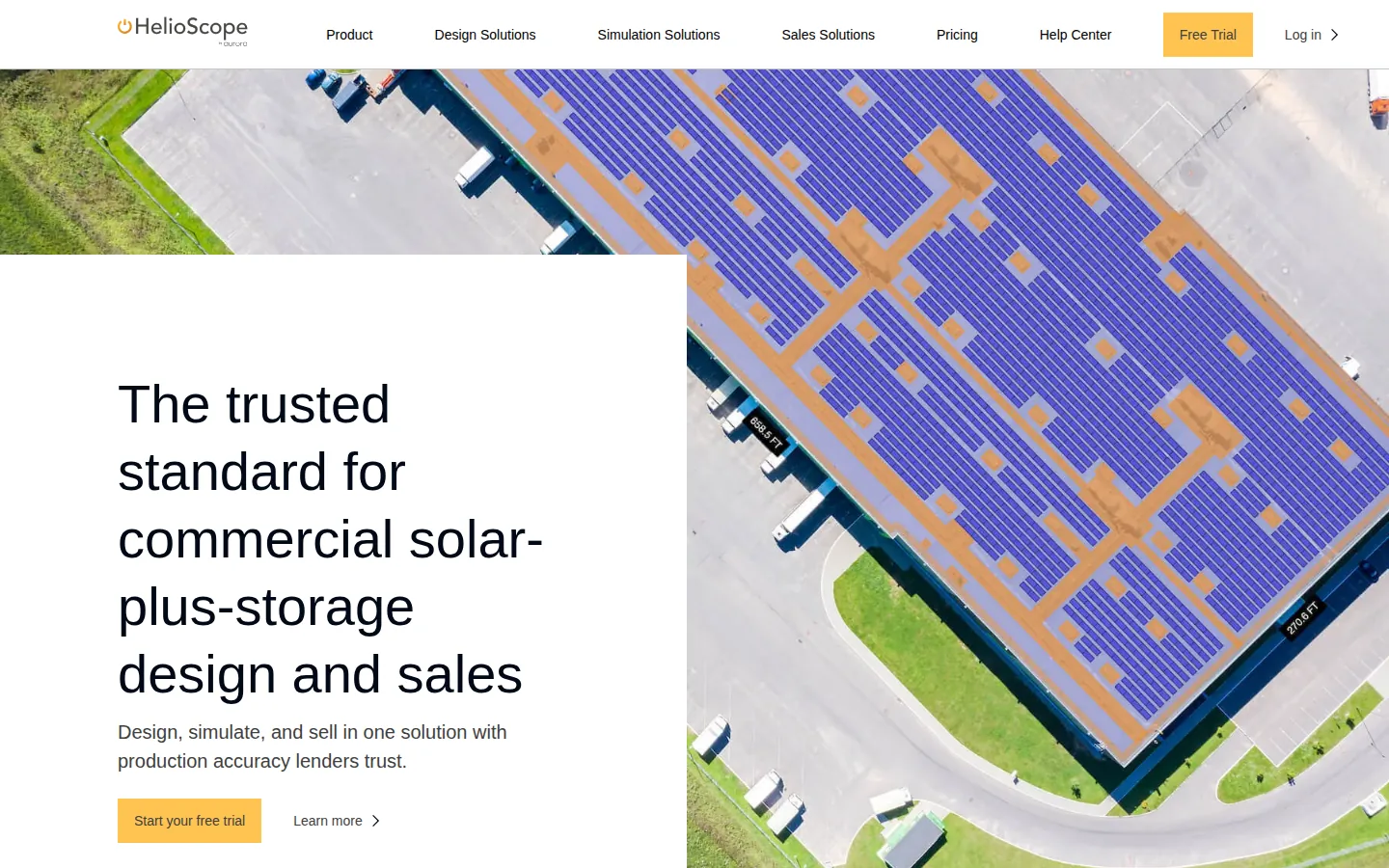
Best for: commercial rooftop, carport and ground-mount designers who want a single line diagram and CAD export on every plan.
Not the right choice if: you need financial tools or sales proposals on the lowest plan. They start at Pro. It is also not right if you want a free tool beyond the trial. HelioScope is an Aurora Inc. company, per its footer, with its own pricing.
What the vendor documents: on its pricing page, all plans list “Rooftop, carport, ground mount, and battery layout on all projects”. They also list CAD export, single-line diagrams, an 8760 production report (output for each of the 8,760 hours in a year), shade reports and “Global weather coverage”. Pro adds a Utility Rate Editor, financial analysis tools, customizable reports and sales proposals, and P90, P95 and P99 values. Enterprise adds single-axis trackers and export to PVsyst. A help article on custom utility rates describes a net metering switch, an annual true-up option and a net export rate. A second article lists report languages: Spanish, German, Dutch, Portuguese, Turkish and American English.
Price (checked October 2026): Basic is $159 USD per license per month, or $1,620 USD per license per year. A Basic license includes 1 user and 10 projects per month. Pro is $259 USD per month or $2,640 USD per year. Enterprise is custom per project. The help center says a standard free trial is 14 days, one per customer.
Limitations: Basic designs up to 1.25 MW (DC), Pro 5 MW and Enterprise 30 MW. The pricing page does not mention Moldova, leu or Romanian. The report language list has neither Romanian nor Russian.
Vendor link: helioscope.aurorasolar.com
OpenSolar
Best for: small teams that want a free core app and want to enter a local net metering or net billing rule themselves.
Not the right choice if: you need a Romanian or Russian proposal, or a single line diagram template for Moldova. OpenSolar’s help article lists SLD templates for AU, NZ, US, CA, UK, FR, DE, IT, ES and IN. Moldova is not on that list.
What the vendor documents: a custom tariff with a Country field and flat, time-of-use, tiered and demand rates. The tariff has a solar compensation setting: net billing, net billing with credit carryover, buy all sell all, or net energy metering. Its proposal language article lists 13 languages: English, Dutch, Swedish, Spanish, French, Norwegian, Thai, German, Polish, Portuguese, Italian, Danish and Finnish. Output uses PVWatts version 6 at hourly resolution with typical meteorological year (TMY) data, or the System Advisor Model with 3D shading, per its help article.
Price (checked October 2026): the core app is free, per the vendor (free page). From 16 April 2026 the vendor charges for API Access and supported connectors. Source: its 16 February 2026 post. We did not compare those fees.
Limitations: its commercial design article recommends keeping 3D designs under 500 kW. It says users have modeled systems up to 5 MW by simplifying settings. The pages we read have no page about Moldova.
Vendor link: opensolar.com
PV*SOL premium
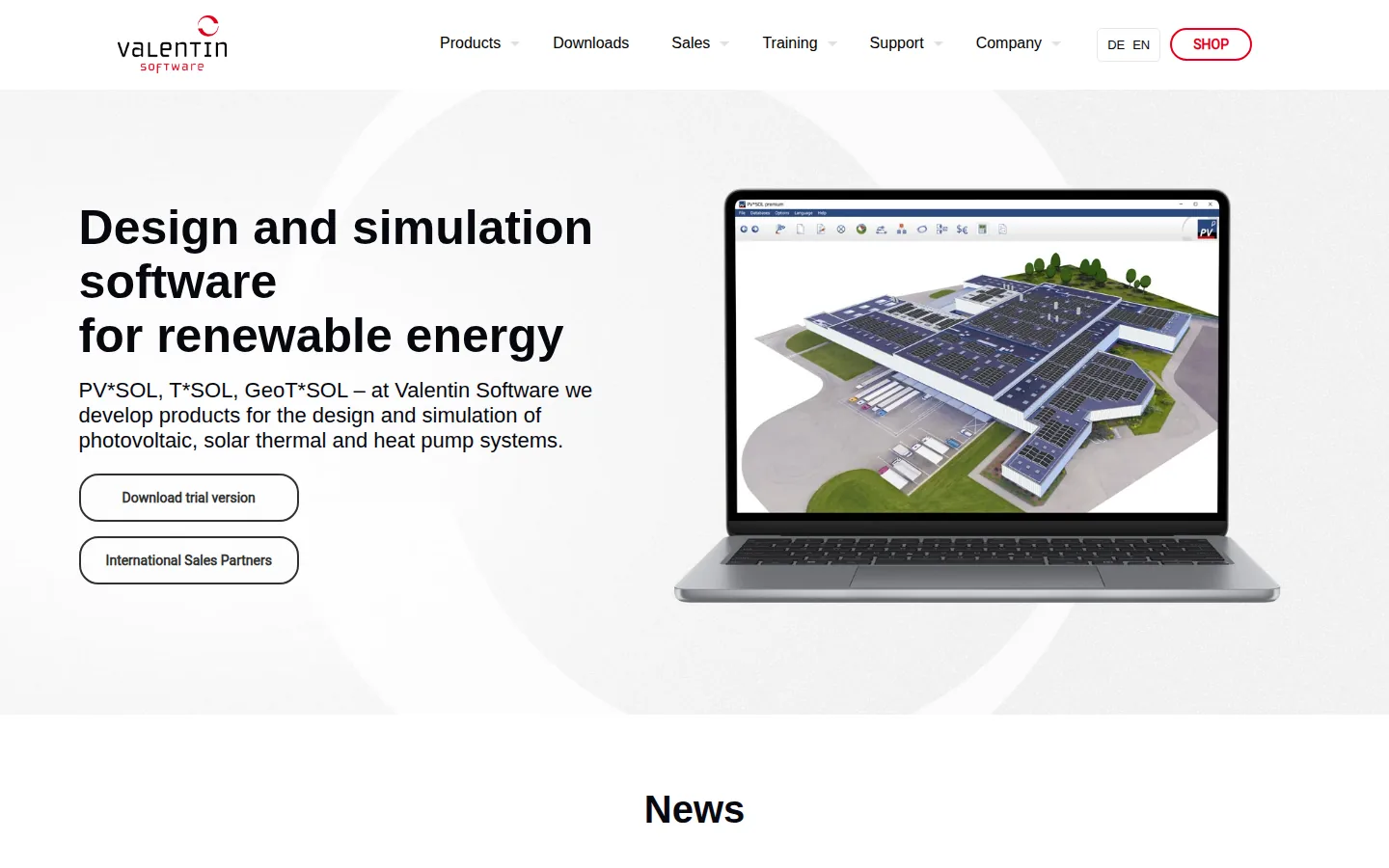
Best for: installers and engineers who want a Windows desktop program with 3D shading, circuit diagrams, a net-metering tariff entry and a price in euros.
Not the right choice if: you work on a Mac or in a browser. The product page lists Windows 10 and 11 (64 bit) only. It is also not right if you need a free tool or Romanian or Russian screens.
What the vendor documents: 3D design with up to 7,500 mounted modules or up to 10,000 roof-parallel modules, with shading from nearby objects. It lists “fully customizable circuit diagrams, including safety components”. It lists climate data for “any location worldwide with Meteonorm 9”, and PVGIS, Solcast and SolarAnywhere as other providers. It lists a 20-year financial analysis with a feed-in tariff database and a customer presentation for quotations. The help page on net-metering tariffs shows how to create an entry. You choose annual or monthly accounting, and a payment for surplus at year end.
Price (checked October 2026): 845,00 EUR plus VAT for a named user license, 1 year. The PV*SOL site offers a 30-day free trial with all features except report printing and saving.
Limitations: the product page lists nine software languages: German, English, Spanish, French, Italian, Polish, Czech, Portuguese and Turkish. It says project reports come in 24 languages and does not list them. It does not say which countries the tariff database covers.
Vendor link: valentin-software.com
PVsyst
Best for: yield studies where you want Russian software screens and a choice of weather databases. Yield means how much energy a system makes.
Not the right choice if: you need proposals, a bill of materials or a roof model from the same tool. The pages we read describe no proposal output. It is also not right if you work on a Mac or in a browser. The requirements page says it runs only under Windows.
What the vendor documents: on its product page, design of grid-connected, standalone or pumping systems. It also lists weather databases: Meteonorm 9, NASA-Power, PVGIS-TMY, NLR/NSRDB TMY, Solcast TMY, Solar Anywhere TGY and Solargis. It lists an economic assessment with NPV (net present value), LCOE (cost of each unit of energy) and ROI (return on investment). The tariff help page covers a fixed feed-in tariff, a progressive annual tariff change, hourly tariffs and self-consumption. It describes self-consumption as a consumption tariff plus another tariff for the surplus sold to the utility. The Meteonorm page says it gives monthly data “for any location on earth”.
Price (checked October 2026): CHF 700 per year for PVsyst 8 Professional. Discounts are 5% for 2 to 4 licences, 15% for 5 to 9 and 20% for 10 or more. The product page lists a one-month free trial.
Limitations: the single line diagram is described as “still work in progress”. It covers grid-connected systems and does not include storage. The product page lists 12 software languages: English, French, Italian, Spanish, German, Portuguese, Turkish, Chinese, Korean, Japanese, Polish and Russian. Romanian is not among them.
Vendor link: pvsyst.com
SurgePV
SurgePV is our product.
Best for: teams that want 3D roof modeling, array layout, shading analysis, energy-yield modeling, financial modeling, electrical workflow support, bill-of-materials output and proposal generation in one product, priced per user. See solar design software for the product page.
Not the right choice if: you want a self-serve trial. SurgePV offers a guided demo. It is also not right if you need a net-metering tariff entry that the vendor describes. OpenSolar, PV*SOL premium and HelioScope describe one. Outputs support design and documentation. They do not replace approval by the responsible engineer, authority, lender, insurer or utility. SurgePV’s published product scope does not list a CRM (customer database). The scope also lists no monitoring or ERP (business planning) product.
What the vendor documents: 3D roof modeling, array layout, shading analysis, energy-yield modeling, financial modeling, electrical workflow support, bill-of-materials output and proposal generation.
Price (checked October 2026): $1,899 per user per year for 1 user, $1,499 per user per year for 3 seats, and $1,299 per user per year for 5 seats, in US dollars. Confirm any leu amount and taxes in a written quote.
Limitations: results depend on source data, assumptions and equipment models. The pricing page and published scope do not state a weather source, a net metering rule, a diagram format, Romanian or Russian screens or a design size limit.
Vendor link: surgepv.com.
Moldova Rules That Shape the Choice
The facts below come from Premier Energy Distribution’s prosumer page and legislation page, read in October 2026. A prosumer is a customer who makes power and uses it. Rules can change, so confirm them with your operator.
Who can be a prosumer. The page says any final consumer, meaning any customer who buys electricity, can build a renewable plant and become a prosumer. For a non-household customer, this cannot be the main business. The plant must connect to the distribution network and to the customer’s own installation at the same consumption point. A two-way meter must record the power sent to the grid and the power taken from it, by the hour or by intervals.
Size limits. The page says the total installed power cannot be above the power you contract with your supplier. It also cannot be above 200 kW. For net billing, Government Decision 599 of 17 September 2025 sets a cap for each customer. It applies until 31 December 2030. A household can take up to 10 kW, or a cap worked out from its yearly use. A non-household customer gets a cap worked out from its use. The formulas use 1,200 kWh per kW per year for solar. The cap comes from the Government decision, not from your design tool.
How credit works. The page quotes article 39 of Law 10/2016 on net metering. At the end of each month, you pay only for the difference between what you used and what you sent to the grid. If you sent more than you used, the extra carries over to later months. On 31 March each year, on your written request, the supplier pays for the unused energy. The price is the average purchase price of the universal service supplier for the last 12 months. The quoted text may be older than the current rules. The page also describes the net billing scheme above and does not say which one applies to a new project. Ask your supplier, and check the tool’s result against the supplier’s calculation.
Steps and times. The page lists 12 steps. You hire an authorized electrician. The electrician or a specialist company checks the roof, including shading, and sizes the plant against your use. You apply to the operator for a connection notice, online, at its commercial office or by post. The operator has 10 calendar days to issue the notice for households and 30 days for companies. The notice is valid for 24 months. A design institution then prepares the project, and the operator and a state verifier check it. An electrician installs the plant. A household gives the operator an electrician’s declaration. A non-household customer needs an act of conformity from ANRE. You then sign a supply contract. The operator connects the plant within two working days after you pay the connection fee.
Documents. For a connection application, a person needs proof of ownership of the property, a power of attorney if someone acts for them, and a calculation of installed power. A company also needs its state registration decision and a site plan. The page names a design institution as responsible for the project.
Rules to read. The legislation page lists Law 10/2016 on promoting renewable energy (26 February 2016) and an ANRE decision of 6 May 2026 that approves the Regulation on connection to the electric networks (HANRE 311/2026). It also lists the ANRE Regulation on admission to operation of electrical installations (29 October 2021). RED-Nord, another operator, publishes its own connection page. ANRE’s website, anre.md, did not load from our network.
Language. The operator pages we read are in Romanian and Russian. Check that the proposal and drawings are in the language your customer and operator need. No tool on this page lists Romanian.
What to Ask Before You Buy
- Ask your operator which net metering or net billing rule applies to your new project.
- Ask your operator which drawings it needs, and in which format.
- Ask each vendor if it can show a proposal in Romanian or Russian.
- Ask for a written quote in the currency you will pay, with taxes.
How We Ordered These Tools
We did not rank these tools. They are listed alphabetically, and the best-for picks come from the matrix above.
- Net metering entry: the credit rule changes what a customer saves. We did not assess whether any calculation matches Moldova’s rule.
- Weather data: yield depends on the weather file for your site. We did not assess accuracy against measured output in Moldova.
- Single line diagram: the operator checks the project drawings. We did not check any tool’s drawing against the operator’s needs.
- Customer proposal: the customer reads the proposal. We did not assess layout or translation quality.
- Romanian and Russian screens: staff and customers need to read the tool. We did not assess translation quality.
Not Compared Here
Other tools are on the global solar software lists for design, simulation and proposals, but not on this page. We chose these five tools because their own sites let us check the facts above. Nearby country lists are available for Romania and Bulgaria.
Sources and Dates
Vendor pages were read in October 2026. HelioScope (pricing and the help center articles linked above). OpenSolar (pricing post, 16 February 2026 and the help center articles linked above). PV*SOL (product page, trial). PVsyst (shop, product page and the help pages linked above). SurgePV (pricing). Local facts come from the two Premier Energy Distribution pages linked above. We did not use the Moldelectrica website, which showed a bot check to our headless browser.
See SurgePV on a Moldovan project
Book a guided demo and ask how it handles the Moldova outputs you need.
Book a Free DemoRelated Solar Software Lists
- Solar design software in Moldova, for design tools
- Solar proposal software in Moldova, for quotation tools
- Solar software in Romania and Bulgaria, the nearest country lists
- Best solar design software, all markets
Frequently Asked Questions
What is the best solar software in Moldova?
It depends on the job. OpenSolar, PV*SOL premium and HelioScope Pro each let you enter a net metering rule yourself. HelioScope lists a single line diagram (SLD, a simple drawing of how the system is wired) on every plan. PVsyst lists Russian among its software languages. SurgePV puts roof modeling, bill of materials and proposals in one product, priced per user.
Does Moldova have net metering for solar?
Premier Energy Distribution’s prosumer page quotes article 39 of Law 10/2016 on net metering. It sets a limit of 200 kW, and the plant cannot be larger than the power you contract with your supplier. The same page also describes a net billing scheme with capacity caps set by Government Decision 599 of 17 September 2025. The page does not say which one applies to a new project, so ask your supplier.
How do I connect a rooftop solar system to the grid in Moldova?
You apply to your distribution operator for a connection notice, online, at its commercial office or by post. The operator’s page gives 10 calendar days for households and 30 days for companies to issue the notice. A design institution prepares the project, and the operator checks it. Non-household systems also need an act of conformity from ANRE, the regulatory authority named on the operator’s pages.
What is the size limit for a solar prosumer in Moldova?
The operator’s page says the total installed power cannot be above 200 kW. It also cannot be above the power you contract with your supplier. For net billing, the Government sets a cap for each customer. A household can take up to 10 kW or a cap worked out from its yearly use.
Does any solar software support Romanian or Russian?
None of the vendor pages we read list Romanian. PVsyst lists Russian among its 12 software languages. OpenSolar lists 13 proposal languages, PV*SOL premium lists nine software languages and HelioScope lists six report languages. None of those three lists includes Romanian or Russian. Ask each vendor before you buy.
How much does solar software cost in Moldova?
No vendor on this list publishes a price in Moldovan leu. Each uses its own currency: HelioScope Basic is $159 USD per license per month, PV*SOL premium is 845,00 EUR plus VAT per year, and PVsyst 8 Professional is CHF 700 per year. OpenSolar’s core app is free, with charges for API Access and connectors from 16 April 2026. SurgePV is $1,899 per user per year for one user.
