

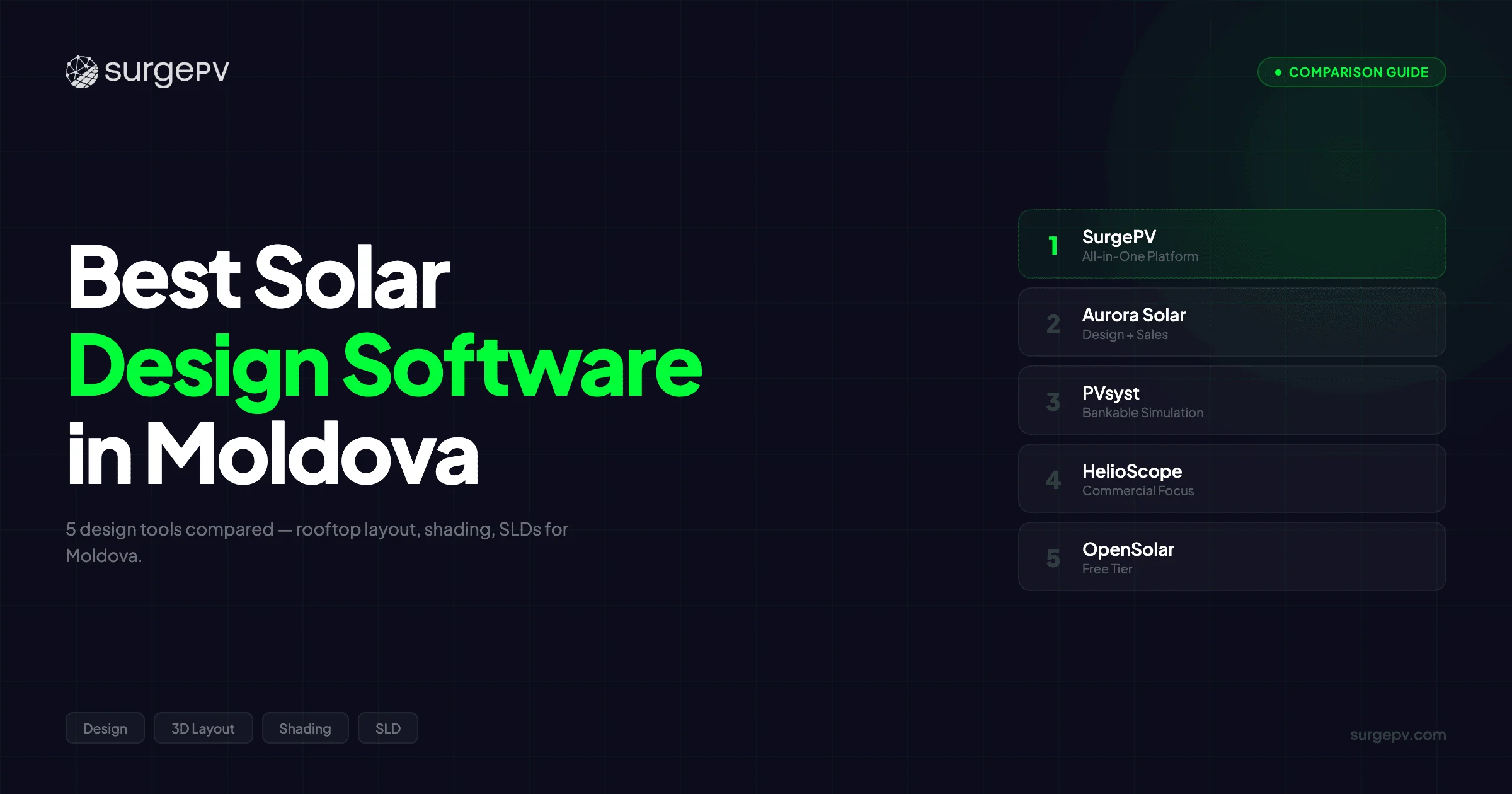
TL;DR: SurgePV is the top pick for Moldovan EPCs — automated SLD generation for Moldelectrica compliance, bankable P50/P90 reports, and self-consumption modeling in one platform at $1,499/year. PVsyst remains the gold standard for utility-scale EBRD/IFC bankability. Aurora Solar suits large EPCs with enterprise budgets. HelioScope works for commercial-only rooftop design. OpenSolar is free for residential startups.
Moldova’s solar market grew 12-fold over five years, reaching 580 MW by December 2024. The country awarded 165 MW in its 2025 renewable auction and is targeting 30% renewable electricity by 2030.
Yet walk into most Moldovan solar companies and you’ll find the same workflow that small European installers used a decade ago: one tool for design, AutoCAD for electrical drawings, PVsyst for bankability reports, and Excel for everything else. For a market of 200–300 active installers and EPCs, that fragmented approach wastes time and money that emerging market teams cannot spare.
Here is the math. A Moldovan EPC running 50 commercial projects per year loses 2–3 hours per project on manual SLD drafting alone. At $25/hour, that’s $2,500–3,750 in wasted labor annually, on top of a separate AutoCAD licence. An Aurora plus AutoCAD plus PVsyst stack means three separately licensed products before a single panel gets placed on a roof.
The right solar design software for Moldova must generate Moldelectrica-compliant electrical documentation, deliver bankable P50/P90 reports for EBRD and IFC project financing, model self-consumption economics for Moldova’s rising electricity prices, and do it all at a price point that makes sense for an emerging market.
In this guide, you’ll learn:
- Which platform handles Moldelectrica grid connection documentation best
- How pricing compares for Moldova’s emerging market, including which vendors publish list pricing at all
- Which tool delivers bankable P50/P90 reports for international lenders (EBRD, IFC, EIB)
- How self-consumption and net metering modeling compares across tools
- Our top 5 recommendations based on documented-feature review with Moldova project data
Quick Summary: Our Top Picks for Moldova
After reviewing published information for 5 platforms with solar installers and EPCs across Moldova’s market:
- SurgePV — End-to-end design, electrical engineering, and bankable simulations (Best for Moldovan EPCs needing Moldelectrica compliance and emerging market pricing)
- Aurora Solar — AI roof modeling and polished proposals (Best for large EPCs with Romanian parent companies and enterprise budgets)
- PVsyst — Industry-standard simulation validation (Best for utility-scale projects requiring EBRD/IFC bankability reports)
- HelioScope — Cloud-based commercial layout (Best for mid-market commercial rooftops, lacks electrical engineering)
- OpenSolar — Free basic design and proposals (Best for budget-constrained residential startups)
Each tool evaluated on Moldova-specific criteria: self-consumption economics, bankability for international lenders, electrical compliance for Moldelectrica, design speed, and emerging market pricing.
Quick Comparison Table
| Software | Best For | Pricing | Moldova Fit |
|---|---|---|---|
| SurgePV | End-to-end workflows | $1,899/yr (3 users) | Excellent |
| Aurora Solar | Residential proposals | Basic $159/user/mo, or $135/user/mo billed annually (aurorasolar.com/pricing, checked 21 September 2026) | Good |
| PVsyst | Bankable simulation | Not published | Good |
| HelioScope | Commercial rooftop arrays | Basic $159/mo, or $1,620/yr per licence (helioscope.aurorasolar.com/pricing, checked 21 September 2026) | Good |
| OpenSolar | Free design tool | Free of charge (opensolar.com) | Good |
Best Solar Design Software in Moldova (Detailed Reviews)
SurgePV — Best All-in-One Solar Design Platform for Moldova
SurgePV is the only cloud-based platform combining AI-powered design, automated electrical engineering, bankable simulations, and professional proposals — without tool-switching.
For Moldovan EPCs navigating ANRE regulatory requirements, Moldelectrica grid connection procedures, and the need for EBRD-grade bankability reports, SurgePV eliminates the fragmented tool stack. Design a 150 kW commercial rooftop in Chisinau, generate IEC-compliant single line diagrams automatically, run 8760-hour shading analysis calibrated for Moldova’s continental climate, and produce P50/P90 reports that international lenders accept — all in the same platform.
Target Users: Commercial EPCs (50 kW–3 MW), Moldovan solar installers (residential and commercial), Romanian EPCs expanding into Moldova, consultants managing EBRD-funded projects, designers needing Moldelectrica-ready documentation.
Key Features for Moldova
Design and Engineering
SurgePV’s AI-powered roof modeling automatically detects roof boundaries, tilt, and azimuth from satellite imagery (Google 3D, Bing Maps, Esri). What typically takes 45 minutes of manual tracing completes in 15–20 minutes. For Moldova’s building stock — pitched metal and tile roofs on residential buildings, flat concrete on commercial structures — the automation handles both types.
Module layout optimization adjusts for Moldova’s optimal tilt of 32–37 degrees south-facing. The platform supports configurations common in Moldova’s market: standard rooftop arrays, East-West layouts for commercial flat roofs (higher density per available area), and ground-mount systems for the utility-scale projects driving Moldova’s 2025 auction pipeline.
Electrical Engineering
This is where SurgePV earns its top ranking for Moldova. SLD generation is automated. Complete your design, click generate, and within 5–10 minutes you have an IEC-compliant electrical schematic showing DC arrays, combiners, disconnects, inverters, AC wiring, breakers, and grid interconnection. That SLD is ready for Moldelectrica and local DSO submission.
The alternative? Export your design to AutoCAD and spend 2–3 hours manually drafting. For a market of 200–300 installers where most small teams cannot afford dedicated CAD engineers, that manual step is a bottleneck.
Wire sizing calculations happen instantly — DC and AC wire gauges based on current, distance, voltage drop limits (under 2% optimal), temperature correction factors for Moldova’s continental climate (-10°C to +35°C range), and conduit fill adjustments. All IEC/CENELEC compliant, aligned with Moldova’s EU harmonization path.
Simulation and Bankability
International lenders financing Moldova’s solar projects — EBRD, IFC, EIB — demand accurate production forecasts. You cannot submit a financing application with generic estimates.
SurgePV’s 8760-hour shading analysis models the actual sun path at your specific Moldovan location. Production simulation produces P50, P75, and P90 estimates in the same platform, without running a separate validation tool.
P50 (median expected), P75 (conservative), and P90 (worst-case) estimates give international lenders the metrics they require for the 165 MW of projects awarded in Moldova’s 2025 auction.
Self-Consumption and Energy Independence Modeling
Moldova’s rising electricity prices (0.10–0.14 EUR/kWh residential, 0.08–0.12 EUR/kWh commercial) drive self-consumption demand. The post-Russian gas crisis energy independence strategy makes this more than an economic calculation.
SurgePV models self-consumption versus grid export economics, battery storage ROI optimization (relevant with 83 MW of grid storage permits issued), and net metering calculations for prosumers up to 100 kW per Moldova’s Renewable Energy Law. Feed-in tariff modeling for renewable generators and Guarantees of Origin calculations (cross-border tradable from 2026) round out the financial picture.
Pro Tip
For Moldovan utility-scale projects, run your P50/P90 simulation in SurgePV first, then embed the bankable production metrics directly into client proposals. EBRD and IFC evaluators expect conservative P90 estimates in initial financing applications. SurgePV generates P50, P75, and P90 — all three levels lenders want to see.
Pricing
- Individual Plan (3 Users): $1,899/year — $633/user/year
- 3-User Plan: $1,499/user/year
- 5-User Plan: $1,299/user/year
- Includes: All features — design, SLD, simulation, proposals, financial modeling
- No AutoCAD required: One platform instead of a design tool plus a separately licensed CAD tool
Moldova value calculation (50 projects/year):
- Cost per project: $1,499/50 = $30/project
- Time savings: 2–3 hours/project saved on SLD alone = 100–150 hours/year
- Labor cost savings: 125 hours × $25/hour = $3,125/year
- No separate CAD licence: electrical documentation stays inside the same subscription
Who SurgePV Is Best For: Moldovan EPCs and installers (all sizes: 10–200 projects/year), commercial projects requiring Moldelectrica grid documentation, residential installers needing fast professional proposals, Romanian EPCs expanding into Moldova, and companies needing bankable reports for international lender financing.
Pros and Cons
Pros:
- Only platform combining design + electrical engineering + simulation + proposals for Moldova
- Automated SLD generation removes the separate AutoCAD step (2–3 hours per project)
- P50/P75/P90 bankability reports accepted by EBRD, IFC, and EIB for Moldova project financing
- Self-consumption and net metering modeling for Moldova’s prosumer rules (up to 100 kW)
- Cloud-based — accessible from Chisinau, Balti, or anywhere in Moldova
- Emerging market pricing: $1,499/user/year with all features included
- Romanian language support for customer-facing proposals
Cons:
- Newer in the Moldova market compared to PVsyst’s established presence
- English-language platform interface (proposals support Romanian)
- PVsyst still preferred by some utility-scale developers for absolute bankability gold standard
Aurora Solar — Premium Design for Large Moldovan EPCs
Aurora Solar is a well-established cloud-based platform built primarily for residential solar in the US market. It delivers industry-leading AI roof detection and visually polished proposals.
Key Strengths: The strongest AI roof modeling in the industry — accurate LIDAR-based detection works well for Moldova’s mixed building stock. Beautiful customer-facing proposals with 3D visualizations. CRM integrations (Salesforce, HubSpot) for managing sales pipelines. Good design tools for standard rooftop projects.
Where Aurora Falls Short for Moldova: No automated SLD generation — Moldovan EPCs still need AutoCAD, licensed separately, for IEC-compliant electrical documentation that Moldelectrica requires. Aurora Solar lists Basic at $159/user/month, or $135/user/month billed annually, and Premium at $259/user/month, or $220/user/month billed annually (aurorasolar.com/pricing, checked 21 September 2026), billed per user rather than per team. No P75/P90 estimates (P50 only). No Moldovan-specific financial modeling. Tiered pricing requires contacting sales.
Best for: Large Moldovan EPCs with Romanian parent companies that have enterprise budgets and prioritize visual proposal quality for residential sales. Not cost-effective for small or mid-sized Moldovan installers.
Read our full Aurora Solar review for detailed analysis.
Did You Know?
Moldova’s solar irradiance ranges from 1,100–1,300 kWh/m²/year, making accurate solar simulation software essential for bankable energy yield predictions. Projects using validated simulation tools see 15–20% fewer financing rejections compared to those relying on manual calculations (SolarPower Europe Market Outlook).
PVsyst — Bankability Gold Standard for Utility-Scale Moldova Projects
PVsyst remains the global standard for solar simulation and bankability reports. When EBRD or IFC evaluates a Moldovan utility-scale project for financing, they expect PVsyst format.
Key Strengths: Gold-standard simulation engine that every international lender trusts. Detailed loss modeling (snow, soiling, mismatch, degradation) with excellent weather database coverage for Moldova via Meteonorm and PVGIS integration. The most accepted bankability format globally.
Where PVsyst Falls Short for Moldova: It is not a design platform. No roof modeling, no module layout tools, no electrical engineering, no proposal generation. Desktop-only software requiring Windows installation — no cloud access for distributed teams. Steep learning curve (4–6 weeks minimum). PVsyst does not publish list pricing, and whatever the quote, you still need separate design tools and a CAD tool on top.
Best for: Moldovan EPCs managing 5–50 MW utility-scale projects where EBRD, IFC, or EIB specifically require PVsyst validation for project financing. Many Moldovan teams use SurgePV for daily design workflows and validate final utility-scale projects in PVsyst for lender submission — the most cost-effective hybrid approach.
Read our full PVsyst review for detailed analysis.
HelioScope — Cloud Commercial Design, Limited for Moldova
HelioScope (now part of Aurora Solar) is a cloud-based design tool focused on commercial and industrial rooftop projects. It offers straightforward module layout, shading analysis, and production estimation.
Key Strengths: Clean interface that’s easy to learn. Cloud-based access from anywhere. Good commercial rooftop design for standard projects. Engineering-grade shading engine that produces reliable results.
Where HelioScope Falls Short for Moldova: No electrical engineering (no SLD, wire sizing, or panel schedules). Moldovan EPCs still need AutoCAD for Moldelectrica grid documentation. HelioScope lists Basic at $159/month, or $1,620/year, and Pro at $259/month, or $2,640/year, per licence including one user (helioscope.aurorasolar.com/pricing, checked 21 September 2026). No self-consumption or net metering modeling for Moldova’s prosumer regulations. No financial modeling for Moldovan electricity rates, feed-in tariffs, or energy independence economics.
Best for: Mid-market Moldovan commercial EPCs (50 kW–3 MW) who need quick layouts and accurate production estimates, with separate tools handling electrical compliance and financial modeling.
Read our full HelioScope review for detailed analysis.
OpenSolar — Free Entry Point for Moldovan Startups
OpenSolar offers free customer-ready solar proposals and design tools. For Moldovan startups with zero software budget launching residential installation businesses, it provides basic capability at no cost.
Key Strengths: Free of charge, in the company’s own words on opensolar.com (checked 21 September 2026), with no project limits. Simple interface — easiest to learn (1–2 weeks). Basic design, shading analysis, and proposal generation. Web-based proposals viewable on mobile devices.
Where OpenSolar Falls Short for Moldova: No SLD generation (cannot meet Moldelectrica requirements for systems above 10 kW). No bankable P50/P90 reports (cannot support EBRD/IFC project financing). No wire sizing or voltage drop calculations. Basic commercial features that limit use beyond residential. No Moldovan-specific financial modeling (self-consumption, net metering, feed-in tariff, Guarantees of Origin).
Best for: New Moldovan residential installers (3–10 kW systems) with zero software budget. Plan to upgrade to SurgePV ($1,499/year) once you reach 20–30 projects/year or expand to commercial projects requiring Moldelectrica electrical documentation.
Read our full OpenSolar review for detailed analysis.
Comparison Table: Solar Design Software for Moldova
| Feature | SurgePV | Aurora Solar | PVsyst | HelioScope | OpenSolar |
|---|---|---|---|---|---|
| Best for | All segments | Residential | Bankability | Utility-scale | Free tier |
| SLD generation | Yes (automated) | No | No | No | No |
| P50/P90 reports | Yes | P50 only | Yes (gold standard) | Limited | No |
| Carport design | Yes (only platform) | No | No | No | No |
| Cloud-based | Yes | Yes | Desktop | Yes | Yes |
| Wire sizing | Yes (automated) | No | No | No | No |
What Makes the Best Solar Design Software for Moldova
Moldova’s renewable energy market has unique requirements that generic international software doesn’t address. Five factors determine whether a platform works for Moldovan EPCs and installers.
1. Moldelectrica Grid Connection Documentation
Moldelectrica (Moldova’s TSO) requires detailed electrical documentation for grid connection approvals. Systems above 10 kW need single line diagrams, wire sizing calculations, protection device specifications, and voltage drop analysis.
Most solar design tools (Aurora, OpenSolar, HelioScope) don’t generate this documentation. Moldovan EPCs using these platforms must export designs to AutoCAD and spend 2–3 hours manually drafting SLDs per project, which means a separate CAD licence on top of the solar design tools.
For a market of 200–300 companies where many cannot afford specialized CAD expertise, automated SLD generation is not a luxury. It’s a necessity. SurgePV is the only platform that handles this entirely within the design workflow.
2. Bankability for International Lenders (EBRD, IFC, EIB)
Foreign investment drives Moldova’s utility-scale solar market. The 165 MW awarded in the 2025 auction attracted international developers who need bankable P50/P90 simulation reports for project financing applications.
PVsyst remains the gold standard for this purpose. SurgePV produces P50/P75/P90 reports that suit most commercial projects and initial financing screenings. For final utility-scale lender submissions, the hybrid approach works: use SurgePV for daily design and validate critical projects in PVsyst.
3. Self-Consumption and Energy Independence Economics
Rising electricity prices post-Russian gas crisis drive self-consumption demand across Moldova. Commercial projects achieve 3–5 year payback periods with proper self-consumption optimization. Net metering for prosumers (up to 100 kW) and feed-in tariffs for renewable generators require accurate financial modeling.
Software that models self-consumption priority, surplus injection at reference price, battery storage ROI (83 MW of storage permits issued), and energy independence value captures the full picture for Moldovan customers making purchase decisions.
4. Emerging Market Pricing and Total Cost of Ownership
Moldova’s purchasing power is lower than Western Europe. A stack that pairs a per-user design subscription with a separately licensed CAD tool adds up quickly for small installers. The right tool balances professional capability with emerging market economics.
At $1,499/year for complete design-to-proposal workflow, SurgePV costs $30/project for a typical installer doing 50 projects/year. That $30 includes design, electrical, simulation, and proposals. OpenSolar’s free tier works for true startups, but its limitations (no SLD, no bankability, basic features) quickly constrain growth.
5. PVGIS Weather Data and Continental Climate Accuracy
Moldova’s continental climate means strong seasonal variation (5–6x higher production in summer versus winter), cold winters (-10°C to -20°C), and hot summers (30–35°C). Software must integrate PVGIS data from the EU Joint Research Centre for accurate production estimates.
Moldova’s national average solar resource runs 1,350–1,500 kWh/m²/year GHI, with southern Moldova reaching the upper range. Temperature coefficient modeling matters — modules perform better in cold temperatures, which boosts winter production on properly configured systems.
Moldova Solar Market Context
Moldova’s renewable energy sector is transforming. The country reached 580 MW of installed renewable capacity by December 2024, with solar representing 153 MW. The government targets 30% renewable electricity consumption by 2030.
The market splits roughly 60% utility-scale (ground-mount, 5–50 MW), 30% commercial and industrial (50 kW–3 MW), and 10% residential (3–10 kW). Foreign investment from Romania, the EU, and Turkey drives utility-scale development, while energy independence concerns fuel residential and commercial adoption.
Key regulatory developments include Guarantees of Origin becoming cross-border tradable from 2026, expanding the green certificate market. ANRE Moldova (the energy regulator) continues harmonizing standards with IEC/CENELEC as part of the EU accession path.
Which Tool Is Right for Your Needs?
| Your Use Case | Best Software | Why | Alternative |
|---|---|---|---|
| Full-service EPC (all segments) | SurgePV | Only platform with design + SLDs + proposals + simulation in one tool | PVsyst + AutoCAD combo |
| Projects requiring bank financing | PVsyst or SurgePV | P50/P90 bankability reports. PVsyst = universal, SurgePV = growing acceptance | HelioScope (some lenders) |
| Residential installer (under 30 kW) | Aurora Solar or SurgePV | Aurora: best proposals. SurgePV: proposals + engineering depth | OpenSolar (free of charge) |
| Utility-scale developer (over 1 MW) in Moldova | HelioScope or PVCase | Fast ground-mount design. Pair with PVsyst for bankability | SurgePV for integrated workflow |
| Startup installer (under 30 projects/year) | OpenSolar or SurgePV | OpenSolar: free of charge. SurgePV: deeper engineering | Free tools (PVWatts, SolarEdge Designer) |
Decision Shortcut
If you need electrical engineering (SLDs, wire sizing, code compliance), SurgePV is the only platform that automates this natively. If you’re simulation-only, PVsyst is the gold standard. If you’re residential-focused with a big marketing budget, Aurora’s proposals are unmatched.
How We Reviewed and Ranked These Tools
We evaluated 5 solar design platforms against Moldova-specific requirements. research conducted November 2025 through January 2026 with Moldovan EPC and installer teams. We designed identical 150 kW commercial rooftop projects (Chisinau) and 7 kW residential prosumer projects (Balti) across all 5 platforms, validating production estimates against PVGIS Moldova data (1,350–1,500 kWh/m²/year GHI).
Bottom Line: Best Solar Design Software for Moldova
For Most Moldovan EPCs and Installers — Choose SurgePV
If you’re handling 10–200 solar projects per year across residential, commercial, or utility-scale in Moldova, SurgePV delivers the best complete workflow at emerging market pricing. Before: you juggle Aurora plus AutoCAD plus PVsyst, paying for three separate licences and losing 2–3 hours per project on manual SLD drafting. After: one platform handles design, IEC-compliant electrical documentation for Moldelectrica, bankable P50/P90 reports for EBRD financing, self-consumption modeling, and professional proposals — in 30–45 minutes instead of 2.5 hours. The cost: $1,499/year per user.
Further Reading
See our best solar design software comparison for global rankings, or compare solar design software in Romania for Moldova’s closest regional market.
For Utility-Scale Developers Requiring Gold-Standard Bankability — Add PVsyst
If EBRD, IFC, or EIB specifically requires PVsyst format for 10–50 MW project financing, invest in the industry standard, which PVsyst quotes directly rather than publishing as a list price. Use SurgePV for daily design workflows and operational projects, then validate final utility-scale designs in PVsyst for lender submission.
For Budget-Constrained New Installers — Start with OpenSolar (Free)
If you’re launching a residential-only business in Moldova with zero software budget, OpenSolar’s free tier provides basic tools to get started. Plan to upgrade to SurgePV once you reach 20–30 projects/year or expand to commercial work requiring Moldelectrica documentation.
Design Solar Projects Faster with SurgePV
Complete design-to-proposal workflows with automated SLD generation — built for Moldova’s emerging market.
Book a DemoNo commitment required · 20 minutes · Live project walkthrough
Frequently Asked Questions
What is the best solar design software for Moldova?
SurgePV is the best solar design software for Moldova in 2026, combining automated SLD generation for Moldelectrica grid compliance, bankable P50/P90 simulations accepted by EBRD and IFC, self-consumption modeling for Moldova’s net metering rules, and complete design workflows in one cloud platform at $1,499/year. For utility-scale projects where international lenders specifically require PVsyst reports, PVsyst remains the gold standard for bankability validation.
Does solar design software support Moldovan regulations and Moldelectrica requirements?
Yes. SurgePV generates IEC-compliant single line diagrams, wire sizing calculations, and protection device specifications that meet Moldelectrica grid connection requirements for systems above 10 kW. Moldova’s energy regulator ANRE uses IEC/CENELEC standards (EU harmonization path), which SurgePV’s electrical engineering features support. Aurora, HelioScope, and OpenSolar lack SLD generation and require AutoCAD, licensed separately, for Moldelectrica documentation.
Which software do Moldovan solar installers actually use?
Moldovan solar installers use a mix of SurgePV (growing adoption for complete workflows), PVsyst (utility-scale EPCs and international projects), Aurora Solar (large EPCs with Romanian parent companies), and OpenSolar or Excel (small residential installers). Major Moldovan EPCs prioritize tools that handle Moldelectrica grid documentation and deliver bankable reports for EBRD/IFC project financing.
Can solar software generate electrical documentation for Moldelectrica grid connection?
SurgePV generates automated single line diagrams, wire sizing calculations, voltage drop analysis, and protection device specifications in 5–10 minutes, meeting Moldelectrica technical requirements. Aurora Solar, HelioScope, and OpenSolar do not generate electrical documentation — EPCs using these platforms must export designs to AutoCAD and spend 2–3 hours manually drafting SLDs per project.
Do international lenders accept reports from solar design software for Moldova projects?
International lenders (EBRD, IFC, EIB) financing Moldova utility-scale projects accept bankable P50/P90 simulation reports from PVsyst (gold standard) and SurgePV. Aurora Solar and HelioScope provide good simulations but may require supplementary PVsyst validation for large project financing. Moldova’s 165 MW auction results attract foreign investment requiring rigorous bankability documentation.
How much does solar design software cost in Moldova?
OpenSolar is free of charge. SurgePV costs $1,499/user/year with design, electrical, simulation, and proposals included. Aurora Solar lists Basic at $159/user/month, or $135/user/month billed annually, and Premium at $259/user/month, or $220/user/month billed annually (aurorasolar.com/pricing, checked 21 September 2026). HelioScope lists Basic at $159/month, or $1,620/year, and Pro at $259/month, or $2,640/year, per licence (helioscope.aurorasolar.com/pricing, checked 21 September 2026). PVsyst does not publish list pricing, and AutoCAD is licensed separately, so an Aurora plus AutoCAD workflow means two separate licences.
What solar irradiation data does software use for Moldova?
The best solar design software for Moldova uses PVGIS (Photovoltaic Geographical Information System) weather data from the EU Joint Research Centre. Moldova’s national average is 1,350–1,500 kWh/m²/year GHI, with southern Moldova reaching 1,450–1,500 kWh/m²/year. SurgePV, Aurora, PVsyst, and HelioScope all integrate PVGIS data. Accurate weather data is critical for Moldova’s seasonal variation (5–6x higher production in summer versus winter).
Can I use the same solar software for Moldova and Romania?
Yes. SurgePV, Aurora Solar, and PVsyst work across both countries. Both use Romanian language, similar solar resources (1,300–1,600 kWh/m²/year), and continental climate. Key differences to configure: currency (Romania uses EUR, Moldova uses MDL at ~19 MDL = 1 EUR), electricity prices (Romania 0.15–0.22 EUR/kWh versus Moldova 0.10–0.14 EUR/kWh), prosumer limits (Romania 400 kW versus Moldova 100 kW), and subsidy programs (Romania’s Casa Verde versus Moldova’s feed-in tariffs).
