

Quick answer
Aurora Solar publishes plan prices, from $135 per user per month billed annually, and documents residential design, sales and plan sets. SurgePV lists $1,899 per user per year for one user and a wider scope including financial modeling. The deciding factor is plan structure: Aurora gates shade reports and the API by plan. Checked October 2026.
SurgePV publishes this page and is one of the two products compared. The facts here come from Aurora’s public pages and SurgePV’s own pricing page, checked October 2026. Last checked: 28 October 2026.
Comparing Aurora Solar with SurgePV?
Bring a recent project to a guided demo and compare design, shading, yield and proposal output with what Aurora gives you today.
Book a Free DemoChecking cost first? See the SurgePV pricing page.
Aurora Solar vs SurgePV: features, price and accuracy at a glance
Aurora is a residential-first design and sales platform with plan tiers. SurgePV is a per-user subscription with a single published scope list. Aurora publishes more detail on what is gated by plan; SurgePV publishes less feature detail.
| Topic | Aurora Solar | SurgePV |
|---|---|---|
| Positioning | Basic described as “all the essential tools for residential design and sales” | Solar design and proposal software |
| Design | Design Mode with automated panel placement, stringing and fire pathways; 3D roof modeling | 3D roof modeling, solar array layout |
| Shading | Irradiance analysis; LIDAR-assisted modeling and bankable shade reports on Premium and Enterprise | Shading analysis |
| Yield | P50 values; Aurora says it “does not natively output P90” | Energy-yield modeling |
| Finance | Payback, NPV, IRR, LCOE, lifetime savings; six named lender integrations | Financial modeling |
| Electrical | SLD editor described as “only available in Europe”; DXF export | Electrical workflow support |
| Proposals | Web and PDF, templates, tracking | Proposal generation |
| Price | Basic $135, Premium $220 per user per month billed annually | $1,899 per user per year (1 user), less per seat on teams |
What does Aurora Solar do?
Aurora groups its tools into Design Mode, Sales Mode, Aurora AI and paid services, per its pricing page. It lists Google HD and Vexcel imagery as included and Nearmap as an add-on. Plan sets are an add-on service: Instant Plan Sets are “built for pitched roof, grid-tied, residential-scale PV systems within the United States” (Instant Plan Sets).
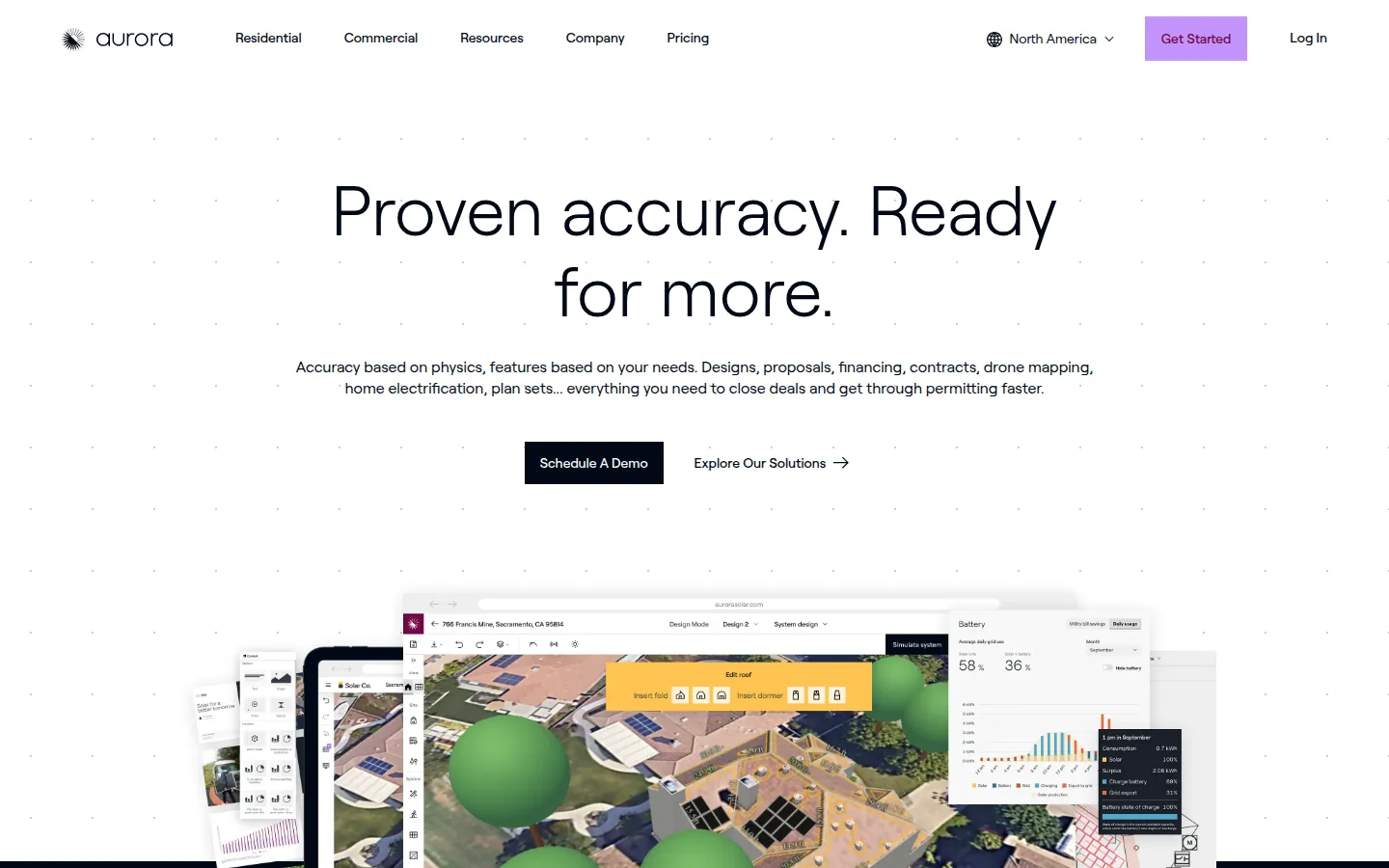
- Plan gating: the shade report is not available on Basic. Aurora AI, drone mapping, the API and Contract Manager are Enterprise only.
- Limits per plan: Basic and Premium each include 1 user and 50 projects per month.
- Commitment: no minimum on monthly plans; one year on annual plans.
- Commercial: Aurora’s site lists HelioScope, a separate Aurora product, under Commercial.
What does SurgePV do?
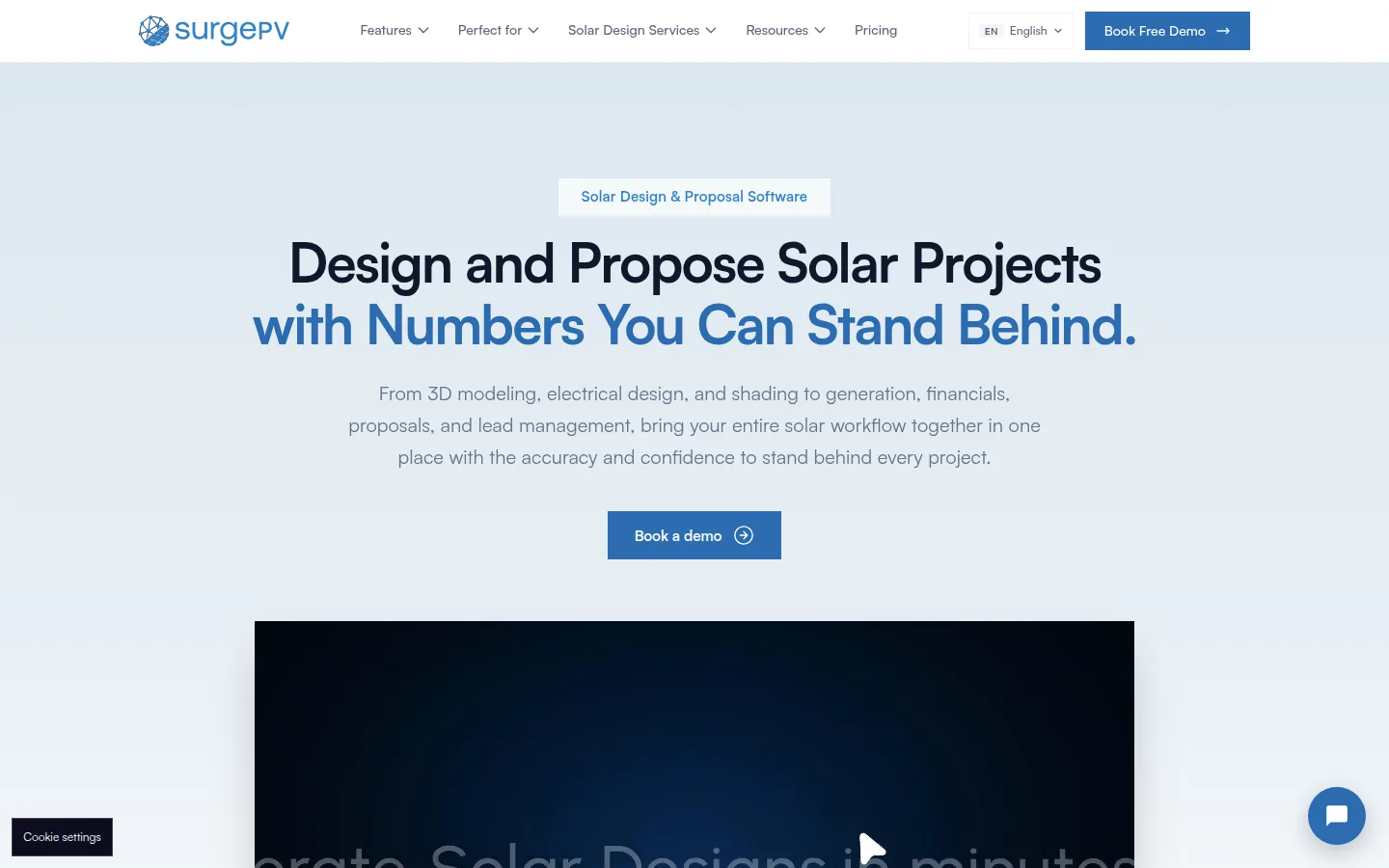
SurgePV lists 3D roof modeling, solar array layout, shading analysis, energy-yield modeling, financial modeling, electrical workflow support, bill-of-materials output and proposal generation. Its pricing page lists unlimited projects, DC stringing, free onboarding and direct support on every plan.
How much do Aurora Solar and SurgePV cost?
Aurora prices per user per month, SurgePV per user per year. The chart converts nothing: it shows each vendor’s annual-billing figure per user per year.
- Aurora Basic$1,620 ($135 per month)
- Aurora Premium$2,640 ($220 per month)
- SurgePV, 1 user$1,899
- SurgePV, 3 seats (each)$1,499
- SurgePV, 5 seats (each)$1,299
Source: Aurora and SurgePV pricing pages, checked October and November 2026.
Aurora’s North America page shows “$” without naming the currency, and its monthly billing rates are $159 (Basic) and $259 (Premium). Aurora add-ons, such as plan sets and engineering stamps, are priced separately; on-demand site models start at $9.99. SurgePV’s page adds 18% GST. The plans include different scope, so the lowest number is not automatically the better value.
See the price for your seat count
SurgePV publishes rates for 1, 3 and 5 seats. Book a demo for a written quote and compare it with the Aurora plan page.
Book a Free DemoGuided demo. SurgePV does not advertise a self-serve trial. No credit card is needed for the demo.
What does each vendor say about accuracy?
Neither vendor publishes a single accuracy percentage on the pages read, so none is quoted here. Aurora says its production figures are P50 values (median expected output in a typical year) and that it does not natively output P90, so you apply an outside P50-to-P90 factor (Aurora P-value help). SurgePV states that results depend on source data, assumptions, equipment models, configuration and review, and do not replace approval by the responsible engineer, authority, lender, insurer or utility.
Pros and cons
Aurora Solar
- Pro: published prices and plan limits; monthly plans with no minimum.
- Pro: named lender integrations and custom financiers; plan sets and engineering stamps as add-ons.
- Con: shade report starts at Premium; P90 is not native; SLD editor limited to Europe per its help article.
- Con: Basic and Premium include 1 user each.
SurgePV
- Pro: one published scope list with finance and proposals under one per-user price.
- Con: less public detail on features than Aurora’s help center.
- Con: guided demo only; no advertised self-serve trial.
Who should pick which?
- Aurora Solar: US residential teams that want plan sets from the same project, lender quotes and monthly plans.
- SurgePV: teams that want per-user annual pricing with shading, yield, finance and proposals in one scope.
- Switching: see the Aurora Solar to SurgePV migration guide.
Bottom line
Aurora gives you more published detail and plan tiers; SurgePV gives you a flat per-user price. Check both against one real project. Book a SurgePV demo or review pricing first.
Sources
Aurora pages read on 28 October 2026; the pricing page was re-read in November 2026. SurgePV facts from its pricing page, checked November 2026.
- Aurora pricing: plans, limits, add-ons.
- Aurora Design Mode and Sales Mode: tools.
- Aurora P-value help: P50 and P90.
- Aurora SLD editor: regional availability.
- Aurora financing integrations: lender list.
- SurgePV: pricing.
Frequently asked questions
Is Aurora Solar better than SurgePV?
It depends on your plan needs. Aurora documents residential design, sales, plan sets and lender integrations with tiered plans, while SurgePV lists a per-user scope with finance and proposals (vendor pages, October 2026).
How much does Aurora Solar cost?
Aurora lists Basic at $159 per user per month, or $135 billed annually, and Premium at $259, or $220 billed annually. Enterprise is custom. The page shows “$” without naming the currency (Aurora pricing, October 2026).
How much does SurgePV cost?
SurgePV lists $1,899 per user per year for 1 user, $1,499 per user for 3 seats and $1,299 per user for 5 seats, in USD, plus 18% GST (SurgePV pricing page, November 2026).
How accurate is Aurora Solar compared with SurgePV?
Neither vendor publishes one accuracy percentage on the pages read. Aurora says its yields are P50 values and not natively P90; SurgePV says results depend on source data, assumptions and review (October 2026).
Does Aurora Solar include shade reports on every plan?
No. Aurora’s help article says the shade report is not available on Basic. LIDAR-assisted modeling and bankable shade reports are listed on Premium and Enterprise (Aurora, October 2026).
Can I switch from Aurora Solar to SurgePV?
Yes, through a guided demo and onboarding. SurgePV lists free onboarding on its pricing page. Check what you need to carry over, such as templates and financing options, in the migration guide.
