A 5 MW rooftop project in Gujarat reached commercial operation agreement with an offtaker, signed an EPC contract, and then stalled. The solar lender engineer returned the energy yield report in week three of due diligence. The P50 figure looked reasonable, but the report contained no uncertainty budget, no documented soiling assumption, and no explanation for the 2.3% far-shading loss. The independent engineer could not sign off. Financial close slipped by six weeks, and the developer paid for a second yield assessment.
That scenario is more common than most developers admit. Lender engineering — also called independent engineering or technical due diligence — is the gate every serious solar project must pass before debt is drawn. A solar lender engineer does not care how elegant the layout looks. The engineer cares whether the project will produce the cash flows the financial model assumes. Design errors that installers tolerate become financing blockers under independent review.
In this guide you will learn:
- What a solar lender engineer does and who hires one
- The four pillars of a lender engineering review
- How P50, P90, and uncertainty budgets shape debt capacity
- Why DSCR is the financial red line for every project
- Which equipment and design details lenders scrutinize most
- Common red flags that delay or kill financings
- How to prepare a lender-ready design package
- How SurgePV automates the documentation independent engineers require
Quick Answer
A solar lender engineer is an independent technical advisor who reviews a solar project’s design, energy yield, equipment, contracts, and risks. The deliverable is an independent engineering report. It confirms whether the project is likely to generate the cash flows needed to repay debt and meet equity returns.
What Is a Solar Lender Engineer?
A solar lender engineer is the technical eyes and ears of the finance party. When a bank or institutional lender considers a solar loan, it hires an independent engineering firm. That firm verifies the project is technically sound and financially realistic. The engineer is not on the developer’s payroll. That independence is the entire point.
The role sits at the intersection of engineering and finance. The lender engineer reads single-line diagrams, checks energy yield models, inspects sites, reviews equipment datasheets, and tests financial assumptions. The output is an independent engineering report, often called an IER or technical due diligence report. The IFC Solar Project Developer’s Guide says a bank-grade energy yield assessment must include P50 and P90 values. It also requires inter-annual variation, site-specific losses, shading review, and degradation analysis.
Common firms that perform this work include DNV, UL Solutions, Black & Veatch, SgurrEnergy, and engineering consultancies known to lenders. UL Solutions describes its solar due diligence scope as covering energy production, technology and design, site suitability, contracts, environmental and permitting, CAPEX/OPEX, and construction-phase oversight.
The lender engineer is not a design critic for the sake of it. The engineer’s job is to quantify risk in dollar terms. A 5% production haircut on a 50 MW project can reduce asset value by millions. The IER translates technical findings into financial impact so lenders can price risk correctly.
Lender Engineer vs Owner’s Engineer
Developers sometimes confuse the lender engineer with the owner’s engineer. The two roles are not interchangeable.
An owner’s engineer works for the developer. The role is to protect the owner’s interests during design, procurement, and construction. The owner’s engineer helps optimize layout, negotiate EPC terms, and resolve site issues. The report stays inside the project team.
A lender engineer works for the finance party. The role is to protect the lender or investor. The engineer reviews the same documents but reports findings to the bank. A negative finding can delay financial close or reduce debt capacity.
This difference matters for communication. An owner’s engineer may accept an aggressive soiling assumption if it helps the bid. A lender engineer will challenge it. Developers who prepare for the lender engineer’s standard from day one avoid surprises at financial close.
The Four Pillars of Lender Engineering Review
Every independent engineering review rests on four pillars. Miss one, and the report comes back with qualifications or outright rejection.
Technical Design Review
The engineer checks whether the plant is designed to produce the claimed energy safely and reliably. This includes module layout, string configuration, inverter sizing, electrical protection, grounding, structural loading, and code compliance. Reviews reference IEC 61730 for module safety, IEC 62446 for commissioning, and local electrical codes such as the NEC in the United States.
Energy Yield Assessment
The yield report is the heart of the IER. The engineer validates the meteorological data source, simulation model, loss assumptions, shading analysis, and uncertainty budget. The key outputs are P50, P75, P90, and sometimes P99 annual energy estimates. For more on these values, see our guide on P50 vs P90 solar.
Equipment and Supply Chain Review
Lenders want bankable equipment with field-proven reliability. The engineer checks module Tier 1 status, inverter track record, balance-of-system quality, warranty terms, and manufacturer financial health. Non-Tier-1 modules or inverters without multi-year field data trigger reservations.
Contract and Risk Allocation Review
The engineer reads the EPC contract, O&M agreement, interconnection agreement, and PPA. The goal is to confirm that responsibilities, penalties, and insurance are allocated clearly. A weak EPC wrap or missing liquidated damages clause can be as damaging as a design flaw.
| Pillar | Key Documents | Typical Review Time | What Can Go Wrong |
|---|---|---|---|
| Technical design | SLD, layout, structural calcs, electrical studies | 2–4 weeks | Undersized conductors, code gaps, shading errors |
| Energy yield | Yield report, meteo data, loss diagram, uncertainty budget | 3–6 weeks | Missing P90, undocumented losses, wrong dataset |
| Equipment | Datasheets, warranties, Tier 1 lists, factory audits | 2–3 weeks | Non-bankable modules, weak warranties |
| Contracts | EPC, O&M, PPA, interconnection, insurance | 2–4 weeks | Weak LDs, unclear O&M scope, missing coverage |
Energy Yield Assessment: P50, P90, and the Uncertainty Budget
The energy yield assessment is where most lender engineering reviews spend their time. The engineer needs to believe the number on which the financial model is built. That belief depends on transparency, not just the headline P50.
P50 Is for Equity, P90 Is for Debt
P50 is the median expected annual production. There is a 50% chance the project will exceed it in any given year. Equity investors use P50 to calculate base-case returns. Lenders ignore it for debt sizing.
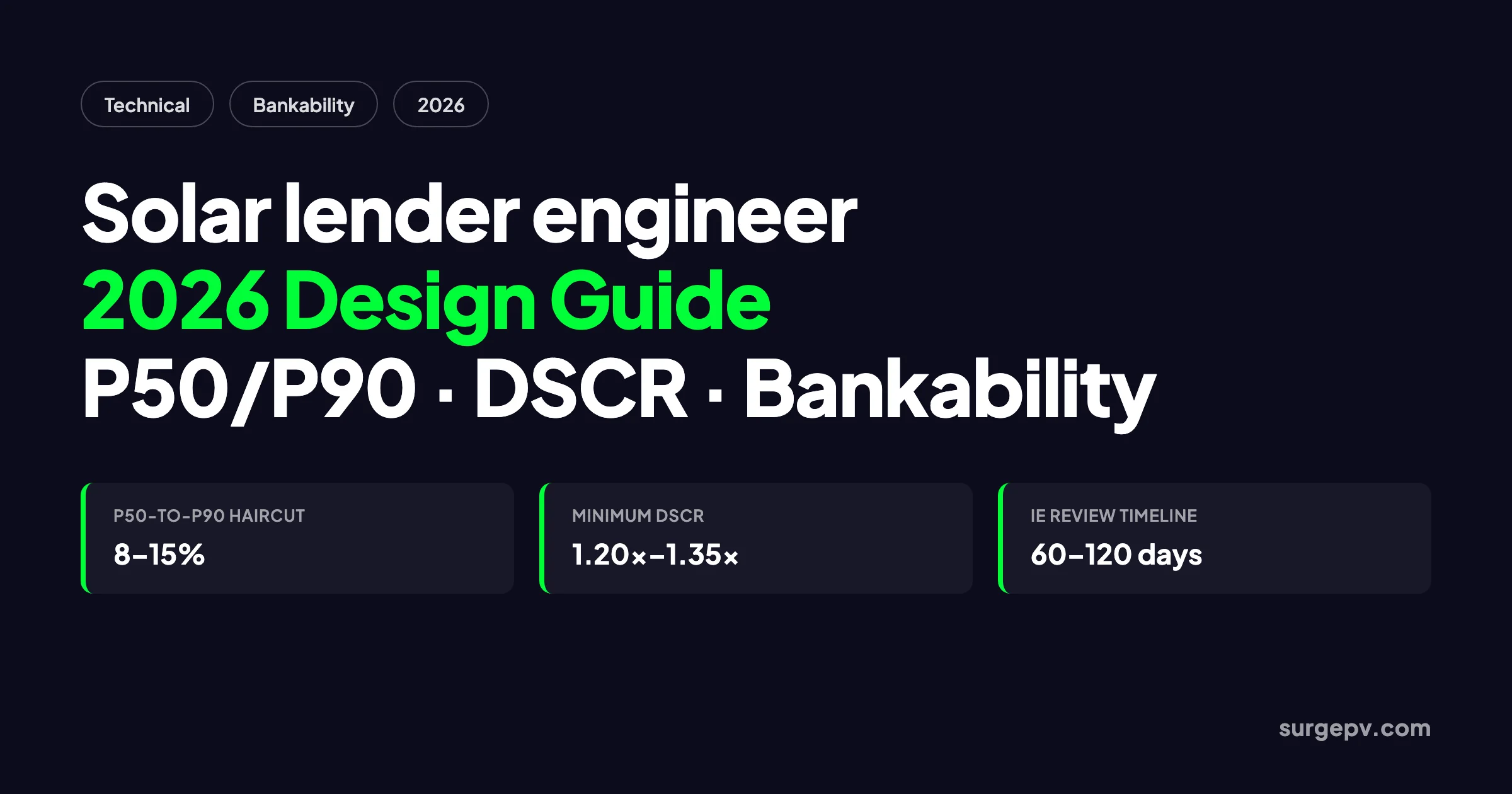
P90 is the production level exceeded in 90% of years. It is lower than P50, usually by 8% to 15% for utility and commercial projects. Lenders size debt against P90 because they need confidence the project can service debt even in a poor solar year. Our due diligence glossary explains why this distinction is non-negotiable in project finance.
The relationship between P50 and P90 is governed by the combined uncertainty. Engineers combine individual uncertainty sources in quadrature, then apply the inverse normal distribution. For 90% exceedance, the z-score is 1.282:
P90 = P50 × (1 − 1.282 × σ)Where σ is the total combined uncertainty expressed as a decimal.
The Uncertainty Budget Matters More Than the P50
A project with a lower P50 but a tighter uncertainty band can support more debt than a project with a higher P50 and wider uncertainty. This is counterintuitive but central to lender thinking.
Consider two 10 MW projects:
| Project | P50 (MWh/year) | Combined Uncertainty | P90 (MWh/year) | P50-to-P90 Haircut |
|---|---|---|---|---|
| A | 18,500 | 7.0% | 16,840 | 9.0% |
| B | 19,000 | 9.5% | 16,700 | 12.1% |
Project A has a lower P50 but a higher P90 because its uncertainty is smaller. The lender will likely offer better terms on Project A. Better meteo data, measured soiling, and validated simulation inputs reduce uncertainty. Developers who invest in data quality raise bankable production without adding a single module.
Sources of Uncertainty
The uncertainty budget combines several independent sources:
- Inter-annual weather variability: year-to-year fluctuation in solar resource
- Meteo dataset uncertainty: accuracy limits of Solargis, Meteonorm, NSRDB, or similar
- Model uncertainty: simulation engine accuracy, typically 2% to 3%
- Soiling uncertainty: variability in dust and cleaning schedules
- Equipment performance tolerance: module and inverter output tolerances
- Degradation uncertainty: long-term module output decline
Each source carries a standard deviation. Engineers combine them as the root sum of squares. A transparent uncertainty budget table is one of the first things a lender engineer asks for.
Debt Sizing and DSCR: The Financial Red Line
Debt service coverage ratio, or DSCR, is the number that decides whether a project gets financed. It measures how much cash flow is available to service debt in each period. The formula is simple:
DSCR = Cash Flow Available for Debt Service / Total Debt ServiceTotal debt service includes principal and interest payments. Cash flow available for debt service is typically revenue minus OPEX, insurance, taxes, and reserves.
Typical Lender Thresholds
Most project finance lenders require a minimum DSCR of 1.20x to 1.35x at P90 production. Strong projects with investment-grade offtakers and long-term PPAs may negotiate lower thresholds. Merchant or partially merchant projects often face 1.30x or higher. A DSCR below 1.0 means the project cannot cover its debt payments from operating cash flow.
Academic research on renewable energy project finance, published by TU Delft (2024), lists common lender requirements. Lenders typically demand a DSCR of at least 1.30, a loan repayment period of 8 to 18 years, and a maximum debt-to-capital ratio of 70%.
Why P90 Anchors DSCR
Lenders do not run DSCR on P50. They run it on P90 because they want to know whether debt is covered in a downside year. A financial model that shows a 1.25x DSCR at P50 but only 1.05x at P90 will fail credit committee. Developers should model both cases from day one. Our solar NPV calculation guide shows how to build the cashflow side of the same model.
Sensitivity Analysis
Lender engineers also test sensitivities. Common scenarios include:
- 10% construction cost overrun
- 0.2 percentage point increase in degradation rate
- 5% reduction in energy yield
- Higher OPEX escalation
- Shorter PPA tenor or merchant price decline
A complete proposal includes these sensitivities before the lender asks. The energy and financial modeling tool in SurgePV produces DSCR tables and sensitivity matrices alongside the yield report.
Equipment and Balance-of-System Specifications Lenders Scrutinize
Lenders finance assets that will perform for 20 to 25 years. Equipment selection is therefore not just an engineering decision. It is a credit decision. The broader financing context is covered in our solar financing options guide.
Modules
Lender engineers prefer modules from BloombergNEF Tier 1 manufacturers. Tier 1 status indicates bankable manufacturing and financial health. The engineer checks:
- Module efficiency and temperature coefficient
- Degradation warranty, typically 0.5% to 0.7% annual linear degradation
- Product and performance warranty terms
- Factory audits and quality certifications
- Track record in similar climates
Inverters
Inverter sizing and selection affect availability, efficiency, and maintenance cost. Lenders look for:
- Inverter efficiency curves and European efficiency ratings
- Availability warranties, often 97% to 99%
- Manufacturer service network in the project region
- Clipping analysis if the DC-to-AC ratio exceeds typical limits
For Indian projects, inverter diligence should verify the exact model’s current certificates, monitoring architecture, warranty terms, supply record, service route, and any scheme-specific domestic-content requirement. Local manufacturing or marketing terminology alone does not establish bankability.
Balance of System
Cables, combiner boxes, mounting systems, and protection devices must be sized correctly. Lender engineers flag:
- Cable losses above 1% to 2% of system output
- Inadequate string fusing or surge protection
- Mounting systems without structural certification for local wind and snow loads
- Grounding and earthing that does not meet local codes
Electrical Studies
For larger projects, the lender engineer reviews interconnection studies, short-circuit analysis, and protection coordination. A project that cannot demonstrate safe grid connection will not reach financial close.
Common Red Flags That Delay Financial Close
Lender engineers see the same mistakes repeatedly. Avoiding these red flags can save weeks and thousands of dollars in re-work.
Missing or Opaque Uncertainty Budget
A yield report that states P90 without showing how it was calculated is unusable. The engineer will demand a full uncertainty budget. Projects that arrive with this table ready move faster.
Undocumented Shading Losses
Shading is site-specific and hard to verify remotely. Lender engineers want horizon profiles, obstruction measurements, and month-by-month shading percentages. A 3D model with timestamped shadow renders is strong supporting evidence. SurgePV’s shadow analysis generates these visuals directly from the design.
Aggressive Soiling Assumptions
Assuming 1% soiling loss in a dusty industrial zone is not credible without site measurements. Lender engineers compare assumptions to regional benchmarks and operational data. Overly optimistic soiling assumptions reduce P90 and trigger haircuts.
Non-Bankable Equipment
Modules not on the Tier 1 list, inverters without local service support, or mounting systems without certification all trigger reservations. Developers sometimes select cheaper equipment to win EPC bids, then discover it hurts financing.
Weak Contracts
EPC contracts without liquidated damages, unclear O&M scopes, or missing warranty backstops are red flags. Lenders need clear risk allocation. If the EPC will not stand behind performance, the lender will require additional security.
Incomplete Interconnection Studies
A project with a signed interconnection agreement is not the same as one with completed impact studies. Lender engineers verify that grid connection studies are finished and that upgrade costs are allocated.
Financial Model Decoupled from Engineering
When the financial model is built in a separate spreadsheet from the energy yield model, errors creep in. Lenders prefer models where every cash flow line traces back to an engineering input. This is one reason integrated solar design software is becoming standard for bankable projects.
How to Prepare a Lender-Ready Design Package in 2026
Preparation separates projects that close in 45 days from projects that drag on for months. A complete package submitted on day one signals professionalism and reduces back-and-forth.
Required Engineering Documents
- Energy yield report with P50, P75, P90, and uncertainty budget
- Hourly or monthly production profile
- Single-line diagram and electrical schematics
- Module and inverter datasheets
- Structural and foundation calculations
- Wind and snow load assessments
- Shading analysis with 3D renders
- Geotechnical report for ground-mount projects
- Site plan and layout drawings
Required Commercial and Legal Documents
- EPC contract with scope, schedule, price, and liquidated damages
- O&M agreement with scope, escalation, and performance guarantees
- PPA or offtake contract with tenor, rate, and escalation
- Interconnection agreement and studies
- Environmental permits and land control documents
- Insurance policies and coverage summaries
- Financial model with DSCR, LLCR, and sensitivity tables
Use Bankable Simulation Tools
Lender engineers trust reports from validated simulation engines. PVsyst has long been the gold standard for utility-scale bankability. For design teams that need speed plus bankability, cloud platforms can produce reports with comparable accuracy and better workflow integration. Our best solar simulation software comparison explains the tradeoffs.
Run a Pre-Submission Review
Before submitting to the lender engineer, have an internal technical reviewer challenge every assumption. Ask:
- Is every loss in the yield report justified by data?
- Does the P90 support the claimed DSCR?
- Are equipment selections defensible to a lender?
- Do contracts allocate risk clearly?
- Is the financial model traceable to the yield report?
A few hours of internal critique can prevent weeks of external review.
How SurgePV Automates Lender-Grade Design Documentation
Modern solar projects generate too much data for manual workflows. Lender engineers expect detailed, consistent, and traceable documentation. SurgePV builds that documentation as a byproduct of the design process.
Integrated Energy Yield and Financial Modeling
SurgePV couples the 8,760-hour energy simulation with the financial model. When the design changes, the yield report, DSCR table, and cashflow waterfall update together. This eliminates the re-keying errors that separate spreadsheets introduce. The generation and financial tool produces P50/P75/P90 bands, sensitivity matrices, and lender-ready cashflow statements.
3D Shading and Shadow Analysis
SurgePV’s solar shading analysis generates horizon profiles, obstruction measurements, and month-by-month shading loss percentages. These outputs are exactly what independent engineers request when they challenge shading assumptions.
Automated Electrical Documentation
The platform auto-generates single-line diagrams, string maps, and electrical summaries from the design. These drawings stay synchronized with the layout, so last-minute module changes do not create inconsistencies in the lender package.
Bankable Proposals and Lender Packs
SurgePV can export a branded customer proposal and a separate lender pack from the same project file. The lender pack includes the yield report, loss diagram, equipment list, cashflow waterfall, DSCR table, and sensitivity analysis. Clara AI can regenerate scenarios in plain English, such as “re-run the model with 0.65% annual degradation and a 7% discount rate.”
Built-In Calculators for Pre-Submission Validation
SurgePV includes calculators that help teams sanity-check assumptions before the lender engineer sees them. The wire size calculator confirms conductor losses stay below lender thresholds. The inverter load calculator validates DC-to-AC ratios. The irradiance estimator and electricity bill calculator give quick reality checks on production and savings. These tools do not replace detailed engineering, but they catch the obvious errors that delay independent reviews.
Design-to-Engineering Handoff
For projects that need detailed engineering or PE-stamped permit drawings, SurgePV designs can be handed off to engineering consultancies. Heaven Designs provides detailed engineering, permit design, and solar engineering consultancy services for EPCs that need additional lender-grade deliverables.
If your team is preparing projects for lender review, start with SurgePV as the design workflow that produces bankable documentation from the first iteration. Book a SurgePV demo to see how the platform generates lender-ready yield reports, DSCR models, and electrical drawings in a single project file.
Frequently Asked Questions
Here are the questions developers and finance teams ask most often about lender engineering.
What does a solar lender engineer do?
A solar lender engineer, also called an independent engineer, reviews a project’s design, energy yield, equipment, and contracts on behalf of lenders or investors. The goal is to confirm the project will produce the cash flows needed to service debt and meet return targets.
Why do lenders require an independent engineering report?
Lenders require an independent engineering report because it provides an objective technical opinion on whether the project will perform as projected. The report validates energy yield, design assumptions, and risk exposure before capital is committed.
What is the difference between P50 and P90 in solar finance?
P50 is the median annual energy yield, exceeded 50% of the time. P90 is a conservative estimate exceeded 90% of the time. Lenders use P90 for debt sizing and DSCR calculations because it reflects a downside production year.
What is a good DSCR for a solar project?
Most project finance lenders require a minimum DSCR of 1.20x to 1.35x at P90 production. The exact threshold depends on market maturity, offtaker credit, and contract structure. Stronger projects may negotiate lower DSCRs.
What are the most common red flags in a lender engineering review?
Common red flags include missing uncertainty budgets, undocumented shading losses, aggressive soiling assumptions, non-Tier-1 modules, undersized conductors, weak EPC contracts, and incomplete interconnection studies. Each finding can delay financial close or reduce debt capacity.
How long does a solar lender engineering review take?
A typical utility-scale review takes 60 to 120 days. Commercial and industrial reviews are faster, usually 30 to 60 days. Timeline depends on data quality, site complexity, and how quickly the developer responds to information requests.
What documents should a developer prepare for a lender engineer?
Prepare the energy yield report with P50/P90, single-line diagram, structural calculations, equipment datasheets, shading analysis, geotechnical report, EPC and O&M contracts, interconnection agreement, and environmental permits. Complete packages shorten review timelines.
Can solar design software produce lender-ready reports?
Yes. Bankable solar design software can generate hourly production profiles, itemized loss diagrams, P50/P90 estimates, single-line diagrams, and financial sensitivity tables. SurgePV exports these outputs in the format independent engineers and lenders expect.
Where this fits
This article is part of SurgePV's Solar Design hub, which works through the topic from first principles to the decisions a project team actually has to make.