

Answer
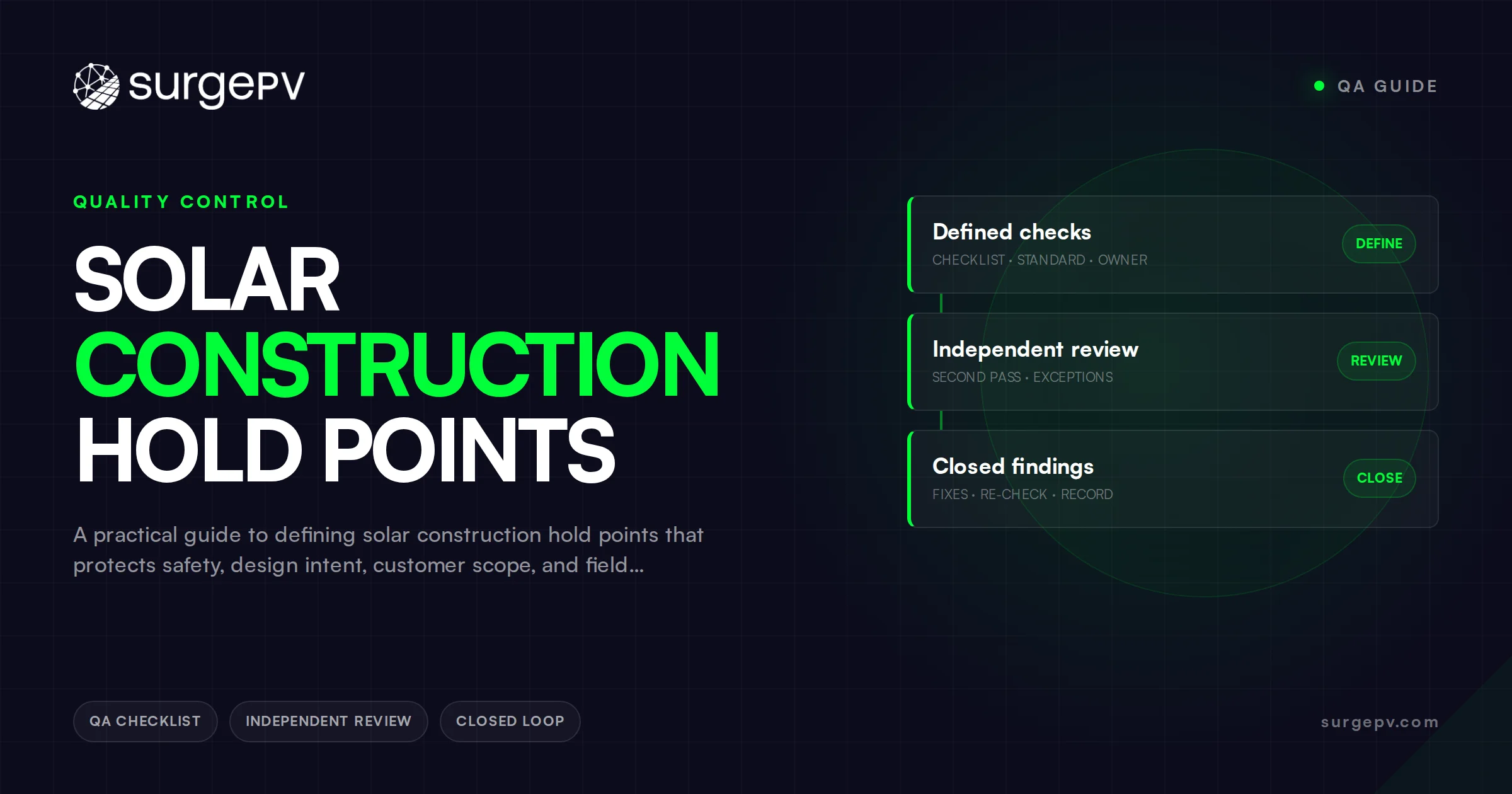
A solar construction hold point is a named moment when affected work must not proceed until the responsible evidence or decision is available. Define the trigger, scope, owner, required evidence, release authority, and permitted work around it before the project reaches the site.
A hold point is a promise that a solar project will not let a decision disappear beneath the next layer of work. It is not a generic instruction to stop. It names a condition, limits the affected work, says what evidence is needed, and identifies who can release the work. Use the record to assign unresolved design, safety, material, access and customer-scope questions to their responsible reviewers rather than leaving them to field improvisation.
This is desk research for installers and EPCs. It is not a safety plan, inspection procedure, engineering approval, contract interpretation, or authority instruction. Project requirements, local rules, manufacturer information, and qualified responsibilities determine which hold points apply. The method below helps teams make controls visible before delivery pressure turns uncertainty into installation work.
A Hold Point Is Not the Same as a To-Do Item
Project task lists can contain hundreds of actions. Most do not need to stop work. A hold point exists when continuing a defined activity could conceal a condition, create rework, compromise safety, depart from the controlled design, or make a customer or authority decision harder to revisit. The point has a release condition, not simply a due date.
The NREL photovoltaics research resources provide context on PV technology, but they cannot specify a project’s installation control points. Use the project’s actual drawings, equipment information, quality requirements, survey evidence, utility instructions, and authority process to determine when work must wait.
Examples may include a site condition that conflicts with the release, a missing technical decision before a mounting activity, an equipment discrepancy before use, a required inspection or documentation event, or a utility/authority condition that governs a later step. The example is not a universal rule. Its value is that the team has named the decision before it is needed.
| Hold-point field | What it answers |
|---|---|
| Trigger | What fact or event activates the hold? |
| Scope | Which activity must wait and what remains permitted? |
| Evidence | What observation, document, review, or approval is required? |
| Owner | Who can assess or release the issue? |
| Release record | Where is the decision documented? |
| Communication | Who needs the status to plan work or speak with the customer? |
Set Hold Points During Planning, Then Confirm Them at Handoff
The best time to define a hold point is before the project reaches the field. Review the site evidence, design assumptions, procurement plan, construction sequence, authority or utility conditions, and customer commitments. Ask where an unanswered question becomes expensive or unsafe once work continues.
At the design-to-installation handoff, confirm the status of each planned hold. A field lead should not discover on the day of work that a drawing refers to a pending review. The project manager should not assume a crew knows whether a substituted item is on hold. Use a short release briefing that identifies the active issues and the route for new observations.
The DOE Solar Energy Technologies Office is useful background for solar technology and deployment. It cannot establish a hold release for a specific project. The evidence and responsible decision-maker remain project-specific.
Scope the Pause Precisely
Overly broad holds frustrate crews and encourage workarounds. Overly narrow holds leave risk unmanaged. State what must not proceed and what may continue safely under the project’s controls. For example, a question about an equipment model may hold installation of that component while unrelated, authorized staging work continues. A safety issue may demand a wider stop under the applicable safety procedure.
| Condition | Possible hold scope | Release needs |
|---|---|---|
| Site feature conflicts with layout | Affected array area or related installation activity | Current evidence and design direction |
| Material identity differs from approved list | Use of the affected material | Responsible technical/project review |
| Required access condition unresolved | Work in the affected access area | Approved access or safety control |
| Drawing revision has not reached site | Work governed by the changed instruction | Confirmed current release and briefing |
| Immediate hazard observed | Work as required by safety process | Applicable safety response and authorization |
For covered U.S. construction work, OSHA 1926.20 addresses employer safety programs and inspections, and 1926.21 addresses safety instruction. These provisions do not prescribe this hold-point table, replace a site-specific plan or apply automatically to every country or work classification. If a condition presents a hazard, follow the applicable safety process. Documentation must support rapid control, not delay it.
Connect Solar Design Decisions to Delivery Handoffs
Explore how SurgePV brings project inputs, Solar Designing, analysis, and customer-facing outputs into one connected workflow.
Book a DemoDiscuss the handoff points around an active project in a live walkthrough.
Make the Release Evidence Specific
“Approved” is not enough in a hold-point log. Record what was reviewed, the evidence source, the decision, any conditions, who made it, and the date. A release may permit work only under a revised drawing, only after a documented measurement, or only for a limited area. Preserve that boundary.
If the holder is a customer, utility, authority, engineer, manufacturer, safety role, designer, or project manager, state the relevant decision rather than treating the title as proof. An email receipt may confirm a message was sent; it may not grant the approval a team needs. A new PDF may be a working file rather than a construction issue. The log should reference the controlled artifact or exact record.
Keep New Site Observations Out of Informal Channels
Field observations will occur even with excellent planning. Give the crew a simple notice route: location, condition, photo or measurement reference where safe and appropriate, affected drawing/activity, immediate concern, and request for direction. The person reporting should describe what was observed, not invent a design solution outside their authority.
The project team then decides whether the observation is within the existing release, needs a short clarification, activates a hold, or requires a larger change process. This prevents an image in a group chat from becoming the project’s only record of a material decision.
For linked design records, Solar Designing is the relevant SurgePV product area. Software can help teams retain related project information; it cannot decide whether a hold should be released or replace qualified project review.
Review Holds With the Same Questions Every Time
- What exact activity is affected?
- What evidence or decision is missing?
- What can safely continue while the hold remains open?
- Who has authority to resolve the condition?
- Where will the release and any conditions be recorded?
- Who must know before the schedule, procurement, or customer communication changes?
The questions make a hold proportional. They avoid both extremes: treating every question as a shutdown and allowing every schedule pressure to overrule a material condition.
Learn From Holds Without Celebrating Delay
At closeout, review which hold points were activated, why, and whether earlier evidence could have prevented the late discovery. Repeated equipment discrepancies may point to a procurement-design handoff gap. Repeated access conditions may improve the survey brief. Do not present internal observations as industry statistics. Use them to improve the next project’s decision sequence.
Avoid the “Conditional Release” That Nobody Can Interpret
Sometimes work can proceed only with a condition: use the revised sheet, retain a particular clearance, wait for a specific attachment, or complete a check before the next activity. Write that condition in language the recipient can act on. “Proceed carefully” is not a control. “Use construction issue C-03 for the east roof plane; do not install the held equipment item; record the specified field measurement before the next release” is a usable instruction.
Conditional releases also need an expiry or review trigger. If the project changes again, the condition may no longer be sufficient. Link it to the relevant drawing revision, observation, or decision record, and tell the field team what to do if the condition cannot be met. This prevents a limited release from being copied into a different work area or later project phase.
Hold-Point Communication Needs a Customer Route
Only the responsible role may determine the permitted work boundary under actual project and safety requirements. A commercial or schedule exception does not waive a required inspection, technical release or hazard control.
Some holds affect only internal sequencing. Others affect an agreed date, system configuration, or scope. When a customer update is needed, distinguish the observed fact from the decision still pending. A clear statement might say that the team identified a site condition, is reviewing the required project response, and will provide the next confirmed update by a named date. Do not promise the result of that review before the responsible person has made it.
The customer-facing owner should receive the same hold reference as the technical owner. That reduces the chance that an early sales expectation and a field-control record tell different stories about the same project.
Store Closed Holds With Their Release Context
A closed hold is evidence that a decision occurred. Preserve the initial trigger, the evidence reviewed, the release, and any conditions in the project record. Do not leave only the final status. A future alteration, service issue, warranty question, or audit may need to understand why a team paused and how it resumed. Keep historical records retrievable under approved access and retention rules while current instructions remain distinguishable.
Practical Next Steps
- Define hold points for conditions that cannot responsibly be decided after affected work proceeds.
- State the scope, evidence, owner, and release record for each hold.
- Give field teams a route to report observations without turning informal messages into undocumented approvals.
Make Solar Delivery Decisions Easier to Trace
Request a guided SurgePV evaluation to see connected Solar Designing, Shadow Analysis, generation modeling, and Solar Proposals.
Request a Guided DemoExplore Solar DesigningFrequently Asked Questions
What is a construction hold point in a solar project?
It is a predefined control point at which specified work must wait for an identified inspection, evidence item, approval, or decision. Its exact authority and use depend on the project requirements.
Does every site issue require a full work stop?
No. A hold point should define its scope. Some issues stop only one activity while unrelated, safe, authorized work may continue. Immediate hazards must follow the applicable safety process.
Who can release a hold point?
The responsible role depends on the condition and project requirements. It may be a qualified technical, safety, design, engineering, project, customer, authority, or utility decision-maker. Record the actual evidence and conditions for release rather than relying on a verbal assurance.
Sources
Primary research and reference material used for this desk-research article.
Where this fits
This article is part of SurgePV's Solar Installation hub, which works through the topic from first principles to the decisions a project team actually has to make.

