

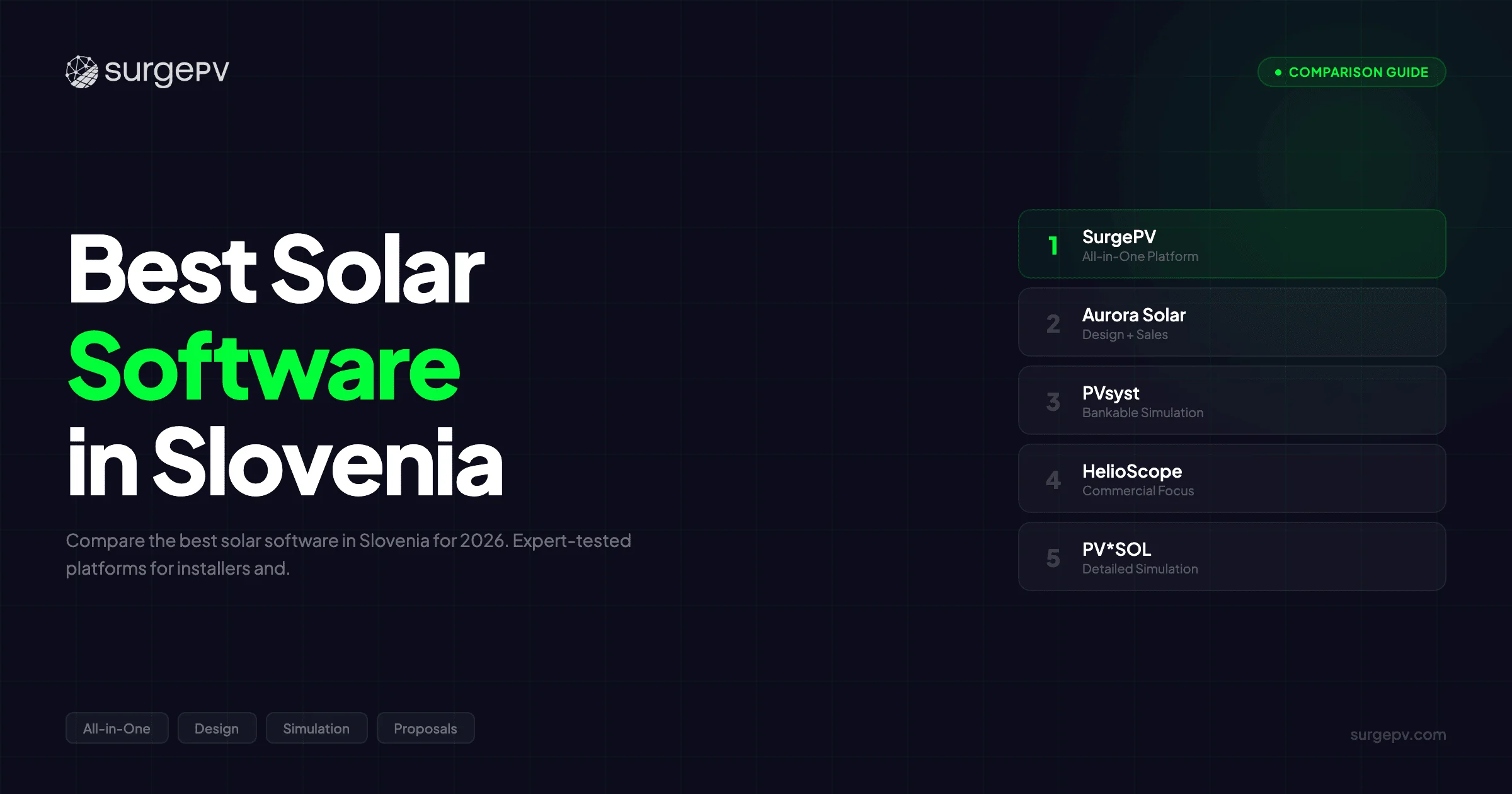
TL;DR: SurgePV is the best all-in-one solar software for Slovenia in 2026 — combining design, simulation, automated SLD generation for all five DSOs, samooskrba self-supply sizing, Eco Fund subsidy calculations, and professional EUR proposals at $1,899 per user per year on the individual plan. PVsyst is the gold standard for bankable simulations. PV*SOL handles European residential design with strong battery modeling.
Two million people. Five DSOs. Three climate zones. And a government target of 3.3 GW of solar by 2030 — nearly four times the current ~900 MW installed base (Slovenia NECP). That is a small country with very big solar ambitions.
The growth is already happening. 250-400 MW of new capacity added annually. Between 200 and 350 installers competing for every project. Eco Fund subsidies driving residential adoption. Self-supply (samooskrba) installations making up half the market.
Here is where most solar software suite falls short: Slovenia is not a one-size-fits-all market. You need self-supply sizing that matches annual consumption. You need SLD generation for five different regional DSOs. You need shading analysis that accounts for alpine peaks in Gorenjska and Mediterranean flatlands in Primorska. You need Eco Fund subsidy calculations built into your proposals. And you need all of this without paying for 3 separate software licenses.
We reviewed and compared 5 solar software platforms for the Slovenian market, evaluating each on self-supply support, grid compliance, terrain handling, simulation accuracy, workflow completeness, and pricing.
In this guide, you’ll learn:
- Which platform handles all five Slovenian DSOs and automates SLD generation
- How pricing compares across tools, and which vendors publish list pricing at all
- Which software models samooskrba self-supply and Eco Fund subsidies natively
- Our recommendation based on 400+ commercial projects across Europe
Quick Comparison Table
| Software | Best For | Pricing/Year | Self-Supply | SLD Generation |
|---|---|---|---|---|
| SurgePV | All-in-one workflows | $1,899 (3 users) | Yes (samooskrba) | Yes (automated) |
| Aurora Solar | Residential proposals | $159/user/mo, $135/user/mo billed annually (published) | No | No |
| PVsyst | Bankable simulations | Not published | No | No |
| HelioScope | Commercial C&I design | $159/mo or $1,620/yr per licence (published) | No | No |
| PV*SOL | European residential + battery | Not published | Basic | No |
Best Solar Software in Slovenia (Detailed Reviews)
SurgePV - Best All-in-One Solar Platform for Slovenia
Best For: EPCs and installers across all segments (self-supply, commercial, utility)
Pricing: $1,899/year (3 users); $1,499/user/year (For 3 Users plan)
Onboarding: 2-3 weeks
SurgePV is a cloud-based solar platform that combines design, simulation, electrical engineering, and proposal generation into a single tool. No add-ons, no separate licenses, no switching between applications.
For Slovenia, that matters more than the feature list suggests.
The typical Slovenian installer workflow looks like this: design a system in one tool, draft single line diagrams manually in AutoCAD for the DSO, run a simulation in PVsyst, then build proposals in Excel or PowerPoint. Three to four applications. Three to four hours per project. Thousands of euros in combined license fees.
SurgePV replaces all of that with a single platform. One login, one project file, one workflow from site assessment to signed proposal.
Key Features for Slovenia
- Self-supply (samooskrba) sizing — Matches system capacity to annual electricity consumption, meeting Slovenia’s self-supply scheme requirements. Integrates net metering calculations at Slovenian retail rates (EUR 0.16-0.22/kWh). Oversizing beyond consumption reduces the financial case — this prevents that mistake automatically.
- Automated SLD generation — Creates code-compliant electrical schematics in 5-10 minutes for all five Slovenian DSOs (Elektro Ljubljana, Maribor, Celje, Gorenjska, Primorska). Manual AutoCAD drafting takes 2-3 hours for the same output. An installer handling 15 projects per month saves 30-45 hours — more than a full working week.
- Eco Fund subsidy integration — Applies Eco Fund subsidies (EUR 180/kW, up to EUR 3,000) directly into financial projections, showing pre- and post-subsidy payback periods in customer proposals.
- P50/P75/P90 bankability metrics — Produces the estimates Slovenian banks (NLB, Nova KBM) require for commercial project financing.
- 8760-hour shading analysis — Hour-by-hour simulation across the full year. Accounts for alpine mountain shading in Gorenjska, Mediterranean conditions in Primorska, and continental patterns in Pomurje.
- Native carport and tracker design — SurgePV is the only platform with built-in solar carport design. Single-axis and dual-axis tracker support included.
- Wire sizing and voltage drop calculations — Instant automated calculations per IEC standards. No manual spreadsheet work, no risk of undersized cables failing DSO inspection.
- 98% accurate BOM generation — Automated bill of materials for procurement accuracy.
Pro Tip
SurgePV’s automated SLD generation saves 2-3 hours per project compared to manual AutoCAD drafting — and removes the separate Autodesk AutoCAD licence entirely. Book a demo to see it on a real Slovenian project.
Pricing
| Plan | Price | Users |
|---|---|---|
| Individual | $1,899/year | 3 users |
| For 3 Users | $1,499/user/year | 3 users |
| For 5 Users | $1,299/user/year | 5 users |
| Enterprise | Custom | Multiple |
All features included on every plan. No hidden fees, no feature gating. See full pricing.
Who SurgePV Is Best for in Slovenia
- Installers handling self-supply (samooskrba) projects needing fast sizing and Eco Fund calculations
- Commercial EPCs needing design-to-proposal workflows with SLD generation for DSOs
- Companies needing bankable P50/P90 reports for Slovenian bank financing
- Teams wanting to replace 3-4 separate tools with a single platform
Limitations
- English interface (no Slovenian localization yet)
- Slovenian DSO utility rates require manual input (not pre-loaded)
Real-World Example
A 6-person EPC in Ljubljana was using PV*SOL for design, AutoCAD for SLDs, PVsyst for simulations, and Excel for proposals. Four tools, four separate licences and renewals, and 4 hours per commercial project. After consolidating to SurgePV, that workflow dropped to 55 minutes per project with a single $1,899/year license. They reassigned one engineer from documentation to business development.
Further Reading
- Best Solar Design Software in Slovenia — Design-focused comparison for Slovenia
- Best Solar Design Software (2026) — Global comparison across 10+ platforms
- Best All-in-One Solar Software — Complete platform reviews
SurgePV has already powered 70,000+ projects globally, and it is the only platform that combines design, electrical engineering, simulation, and proposals natively — which is exactly the workflow gap that costs Slovenian installers 2-3 extra hours per project.
Aurora Solar - Best for Slovenian Residential Sales Presentations
Best For: Larger installers focused on high-volume residential proposals
Pricing: Aurora Solar publishes list pricing of $159 per user per month for Basic, or $135 per user per month billed annually, and $259 per user per month for Premium, or $220 per user per month billed annually, with Enterprise quoted per project by sales (aurorasolar.com/pricing/, checked 21 September 2026)
Aurora Solar leads the industry in sales presentation quality. Its interactive web-based proposals — where homeowners explore their roof in 3D and toggle system options in real time — are genuinely impressive. For the US residential market, it is the dominant platform.
What Works for Slovenia
- Industry-leading automatic 3D roof detection for fast residential design
- Beautiful interactive proposals that help close deals in competitive markets
- CRM integrations (Salesforce, HubSpot) for larger sales teams
- Strong AI-powered design tools for standard rooftop layouts
Where It Falls Short in Slovenia
- No samooskrba modeling — Cannot size systems to match annual consumption per Slovenia’s self-supply rules
- No Eco Fund integration — EUR 180/kW subsidies must be calculated manually
- No SLD generation — DSO grid connection documentation requires AutoCAD, licensed separately by Autodesk
- USD-first platform — Proposals generate in USD by default, requiring manual EUR conversion
- Per-seat billing — Aurora is priced per user per month, which is steep for Slovenian installer margins
Best for: Larger Slovenian companies with international operations who prioritize visual proposal quality over local regulatory features.
For a deeper analysis, read our full Aurora Solar review.
PVsyst - Simulation Gold Standard for Slovenian Bank Financing
Best For: Engineers focused on commercial and utility-scale bankable simulations
Pricing: Not published. PVsyst’s shop is registration-gated and it does not publish list pricing. AutoCAD is licensed separately by Autodesk for a complete workflow.
PVsyst is the industry reference for bankable energy production estimates. If you are seeking project financing from Slovenian banks like NLB or Nova KBM, PVsyst reports carry unmatched credibility.
What Works for Slovenia
- Universally accepted by Slovenian banks and financing institutions
- Detailed loss modeling (temperature, soiling, mismatch, inverter efficiency)
- P50/P90 reports are the gold standard for project financing
- Meteonorm integration includes Slovenian weather data across all regions
Where It Falls Short in Slovenia
- Simulation-only — Not a design platform. You need separate software for layout and engineering
- No SLD generation — Electrical documentation requires external CAD tools
- No proposal generation — Cannot produce client-facing sales documents
- No self-supply modeling — Cannot calculate samooskrba sizing or Eco Fund subsidies
- Desktop-only — No cloud collaboration for team-based workflows
Best for: Engineering teams focused on commercial and utility-scale projects where bankable simulations are the primary requirement. Pair with SurgePV for the complete workflow.
Read our full PVsyst review for a detailed breakdown.
Did You Know?
Slovenia’s revised National Energy and Climate Plan targets 3.3 GW of solar capacity by 2030 — nearly four times the current installed base. The market is projected to add 250-400 MW annually through the decade (IRENA Country Profile).
HelioScope - Fast Commercial Solar Design for Slovenian C&I Projects
Best For: Commercial EPCs designing 50 kW-5 MW rooftop systems
Pricing: HelioScope publishes $159 per month or $1,620 per year per licence for Basic and $259 per month or $2,640 per year per licence for Pro, each including one user, with Enterprise quoted by sales (helioscope.aurorasolar.com/pricing/, checked 21 September 2026)
HelioScope is a cloud-based design platform focused on commercial and industrial (C&I) solar projects. Its browser-based CAD tools make it fast to learn and fast to use for mid-scale rooftop work.
What Works for Slovenia
- Fast commercial rooftop design in a browser-based interface
- Integrated simulation with credible production estimates
- Supports Slovenian locations with international weather data
- Team collaboration through cloud-based project sharing
Where It Falls Short in Slovenia
- No SLD generation — Commercial projects requiring DSO electrical documentation need external tools
- No self-supply features — Cannot model samooskrba sizing or Eco Fund subsidies
- Limited residential tools — Not optimized for Slovenia’s dominant self-supply segment (50% of market)
- Enterprise tiers are quoted by sales — the published per-licence rates cover Basic and Pro only
- No carport or tracker design — Limited for emerging Slovenian project types
Best for: Commercial EPCs designing 50 kW-5 MW rooftop systems who prioritize speed over local regulatory features.
See our full HelioScope review for more details.
PV*SOL - European Residential Design with Strong Battery Modeling
Best For: Residential installers familiar with European software tools
Pricing: Not published. PV*SOL does not publish list pricing for Slovenia.
PV*SOL is a German-developed desktop tool built for European markets. Its strength lies in detailed residential design with excellent battery storage modeling — relevant as 30-40% of Slovenian residential buyers now ask about storage.
What Works for Slovenia
- European-focused with some Slovenian climate data included
- Excellent battery storage modeling and self-consumption optimization
- Good residential 3D visualization for tile rooftops
- IEC-standard electrical calculations
- One-time license option available
Where It Falls Short in Slovenia
- No SLD generation — DSO grid documentation requires AutoCAD, licensed separately by Autodesk
- No Eco Fund integration — Subsidy calculations must be done manually
- No samooskrba sizing — Cannot automatically match system to annual consumption
- Desktop-only — No cloud collaboration for team-based workflows
- Limited proposal generation — Technical reports rather than professional client-facing proposals
Best for: Slovenian residential installers already familiar with European tools who want solid battery modeling and traditional desktop design.
Solar Software Comparison Table for Slovenia
| Feature | SurgePV | Aurora Solar | PVsyst | HelioScope | PV*SOL |
|---|---|---|---|---|---|
| Best for | All-in-one workflows | Residential sales | Simulation | Commercial design | EU residential |
| Self-supply sizing | Yes (samooskrba) | No | No | No | Basic |
| SLD generation | Yes (automated) | No | No | No | No |
| P50/P90 reports | Yes | P50 only | Yes (gold standard) | Yes | Good |
| Eco Fund calculator | Yes | No | No | No | No |
| Proposal generation | Yes | Yes (best-in-class) | No | Basic | Basic |
| Battery modeling | Yes | Good | Limited | No | Excellent |
| Cloud-based | Yes | Yes | No (desktop) | Yes | No (desktop) |
| Carport design | Yes (only platform) | No | No | No | No |
| Wire sizing | Yes (automated) | No | No | No | Basic |
| Pricing/year | $1,899 (3 users) | $159/user/mo, $135/user/mo billed annually (published) | Not published | $159/mo or $1,620/yr per licence (published) | Not published |
Further Reading
For a broader comparison beyond Slovenia, see our guide to the best solar software globally.
What Slovenian Solar Projects Actually Demand From Your Software
Self-Supply (Samooskrba) Support Is Non-Negotiable
Half of Slovenia’s solar market operates under the samooskrba self-supply scheme. The rules: system capacity must match annual electricity consumption, with annual net metering at the retail rate (EUR 0.16-0.22/kWh). Oversizing beyond consumption means excess production is compensated at a lower rate or given away (Agencija za energijo).
If your platform cannot model self-supply sizing accurately, you are either undersizing systems (leaving money on the table) or oversizing (creating a poor financial case that loses the sale). SurgePV automates this. Most competitors require manual calculations.
DSO Grid Compliance for 5 Regional Operators
Slovenia has five regional DSOs — Elektro Ljubljana, Elektro Maribor, Elektro Celje, Elektro Gorenjska, and Elektro Primorska. Each requires technical documentation including single line diagrams, protection device specifications, and inverter details for grid connection approval (ELES Grid Codes). Software that generates SLDs automatically saves 2-3 hours per project. Over 15 projects per month, that is 30-45 hours — more than a full working week recovered from documentation work.
Alpine Terrain and Climate Diversity
Slovenia’s geography is unusually diverse for its size. Alpine Gorenjska and Koroska experience heavy snowfall and mountain shading. Coastal Primorska enjoys Mediterranean irradiance (1,300-1,400 kWh/m2/year). Continental Pomurje has hot summers and cold winters. Your simulation tool needs accurate local weather data and must account for mountain horizons, snow cover losses, and significant regional variation. A tool using generic national averages will over-promise in the Alps and under-promise on the coast.
Eco Fund (Eko Sklad) Subsidies in Every Proposal
Eco Fund provides EUR 180/kW subsidies for residential solar — up to EUR 3,000 per system. These subsidies reduce a typical 8-year payback to 5-6 years. Homeowners expect to see this impact in proposals immediately. Software that integrates subsidy calculations into financial projections automatically produces more persuasive proposals and closes deals faster.
Workflow Efficiency in a Competitive Market
200-350 installers competing for customers. Homeowners comparing 3-6 quotes. In this environment, your software workflow directly impacts your win rate. An installer using SurgePV completes a full project — design, SLDs, simulation, proposal — in under an hour. An installer toggling between 3-4 tools takes 3-4 hours for the same output. The fast installer sends same-day proposals. The slow installer loses the deal to someone who responded first.
Our Review Method Methodology (And Why It Matters)
We evaluated each platform against five weighted criteria specific to the Slovenian market:
- Self-supply and subsidy support (30%) — Samooskrba sizing accuracy, net metering calculations, Eco Fund integration, financial modeling
- Feature completeness (25%) — Design + simulation + electrical engineering + proposals in one platform versus requiring multiple tools
- Grid compliance (20%) — Five DSO requirements, SLD generation, protection device specifications, electrical documentation
- Alpine and terrain design (15%) — Snow loading, mountain shading, diverse geography from coast to Alps, regional weather data accuracy
- Cost-effectiveness (10%) — Annual cost relative to Slovenian installer margins and team size scalability
The research used published sources between January and February 2026, using representative Slovenian project assumptions and regulatory documentation from Agencija za energijo, ELES, and the five regional DSOs.
Run Your Entire Slovenian Solar Workflow in One Platform
Design, simulation, SLD generation, and proposals — all in one tool built for Slovenian market requirements.
Book a DemoNo commitment required · 20 minutes · Live project walkthrough
Bottom Line: Best Solar Software for Slovenia
Slovenia’s solar market is growing fast — and the combination of five DSOs, samooskrba rules, Eco Fund subsidies, alpine terrain, and intense competition makes software selection more important than in simpler markets.
For installers and EPCs who want one platform: SurgePV delivers the most complete workflow for Slovenia. Self-supply sizing, Eco Fund subsidy calculations, automated SLD generation for all five DSOs, P50/P90 bankable simulations, and professional EUR proposals — all at $1,899 per user per year on the individual plan. One tool replaces 3-4.
For residential sales teams: Aurora Solar offers the best visual proposals in the industry. But with per-user monthly billing and no self-supply sizing, no Eco Fund, no SLDs, and USD-first pricing, it is a hard sell for most Slovenian installers.
For simulation-only needs: PVsyst remains the bankability gold standard for commercial and utility-scale financing. Pair it with SurgePV for the complete design-to-proposal workflow.
For commercial C&I specialists: HelioScope is fast for mid-scale rooftop design, but missing self-supply features and SLD generation limit its value in Slovenia’s residential-dominated market.
For European residential design: PV*SOL offers strong battery modeling and familiar European workflows, but desktop-only limitations and missing SLD generation hold it back for complete Slovenian workflows.
Slovenia’s 3.3 GW target is not aspirational — it is policy. The installers winning projects today are the ones producing DSO-compliant documentation, accurate self-supply proposals, and Eco Fund calculations faster than their 300+ competitors. Your software choice is a competitive advantage in a market where speed and accuracy determine who gets the customer’s signature.
Want to see how SurgePV handles Slovenian project workflows? Book a demo and our team will walk you through a self-supply project using your actual site data.
Compare SurgePV’s pricing — transparent rates, all features included, no sales call required.
Further Reading
- Best Solar Proposal Software in Slovenia — Proposal-focused platform comparison
- Best Solar Software for EPCs — EPC workflow comparison
- Best Solar Simulation Software — Bankability comparison
Which Software Is Right for Your Use Case?
| Your Situation | Recommended Software | Why It Fits |
|---|---|---|
| Large EPC doing commercial projects | SurgePV, PVsyst, HelioScope | Need bankable simulation, electrical design automation, and grid compliance documentation for DSO approvals |
| Commercial installer (5-20 projects/month) | SurgePV, HelioScope, Aurora Solar | Balance between design accuracy and proposal speed; integrated workflow reduces tool-switching |
| Residential-focused installer | Aurora Solar, OpenSolar, SurgePV | Prioritize fast proposals with visual sales tools; moderate simulation depth sufficient for residential financing |
| Developer doing feasibility studies | PVsyst, SurgePV, HelioScope | Need accurate energy yield modeling and financial analysis for investment decisions; banks require P50/P75/P90 estimates |
| Small team (1-3 people) | SurgePV, OpenSolar | All-in-one platforms reduce software stack complexity and training time; eliminate AutoCAD dependency for SLD generation |
| Multi-regional operations | SurgePV | Cloud collaboration handles regulatory differences from single platform; flexible regional input for incentive modeling |
Pro Tip
Multi-regional EPCs managing projects across different regulatory systems save the most with SurgePV’s cloud-based collaboration. One platform, multiple regions, zero tool-switching. See how it works.
When You May Not Need Advanced Solar Software
Not every solar project requires comprehensive design and simulation platforms. Consider simpler alternatives if:
- Small residential projects with standard layouts — Basic design tools or manufacturer calculators may suffice for simple rooftop arrays with minimal shading complexity.
- Engineering is outsourced — If your company uses external engineering services, you may only need proposal and CRM tools rather than full design platforms.
- Very limited project volume — Teams handling fewer than 5 projects per year may find that manual AutoCAD workflows and spreadsheet modeling are more cost-effective than software subscriptions.
- Non-technical sales teams — Sales-focused companies without in-house engineers may only require proposal generation tools rather than technical design software.
Most EPCs, developers, and medium-to-large installers benefit from integrated platforms that reduce manual work and improve accuracy. With strict DSO requirements for electrical documentation, manual workflows create bottlenecks that delay project approvals and increase labor costs.
Frequently Asked Questions
What is the best solar software in Slovenia?
SurgePV is the best all-in-one solar software for Slovenia in 2026. It combines design, bankable simulation, automated SLD generation for all five DSOs, self-supply (samooskrba) sizing, Eco Fund subsidy calculations, and professional EUR proposals at $1,899 per user per year on the individual plan. For simulation-only needs, PVsyst remains the bankability standard.
What software do Slovenian solar installers use?
Slovenian installers use a mix depending on project type and budget. SurgePV covers complete workflows. PVsyst is standard for bankable simulations. PV*SOL handles European residential design. Aurora Solar serves larger companies focused on sales presentations. HelioScope handles commercial C&I design.
Can solar software model Slovenian self-supply (samooskrba)?
Yes. SurgePV sizes systems to match annual electricity consumption per Slovenia’s samooskrba scheme, models net metering at retail rates (EUR 0.16-0.22/kWh), and integrates Eco Fund subsidies (EUR 180/kW) for accurate financial projections. PV*SOL offers basic self-supply support without Eco Fund integration.
How much does solar software cost in Slovenia?
Published list pricing is uneven across this market. Aurora Solar publishes $159 per user per month for Basic, or $135 per user per month billed annually (aurorasolar.com/pricing/, checked 21 September 2026). HelioScope publishes $159 per month or $1,620 per year per licence for Basic (helioscope.aurorasolar.com/pricing/, checked 21 September 2026). PV*SOL and PVsyst do not publish list pricing. SurgePV starts at $1,899 per user per year on the individual plan with all features included. Consider total cost — tools without SLD generation often require an additional AutoCAD licence, sold separately by Autodesk. See full SurgePV pricing.
Which solar software generates SLDs for Slovenian DSOs?
SurgePV generates SLDs for all five Slovenian DSOs (Elektro Ljubljana, Maribor, Celje, Gorenjska, Primorska) automatically in 5-10 minutes. No other solar platform includes native SLD generation — competitors require AutoCAD, licensed separately by Autodesk.
Does solar software handle Slovenia’s alpine terrain?
SurgePV models alpine terrain with mountain shading, snow loading for Gorenjska, and diverse geography from coastal Primorska (1,300-1,400 kWh/m2) to continental Pomurje. Its 8760-hour shading analysis accounts for seasonal variation across Slovenia’s three climate zones.
Which solar software includes Eco Fund calculations?
SurgePV integrates Eco Fund (Eko sklad) subsidies — EUR 180/kW, up to EUR 3,000 per system — into financial projections and proposals, showing pre- and post-subsidy payback periods for Slovenian residential customers. No other platform tested includes this feature natively.
Is there free solar software for Slovenia?
OpenSolar offers a free tier but lacks Slovenian self-supply modeling, Eco Fund calculations, and DSO compliance features. PVsyst has a 30-day trial. SurgePV at $1,899 per user per year on the individual plan provides the most complete Slovenian market support with design, simulation, engineering, and proposals in one platform.
Important
All pricing data in this article was verified against official sources as of February 2026. Prices may have changed since publication.
Sources
- Agencija za energijo (Energy Agency of Slovenia) — Self-supply regulations and grid connection rules
- ELES (Slovenian Transmission System Operator) — Grid codes and connection standards
- Eco Fund (Eko sklad) — Residential solar subsidies and application guidelines
- Ministry of Infrastructure of Slovenia — Energy policy and NECP targets
- IRENA — Slovenia Renewable Energy Profile — Installed capacity and growth data
- European Commission — Slovenia NECP — National Energy and Climate Plan
- Global Solar Atlas — GHI data for Slovenian regions
- Bisol Group — Slovenian solar manufacturer reference
- Gen-I — Slovenian electricity tariff data
- GZS (Chamber of Commerce and Industry) — Industry statistics and installer landscape
- G2 Aurora Solar Reviews — User reviews and ratings
- SurgePV Product Documentation — Official feature specifications (accessed February 2026)
