

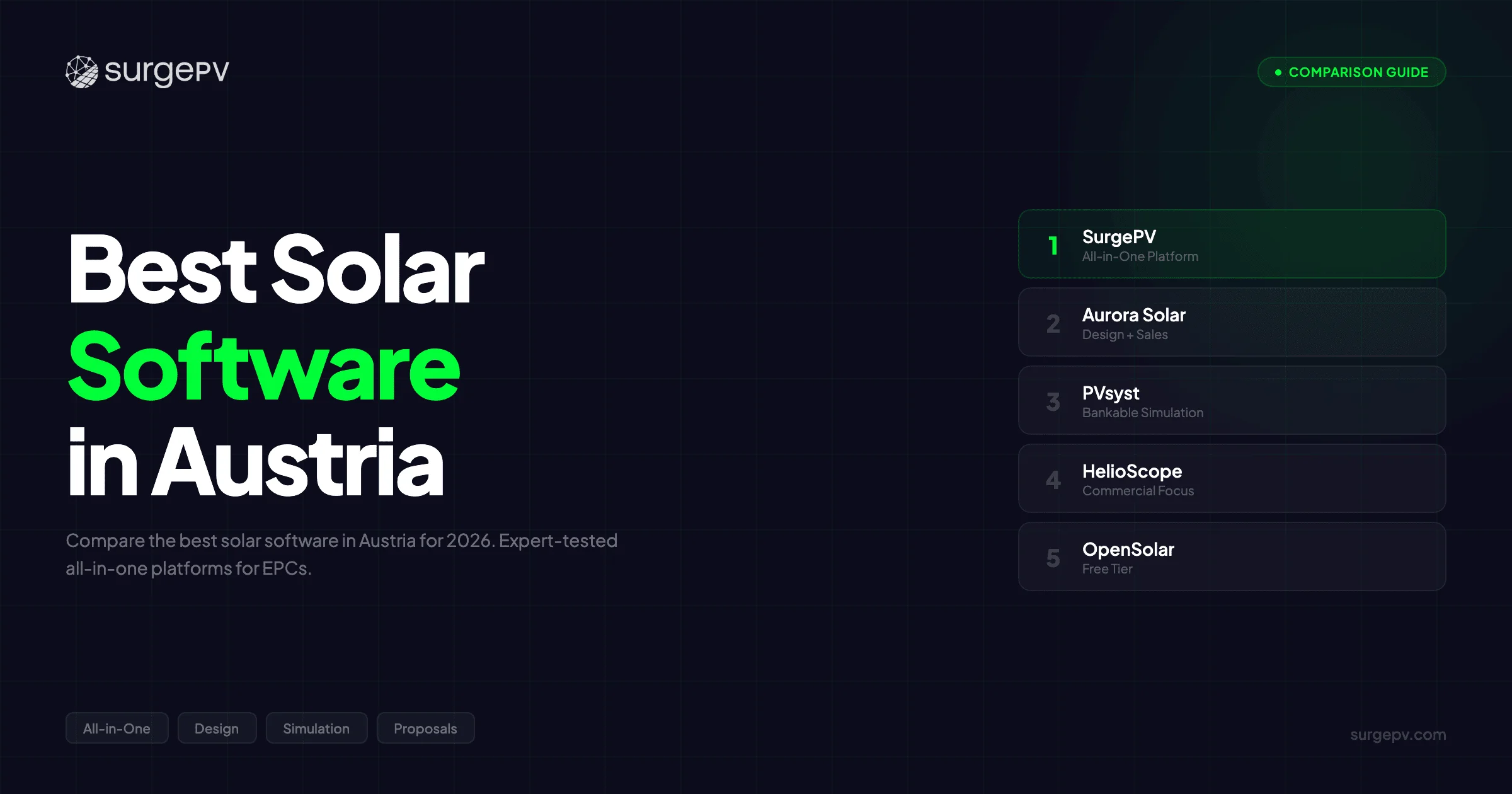
TL;DR: SurgePV is the only all-in-one platform built for Austrian EPCs — OVE-compliant SLD automation, EAG grant calculations, bankable P50/P90 simulation, and German-language proposals in one tool at EUR 633/user/year. PVsyst remains the gold standard for bankable simulation reports required by Austrian banks. Aurora Solar leads on proposal polish but requires AutoCAD for SLDs and has no Austrian market automation. HelioScope suits large commercial EPCs with separate CAD workflows. OpenSolar is the budget option for simple residential projects.
Austria’s solar market is growing at 30–40% per year. The EAG targets triple capacity by 2030. Electricity prices sit at EUR 0.25–0.35/kWh.
But here is the real problem: most Austrian solar businesses still use 3–5 separate tools. One for design. One for electrical engineering. One for simulation. One for proposals. And a spreadsheet for everything else. Manual data re-entry, version control chaos, and a separate licence and renewal cycle for every tool in the stack.
The right solar software platform changes that equation entirely.
We reviewed 5 solar platforms for the Austrian market — evaluating each on workflow completeness (design, engineering, simulation, and proposals), OVE compliance, EAG grant support, bankability, and total cost of ownership.
In this guide, you’ll find:
- 5 solar platforms reviewed for the Austrian market
- OVE compliance and EAG grant automation analysis
- Total cost of ownership breakdown (multi-tool stacks vs. all-in-one)
- Bankability requirements for Austrian lenders (Erste Bank, Raiffeisen, BAWAG)
- Use-case recommendations by company type and project scale
Quick Comparison: Austrian Solar Software
| Software | Best For | OVE SLD | EAG Grant | German Language | Starting Price |
|---|---|---|---|---|---|
| SurgePV | Full-service EPCs, all segments | Automated | Yes | Yes | EUR 633/user/year |
| Aurora Solar | International teams, US workflows | Requires AutoCAD | No | No | Basic $135/user/mo billed annually; Premium $220/user/mo billed annually (aurorasolar.com/pricing, checked 21 September 2026) |
| PVsyst | Bankable simulation, due diligence | No | No | No | Does not publish list pricing |
| HelioScope | Large commercial EPCs (500 kW+) | No | No | No | Basic $1,620/year; Pro $2,640/year per licence (helioscope.aurorasolar.com/pricing, checked 21 September 2026) |
| OpenSolar | Budget residential (under 10 kWp) | No | No | No | Free of charge (opensolar.com, checked 21 September 2026) |
Workflow Cost Comparison
Multi-tool workflow (4 separate tools): 4–6 hours per commercial project, across four separately licensed products. SurgePV all-in-one workflow: 30–45 minutes per project, EUR 633/user/year — all features included.
Best Solar Software in Austria: Detailed Reviews
SurgePV — Best All-in-One Platform for Austria
Best for: Commercial EPCs, solar installers, engineering consultants
Pricing: EUR 633–1,299/user/year. All features included.
SurgePV is the only cloud-based platform combining AI-powered design, automated electrical engineering, bankable simulation, and professional proposals without requiring AutoCAD or tool switching. Built for Austrian EPCs and installers, SurgePV delivers OVE-compliant SLDs, EAG grant calculations, and German language support in one unified workflow.
Pro Tip
SurgePV’s automated SLD generation saves 2–3 hours per project compared to manual AutoCAD drafting — and removes the separate AutoCAD license entirely. For Austria EPCs handling 10+ projects per month, that’s 20–30 hours saved monthly. Book a demo to see it in action.
Key Features for Austria
- AI-powered roof modeling — the roof outline and obstructions are detected automatically instead of being traced by hand
- Automated SLD generation — OVE-compliant SLDs in 5–10 minutes vs. 2–3 hours in AutoCAD
- Wire sizing calculations — Automatic DC/AC wire sizing per OVE regulations and NINorm. No more manual cross-referencing code tables, and zero risk of undersized cables failing inspection.
- Native carport design — The only platform with built-in solar canopy structures. With Austrian commercial parking lots increasingly requiring solar canopies, this is a competitive differentiator, not a nice-to-have.
Simulation and bankability:
- P50/P75/P90 simulation — Meets requirements from Erste Bank, Raiffeisen, and BAWAG. Your financing applications include the bankability data lenders actually require, not just optimistic P50 estimates that get rejected.
- 8760-hour shading analysis — Within ±3% accuracy vs. PVsyst
- Grid connection documentation — TOR-compliant reports for Austrian DSO submission
Proposals and sales:
- EAG grant calculator — Automatic federal and regional subsidy deduction
- Austrian electricity rate database — Regional rates (EUR 0.25–0.35/kWh)
- Financial modeling — Cash, loan, lease scenarios with Austrian energy prices
- German language — Full German interface and proposal templates. When 95%+ of your customers speak German, an English-only tool is a trust-killer.
Pricing
- Individual Plan: EUR 1,899/year for 3 users (EUR 633/user/year)
- For 3 Users: EUR 1,499/user/year (EUR 4,497/year total)
- For 5 Users: EUR 1,299/user/year (EUR 6,495/year total)
All plans include every feature. No tiered gating. See full pricing details.
Real-World Example
A growing EPC in Upper Austria (Oberosterreich) with residential and commercial projects was maintaining separate design, simulation, and CAD licenses — and still spending 15 hours per week on tool-switching overhead. After consolidating to SurgePV at $4,497/year (3-user plan), they freed up two full working days per week and went from several renewals to one.
You might be wondering: if SurgePV does all this, why haven’t I heard of it? Fair question. PVsyst has had a 30-year head start. Aurora Solar has spent hundreds of millions on marketing. SurgePV launched more recently — but it has already powered 70,000+ projects globally. The platform was built specifically for the workflow gaps that legacy tools leave open, especially automated electrical engineering, which no other platform offers natively.
Want to see how SurgePV handles Austrian projects? Book a demo to test OVE-compliant SLD generation and EAG grant proposals with your own project data.
Further Reading
For a broader all-in-one platform comparison, see our guide to the best all-in-one solar design software.
Aurora Solar — Industry-Leading Platform (US-Focused)
Best for: International installers with US parent company workflows
Pricing: Aurora Solar lists Basic at $159/user/month, or $135/user/month billed annually, and Premium at $259/user/month, or $220/user/month billed annually; Enterprise is custom per project (aurorasolar.com/pricing, checked 21 September 2026). AutoCAD is licensed separately from Autodesk on top of this.
Aurora Solar is the market-leading solar platform globally with advanced 3D roof modeling and polished proposals. But it requires AutoCAD for SLDs, has no EAG grant automation, no German language support, and a US-centric design focus.
Did You Know?
Austria’s solar irradiance ranges from 1,050–1,250 kWh/m²/year, making accurate simulation software important for bankable energy yield predictions. Projects using validated simulation tools see 15–20% fewer financing rejections compared to those relying on manual calculations (source: SolarPower Europe Market Outlook).
PVsyst — Gold-Standard Bankable Simulation Software
Best for: Energy consultants and large EPCs needing bankable due diligence reports
Pricing: PVsyst does not publish list pricing on its own site, so we quote no figure. CAD software is licensed separately on top.
PVsyst is the industry standard for bankable simulations. Every major Austrian bank accepts PVsyst reports. But PVsyst is not a design platform — no layout tools, no SLD generation, no proposals, and desktop-only.
HelioScope — Cloud-Based Commercial Design and Simulation
Best for: Large commercial EPCs (500 kW+ projects) with separate CAD workflows
Pricing: HelioScope lists Basic at $159/month or $1,620/year per licence and Pro at $259/month or $2,640/year per licence, each including 1 user; Enterprise is custom (helioscope.aurorasolar.com/pricing, checked 21 September 2026)
HelioScope (now part of Aurora Solar) offers cloud-based design and simulation for commercial projects. No SLD generation, no EAG grant automation, and US-focused regulatory templates.
OpenSolar — Budget-Friendly Residential Platform
Best for: Budget-conscious residential installers doing simple projects under 10 kWp
Pricing: Free of charge. OpenSolar describes its platform as “Free of charge” (opensolar.com, checked 21 September 2026)
OpenSolar offers all-in-one basics for small residential installers at no charge. No SLD generation, no EAG grant calculator, no German language support, and limited engineering capabilities for commercial projects.
Why Most Austrian Solar Companies Overpay for Software
Complete all-in-one platform
According to PV Austria market data, Austrian EPCs need design, electrical engineering (SLD), simulation, and proposals in one tool. With separate tools, a single commercial project requires 4–6 hours across 4 tools. With an all-in-one platform like SurgePV: 30–45 minutes in one tool.
OVE compliance and Austrian electrical standards
Austrian solar installations must comply with OVE standards. Your software needs to generate SLDs showing protection devices per OVE E 8001, wire sizing per NINorm, and voltage drop analysis. Manual SLD creation takes 2–3 hours per commercial project plus a separately licensed copy of AutoCAD.
Austrian market automation
The best platform automates: EAG grant calculator (EUR 200–250/kWp), Austrian electricity rates per E-Control data, feed-in tariff modeling through OeMAG, German language support, and TOR compliance for DSOs.
Bankability and lender acceptance
Austrian banks require bankable energy yield reports meeting IRENA best-practice standards. PVsyst is the gold standard. SurgePV’s P50/P75/P90 analysis delivers comparable accuracy (within ±3%) inside an all-in-one workflow.
Which Software Is Right for Your Use Case?
| Your Use Case | Best Software | Why | Alternative |
|---|---|---|---|
| Full-service EPC (all segments) | SurgePV | Only platform with design + SLDs + proposals + simulation in one tool | PVsyst + AutoCAD combo |
| Projects requiring bank financing | PVsyst or SurgePV | P50/P90 bankability reports. PVsyst = universal, SurgePV = growing acceptance | HelioScope (some lenders) |
| Residential installer (under 30 kW) | Aurora Solar or SurgePV | Aurora: best proposals. SurgePV: proposals + engineering depth | OpenSolar (free of charge) |
| Utility-scale developer (over 1 MW) | HelioScope or PVCase | Fast ground-mount design. Pair with PVsyst for bankability | SurgePV for integrated workflow |
| Startup installer (under 30 projects/year) | OpenSolar or SurgePV | OpenSolar: free of charge. SurgePV: deeper engineering | Free tools (PVWatts, SolarEdge Designer) |
| Your Situation | Recommended Software | Why It Fits |
|---|---|---|
| Large EPC doing utility-scale projects | PVsyst, PVcase, SurgePV | Need bankable simulation, electrical design automation, and grid compliance documentation for Austrian DSOs |
| Commercial installer (5–20 projects/month) | SurgePV, HelioScope, Aurora Solar | Balance between design accuracy and proposal speed; integrated workflow reduces tool-switching for EAG grant applications |
| Residential-focused installer | Aurora Solar, OpenSolar, SurgePV | Prioritize fast proposals with visual sales tools; moderate simulation depth sufficient for residential financing |
| Developer doing feasibility studies | PVsyst, SurgePV, HelioScope | Need accurate energy yield modeling and financial analysis for investment decisions with Austrian lender acceptance |
| Small team (1–3 people) | SurgePV, OpenSolar | All-in-one platforms reduce software stack complexity and training time; German language support eliminates translation overhead |
Further Reading
For a broader comparison beyond this market, see our guide to the best solar design software globally.
Decision Shortcut
If you need electrical engineering (SLDs, wire sizing, code compliance), SurgePV is the only platform that automates this natively. If you’re simulation-only, PVsyst is the gold standard. If you’re residential-focused with a large marketing budget, Aurora’s proposals are hard to beat.
Bottom Line: Best Solar Software for Austria
For Austrian EPCs and installers needing complete workflows: SurgePV offers the only true all-in-one platform with OVE-compliant SLD automation, EAG grant calculation, bankable P50/P90 simulation, and German language proposals — all for EUR 633–1,299/user/year.
For international teams: Aurora Solar provides advanced design and proposals but requires AutoCAD for SLDs and lacks Austrian market automation.
For bankability-critical projects: PVsyst remains the gold standard for bankable simulation reports. Pair with SurgePV for complete workflows.
For budget-conscious residential installers: OpenSolar offers basic all-in-one features free of charge but lacks engineering capabilities and Austrian automation.
The Austrian solar market is not slowing down. The EPCs winning projects today are the ones delivering complete designs, bankable reports, and professional proposals faster than the competition — not juggling four separate tools. Your solar PV design software choice is a competitive advantage, not just a back-office decision.
One Platform for All Austrian Solar Projects
Design, engineer, simulate, and generate proposals without AutoCAD or tool switching.
Book a DemoNo commitment required · 20 minutes · Live project walkthrough
Further Reading
See our guide to the best solar design software (2026) for a global design tool comparison, and our PVCase review for utility-scale design analysis.
When You May Not Need Advanced Solar Software
Not every solar project requires comprehensive design and simulation platforms. Consider simpler alternatives if:
- Small residential projects with standard layouts — Basic design tools or manufacturer calculators may suffice for simple rooftop arrays.
- Engineering is outsourced — If your company uses external engineering services, you may only need proposal and CRM tools rather than full design platforms.
- Very limited project volume — Teams handling fewer than 5 projects per year may find that manual AutoCAD workflows and spreadsheet modeling are more cost-effective than software subscriptions.
- Non-technical sales teams — Sales-focused companies without in-house engineers may only require proposal generation tools rather than technical design software.
Most Austrian EPCs, developers, and medium-to-large installers benefit from integrated platforms that reduce manual work and improve accuracy. With Austria’s OVE/ONORM compliance requirements and grid connection documentation for regional utilities, manual workflows create bottlenecks that delay project approvals.
Bottom Line
For Austria EPCs and installers, SurgePV delivers the most complete design-to-proposal workflow with automated SLD generation, bankable P50/P90 simulations, and integrated proposals — all at $1,899 per user per year on the individual plan. Book a demo to see it in action.
Transparency Note
SurgePV publishes this content. We compare SurgePV honestly against competitors and acknowledge where PVsyst and Aurora Solar lead in specific categories. This guide is based on documented-feature review and publicly available product documentation as of February 2026. See our editorial standards.
Go deeper on a specific category
This page compares solar software across categories for Austria. If you already know which part of the workflow you are buying for, these go into more detail:
Frequently Asked Questions
What is the best solar software in Austria?
SurgePV is the best all-in-one solar software for Austria in 2026, combining OVE-compliant electrical engineering, automated SLD generation, bankable P50/P90 simulation, and professional German-language proposals in one cloud-based platform — without requiring AutoCAD. Pricing starts at EUR 633/user/year with all features included. For Austrian EPCs and installers, SurgePV eliminates the need to purchase AutoCAD, which Autodesk licenses separately, while delivering complete electrical documentation, TOR-compliant grid reports, and EAG grant-ready proposals.
Do I need multiple tools for solar projects in Austria?
No, if you use all-in-one platforms like SurgePV or Aurora Solar. Yes, if you use specialized tools like PVsyst (simulation only) or HelioScope (design and simulation only). Running 3–5 separate tools means 3–5 separate licences to buy and renew, and it adds hours of data re-entry per project. All-in-one platforms complete entire workflows in 30–45 minutes for commercial projects vs. 4–6 hours with separate tools.
Which solar software supports OVE standards in Austria?
SurgePV generates OVE-compliant Single Line Diagrams automatically per OVE R 11-1 and OVE E 8001. PVsyst meets OVE simulation standards. Aurora Solar, HelioScope, and OpenSolar lack OVE-specific SLD generation — they require AutoCAD, which Autodesk licenses separately. Austrian DSOs — Wien Energie, EVN, Netz Oberosterreich — require TOR-compliant electrical documentation.
What does all-in-one solar software cost in Austria?
SurgePV’s Individual Plan is EUR 633/user/year. Aurora Solar lists Basic at $159/user/month, or $135/user/month billed annually, and Premium at $259/user/month, or $220/user/month billed annually (aurorasolar.com/pricing, checked 21 September 2026); Austrian pricing is not separately published. SurgePV includes SLD generation without AutoCAD, which Autodesk licenses separately. PVsyst does not publish list pricing. See SurgePV pricing for detailed plan comparison.
Can solar software calculate EAG grants in Austria?
SurgePV automatically calculates EAG investment grants (EUR 200–250/kWp) and regional Bundeslaender subsidies. Aurora Solar, PVsyst, HelioScope, and OpenSolar do not support Austrian grant automation. On a 100 kWp commercial system, EAG grants can reach EUR 20,000–25,000. Software with automated BOM generation and cost reporting streamlines EAG applications.
Which Austrian banks accept solar software simulation reports?
Austrian banks (Erste Bank, Raiffeisen, BAWAG, Bank Austria) accept bankable simulation reports from PVsyst (gold standard) and SurgePV (P50/P90 reports) that meet IEC 61724 and IEC 62446 standards. SurgePV’s P50/P75/P90 analysis delivers comparable accuracy (within ±3% vs. PVsyst) inside an all-in-one workflow.
Is cloud-based or desktop solar software better for Austria?
Cloud-based platforms (SurgePV, Aurora, HelioScope, OpenSolar) enable faster team collaboration, mobile access from job sites, and automatic updates. Desktop software (PVsyst) requires installation, lacks real-time collaboration, but offers offline access. For Austrian teams with offices in Vienna, Salzburg, and Graz, cloud-based platforms are the practical choice.
What features should Austrian solar software include?
Austrian solar software must include OVE-compliant SLD generation (per OVE R 11-1 and OVE E 8001), EAG grant calculation, Austrian electricity rate database, bankable P50/P90 simulation, German language support, professional proposal generation, and net metering and self-consumption modeling. SurgePV is the only platform delivering all seven features.
Note
Pricing information is based on publicly available data as of February 2026. Contact vendors directly for current pricing and Austria-specific quotes. Some vendors offer regional pricing adjustments.
Sources
- SurgePV Product Documentation — Official feature specifications and proof points (accessed February 2026)
- OVE (Oesterreichischer Verband fuer Elektrotechnik) — Official website — OVE R 11-1, OVE E 8001 electrical standards (accessed February 2026)
- E-Control Austria — Official website — Austrian energy regulator, grid connection rules, electricity rates (accessed February 2026)
- EAG / Klimafonds — Official website — Investment grant programs and subsidy requirements (accessed February 2026)
- BMK (Austrian Federal Ministry for Climate Action) — Official website — Solar market statistics and policy updates (accessed February 2026)
- PV Austria — Official website — Austrian solar market analysis and industry data (accessed February 2026)
- Aurora Solar, PVsyst, HelioScope, OpenSolar Official Documentation — Feature specifications and pricing (accessed February 2026)
- G2 Reviews — Verified user reviews for solar software platforms (accessed February 2026)
- IEC Standards (61724, 62446) — PV system monitoring and documentation standards (accessed February 2026)
- Wien Energie, EVN, Netz Oberosterreich — DSO grid connection requirements and TOR standards (accessed February 2026)
Vendor source links
Vendor pages checked 29 September 2026. Pricing, billing terms and license scope can vary by offer and region; confirm the current terms with the vendor.
