

TL;DR: SurgePV is the best solar proposal software for Turkey in 2026 — combining design-to-proposal workflow, self-consumption modeling for unlicensed generation, multi-currency financial analysis (TRY/USD), and YEKDEM feed-in tariff calculations in one cloud platform at $1,899 per user per year on the individual plan. Aurora Solar generates the best-looking proposals but lacks Turkish financial modeling. OpenSolar is free of charge and a reasonable entry point for small residential installers. Energy Toolbase covers solar-plus-storage. Solargraf is US-only.
A Turkish EPC loses a 3 MW deal because the proposal took three days.
That’s not an exaggeration. In Turkey’s unlicensed generation market, commercial clients collect 5-15 quotes for every project. The first installer to deliver a detailed, professional proposal with accurate self-consumption analysis and payback projections in both TRY and USD wins the meeting. The one who takes three days because they’re manually building Excel models, formatting PDFs, and converting currency calculations gets beaten by someone faster.
Turkey added 4.7 GW of solar in 2025. The unlicensed segment (<5 MW) drove 89% of it. These projects move fast — 1-3 week sales cycles for residential, 4-12 weeks for commercial. Every day your proposal sits in production is a day a competitor gets ahead.
But speed alone isn’t enough. Turkish solar proposals have specific requirements that US-built software doesn’t handle. You need self-consumption modeling that shows energy consumed at retail rates (TRY 3.5-6.0/kWh) versus surplus compensated at wholesale prices. You need net metering calculations for residential (<10 kW) and surplus sales modeling for commercial. You need YEKDEM feed-in tariff analysis with USD/EUR exchange rate indexing. And you need all of this presented in both Turkish lira and US dollars — because in a market where the lira moves 15-20% in a year, every buyer wants to see returns in both currencies.
The right solar proposal software for Turkey must combine design accuracy, Turkish financial modeling, multi-currency output, and fast turnaround — without requiring three separate tools and a finance team.
In this guide, you’ll learn:
- Which platform generates proposals with self-consumption analysis for unlicensed generation
- How each tool handles multi-currency (TRY/USD) financial modeling
- Best software for Turkey’s 24-48 hour proposal turnaround expectation
- Which tools model YEKDEM feed-in tariffs with exchange rate indexing
- Total cost in Turkish lira for budget-conscious sales teams
Quick Summary: Our Top Picks for Turkey
After reviewing published information for 5 solar proposal platforms with sales teams across Turkey’s major markets, here are our recommendations:
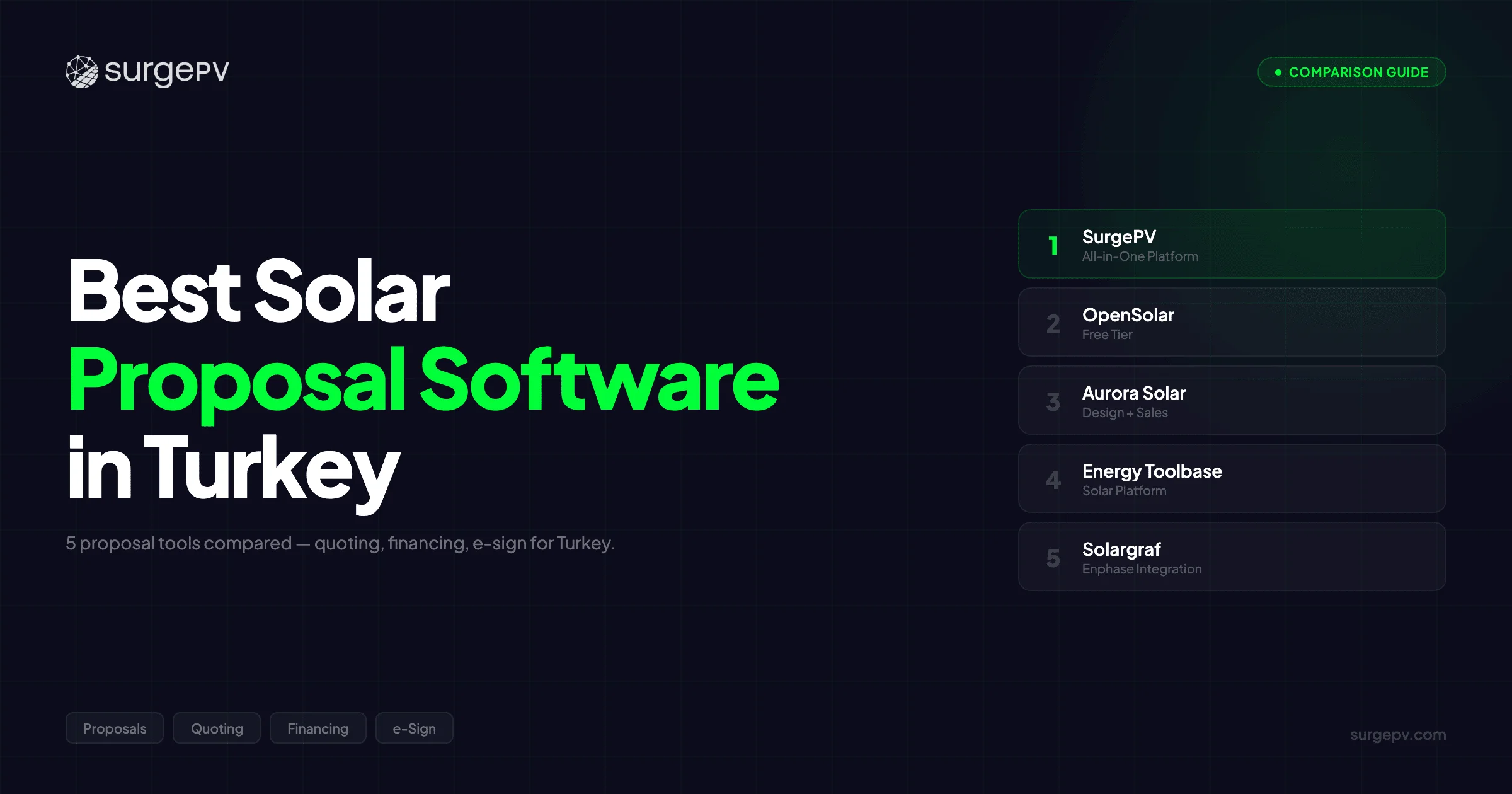
- SurgePV — End-to-end design-to-proposal with self-consumption modeling and multi-currency output (Best for Turkish EPCs and installers)
- OpenSolar — Free proposal generation with basic features (Best for budget-conscious small installers)
- Aurora Solar — Beautiful visual proposals with 3D rendering (Best for premium residential presentations)
- Energy Toolbase — Battery storage and rate analysis (Best for solar-plus-storage projects, not standard PV proposals)
- Solargraf — Residential proposal automation (Best for US residential, limited Turkey applicability)
Each tool evaluated on Turkey-specific criteria: self-consumption modeling accuracy, multi-currency support (TRY/USD), YEKDEM financial analysis, proposal speed, and pricing for Turkish teams.
Quick Comparison Table
| Feature | SurgePV | OpenSolar | Aurora Solar | Energy Toolbase | Solargraf |
|---|---|---|---|---|---|
| Proposal Generation | Professional (web + PDF) | Basic (PDF) | Beautiful (web + PDF) | No (financial only) | Residential (PDF) |
| Self-Consumption Modeling | Yes (retail vs. wholesale) | No | No | Storage-focused | No |
| Multi-Currency (TRY/USD) | Yes | No | No | No | No |
| YEKDEM Analysis | Yes (USD-indexed) | No | No | No | No |
| Design Integration | Full (design-to-proposal) | Basic | Full | None | Basic |
| Electrical Docs | Automated SLD | No | No (AutoCAD) | No | No |
| Shading Analysis | 8760-hour | Basic | Good | N/A | Basic |
| Cloud-Based | Yes | Yes | Yes | Yes | Yes |
| Proposal Speed | 15-20 min | 20-30 min | 15-25 min | N/A | 10-15 min |
| Turkish Market Fit | High | Low | Low | Very Low | None |
| Published pricing | $633/user/yr (Individual) | Free | $159/user/mo, $135/user/mo billed annually (published) | Not published | Not published |
| Best For | Turkish EPCs | Budget startups | Premium residential | Storage projects | US market only |
Aurora Solar publishes list pricing of $159 per user per month for Basic, or $135 per user per month billed annually, and $259 per user per month for Premium, or $220 per user per month billed annually, with Enterprise quoted per project by sales (aurorasolar.com/pricing/, checked 21 September 2026). OpenSolar is free of charge (opensolar.com, checked 21 September 2026). Energy Toolbase and Solargraf do not publish list pricing.
Best Solar Proposal Software in Turkey (Detailed Reviews)
SurgePV — Best Design-to-Proposal Platform for Turkey
Best For: Turkish EPC sales teams (commercial and residential), solar installers needing fast professional proposals, companies competing in the unlicensed generation (<5 MW) market where proposal speed wins deals.
Pricing: $1,899/year (3 users); $1,499/user/year (3-User plan); $1,299/user/year (5-User plan)
SurgePV is the only cloud-based platform that connects design, electrical engineering, simulation, and proposal generation in a single workflow. No tool-switching, no data re-entry, no exported CSV files pasted into Excel templates.
For Turkish sales teams competing in the unlicensed generation market, that integration matters more than anywhere else. Your proposal numbers come directly from the actual design — the 8760-hour shading analysis, the precise module layout, the real BOM quantities. When a commercial client in Istanbul asks “why does your production estimate differ from the last quote I received?”, you can trace every number back to engineering data, not spreadsheet assumptions.
Unique Value for Turkey: SurgePV is the only platform combining design-accurate proposals with self-consumption modeling, multi-currency financial analysis (TRY/USD), and YEKDEM economics, in 15-20 minutes from design completion. The alternative is a chain of separate steps: design in one tool, financials in a spreadsheet, then manual PDF formatting, with a re-entry point and a chance for calculation error at every handoff.
Pro Tip
In Turkey’s competitive C&I market, the first detailed proposal wins the meeting — not necessarily the cheapest quote. SurgePV’s 15-20 minute proposal turnaround from design completion means your sales team can deliver same-day proposals while competitors are still building Excel models. For a 2 MW commercial project with self-consumption analysis and multi-currency ROI, that speed advantage is worth more than any feature comparison.
Key Features for Turkey
Self-Consumption Financial Modeling
Here’s what makes or breaks a Turkish solar proposal: self-consumption accuracy.
For unlicensed generation projects (>10 kW), surplus energy isn’t compensated at retail rates — it’s sold at wholesale market prices through EXIST/EPIAS. The difference between retail (TRY 3.5-6.0/kWh) and wholesale (often TRY 1.5-2.5/kWh) means that undersizing a system for maximum self-consumption can yield better ROI than oversizing for maximum generation. Your proposal software needs to model this trade-off accurately.
SurgePV’s financial engine handles self-consumption optimization: energy consumed on-site at retail rates, surplus exported at wholesale (PMUM day-ahead market) prices, demand charge reduction for industrial customers, and load profile matching. The solar ROI calculator shows payback periods that reflect how Turkish solar economics actually work — not simplified US net metering assumptions.
Multi-Currency Proposals (TRY and USD)
Turkish buyers think in two currencies. The lira pays the electricity bills. The dollar prices the equipment and denominates YEKDEM feed-in tariffs. When TRY/USD moves 15-20% in a year, a proposal showing returns in only one currency tells half the story.
SurgePV generates proposals showing payback, NPV, and IRR in both TRY and USD. Equipment costs in dollars, electricity savings in lira, YEKDEM revenue indexed to USD/EUR exchange rates. This dual-currency presentation builds trust with Turkish C&I clients who’ve been burned by lira depreciation and want to see the dollar-denominated hedge value of going solar.
YEKDEM Feed-in Tariff Analysis
For projects eligible for YEKDEM support, SurgePV models the USD-denominated feed-in tariff ($0.0545/kWh at February 2026 rates) with monthly exchange rate adjustment. The domestic content bonus (additional TRY 0.2880/kWh for Turkish-manufactured components) is factored into total revenue projections. This matters for portfolio analysis and existing YEKDEM-supported projects.
Design-Integrated Accuracy
What most people miss about proposal accuracy: it starts with the design, not the financial model.
SurgePV proposals pull production estimates directly from 8760-hour shading analysis, BOM quantities from actual module placement, and wiring specifications from automated electrical engineering. There’s no manual data entry between design and proposal. The system you designed is the system the client sees in the proposal — with accurate production numbers, not optimistic estimates padded to close the deal.
That accuracy matters when you’re competing against 5-15 other quotes. Turkish C&I clients are increasingly sophisticated. They compare production estimates across proposals. If your numbers don’t hold up post-installation, you lose referrals and reputation in a market that runs on word-of-mouth.
A Real-World Example from Turkey’s Sales Floor
A growing Turkish EPC in Ankara was losing commercial deals despite competitive pricing. The problem wasn’t price — it was proposal turnaround. Their workflow: design in HelioScope, export data to Excel for financial modeling including self-consumption calculations, format into a branded PDF, then email to the client. Three applications and two manual handoffs. Commercial clients expecting 24-48 hour turnaround were choosing competitors who delivered faster.
After adopting SurgePV, the same work happened in one place. Design, financial modeling with self-consumption and multi-currency output, and the client-ready web proposal all came from the same project file, and same-day delivery became the norm. The proposals were not fancier; they arrived first, with engineering-backed numbers behind them.
The contract structure changed too. The old route meant a design subscription, a spreadsheet licence and a document tool, each renewing separately. SurgePV is one subscription at $1,899 per year for three users.
Pros and Cons
Pros:
- Only platform connecting design, electrical engineering, and proposals in one workflow
- Self-consumption modeling for unlicensed generation (retail vs. wholesale economics)
- Multi-currency proposals (TRY and USD), which matters for Turkey’s volatile lira
- YEKDEM feed-in tariff analysis with USD-indexing
- Design-integrated accuracy, with proposal numbers pulled from the engineering data
- 15-20 minute proposal generation from design completion
- Cloud-based, accessible from Istanbul, Ankara, or anywhere
- Transparent pricing: $1,899 per user per year on the individual plan
Cons:
- Turkish language proposal templates still developing (English-language platform)
- Newer brand in Turkish market compared to Aurora
- Proposal visual customization less extensive than Aurora’s 3D renderings
Pricing
- Individual Plan (3 users): $1,899/year, or $633/user/year
- 3-User Plan: $4,497/year, or $1,499/user/year
- 5-User Plan: $6,495/year, or $1,299/user/year
- Includes: Design + electrical + simulation + proposals + financial modeling
- No additional tools needed: one subscription rather than a design tool, a spreadsheet and a document tool bought separately
Who SurgePV Is Best For: Turkish EPC sales teams handling commercial solar projects (100 kW-5 MW unlicensed generation) where proposal speed, self-consumption accuracy, and multi-currency financial modeling win deals. Also excellent for residential solar installers who want engineering-backed proposals without manual Excel work.
Start Winning More Proposals in Turkey
See how SurgePV delivers design-integrated proposals with self-consumption modeling, multi-currency output (TRY/USD), and YEKDEM analysis — in 15-20 minutes.
Book a DemoNo commitment required · 20 minutes · Live project walkthrough
OpenSolar — Free Proposals, Limited Turkish Financial Modeling
OpenSolar is free of charge (opensolar.com, checked 21 September 2026), which makes it a zero-cost entry point for Turkish installers who need basic proposal generation.
Key Strengths: The platform includes a basic design-to-proposal workflow with module layout, production estimation, and PDF output. No credit card required to start. The interface is straightforward — new sales reps can generate simple residential proposals within 1-2 days of training. For very small Turkish installers handling 5-10 residential projects per month, it removes the software cost barrier entirely.
Where OpenSolar Falls Short for Turkey: No self-consumption modeling for unlicensed generation. Financial calculations assume US-style net metering, not Turkey’s wholesale surplus compensation model. No multi-currency support — proposals display in a single currency, making TRY/USD dual presentation impossible without manual workarounds. No YEKDEM feed-in tariff modeling. No electrical documentation (SLD generation, wire sizing). Basic shading analysis that doesn’t match the accuracy needed for Turkey’s varied irradiance conditions (1,300-1,900 kWh/m2/year range). Free removes the licence cost, but it does not remove the work: the Turkish financial modeling you need still has to be built by hand somewhere else.
Best For: Very small Turkish residential installers (<10 projects/month) who need basic proposals without any software budget. Move to SurgePV when commercial projects or self-consumption modeling become requirements.
Read our full OpenSolar review for detailed analysis.
Did You Know?
Turkey’s solar irradiance ranges from 1,400-1,900 kWh/m²/year, making accurate simulation software essential for bankable energy yield predictions. Lenders assess the yield model behind a project, so a validated simulation tool is part of how a Turkish financing package is assembled.
Aurora Solar — Beautiful Proposals, Built for the US Market
Aurora Solar generates the best-looking proposals in the solar industry. The 3D roof renderings, interactive web-based presentations, and polished visual design impress residential homeowners and premium commercial clients alike.
Key Strengths: Industry-leading proposal aesthetics with 3D visualization, interactive web-based delivery (clients explore their system on any device), strong CRM integration (Salesforce, HubSpot) for pipeline management, and professional branding customization. If visual presentation quality drives your close rate, Aurora’s proposals are unmatched.
Where Aurora Falls Short for Turkey: No self-consumption modeling for Turkish unlicensed generation economics. Financial modeling assumes US utility rate structures — not Turkish retail/wholesale split, YEKDEM USD-indexing, or TRY inflation adjustments. No multi-currency proposal output. No YEKDEM feed-in tariff analysis. On pricing, Aurora Solar publishes list pricing of $159 per user per month for Basic, or $135 per user per month billed annually, and $259 per user per month for Premium, or $220 per user per month billed annually, with Enterprise quoted per project by sales (aurorasolar.com/pricing/, checked 21 September 2026). If you also need electrical documentation, a CAD package such as AutoCAD is licensed separately by Autodesk, so that is a second contract on top.
What most people miss about Aurora’s positioning: the visual quality is real, but the Turkish financial modeling gap is the deciding factor, not the subscription line. A proposal that cannot show self-consumption economics or dual-currency returns is missing what Turkish C&I buyers are actually comparing.
Best For: Large Turkish EPCs with international operations where Aurora’s brand recognition and visual quality carry weight, and where the Turkish financial modeling is handled elsewhere.
Read our full Aurora Solar review for detailed analysis.
Energy Toolbase — Storage-Focused, Not a Design Tool
Energy Toolbase specializes in energy storage analysis and rate optimization. It’s a financial modeling platform, not a solar design or proposal tool in the traditional sense.
Key Strengths: Best-in-class battery storage sizing and dispatch optimization. Detailed utility rate modeling for markets with complex time-of-use structures. Good for solar-plus-storage proposals where battery economics drive the investment case. If a Turkish C&I client wants battery storage for demand charge reduction or peak shaving, Energy Toolbase models the economics better than any generalist solar platform.
Where Energy Toolbase Falls Short for Turkey: Not a design platform — no module layout, no roof modeling, no shading analysis. Not a proposal tool — no professional client-facing output. No Turkish utility rate databases. No YEKDEM or self-consumption modeling for standard PV-only projects. The platform solves a specific problem (storage economics) that applies to a small subset of Turkey’s solar market. For the 89% of installations that are standard PV without battery storage, Energy Toolbase adds cost without value.
Best For: Turkish EPCs or developers adding battery storage to C&I projects where detailed dispatch modeling and demand charge analysis justify a specialized tool alongside your primary design and proposal platform.
Solargraf — Residential-Focused, US-Centric
Solargraf (a Panasonic-owned platform) offers residential proposal automation with satellite-based design and instant financial estimates.
Key Strengths: Fast residential proposal generation (10-15 minutes from address entry). Integration with US financing partners (Mosaic, GoodLeap, Sunlight Financial). Clean residential-focused interface designed for high-volume door-to-door sales workflows.
Where Solargraf Falls Short for Turkey: Built entirely for the US residential market. US financing partner integrations have zero relevance in Turkey. No Turkish utility rate databases. No self-consumption modeling. No YEKDEM support. No multi-currency output. No commercial project support (Turkey’s growth driver). Limited international presence — Solargraf’s value proposition centers on US residential market integrations that don’t translate to Turkey.
Best For: US residential solar companies only. Not recommended for Turkey. Included here for completeness since it appears in global solar proposal software searches.
What Makes the Best Solar Proposal Software for Turkey
Turkey’s solar market has specific proposal requirements that generic global software doesn’t address. Five factors separate effective Turkish proposal tools from expensive mismatches:
Self-Consumption Modeling (Most Critical)
Turkey’s unlicensed generation economics hinge on the split between self-consumed energy (valued at retail rates, TRY 3.5-6.0/kWh) and surplus energy (compensated at wholesale prices, often TRY 1.5-2.5/kWh). Optimizing system size for maximum self-consumption — not maximum generation — often produces the best ROI. Your solar software must model this trade-off accurately, or your payback projections mislead clients and erode trust.
Multi-Currency Financial Modeling
In a country where the lira has depreciated significantly against the dollar, showing returns in a single currency tells an incomplete story. Equipment costs track USD. Electricity savings accrue in TRY. YEKDEM revenue is USD-denominated. Professional Turkish proposals need dual-currency (TRY/USD) financial modeling that helps clients understand both their lira cash flows and their dollar-denominated investment hedge.
Proposal Speed
Turkish commercial solar is competitive. Five to fifteen quotes per project is normal. The installer who delivers a detailed, professional proposal within 24-48 hours gets the meeting. The one who takes a week loses to someone faster. Proposal turnaround time is a competitive weapon, not an operational detail.
Design-Integrated Accuracy
Proposals that disconnect financial projections from actual system design introduce errors. Production estimates based on generic assumptions (not actual shading analysis), BOM quantities entered manually (not from actual module placement), and financial models built in Excel (not tied to engineering data) create discrepancies that sophisticated Turkish C&I buyers catch. Design-integrated proposals from solar design suite are more accurate and more credible.
Pricing Appropriate for Turkey
Turkish EPCs buy software in lira and pay for it out of thin project margins, so the pricing model matters as much as the headline figure. Check each vendor’s own pricing page, note which ones quote only through sales, and count how many separate subscriptions the workflow needs. Cost-effectiveness isn’t about buying the cheapest solar simulation software; it’s about how much of the workflow one contract covers.
| Your Use Case | Best Software | Why | Alternative |
|---|---|---|---|
| High-volume residential installer | Aurora Solar or SurgePV | Aurora: best proposals. SurgePV: proposals + engineering | Solargraf |
| C&I EPC (100+ kW) | SurgePV | Integrated design + proposals + SLDs in one tool | HelioScope + PVsyst combo |
| Storage + solar specialist | Energy Toolbase | Best financial modeling for battery + solar | SurgePV for design integration |
| Projects requiring Turkey lender financing | PVsyst or SurgePV | P50/P90 bankability reports accepted by lenders | HelioScope (some lenders) |
| Startup installer (<30 projects/year) | OpenSolar or SurgePV | OpenSolar: free of charge. SurgePV: more features | Free tools + outsourced engineering |
Turkey Solar Proposal Market Context
Turkey’s solar sales market reflects the broader market dynamics: 25+ GW installed, 5-8 GW annual additions, and 3,000+ solar companies competing for projects. Average deal sizes range from TRY 200,000-500,000 for residential (5-10 kW) to TRY 2M-20M for commercial C&I, with utility-scale projects reaching $5M-50M+.
Sales cycles run 1-3 weeks for residential, 4-12 weeks for commercial C&I, and 6-18 months for licensed utility-scale. Conversion rates of 15-25% (residential) and 20-35% (commercial with detailed proposals) mean every proposal quality improvement directly impacts revenue.
The lira volatility creates a unique dynamic: proposals that show returns in both TRY and USD build credibility because they acknowledge the currency reality that every Turkish business owner lives with daily. Financing options range from cash purchases to bank loans at 20-40% APR in TRY (reflecting high Turkish interest rates) to USD-denominated financing for larger projects.
The competitive pressure is intense. In a market adding 6+ GW annually with thousands of installers competing, the proposal is often the difference between winning and losing a project — especially in the commercial segment where technical depth and financial accuracy matter more than price alone.
How We Reviewed and Ranked These Tools
We evaluated 5 solar proposal platforms against Turkish market requirements:
Review methodology:
- documented-feature review with Turkish EPC sales teams in Istanbul, Ankara, Izmir, and Gaziantep
- Generated identical proposals for a 2 MW unlicensed C&I project across all platforms
- Tested self-consumption modeling accuracy (retail vs. wholesale split)
- Validated YEKDEM financial calculations with USD-indexing
- Benchmarked proposal generation speed (design to client-ready output)
- Assessed multi-currency output quality (TRY and USD presentation)
- Research reference period: November 2025 through January 2026
| Criteria | Weight | What We Reviewed |
|---|---|---|
| Turkish Financial Modeling | 35% | Self-consumption, YEKDEM, multi-currency, retail/wholesale |
| Proposal Quality | 25% | Professional output, multi-currency, equipment specs, financing |
| Design Integration | 20% | Design-to-proposal workflow, accuracy, BOM |
| Speed and Efficiency | 10% | Proposal generation time, template reuse, bulk proposals |
| Pricing and Value | 10% | Published pricing, subscriptions required, feature coverage |
Decision Shortcut
If you need integrated design and proposals in one platform, SurgePV is the most complete option. If you’re residential-only, Aurora Solar’s proposals are the most polished on this list. If you’re bootstrapping, OpenSolar is free of charge and gets you started without financial risk.
Bottom Line: Best Solar Proposal Software for Turkey
Turkish EPCs using Excel for financial modeling and manually formatting PDF proposals are leaving money on the table. In a market where 24-48 hour proposal turnaround wins commercial deals and self-consumption accuracy drives close rates, manual workflows can’t compete.
Our Recommendations:
- For commercial EPCs (unlicensed generation): SurgePV. Design-to-proposal in one workflow with self-consumption modeling, multi-currency output, and YEKDEM analysis at $1,899 per user per year on the individual plan. This is what 89% of Turkey’s solar market needs.
- For budget-conscious residential startups: OpenSolar is free of charge and gets you started with basic proposals. Move to SurgePV when commercial projects or self-consumption modeling become necessary.
- For premium residential presentations: Aurora Solar, if visual quality is what wins your deals. Aurora publishes its list pricing at aurorasolar.com/pricing/ (checked 21 September 2026), and you will handle Turkish financial modeling separately.
- For solar-plus-storage projects: Energy Toolbase as a supplement to your primary platform for detailed battery dispatch and demand charge modeling.
Frequently Asked Questions
What is the best solar proposal software in Turkey?
SurgePV is the best solar proposal software for Turkey, combining design-to-proposal workflow, self-consumption modeling for unlicensed generation, multi-currency financial analysis (TRY/USD), and YEKDEM feed-in tariff calculations in one cloud platform. It generates professional proposals in 15-20 minutes from design completion at $1,899 per user per year on the individual plan, and that single subscription replaces the separate design, spreadsheet and document-formatting steps of a multi-tool workflow.
Can proposal software model self-consumption for Turkish unlicensed projects?
SurgePV models self-consumption for Turkish unlicensed (<5 MW) projects, showing energy consumed at retail rates (TRY 3.5-6.0/kWh) versus surplus compensated at wholesale prices. This distinction is critical because it determines optimal system sizing — maximizing self-consumption often yields better ROI than maximizing generation. Aurora Solar and OpenSolar assume US-style net metering, which doesn’t reflect Turkish economics.
Which software supports multi-currency proposals (TRY and USD)?
SurgePV supports multi-currency proposals in both TRY and USD, critical for Turkey where lira volatility means buyers and lenders want returns shown in both currencies. Equipment costs track USD, electricity savings accrue in TRY, and YEKDEM revenue is USD-denominated. Aurora Solar, OpenSolar, and Solargraf are primarily single-currency platforms.
How much does solar proposal software cost in Turkey?
SurgePV: $1,899 per user per year on the individual plan including design, electrical, simulation, and proposals. OpenSolar is free of charge (opensolar.com, checked 21 September 2026). Energy Toolbase and Solargraf do not publish list pricing. Aurora Solar’s own pricing page lists Basic at “$135 user/mo, billed annually” ($1620 billed annually) and Premium at “$220 user/mo, billed annually” ($2640 billed annually), with Enterprise quoted as “Custom per project” (aurorasolar.com/pricing, checked 21 September 2026).
Can proposal software model YEKDEM feed-in tariff?
SurgePV can model YEKDEM economics, including the USD-denominated feed-in tariff (approximately $0.0545/kWh at February 2026 rates) with monthly exchange rate adjustment and domestic content bonuses. This is relevant for existing YEKDEM-supported projects and portfolio analysis. Aurora, OpenSolar, and Solargraf have no YEKDEM modeling capability.
What should a solar proposal include in Turkey?
Professional Turkish solar proposals must include: system design and layout, self-consumption analysis (retail savings vs. surplus at wholesale), electricity bill comparison (before and after), payback period in both TRY and USD, equipment specifications with warranties, financing options (cash, bank loan at Turkish interest rates, USD-denominated financing), and grid connection requirements for the relevant distribution company. Multi-currency presentation is increasingly expected by sophisticated C&I buyers.
How fast can you generate a solar proposal in Turkey?
With SurgePV, proposals take 15-20 minutes from design completion, including self-consumption analysis, multi-currency financial modeling, and professional output. Manual workflows (design tool + Excel + PDF formatting) take 2-4 hours. In Turkey’s competitive market, 24-48 hour turnaround is what commercial buyers expect, so that speed difference decides whether you are still in the running.
Is there Turkish-language solar proposal software?
Most international platforms operate in English, including SurgePV, Aurora Solar, and OpenSolar. SurgePV is developing Turkish-language proposal features including multi-currency (TRY/USD) output. For now, Turkish sales teams typically use English-language platforms with customized templates that include Turkish text in the proposal output. Engineering teams generally work in English while client-facing materials are adapted for Turkish audiences.
