


Romanian installers and EPC teams quoting prosumer systems can use this comparison of four proposal tools. Short answer: residential design and sales with financing integrations suits Aurora Solar, and a free core app with proposals, checkout and e-signature suits OpenSolar.
ANRE and Rețele Electrice describe how a Romanian prosumer is billed and connected, and no vendor page states a Romanian tariff or subsidy rule. The vendors differ elsewhere. OpenSolar’s core app is free. Aurora Solar lists design, financing integrations and proposal tracking. SurgePV lists roof modeling, bill of materials and proposals in one product, priced per user in US dollars. Put a real Romanian project through each one.
This is a desk comparison built from vendor pages read in November 2026, with no side-by-side runs. SurgePV publishes this page and is one of the 4 tools on it. Tool facts come from each vendor’s own site, and listed prices may change. Manual spreadsheets are excluded because they have no vendor page.
Methodology: alphabetical order, no ranking. The criteria are the design link, the listed price and the scope each vendor claims. See How We Ordered These Tools.
Want to see SurgePV quote a Romania project?
Book a guided demo and bring a real Romania site. We walk through design, yield, finance and the proposal in one platform.
Book a Free DemoChecking cost first? See the SurgePV pricing page.
Best-For Picks for Romania
- Residential quote with financing integrations, for a customer paying privately or through Casa Verde: Aurora Solar. The pricing page lists tablet-friendly proposals, integrated financing and proposal activity tracking. Contract Manager and e-signature tools are Enterprise features.
- Proposal, checkout and e-signature on a free core app: OpenSolar. API Access and connectors are charged from 16 April 2026.
- Yield figures to back a larger prosumer plant or a lender: PVsyst. Help documents P50 to P90 evaluations; it is Windows-only and lists no proposal generation.
- One product from roof model to proposal, per user: SurgePV. It lists 3D roof modeling, shading, yield, financial modeling, bill of materials and proposal generation, with access through a guided demo.
Romania Solar Proposal Software Comparison Table
The order is alphabetical, not a ranking. Prices come from each vendor’s own page, read in November 2026.
| Tool | Best for | Price | Free or paid | Decisive scope fact |
|---|---|---|---|---|
| Aurora Solar | Design and sales proposals, per user | Basic $159 per user per month; $135 per user per month billed annually | Paid | Contract Manager and e-signature tools only on Enterprise |
| OpenSolar | Free core app with proposals | Core app free; API Access and connectors charged from 16 April 2026 | Free core app, paid API and connectors | Proposal formats are for residential workflows |
| PVsyst | Yield simulation and bankable reports | CHF 700 per year (Professional) | Paid | Windows only; no proposal generation listed |
| SurgePV | Roof model to proposal in one product | $1,899 per user per year (1 user) | Paid, guided demo | Proposal built from the design model; no Romania-specific output stated |
What a Romanian Solar Quote Has to Explain
A proposal for a Romanian customer is also a short guide to how the customer will be billed. The regulator ANRE’s page how to become a prosumer describes a prosumer as someone who produces renewable electricity mainly for their own use. Delivering the surplus to the grid is not mandatory. Surplus that is delivered goes into the grid automatically. The distribution operator measures the energy consumed and injected and sends the data to the supplier for billing. The supplier buys the injected energy under a sale-purchase contract that the prosumer signs. ANRE lists a framework contract for this (Order 227/2018) and a methodology for trading electricity from prosumer plants up to 400 kW per site (Order 15/2022).
The same page names a quantitative compensation mechanism in Order 12/2025, covering prosumers up to 200 kW and applicable from 1 April to 30 June 2025. It gives no rates or formulas, so a quote cannot take an export price from ANRE’s page. ANRE’s page on the contents of an electricity bill states that the active energy price is set in lei per kWh, with reactive energy in kVArh. A Romanian quote should therefore show savings in lei per kWh and take the rate from the customer’s own supplier contract.
Financing is the other local item. The operator Rețele Electrice describes a route for an existing house with solar funded privately or through the Casa Verde programme, with a separate route when a technical connection approval is needed to reach another financing programme. A proposal should say which route applies, because it changes the paperwork the customer must finish before the system is switched on. ANRE also lists a Q&A on installing plug-in solar panels under 800 W, so a small balcony offer is a different product from a roof quote.
How this changes which proposal tool fits:
- Two value lines. Show self-consumed energy and exported energy separately, because the export is sold under a contract and the rest is not.
- Editable rate fields. With no rate on the regulator page, the tariff must be an input per customer, in lei.
- A clear next-steps page. The customer must obtain a technical connection notice, sign a connection contract and later sign a supply sale-purchase contract. A proposal template with a steps section saves a sales call.
- Size bands. Quotes up to 10.8 kW, up to 400 kW and above 400 kW follow different routes in the sources above, so keep separate templates.
What to Check for Romania
Give each vendor one Romanian job, such as a house under 10.8 kW selling surplus to its supplier, and check five things. The proposal in Romanian and in lei. An input for the customer’s supplier rate and an export price. A place for the incentive or tax item. The design data behind the production number. The price in your invoice currency. None of the four states Romania coverage on the pages we read, so a demo or trial is where to settle it.
Tool Entries
Aurora Solar
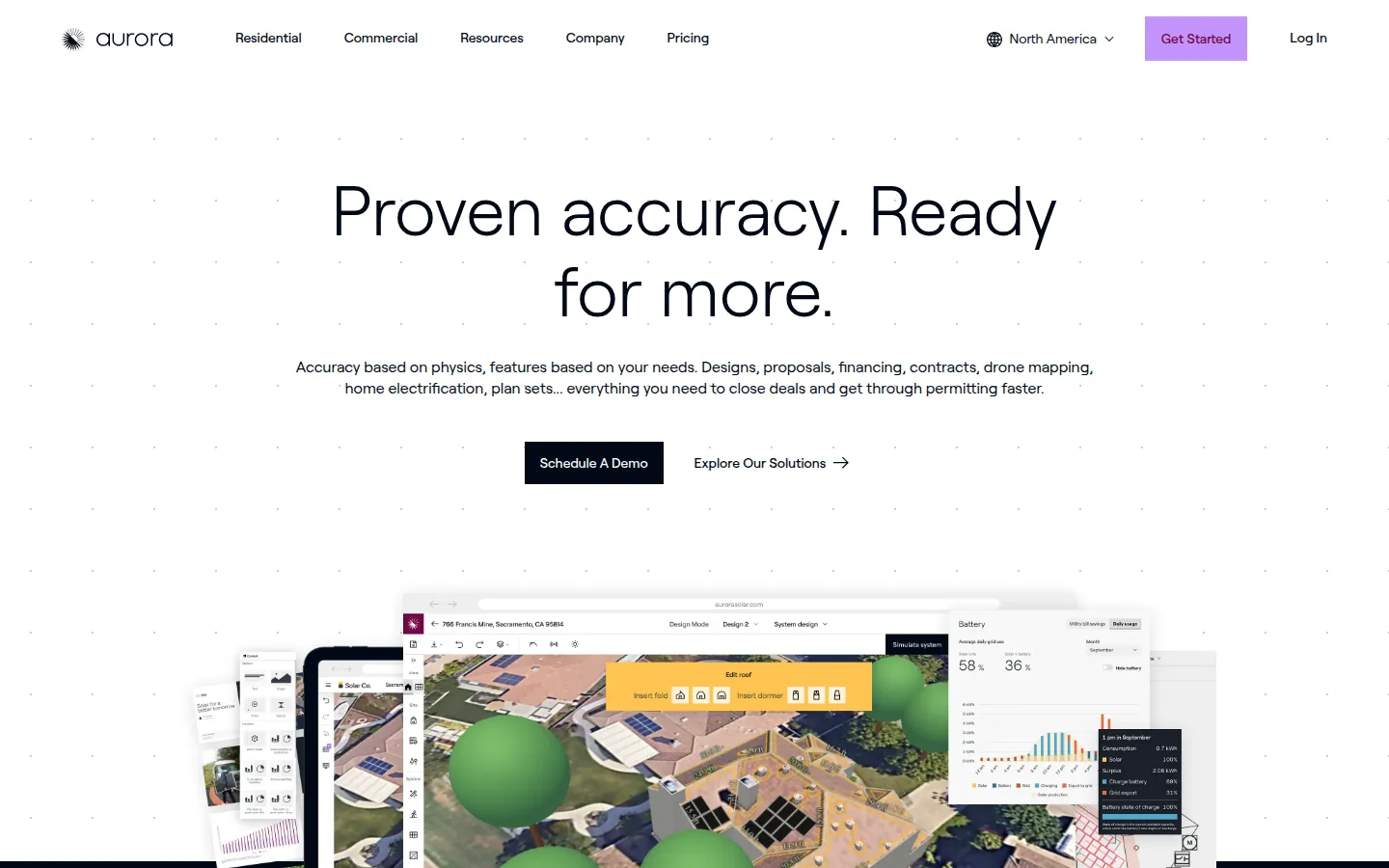
Aurora Solar is a design and sales platform; the details below come from its pricing page.
Best for: a Romanian residential installer who wants design, a tablet-friendly proposal and financing integrations together. Aurora’s pricing page describes Basic as a residential design and sales plan.
Not the right choice if: the customer signs a sales agreement in the tool. Contract Manager, e-signature tools and customizable sales agreement templates are listed on Enterprise, not Basic or Premium. It is also a poor fit beyond one user and 50 projects a month on Basic or Premium, though Aurora’s FAQ says more licenses can be bought in the app.
What the vendor documents: customizable proposal templates, custom branding, and custom pricing methods (per watt, per component or flat fee). It also lists adders, discounts and incentives, a utility rate database, and web and PDF proposals. Adders are extra items added to the price. It lists proposal activity tracking and integrated and custom financing (GoodLeap, Dividend, Mosaic and more). It also lists financing and energy bill comparisons. Design features on the same page include 3D roof modeling and trees and performance simulation.
Price (checked October 2026): Basic is $159 per user per month billed monthly, or $135 per user per month billed annually ($1,620 billed annually). Premium is $259 per user per month billed monthly, or $220 per user per month billed annually ($2,640 billed annually). Enterprise is custom per project. Source: Aurora pricing.
Limitations: Aurora’s pricing FAQ attaches a one-year commitment to annual Basic and Premium plans, which list 1 user and 50 projects a month. The page says nothing about lei or a Romanian supplier rate.
Vendor link: aurorasolar.com.
OpenSolar
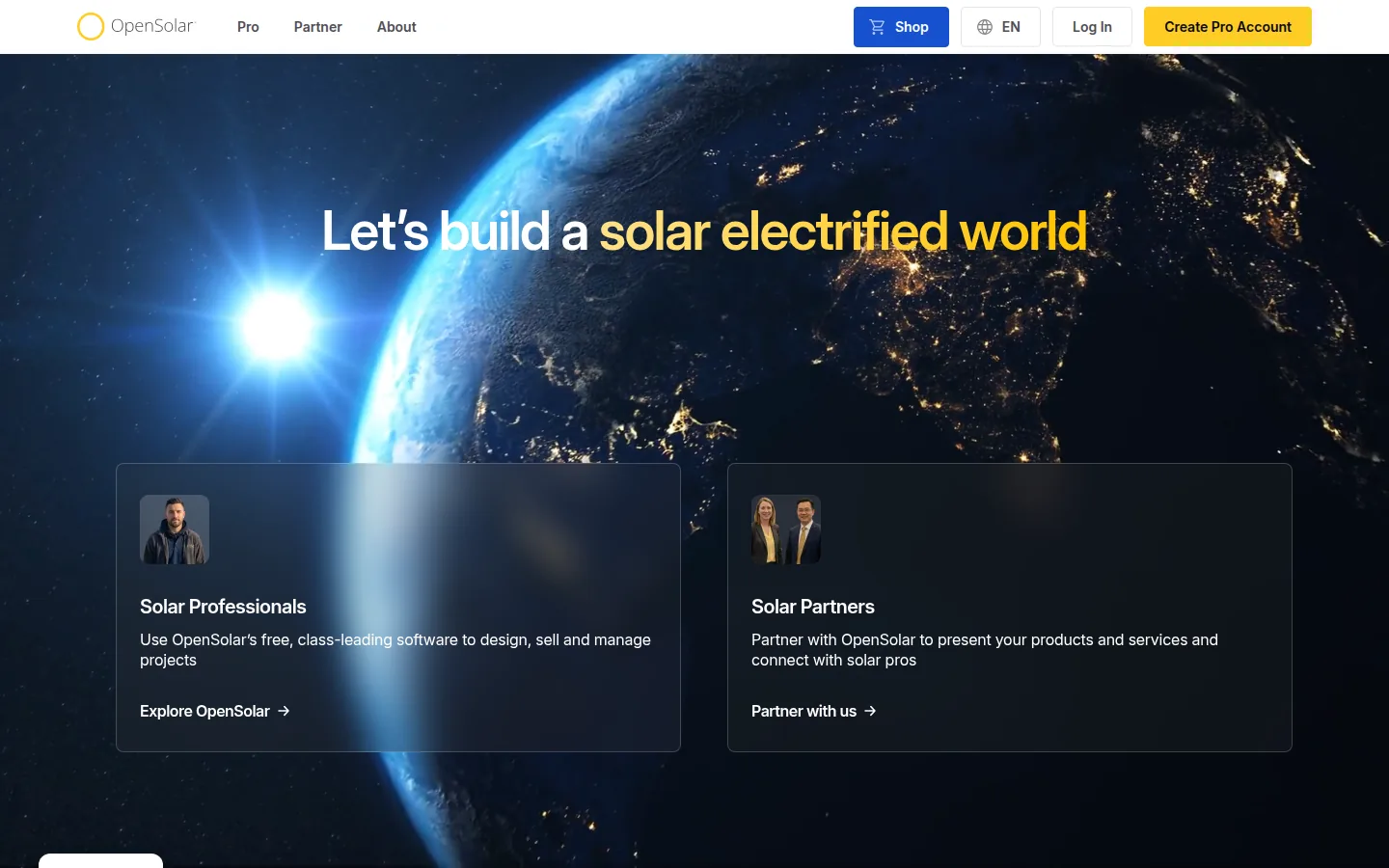
OpenSolar says the core app stays free and that a partner ecosystem funds the product (16 February 2026 post).
Best for: a small Romanian installer who wants design, a proposal, checkout and e-signature inside one free core application.
Not the right choice if: the quote is commercial, since OpenSolar’s proposal FAQ says Swipe, Scroll and Bespoke “are for residential proposal workflows”. Connecting many outside systems adds cost, because API Access and connectors are charged from 16 April 2026. The proposal page also says availability is “enabled by region”.
What the vendor documents: the Sales Machine Proposal page lists Swipe (slide-based), Scroll (long-form) and Bespoke proposals. It also lists a Quick Quote path, a fast quote and checkout route for simpler service and non-solar jobs. It lists branding controls and a template library. It lists savings views that compare current and electrified energy costs. It also lists deposits through CashFlow. It also lists financing “where available” and acceptance inside the same flow. A WhatsApp share option and section-view tracking “where available” are listed as well. The e-signature page lists a built-in signing workflow, PandaDoc or DocuSign.
Price (checked October 2026): the core app is free of charge for solar professionals, per the vendor (free page). From 16 April 2026 the vendor charges for API Access, a per-project fee. The per-project API fee is on OpenSolar’s API page. It also charges for supported connectors, a monthly fee per organization. The 16 February 2026 post says accounting connectors are billed as a monthly fee per organization. Bespoke proposals are offered through the optional paid Enterprise Services. Support is US$500 per month. Customize is US$1,350 per month (one exclusive proposal template). Enterprise is custom (“fully bespoke proposal”). Premium imagery is pay per image (price shown in the app).
Limitations: per the proposal page, Swipe, Scroll and Bespoke support up to six designs per project where design selection applies. The API page prices API Access and connectors by region; the Romanian rate was not compared.
Vendor link: opensolar.com
PVsyst
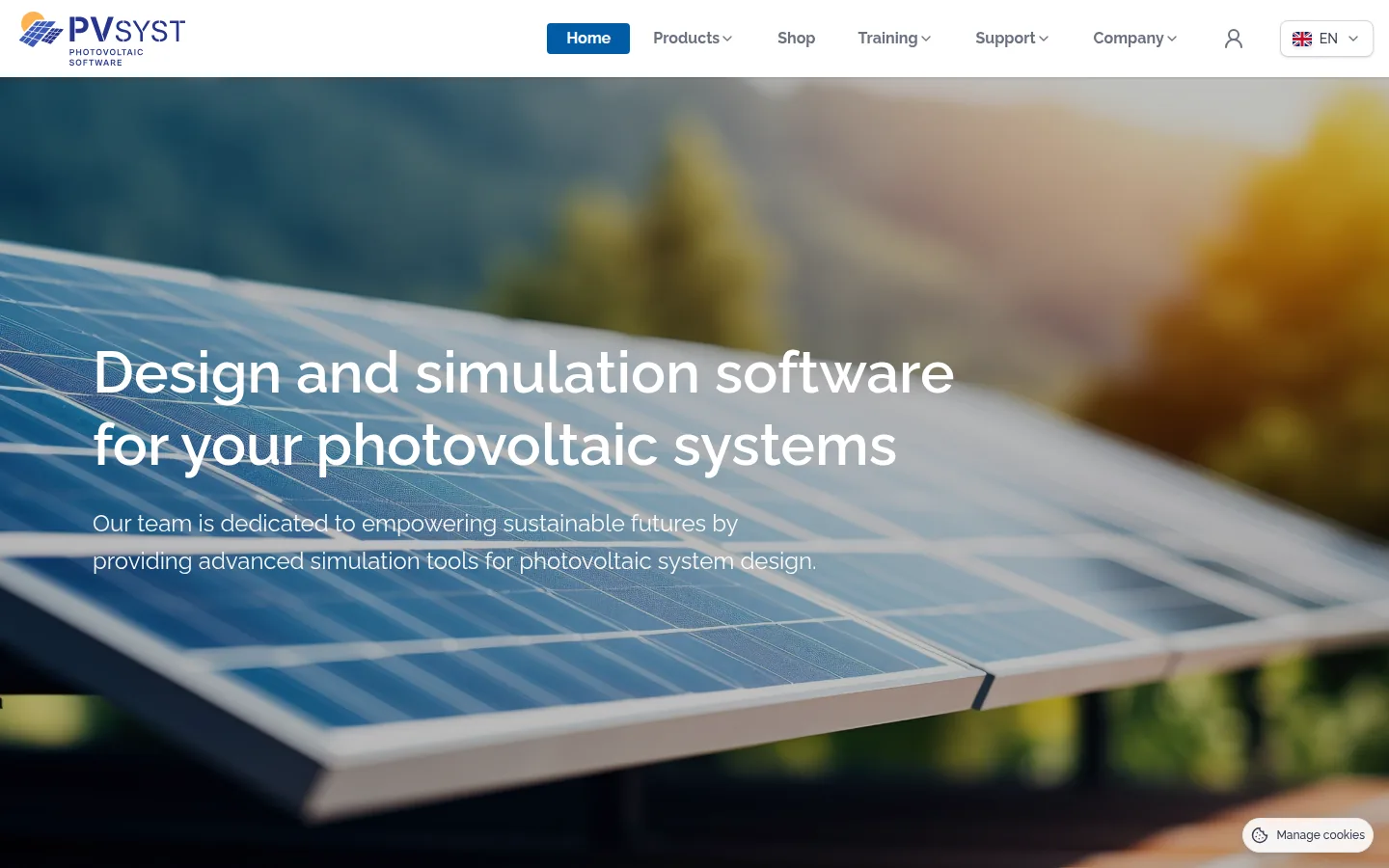
PVsyst is a Windows-only desktop program from PVsyst SA, based in Satigny, Switzerland.
Best for: the engineer who produces the yield report that a financed Romanian project cites in its quote.
Not the right choice if: a customer-facing quote is the deliverable. The product page lists simulation, a final report with customizable graphs and an economic assessment, but no proposal generation. The requirements page limits it to Windows.
What the vendor documents: hourly and sub-hourly simulation, near shadings from a 3D scene, and a gains and losses report. It also lists an economic assessment of CAPEX (up-front cost), OPEX (running cost) and custom costs. The assessment calculates NPV (net present value), LCOE (cost of each unit of energy over the system’s life) and ROI. Its help also lists a single line diagram editor and viewer for grid-connected systems. Storage is not included, and the page calls it work in progress. The help also has a feed-in tariff and self-consumption page. A feed-in tariff is the rate paid for power you send to the grid.
Price (checked October 2026): CHF 700 per year for PVsyst 8 Professional, with updates included. The one-month free trial of PVsyst 8 is described on the product page. Source: PVsyst shop.
Limitations: each license covers one computer, and installation is on the workstation that runs it.
Vendor link: pvsyst.com.
SurgePV
SurgePV is our product, a point to bear in mind when reading this entry.
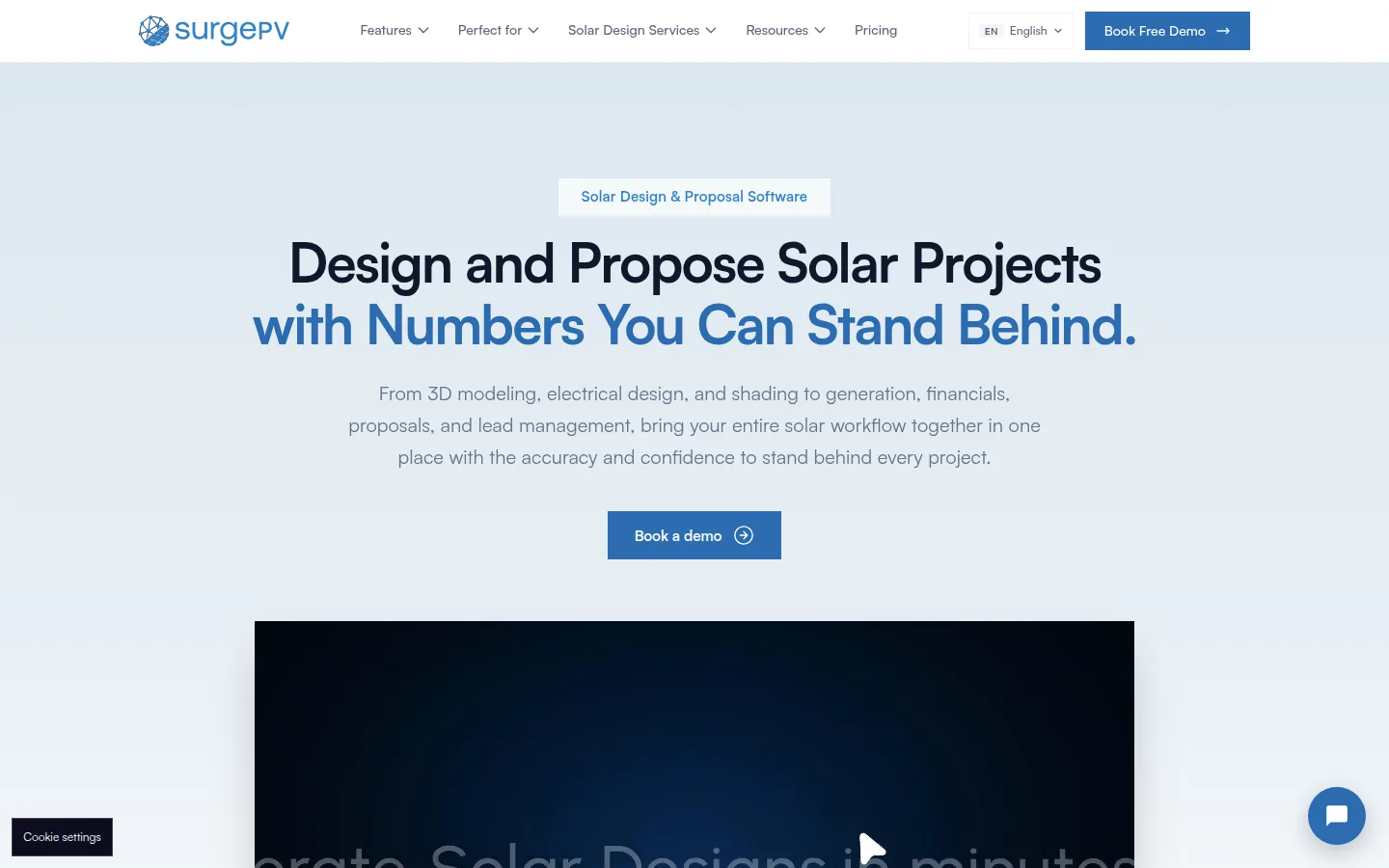
Best for: installers and EPC teams (engineering, procurement and construction) in Romania that want a proposal generated from one 3D roof model, array layout and shading analysis, plus energy-yield and financial modeling, in a web application.
Not the right choice if: you need a self-serve trial (SurgePV offers a guided demo) or financing, contracts or e-signature within the proposal flow. The pricing page lists proposal generation and a generation and financial analysis feature without describing either. Its published scope has no CRM (customer tracking tool), and the responsible engineer, authority, lender or utility still approves the work.
What the vendor documents: 3D roof modeling, solar array layout, shading analysis and energy-yield modeling. It also lists financial modeling, electrical workflow support, bill-of-materials output and proposal generation. The pricing page lists unlimited projects, shadow analysis, generation and financial analysis, and proposal generation under “Everything included”. See the solar proposal software page for the product.
Price (checked November 2026): $1,899 per user per year for 1 user, $1,499 per user for 3 seats, $1,299 per user for 5 seats, in US dollars. Access is a guided demo.
Limitations: results rest on source data, assumptions, equipment models and review. The published scope names no Romanian tariff, subsidy, language or currency, so ask about all four, and about lei per kWh, in a demo.
Vendor link: surgepv.com. Book a Free Demo.
See SurgePV on your Romania project
Book a guided demo and ask what the product produces for a Romanian prosumer quote.
Book a Free DemoHow We Ordered These Tools
These four tools are in alphabetical order with no ranking, and each pick follows what the vendor publishes.
- Design link: whether the vendor says the proposal is generated from the design model. Output quality was not assessed.
- Price: the vendor’s listed figure in its own currency, with discounts and negotiated quotes left unassessed.
- Scope: the coverage stated on the vendor’s own pages. Where a page says nothing, this page says nothing too.
More Solar Software Guides to Compare
- Solar proposal software, all markets
- Solar design software for Romania
- Solar software in Romania
- SurgePV solar proposal software
Sources and Dates
Vendor pages were read in October and November 2026. Romania billing and connection facts were read on 3 November 2026 from ANRE, how to become a prosumer, ANRE, electricity bill contents and Rețele Electrice, prosumer connection steps. Screenshots are public website captures from 29 October 2026. Sources are the vendor pages linked in each entry: pricing, product and help pages. SurgePV facts come from its pricing page. SurgePV publishes this page and is a vendor on the list.
Frequently Asked Questions
What is the best solar proposal software in Romania?
It depends on the job. OpenSolar’s core app is free. Aurora Solar lists design, financing integrations and proposal tracking. SurgePV lists roof modeling, bill of materials and proposals in one product. PVsyst documents P50 to P90 yield results. We did not verify Romania-specific coverage for any tool, so test each on a real Romania project before you buy.
How much does solar proposal software cost in Romania?
Vendors price in their own currency, and the pages we read do not give a local-currency price. SurgePV lists $1,899 per user per year for one user. OpenSolar’s core app is free, with charges for API Access and connectors from 16 April 2026. Aurora Basic is $159 per user per month, or $135 per user per month billed annually. PVsyst 8 Professional is CHF 700 per year.
Is there free solar proposal software for Romania?
OpenSolar says its core app is free for solar professionals. The vendor charges for API Access and supported connectors from 16 April 2026. Check regional availability of any free tool for Romania.
Can solar proposal software handle Romania tariffs and incentives?
The vendor pages we read describe tariff and incentive features in general terms and do not list Romania-specific rates or programs. Ask each vendor to model one real Romania bill and incentive in a demo or trial.
Does SurgePV publish this list?
Yes. SurgePV publishes this page and is one of the tools on it. The tools are listed alphabetically and are not ranked.
How does a Romanian prosumer get paid for surplus solar power?
ANRE says the distribution operator measures injected energy and the supplier buys it under a sale-purchase contract. ANRE’s page gives no rates, so take the price from the customer’s supplier contract and show it in lei per kWh in the quote.
What should a Romanian solar proposal tell the customer about the connection?
ANRE lists a connection request, a technical connection notice, a connection contract, test energization, a commissioning report and a sale-purchase contract with the supplier. Rețele Electrice names Casa Verde as one funding route. Put these steps and the funding route in the proposal.
