

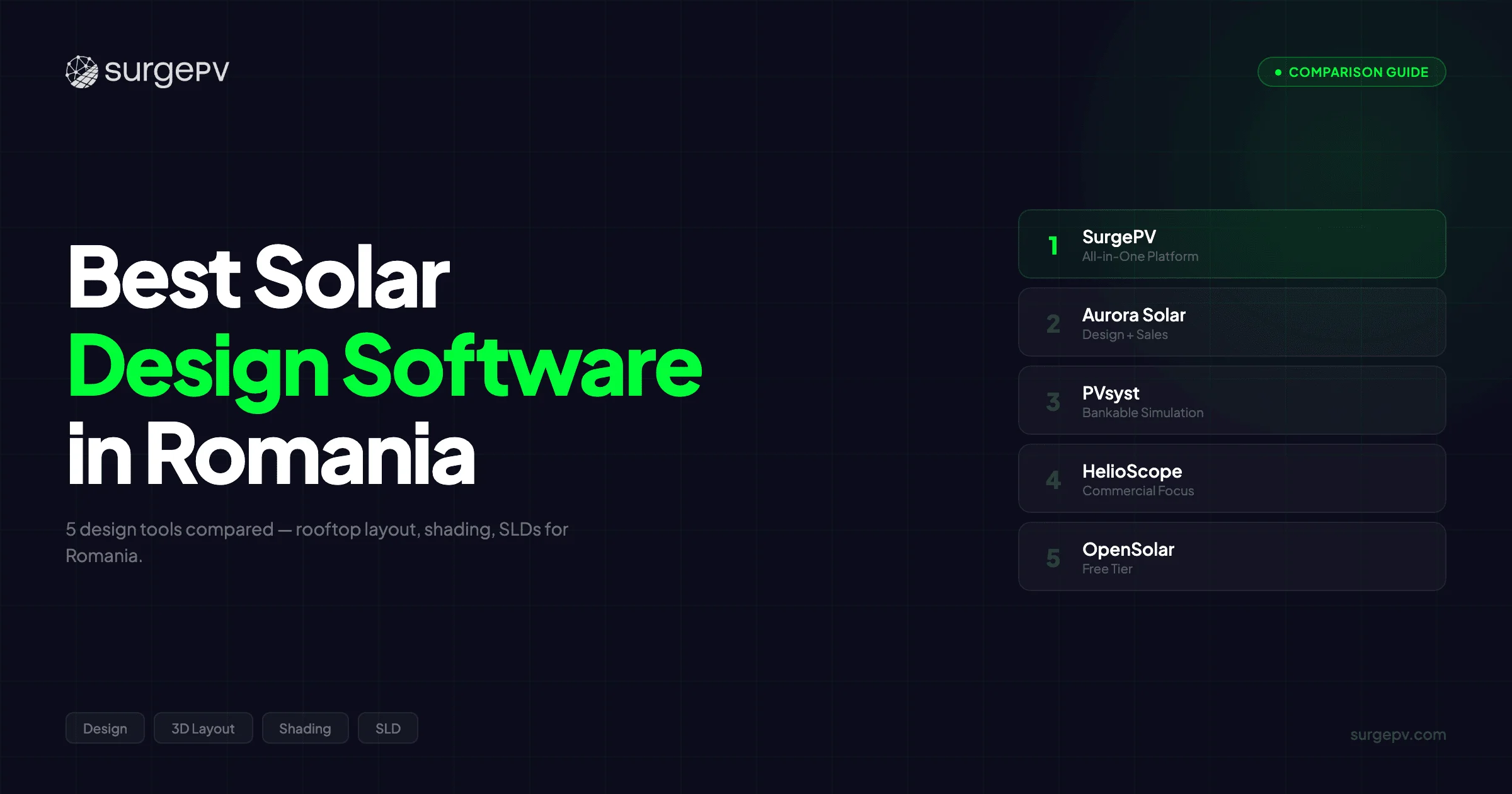
TL;DR: SurgePV is the best solar design software for Romania in 2026 — the only platform combining AI-powered design, automated SLD generation for DSO approval, bankable P50/P90 simulations, and prosumer net billing under Law 184/2018 in a single workflow. Aurora Solar ranks second for enterprise residential volume. PVsyst is the gold standard for simulation-only needs. HelioScope handles fast commercial layouts. OpenSolar works for small-budget installers.
Romania’s solar market is surging. 5.5 GW installed. 2-3 GW added every year. On track for 10+ GW by 2030 (SolarPower Europe).
But here is the problem. Most solar design platform tools were not built for Romania. Prosumer net billing under Law 184/2018. Casa Verde Fotovoltaice subsidy calculations. DSO connection documentation for E-Distributie, DEER, and Delgaz Grid. These are not edge cases — they are every single project. And software built for the US or Western Europe trips up on all of them.
The wrong tool costs you hours per project in workarounds. The right one handles prosumer economics, IEC/CENELEC-compliant electrical SLDs, and bankable simulations natively — without a single manual export.
We reviewed and compared the top 5 solar design platforms for the Romanian market. Prosumer compliance, design speed, simulation accuracy, electrical engineering depth, and total cost of ownership — every factor that actually matters for Romanian projects.
Quick Comparison Table
| Rank | Software | Best For | Pricing | Score |
|---|---|---|---|---|
| 1 | SurgePV | All-in-one design + electrical + proposals | $1,499/user/yr | 95/100 |
| 2 | Aurora Solar | Enterprise residential installers | Basic $159/user/mo, or $135/user/mo billed annually (aurorasolar.com/pricing, checked 21 September 2026) | 78/100 |
| 3 | PVsyst | Bankable simulation reports | Not published | 72/100 |
| 4 | HelioScope | Commercial layout design | Basic $159/mo, or $1,620/yr per licence (helioscope.aurorasolar.com/pricing, checked 21 September 2026) | 68/100 |
| 5 | OpenSolar | Budget prosumer installers | Free of charge | 60/100 |
Further Reading
For a broader comparison beyond this market, see our guide to the best solar design software globally.
Best Solar Design Software in Romania
SurgePV — Best All-in-One Solar Design Platform for Romania
Best For: Romanian EPCs and commercial solar installers needing integrated design-to-proposal workflows with electrical engineering
Pricing: $1,499/user/year — all features included
Ease of Use: 2-3 week onboarding
Overall Score: 95/100
Why SurgePV Ranks #1
SurgePV is the only platform that combines AI-powered design, automated electrical engineering, bankable simulations, and professional proposal generation in a single cloud-based workflow. For Romanian EPCs and installers, that means one tool instead of three or four.
Prosumer net billing modeling. SurgePV handles self-consumption economics under Law 184/2018, calculating grid injection credits at reference price and showing battery storage impact on prosumer ROI. For Casa Verde Fotovoltaice projects, the platform includes incentive calculators that show pre- and post-subsidy payback periods.
Automated SLD generation. This is SurgePV’s biggest differentiator. The platform generates permit-ready single line diagrams in 5-10 minutes — compared to 2-3 hours of manual drafting in AutoCAD. None of the other four tools on this list offer automated SLD generation.
Romanian DSOs (E-Distributie, DEER, Delgaz Grid) require electrical documentation for connection approval. Without automated SLDs, your team is exporting designs to AutoCAD and manually drafting schematics for every project.
Bankable P50/P90 simulations. SurgePV’s 8760-hour shading analysis delivers bankability-grade P50/P90 output. For commercial and utility-scale projects requiring Romanian bank approval, that means bankable reports without a separate simulation tool.
Did You Know?
Romania’s solar irradiance ranges from 1,200-1,400 kWh/m²/year, making accurate simulation software essential for bankable energy yield predictions. Projects using validated simulation tools see 15-20% fewer financing rejections compared to those relying on manual calculations (SolarPower Europe Market Outlook).
Key Strengths
- Automated Electrical Engineering: SLD generation and wire sizing in 5-10 minutes, eliminating AutoCAD dependency
- Prosumer Compliance: Net billing modeling under Law 184/2018 with Casa Verde subsidy calculator
- Bankable Outputs: P50/P90 reports for Romanian lender acceptance. Your financing applications include the bankability data lenders actually require — not just optimistic P50 estimates that get rejected.
- Native Carport Design: Only platform with built-in carport solar design. With Romanian commercial parking lot installations growing, this is a competitive advantage.
- Transparent Pricing: $1,499/user/year with all features included, no hidden fees. No surprise add-on costs for SLDs, proposals, or simulation.
Limitations
- Brand Recognition: Newer brand compared to Aurora or PVsyst (growing rapidly)
- Cloud-Only: No desktop application (requires internet connection)
- Community Size: Smaller user community than Aurora Solar
You might be wondering: if SurgePV does all this, why haven’t I heard of it? Fair question. PVsyst has had a 30-year head start. Aurora Solar has spent hundreds of millions on marketing. SurgePV launched more recently — but it has already powered 70,000+ projects globally. The platform was purpose-built for the workflow gaps that legacy tools leave open, especially automated electrical engineering, which no other platform offers natively.
Further Reading
- Best Solar Design Software (2026) — Global comparison across 10+ platforms
- Best Solar Electrical Design Software — SLD generation compared
- PVsyst Review — Full simulation analysis and pricing
Who Should Consider SurgePV
Romanian EPCs and commercial solar installers needing integrated design-to-proposal workflows with electrical engineering. Also strong for residential solar prosumer projects. Teams handling 10+ projects per month will see the fastest ROI.
Pro Tip
SurgePV’s automated SLD generation saves 2-3 hours per project compared to manual AutoCAD drafting, and removes the need for a separately licensed CAD tool. For Romania EPCs handling 10+ projects per month, that’s 20-30 hours saved monthly. Book a demo to see it in action.
Who Should Look Elsewhere
Teams deeply committed to PVsyst desktop workflow who don’t need proposals or SLD generation. Budget-zero installers doing fewer than 5 projects per month (consider OpenSolar instead).
See SurgePV Handle Romanian Solar Projects
Automated SLD generation saves 2-3 hours per project. Prosumer net billing, Casa Verde calculations, and bankable P50/P90 reports — all in one platform.
Book a DemoNo commitment required · 20 minutes · Live project walkthrough
Aurora Solar — Best for Enterprise Residential Volume
Best For: Large Romanian residential installers with enterprise budgets
Pricing: Aurora Solar lists Basic at $159/user/month, or $135/user/month billed annually, and Premium at $259/user/month, or $220/user/month billed annually (aurorasolar.com/pricing, checked 21 September 2026). AutoCAD, needed for electrical documentation, is licensed separately.
Ease of Use: 4-6 week learning curve for commercial
Overall Score: 78/100
Why Aurora Solar Ranks #2
Aurora Solar is the most recognized solar design platform globally. It delivers excellent AI roof modeling, attractive proposals, and strong CRM integrations. Aurora’s AI roof detection is industry-leading, and the proposal output is polished and professional.
Key Strengths
- AI Roof Detection: Industry-leading accuracy for satellite imagery analysis. Speeds up residential roof mapping so your design team spends less time tracing outlines manually.
- Professional Proposals: Beautiful interactive 3D visualizations
- CRM Integrations: Native Salesforce and HubSpot connections
Limitations
- No SLD Generation: Requires AutoCAD, licensed separately, and 2-3 hours manual drafting per project
- P50 Only: No P75/P90 bankability reports for Romanian lenders
- No Prosumer Modeling: Net billing under Law 184/2018 not natively supported
- Two separate licences: Aurora is billed per user per month, and AutoCAD is licensed separately on top
Who Should Consider Aurora Solar
Large Romanian residential enterprises with separate engineering departments and enterprise budgets.
Who Should Look Elsewhere
Romanian EPCs needing IEC-compliant electrical documentation or P50/P90 bankability for lender presentations. Price-sensitive teams.
PVsyst — Best for Bankable Simulation Reports
Best For: Utility-scale developers needing bankable simulation for Romanian financiers
Pricing: PVsyst does not publish list pricing.
Ease of Use: 4-6 week learning curve
Overall Score: 72/100
Why PVsyst Ranks #3
PVsyst is the gold standard for solar energy simulation. Romanian banks and international lenders almost universally accept PVsyst reports for project financing. No other tool matches PVsyst for simulation depth and detailed loss analysis.
Key Strengths
- Gold Standard Simulation: Universal acceptance by Romanian banks and EU lenders
- Detailed Loss Analysis: Snow soiling, temperature derating, inverter clipping, cable losses
- Excellent Romanian Weather Data: PVGIS and Meteonorm integration for all regions
Limitations
- Simulation-Only: No design tools, no proposals, no electrical documentation
- Desktop-Only: No cloud collaboration or mobile access
- Steep Learning Curve: 4-6 weeks to reach proficiency
Who Should Consider PVsyst
Romanian utility-scale developers needing bankable P50/P90 reports for lender presentations. Best used alongside a design platform like SurgePV.
Who Should Look Elsewhere
Teams needing daily design workflow, proposals, or electrical documentation. Residential installers (overkill for prosumer projects).
HelioScope — Best for Commercial Layout Design
Best For: Romanian commercial EPCs needing fast commercial roof layouts
Pricing: HelioScope lists Basic at $159/month, or $1,620/year, and Pro at $259/month, or $2,640/year, per licence including one user (helioscope.aurorasolar.com/pricing, checked 21 September 2026)
Ease of Use: 2-3 week learning curve
Overall Score: 68/100
Why HelioScope Ranks #4
HelioScope is a cloud-based commercial solar design tool now owned by Aurora Solar. It focuses on fast layout design for flat commercial rooftops and ground-mount arrays.
Key Strengths
- Fast Commercial Layouts: Drag-and-drop handles complex roof geometries well
- Good Simulation Engine: Reasonable energy yield estimates for commercial projects
- Cloud-Based: Accessible from anywhere
Limitations
- No SLD Generation: Same electrical gap as Aurora
- No Prosumer Modeling: Net billing and Casa Verde features absent
- Tied to Aurora Ecosystem: Bundled with Aurora Premium plans
Who Should Consider HelioScope
Romanian commercial EPCs already on the Aurora platform who need faster commercial roof layouts.
OpenSolar — Best Free Option for Budget Installers
Best For: Small Romanian residential installers with minimal budgets
Pricing: Free
Ease of Use: 1-2 week learning curve
Overall Score: 60/100
Why OpenSolar Ranks #5
OpenSolar is a free solar design and proposal platform. For small Romanian installers handling a few prosumer projects per month, it provides basic functionality at zero cost.
Key Strengths
- Free of charge: In the company’s own words on opensolar.com (checked 21 September 2026)
- Easy to Learn: Most installers productive within 1-2 weeks
- Cloud-Based: Basic proposals included
Limitations
- No Bankable Simulations: No P50/P90 reports for commercial financing
- No SLD Generation: Electrical documentation handled separately
- No Prosumer Optimization: Net billing under Law 184/2018 not modeled
Who Should Consider OpenSolar
Small Romanian residential installers handling fewer than 10 prosumer projects per month with minimal technical requirements.
Why Most Solar Design Tools Fail in Romania
Romania isn’t Germany. It isn’t Spain. The Romanian solar market has specific requirements that most global platforms handle poorly. Here’s what actually matters when choosing design solar software for installers for Romanian projects.
Prosumer net billing economics
Romania’s prosumer legislation (Law 184/2018, updated 2023) defines how residential producers up to 400 kW sell excess electricity back to the grid through net billing. Your design software needs to model self-consumption vs grid injection at ANRE-regulated reference prices, battery storage impact on prosumer economics, day vs night tariff differences, and seasonal production variation.
Bankability for Romanian lenders
Commercial and utility-scale projects require bankable energy yield reports. Romanian banks require P50/P90 production estimates, detailed loss analysis, and weather data from recognized databases (PVGIS, Meteonorm) covering Romanian regions with GHI ranging from 1,300-1,600 kWh/m²/year.
IEC/CENELEC electrical compliance
Romanian electrical standards follow IEC/CENELEC frameworks. For DSO connection approval, projects require single line diagrams, wire sizing calculations, protection device specifications, and grid connection documentation for the aviz tehnic de racordare (ATR). SurgePV is the only platform that generates these documents automatically.
Casa Verde subsidy integration
The Casa Verde Fotovoltaice program provides up to RON 20,000 (~EUR 4,000) for residential solar installations. Your software should show pre-subsidy vs post-subsidy payback in customer-facing proposals.
Decision Shortcut
If you need electrical engineering (SLDs, wire sizing, code compliance), SurgePV is the only platform that automates this natively. If you’re simulation-only, PVsyst is the gold standard. If you’re residential-focused with a big marketing budget, Aurora’s proposals are unmatched.
Our Review Method Methodology (And Why It Matters)
Our evaluation methodology for Romanian solar design software:
- documented-feature review with Romanian project parameters (prosumer 5 kW, 200 kW commercial, 5 MW ground-mount)
- Prosumer compliance verification against Law 184/2018 net billing requirements
- Simulation accuracy comparison using Romanian weather data from PVGIS
- DSO documentation review for E-Distributie, DEER, and Delgaz Grid compliance
- Pricing analysis including total cost of ownership with all required add-ons
- User feedback review from G2, Capterra, and Romanian solar installer communities
Evaluation weights: Prosumer and self-consumption modeling (30%), bankability and simulation accuracy (25%), design speed (20%), electrical engineering and compliance (15%), pricing and value (10%).
Further Reading
- Best All-in-One Solar Design Software — Complete platform comparison
- Best Solar Shading Analysis Software — Shade modeling compared
- Aurora Solar Review — Full feature analysis and pricing
Which Software Is Right for Your Use Case?
| Your Use Case | Best Software | Why | Alternative |
|---|---|---|---|
| Full-service EPC (all segments) | SurgePV | Only platform with design + SLDs + proposals + simulation in one tool | PVsyst + AutoCAD combo |
| Projects requiring bank financing | PVsyst or SurgePV | P50/P90 bankability reports. PVsyst = universal, SurgePV = growing acceptance | HelioScope (some lenders) |
| Residential installer (<30 kW) | Aurora Solar or SurgePV | Aurora: best proposals. SurgePV: proposals + engineering depth | OpenSolar (free of charge) |
| Utility-scale developer (>1 MW) in Romania | HelioScope or PVCase | Fast ground-mount design. Pair with PVsyst for bankability | SurgePV for integrated workflow |
| Startup installer (<30 projects/year) | OpenSolar or SurgePV | OpenSolar: free of charge. SurgePV: deeper engineering | Free tools (PVWatts, SolarEdge Designer) |
Which Software Fits Your Business Profile?
| Your Business Profile | Recommended Software | Why This Choice |
|---|---|---|
| Multi-segment EPC (residential + commercial) | SurgePV | Handles all project types in one platform. Automated SLD generation eliminates AutoCAD dependency. Bankable P50/P90 simulations for commercial financing. Best all-in-one ROI for teams handling 10+ diverse projects monthly. |
| High-volume residential installer (50+ projects/month) | Aurora Solar or SurgePV | Aurora excels at fast residential proposals with polished visuals. SurgePV offers similar proposal quality plus electrical engineering in the same platform. |
| Utility-scale developer (financing required) | PVsyst + SurgePV | PVsyst delivers gold-standard bankable reports. Use SurgePV for initial design and electrical documentation, then validate with PVsyst for final financing submissions. |
| Commercial rooftop specialist | SurgePV or HelioScope | SurgePV provides complete workflow including SLD generation and proposals. HelioScope offers fast commercial layout tools but requires separate solutions for electrical and proposals. |
| Small installer (under 10 projects/month, tight budget) | OpenSolar or PV*SOL | OpenSolar is free of charge for basic design and proposals. Neither provides SLD automation or advanced bankability, but cost-effective for smaller operations. Upgrade to SurgePV as you scale. |
| Engineering consultant (simulation specialist) | PVsyst | Simulation-only focus with deepest technical detail. Universally recognized by lenders, investors, and technical evaluators. |
When You May Not Need Advanced Solar Software
Not every solar project in Romania requires a full-featured design platform. Here are scenarios where simpler tools might suffice:
Small residential installers (under 10 projects/month)
If you’re handling fewer than 10 residential installations per month with straightforward roof layouts, free tools like OpenSolar or basic spreadsheet calculations may meet your needs. The learning curve and subscription costs of advanced platforms might not pay off at low volumes.
Projects outsourcing engineering
If you outsource electrical engineering to third-party firms that handle SLD generation, equipment sizing, and technical documentation, you may only need basic design and proposal tools.
Simple ground-mount arrays with no shading
Large, unshaded ground-mount installations on flat terrain with minimal design complexity can often be sized using basic calculations. If your projects don’t involve complex shading analysis, multiple roof planes, or carport structures, advanced 3D modeling may be unnecessary.
Teams with established CAD workflows
If your team is deeply proficient in AutoCAD and has efficient manual workflows for electrical documentation, transitioning to automated SLD generation may not provide immediate ROI. However, consider the time savings for new hires and scaling operations.
Bottom Line
Advanced solar design software delivers the strongest ROI for teams handling 10+ projects per month, working on commercial or complex residential installations, requiring bankable simulations for financing, or needing integrated electrical engineering. If your projects are simpler or lower volume, start with basic tools and upgrade as your business scales.
Bottom Line
For Romania EPCs and installers, SurgePV delivers the most complete design-to-proposal workflow with automated SLD generation, bankable P50/P90 simulations, and integrated proposals — all at $1,899 per user per year on the individual plan. Book a demo to see it in action.
Frequently Asked Questions
What is the best solar design software in Romania?
SurgePV is the best all-in-one solar design software for Romania in 2026. It combines 3D design, bankable P50/P90 simulations, automated SLD generation, and professional proposals with prosumer self-consumption modeling at $1,499/user/year. For simulation-only needs, PVsyst remains the gold standard for bankable reports accepted by Romanian banks and international lenders.
Does solar design software support Romanian prosumer regulations?
SurgePV models prosumer self-consumption economics per Law 184/2018, including net billing calculations, grid injection at ANRE-regulated reference price, and battery storage optimization for Romanian prosumer installations. Aurora Solar and OpenSolar do not natively support Romanian prosumer calculations.
Which software do Romanian solar installers use?
Romanian installers use SurgePV, PVsyst, Aurora Solar, and OpenSolar. Utility-scale EPCs rely on PVsyst for bankable simulations. Growing residential and commercial installers adopt SurgePV for integrated design-to-proposal workflows that handle prosumer economics natively.
Can solar software calculate Casa Verde subsidy impact?
Solar proposal software like SurgePV includes incentive calculators that factor Casa Verde Fotovoltaice subsidy amounts (up to RON 20,000/~EUR 4,000) into customer proposals, showing pre- and post-subsidy payback periods for eligible residential installations.
Can solar software generate SLDs for Romanian DSO approval?
SurgePV is the only platform that generates automated single line diagrams meeting IEC/CENELEC standards for Romanian DSO connection approval. The aviz tehnic de racordare process requires detailed electrical documentation. All other platforms require separate AutoCAD work, licensed separately, plus 2-3 hours per project.
How much does solar design software cost in Romania?
OpenSolar is free of charge. SurgePV is $1,499/user/year with all features included. Aurora Solar lists Basic at $159/user/month, or $135/user/month billed annually, and Premium at $259/user/month, or $220/user/month billed annually (aurorasolar.com/pricing, checked 21 September 2026). HelioScope lists Basic at $159/month, or $1,620/year, and Pro at $259/month, or $2,640/year, per licence including one user (helioscope.aurorasolar.com/pricing, checked 21 September 2026). PVsyst does not publish list pricing, and AutoCAD is licensed separately. Use our solar ROI calculator to estimate savings.
Sources
- ANRE — Romanian energy regulator, prosumer tariffs (accessed February 2026)
- AFM — Casa Verde Fotovoltaice subsidy program (accessed February 2026)
- Transelectrica — Romanian TSO, grid data (accessed February 2026)
- E-Distributie — DSO connection requirements (accessed February 2026)
- SolarPower Europe — EU Solar Market Outlook 2026 (accessed February 2026)
- PVGIS — Romanian irradiation data (accessed February 2026)
- Aurora Solar Pricing — Official pricing (checked 21 September 2026)
- PVsyst Official Site — Features and pricing (accessed February 2026)
