


This page is for installers and EPC teams in the Philippines choosing solar proposal software. Short answer: for free core app and a Philippines start guide, pick OpenSolar; for a vendor that says it has Philippine tariff and permit modules, pick Arka360.
A Philippine solar proposal has to show two prices. Power you use yourself means you buy less from the grid. Power you send to the grid earns only a credit. For Meralco customers, Meralco says the credit uses its monthly generation charge, based on its blended generation cost, before other generation adjustments. A tool that uses one rate for both can overstate savings. Check this first, whichever tool you pick.
On the pages we read, OpenSolar and Aurora Solar publish help articles on setting your own export rate. OpenSolar’s core app is free. The vendor charges for API Access and connectors from 16 April 2026. Arka360 says on its own Philippines pages that it has Philippine tariff and permit modules, but we could not see how they work. Energy Toolbase suits commercial solar plus storage. SurgePV documents the design-to-proposal workflow, but its published scope names none of these Philippine items. Ask for them in a demo.
This is a desk comparison of what each vendor publishes, checked October 2026. We have not run side-by-side tests. SurgePV publishes this page and is one of the tools listed. Local rules come from the Department of Energy (DOE), the Energy Regulatory Commission (ERC) and Meralco. Tool facts come from each vendor’s own site. For the wider rules, see our Philippines solar compliance guide.
Criteria used: separate export price, own tariff entry, Philippines page or support, peso price, free tier.
Solargraf is not compared on this page. Its site, solargraf.com, returned HTTP 403 to automated reads, including a headless browser, in October 2026.
Want to see SurgePV quote a the Philippines project?
Book a guided demo and bring a real the Philippines site. We walk through design, yield, finance and the proposal in one platform.
Book a Free DemoChecking cost first? See the SurgePV pricing page.
Best-For Picks for the Philippines
- Free core app and a Philippines start guide: OpenSolar. The core app is free for solar professionals. The vendor charges for API Access and connectors from 16 April 2026. Its help center has a Philippines Quick Start Guide with webinars in Tagalog and English. You build the Meralco tariff yourself as a custom tariff.
- A vendor that says it has Philippine tariff and permit modules: Arka360. This is the vendor’s own claim on its Philippines pages. No peso price is published, so ask for a demo and a written quote.
- Solar plus storage for a business, with cash, PPA, loan and lease options: Energy Toolbase. Its FAQ says the Developer product compares these financing types. A PPA is a power purchase agreement, where the customer pays for the power instead of buying the system. Pricing comes from a call.
- Your team already uses Aurora: Aurora Solar. Its help center shows how to edit the import rate, the export rate and the compensation policy on a project. You enter the Meralco rate by hand.
- Roof model to bill of materials and proposal in one product, priced per user: SurgePV. It documents roof modeling, shading, yield, financial modeling, electrical workflow support, bill of materials and proposals. Its published scope names no Philippine tariff or export rule. Ask in a demo how it handles them.
Philippines Solar Proposal Software Comparison Table
The tools are in alphabetical order. This is not a ranking. Pick by the situation above. Prices checked October 2026 on each vendor’s own page. None of these vendors publishes a peso price.
| Tool | Best for | Price | Free or paid | Decisive scope fact |
|---|---|---|---|---|
| Arka360 | Vendor-stated Philippine modules | Basic $199 per month; Premium $358 per month | Paid | Says it has Philippine tariff and permit modules |
| Aurora Solar | Teams already on Aurora | $159 or $259 per user per month (monthly billing); $135 or $220 billed annually | Paid | Export rate and compensation policy can be edited per project |
| Energy Toolbase | Commercial solar plus storage | Not published; demo and pricing on a call | Paid | Compares cash, PPA, loan and lease |
| OpenSolar | Free quoting with a custom Meralco tariff | Core app free of charge; API Access and connectors charged from 16 April 2026 | Free core app, paid API and connectors | Custom tariffs with a net billing option |
| SurgePV | Roof model to BOM and proposal, per user | $1,899 per user per year (1 user), in US dollars | Paid, guided demo | BOM and proposal generation in scope; no Philippine item stated |
Philippines Criteria Matrix
Each cell is Documented, Partial or Not stated, based on the vendor pages we read in October 2026. Documented means the vendor’s own page states it for this task. Partial means the page lists a related feature but not the Philippine item. Not stated means the pages we read do not say. There are no scores or weights.
| Tool | Separate export price | Own tariff entry | Philippines page or support | Peso price | Free tier |
|---|---|---|---|---|---|
| Arka360 | Not stated | Partial (vendor says “tariff modules”; no detail) | Documented (Philippines pages) | Not published (USD shown) | Not stated |
| Aurora Solar | Documented (export rate, compensation policy) | Documented (edit and create rates) | Not stated | Not published (USD shown) | Not stated |
| Energy Toolbase | Not stated | Documented (custom rate schedules) | Not stated | Not published for ETB Developer (price on a call) | Not stated |
| OpenSolar | Documented (net billing options) | Documented (custom tariffs) | Documented (Philippines Quick Start Guide) | Not published (core app free) | Documented |
| SurgePV | Partial (financial modeling listed) | Not stated | Not stated | Not published (USD) | Not stated (guided demo) |
Two things stand out. No vendor publishes a peso price. On the pages we read, only OpenSolar and Aurora Solar publish help pages on setting an export rate. A tool that does not state an item may still support it, so ask each vendor to quote one real Meralco job before you buy.
Tool Entries
Arka360
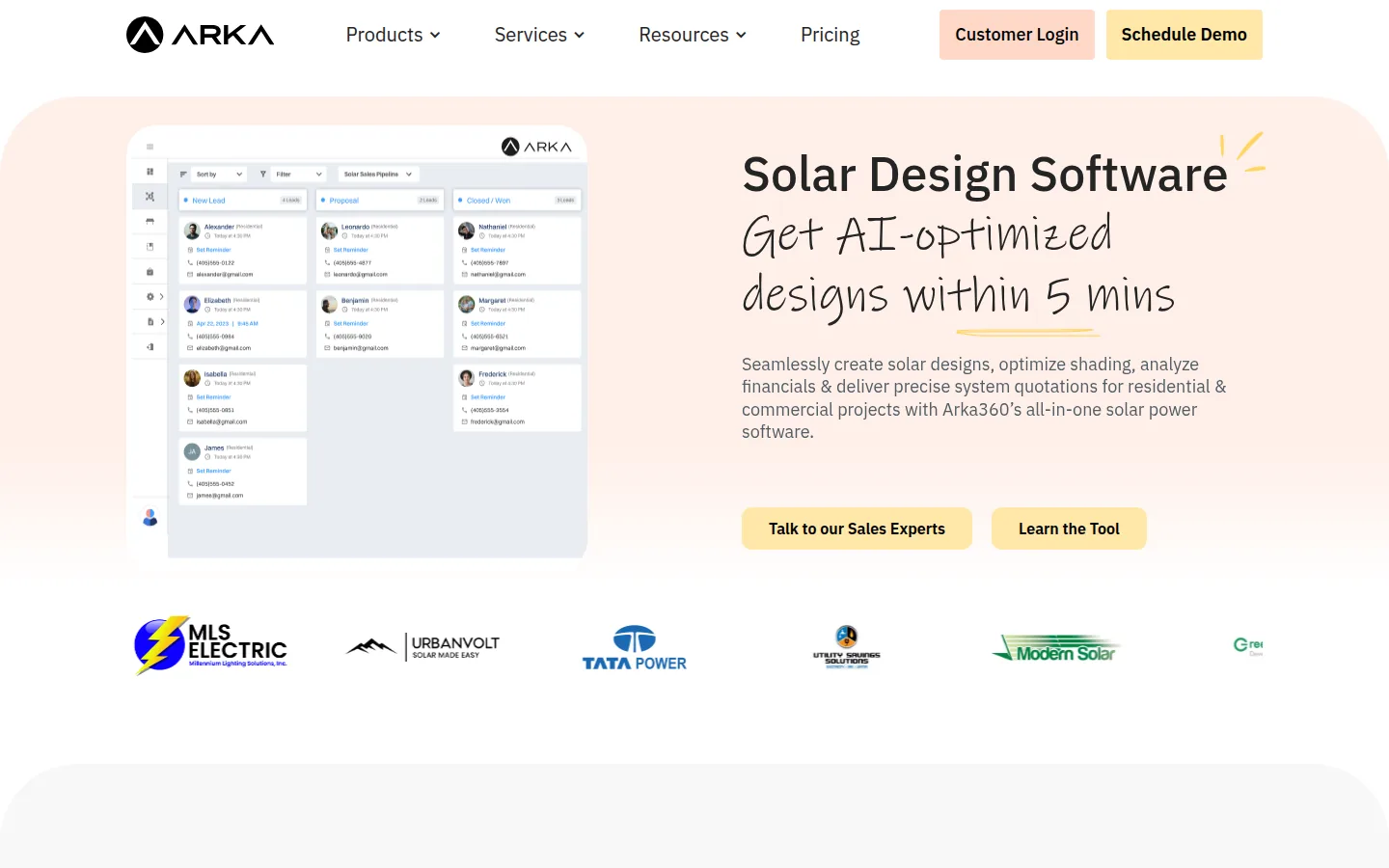
Best for: installers who want a vendor with Philippines pages and a vendor claim of Philippine tariff and permit modules.
Not the right choice if: you need a published peso price, or proof of how the Philippine tariff module works. The pages we read do not name Meralco or show the module.
What the vendor documents: its Philippines comparison page says Arka360 has “local permit templates and tariff modules” and “partial offline access”. These are the vendor’s own claims. On its pricing page, Basic lists basic design software, an engineering service portal, lead management, a shade report and a basic proposal. Premium adds AI assisted modeling, battery storage and backup sizing, CAD export and a customized proposal. Enterprise adds API integration.
Price (checked October 2026): the pricing page, which is titled for the USA, shows Basic at $199 per month with 1 user and Premium at $358 per month with 2 users. Enterprise is “Talk to Sales”. The page code also holds other price blocks, in rupees and in other dollar amounts. We quote only the dollar cards that display on the page. No peso price is shown.
Limitations: the vendor describes its Philippine modules in marketing text only. We did not see them work.
Vendor link: arka360.com.
Aurora Solar
Best for: teams already on Aurora that will enter the Meralco rate by hand.
Not the right choice if: you want a Philippine rate library or a peso price. The pages we read do not name the Philippines. They also do not say which imagery covers Philippine sites.
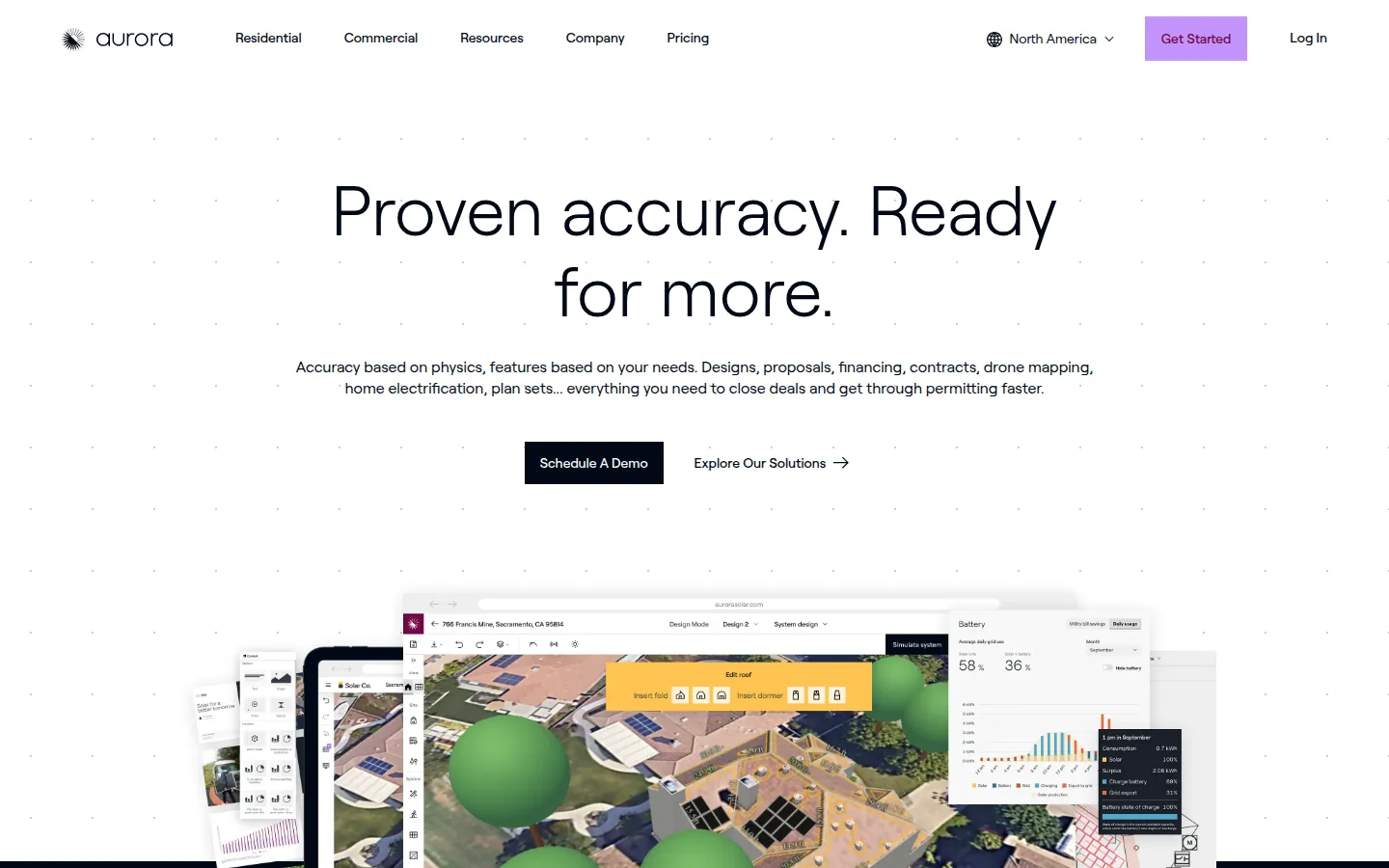
What the vendor documents: its help article Editing utility rates on a project says you can change the import rate, the export rate, rate details and the compensation policy. With net billing, Aurora works out savings from the rates before and after solar. Its Europe page says projects have been designed in 150+ countries.
Price (checked October 2026): Basic $159 per user per month billed monthly, or $135 per user per month billed annually ($1,620 billed annually); Premium $259 per user per month, or $220 billed annually ($2,640 billed annually). Enterprise is custom, by contacting Aurora. The page shows dollars and does not name the currency.
Limitations: no Philippine tariff or export rule is stated. You set the rates yourself.
Vendor link: aurorasolar.com.
Energy Toolbase
Best for: installers who sell solar plus storage to businesses and need to compare cash, PPA, loan and lease options.
Not the right choice if: you want to lay out panels in the same tool. Its ETB Developer page has a comparison table. For ETB Developer, it shows no in-app PV panel layout tool and shows PV design partnerships with design software tools. It is also not right if you need a published price.
What the vendor documents: its ETB Developer FAQ says the platform supports cash purchases, PPAs, loans and leases. It also says it can analyze standalone storage and solar plus storage. Its rate schedules help page says the rates database covers 50 states and 42 international territories, and that users can create custom rate schedules. The pages we read do not name the Philippines.
Price (checked October 2026): not published for ETB Developer. The pricing page says to book 30 minutes for a demo and pricing for your team size. The dollar figures on that page are for other products.
Limitations: the pages we read do not describe how an export credit is set. Net metering covers systems up to 100 kW, so check how a larger system is modeled.
Vendor link: energytoolbase.com.

OpenSolar
Best for: installers who want a free core app and will build the Meralco tariff as a custom tariff.
Not the right choice if: you want the Meralco rate already loaded. The pages we read do not name Meralco. The help center says to send the customer’s bill or the official tariff to its support team, which can create the custom tariff for you.
What the vendor documents: its help center has a Philippines Quick Start Guide with webinars in Tagalog and English and free online training. Its article How to create a tariff lists name, code, country, bill frequency and a solar compensation mechanism. The options are Net Billing, Net Billing with Credit Carryover, Buy All Sell All and Net Energy Metering. You can set flat, time-of-use, tiered and demand-charge rates.
Price (checked October 2026): the core app is free of charge for solar professionals, per the vendor. From 16 April 2026 the vendor charges for API Access, a per-project fee, and for supported connectors, a flat monthly subscription. API Access lets other software connect to OpenSolar. This comes from its 16 February 2026 post and its API page. Optional paid Enterprise Services: Support US$500 per month, Customize US$1,350 per month.
Limitations: check that the compensation option you pick matches Meralco’s rule that unused credits carry over and cannot be paid out in cash. No peso price or Philippine tariff is stated.
Vendor link: opensolar.com.
SurgePV
SurgePV is our product.
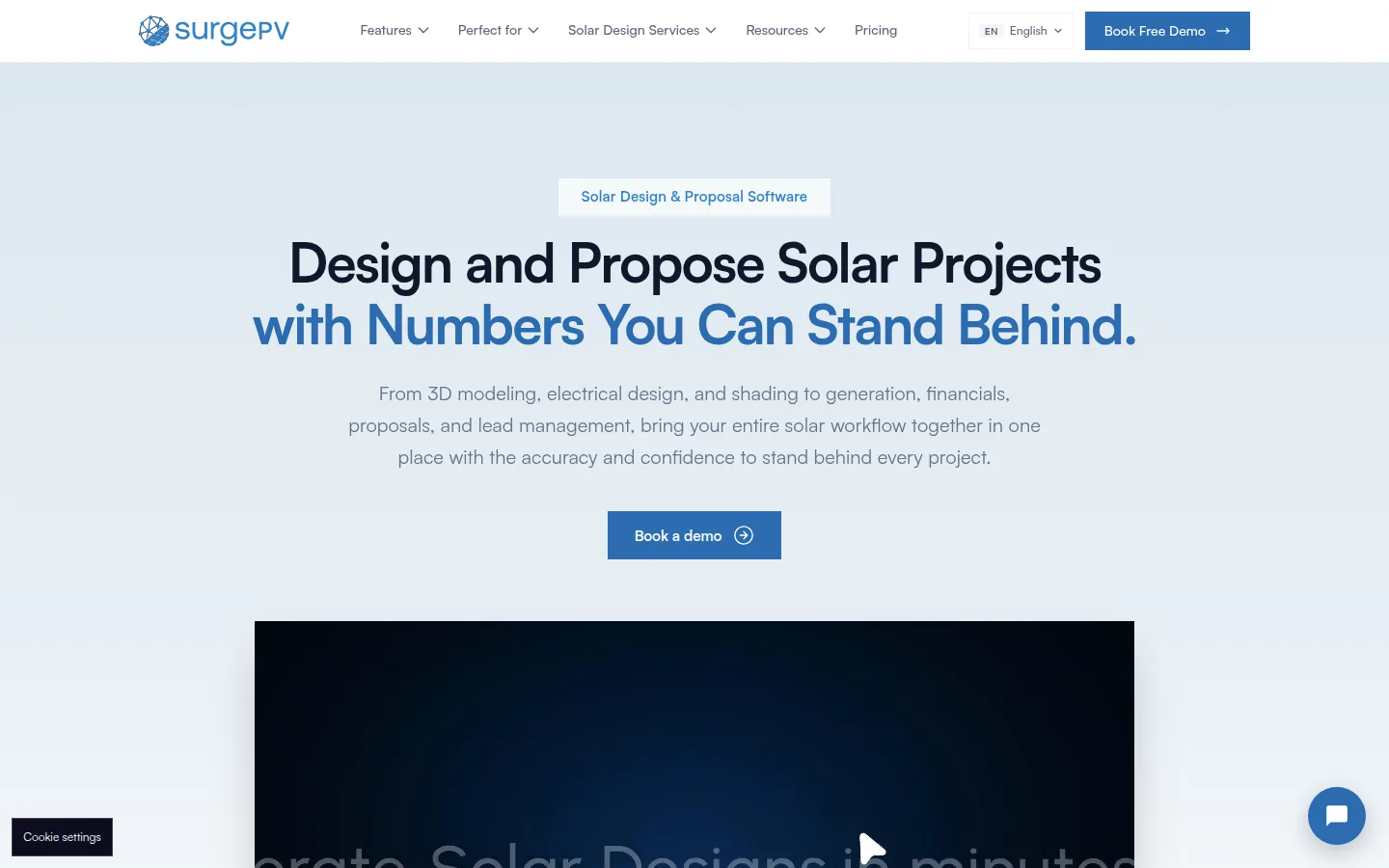
Best for: teams that want roof modeling, shading, yield, financial modeling, bill of materials (BOM, a parts list) and proposals in one product, priced per user. They will confirm the Philippine items in a demo.
Not the right choice if: you want a self-serve trial (SurgePV offers a guided demo). It is also not right if you need a peso price in writing before you talk to sales, because none is published. Skip it too if you need a documented Philippine tariff or export-credit workflow today. Outputs support design and documentation. They do not replace approval by the responsible engineer, authority, lender or utility. If you need a CRM, SurgePV’s published product scope does not list one; the pricing page lists lead management.
What the vendor documents: 3D roof modeling, array layout, shading analysis and energy-yield modeling. It also lists financial modeling, electrical workflow support, bill-of-materials output and proposal generation. See solar proposal software for the product page.
Price (checked October 2026): $1,899 per user per year for 1 user, $1,499 per user for 3 seats, $1,299 per user for 5 seats, in US dollars.
Limitations: results depend on source data, assumptions and equipment models. The pricing page and published scope do not name Meralco, a Philippine export credit or a peso price.
Vendor link: surgepv.com.
Philippines Rules That Shape the Choice
Net metering covers systems up to 100 kW. Net metering is a program where you send extra solar power to the grid and get a credit on your bill. The DOE’s 1 April 2026 media release says the program is under Republic Act No. 9513 and covers renewable energy systems of up to 100 kilowatts (kW). Meralco’s net metering page gives the same 100 kW limit. The pages we read do not say how a larger system is treated, so ask Meralco before you quote one with an export credit.
The export credit is the generation charge, not the full bill rate. Meralco’s page What is Net-Metering says your credit is the exported kWh times that month’s blended generation rate. It says exported energy uses Meralco’s monthly generation charge, based on its blended generation cost, before other generation adjustments. It also says unused credits carry over and cannot be converted to cash. An archived copy of DOE’s net metering guide states the same credit rule for every distribution utility (DU, the company that runs your local power network). It also says DUs must publish their monthly generation cost on their websites. We could not read the ERC’s own net metering resolution, because erc.gov.ph returned HTTP 403 to our reads.
Approval times are set by the DOE. The DOE release says DUs and electric cooperatives must finish processing within 10 working days, with no extension. Local government units (LGUs, the local government) must act on net metering permits within three working days. It says the order lasts while the declared State of National Energy Emergency lasts, unless the DOE ends it sooner. Check that it is still in force, and do not promise a fixed approval date in a proposal.
The application needs four documents. The ERC’s 22 September 2025 advisory limits what a DU can ask for. The list has four items. They are the application form and a Certificate of Final Electrical Inspection (CFEI) from the LGU. The other two are the amended Net-Metering Agreement and the Certificate of Compliance (COC) application fee, paid to the ERC. The advisory says DUs must not add requirements such as a bill of materials or solar equipment catalogs. We read this copy on Meralco’s file host, because erc.gov.ph blocked our reads. Meralco’s application steps follow the same list.
Meter cost and grid limits. For an existing residential customer, the advisory caps the meter swap charge at PHP 3,000. Testing and commissioning are at no cost to the applicant. Meralco’s application page lists a hosting capacity by transformer size. A 25 kVA transformer allows 10 kW. A 50 kVA transformer allows 19 kW. This applies to single-phase transformers in Meralco’s area, and Meralco makes the final check. Size your proposal against that limit.
Money and units. Proposals for Philippine homes should show pesos and kW. None of the five vendors here publishes a peso price.
Regulator pointers. The DOE (doe.gov.ph) and the ERC (erc.gov.ph, which blocked our reads) set the rules. Your DU runs the application. Our Philippines compliance guide covers wider installer topics.
How We Ordered These Tools
We did not rank these tools. They are listed alphabetically, and the best-for picks come from the matrix above.
- Separate export price: the credit for exported power is lower than what self-use saves, so the tool must price them apart. We did not assess whether any tool matches Meralco’s rule.
- Own tariff entry: the Meralco rate may not be preloaded, so you need a way to enter it. We did not assess how accurate any entered tariff is.
- Philippines page or support: local help saves time at setup. We did not assess the quality of that help.
- Peso price: a peso price shows what a Philippine buyer will pay. We did not assess discounts or negotiated quotes.
- Free tier: a free plan lets a small team test the workflow. We did not assess its limits beyond what the page states.
Sources and Dates
Vendor pages were read in October 2026. The sources are Arka360 (pricing and the Philippines comparison page above), Aurora (pricing and the help article above), Energy Toolbase (pricing, FAQ and help page above), OpenSolar (free and the help articles above), and SurgePV (pricing). Government and utility sources: the DOE media release, the ERC advisory, and the Meralco pages linked above. Help-center articles were read in a browser.
See SurgePV on your Philippines project
Book a guided demo and ask for the Philippine tariff and export lines you need in the proposal.
Book a Free DemoMore Solar Software Guides to Compare
- Best solar software in the Philippines
- Solar design software for the Philippines
- Solar proposal software for Malaysia and Indonesia, the nearest country lists
- Best solar proposal software, all markets
Frequently Asked Questions
What is the best solar proposal software in the Philippines?
It depends on the job. From what the vendors publish, OpenSolar’s core app is free and has a Philippines Quick Start Guide. The vendor charges for API Access and connectors from 16 April 2026. Arka360 says it has Philippine tariff and permit modules, but we could not see them work. Energy Toolbase suits commercial solar plus storage. Ask each vendor to quote one real Meralco job.
Can proposal software model Philippine net metering credits?
Some tools let you set an export rate yourself. OpenSolar lets you pick a compensation mechanism, including Net Billing with Credit Carryover. Aurora lets you edit the export rate and compensation policy on a project. No vendor here states a built-in Philippine export rule on the pages we read. Check that the credit follows Meralco’s rule before you send a quote.
What export rate should a Philippine solar proposal use?
Meralco says exported energy is credited at its monthly generation charge, based on its blended generation cost, before other generation adjustments. Unused credits carry over and cannot be paid out in cash. Net metering covers systems up to 100 kW, per the DOE. Use the current monthly rate from your utility, not the full bill rate.
Does proposal software support Meralco tariff analysis?
The pages we read do not name Meralco for any of the five vendors. OpenSolar and Energy Toolbase let you create custom tariffs or rate schedules. Aurora lets you edit rates on a project. Arka360 says it has tariff modules for the Philippines but shows no detail. SurgePV’s published scope does not mention it.
How much does solar proposal software cost in the Philippines?
No vendor here publishes a peso price. OpenSolar’s core app is free, and the vendor charges for API Access and supported connectors from 16 April 2026. Arka360 shows $199 per month for Basic and $358 per month for Premium. Aurora lists $159 per user per month for Basic when billed monthly. Energy Toolbase publishes no price. SurgePV lists $1,899 per user per year for one user. Ask for a written peso quote.
What does a Philippine net metering application need?
The ERC’s 22 September 2025 advisory limits the list to four items. These are the application form, a CFEI from the local government, the amended Net-Metering Agreement, and the COC application fee paid to the ERC. DUs must not ask for extras such as a bill of materials or equipment catalogs. The DOE says DUs and electric cooperatives must finish within 10 working days.
