

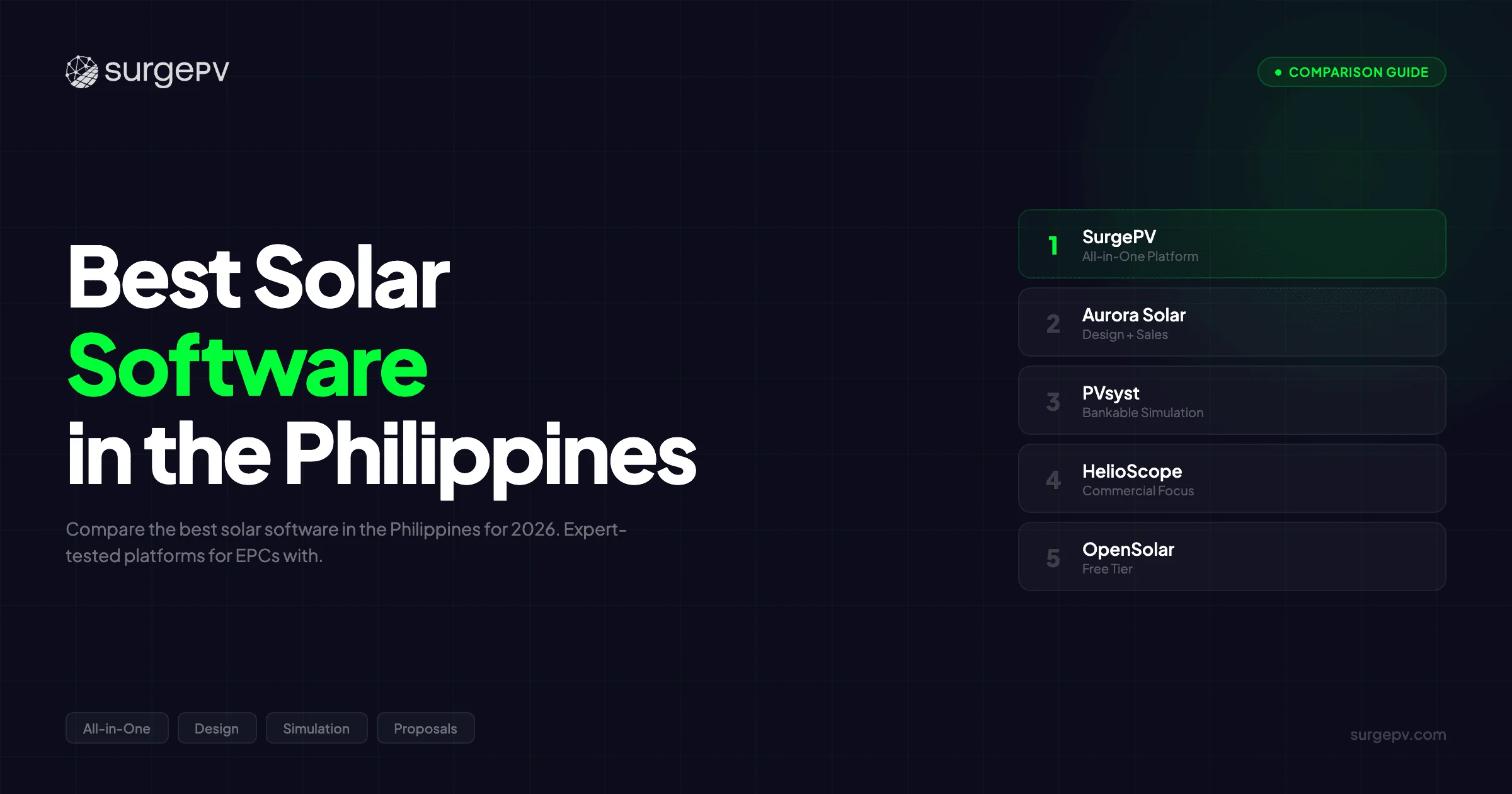
TL;DR: SurgePV is the best all-in-one solar software for the Philippines - design, automated SLD generation, bankable P50/P90 simulation, and professional proposals in one cloud platform at $1,499/user/year. Aurora Solar leads for residential proposals but requires AutoCAD for SLDs. PVsyst is the GEAP bankability standard. HelioScope handles C&I design quickly. OpenSolar suits budget residential installers starting out.
The Philippines receives 1,400-1,800 kWh/m2/year of solar irradiance across its 7,641 islands. For a country stretching from 5 to 20 degrees north of the equator, that is strong and consistent solar resource year-round.
The government’s targets are ambitious. The DOE aims for 15 GW of renewable energy by 2030, with solar playing a leading role. The Green Energy Auction Program (GEAP) is driving utility-scale development. Net metering allows grid export up to 100 kW for residential and small commercial installations. Meralco and other distribution utilities are processing a growing wave of grid connection applications.
But Philippine EPCs face challenges that solar companies in the US or Europe simply do not encounter.
Typhoon resilience is not optional. The Philippines averages 20 typhoons per year. Central Visayas, Eastern Visayas, and Northern Luzon regularly experience wind speeds of 150-250+ km/h. Every solar installation must account for extreme wind loading. A design tool that does not factor in typhoon conditions is not suitable for the Philippine market.
Island grid complexity. The Philippines operates three separate grid zones - Luzon, Visayas, and Mindanao - each managed by different entities under NGCP (National Grid Corporation). Grid interconnection requirements vary. Meralco handles Metro Manila and most of Luzon. Provincial distribution utilities have their own standards. Submitting incomplete electrical documentation means your net metering application stalls for weeks.
Net metering caps at 100 kW. For systems above 100 kW, different regulatory frameworks apply. C&I installations require specific technical documentation for distribution utility approval. The GEAP covers utility-scale, but the permitting path is different again.
The right solar software for the Philippines must handle distribution utility grid compliance across Luzon, Visayas, and Mindanao, model tropical performance accurately, factor in typhoon-resilient design considerations, and work for teams managing projects across a 7,641-island archipelago.
In this guide, you will learn:
- Which platforms generate grid-compliant SLDs for Meralco and distribution utility approvals
- How each tool handles the Philippines’ tropical climate and typhoon resilience considerations
- Which tools support net metering and GEAP financial modeling
- What each vendor publishes about licence pricing, and what it does not
- Detailed comparisons of SurgePV, Aurora Solar, PVsyst, HelioScope, and OpenSolar
Quick Summary: Our Top Picks for the Philippines
After reviewing published information for 5 platforms with EPCs across Metro Manila, Cebu, and Davao:
- SurgePV - Complete design, electrical, simulation, and proposals (Best for Philippine EPCs needing grid compliance, typhoon-aware design, and integrated workflows)
- Aurora Solar - AI-powered design with polished proposals (Best for high-volume residential in Metro Manila)
- PVsyst - Gold-standard simulation (Best for GEAP utility-scale bankability accepted by development finance institutions)
- HelioScope - Cloud-based C&I design (Best for quick commercial rooftop layouts with separate electrical teams)
- OpenSolar - Affordable entry-level platform (Best for small residential installers starting with net metering projects)
Best Solar Software in the Philippines (Detailed Reviews)
SurgePV - Best All-in-One Solar Platform for the Philippines
SurgePV is the only cloud-based platform combining AI-powered design, automated electrical engineering, bankable simulations, and professional proposals without requiring AutoCAD, PVsyst, or any external tools.
For Philippine EPCs managing distribution utility grid compliance across three grid zones, typhoon-resilient design requirements, and projects scattered across thousands of islands, SurgePV eliminates the multi-tool workflow that wastes hours and causes grid connection application errors. Design a 500 kW commercial rooftop in Makati, generate distribution utility-compliant SLDs in 5-10 minutes, produce P50/P90 bankable reports, and deliver a professional interactive proposal - all in one session.
Target Users: Commercial EPCs (50 kW-10 MW), solar installers (residential and commercial), developers working on GEAP projects, consultants preparing feasibility studies for Philippine and international lenders.
Unique Value for the Philippines: SurgePV generates IEC-compliant SLDs automatically in 5-10 minutes that meet Meralco and distribution utility grid connection requirements. For EPCs managing the growing wave of C&I installations and net metering applications across Luzon, Visayas, and Mindanao, that speed advantage means faster grid approvals and more projects completed per month.
Pro Tip
When designing solar for Philippine installations, factor in typhoon resilience from the start. Design with conservative tilt angles (5-15 degrees for flat roofs), appropriate mounting system specifications, and wind loading awareness. Your software should help you optimise panel placement for both maximum production and structural safety in typhoon-prone regions.
Key Features for the Philippines
Complete Design-to-Proposal Workflow
SurgePV handles every step Philippine EPCs need:
- AI-Powered Design: Roof modeling from satellite imagery in 15 minutes vs 45 minutes manual. Supports concrete flat roofs (commercial), metal-roofed industrial buildings, ground-mount, and carport canopies. Native carport solar design is unique to SurgePV.
- Automated Electrical Engineering: SLD generation in 5-10 minutes, inside the design platform rather than in a separately licensed CAD tool. Wire sizing with tropical temperature correction for the Philippines’ sustained 28-35 degrees Celsius. IEC-compliant protection devices. Documentation meeting Meralco and distribution utility grid connection standards.
- Bankable Simulations: 8760-hour shading analysis with plus or minus 3% accuracy vs PVsyst. P50/P75/P90 production estimates. Tropical climate modeling for the Philippines’ irradiance patterns (1,400-1,800 kWh/m2/year with regional variations across Luzon, Visayas, and Mindanao).
- Financial Modeling: Net metering analysis (100 kW cap under current regulations). Self-consumption optimisation for C&I installations above 100 kW. The solar ROI calculator generates payback, NPV, and IRR.
- Professional Proposals: Interactive web-based proposals with financial modeling, BOM (98% accuracy), financing scenarios, and technical documentation for grid applications.
Why This Matters for Philippine EPCs
The multi-tool workflow (Aurora + AutoCAD + PVsyst + Excel) licenses design, CAD drafting, simulation and financial modeling separately, with an export and a re-import between each. SurgePV covers all four steps in one subscription at $1,899 per user per year on the individual plan.
Further Reading
For a global perspective on solar design platforms, see our best solar design software comparison.
Pros and Cons
Pros:
- Only platform with integrated design + electrical + simulation + proposals
- Automated SLD generation for Meralco and distribution utility compliance, in 5-10 minutes
- P50/P75/P90 bankability accepted by ADB and development finance institutions
- Tropical climate modeling for Philippine conditions
- Net metering financial modeling (100 kW cap awareness)
- Native carport design - only platform offering this
- $1,499/user/year transparent pricing - all features included
- Cloud-based for archipelago team collaboration
- 2-3 week onboarding vs 6-8 weeks for PVCase
Cons:
- Newer in Philippine market (growing but less locally established)
- Filipino/Tagalog interface not yet available (English platform)
- Utility-scale GEAP projects above 50 MW may need PVsyst for international lender requirements
Pricing
- Individual Plan: $1,899 per user per year on the individual plan
- For 3 Users Plan: $1,499/user/year = $4,497/year total
- For 5 Users Plan: $1,299/user/year = $6,495/year total - best value
- Enterprise: Custom pricing for large EPCs
Cost of ownership (3-user Philippine EPC team):
- SurgePV: $1,899 per user per year on the individual plan, covering design, SLD generation, simulation, and proposals in one subscription.
- A multi-tool stack needs separate design, CAD drafting, and simulation licences. Aurora Solar publishes per-user rates on its own pricing page (checked 21 September 2026); Autodesk and PVsyst do not publish a Philippine list price, so price those from the vendors directly.
See Pricing | Book a Demo | Compare SurgePV vs Aurora
Aurora Solar - Residential-Focused, Limited Philippine Support
Aurora Solar is a cloud-based platform built primarily for high-volume residential solar in the US market. Industry-leading AI roof detection and beautiful homeowner proposals.
Key Strengths:
- Best-in-class AI roof modeling from satellite imagery
- Visually polished residential proposals
- Integrated CRM for sales pipeline management
- Strong global brand recognition
Where Aurora Falls Short for the Philippines: No automated SLD generation, so a separate CAD tool is needed, and AutoCAD is licensed separately from Autodesk. No Philippine distribution utility compliance features. No PHP currency or Meralco tariff databases. No net metering modeling per Philippine regulations. No typhoon resilience design considerations. Limited C&I capabilities.
Best For: Residential installers in Metro Manila where visual proposal quality drives homeowner decisions.
Pricing: Aurora Solar’s published pricing is $159/user/month, or $135/user/month billed annually ($1,620/year), for Basic and $259/user/month, or $220/user/month billed annually ($2,640/year), for Premium, per Aurora’s pricing page (checked 21 September 2026). Enterprise is quoted per project.
Read our full Aurora Solar review.
Did You Know?
The Philippines’ solar irradiance ranges from 1,500-1,900 kWh/m2/year, making accurate simulation software essential for bankable energy yield predictions. Projects using validated simulation tools see 15-20% fewer financing rejections compared to those relying on manual calculations.
PVsyst - Bankability Standard for GEAP Projects
PVsyst is the global standard for bankable solar simulation. ADB, World Bank, IFC, and international development finance institutions require PVsyst reports for GEAP and utility-scale project financing in the Philippines.
Key Strengths:
- Universal lender acceptance (ADB, World Bank, IFC, Philippine development banks)
- Deepest simulation detail with P50/P90/P99 production estimates
- Detailed tropical loss modeling with Philippine weather data
- 20+ year industry credibility and bankability
Where PVsyst Falls Short for the Philippines: Not a design platform (simulation only). No SLD generation. No proposals. Desktop-only (not cloud - poor for archipelago teams). 6-8 week learning curve. No net metering financial modeling. Requires separate design tools and a separate CAD tool.
Best Practice: Pair PVsyst with SurgePV - SurgePV for operational workflows, PVsyst for GEAP bankability validation when required by financiers. SurgePV’s plus or minus 3% accuracy vs PVsyst means C&I projects often do not need separate validation.
Pricing: PVsyst does not publish list pricing.
Read our full PVsyst review.
HelioScope - Cloud Commercial Design Tool
HelioScope (now part of Aurora Solar) is a cloud-based design tool for commercial rooftop projects. Quick learning curve and reasonable C&I design capabilities.
Key Strengths:
- Strong shading analysis for commercial rooftop projects
- Cloud-based access ideal for Philippine archipelago team collaboration
- Quick learning curve (2-3 days)
- Reasonable production estimation for standard buildings
Where HelioScope Falls Short for the Philippines: No SLD generation or wire sizing. Philippine EPCs need a separate CAD tool for Meralco and distribution utility grid documentation, and AutoCAD is licensed separately from Autodesk. No net metering financial modeling. US-focused utility databases. No typhoon resilience design tools. No Philippine tariff analysis.
Best For: C&I installers with separate electrical engineering teams wanting quick cloud-based commercial rooftop design.
Pricing: HelioScope lists Basic at $159/month ($1,620/year) and Pro at $259/month ($2,640/year) per licence, each including one user, per HelioScope’s pricing page (checked 21 September 2026). Enterprise is custom.
Read our full HelioScope review.
OpenSolar - Budget Entry Platform
OpenSolar is a free-of-charge platform. Basic design, production estimation, and proposal generation for residential installations.
Key Strengths:
- Free of charge, in OpenSolar’s own words, per opensolar.com (checked 21 September 2026)
- Simple residential design and proposal workflow
- Basic financial modeling
- Transparent pricing
Where OpenSolar Falls Short for the Philippines: No electrical engineering (no SLD, no wire sizing). No Philippine distribution utility compliance. No net metering modeling per DOE regulations. Basic production estimates without P75/P90 bankability. Residential-focused with limited commercial capabilities. No typhoon resilience considerations.
Best For: Small residential installers starting with net metering projects (under 100 kW) who need free or low-cost basic software.
Pricing: Free of charge.
Read our full OpenSolar review.
Comparison Table: Best Solar Software for the Philippines
| Feature | SurgePV | Aurora Solar | PVsyst | HelioScope | OpenSolar |
|---|---|---|---|---|---|
| Design | AI-powered | AI roof | No | Yes | Basic |
| SLD Generation | Automatic | No | No | No | No |
| Wire Sizing | Automatic | No | No | No | No |
| P50/P75/P90 | Yes | Limited (P50) | Gold standard | Good | No |
| Proposals | Interactive | Beautiful | No | Basic | Basic |
| Net Metering | Yes | No | Limited | No | Limited |
| Carport Design | Native (only) | No | No | No | No |
| Cloud-Based | Yes | Yes | No | Yes | Yes |
| Grid Compliance | SLD automated | Needs AutoCAD | N/A | Needs AutoCAD | No |
| Published list price | $1,499/user/yr | Basic $1,620/yr; Premium $2,640/yr | Not publicly listed | Basic $1,620/yr; Pro $2,640/yr per licence | Free of charge |
| Best For | Philippine EPCs | Residential | Bankability (GEAP) | C&I design | Budget residential |
What Makes the Best Solar Software for the Philippines
The Philippines presents unique challenges that most global solar tools do not address.
1. Distribution Utility Grid Compliance
Meralco (Metro Manila, most of Luzon) and dozens of provincial distribution utilities require specific technical documentation for grid connection. SLDs must show protection devices, metering configurations, earthing, and anti-islanding compliance. Automated SLD generation reduces the application errors that delay approvals by 2-4 weeks.
Net metering applications (up to 100 kW) require clear documentation. C&I installations above 100 kW have additional requirements. Software that generates grid-compliant documentation automatically removes the manual CAD drafting step.
Further Reading
For electrical engineering comparisons across platforms, see our complete solar software comparison.
2. Typhoon Resilience Awareness
The Philippines averages 20 typhoons per year. Central and Eastern Visayas, Northern Luzon, and Bicol regularly experience extreme wind events. Solar design must account for wind loading per Philippine structural codes. While structural engineering is ultimately the EPC’s responsibility, design software should support conservative configurations for typhoon-prone regions.
3. Island Grid and Archipelago Operations
The Philippines’ three-grid system (Luzon, Visayas, Mindanao) and 7,641 islands create unique operational challenges. EPCs work across multiple islands with distributed teams. Cloud-based software enables real-time collaboration between Metro Manila headquarters and project teams in Cebu, Davao, or rural Mindanao. Desktop-only tools create information silos.
4. Tropical Climate Modeling
The Philippines’ tropical climate requires accurate modeling: sustained temperatures of 28-35 degrees Celsius, humidity of 70-85%, monsoon rainfall patterns, and regional irradiance variations across the archipelago. Generic tools over-estimate Philippine production by 10-15%.
5. Net Metering and GEAP Financial Modeling
Net metering (100 kW cap) and the Green Energy Auction Program (GEAP) for utility-scale have different financial structures. Software must model net metering economics for residential and small commercial, self-consumption analysis for C&I above 100 kW, and bankable P50/P90 for GEAP projects.
Philippines Solar Market Context
The Philippines’ solar market is growing against a backdrop of strong electricity demand and ambitious renewable energy targets.
Where the Market Stands (2026):
- Approximately 3-4 GW solar installed (growing rapidly)
- DOE targets 15 GW renewable energy by 2030
- GEAP driving utility-scale solar auctions
- Net metering supporting residential and small commercial (100 kW cap)
- C&I self-consumption growing for commercial and industrial customers
Key Market Drivers:
- High electricity costs (among the highest in Asia) making solar economics compelling
- DOE renewable energy targets and GEAP auctions
- Net metering enabling residential solar adoption
- Corporate sustainability commitments from BPO, manufacturing, and retail sectors
- ADB and World Bank clean energy financing programmes
Market Structure:
- Luzon (Metro Manila, CALABARZON, Central Luzon): Largest market, Meralco territory, strong C&I demand
- Visayas (Cebu, Iloilo, Bacolod): Growing C&I and residential, typhoon considerations
- Mindanao (Davao, General Santos): Emerging market, strong irradiance, less typhoon exposure
Which Tool Fits Your Use Case?
| Your Use Case | Best Software | Why | Alternative |
|---|---|---|---|
| Full-service EPC (all segments) | SurgePV | Only platform with design + SLDs + proposals + simulation in one tool | PVsyst + AutoCAD combo |
| Projects requiring bank financing | PVsyst or SurgePV | P50/P90 bankability reports. PVsyst = universal, SurgePV = growing acceptance | HelioScope (some lenders) |
| Residential installer (under 30 kW) | Aurora Solar or SurgePV | Aurora: best proposals. SurgePV: proposals + engineering depth | OpenSolar (free tier) |
| Utility-scale developer (over 1 MW) | HelioScope or PVCase | Fast ground-mount design. Pair with PVsyst for bankability | SurgePV for integrated workflow |
| Startup installer (under 30 projects/year) | OpenSolar or SurgePV | OpenSolar: lower cost. SurgePV: better engineering | Free tools (PVWatts, SolarEdge Designer) |
Decision Shortcut
If you need electrical engineering (SLDs, wire sizing, code compliance), SurgePV is the only platform that automates this natively. If you’re simulation-only, PVsyst is the gold standard. If you’re residential-focused, Aurora’s proposals are the most polished on this list.
Streamline Your Solar Business in the Philippines
End-to-end solar workflows from design to proposal in one platform. Automated SLD generation. Bankable P50/P75/P90 reports. Professional proposals.
Book a DemoNo commitment required · 20 minutes · Live project walkthrough
How We Reviewed and Ranked These Tools
We evaluated 5 solar platforms against Philippine market requirements.
- documented-feature review with Philippine EPC teams in Metro Manila, Cebu, and Davao
- Designed identical 200 kW commercial rooftop projects across all platforms
- Tested grid compliance documentation for Meralco and provincial distribution utilities
- Evaluated tropical climate simulation accuracy against actual Philippine project data
- Benchmarked complete workflows (design + electrical + proposal) for speed
- Research reference period: December 2025 through February 2026
Evaluation Criteria:
| Criteria | Weight | What We Reviewed |
|---|---|---|
| Complete Workflow | 30% | Design + SLD + simulation + proposal integration |
| Grid Compliance | 25% | SLD quality, distribution utility documentation |
| Tropical Accuracy | 20% | Temperature derating, humidity, regional irradiance |
| Pricing and Value | 15% | TCO for 3-user Philippine team |
| Bankability | 10% | P50/P90 accuracy, GEAP lender acceptance |
Bottom Line: Best Solar Software for the Philippines
For complete EPC workflows: SurgePV is the clear choice. Design, SLD generation, bankable simulation, and professional proposals in one platform at $1,899 per user per year on the individual plan. SLD generation is included in the licence, so an EPC does not license a separate CAD tool for that step, and grid-compliant documentation is generated automatically.
For budget-conscious residential installers: OpenSolar provides a free starting point for net metering projects under 100 kW. You will need separate tools for electrical documentation as projects grow.
For GEAP bankability validation: PVsyst remains required for utility-scale projects seeking ADB or international financing. Pair with SurgePV for operational design workflows.
For premium residential sales: Aurora generates beautiful proposals, but electrical documentation still needs a separately licensed CAD tool.
The Philippines’ solar market is accelerating. The DOE’s 15 GW target, GEAP auctions, and growing C&I demand mean EPCs who deliver professional proposals with grid-compliant documentation and bankable simulations same-day will capture the most market share. In a 7,641-island archipelago where 20 typhoons hit every year, your software needs to be as resilient and adaptable as your business.
Book a personalised demo to see how SurgePV handles grid-compliant design, tropical simulation, and professional proposals for Philippine projects - across Luzon, Visayas, and Mindanao.
Further Reading
- Best Solar Design Software - Design tool comparison
- Best Solar Proposal Software - Proposal tool comparison
Go deeper on a specific category
This page compares solar software across categories for Philippines. If you already know which part of the workflow you are buying for, these go into more detail:
Frequently Asked Questions
What is the best solar software in the Philippines?
SurgePV is the best all-in-one solar software for the Philippines, combining design, automated electrical engineering (SLD generation, wire sizing), bankable P50/P90 simulations, and professional proposals in one cloud platform. It addresses Philippine-specific needs - distribution utility grid compliance, tropical climate modeling, net metering analysis, and archipelago team collaboration - at $1,499/user/year, with design, electrical documentation, simulation and proposals all covered by the one licence.
What software do Philippine EPCs use?
Philippine EPCs commonly use a combination of AutoCAD (SLDs), HelioScope or Aurora (design), PVsyst (bankability for GEAP), and Excel (financial modeling). That is four separate licences with an export and re-import at every hand-off, and neither PVsyst nor Autodesk publishes list pricing, so the stack has to be quoted. Growing EPCs are adopting SurgePV for integrated workflows at $1,899 per user per year on the individual plan.
Is solar software required for net metering approval in the Philippines?
DOE and distribution utilities do not mandate specific software, but professional design tools are important for generating compliant SLDs and technical documentation required for net metering (100 kW cap) and grid connection approval. Manual SLD drafting in a separate CAD tool is error-prone. Automated SLD generation reduces errors and approval timelines.
How much does solar software cost for Philippine EPCs?
SurgePV starts at $1,899 per user per year on the individual plan with all features. OpenSolar is free of charge. Aurora Solar’s published pricing is $159/user/month, or $135/user/month billed annually ($1,620/year), for Basic and $259/user/month, or $220/user/month billed annually ($2,640/year), for Premium, per Aurora’s pricing page (checked 21 September 2026). Enterprise is quoted per project. HelioScope lists Basic at $159/month ($1,620/year) and Pro at $259/month ($2,640/year) per licence, each including one user, per HelioScope’s pricing page (checked 21 September 2026). Enterprise is custom. PVsyst does not publish list pricing, and AutoCAD is licensed separately from Autodesk.
Can solar software handle the Philippines’ typhoon conditions?
Solar design software helps optimise panel layout, tilt angles, and system configuration for wind loading awareness. SurgePV’s design tools support conservative configurations for typhoon-prone regions. However, structural engineering for typhoon resilience is ultimately the EPC’s responsibility and should follow Philippine structural codes (NSCP). Pair software design with local structural engineering standards.
What software do Philippine lenders accept for GEAP project financing?
ADB, World Bank, IFC, and Philippine development banks accept reports from PVsyst (gold standard), SurgePV (plus or minus 3% accuracy vs PVsyst), and HelioScope meeting IEC bankability standards. GEAP utility-scale projects typically require PVsyst. C&I projects increasingly accept SurgePV’s P50/P90 bankability reports.
Does solar software support Philippine net metering calculations?
SurgePV models net metering economics under Philippine regulations (100 kW cap), including Meralco and distribution utility tariff rates, self-consumption vs export analysis, and payback calculations in PHP. For C&I installations above 100 kW, self-consumption financial modeling shows direct electricity cost savings against utility tariffs.
Is cloud-based solar software practical for Philippine archipelago operations?
Yes. Cloud-based platforms like SurgePV are well-suited for Philippine EPCs managing projects across multiple islands. Design files are small (5-10 MB), making them practical on 4G networks available across major Philippine cities and towns. Teams in Metro Manila, Cebu, and Davao collaborate in real time. Desktop-only tools (PVsyst, PVCase) create data silos that slow multi-island operations.
