

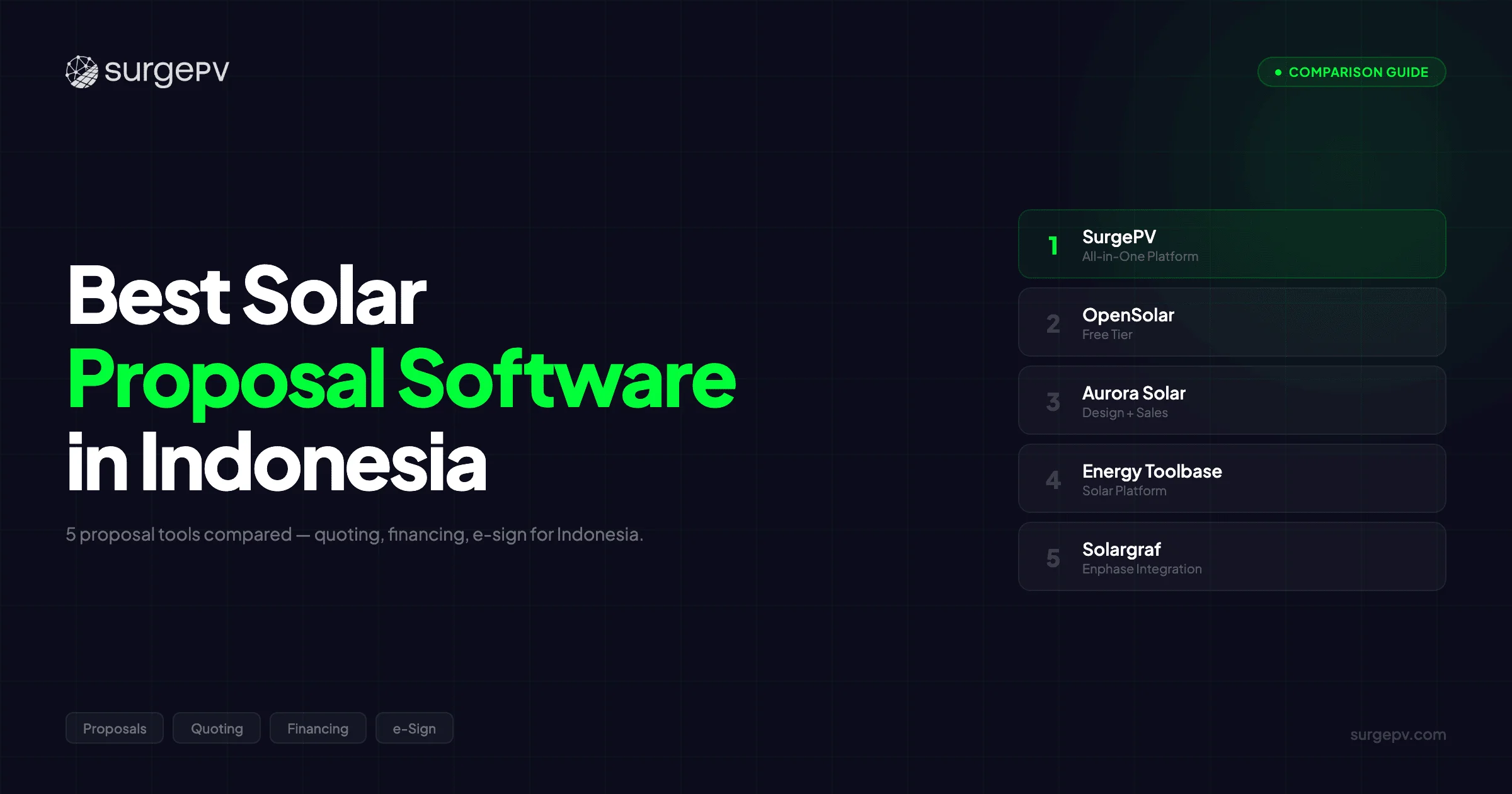
TL;DR: SurgePV is the best solar proposal software for Indonesia — automated proposal generation with PLN net metering modelling and ESDM-compliant financial analysis. OpenSolar offers a free entry tier for smaller installers.
Indonesian Solar Installers Lose 60% of Bids Because They’re Too Slow.
Indonesia has 200+ registered solar installers competing for every C&I rooftop project. On a typical 300 kW factory bid in Cikarang industrial estate, 3–5 EPCs submit proposals. The company that delivers a professional, accurate proposal within 48 hours gets the meeting with the factory owner. The company still building their Excel model after a week doesn’t even get a response.
Manual proposal creation takes 4–8 hours for a single Indonesian C&I project. Pull design data from one tool, simulation results from another, financial modeling from Excel, format everything in Word or PowerPoint, and manually calculate net metering savings per ESDM 49/2018. Every manual step introduces errors. Every hour of delay gives your competitor an advantage.
And Indonesian C&I buyers are getting more sophisticated. Factory CFOs in Java’s industrial zones want detailed self-consumption analysis, not just “your system will save money.” They want to see their specific PLN tariff rates, peak vs off-peak analysis, payback calculations with real financing terms from Bank Mandiri or BNI, and O&M cost projections. Government tenders require even more: SLDs, BOMs, project timelines, equipment certifications, and past project references.
The right solar proposal software for Indonesia must generate professional proposals in minutes, model net metering and self-consumption accurately per Indonesian regulations, produce tender-ready documentation for government RFPs, and work for teams distributed across the archipelago.
In this guide, you’ll learn:
- Which platforms generate Indonesian solar proposals fastest
- How each tool handles net metering and PLN tariff modeling
- Which tools produce tender-ready documentation for government and corporate RFPs
- Total cost comparison for Indonesian sales teams
- Detailed comparisons of SurgePV, OpenSolar, Aurora Solar, Energy Toolbase, and Solargraf
Quick Summary: Our Top Picks for Indonesia
After reviewing published information for 5 platforms with solar sales teams across Indonesia, here are our top recommendations:
- SurgePV — End-to-end design, simulation, and proposal (Best for C&I EPCs needing tender-ready proposals with net metering analysis)
- OpenSolar — Free proposal generation (Best for budget-conscious small residential installers)
- Aurora Solar — Beautiful residential proposals with AI design (Best for premium residential presentations)
- Energy Toolbase — Solar+storage financial modeling (Best for C&I with battery storage projects)
- Solargraf — Mobile-first residential sales (Best for field teams closing residential deals on-site)
Each tool evaluated on proposal speed, financial accuracy, tender documentation, net metering modeling, and Indonesia market fit.
Best Solar Proposal Software in Indonesia (Detailed Reviews)
| Software | Best For | Pricing | Indonesia Fit |
|---|---|---|---|
| SurgePV | All-in-one proposals + design | ~$1,899/yr (3 users) | Excellent |
| OpenSolar | Free proposals | Free of charge | Good |
| Aurora Solar | AI-powered proposals | $1,620 Basic, $2,640 Premium billed annually per user (aurorasolar.com/pricing, checked 21 September 2026) | Good |
| Energy Toolbase | Storage proposals | Contact for pricing | Good |
| Solargraf | Residential proposals | Contact for pricing | Good |
SurgePV — Best End-to-End Design and Proposal Platform for Indonesia
About SurgePV
SurgePV connects design, simulation, and proposal generation in one workflow. Your proposal numbers come directly from your design data and simulation results — no manual data entry, no copy-paste errors, no disconnected spreadsheets.
For Indonesian EPCs where 3–5 companies bid on every C&I project, this integration means you deliver accurate, professional proposals in 15–20 minutes instead of 4–8 hours. When the factory owner in Bekasi calls back to ask about a layout change, you update the design and regenerate the proposal in 10 minutes. Your competitor using Excel takes a day.
Target Users: C&I EPCs bidding on factory and warehouse projects, developers preparing corporate PPA proposals, installers responding to government tenders, consultants creating feasibility studies.
Unique Value for Indonesia: SurgePV generates proposals with PLN net metering calculations per ESDM 49/2018, self-consumption analysis with load profile matching, and PLN tariff savings projections. The proposal includes technical documentation (SLD, BOM, equipment specs) that tender evaluators require — generated automatically from the same design data.
Pro Tip
For Indonesian government tenders, always include the single line diagram in your proposal appendix. Most competing bidders submit proposals without SLDs and submit them separately later. Including PLN-compliant electrical documentation in the initial proposal demonstrates technical readiness and differentiates your bid from price-only competitors.
Key Features for Indonesia
Proposal Generation and Speed
SurgePV generates professional proposals in 15–20 minutes from design completion. Output includes executive summary, system design visualization, tropical-adjusted production estimates, financial analysis with payback/NPV/IRR, BOM with pricing, timeline, and warranty terms. All automatically populated from design and simulation data.
Templates are branded with your company identity. For corporate C&I clients, proposals include PPA comparison options and self-consumption analysis. For government tenders, documentation packages include technical specifications that RFP evaluators require.
Net Metering Financial Modeling (Critical for Indonesia)
Net metering per ESDM Regulation 49/2018 allows export up to 100% of contracted capacity with monthly netting. SurgePV models this accurately: monthly production vs consumption matching, the netting calculation (excess does not carry forward), offset value at PLN tariff rates, and the net financial impact.
For self-consumption-focused projects (increasingly common as regulations evolve), SurgePV optimizes system size against load profiles to maximize savings from on-site consumption rather than grid export.
PLN Tariff and Financial Analysis
Indonesian commercial electricity runs IDR 1,400–1,800/kWh depending on category and time of use. SurgePV models PLN tariff structures including demand charges and electricity price escalation (5–7% annually) to show long-term savings. Financial projections include financing options from Indonesian banks (Bank Mandiri, BNI, BRI terms) and comparison with grid electricity costs.
Tender Documentation
Government tenders require detailed packages: equipment specifications with datasheets, PLN-compliant SLDs and protection schemes, project timelines, BOM with pricing breakdown, warranty documentation, and company credentials. SurgePV generates most of this automatically from design data, saving hours of manual document assembly.
Pros and Cons
Pros:
- Complete design-to-proposal in one platform (15–20 minutes)
- Net metering modeling per ESDM 49/2018 with monthly netting
- PLN tariff analysis with self-consumption optimization
- Tender-ready documentation (SLD, BOM, specs, timeline) auto-generated
- Cloud collaboration for sales teams across Indonesian archipelago
- Accurate data from integrated design/simulation (no re-entry errors)
- P50/P90 bankability reports included in proposal package
Cons:
- Requires design/simulation step before proposal (not standalone proposal tool)
- Higher entry price than proposal-only tools (but includes design and simulation)
- English-language proposals (Bahasa Indonesia templates in development)
Pricing
- Per User: $1,499/year (~IDR 24M/year) — includes design, simulation, proposals, SLD
- 3-User Plan: $4,497/year (~IDR 72M/year)
Pro Tip
SurgePV’s automated SLD generation saves 2–3 hours per project compared to manual AutoCAD drafting. For Indonesia EPCs handling 10+ projects per month, that’s 20–30 hours recovered. Book a demo to see it in action.
Who SurgePV Is Best For: Indonesian C&I EPCs competing on proposal speed and quality. If you’re bidding against 3–5 companies for every factory rooftop and need professional, net-metering-accurate proposals with technical documentation in 24 hours, SurgePV is the tool that wins deals.
Further Reading
- Best Solar Proposal Software (2026) — Global comparison across platforms
- Best Solar Design Software — Design tools compared
- Aurora Solar Review — Detailed proposal feature analysis
OpenSolar — Free Residential Proposals, Limited Indonesian Features
OpenSolar provides free proposal generation for residential solar installers. It automates basic proposal creation with financing calculators and customer portals.
Key Strengths
Free access with no subscription. Fast residential proposals (10–15 minutes). Built-in loan calculators. Interactive customer portal where homeowners view proposals and sign contracts. E-signature for digital contract execution.
Where OpenSolar Falls Short for Indonesia
No PLN tariff database. No net metering modeling per ESDM regulations. No IDR currency natively. Financing integrations don’t support Indonesian banks. Limited technical documentation — not suitable for government tenders or corporate RFPs. Basic simulation that may overestimate Indonesian production.
Best For
Small Indonesian residential installers in Jakarta or Bali doing fewer than 10 proposals per month who need a free starting point.
Read our full OpenSolar review for detailed analysis.
Did You Know? Indonesia’s solar irradiance ranges from 1,500–1,900 kWh/m²/year, making accurate simulation software essential for bankable energy yield predictions. Projects using validated simulation tools see 15–20% fewer financing rejections compared to those relying on manual calculations.
Aurora Solar — Polished Residential Proposals, USD-Only
Aurora Solar delivers the most visually impressive customer-facing proposals — interactive 3D web experiences that homeowners can explore on mobile devices.
Key Strengths
Beautiful 3D proposal visualizations. AI-powered design speeds up the workflow. Integrated CRM for sales pipeline management. Financing calculators built into proposals.
Where Aurora Falls Short for Indonesia
All financial modeling in USD — no PLN tariffs, no IDR currency, no Indonesian financing terms. No net metering per ESDM 49/2018. No government tender documentation capability. Aurora lists Basic at $159/user/month, or $135/user/month billed annually, and Premium at $259/user/month, or $220/user/month billed annually (aurorasolar.com/pricing, checked 21 September 2026), and its functionality requires manual adaptation for Indonesian markets.
Best For
Residential installers targeting premium customers in Jakarta who value visual presentation quality above local financial accuracy.
Read our full Aurora Solar review for detailed analysis.
Energy Toolbase — Storage-Focused, Niche for Indonesia
Energy Toolbase specializes in solar+storage proposals with advanced tariff analysis and demand charge modeling for C&I customers.
Key Strengths
Best-in-class battery storage financial modeling. Demand charge reduction calculations. Solar+storage sizing optimization. Professional C&I presentations.
Where Energy Toolbase Falls Short for Indonesia
Built around US utility tariff structures, not PLN rates. Battery storage market in Indonesia is still nascent. No tender documentation capability. No PLN SLD generation. Expensive for a niche tool in a market where most projects are solar-only.
Best For
Indonesian EPCs specifically selling solar+storage to factories with high peak demand charges.
Read our full Energy Toolbase review for detailed analysis.
Solargraf — Mobile-First Sales, Basic for Indonesia
Solargraf is a mobile-first proposal app for residential sales teams who close deals during customer meetings.
Key Strengths
Generate proposals in 5–10 minutes on a tablet. Simple interface. Loan calculators. E-signature for on-site contract execution.
Where Solargraf Falls Short for Indonesia
No Indonesian market features. No PLN tariffs. No net metering modeling. Not suitable for C&I or government tenders. Very basic technical documentation. USD-only financials.
Best For
Indonesian residential door-to-door sales teams in urban areas where on-site closing speed matters most.
Read our full Solargraf review for detailed analysis.
Comparison Table: Solar Proposal Software for Indonesia
| Feature | SurgePV | OpenSolar | Aurora Solar | Energy Toolbase | Solargraf |
|---|---|---|---|---|---|
| Best for | All-in-one | Free of charge | Residential | Storage | Residential |
| Proposal generation | Yes (branded) | Yes (basic) | Yes (premium) | Limited | Yes |
| Financial modeling | Yes | Yes | Basic | Yes (advanced) | Basic |
| SLD generation | Yes (automated) | No | No | No | No |
| CRM integration | API | Built-in | Salesforce/HubSpot | API | Basic |
Proposal Speed comparison:
| SurgePV | OpenSolar | Aurora Solar | Energy Toolbase | Solargraf | |
|---|---|---|---|---|---|
| Time to proposal | 15–20 min | 10–15 min | 15–20 min | 20–30 min | 5–10 min |
| Net Metering (ESDM) | Yes (49/2018) | No | No | No | No |
| PLN Tariff Analysis | Yes | No | No (USD) | No (USD) | No (USD) |
| Tender Documentation | Full RFP package | No | Limited | Limited | No |
| SLD in Proposal | Yes (auto-generated) | No | No | No | No |
| P50/P90 Bankability | Yes | Basic | Limited | N/A | No |
| Pricing/user/year | ~IDR 24M | Free | ~IDR 50M | ~IDR 48M–64M | ~IDR 12M–24M |
What Makes the Best Solar Proposal Software for Indonesia
Indonesia’s competitive solar market demands specific proposal capabilities:
1. Net Metering Financial Accuracy
ESDM Regulation 49/2018 defines how net metering works in Indonesia — export up to 100% capacity, monthly netting, no carryover. Proposals must model these mechanics accurately to show realistic customer savings. Tools that use generic solar savings formulas overestimate returns and create customer dissatisfaction.
2. Tender-Ready Documentation
Indonesian government and corporate RFPs require detailed technical packages beyond a simple financial quote. Proposals need equipment specifications, SLDs, BOMs, project timelines, warranty terms, and company credentials. Software that auto-generates these from design data saves hours of manual assembly per tender.
3. Speed in a Competitive Market
With 200+ solar installers competing, speed determines who wins. Proposals must be generated in under 30 minutes (ideally under 20) from design completion. Delays of even 24–48 hours can cost you a deal to a faster competitor.
4. Professional Presentation for Corporate Buyers
Indonesian C&I customers — especially multinational manufacturers in Java’s industrial estates — expect branded, professional proposals with executive summaries, clear financial analysis, and technical depth. Proposals that look like they were assembled in Excel signal amateur operations.
5. PLN Interconnection Clarity
Customers have questions about PLN processes. Proposals should explain the interconnection timeline, net metering mechanics, bidirectional metering requirements, and utility application process. This transparency builds trust and differentiates you from competitors who avoid the complexity.
| Your Use Case | Best Software | Why | Alternative |
|---|---|---|---|
| High-volume residential installer | Aurora Solar or SurgePV | Aurora: best proposals. SurgePV: proposals + engineering | Solargraf |
| C&I EPC (100+ kW) | SurgePV | Integrated design + proposals + SLDs in one tool | HelioScope + PVsyst combo |
| Storage + solar specialist | Energy Toolbase | Best financial modeling for battery + solar | SurgePV for design integration |
| Projects requiring Indonesia lender financing | PVsyst or SurgePV | P50/P90 bankability reports accepted by lenders | HelioScope (some lenders) |
| Startup installer (<30 projects/year) | OpenSolar or SurgePV | OpenSolar: free entry. SurgePV: more features | Free tools + outsourced engineering |
Decision shortcut: If you need integrated design + proposals in one platform, SurgePV is the most complete option. If you’re residential-only with a large marketing budget, Aurora Solar’s proposals are beautiful. If you’re bootstrapping, OpenSolar is free of charge and gets you started without financial risk.
How We Reviewed and Ranked These Tools
| Criteria | Weight | What We Reviewed |
|---|---|---|
| Proposal Speed and Efficiency | 30% | Time from design to customer-ready proposal |
| Financial Modeling Accuracy | 25% | Net metering per ESDM 49/2018, PLN tariff accuracy |
| Professional Presentation | 20% | Branding, readability, corporate/government readiness |
| Indonesia Market Fit | 15% | PLN documentation, IDR currency, Indonesian terms |
| Integration and Workflow | 10% | Design/simulation data sync, collaboration features |
research conducted with Indonesian EPC sales teams from December 2025 through February 2026 on actual C&I proposals and government tender responses.
Bottom Line: Best Solar Proposal Software for Indonesia
For C&I EPCs and tender-bidding teams: SurgePV delivers integrated design-to-proposal with net metering modeling, PLN-compliant documentation, and professional presentation — all in 15–20 minutes, with the accuracy that wins deals and tender evaluations.
For budget-conscious residential installers: OpenSolar provides free basic proposals to get started, though you’ll need manual financial adjustments for Indonesian conditions.
For premium residential presentations: Aurora delivers the most visually impressive proposals, but requires manual adaptation for PLN tariffs and Indonesian financing.
For solar+storage specialists: Energy Toolbase handles battery economics if that’s your niche in the Indonesian market.
Create Winning Solar Proposals with SurgePV
Professional proposals with integrated design, simulation, and financing for Indonesian EPCs.
Book a DemoNo commitment required · 20 minutes · Live project walkthrough
Frequently Asked Questions
What is the best solar proposal software in Indonesia?
SurgePV is the best solar proposal software for Indonesia, combining design, simulation, and professional proposal generation with net metering modeling per ESDM 49/2018, PLN tariff analysis, and tender-ready documentation in one platform. It reduces proposal time from 4–8 hours to 15–20 minutes.
How long does it take to create a solar proposal in Indonesia?
Manual proposals take 4–8 hours using Excel and PowerPoint. SurgePV’s solar design suite generates professional proposals in 15–20 minutes from design completion. In Indonesia’s competitive market with 3–5 EPCs bidding per project, speed directly impacts win rates.
Can solar proposal software model PLN net metering?
Yes. SurgePV models PLN net metering per ESDM Regulation 49/2018, including export up to 100% of contracted capacity, monthly netting calculations, and electricity offset savings at PLN tariff rates. OpenSolar, Aurora, and Solargraf lack Indonesian net metering modeling.
What should an Indonesian solar proposal include?
A professional Indonesian solar proposal should include: executive summary, system design with layout, energy production estimates (tropical-adjusted), net metering savings analysis, payback period and ROI, BOM with pricing, equipment specifications, PLN interconnection timeline, warranty terms, and O&M schedule. Government tenders additionally require SLDs, equipment certifications, and project Gantt charts.
Which proposal software works best for government tenders?
SurgePV is best for Indonesian government tenders because it auto-generates technical documentation (SLDs, BOMs, equipment specs, timelines) from design data. Standalone proposal tools (OpenSolar, Solargraf) lack the technical depth that tender evaluators require.
Can proposals include financing from Indonesian banks?
SurgePV models financing options with Indonesian terms including Bank Mandiri, BNI, and BRI loan rates (5–7% interest), PPA structures, and lease options. Other tools (Aurora, Energy Toolbase, Solargraf) default to US financing assumptions.
How accurate are solar software financial projections in Indonesia?
SurgePV’s financial projections use actual design data, tropical-adjusted simulation results, and PLN tariff rates, so projections track actual project performance closely. Manual calculations in Excel are more error-prone because of generic solar savings formulas that don’t model Indonesian net metering mechanics or tropical performance losses.
