


Since net billing replaced net metering for new Croatian plants on 1 January 2026, a quote has to split self-used from exported energy and price the exports. This comparison asks which of four tools lets an installer do that by hand: Aurora Solar for a fixed export rate, Energy Toolbase for cash, loan, lease and PPA comparisons.
None of the vendor pages names Croatia, so the entry options decide. OpenSolar offers a custom tariff in a free core app. Aurora Solar has a fixed export rate field. Energy Toolbase puts cash, loan, lease and PPA (power purchase agreement) offers into one view. SurgePV generates proposals from a roof model and charges per user. No page prints a Croatian price list, and none shows a Croatian interface.
This is a desk comparison of vendor-published material as of October 2026, not a trial run. SurgePV publishes this page and is one of the four tools on it. Vendor facts come from vendor sites. Settlement facts come from the HERA documents cited in the Croatian section below, so for tariffs and other rules, go to your supplier or the regulator.
Solargraf was in an earlier edition and is no longer compared, because solargraf.com gave automated reads an HTTP 403 in October 2026.
The comparison columns are tariff entry, export-credit setting, local-language proposals, price in a stated currency and free start.
Want to see SurgePV quote a Croatia project?
Book a guided demo and bring a real Croatia site. We walk through design, yield, finance and the proposal in one platform.
Book a Free DemoChecking cost first? See the SurgePV pricing page.
Best-For Picks for Croatia
- One fixed export rate: Aurora Solar. Its help article contains a “Fixed export rate” field with the unit written as “$ per kWh”, so ask how a euro figure is entered. Under Croatian net billing, exports are paid at a statutory minimum price at least, so the rate field can hold that minimum.
- Cash, loan, lease and PPA offers: Energy Toolbase. Its FAQ states that the platform supports “cash purchases, power purchase agreements (PPAs), loans, and leases”. It publishes no price.
- A custom tariff in a free core app: OpenSolar. The tariff article lists flat, time-of-use, tiered and demand rates alongside several export-credit methods. Its core app is free, and API Access and connectors are charged from 16 April 2026.
- Roof model to bill of materials to proposal, charged per user: SurgePV. It lists roof modeling, shading, yield, financial modeling, bill of materials and proposals. Ask how a Croatian tariff and euro pricing are handled, since the published scope mentions neither.
Croatia Solar Proposal Software Comparison Table
Alphabetical rows, no ranking. Pick the row that fits your quote type. Every price was taken from the vendor’s own page in October 2026.
| Tool | Best for | Price | Free or paid | Decisive scope fact |
|---|---|---|---|---|
| Aurora Solar | Fixed export rate and custom rates | Basic $159 per user per month (monthly billing); $135 billed annually | Paid | Compensation policy: net billing or feed-in tariff |
| Energy Toolbase | Cash, loan, lease and PPA comparisons | Not published (book a demo) | Paid | Works with partner design tools |
| OpenSolar | Custom tariff, free core app | Core app free of charge; API Access and connectors charged from 16 April 2026 | Free core app, paid API and connectors | 13 proposal languages |
| SurgePV | Roof model to BOM and proposal, per user | $1,899 per user per year (1 user), in US dollars | Paid, guided demo | BOM and proposal generation in scope |
Croatia Criteria Matrix
Documented means the vendor’s page states a point directly. Partial means only part of it appears, or it appears for other markets. Not stated means the pages read in October 2026 are silent. There are no scores or weights.
| Tool | Tariff entry | Export-credit setting | Local-language proposals | Price in a published currency | Free start |
|---|---|---|---|---|---|
| Aurora Solar | Documented (custom rates, or Genability and Aurora rates) | Documented (fixed export rate; net billing or feed-in tariff) | Not stated | Partial (dollar figures; currency not named) | Not stated |
| Energy Toolbase | Partial (utility rates team described; Croatia not named) | Not stated | Not stated | Not published for ETB Developer | Not stated |
| OpenSolar | Documented (custom tariff) | Partial (several credit options; none named for Croatia) | Partial (13 proposal languages; see the entry) | Documented (core app free) | Documented |
| SurgePV | Partial (financial modeling; no tariff entry described) | Not stated | Not stated | Partial (USD only) | Not stated (guided demo) |
Note two things. Croatia is named on no vendor page read here, and the sharpest divide between tools is whether you can enter a tariff and an export rate unaided. A Not stated cell may still conceal a working feature, so ask every vendor for one real Croatian quote that separates self-use from export before you sign.
Tool Entries
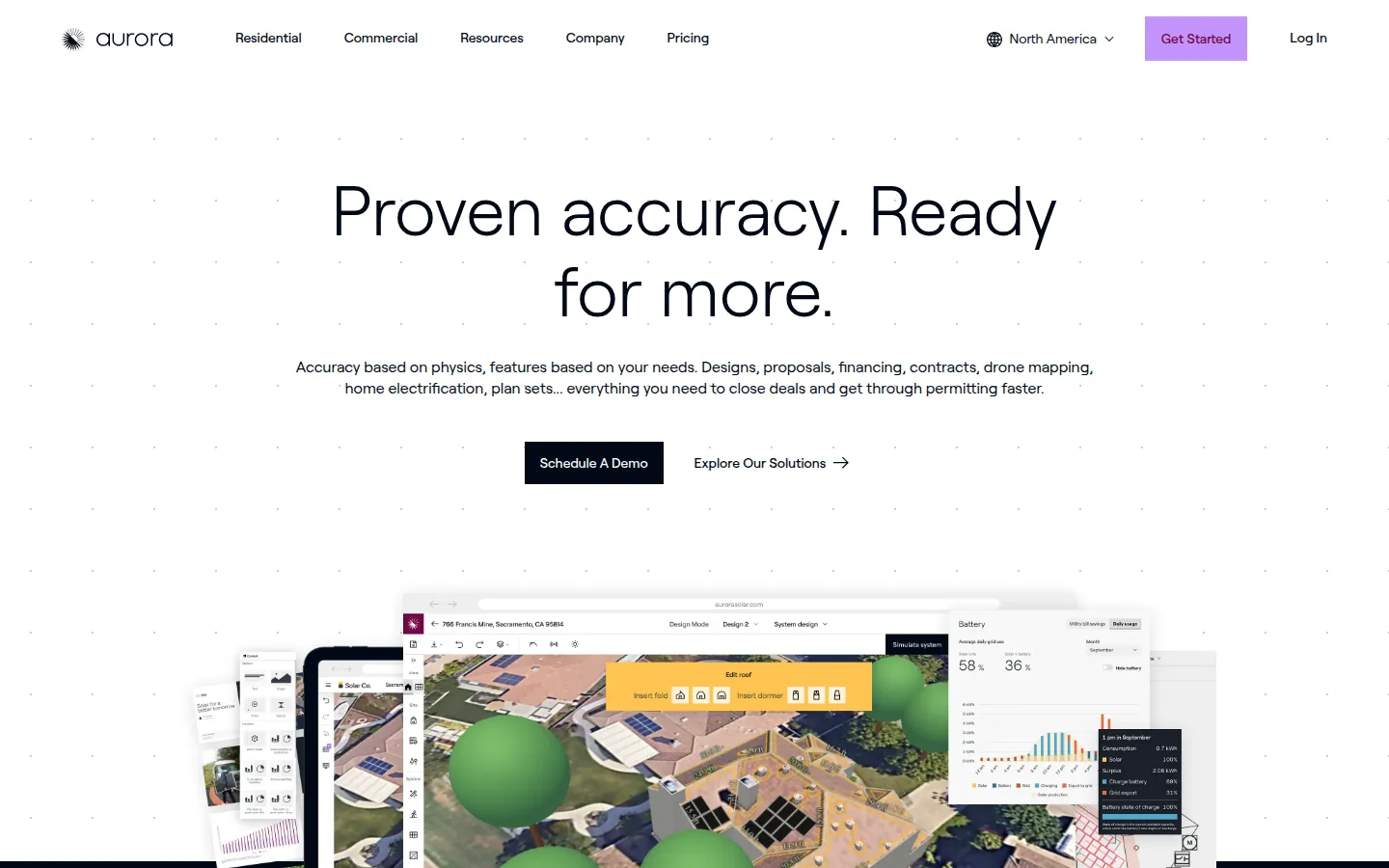
Aurora Solar
Best for: design teams that want to key in a fixed export rate and switch between net billing and a feed-in tariff without leaving one tool.
Not the right choice if: you need a euro price or a Croatian proposal template documented, which the pages read do not show, or want a free plan. The pricing page presents paid plans plus a custom Enterprise tier.
What the vendor documents: each plan on the pricing page carries 3D roof modeling, proposal templates, custom pricing methods and a utility rate database, and the page invites you to “Configure your own rates or use rates from Genability and Aurora”. It also lists web and PDF proposals and financing comparisons, with battery modeling and bankable shade reports on Premium. The help article says: “With Feed-in tariff, Aurora credits all the energy the system produces at a tariff rate”.
Price (checked October 2026): Basic $159 per user per month billed monthly, or $135 per user per month billed annually ($1,620 billed annually). Premium $259 per user per month, or $220 per user per month billed annually ($2,640 billed annually). Enterprise is custom, per project. The page shows a dollar sign and does not name the currency.
Limitations: the export-rate unit is “$ per kWh”, the pricing page lists North America and Europe regions, and Croatia is not named on any page read.
Vendor link: aurorasolar.com
Energy Toolbase
Best for: sellers who must lay out cash, loan, lease and PPA offers for a commercial customer, or who model solar combined with storage.
Not the right choice if: you need a published price, as the pricing page sends buyers to a demo booking, or you need roof design built in. The ETB Developer page cites “PV design partnerships with leading design software tools”, so put layout questions to the vendor.
What the vendor documents: the ETB Developer page lists proposals, quick financial analysis, “up-to-date utility rates” and lead management, with “120k+” utility rates tracked. The FAQ adds “cash purchases, power purchase agreements (PPAs), loans, and leases”. The tool is web-based.
Price (checked October 2026): not published for ETB Developer. The pricing page says “Book 30 minutes” for a demo and pricing for your team size. Dollar figures on that page belong to its ETB Controller and ETB Monitor products.
Limitations: Croatia and euro pricing are missing from the pages read, and so is a list of countries behind the utility rates.
Vendor link: energytoolbase.com

OpenSolar
Best for: small teams that want a free core app and will enter the Croatian supplier’s price by hand.
Not the right choice if: Croatian is the proposal language, because the language article names only English, Dutch, Swedish, Spanish, French, Norwegian, Thai, German, Polish, Portuguese, Italian, Danish and Finnish. Croatian is not on that list, and the article says a template has to be translated manually.
What the vendor documents: flat, time-of-use, tiered and demand tariffs, with export crediting chosen from Net Billing, Net Billing with Credit Carryover, Buy All, Sell All and Net Energy Metering. The article stops short of saying which option suits which country’s program.
Price (checked October 2026): the core app is free of charge for solar professionals, per the vendor. From 16 April 2026 the vendor charges for API Access, a per-project fee, and for supported connectors, a flat monthly subscription. Source: its 16 February 2026 post and its API page.
Limitations: Croatia and euro pricing are not named on the pages read.
Vendor link: opensolar.com
SurgePV
SurgePV is our product.
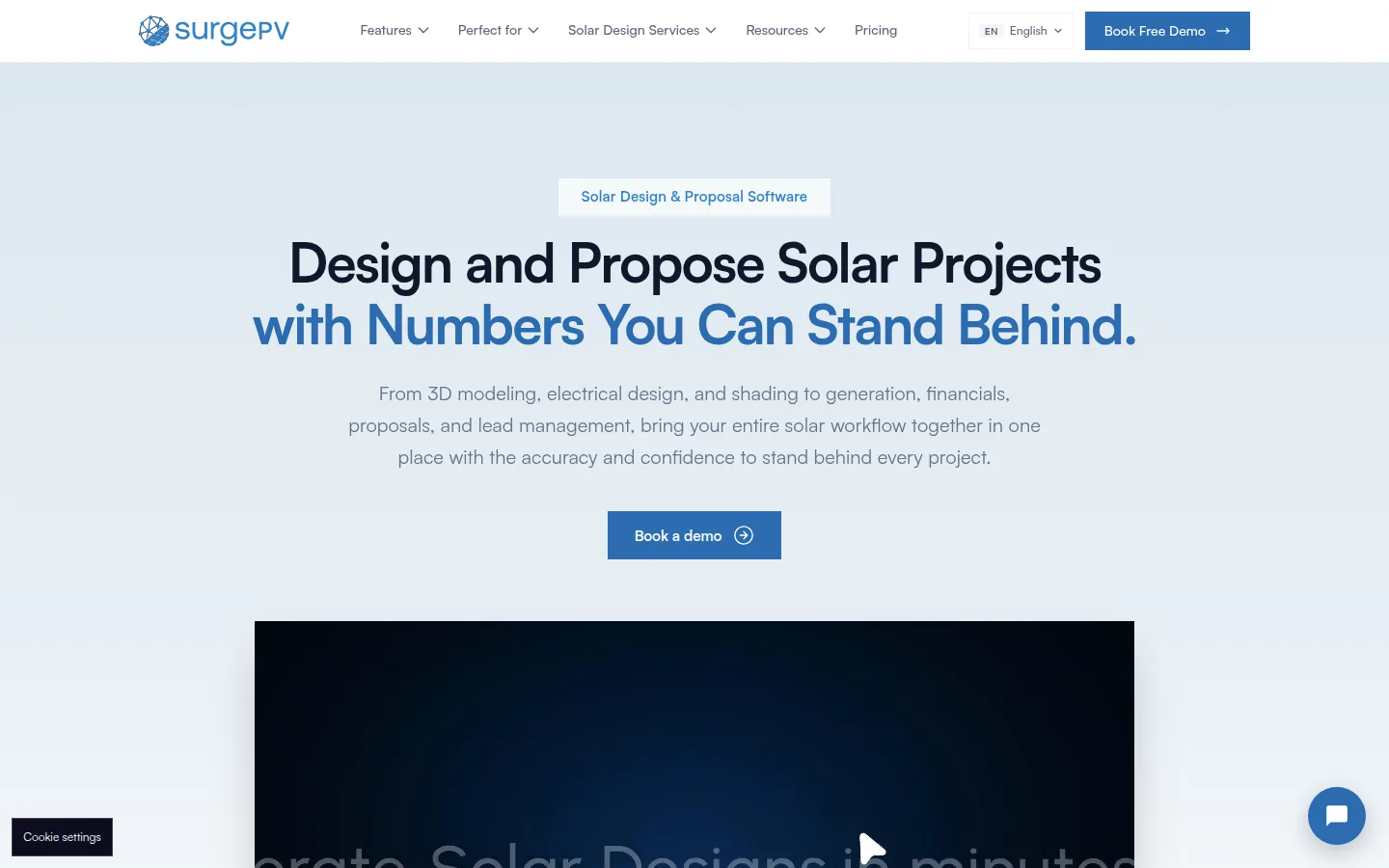
Best for: teams that want roof modeling, array layout, shading analysis, energy-yield modeling, financial modeling, electrical workflow support, bill-of-materials output and proposals together in a per-user product. Croatian items belong on the demo agenda. The product page is solar proposal software.
Not the right choice if: a self-serve trial is essential (SurgePV works through a guided demo) or a euro quote must be in writing before a sales call. Outputs support design and documentation, and the responsible engineer, authority, lender or utility still gives the actual approval.
What the vendor documents: 3D roof modeling, array layout, shading analysis, energy-yield modeling, financial modeling, electrical workflow support, bill-of-materials output and proposal generation.
Price (checked October 2026): $1,899 per user per year for 1 user, $1,499 per user for 3 seats, $1,299 per user for 5 seats, in US dollars. Confirm any local-currency amount and taxes in a written quote.
Limitations: results depend on source data, assumptions and equipment models. The published scope names no Croatian tariff, no export-credit setting, no local-language proposals and no design size limit.
Vendor link: surgepv.com.
Croatian Settlement Rules That Change a Solar Quote
A Croatian quote depends on which billing model applies. HERA’s self-consumption framework decision, adopted on 16 July 2026 and announced in a notice of 21 July 2026, describes both. The PDF read for this page is headed as the proposal for adoption, version of 13 July 2026. Figures are as of November 2026 per that document.
Net billing for new plants, net metering for older ones. The document says net billing (neto-obračun) should apply from 1 January 2026. Net metering (neto-mjerenje) continues for existing users for 10 years from the permanent operation certificate, and for customers who filed a proper connection-possibility request by 31 December 2025 and then received the operator’s notice. Under net billing the customer pays for all energy drawn at the supply-contract price, and the supplier pays for all exported surplus at least the statutory minimum price unless a better one is agreed. That minimum applies for 10 years from the permanent operation certificate, and after that the price is freely agreed. Billing runs by calendar month.
How the minimum price is built. For a customer with own production the minimum is 0.9 times the average unit supply price, excluding the regulated network part, fees and taxes. For household self-supply users it is that price multiplied by a factor kSO, and the framework proposes kSO of 1 for households and 0.9 for institutions until HERA completes its analysis. A quote should therefore state the supply price it assumes and the date of the connection request.
Why net metering was costly. Under monthly net metering, network charges were netted on the monthly difference, which the document describes as the grid acting as free virtual storage. It says the cost fell on network charges paid by other customers. This is one reason for the move to net billing.
Payback example. The document works through a Split household with 10,000 kWh a year and a south-facing plant under net billing. Payback time grows with plant size and shortens when supply prices and network charges are higher. It used 2025 supply prices under the version of the decree on removing disturbances on the domestic energy market that was in force until 30 September 2025, so recalculate with current prices.
Market size. Citing HERA’s 2024 annual report, it counts 20,131 household self-supply users at the end of 2024, 9,334 more than a year earlier, with 155 MW of feed-in connection power, up 81 MW.
Yield assumption. PVGIS for Zagreb (45.815 N, 15.982 E, 129 m; 1 kWp, fixed, 35 degrees facing south, 14% losses) gives 1,234 kWh a year, with 18.6% of it from November to February. Under net billing the split between self-used and exported energy matters more than before, so show it.
For the market see Best Solar Software for Croatia, for grid and sizing rules see Best Solar Design Software for Croatia, and for features see Best Solar Proposal Software.
How We Ordered These Tools
The entries run alphabetically and are not ranked, and the picks follow from the matrix. Each criterion, and what was left out:
- Tariff entry: the quote needs the supplier price the client actually pays. Handling of time-of-use or tiered rates was not assessed.
- Export-credit setting: exports can earn a flat price or a credit. Whether a tool can model Croatian net billing, with its statutory minimum price and calendar-month billing, was not assessed.
- Local-language proposals: a client reads best in a familiar language. Translation quality was not assessed.
- Price in a published currency: a stated currency shows what a buyer really pays. Discounts and negotiated quotes were not assessed.
- Free start: a free plan lets a small team try the workflow. Limits beyond what the page says were not assessed.
Methodology and Disclosure
SurgePV is published by SurgePV, which is also one of the vendors on this list. Its entry has the same layout and the same type of sources as the others, public vendor pages read in October 2026. The Croatian items are unresolved for all four vendors, SurgePV included, and a feature that a page leaves out is marked Not stated.
Sources and Dates
Vendor pages were read in October 2026, and each tool entry links its own sources. SurgePV details come from its pricing page and proposal software page.
Croatia settlement facts were read in November 2026 from the regulator HERA: the notice of 21 July 2026 and the decision document. The yield figure comes from PVGIS for Zagreb.
See SurgePV on your Croatia project
Book a guided demo and ask for the Croatia items you need in the quote.
Book a Free DemoMore Solar Software Guides to Compare
- Solar software in Croatia
- Solar design software for Croatia
- Best solar proposal software, all markets
- Aurora Solar alternatives
Frequently Asked Questions
What is the best solar proposal software in Croatia?
It depends on what the quote must show. The vendor pages we read do not name Croatia, so pick by what you can enter yourself. OpenSolar’s core app is free and takes a custom tariff. Aurora Solar lets you enter a fixed export rate. Energy Toolbase compares cash, loan, lease and PPA options. SurgePV lists proposal generation in one product with roof modeling, priced per user.
Is there free solar proposal software for Croatia?
OpenSolar says its core app is free for solar professionals. It charges for API Access and supported connectors from 16 April 2026. Its help article lists 13 proposal languages. The other tools here are paid, and the pages we read show no free plan for them. SurgePV offers a guided demo and no self-serve trial.
Can proposal software show Croatia tariffs and local currency?
No vendor page we read names Croatia tariffs or a Croatia price list. OpenSolar and Aurora Solar let you enter custom tariffs. Enter the rate for your client’s class from your utility, and check that the proposal prints the currency you want.
Which proposal tools support Croatia languages?
The pages we read do not say which tools offer a Croatia interface or proposal template. OpenSolar’s help article lists English, Dutch, Swedish, Spanish, French, Norwegian, Thai, German, Polish, Portuguese, Italian, Danish and Finnish, and says a proposal template must be translated by hand. Check the language list before you buy.
How much does solar proposal software cost for Croatia installers?
No vendor on this page lists a Croatia price on the pages we read. Aurora Solar Basic is $159 per user per month billed monthly, or $135 per user per month billed annually. Energy Toolbase does not publish a price for ETB Developer. OpenSolar’s core app is free. SurgePV Individual is $1,899 per user per year. Ask each vendor for a written quote.
