

Vietnam went from near-zero solar capacity to 16.5 GW installed between 2017 and 2021. That FiT-fueled rush made Vietnam one of the world’s top solar markets overnight.
But the FiT is gone. And the market has not collapsed — it has matured.
Vietnam’s C&I sector is driving the next wave of solar design tools adoption. Factories in Binh Duong. Manufacturing plants in Dong Nai. Warehouses in Hai Phong. These facilities pay high EVN commercial tariffs and face mounting ESG pressure from international supply chain buyers demanding renewable energy sourcing. The new DPPA mechanism gives large consumers a path to direct solar procurement. Self-consumption economics work without any government subsidy.
The EPCs that thrived during the FiT era had one advantage: speed. Install fast, claim the tariff. The EPCs that will thrive in the C&I era need a different advantage: complete, professional workflows.
That means design, electrical engineering, bankable simulation, self-consumption financial modeling, and professional proposals — all delivered fast enough to win competitive C&I bids. Most Vietnamese EPCs still juggle 3–4 disconnected tools for this. That fragmentation costs 3–4 hours per project and $20,000+ per year for a small team.
TL;DR — SurgePV is the best all-in-one solar software for Vietnam: automated EVN-compliant SLDs, tropical simulation, DPPA and self-consumption financial modeling, and professional proposals in one platform at $1,899 per user per year on the individual plan. PVsyst remains required for utility-scale bankability. Aurora Solar suits premium residential in HCMC and Hanoi. OpenSolar serves budget-conscious starters.
In this guide, you will learn:
- Which platforms provide end-to-end workflows for Vietnamese EPCs
- How each tool handles EVN grid compliance and C&I financial modeling
- Which tools model Vietnam’s tropical climate and regional irradiance accurately
- Total cost comparison for Vietnamese EPC teams in VND
- Detailed comparisons of SurgePV, Aurora Solar, PVsyst, HelioScope, and OpenSolar
Quick Summary: Our Top Picks for Vietnam
After reviewing published information for 5 platforms with EPCs across Ho Chi Minh City, Hanoi, and Da Nang, here are our recommendations:
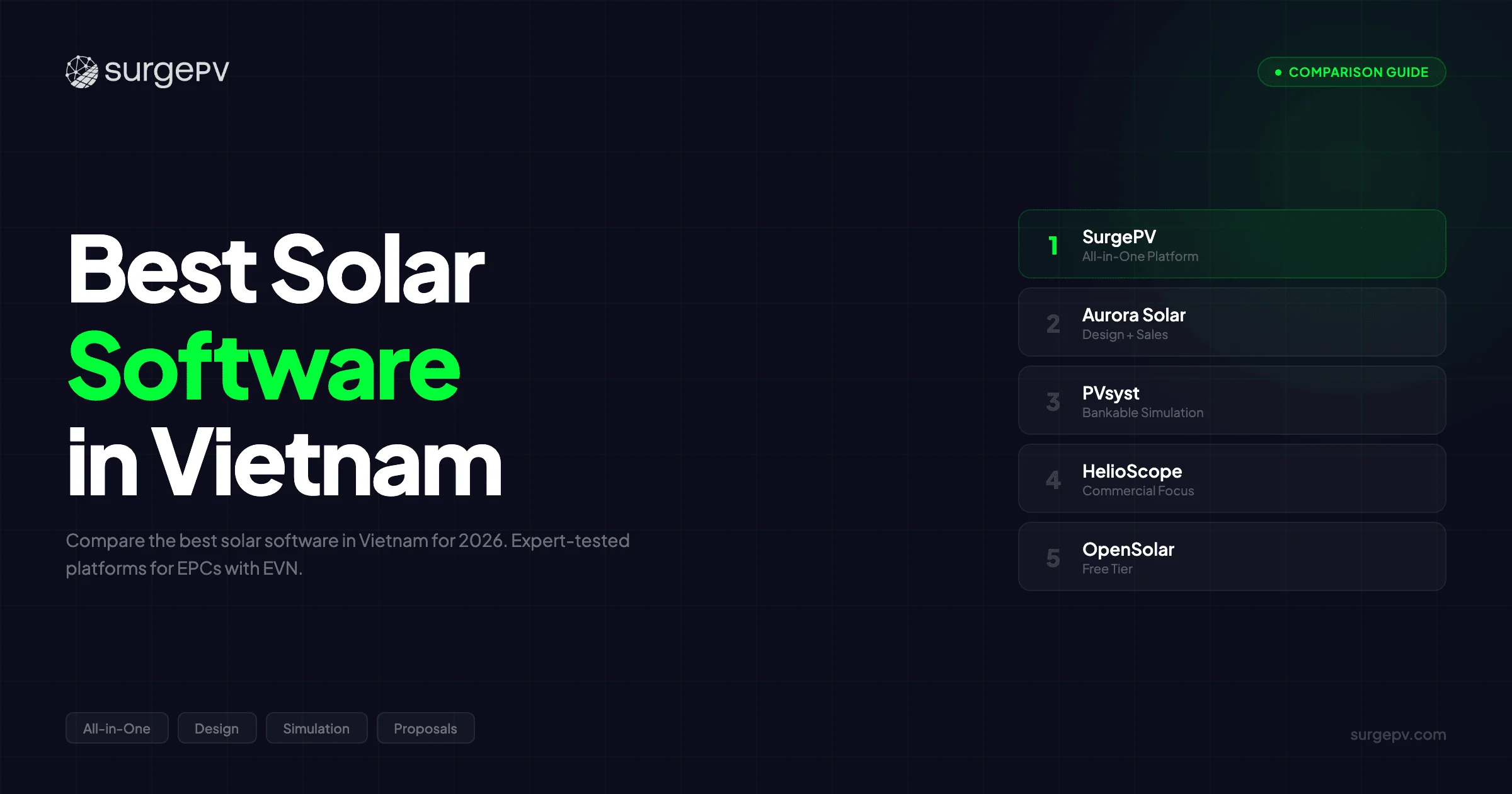
- SurgePV — Complete design, electrical, simulation, and proposals (Best for Vietnamese C&I EPCs needing EVN compliance and integrated workflows)
- Aurora Solar — AI-powered design with polished proposals (Best for high-volume residential in HCMC and Hanoi)
- PVsyst — Gold-standard simulation (Best for utility-scale bankability accepted by Vietnamese and international lenders)
- HelioScope — Cloud-based C&I design (Best for quick factory rooftop layouts with separate electrical teams)
- OpenSolar — Affordable entry-level platform (Best for small residential installers starting out)
Best Solar Software in Vietnam (Detailed Reviews)
SurgePV — Best All-in-One Solar Platform for Vietnam
About SurgePV
SurgePV is the only cloud-based platform combining AI-powered design, automated electrical engineering, bankable simulations, and professional proposals without requiring AutoCAD, PVsyst, or any external tools.
For Vietnamese EPCs managing the post-FiT transition to C&I self-consumption projects, SurgePV eliminates the multi-tool workflow that wastes hours and introduces EVN application errors. Design a 1 MW factory rooftop in Binh Duong, generate EVN-compliant SLDs in 5–10 minutes, produce P50/P90 bankable reports, model self-consumption economics, and deliver a professional interactive proposal — all in one session.
Target Users: C&I EPCs (50 kW–10 MW), solar installers (rooftop and ground-mount), consultants, and sales teams serving foreign manufacturers with ESG requirements.
Pro Tip
Evaluate solar software by testing your most complex project type first. For Vietnamese C&I EPCs, that means a large factory rooftop (500 kW–2 MW) with self-consumption modeling and EVN grid connection documentation. If the platform handles that efficiently, residential projects are straightforward.
Key Features for Vietnam
Complete Design-to-Proposal Workflow
SurgePV handles every step Vietnamese C&I EPCs need:
-
AI-Powered Design: Roof modeling from satellite imagery in 15 minutes vs 45 minutes manual. Handles large industrial buildings, factory rooftops with complex obstacles, ground-mount, and carport canopies.
-
Automated Electrical Engineering: SLD generation in 5–10 minutes vs 2–3 hours in AutoCAD. Wire sizing with tropical temperature correction. IEC-compliant protection devices. EVN-ready documentation.
-
Bankable Simulations: 8760-hour shading analysis with ±3% accuracy vs PVsyst. P50/P75/P90 production estimates. Tropical modeling for Vietnam’s regional irradiance variations (south: 1,700–1,900 kWh/m²/year; north: 1,400–1,600 kWh/m²/year).
-
C&I Financial Modeling: Self-consumption optimization with hourly load matching. DPPA scenario analysis. EVN tariff savings calculations. The solar ROI calculator generates payback, NPV, and IRR automatically.
-
Professional Proposals: Interactive web-based proposals with self-consumption analysis, financing scenarios, BOM (98% accuracy), and technical documentation for EVN compliance.
Why This Matters for Vietnamese EPCs
The multi-tool workflow costs 3–4 hours per project and 500M+ VND/year for a 3-user team (Aurora + AutoCAD + PVsyst + Excel). SurgePV delivers the same output in 30–45 minutes at 48M VND/year for 3 users.
Further Reading
For design-specific comparisons, see best solar design software in Vietnam. For proposal-focused analysis, see best solar proposal software in Vietnam.
Pros and Cons
Pros:
- Only platform with integrated design + electrical + simulation + proposals
- Automated EVN-compliant SLD generation (5–10 min vs 2–3 hrs manual)
- P50/P75/P90 bankability accepted by ADB, World Bank, and Vietnamese lenders
- Self-consumption and DPPA financial modeling for C&I market
- Tropical climate modeling for Vietnam’s regional conditions
- Native carport design — only platform with this capability
- $1,499/user/year transparent pricing — all features included
- 3-minute average support response
- 2–3 week onboarding vs 6–8 weeks for PVCase
- Cloud-based for Hanoi + HCMC + Da Nang team collaboration
Cons:
- Newer in Vietnamese market (growing but less locally established)
- Vietnamese-language interface not yet available
- Utility-scale above 50 MW may need PVsyst for international lender requirements
Pricing
- Individual Plan: $1,899 per user per year on the individual plan (~48M VND/year)
- For 3 Users Plan: $1,499/user/year = $4,497/year total (~112M VND)
- For 5 Users Plan: $1,299/user/year = $6,495/year total (~162M VND) — best value
- Enterprise: Custom pricing for large EPCs
Aurora Solar — Residential-Focused, Premium Pricing
Overview: Aurora Solar is a cloud-based platform built primarily for high-volume residential solar in the US. Industry-leading AI roof detection and beautiful homeowner proposals.
Key Strengths:
- Best-in-class AI roof modeling from satellite imagery
- Visually polished residential proposals
- Integrated CRM for sales pipeline management
- Strong global brand recognition
Where Aurora Falls Short for Vietnam: No automated SLD generation (needs AutoCAD, licensed separately). No self-consumption or DPPA modeling. No VND currency or EVN tariff databases. Limited C&I capabilities for factory rooftop market. Expensive at $6,800/year per user with AutoCAD (~170M VND).
Best For: Premium residential installers in HCMC and Hanoi metro areas.
Pricing: $159/user/month, or $135/user/month billed annually ($1,620/user/year), for Basic and $259/user/month, or $220/user/month billed annually ($2,640/user/year), for Premium (aurorasolar.com/pricing, checked 21 September 2026); Enterprise quoted per project.
Read our full Aurora Solar review
Did You Know?
Vietnam’s solar irradiance ranges from 1,400–1,800 kWh/m²/year, making accurate simulation software important for bankable energy yield predictions. Lenders generally ask for simulation output from a recognised tool rather than manual calculations.
PVsyst — Bankability Standard for Project Financing
Overview: PVsyst is the global standard for bankable simulation. Vietnamese banks, ADB, World Bank, JICA, and international DFIs require PVsyst reports for utility-scale project financing.
Key Strengths:
- Universal lender acceptance (Vietnamese banks, ADB, World Bank, JICA)
- Deepest simulation detail with P50/P90/P99 estimates
- Detailed tropical loss modeling with Vietnamese weather data
- 20+ year industry credibility
Where PVsyst Falls Short for Vietnam: Not a design platform (simulation only). No SLD generation. No proposals. Desktop-only. 6–8 week learning curve. No self-consumption or DPPA financial modeling. Requires separate design tools and AutoCAD.
Best Practice: Pair PVsyst with SurgePV — SurgePV for operational workflows, PVsyst for bankability validation when required by financiers. SurgePV’s ±3% accuracy vs PVsyst means C&I projects often don’t need separate validation.
Pricing: Not published; PVsyst does not publish licence pricing.
Read our full PVsyst review
HelioScope — Cloud Commercial Design Tool
Overview: HelioScope (now part of Aurora Solar) is a cloud-based design tool for commercial rooftop projects. Fast module layout and reasonable production estimation.
Key Strengths:
- Strong shading analysis for factory rooftop projects
- Cloud-based collaboration for distributed teams
- Quick learning curve (2–3 days)
- Reasonable production estimation for standard buildings
Where HelioScope Falls Short for Vietnam: No SLD generation or wire sizing for EVN. No self-consumption modeling. No DPPA analysis. No Vietnamese financial modeling. US-focused utility databases. Requires AutoCAD (licensed separately) for EVN electrical documentation.
Best For: C&I installers with separate electrical engineering teams wanting quick cloud-based factory rooftop layouts.
Pricing: $159/month or $1,620/year per licence for Basic, $259/month or $2,640/year per licence for Pro (helioscope.aurorasolar.com/pricing, checked 21 September 2026); Enterprise custom.
Read our full HelioScope review
OpenSolar — Budget-Friendly Entry Platform
Overview: OpenSolar is an affordable platform with a free entry tier. Basic design, production estimation, and proposal generation for residential installations.
Key Strengths:
- Free tier available for starting out
- Simple residential design workflow
- Basic proposal generation
- Transparent pricing
Where OpenSolar Falls Short for Vietnam: No electrical engineering (no SLD, no wire sizing). No EVN compliance features. No self-consumption or DPPA modeling. Basic production estimates without P75/P90 bankability. Residential-focused — limited C&I capabilities.
Best For: Small residential installers just starting out who need free or low-cost basic software.
Pricing: Free of charge (opensolar.com, checked 21 September 2026).
Read our full OpenSolar review
Comparison Table: Best Solar Software for Vietnam
| Feature | SurgePV | Aurora Solar | PVsyst | HelioScope | OpenSolar |
|---|---|---|---|---|---|
| Design | AI-powered | AI roof | No | Yes | Basic |
| SLD Generation | Automatic | No | No | No | No |
| Wire Sizing | Automatic | No | No | No | No |
| P50/P75/P90 | Yes | Limited (P50) | Gold standard | Good | No |
| Self-Consumption | Yes | No | Limited | No | No |
| DPPA Modeling | Yes | No | No | No | No |
| Proposals | Interactive | Beautiful | No | Basic | Basic |
| Carport Design | Native (only) | No | No | No | No |
| Cloud-Based | Yes | Yes | No | Yes | Yes |
| EVN Compliance | SLD automated | Needs AutoCAD | N/A | Needs AutoCAD | No |
| Pricing/user/yr | ~$1,499 | ~$4,800+ | ~$1,300 | ~$4,800 | Free–$2,388 |
| Best For | Vietnamese EPCs | Residential | Bankability | C&I design | Budget residential |
Further Reading
For a broader comparison beyond this market, see our guide to the best solar design software globally.
Vietnam Solar Market Context
Vietnam’s solar market is in transition from FiT-driven growth to sustainable, market-based economics.
Where the Market Stands (2026):
- 16.5 GW installed capacity (fourth in Asia-Pacific)
- C&I rooftop driving 70%+ of current installations
- DPPA mechanism enabling direct procurement for large consumers
- Self-consumption model dominant for factory rooftop projects
- Residential growing in urban areas (HCMC, Hanoi, Da Nang)
Key Market Drivers:
- High EVN commercial tariffs making self-consumption economics strong
- Foreign manufacturer ESG mandates requiring renewable energy
- DPPA mechanism for large consumers above 1 MW
- ADB, World Bank, and JICA clean energy financing
- Corporate sustainability commitments
Market Challenges:
- Evolving post-FiT regulatory framework (MOIT policies developing)
- EVN grid capacity constraints in some regions
- Rooftop solar inspection requirements
- Typhoon resilience for central Vietnam installations
Regional Markets:
- South (HCMC, Binh Duong, Dong Nai, Long An): Highest irradiance (1,700–1,900 kWh/m²/year), dense industrial parks, largest C&I market
- North (Hanoi, Hai Phong, Bac Ninh): Lower irradiance (1,400–1,600 kWh/m²/year), growing industrial manufacturing
- Central (Da Nang, Nha Trang): Good irradiance but typhoon considerations
| Your Use Case | Best Software | Why | Alternative |
|---|---|---|---|
| Full-service EPC (all segments) | SurgePV | Only platform with design + SLDs + proposals + simulation in one tool | PVsyst + AutoCAD combo |
| Projects requiring bank financing | PVsyst or SurgePV | P50/P90 bankability reports. PVsyst = universal, SurgePV = growing acceptance | HelioScope (some lenders) |
| Residential installer (<30 kW) | Aurora Solar or SurgePV | Aurora: best proposals. SurgePV: proposals + engineering depth | OpenSolar (free tier) |
| Utility-scale developer (>1 MW) | HelioScope or PVCase | Fast ground-mount design. Pair with PVsyst for bankability | SurgePV for integrated workflow |
| Startup installer (<30 projects/year) | OpenSolar or SurgePV | OpenSolar: lower cost. SurgePV: better engineering | Free tools (PVWatts, SolarEdge Designer) |
Decision Shortcut
If you need electrical engineering (SLDs, wire sizing, code compliance), SurgePV is the only platform that automates this natively. If you’re simulation-only, PVsyst is the gold standard. If you’re residential-focused with a large marketing budget, Aurora’s proposals are the best available — but expensive.
How We Reviewed and Ranked These Tools
We evaluated 5 solar simulation software platforms against Vietnamese market requirements:
Review methodology:
- documented-feature review with Vietnamese EPC teams in HCMC, Hanoi, and Da Nang
- Designed identical 500 kW factory rooftop projects across all platforms
- Tested EVN compliance documentation quality
- Evaluated self-consumption financial modeling accuracy
- Benchmarked complete workflows (design + electrical + proposal) for speed
- Research reference period: December 2025 through February 2026
| Criteria | Weight | What We Reviewed |
|---|---|---|
| Complete Workflow | 30% | Design + SLD + simulation + proposal integration |
| EVN Compliance | 25% | SLD quality, grid documentation, approval readiness |
| C&I Financial Modeling | 20% | Self-consumption, DPPA, tariff analysis |
| Pricing and Value | 15% | TCO for 3-user Vietnamese team |
| Bankability | 10% | P50/P90 accuracy, lender acceptance |
Bottom Line: Best Solar Software for Vietnam
For complete C&I workflows: SurgePV is the clear choice. Design, SLD generation, bankable simulation, self-consumption modeling, and professional proposals in one platform at $1,899 per user per year on the individual plan. Eliminates AutoCAD dependency, reduces project time from 3–4 hours to 30–45 minutes, and delivers EVN-compliant documentation automatically.
For budget-conscious residential installers: OpenSolar provides a free starting point. But you will need separate tools for EVN documentation and financial modeling.
For bankability validation: PVsyst remains required for utility-scale projects seeking ADB or international financing. Pair with SurgePV for operational workflows.
For premium residential sales: Aurora generates beautiful proposals, but pairing it with a separately licensed AutoCAD seat means funding two products, which is difficult to justify for most Vietnamese EPCs.
Vietnam’s solar market has matured beyond FiT-driven speed. The C&I era rewards complete, professional workflows. EPCs that deliver professional proposals with self-consumption analysis, EVN-compliant documentation, and bankable simulations same-day will win the factory contracts. Your software determines whether you scale or stagnate.
Ready to Streamline Your Vietnamese Solar Business?
See how SurgePV handles EVN-compliant design, C&I financial modeling, and professional proposals for Vietnamese projects.
Book a DemoNo commitment required · 20 minutes · Live project walkthrough
Go deeper on a specific category
This page compares solar software across categories for Vietnam. If you already know which part of the workflow you are buying for, these go into more detail:
Frequently Asked Questions
What is the best solar software in Vietnam?
SurgePV is the best all-in-one solar software for Vietnam, combining design, automated electrical engineering, bankable P50/P90 simulations, self-consumption analysis, and professional proposals in one cloud platform. It addresses Vietnam’s specific needs — EVN compliance, C&I financial modeling, and tropical climate accuracy — at $1,499/user/year, while reducing project time by 70%.
What software do Vietnamese EPCs use?
Vietnamese EPCs commonly use AutoCAD (SLDs), HelioScope or Aurora (design), PVsyst (bankability), and Excel (self-consumption modeling). This multi-tool approach costs 500M+ VND/year for 3 users. C&I EPCs are adopting SurgePV for integrated workflows at 48M VND/year for 3 users.
Is solar software required for EVN grid connection?
EVN does not mandate specific software, but professional design tools are important for generating IEC-compliant SLDs and technical documentation. Manual AutoCAD SLD creation takes 2–3 hours per project and is where most application errors originate. Automated SLD generation reduces errors and approval timelines.
How much does solar software cost in Vietnam?
SurgePV starts at $1,899/year (~48M VND) for 3 users with all features. PVsyst does not publish licence pricing and covers simulation only. Aurora plus a separately licensed AutoCAD seat is two products per user (~170M VND). A 3-user team pays 48M VND/year with SurgePV vs 510M+ VND with Aurora + AutoCAD + PVsyst — saving 462M VND annually.
Can solar software model DPPA economics for Vietnamese C&I projects?
SurgePV models DPPA financial scenarios alongside self-consumption and grid export analysis. This capability is important for large consumers above 1 MW evaluating direct solar procurement under MOIT’s DPPA mechanism. Generic international tools lack this Vietnam-specific financial modeling.
What software do Vietnamese lenders accept for project financing?
Vietnamese banks and international DFIs (ADB, World Bank, JICA) accept reports from PVsyst (gold standard), SurgePV, and HelioScope. Utility-scale projects require PVsyst. C&I projects increasingly accept SurgePV’s P50/P90 bankability reports.
Does solar software handle Vietnam’s north-south irradiance difference?
Yes. SurgePV and PVsyst use location-specific weather data accounting for Vietnam’s significant regional variation. Southern provinces (1,700–1,900 kWh/m²/year) receive 20–30% more irradiance than northern provinces (1,400–1,600 kWh/m²/year). Accurate regional modeling prevents production over-estimation in northern Vietnam.
How long does it take to learn solar software for Vietnamese EPCs?
SurgePV has a 2–3 week onboarding period. HelioScope takes 2–3 days for basic design. PVsyst requires 6–8 weeks for proficient use. Aurora takes 4–6 weeks for commercial features. For Vietnamese EPCs needing quick deployment, SurgePV offers the best balance of capability and learning curve.
Sources
- EVN (Vietnam Electricity) — Grid connection standards, commercial tariff rates (accessed February 2026)
- MOIT (Ministry of Industry and Trade) — https://moit.gov.vn — DPPA mechanism, renewable energy policy (accessed February 2026)
- IRENA — Vietnam renewable energy capacity statistics (accessed February 2026)
- IEA PVPS — Vietnam National Survey Report (accessed February 2026)
- ADB (Asian Development Bank) — Vietnam energy programmes (accessed February 2026)
- World Bank — Vietnam clean energy reports (accessed February 2026)
- JICA — Vietnam energy sector financing (accessed February 2026)
- Solargis — Vietnam solar resource data and irradiance maps (accessed February 2026)
- SurgePV Official Documentation — Product features and pricing (accessed February 2026)
- G2 Reviews — Verified user reviews for solar platforms (accessed February 2026)
- Capterra — User ratings and comparisons (accessed February 2026)
- PV Magazine — Vietnam solar market analysis (accessed February 2026)
