


If you design solar systems in North Macedonia, start with the job. Aurora Solar prices per user in US dollars and describes its estimates as P50 values. HelioScope lists a dollar price and designs up to 5 MW DC on its Pro plan. PVcase documents ground-mount layout and single line diagram export. PVsyst documents P50 to P90 yield. SurgePV documents roof modeling through proposals but states no ground-mount, tracker or diagram output. None of this page’s sources is a North Macedonia regulator, so it makes no claim about North Macedonia’s grid code, tariffs or incentives.
This is a desk comparison of what each vendor publishes, checked October 2026. We have not run side-by-side tests. SurgePV publishes this page and is one of the 5 tools on it. Tool facts come from each vendor’s own site. Single line diagram (SLD) means a simple drawing of how the system is wired. P50 and P90 are yields with a 50% and a 90% probability of being met or exceeded in a year. A bill of materials (BOM) is a parts list.
Criteria used: single line diagram, P50 to P90 yield, interface or proposal languages, price and currency, where the tool runs.
This page compares 5 tools. Other tools are compared on the global design list. HelioScope is an Aurora Inc. company, and both appear here as separate products.
Working on a North Macedonia project? See SurgePV on it
Book a guided demo and bring a real site. We walk through design, yield, finance and the proposal in one platform.
Book a Free DemoChecking cost first? See the SurgePV pricing page.
Best-For Picks for North Macedonia
- Design and sales proposals on a per-user plan: Aurora Solar. Its pricing page lists Basic at $159 per user per month and Premium at $259, with lower annual rates. Its help pages describe estimates as P50 values and the SLD editor as only available in Europe.
- Dollar-priced commercial and mid-size plants: HelioScope. Its Pro plan lists designs up to 5 MW (DC) and P90, P95 and P99 values. Enterprise lists designs up to 30 MW (DC) and single-axis trackers. Its help article lists a single-line diagram export.
- Ground-mount plants with terrain, piling and a diagram: PVcase. Its Ground Mount plan page lists terrain-aware layouts, slope and collision analysis, piling analysis and single line diagram export. It is built on AutoCAD. Its price is given only through sales.
- A P50 to P90 yield report: PVsyst. Its help page documents the P50 to P90 tool, and its product page lists 12 software languages. It runs on Windows only.
- Roof model to bill of materials and proposal in one product, priced per user: SurgePV. It documents roof modeling, shading, yield, financial modeling, bill of materials and proposals. Ask in a demo about diagrams, ground-mount layout and P50 to P90 yield. Its published scope names none of them.
Comparison Table
Listed alphabetically. This is not a ranking; pick by the situation above. Prices checked October 2026 on each vendor’s own page, in the currency the vendor publishes.
| Tool | Best for | Price | Free or paid | Decisive fact |
|---|---|---|---|---|
| Aurora Solar | Design and sales proposals, per user | Basic $159 per user per month; $135 billed annually | Paid | SLD editor “only available in Europe”; P50 only |
| HelioScope | Dollar-priced commercial and mid-size plants | $159 or $1,620 per license (Basic); $259 or $2,640 (Pro), per month or per year | Paid | Single-line diagram export; P90, P95, P99 on Pro |
| PVcase | Ground-mount plants with terrain and diagrams | Not published (sales) | Paid | Single line diagram export; built on AutoCAD |
| PVsyst | P50 to P90 yield reports | CHF 700 per year (Professional) | Paid; one-month free trial | P50 to P90 tool; Windows only |
| SurgePV | Roof model to BOM and proposal, per user | $1,899 per user per year (1 user), in US dollars | Paid, guided demo | BOM and proposals in scope; no diagram or P50 to P90 item stated |
North Macedonia Criteria Matrix
Each cell is Documented, Partial or Not stated. Documented means the vendor’s own page states it. Partial means the page states a related feature but not the full item. Not stated means the pages we read in October 2026 do not say. There are no scores or weights. A tool that does not state an item may still support it, so ask each vendor to produce the item for one real North Macedonia site.
| Tool | Single line diagram | P50 to P90 yield | Languages listed | Price and currency | Runs in |
|---|---|---|---|---|---|
| Aurora Solar | Partial (editor listed for Europe; ask whether it covers North Macedonia) | Partial (P50 only; no native P90) | Partial (French help centre and Europe site; app language not stated) | Documented (USD, per user) | Not stated |
| HelioScope | Documented (help article) | Documented (P90, P95, P99 on Pro) | Not stated | Documented (USD, per license) | Browser (help article recommends Chrome or Firefox) |
| PVcase | Documented (Ground Mount plans) | Partial (PVcase Yield plans list P50, P90) | Not stated | Not published | AutoCAD (Ground Mount) |
| PVsyst | Partial (grid-connected only, no storage, work in progress) | Documented | Documented (12 languages; English is the reference) | Documented (CHF) | Windows only |
| SurgePV | Not stated (electrical workflow support listed) | Not stated (energy-yield modeling listed) | Not stated | Documented (USD) | Web |
Tool Entries
Aurora Solar
Best for: North Macedonia installers who would rather license seats than projects, and who are fine reading prices in dollars.
Not the right choice if: your North Macedonia files need P90 yield (Aurora does not natively output it for solar energy production) or a diagram outside the editor’s coverage. The vendor lists dollar prices only.
What the vendor documents: the single line diagram editor page limits the single line diagram editor to Europe. The help article on P-values describes P50 estimates built from typical-year weather data. The help article on utility rates allows an export rate in dollars per kWh and a compensation policy. French is offered in the help centre and Europe site, but no page read names the language of the app or the proposals, so Macedonian output needs checking.
Price (checked October 2026): on the pricing page, Basic is $159 per user per month, or $135 per user per month billed annually ($1,620 billed annually). Premium is $259 per user per month, or $220 per user per month billed annually ($2,640 billed annually). The page uses a $ sign without naming the currency. It shows North America as the selected region.
Limitations: nothing on this page speaks for North Macedonia. Put one real North Macedonia site through a trial first.
Vendor link: aurorasolar.com.

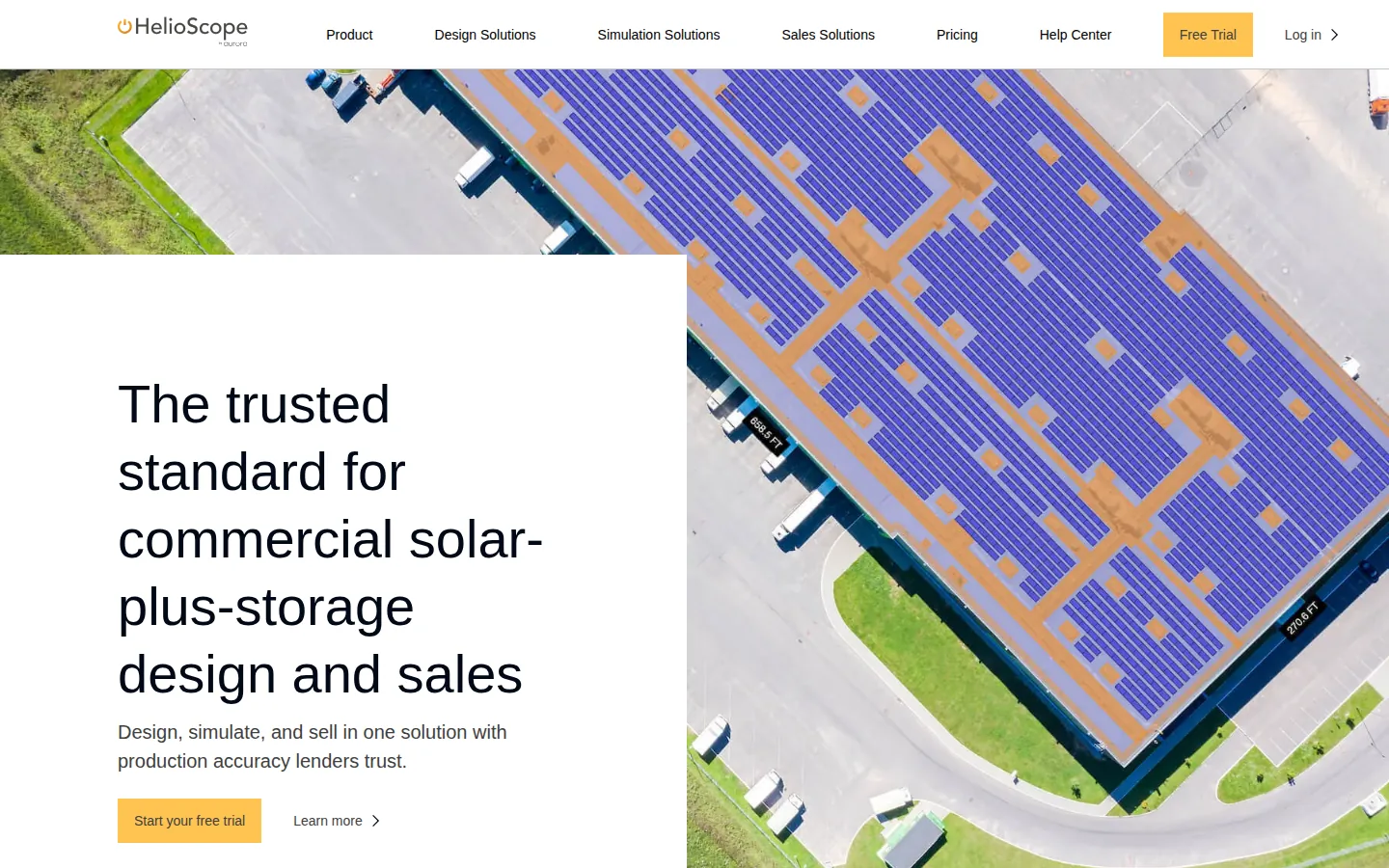
HelioScope
Best for: commercial designers in North Macedonia who want published dollar plan prices and mid-size project capacity.
Not the right choice if: the plant you are designing in North Macedonia is above a plan’s size cap, or you need to see Macedonian among interface languages. Size caps on the pricing page are 1.25 MW (DC) Basic, 5 MW (DC) Pro and 30 MW (DC) Enterprise, and language lists are not published on the pages read.
What the vendor documents: exports first: the export article names a .dxf CAD file and a single-line diagram, “a simple electrical schematic”. On features, all projects list rooftop, carport and ground mount plus storage design; Pro adds LIDAR-assisted modeling, financial modeling, sales proposals and P90, P95 and P99 values; Enterprise adds unlimited users, single-axis trackers, PVsyst export, API access and SSO (single sign-on). Footer wording: “an Aurora Inc. Company”. Browser: a help article recommends Chrome or Firefox for the design tool.
Price (checked October 2026): Basic $159 USD per license per month or $1,620 USD per license per year, including 1 user. Pro $259 USD per license per month or $2,640 USD per license per year, including 1 user. Enterprise is custom per-project pricing. All from the pricing page.
Limitations: this page says nothing specific about North Macedonia, so try a real North Macedonia site first.
Vendor link: helioscope.aurorasolar.com.
PVcase
Best for: North Macedonia utility-scale and ground-mount engineers who work in CAD and need terrain, piling and diagram output together.
Not the right choice if: you need a price list online or want to avoid AutoCAD. The home page describes PVcase Ground Mount as “built on AutoCAD”, and any separate AutoCAD licence is a question for the vendor.
What the vendor documents: for a North Macedonia ground-mount job the plan page lists the following: terrain-aware layouts, slope, collision and piling analysis, ground grading, stringing, cable sizing and voltage drop, single line diagram export, bill of materials exports, BESS (battery storage) design and QuickYield (Ground Mount plan page). A blog post adds terrain-following tracker optimization; the PVcase Yield page states “built-in probability scenarios (P50, P90)”.
Price (checked October 2026): not published. The home page says, “We don’t offer a complete price list online”. The plan pages say to talk to sales.
Limitations: this page makes no North Macedonia-specific statement, so check on a real North Macedonia site.
Vendor link: pvcase.com.
PVsyst
Best for: lender-facing yield work in North Macedonia, where P50 to P90 values are asked for.
Not the right choice if: your North Macedonia team works in a browser or expects automatic ground-mount row layout, because a 3D scene must be modeled by hand. Per the product page, PVsyst is Windows only with one license per computer.
What the vendor documents: the P50 to P90 help page states that the annual production has a 50% chance of exceeding the P50 value and a 90% chance of exceeding P90. The single line diagram page limits diagrams to grid-connected systems, leaves out storage and calls itself “still work in progress”. Beyond that: grid-connected, standalone and pumping design, a 3D scene you model, unlimited orientations, single or dual-axis trackers with backtracking, weather databases (Meteonorm 9, NASA-Power, PVGIS-TMY) and NPV, LCOE and ROI economics. It lists 12 languages including French, not Macedonian.
Price (checked October 2026): PVsyst 8 Professional is CHF 700 per year, updates included. Group discounts are 5% for 2 to 4 licences, 15% for 5 to 9 and 20% for 10 or more. The product page lists a one-month free trial. The price is in Swiss francs.
Limitations: this page does not speak for North Macedonia, so use the free month on one real North Macedonia site.
Vendor link: pvsyst.com.
SurgePV
SurgePV is our product.
Best for: installers in North Macedonia who want roof modeling, shading, yield, financial modeling, a bill of materials (the parts list) and proposals together, per user. Bring a North Macedonia site to the demo.
Not the right choice if: you must trial it alone (the vendor runs a guided demo), lay out terrain-following ground-mount plants, or hold a written single line diagram or P50 to P90 result; its published scope lists roof modeling and array layout instead. Approval stays with the responsible engineer, authority, lender or utility, because outputs only support design and documentation. The scope lists no CRM (customer tracking tool) and puts monitoring and ERP (business management software) outside it.
What the vendor documents: 3D roof modeling, array layout, shading analysis, energy-yield modeling, financial modeling, electrical workflow support, bill-of-materials output and proposal generation. See solar design software for the product page.
Price (checked October 2026): $1,899 per user per year for 1 user, $1,499 per user for 3 seats, $1,299 per user for 5 seats, in US dollars.
Limitations: source data, assumptions and equipment models drive results. None of single line diagram, ground-mount or tracker layout, P50 to P90 yield or an interface language list appears in the published scope. Nothing here claims a North Macedonia output.
Vendor link: surgepv.com.
Language Check for North Macedonia
Clients in North Macedonia may expect Macedonian. PVsyst lists French among 12 software languages and says English is the reference language. Its help pages are in English. Aurora’s help centre and Europe site offer French; the pages we read do not state the language of the app. The HelioScope, PVcase and SurgePV pages we read do not list interface languages. Vendor lists change, so ask for a sample proposal in Macedonian before you buy.
North Macedonian Connection Rules and Irradiation That Shape a Design
Who is in the chain. The regulator’s electricity sector page names MEPSO as transmission operator, Elektrodistribucija as the distribution operator for the whole country and MEMO as market operator. It also says self-supplying consumers that meet the conditions can take part in the market directly, with a balancing responsibility agreement with MEPSO. The page carries no dates or figures, and it does not describe connection procedures.
Standard and non-standard connections. A decision of the Energy Regulatory Commission of 15 June 2026 quotes Article 35 of the Distribution Network Rules (Official Gazette 191/19, 101/22, 68/24 and 106/25). A standard connection at low or medium voltage is one in an area covered by a detailed urban plan, a village plan or a plan outside settlements, and where either the approved maximum simultaneous power is at most 400 kW or the building is a collective residential or commercial one. An exception makes a low-voltage connection standard when the building’s maximum simultaneous power is at most 11 kW, no local plan covers it and other users or likely applicants are nearby. Everything else is non-standard. Where a network was built for a non-standard connection, later connections from it stay non-standard until the connection fees collected equal the investment.
The case in that decision concerned eleven weekend houses outside an urban plan, not solar plants, so it does not say how PV plants are classified. What it does show is that the rule is written around the approved maximum simultaneous power and the site’s planning status. A design file that states the site’s load, the inverter AC output and the plan status next to each other gives Elektrodistribucija what it needs to classify the connection. Ask the operator how it treats a plant at your site.
Irradiation for Skopje. PVGIS for Skopje (41.998 N, 21.428 E, 247 m; 1 kWp, 14% losses, 2005 to 2023 data) gives 1,346 kWh a year at 35 degrees facing south, with 62.3 kWh in December and 154.1 kWh in July. At 15 degrees the result is 1,285 kWh, which is 4.6% lower over the year, 21.2% lower in December and 5.8% higher in July. A flat-roof layout therefore changes the monthly shape more than the annual total, and a design tool should show both.
For the market view see Best Solar Software for North Macedonia, for quote and tariff content see Best Solar Proposal Software for North Macedonia, and for the general category see Best Solar Design Software.
What to Ask a Vendor Before Buying
Ask each vendor for one sample North Macedonia project. Then look for these items. First, a single line diagram you could hand to the local utility. Second, a P50 to P90 yield report if a lender will read it. Third, output in Macedonian if your client needs it. Fourth, a price in the currency you will be invoiced in. Where a vendor does not publish a feature on the pages we read, the matrix says so. A demo or trial is the place to check it.
How We Ordered These Tools
We did not rank these tools. They are listed alphabetically, and the best-for picks come from the matrix above.
- Single line diagram: utilities and authorities often ask for one. We did not assess whether any tool’s diagram meets a particular utility’s format.
- P50 to P90 yield: lenders and investors read these values. We did not assess whether any report is accepted by a lender.
- Languages: we only report the language lists the vendors publish. We did not assess translation quality or the report language for North Macedonia.
- Price and currency: a published price lets you plan before a call. We did not assess discounts or negotiated quotes.
- Runs in: a Windows-only or CAD-based tool limits who can open a file. We did not assess speed or file size.
Sources and Dates
Vendor pages were read in October 2026. They are Aurora Solar (pricing and three help articles), HelioScope (pricing and help articles), PVcase (Ground Mount plans, Yield plans, home page and a blog post), PVsyst (product, shop and help pages) and SurgePV (pricing). Help-centre articles were read in a browser. SurgePV publishes this page and is a vendor on the list. No government or regulator page is used on this page.
North Macedonia connection facts were read in November 2026 from the Energy Regulatory Commission: its electricity sector page and a decision of 15 June 2026. Irradiation figures come from PVGIS for Skopje at 35 degrees and 15 degrees.
See SurgePV on a North Macedonia project
Book a guided demo and ask which of the outputs you need for a North Macedonia project it can produce.
Book a Free DemoRelated Solar Software Lists
- Best solar software in North Macedonia
- Solar proposal software for North Macedonia
- Solar design software for Serbia, a nearby country list
- Solar design software for Montenegro, a nearby country list
- Solar design software for Bulgaria, a nearby country list
- Solar single line diagram software and solar plant design software
- Best solar design software, all markets
Frequently Asked Questions
What is the best solar design software for North Macedonia?
It depends on the job. Aurora Solar prices per user in US dollars and describes its estimates as P50 values. HelioScope lists a dollar price and designs up to 5 MW DC on its Pro plan. PVcase documents ground-mount layout and single line diagram export. PVsyst documents P50 to P90 yield. SurgePV documents roof modeling through proposals but states no ground-mount, tracker or diagram output. This page makes no claim about North Macedonia’s grid code, tariffs or incentives, so test each tool on one real North Macedonia site.
Which solar design tools make a single line diagram for North Macedonia?
Aurora’s help page says its single line diagram editor is only available in Europe. HelioScope lists a single-line diagram among its exports. PVcase lists single line diagram export on its Ground Mount plan page. PVsyst has a single line diagram editor for grid-connected systems, which it calls work in progress and which does not include storage. SurgePV’s published scope lists electrical workflow support but no diagram output. Ask each vendor to produce the diagram for one real North Macedonia project.
Which solar design tools document P50 to P90 yield?
Aurora’s estimates are P50 values and it does not natively output P90. HelioScope Pro lists P90, P95 and P99 values. PVcase Yield plans list built-in P50 and P90 scenarios. PVsyst documents a P50 to P90 evaluation tool. SurgePV’s published scope lists energy-yield modeling but no P50 to P90 results. P90 is a yield expected to be met or exceeded in 90% of years, and P50 in 50% of years.
Does solar design software work in Macedonian for North Macedonia?
PVsyst lists French among 12 software languages and says English is the reference language. Its help pages are in English. Aurora’s help centre and Europe site offer French; the pages we read do not state the language of the app. The HelioScope, PVcase and SurgePV pages we read do not list interface languages. Ask each vendor to show output in Macedonian before you buy.
How much does solar design software cost for a team in North Macedonia?
Aurora Basic is $159 per user per month, or $135 per user per month billed annually. HelioScope lists $159 per month or $1,620 per year for Basic and $259 per month or $2,640 per year for Pro, per license. PVcase publishes no price. PVsyst 8 Professional is 700 Swiss francs per year. SurgePV lists $1,899 per user per year for one user. Prices were checked in October 2026 on each vendor’s own page, in the currency the vendor publishes.
Is there free solar design software for North Macedonia?
None of the vendors on this list states a free plan on the pages we read. PVsyst offers a one-month free trial. SurgePV offers a guided demo.
