Quick Answer
Solar technical advisory services independently review defined project evidence, assumptions, designs, contracts, construction, testing, or performance for an owner, lender, investor, or developer. Buyers should define the decision, independence, competence, deliverables, reliance, limitations, conflicts, and update triggers; no advisory report automatically makes a project bankable or guarantees an outcome.
The global solar industry installed 444 GW of new capacity in 2024, according to SolarPower Europe. The United States added 7.8 GWdc in Q1 2026, according to SEIA and Wood Mackenzie. Every megawatt of that growth relied on a design that someone had to trust. Some designs earned that trust through rigorous review. Others slipped through with errors that surfaced only after the first year of underperformance.
A solar technical advisory is the independent engineering layer that separates bankable projects from risky guesses. It is not only for lenders or billion-dollar portfolios. It is a quality gate that any serious project can use to catch design flaws, validate assumptions, and protect returns. Solar design software can automate much of the calculation work behind those reviews. This guide treats solar technical advisory as a design discipline, not a financing formality.
Quick Answer
A solar technical advisory is independent engineering review of a photovoltaic project’s design, equipment, and risk from feasibility through operation. It catches design errors before construction, validates energy and financial models, and gives owners, lenders, and EPCs the data they need to proceed.
In this guide you will learn:
- The five lifecycle stages of a solar technical advisory in 2026
- A design-review checklist that applies to rooftop, commercial, and utility projects
- The engineering calculations every advisory must verify
- Common design mistakes an advisor catches before they become field problems
- How solar design software and calculators can automate the repetitive parts of advisory work
- When to hire an advisor and what to expect from the engagement
What Is a Solar Technical Advisory?
A solar technical advisory is independent engineering advice on a PV project’s technical risk. The advisor reviews designs, checks equipment, models energy yield, inspects construction, and validates commissioning. The goal is simple: make sure the project will perform the way the proposal says it will.
The role goes by several names. An owner’s engineer works for the project owner. An independent engineer works for lenders or investors. A lender’s technical advisor focuses on bankability and debt covenants. A technical due diligence provider evaluates an existing or under-construction asset for sale or refinance. The work is similar even when the client differs.
IEC 62446-1 governs commissioning tests and inspection for grid-connected PV systems, according to the IEC. NEC Article 690 sets the electrical safety requirements for PV installations in the United States, as maintained by NFPA.
SolarPower Europe’s 2026 Technical Due Diligence Guidelines call these reviews “health checks”. They protect the integrity, financial viability, and long-term reliability of hybrid solar and battery systems, according to SolarPower Europe. UL Solutions offers a similar portfolio of advisory, testing, inspection, and certification services across the full project lifecycle, according to UL Solutions.
The best advisors do more than audit. They work alongside the design team to close gaps before drawings go to procurement. That early involvement is where most value is created.
The Solar Technical Advisory Lifecycle in 2026
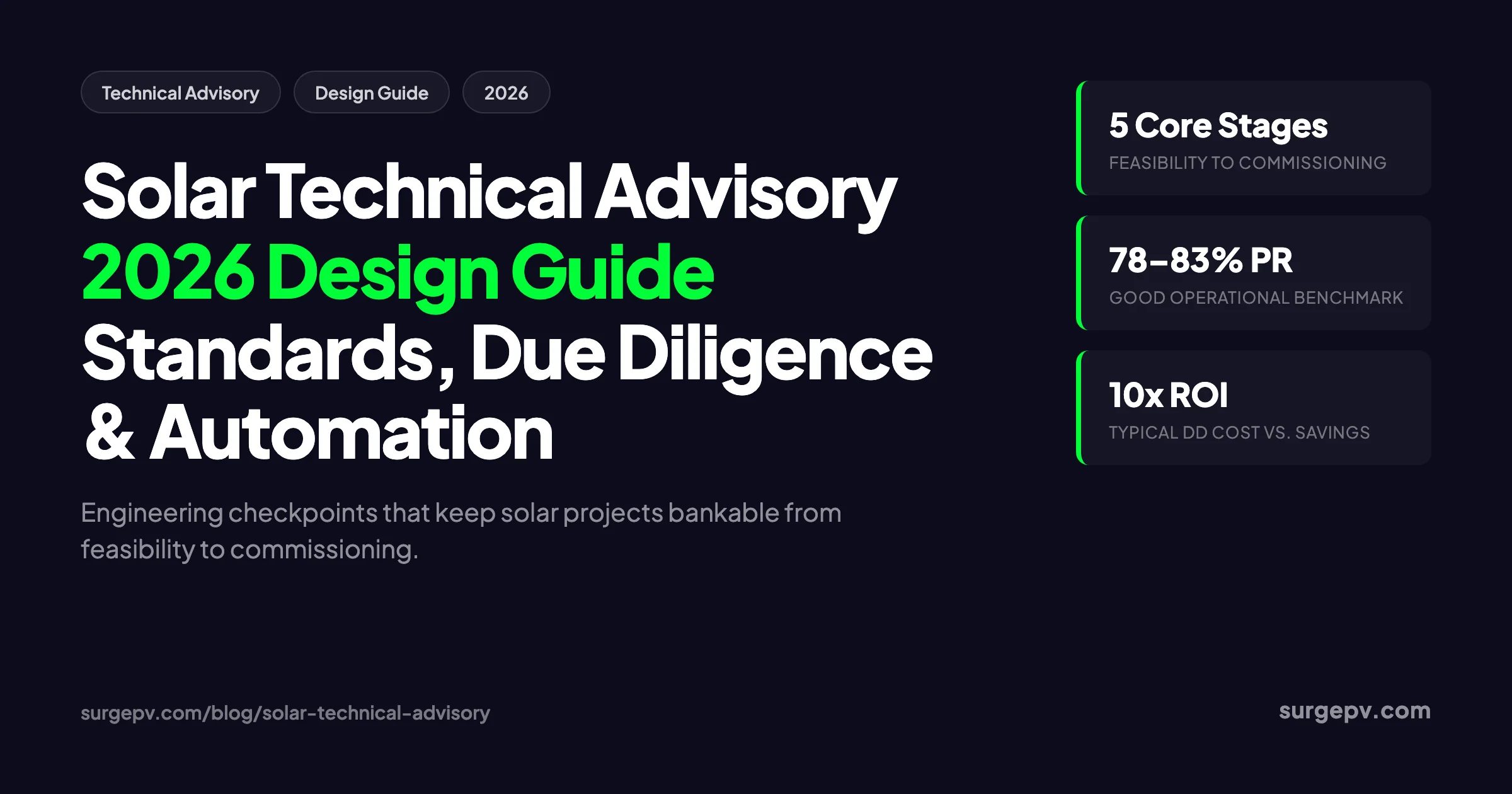
A solar technical advisory is not a single report. It is a sequence of reviews that matches the project risk at each stage. The five stages below are typical for commercial and utility-scale projects. Residential projects can compress them, but the technical logic stays the same.
| Stage | Typical Timing | Key Advisory Deliverable |
|---|---|---|
| Feasibility and site screening | Pre-development to early design | Site feasibility memo, red-flag list, preliminary yield estimate |
| Design review and energy yield | Basic to detailed design | Design review report, P50/P75/P90 yield assessment, single-line review |
| Procurement and contract review | Tender to EPC award | Bid evaluation, equipment vetting, EPC and O&M contract comments |
| Construction monitoring and QA/QC | Mobilization to substantial completion | Inspection reports, test witnessing, punch-list tracking |
| Commissioning and performance verification | Energization to final acceptance | Commissioning protocol, performance ratio test, as-built review |
Skipping a stage is usually a false economy. A design error caught in stage two costs minutes to fix. The same error caught in stage five can cost weeks and thousands of dollars.
Feasibility and Site Screening
At this stage the advisor checks whether the project is even worth designing in detail. Key questions include solar resource quality, grid connection capacity, land or roof constraints, shading, soil conditions, permitting risk, and environmental restrictions. The output is often a short memo that saves the owner from spending money on a site that cannot deliver.
For quick early checks, the irradiance estimator and solar panel sizer give a first-pass view of production potential without building a full model.
Design Review and Energy Yield
This is the core advisory stage. The advisor reviews layout drawings, electrical schematics, string sizing, structural loads, and equipment selection. They also run an independent energy yield model to verify the developer’s P50 estimate. A typical yield review tests sensitivity to soiling, degradation, inverter loading, and temperature losses.
Procurement and Contract Review
The advisor evaluates EPC and O&M bids against the technical specification. They check that proposed modules, inverters, and balance-of-plant equipment match the design intent. They also flag risky contract terms such as vague availability guarantees, weak warranty language, or unclear commissioning criteria.
Construction Monitoring and QA/QC
During construction the advisor visits the site, witnesses key tests, and reviews quality documentation. The goal is not to replace the EPC’s quality system. It is to provide an independent check that critical items such as torque, grounding, and cable management are actually done.
Commissioning and Performance Verification
The final stage confirms the plant performs as designed. The advisor reviews commissioning tests against IEC 62446-1 requirements, witnesses performance ratio tests, and validates that as-built drawings match what was built. This stage is essential before final payment or takeover.
Key Takeaway
Technical advisory value rises as the project progresses. Early design review prevents errors. Late-stage verification only documents them. Involve an advisor before freezing the design.
Design Review Checklist for Solar Technical Advisors
A design review is the heart of solar technical advisory. The checklist below organizes the most common failure points by discipline. Use it on rooftop commercial, ground-mount utility, or hybrid solar-plus-storage projects.
Site and Solar Resource
- Confirm irradiance data source, time series length, and uncertainty.
- Verify albedo, soiling, and temperature assumptions against local conditions.
- Check shading from nearby buildings, trees, terrain, or future construction.
- Validate orientation, tilt, and row spacing with a production model.
- Review geotechnical and hydrological reports for ground-mount projects.
The shadow analysis tool lets installers model shade losses early and share visual reports with clients.
Array Layout and String Sizing
- Confirm string voltage stays inside the inverter MPPT range at record low and high temperatures.
- Check that open-circuit voltage at the lowest design temperature is below the inverter maximum input.
- Verify string current matches fuse and combiner ratings after temperature corrections.
- Minimize mismatch by grouping modules with the same orientation, tilt, and string length.
- Leave maintenance walkways and fire setbacks per local code.
The string sizing calculator automates temperature-corrected Voc and string-to-inverter matching.
Electrical Design and Protection
- Review the single-line diagram for correct inverter, transformer, and switchgear ratings.
- Verify conductor ampacity after rooftop temperature derating.
- Check voltage drop on DC and AC circuits, typically targeting under 2% total loss.
- Confirm overcurrent protection coordination between string fuses, combiner boxes, and inverters.
- Validate grounding, bonding, surge protection, and rapid shutdown requirements.
Use the voltage drop calculator and wire size calculator to size conductors before the review meeting.
Structural and Civil
- Check wind and snow loads against the mounting structure certification.
- Verify roof attachment spacing, structural member capacity, and waterproofing details.
- Review ballast and foundation designs for ground-mount and carport systems.
- Confirm access roads, drainage, and fencing meet the project specification.
Equipment Selection and Warranties
- Confirm modules carry IEC 61215 and IEC 61730 certification for the intended climate.
- Verify inverter listing for local grid codes such as IEEE 1547 or VDE-AR-N 4105.
- Check that battery systems meet IEC 62619, UL 9540, or local fire safety requirements.
- Review warranty terms, degradation guarantees, and claims procedures.
Documentation and Compliance
- Ensure permit sets include single-line diagrams, site plans, structural calculations, and equipment datasheets.
- Verify interconnection applications match the installed design.
- Confirm labeling plans meet NEC Article 690 or local equivalents.
- Check that the commissioning test plan references IEC 62446-1 or the relevant national standard.
Pro Tip
Never accept a design where the as-built drawings do not match the permit set. Most hidden liabilities live in that gap.
Key Engineering Calculations Every Advisory Includes
Independent verification means redoing the math, not only reading the report. The calculations below are the minimum set any technical advisor should complete.
Energy Yield and Performance Ratio
The advisor models annual production using a weather file, layout, and component losses. The result is usually expressed as P50, P75, and P90 estimates. P50 is the expected median; P90 is the conservative estimate that the plant should exceed 90% of the time.
The performance ratio measures how much of the incoming solar energy becomes AC output. Modern plants typically fall in the 78–83% range. A plant above 83% is excellent. Below 75% usually signals design, shading, or equipment problems, according to PV-Maps (2026).
The generation and financial tool lets teams build P50 scenarios and compare them against actual commissioning data.
DC-to-AC Ratio
The DC-to-AC ratio compares installed module capacity to inverter capacity. Ratios between 1.1 and 1.3 are common because they reduce inverter cost and clipping losses while raising annual energy yield. Ratios above 1.35 can trigger excessive clipping unless the climate justifies it.
Temperature-Corrected Voltage
Module open-circuit voltage rises as temperature drops. A string that is safe at 25°C can exceed the inverter limit during a winter morning. Advisors calculate the temperature-corrected Voc using the module temperature coefficient and the site’s record low temperature.
Voltage Drop and Cable Losses
Long DC or AC cable runs create resistive losses. A well-designed system keeps total cable losses under 2%. Advisors verify conductor size, route length, and connector quality. Poor connections can add hidden resistance that thermography later reveals as hot spots.
Conductor Ampacity
Rooftop conductors operate above ambient temperature. A 14 AWG conductor rated for 20 A at 30°C may carry only 15 A at 70°C. Advisors apply temperature derating factors from NEC 310.16 or the local cable standard.
Financial Model Sanity Check
Technical advisors do not replace financial analysts, but they must flag inputs that do not match engineering reality. Common problems include overly optimistic degradation, ignored inverter replacement reserves, and unrealistic availability assumptions.
The payback period calculator and solar savings calculator help teams test financial assumptions against real design inputs.
Common Design Mistakes a Technical Advisory Catches
Most solar projects fail in the same predictable ways. An experienced advisor has seen them before and knows where to look.
Cold-Weather Voltage Overshoot
A 10-module string of 45 V panels measures 450 V at standard test conditions. At -10°C the same string can reach 517 V. If the inverter maximum input is 500 V, the system will fail on the first cold morning. The fix is simple: reduce the string length or select a higher-voltage inverter. Catching it early avoids a field retrofit.
String Mismatch and Partial Shading
Strings with different lengths, orientations, or shading profiles create mismatch losses. One underperforming string drags down the entire MPPT channel. Advisors catch this by checking string layout against the shading study and requiring module-level power electronics where needed.
Undersized Conductors and Connectors
Installers sometimes size conductors using STC current without temperature derating. The result is overheated cables, failed connectors, and fire risk. A single loose MC4 connector can generate enough heat to damage a combiner box and neighboring modules. The fault is usually a missing pin, wrong crimp die, or partial engagement that a proper inspection would catch.
Wrong Protection Devices
AC fuses do not belong in DC circuits. DC arc faults need listed arc-fault protection. Surge protectors need proper grounding to work. These are basic points, but they remain common inspection failures.
Optimistic Soiling Assumptions
A yield model that assumes 2% soiling in a dusty industrial zone will overestimate production. Advisors check soiling assumptions against local data and require cleaning contracts where needed.
Grounding and Bonding Gaps
Every metal part of the array must be bonded. A missing equipment grounding conductor, loose rail splice, or corroded bond creates both a safety hazard and a warranty problem. The solar installation quality inspection checklist covers the 47 points that prevent these failures.
Example
On a hypothetical 250 kW commercial rooftop, a technical advisory review found a problem. The design string voltage exceeded the inverter maximum input at the site’s record low temperature. The EPC reduced the string by one module. The change took 30 minutes in the model. It avoided an inverter replacement plus downtime.
How SurgePV Automates the Technical Advisory Workflow
Technical advisory is judgment work. The repetitive calculations underneath it are not. The right solar design platform checks string sizing, voltage limits, shading, yield, and financials in seconds. That frees engineers to focus on risk, tradeoffs, and decisions.
SurgePV’s design automation handles the calculations that advisors repeat on every project:
- String sizing calculator — verifies temperature-corrected Voc and MPPT range for any inverter.
- Voltage drop calculator — sizes conductors and flags excessive losses on long runs.
- Irradiance estimator — gives site-specific solar resource data for first-pass yield checks.
- Solar savings calculator — turns production into customer-facing savings numbers.
- Payback period calculator — models simple and discounted payback under different financing assumptions.
- Battery size calculator — sizes storage for backup, self-consumption, or tariff arbitrage goals.
The shadow analysis module produces 3D shade studies that advisors can compare against layout drawings. The energy and financial modeling tool builds production and revenue models that feed directly into solar proposals. And Clara AI accelerates preliminary layout and system sizing from satellite imagery.
Run design checks in minutes, not days
SurgePV automates the calculations that fill technical advisory reports. That includes string sizing, voltage drop, shading, yield, and payback. Your team can then focus on engineering judgment.
Book a DemoNo commitment required · 20 minutes · Live project walkthrough
What Most Guides Miss
Most technical advisory guides focus on large utility or M&A transactions. The same design-review discipline works for 30 kW commercial rooftops. The dollar amounts are smaller, but the failure modes are identical.
2026 Trends Shaping Solar Technical Advisory
Solar technical advisory is changing because solar projects are changing. Four trends are raising the stakes in 2026.
Hybrid PV plus battery storage. SolarPower Europe’s 2026 guidelines introduced the first unified technical due diligence framework for hybrid utility-scale solar and battery systems. Advisors now must review both generation and storage simultaneously, including DC-coupled and AC-coupled architectures, battery cycling strategies, and fire safety integration.
Higher DC voltages. Commercial systems have moved from 600 V to 1000 V and now to 1500 V. Higher voltage reduces cable losses and balance-of-system cost. It also raises the consequence of a string voltage miscalculation or insulation failure.
Larger modules and trackers. Modules above 600 W and single-axis trackers increase energy density but add structural and wind-load complexity. Advisors must verify that racking and foundation designs match the actual module and tracker loading.
Tighter grid codes. Interconnection standards such as IEEE 1547-2018 require advanced ride-through, voltage regulation, and anti-islanding functions. Advisors now spend more time reviewing inverter settings and utility approval documentation.
These trends do not make advisory optional. They make it more necessary.
How to Buy a Solar Feasibility Study
Define the investment decision and stage before asking consultants to quote. A screening memo, rooftop feasibility assessment, land-development study, and lender-facing review require different evidence. The brief should identify the site, load or offtake, capacity range, solar-resource source, layout constraints, grid connection, structural or geotechnical inputs, permitting context, commercial assumptions, scenarios, and acceptance criteria.
Request an input register, red-flag log, preliminary layout, yield range with stated uncertainty, grid and permitting assumptions, cost and schedule basis, sensitivity cases, recommended next investigations, and editable source models where appropriate. Require every conclusion to distinguish verified facts, third-party inputs, assumptions, and unresolved risks. A feasibility study supports a gate decision; it does not guarantee land rights, permits, grid capacity, energy output, construction cost, or financing.
Heaven Designs publishes a combined site-survey and land-feasibility service. Buyers should confirm whether fieldwork, cadastral review, geotechnical investigation, environmental review, grid study, financial modelling, or professional certification is included. Independent specialists may still be required.
Disclosure: SurgePV is promoting Heaven Designs through a commercial relationship. Apply the same evidence grading, uncertainty review, specialist verification, and independent decision gate to every consultant.
Review the Heaven Designs feasibility service, visit the Heaven Designs website, and request a comparable feasibility sample before seeking a quote.
When to Hire a Solar Technical Advisor
Not every project needs a full independent engineer. Use the checklist below to decide.
Hire a technical advisor when:
- The project is commercial, industrial, or utility scale.
- A lender or investor requires independent engineering.
- You are acquiring or refinancing an operating plant.
- The design uses a technology your team has not deployed before, such as bifacial modules, trackers, or DC-coupled storage.
- Local grid codes or permitting are complex.
- The project has tight margins where a 5% production shortfall kills returns.
You may keep advisory in-house when:
- The project is a straightforward residential repeat design.
- Your team has recent, documented experience with the same equipment and jurisdiction.
- The budget cannot support external review and the risk is low.
Some owners need detailed engineering or PE-stamped permit drawings. An external solar design and engineering consultancy can act as an extension of the in-house team.
Frequently Asked Questions
What is a solar technical advisory?
A solar technical advisory is independent engineering review of a photovoltaic project’s design, equipment, and risk from feasibility through operation. It catches design errors before construction, validates energy and financial models, and gives owners, lenders, and EPCs the data they need to proceed.
What is the difference between a technical advisor and an owner’s engineer?
A technical advisor is a broad term for any independent engineer reviewing project risk. An owner’s engineer is hired by the project owner and acts as the owner’s technical representative through design, procurement, construction, and commissioning. Lenders hire independent engineers to protect debt providers.
When should a project hire a solar technical advisor?
Hire an advisor before final design sign-off on commercial or utility projects. Bring one in before financial close, because lenders usually require independent engineering. Also use an advisor before acquiring an operating plant or when the in-house team lacks deep experience in a technology, market, or standard.
What does a solar technical advisory design review cover?
The design review covers site and solar resource validation. It checks array layout, string sizing, electrical single-line diagrams, and protection. It also reviews structural and civil loads, equipment selection and warranties, and compliance with IEC, NEC, IEEE, and local grid codes.
How much does solar technical due diligence cost?
For a 20–50 MW operational plant, a full technical due diligence package typically costs €70,000 to €165,000, according to PV-Maps (2026). That figure includes the independent engineer, legal and financial advisors, and site testing. The cost is usually small compared with the value at risk.
What is a good performance ratio for a solar plant?
Modern fixed-tilt plants in sunny climates typically achieve performance ratios above 78%. A plant above 83% is excellent, 75–78% is acceptable but warrants investigation, and below 75% usually signals design, shading, or equipment problems.
Can software replace a solar technical advisor?
Software cannot replace engineering judgment, but it can automate the calculations that consume most advisory hours. Solar design platforms check string sizing, voltage drop, shading, yield, and financials in seconds, leaving engineers free to focus on risk and decisions.
What standards govern solar technical advisory work?
Key standards include IEC 62446 for commissioning and inspection, plus IEC 61215 and IEC 61730 for module qualification. NEC Article 690 covers US electrical safety, and IEEE 1547 covers grid interconnection. SolarPower Europe’s technical due diligence guidelines apply to hybrid PV and battery projects.
Conclusion
Solar technical advisory is not a luxury for big projects. It is a design discipline that prevents small errors from becoming expensive failures. In 2026, with higher string voltages, larger modules, and more storage integration, independent review matters more than ever.
- Start advisory early. Review the design before procurement, not after construction.
- Verify the math independently. Yield, voltage, conductor sizing, and financials all deserve a second pass.
- Use automation for speed. Solar design software handles calculations instantly so engineers can focus on judgment.
Where this fits
This article is part of SurgePV's Solar Design hub, which works through the topic from first principles to the decisions a project team actually has to make.