

Answer
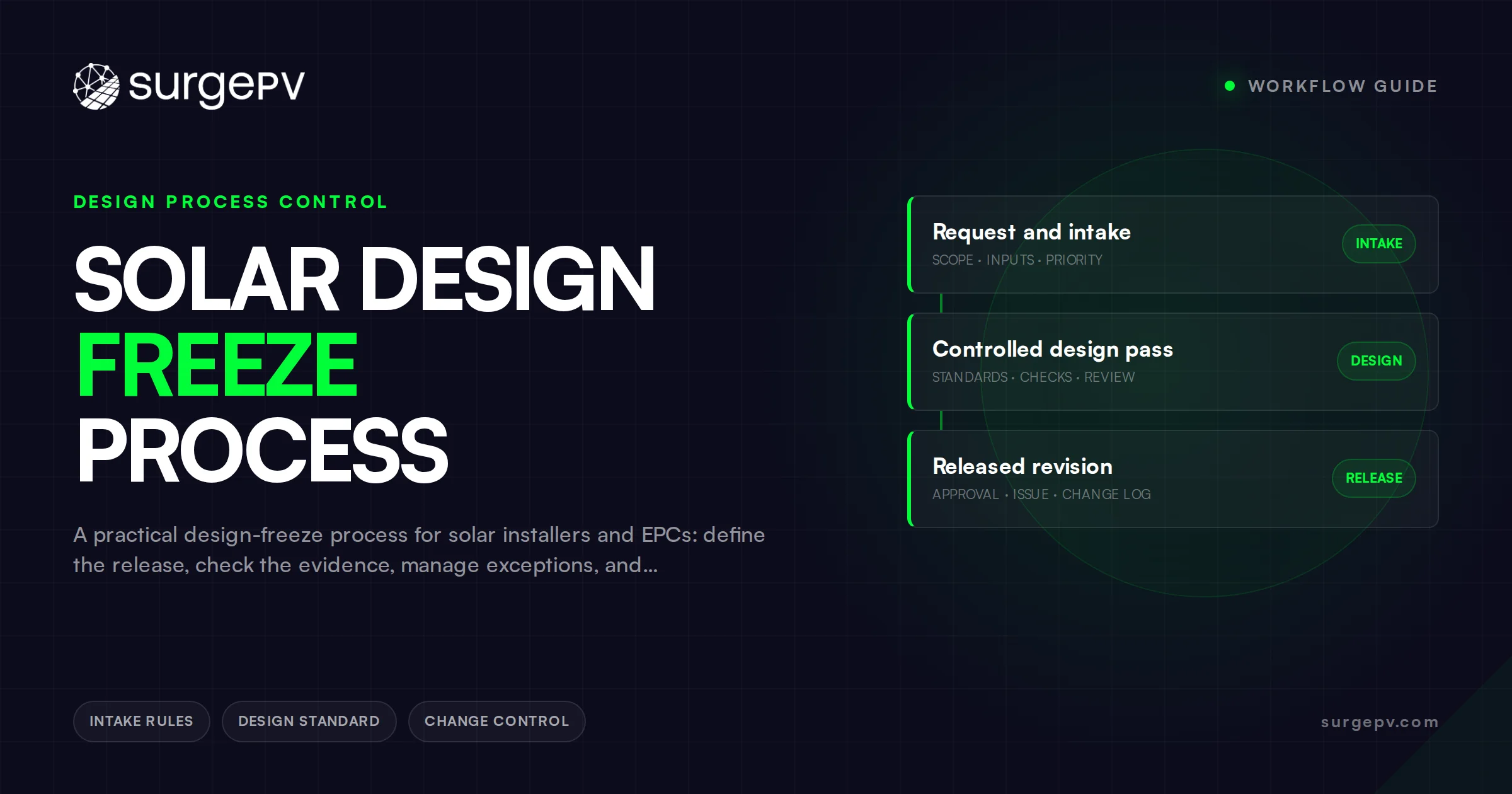
A solar design freeze is a controlled agreement that a defined revision is stable enough for a named next decision, such as proposal approval, procurement, permit preparation, or field planning. It is not a claim that nothing can ever change; it sets the baseline, open exceptions, and route for any later change.
A solar design freeze is a decision boundary, not a promise that the project has become immune to change. Its purpose is to stop different teams from acting on different versions of the same project. When a design is frozen for procurement, for example, the purchaser should know exactly which configuration, quantities, assumptions, and exceptions they are being asked to use.
Projects do change. A survey can reveal a condition not visible in imagery. A customer can select a different option. A utility instruction can change. Equipment can become unavailable. The value of a freeze is not preventing those events; it is making the original baseline and the route for responding to the event clear. That protects the customer-facing proposal and the people doing later work.
Direct Answer
Freeze a solar design only for a named purpose and revision. Confirm the required inputs and reviews for that purpose, publish the baseline and any permitted open exceptions, notify downstream owners, and require later changes to identify their impact before they replace the baseline.
Do Not Freeze “the Project”
The phrase “design freeze” becomes risky when it has no qualifier. A layout may be stable enough for a customer to compare options but not stable enough for equipment ordering. A procurement list may be stable enough for a supplier enquiry but not stable enough for a field crew. A permit-related package may have its own evidence and review requirements. These are separate decisions.
Name the freeze by purpose: proposal freeze, pricing freeze, technical-review freeze, procurement freeze, permit-preparation freeze, or field-planning freeze. The name should answer two questions: who can act on this version, and what is still outside its scope? If neither answer is clear, the project has a status label but not a useful control.
This article is a workflow guide, not engineering, legal, safety, code, utility, or contract advice. Local requirements, qualified professionals, manufacturer instructions, property conditions, and the intended use of a document determine what must be checked. The project’s release checklist must reflect those realities.
Establish a Baseline That People Can Find
A freeze starts with a uniquely identifiable baseline. Record the design revision, date, intended release, configuration summary, source links, and customer-facing proposal version if there is one. A later colleague should not have to ask whether “final layout.pdf” means the same thing as the live model or last email attachment.
The baseline does not have to reproduce every drawing. It should point to the controlled record. At minimum, identify the array concept, key equipment assumptions, quantity basis, production or financial scenario reference where used, material exclusions, and open conditions. If the layout is linked to a customer proposal, show which proposal version incorporates it.
NREL describes PVWatts as an energy-production and value estimator for grid-connected PV systems. That reminder is useful at a freeze: modeled outputs belong to a stated version and input set. A number copied into a proposal without its model basis can be mistaken for a property of the project rather than an estimate made under assumptions.
Decide the Entry Criteria Before the Meeting
Teams lose time when “ready to freeze” is decided from a feeling. Define a compact entry checklist for each release type. For a proposal freeze, the checklist may include customer objectives, source consumption information, a readable layout, selected options, stated financial assumptions, material exclusions, and a review of the customer story. For procurement, it may include a current bill of materials, selected identifiers, quantities, approved alternatives, a revision check, and confirmation that open conditions do not invalidate ordering.
The checklist should not imply that every project has the same requirements. A ground-mounted project, a complex commercial roof, a storage addition, and a straightforward residential concept present different questions. Use the checklist to prompt the right review, then add project-specific conditions rather than forcing a superficial pass.
Here is a useful pre-freeze table:
| Check | Why it matters | Result to record |
|---|---|---|
| Intended release named | Defines the decision being authorised | “Pricing freeze, revision C” |
| Design source current | Prevents action on superseded work | Link to controlled revision |
| Customer scope aligned | Avoids a silent mismatch with proposal | Proposal version or exception |
| Material assumptions visible | Shows what can still change the outcome | Assumption and owner |
| Open constraints assessed | Prevents blocked work from moving downstream | Release boundary and status |
| Review route complete | Matches review to consequence | Reviewer or escalation note |
The result is not a ceremonial signature. It is an evidence trail that lets people understand why this stage was appropriate.
Keep Open Exceptions Visible
The worst freeze is one that hides its exceptions. A project may reasonably proceed to a limited next step while a condition remains open, but the condition must be named, bounded, and owned. “Site survey to verify access before field planning” can coexist with a pricing freeze. “Electrical service unknown” may be incompatible with final equipment selection, depending on the project and applicable review.
Use an exception note with five parts: the condition, the evidence currently available, impact if it changes, owner, and latest stage for closure. Link it to the constraint register or equivalent project record rather than copy-and-pasting an unmaintained list. A freeze should reference the live control, not create a second version of it.
Do not call all unresolved issues “risks.” Some are merely information requests. Others may be material blockers. The point is to distinguish them. A customer waiting to choose a payment method is different from an unresolved condition that could change electrical design. Both can be visible without being given the same response.
Make the Freeze a Cross-Functional Handoff
Solar proposals tie together sales conversations, site information, design choices, model outputs, pricing, and delivery dependencies. A freeze conducted by one function alone may produce a tidy document and an untidy handoff. Invite the roles that own the next decision, but keep the review focused on what they need.
For a proposal freeze, sales may confirm the buyer’s objective and selected option; design may confirm that the layout and proposal inputs point to the same revision. For a procurement freeze, design and procurement need to agree what quantities and substitutions are controlled. For field planning, operations and technical owners need to see site conditions, access assumptions, and release boundaries. Questions requiring qualified or local judgment should go to the appropriate route rather than being settled by a general status meeting.
The Solar Designing workflow can help bring design information into a connected process. It does not assign legal responsibility or replace independent verification. A robust handoff still says who reviewed what, for which purpose, and what is pending.
Connect Solar Design Revisions and Proposal Outputs
See how SurgePV brings solar design, Shadow Analysis, generation and financial modeling, and customer proposals into one workflow.
Book a DemoBring a real revision-control question to the demo.
Publish a Short Freeze Note
After review, send a concise freeze note to the people who need it. A useful note includes the release name, revision, date, intended action, baseline link, open exceptions, and the rule for changes. Avoid a message that says simply “approved” or “final.” Those words are easy to forward and hard to interpret.
For example: “Procurement freeze: layout revision D and BOM revision D are the current baseline for supplier quotation only. Roof access verification remains open and must close before field planning. Do not order substitutes without a design-impact review.” This is not legal language; it is operationally specific language.
Make sure the customer-facing proposal stays aligned. If a scope or assumption changes during freeze, the sales owner should know whether the existing proposal needs an update before the buyer is asked to decide. No customer should discover from a procurement change that the described system is different from the one they reviewed.
Route Changes Through an Impact Question
Change after freeze is normal. Uncontrolled change is not. When new evidence arrives, start with the impact question: does this alter the released configuration, quantities, commercial scope, model input, schedule, approval route, field instruction, or customer promise? If not, it may be a record update. If yes, create a new revision or formal change note before downstream work continues.
The change request should identify the trigger, affected baseline, proposed response, evidence, and people who must review it. A module substitution, for example, may affect dimensions, electrical configuration, availability, price, or documentation. It should not be treated as a simple procurement preference until the relevant effects are checked.
NREL’s PV operations and maintenance best-practices publication highlights the enduring value of documentation and defined responsibilities. A project’s early change record matters for the same reason: it helps subsequent people understand what was intended and what actually changed.
Avoid Two Common Freeze Failures
The first failure is freezing too early to create a comforting schedule status. When significant inputs are missing, the baseline may be too fragile for the next action. The better response is a limited freeze with clear exceptions, or a decision to hold until evidence arrives. A status label cannot make missing evidence disappear.
The second failure is freezing too late. Teams sometimes keep a project “in design” even when the customer, purchaser, or planner needs a stable version. That encourages everyone to use informal copies. A timely, purpose-specific freeze gives the next team something authoritative to work from while preserving a route for legitimate changes.
Balance comes from naming the decision and testing the evidence against it. Not every unknown needs resolution before every step. Every unknown does need a visible consequence and a deadline.
Use Customer Language That Matches the Stage
A freeze is internal control, but it changes customer communication. At a proposal stage, say what has been modeled, what is included in the option, and which conditions will be checked before a later release. If the customer chooses a revision, tell them which version they are accepting. If field findings require a change, explain the evidence and the changed consequence before presenting a replacement.
This approach prevents a polished proposal from being read as an unconditional construction promise. It also makes follow-up more useful. Rather than asking “Any update?”, a sales owner can ask whether the customer has decided between the named options or whether a stated assumption needs clarification. Solar Proposals can support that connected presentation while the project team maintains the controlled baseline behind it.
A Ten-Minute Freeze Review Agenda
Use a short agenda to keep the discussion evidence-led:
- State the named release and revision.
- Confirm the configuration and customer-facing version.
- Review material inputs that changed since the previous baseline.
- Read open exceptions, owners, and release boundaries.
- Confirm the next team’s permitted action.
- Record whether the baseline is released, limited, held, or escalated.
If the project cannot answer one of these questions, that is useful information. It shows exactly what must be resolved rather than allowing a vague “almost final” condition to circulate.
Start With One Release Type
Do not attempt to design a universal process for every project in one week. Start with the handoff that currently creates the most rework: perhaps proposal to delivery, design to procurement, or survey to technical review. Define its entry criteria, baseline fields, exception format, and change route. Test it on several projects, then revise the checklist using real feedback.
The aim is not bureaucracy. It is a shared answer to a simple operational question: what is stable enough for us to do next, and what must still be managed before we do more?
Ready to Keep Solar Project Revisions Easier to Trace?
Book a free SurgePV demo to explore connected solar design, shadow analysis, generation and financial tools, and Solar Proposals.
Book a Free DemoFrequently Asked Questions
What is a solar design freeze?
It is a controlled baseline for a named next decision. The record identifies the current revision, intended use, evidence and reviews completed, open exceptions, and the process for later changes.
Does freezing a design mean it cannot change?
No. New site evidence, buyer choices, availability, utility requirements, or technical findings can require a change. The freeze makes that change traceable against an agreed starting point.
What should block a procurement freeze?
Any unresolved condition that can materially change the items being sourced, their quantities, configuration, or permitted use should be assessed before procurement action. The exact release criteria depend on the project and relevant requirements.
Who approves a freeze?
The answer depends on the release. The people accountable for the next decision should confirm it, with qualified technical or local review used where the question requires it. A generic approval label is not a substitute for a defined route.
Sources
Primary research and reference material used for this desk-research article.
Where this fits
This article is part of SurgePV's Solar Design hub, which works through the topic from first principles to the decisions a project team actually has to make.