

Quick Answer
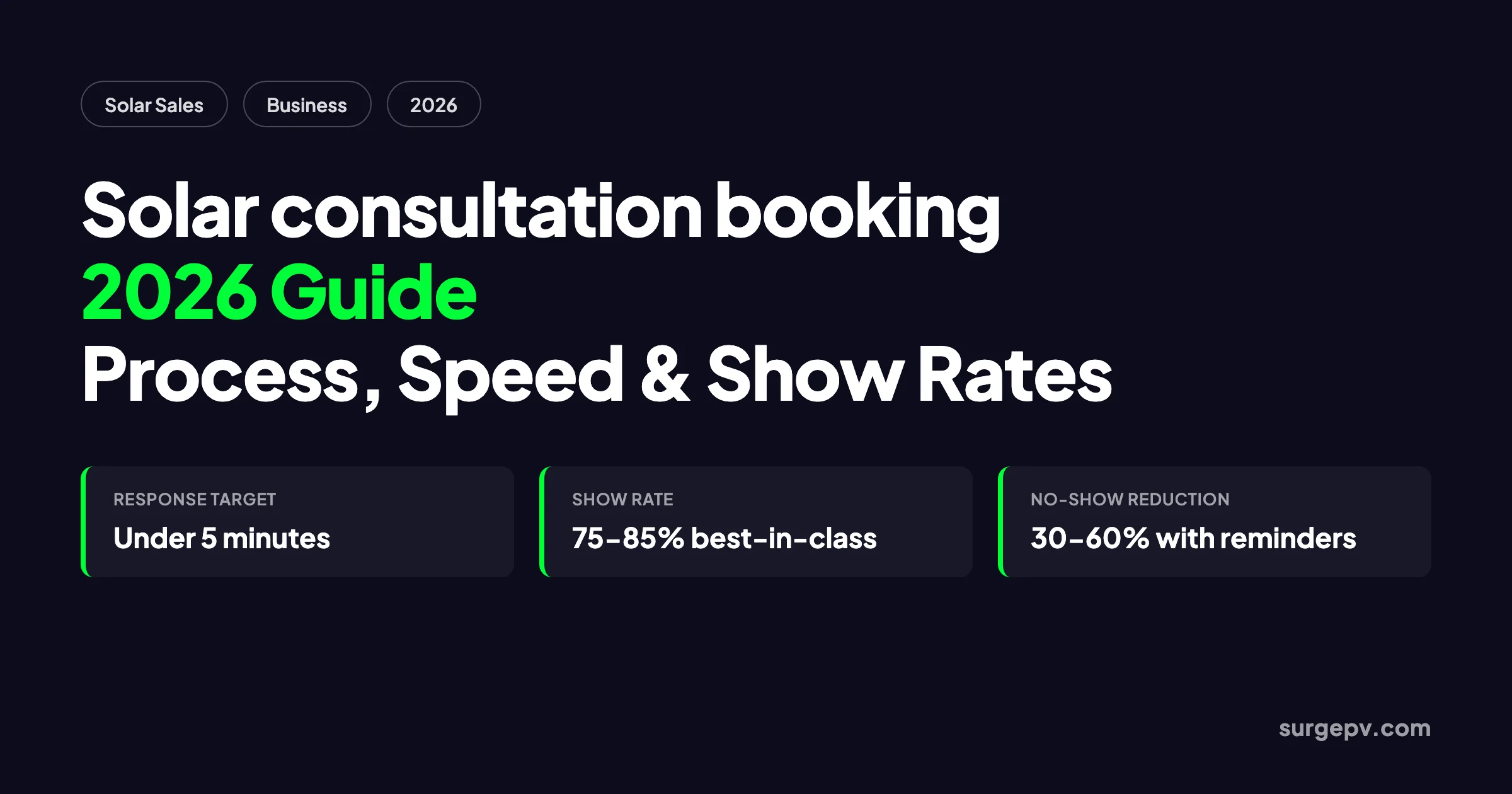
Solar consultation booking is the process of converting an interested prospect into a scheduled, qualified consultation. In 2026, top installers book consultations within 5 minutes of inquiry, pre-qualify on five points, and use automated reminders to push show rates above 75%.
Your sales calendar is full. Your reps are driving from one consultation to the next. But your close rate is stuck below 20%, and your no-show rate is climbing. The problem is not that your team cannot sell. The problem is that the wrong appointments are getting booked.
This is the hidden cost of weak solar consultation booking. A booked appointment is not a qualified appointment. A prospect who rents, owns a 25-year-old roof, or pays a $60 monthly electric bill will rarely become a customer. Yet many solar companies still measure their appointment setters by volume alone. More consultations feel like progress. They are not.
Solar consultation booking is the process of converting an interested prospect into a scheduled, qualified consultation. In 2026, top installers book consultations within 5 minutes of inquiry, pre-qualify on five points, and use automated reminders to push show rates above 75%.
This guide is a business and sales playbook for the entire booking process. It covers qualification, speed, objection handling, confirmation tactics, and the systems that connect booking to closing.
Quick Answer
Solar consultation booking converts interested prospects into scheduled, qualified consultations. Top-performing installers respond within 5 minutes, verify five qualification points before booking, and use multi-channel reminders to keep show rates above 75%.
In this guide:
- What solar consultation booking is and how it differs from lead generation
- The five-point pre-qualification checklist every setter should use
- Why the first 5 minutes after inquiry matter more than the sales pitch
- Exact scripts for the six most common booking objections
- Confirmation tactics that cut no-shows by 30% to 60%
- How to decide between in-house and outsourced appointment setting
- The mistakes that keep solar teams busy but unprofitable
- How SurgePV connects booking, design, and proposals into one workflow
What Is Solar Consultation Booking?
Solar consultation booking is the bridge between a marketing lead and a sales conversation. It includes every step from first contact to a confirmed appointment. That means responding to the inquiry, qualifying the prospect, proposing a time, sending confirmation, and handing the appointment to the sales rep.
The consultation itself can take several forms:
- In-home site survey: A rep visits the property to inspect the roof, review the electrical panel, and discuss options face-to-face.
- Virtual consultation: A video call where the rep reviews satellite imagery, usage data, and preliminary savings estimates.
- Phone consultation: A detailed discovery call used for commercial prospects or remote residential markets.
- Hybrid model: A quick qualification call followed by an in-person site survey for promising prospects.
Each format requires the same core inputs: property ownership, roof condition, average electricity bill, decision-maker availability, and timeline. Booking is not administrative work. It is the first filter in your sales funnel.
A well-booked consultation gives the sales rep three things: a qualified prospect, relevant context, and a clear next step. A poorly booked consultation gives the rep a long drive and a disappointed homeowner.
Why Consultation Booking Is Different From Lead Generation
Lead generation is about attracting interest. Consultation booking is about converting that interest into a structured conversation. The skills, metrics, and incentives are not the same.
Marketing teams are measured on cost-per-lead, lead volume, and channel mix. Appointment setters should be measured on qualified consultation rate, show rate, and handoff quality. When these two functions are confused, companies optimize for the wrong outcome.
A common mistake is giving appointment setters a lead volume target without a quality target. The setter books anyone who agrees to a time. The calendar looks healthy. The sales team wastes hours on prospects who cannot buy.
Another mistake is treating booking as a simple scheduling task. In solar, the setter must also do early qualification. Roof condition, electric bill, and homeownership status determine whether the appointment is worth the rep’s time. The best setters ask these questions naturally, within the first 90 seconds of the call.
The handoff matters too. A sales rep who walks into an appointment blind has to re-qualify from scratch. That kills rapport and momentum. The booking note should include the prospect’s bill range, roof age, motivation for going solar, and any objections already raised. Read our solar lead response time guide for more on how fast handoffs protect buyer intent.
The 2026 Solar Consultation Booking Playbook
A repeatable booking process has six steps. Each step has a clear owner, a time target, and a quality gate.
Step 1: Capture the Lead in One Place
Leads arrive from many sources: website forms, Facebook Lead Ads, Google Ads, phone calls, referrals, door-to-door canvassing, and third-party marketplaces. If these leads sit in separate inboxes, response time becomes inconsistent and prospects fall through gaps.
Route every lead into a single CRM or lead inbox within 60 seconds of capture. The CRM should timestamp the inquiry, tag the source, and assign ownership automatically. This removes the delay caused by manual forwarding and prevents disputes over who owns the follow-up.
Step 2: Respond Before the Prospect Cools
Speed is the single biggest lever in consultation booking. The MIT / InsideSales.com Lead Response Management Study analyzed over 15,000 leads and 100,000 call attempts. It found that contacting a lead within 5 minutes versus 30 minutes makes you 100 times more likely to reach them. Qualifying within 5 minutes makes you 21 times more likely to succeed. MIT / InsideSales.com Lead Response Management Study (2007)
A 2011 Harvard Business Review audit of 2,241 U.S. companies confirmed the pattern. Firms that contacted test leads within an hour were nearly 7 times more likely to qualify the lead than those that waited another hour. Harvard Business Review (2011)
Set a simple rule: every inbound lead gets a human response within 5 minutes during business hours. After-hours leads should receive an automated acknowledgment within 2 minutes.
Step 3: Qualify Before You Schedule
Never offer a time slot before you know the prospect can buy. The five-point checklist below gives the minimum qualification threshold. If the prospect fails two or more points, politely end the call and move on.
This step protects your sales team. It also protects the prospect from wasting time on a consultation that will not result in a viable proposal.
Step 4: Offer Two Time Slots, Not an Open Calendar
Asking “when are you available?” invites hesitation and delay. Instead, offer a choice of two specific slots: “Would Tuesday at 4 PM or Saturday at 10 AM work better for you?”
This approach, known as the alternative close, increases booking rates because it removes the mental work of scanning a calendar. It also keeps control of the schedule so you can cluster appointments geographically and reduce drive time.
Step 5: Confirm Immediately and Often
A booked appointment is not a guaranteed show. Send confirmation through every channel the prospect uses: calendar invite, SMS, and email. Include the date, time, rep name, and what the homeowner should have ready.
Then schedule reminders at 24 hours before and on the day of the appointment. Automated reminders can reduce no-shows by 30% to 60%, according to aggregated appointment reminder research. Appointment Reminder no-show statistics guide (2026)
Step 6: Hand Off With Context
The sales rep should receive a briefing before the appointment. At minimum, this should include:
- Name, address, and phone number
- Source of the lead
- Homeownership status
- Roof age and condition
- Average monthly electric bill
- Decision-makers and timeline
- Objections or concerns raised during booking
- Confirmation status
This allows the rep to start the consultation at a higher level. Instead of asking basic qualification questions, they can move directly to value, savings, and system design.
The Five-Point Pre-Qualification Checklist
Every consultation booking should verify five core criteria. These five points prevent the most common causes of wasted appointments.
1. Homeownership
Only property owners can authorize a solar installation. Renters may be interested, but they cannot sign the contract or apply for most incentives. Ask directly: “Do you own the home?” If the answer is no, end the call unless the landlord is involved.
2. Roof Age and Condition
A roof that needs replacement within the next 5 years is usually a disqualifier unless the homeowner is already planning to re-roof. Solar panels last 25 to 30 years. Installing them on a failing roof creates warranty disputes and unhappy customers.
Ask: “How old is your roof?” Also ask if it has been replaced recently. If the roof is over 20 years old or shows visible damage, flag it for review. A structural check should happen before booking.
3. Average Monthly Electric Bill
Solar savings scale with energy use. A homeowner with a $60 monthly bill will rarely see enough savings to justify the system cost. Most installers look for a bill above $80 to $100 per month, depending on local electricity rates.
Ask: “What is your average monthly electric bill?” This single number tells you more about sales potential than most other questions.
4. Credit and Financing Direction
Cash buyers are ideal, but most residential solar in the United States is financed. A credit score below the lender’s threshold will kill the deal after the consultation. Early screening avoids wasted time.
Ask: “Are you planning to pay cash, finance, or lease the system?” Then ask about the general credit range. You do not need exact scores. A general direction is enough to assess fit.
5. Decision-Maker Availability
Solar is a household decision. If one spouse is interested and the other is not present, the consultation often ends with “I need to talk to my partner.” Schedule the appointment when every decision-maker can attend.
Ask: “Besides yourself, who else is involved in the decision? Will they be available at the same time?”
Speed-to-Book: Why the First Five Minutes Decide Everything
Solar buyers do not wait. When a homeowner submits a quote request, they often send the same request to 3 to 5 installers. The first company to respond competently usually wins the appointment. The second company gets told, “We already have someone coming.” The third company goes to voicemail.
This is why speed-to-book is a commercial advantage. It is not about being pushy. It is about reaching the prospect while their interest is at its peak.
The data is consistent across industries. Velocify analyzed roughly 3.5 million leads and found that calling within one minute of receiving a lead increases conversion rates by 391%. AInora lead response time study review (2026)
For solar specifically, response speed is even more critical because the purchase is considered, not urgent. The homeowner is comparison shopping. The company that responds first sets the anchor. Every later proposal is compared against the first one.
After-Hours Leads Are Not Optional
A large share of solar inquiries arrives outside business hours. Homeowners research after dinner, on weekends, and after receiving a high bill. If your booking process only operates during office hours, you are losing these leads to competitors with instant response systems.
The solution is not to staff a 24-hour call center. The solution is to automate the first touch. An AI voice agent, SMS sequence, or self-service booking page can qualify and schedule while your team is offline. The lead is then warm when your rep starts the next day.
How to Handle the Six Most Common Booking Objections
Objections during booking are not rejections. They are requests for more information. A trained setter can turn most objections into confirmed appointments.
“I am just getting quotes right now.”
Response: “That makes sense. Most homeowners compare two or three options. Our consultation is free, takes about 30 minutes, and gives you a detailed savings estimate based on your actual roof and usage. Would Tuesday at 4 PM or Saturday at 10 AM work better?”
The key is to agree with the prospect, restate the value, and move back to scheduling.
“How much does it cost?”
Response: “The exact cost depends on your roof layout, shading, and how much energy you use. That’s exactly why we do a free site review first. After that, we can give you a firm number. Would morning or afternoon work better this week?”
Never give a price before the consultation. An inaccurate guess either scares the prospect away or creates a mismatch later.
“I need to talk to my spouse.”
Response: “Of course. Is your spouse usually home in the evenings or on weekends? I’d rather schedule a time when you can both be there so we can answer all your questions at once.”
This objection often means the decision-maker is not present. Turn it into a scheduling requirement.
“I do not have time right now.”
Response: “I understand. Would a 15-minute call next Tuesday work, or would a weekend appointment be easier? We can also do a video consultation if that saves you time.”
Offer shorter or more convenient formats. The goal is to remove friction, not pressure the prospect.
“I am worried about my roof.”
Response: “That’s one of the main things we check during the consultation. If your roof needs work before solar, we’ll tell you upfront and can include re-roofing in the proposal. Should we schedule the inspection for this week?”
Acknowledge the concern and position the consultation as the way to get clarity.
“Can you just send me information by email?”
Response: “Absolutely. I’ll send a short overview right after this call. The consultation is really where the numbers come to life, because we look at your specific roof and bill. Would Wednesday evening or Saturday morning work?”
Promise the information, but do not let the call end without attempting to book.
Confirmation and Show-Rate Tactics
A consultation that does not happen has zero value. Show rate is one of the most under-managed metrics in solar sales.
Industry average show rates range from 55% to 70%. Best-in-class operations achieve 75% to 85%. Televista solar appointment show rate analysis (2025) The gap is rarely about the prospect. It is about the process.
Send the Right Confirmation Sequence
A strong confirmation sequence has three touches:
- Immediate confirmation: Calendar invite, SMS, and email sent within 5 minutes of booking.
- 24-hour reminder: SMS or call confirming the appointment and restating the value.
- Same-day reminder: A brief message with the rep’s name, arrival window, and what to prepare.
Each message should reinforce why the appointment matters. “We’ll review your last 12 months of electric bills and show you exactly how much a system could save.”
Make Rescheduling Easy
Life happens. A prospect who cannot make the original time will often silently no-show rather than call to reschedule. Offer a one-click reschedule link in your SMS and email reminders. This keeps the lead in the pipeline instead of losing it.
Cluster Appointments Geographically
When a rep drives 45 minutes between consultations, delays and no-shows become more costly. Cluster appointments by zip code or neighborhood. If one appointment cancels, the rep is already nearby for the next one. This also reduces the cost per appointment and improves rep utilization.
Confirm Commitment at Booking
Before ending the booking call, ask: “Can I confirm you’ll both be available and that we have the right address?” This small step increases commitment. It also reduces casual bookings.
In-House vs. Outsourced Appointment Setting
At some point, every growing solar company asks whether to build appointment setting internally or outsource it. Both models can work. The right choice depends on volume, seasonality, and control preferences.
In-House Appointment Setting
Advantages:
- Full control over scripts, tone, and qualification standards
- Direct feedback between setters and sales reps
- Faster iteration on messaging
- Better protection of customer data and brand reputation
Disadvantages:
- Hiring and training overhead
- High turnover in setter roles
- Difficulty scaling during peak seasons
- Fixed cost even when lead volume drops
In-house works best when lead volume is steady, quality standards are strict, and the sales team is close enough to provide daily feedback.
Outsourced Appointment Setting
Advantages:
- Faster ramp during busy seasons
- Access to trained setters who understand solar qualification
- Lower fixed overhead
- Scalable up or down with lead flow
Disadvantages:
- Less direct control if onboarding is weak
- Quality varies significantly between providers
- Requires clear scripts, SLAs, and feedback loops
- May not understand local incentives or financing options
Outsourced works best when lead volume is seasonal, growth is rapid, or the internal team is already at capacity.
A hybrid model is also common: keep high-value referral and organic leads in-house, and outsource overflow from paid lead marketplaces. Shared leads from marketplaces convert at only 5% to 10%, while exclusive leads convert at 15% to 25%. Marketing LTB solar marketing statistics (2026) The channel should influence where you invest setter time.
For installers in India, WhatsApp and mobile-first CRM workflows dominate. Tools like QuickEstimate can automate lead capture, follow-up, and consultation scheduling in the channels customers already use.
What Most Solar Teams Get Wrong About Consultation Booking
The biggest misconception in solar sales is that more consultations always equal more revenue. They do not. Unqualified consultations consume rep time, fuel, and morale. They also reduce the time available for real opportunities.
Here are the most common mistakes:
Mistake 1: Measuring Setters by Volume Alone
If setters are paid per booked appointment, they will book anything. Tie compensation to qualified show rate and close rate, not just appointments scheduled.
Mistake 2: Weak Handoffs
A rep who arrives without context starts the relationship poorly. The homeowner has to repeat information. The rep looks unprepared. Both sides lose trust.
Mistake 3: Ignoring After-Hours Inquiries
Leads that come in at 8 PM on Saturday are often the highest intent. They are actively researching after a bill or a neighbor’s installation. A Monday morning response is too late.
Mistake 4: Booking Too Far in Advance
Appointments booked more than 7 days in advance have higher no-show rates. The prospect’s motivation fades. Schedule consultations within 3 to 5 days when possible.
Mistake 5: Skipping the Confirmation Sequence
One confirmation email is not enough. A sequence of SMS, email, and calendar reminders is standard in other industries. Solar should be no different.
The correction is simple but hard to enforce: treat consultation booking as a profit center, not a cost center. Every appointment has a real cost. Every unqualified appointment is a small loss.
How SurgePV Fits Into the Consultation Booking Process
A fast, qualified consultation is only useful if the rep can turn it into a signed proposal quickly. The gap between booking and proposal is where many solar deals die.
SurgePV connects the booking, design, and proposal stages into one workflow. When a lead is qualified, the sales rep can use solar design software to build a preliminary roof layout from satellite imagery before the consultation. The generation and financial tool turns that design into a savings and payback estimate. The solar proposals feature packages the design, financing options, and equipment choices into a professional proposal the homeowner can review and sign.
This matters because the first company to present a credible proposal often frames the entire comparison. A rep who walks into a consultation with a preliminary design and savings estimate is not just booking an appointment. They are shortening the sales cycle.
For sales teams, SurgePV for sales professionals provides the tools to prepare, present, and close proposals without waiting on a separate design team. For teams handling high volumes, Clara AI can assist with design and financial modeling so reps spend less time on technical work and more time selling.
If your consultation booking process is strong but your proposal process is slow, the bottleneck is not at the top of the funnel. It is in the handoff from appointment to signed contract. Book a SurgePV demo to see how the design-to-proposal workflow can compress that handoff.
Frequently Asked Questions
What is solar consultation booking?
Solar consultation booking is the process of scheduling a qualified prospect for a site survey, video consultation, or in-home sales appointment. It sits between lead generation and proposal delivery. The goal is not simply to fill the calendar. A good booking also confirms ownership, roof condition, bill size, and financing readiness.
How fast should a solar company book a consultation?
Best-in-class teams book consultations within 5 minutes of a web-form inquiry and answer inbound calls within 60 seconds. Research from MIT and Harvard Business Review shows that response speed within the first hour has a dramatic impact on contact and qualification rates. After 24 hours, most solar prospects have already scheduled with a competitor.
What should a solar consultation booking script include?
A strong booking script confirms the prospect’s name and address. It verifies homeownership, roof age, electric bill, and decision-maker availability. The script should end with a choice of two specific time slots rather than an open-ended question.
How do you reduce no-shows for solar consultations?
Reduce no-shows with a confirmation sequence. Send an immediate calendar invite and SMS, a reminder 24 hours before, and a same-day message with the rep’s name. Automated reminders can cut no-show rates by 30% to 60%. Making rescheduling easy also prevents silent cancellations.
What is a good show rate for solar consultations?
Industry average show rates range from 55% to 70%. Best-in-class operations with strong qualification and confirmation sequences achieve 75% to 85%. If your show rate is below 60%, the problem is usually upstream: weak qualification, slow confirmation, or appointments booked too far in advance.
Should solar consultation booking be in-house or outsourced?
In-house booking gives you full control, faster feedback loops, and tighter alignment with your sales team. Outsourced appointment setting adds scale during peak seasons and reduces hiring overhead. The right choice depends on lead volume, seasonality, and whether you can train an external partner on your market and financing options.
What are the biggest mistakes in solar consultation booking?
The biggest mistakes are booking unqualified leads, asking open-ended scheduling questions, failing to confirm appointments, ignoring after-hours inquiries, and handing off leads without context. Each error wastes rep time, burns fuel, and inflates customer acquisition cost.
How does consultation booking connect to solar proposals and CRM?
Booking data should flow directly into your CRM so the sales rep sees the qualification notes before the appointment. Integrated design and proposal tools then let the rep build a preliminary system layout and savings estimate while the consultation is being booked. That preparation shortens the sales cycle and raises close rates.
Where this fits
This article is part of SurgePV's Solar Sales & Proposals hub, which works through the topic from first principles to the decisions a project team actually has to make.


