Quick Answer
OpenSolar already includes a customizable CRM and project-management workflow, so do not replace it without a measured gap. Stay when the built-in flow passes. Integrate another CRM when each system has clear ownership and the connector earns its cost. Replace the CRM layer only after a controlled pilot proves migration, security, support, TCO, and exit readiness.
An OpenSolar CRM alternative is not automatically necessary because OpenSolar already includes a customizable CRM and project-management workflow. Its official pages describe leads, contacts, projects, stages, actions, assignments, scheduling, communications, documents, e-signature, payments, and project activity.
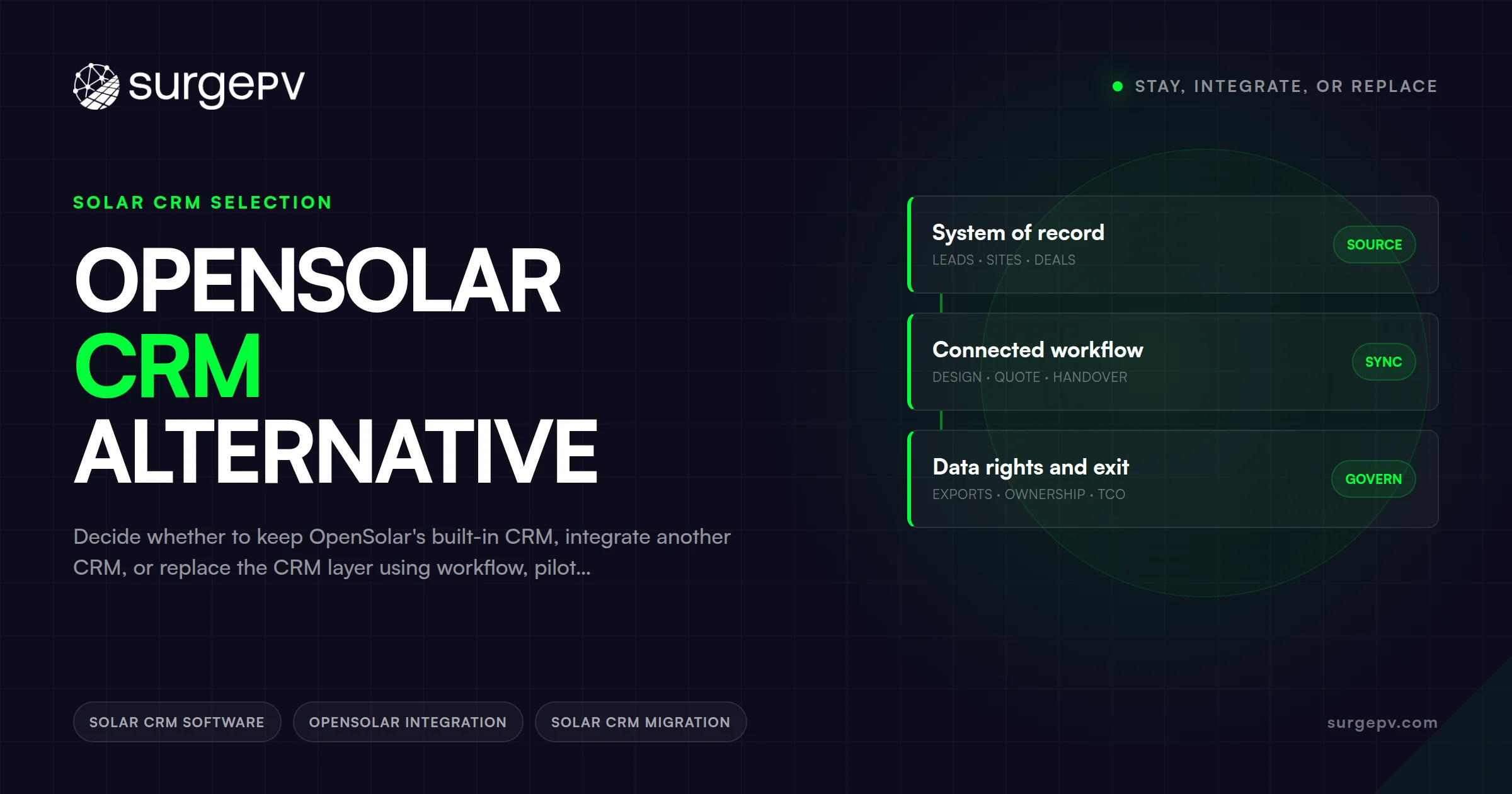
The correct decision has three paths. Stay inside OpenSolar when its built-in flow passes the requirements. Integrate another CRM when each system has a clear job. Replace the CRM layer only when a controlled pilot proves that migration creates a better operating result.
Pricing also needs a current distinction. OpenSolar says the core app remains free for work retained inside the platform. Charges began on 16 April 2026 for API Access and supported connectors that move data to or from third-party tools.
Direct answer
Start with a failed workflow, not a vendor list. Measure the gap using real leads, users, projects, documents, permissions, reports, and exports. Keep OpenSolar when it passes. Integrate only with field ownership and recovery controls. Replace only after the new CRM passes migration, security, support, cost, rollback, and exit gates.
Related-party disclosure
SurgePV and QuickEstimate have a commercial relationship. QuickEstimate links are sponsored. Its public claims are first-party evidence and receive no automatic rank. Apply the same requirements, pilot, security, export, support, TCO, and exit gates to every candidate.
Key takeaways
- OpenSolar is an end-to-end solar platform with a built-in CRM.
- The core app remains free according to OpenSolar’s current announcement.
- API Access and supported connectors have been chargeable since 16 April 2026.
- A second CRM creates data ownership, reconciliation, cost, and failure risks.
- Replacement needs a tested export and readable archive before cutover.
- QuickEstimate is a related-party candidate, not a predetermined winner.
- SurgePV is not a CRM and is excluded from CRM ranking.
What OpenSolar Currently Includes
The official OpenSolar CRM page calls the product a customizable built-in CRM. It describes lead and project management, customer communications, scheduling, assignments, permissions, documents, contracting, e-signature, and payment processing.
The current application flow presents three connected zones. They cover business settings, project management, energy, design, and proposals. OpenSolar is therefore more than a solar design tool.
The Manage Page documentation shows contacts, project workflow stages, actions, assignments, activity, documents, transactions, sales, installation, and region-dependent integrations.
These pages establish a broad first-party scope. They do not prove that every account, market, integration, payment option, or partner service behaves identically. A buyer still needs an account-level pilot.
| CRM or project job | OpenSolar public evidence | What the pilot must establish |
|---|---|---|
| Lead and contact record | CRM page describes leads and contacts | Required fields, duplicates, consent, source, assignment, and search |
| Projects and pipeline | Custom stages, project views, filters, priority, and assignee | Actual sales and delivery stages, required transitions, and controls |
| Tasks and ownership | Actions, assignees, due dates, notifications, and activity | Recurrence, escalation, reassignment, overdue handling, and audit need |
| Scheduling | Digital calendars and scheduling are described | Team calendar fit, appointment changes, reminders, and mobile behavior |
| Communication | Customer communications and project activity are described | Required email, messaging, templates, consent, history, and failures |
| Documents | Upload, generate, tag, merge, and send documents | File limits, search, versions, permissions, export, and retention |
| Design and proposal | Energy, design, online proposal, and PDF proposal are connected | Required accuracy, approvals, versions, branding, and customer choice |
| Contracts and payments | E-signature, transactions, and payment functions are described | Market availability, provider terms, reconciliation, refunds, and evidence |
| Permissions | Assignment and permission features are described | Least privilege, admin controls, offboarding, shared accounts, and review |
| Automation | Workflow actions and notifications are described | Required triggers, conditions, exceptions, logs, and recovery |
| Reporting | Project performance metrics, views, filters, and export are documented | KPI definitions, date logic, custom fields, completeness, and repeatability |
| API and connectors | Official API and supported connector routes exist | Exact objects, errors, billing, limits, security, ownership, and maintenance |
| India workflows | Integrations can vary by country and enabled services | Lead sources, WhatsApp, tax, subsidy, DISCOM, consent, language, and support |
| Mobile work | OpenSolar references on-the-go actions and a mobile application | Offline need, permissions, speed, upload, task, proposal, and field usability |
| Support | Public Help Center and support route exist | Response path, hours, escalation, account coverage, and contract terms |
| Data exit | Project-list CSV export is documented | Fields, files, histories, designs, proposals, transactions, settings, and archive |
Do not mark a row “missing” from memory. Test the current account and document the result. A feature can exist yet fail the company’s required depth, market, control, or support level.
Current OpenSolar Pricing: Free Core, Paid Connections
OpenSolar published a pricing announcement on 16 February 2026. The official API and connector pricing update states that the core app remains free.
That statement applies to end-to-end work kept inside OpenSolar. It includes no general subscription charge for the core workflow described in the announcement. Optional partner services, finance, hardware, imagery, or other commercial items should be checked separately.
Starting 16 April 2026, charges apply to two connection paths:
- API Access for external workflows using the OpenSolar API.
- OpenSolar-built and supported connectors to specific third-party tools.
OpenSolar says API Access and connectors are separate. A CRM connection through the API and an accounting connector can therefore create separate charges. The announcement also says API Access uses OpenSolar Wallet.
The public announcement does not state one universal numeric API price. It says connector-specific details follow their own billing model. Do not insert a rate from an old screenshot, forum, or unrelated account.
Before approving an integrated architecture, obtain the current billing screen or written quote. Record currency, tax, unit, event, minimum, Wallet behavior, connector fee, overage, failed-call treatment, refund rules, and price-change notice.
Core free does not mean total operating cost is zero. Configuration, data cleanup, training, administration, support, controls, export, integration, and exit work still consume money and time.
Define the Gap Before Comparing Alternatives
Write each missing job as a testable requirement. “We need a better CRM” is not testable. “A Meta lead must enter once, preserve consent evidence, receive an owner, and appear in an exception queue within five minutes” is testable.
Use this structure:
| Requirement field | Example entry |
|---|---|
| Trigger | New lead, stage change, proposal approval, payment, or installation event |
| Input | Required data, consent, source, owner, project ID, and attachment |
| Rule | Validation, routing, permission, duplicate, and approval logic |
| Output | Record, task, message, document, report, or downstream update |
| Time target | Measured operational deadline chosen by the company |
| Evidence | Log, timestamp, export row, screenshot, audit event, or signed document |
| Exception | Missing phone, duplicate, API failure, revoked consent, or user absence |
| Recovery | Retry, queue, correction, escalation, reconciliation, and owner |
Interview sales, design, operations, finance, installation, service, management, security, and legal stakeholders. Each group sees a different part of the customer record.
Separate mandatory requirements from preferences. A missing legal or security control is not equal to a preferred dashboard colour. Define pass gates before anyone watches a vendor demonstration.
Stay, Integrate, or Replace Decision Framework
The decision should remain open until all three options have been tested against the same requirements.
| Path | Choose it when | Main benefit | Main risk | Required proof |
|---|---|---|---|---|
| Stay in OpenSolar | Built-in CRM and project flow pass mandatory jobs | One connected customer, design, proposal, and project record | Team may work around a depth or regional gap | Current-account workflow test, adoption evidence, exports, controls, and TCO |
| Integrate another CRM | Another system must own a proven sales or governance job | Preserve OpenSolar design and proposal value | Duplicate data, sync failures, connector charges, and unclear ownership | Architecture, field map, error tests, reconciliation, billing, security, and exit |
| Replace CRM layer | Mandatory gaps persist and integration is the worse operating choice | One CRM can own the required commercial workflow | Migration loss, cutover disruption, retraining, and split historical records | Pilot, migration rehearsal, archive, rollback, support, legal review, and complete TCO |
Stay gate
Stay when the built-in system passes every mandatory requirement. Confirm user adoption with ordinary work, not only administrator demonstrations. Measure incomplete fields, overdue tasks, duplicate records, export success, and exception handling.
Staying is not a passive choice. Assign an OpenSolar owner, configuration process, permission review, data-quality cadence, user training, support route, export schedule, and annual exit test.
Integrate gate
Integrate only when each system has a stable purpose. A common pattern lets the external CRM own lead and sales activity while OpenSolar owns technical design and proposals. That pattern is not automatically correct.
Name one system of record for every shared field. Define creation, update, delete, merge, consent, stage, price, system size, document, and status behavior. Test conflicts and failures before production.
Include OpenSolar API Access or connector charges in the decision. Include the second CRM, integration platform, development, monitoring, maintenance, and support costs too.
Replace gate
Replace when a mandatory gap remains after configuration and an integrated stack creates unacceptable cost or risk. The new CRM must pass workflow, data, security, support, migration, TCO, and exit gates.
Replacement can target the CRM layer while OpenSolar remains the design and proposal platform. Do not discard a working technical workflow merely because another CRM wins the sales record.
Pass Gates Before Scoring
Scoring creates false precision when a mandatory condition is missing. Apply pass or fail gates first.
- Required workflow coverage.
- Exact record and field ownership.
- Data capture and consent evidence.
- Duplicate prevention and reconciliation.
- Design and proposal handoff.
- Permissions, security, privacy, and legal review.
- Export and readable archive.
- Support and incident escalation.
- Complete three-year TCO using current quotes.
- Rollback and exit readiness.
A failed gate removes the option until the supplier closes it in writing and in the pilot. Do not trade a missing exit path for extra dashboard features.
After the gates pass, weight useful differences. These can include usability, configuration effort, reporting depth, mobile work, India process fit, administration, and vendor support.
Requirements and System-of-Record Matrix
For an integrated stack, the field map is the operating contract between systems.
| Object or field | CRM owner | OpenSolar owner | Direction | Conflict rule | Reconciliation evidence |
|---|---|---|---|---|---|
| Lead source and consent | Decide before pilot | Decide before pilot | One-way or none | Never overwrite evidence silently | Source record and consent timestamp |
| Name, phone, and email | One named owner | Read copy if needed | Defined | Manual review for uncertain duplicates | Duplicate and mismatch queue |
| Project identifier | Shared immutable key | Shared immutable key | Both reference | No regenerated key after sync | Cross-system lookup report |
| Opportunity stage | One commercial owner | Mapped project stage if needed | Defined | Owner wins, exception logged | Daily stage mismatch report |
| Design version and size | Read copy if needed | Technical owner | OpenSolar outward | Approved design wins | Version and approval log |
| Price and proposal status | Define commercial authority | Proposal record | Defined | Signed or approved version wins | Quote reconciliation report |
| Tasks and appointments | One system per task class | One system per task class | Avoid duplicate creation | Route by task type | Overdue and orphan-task report |
| Documents | Define master by document type | Define master by document type | Link, copy, or none | Never overwrite signed files | Document count and hash sample |
| Contract and payment status | Define legal and finance owner | Transaction view if used | Defined | Finance source wins | Signed contract and ledger match |
| Installation status | Operations owner | Project record if used | Defined | Approved completion record wins | Completion and serial report |
Avoid unrestricted bidirectional sync. It can create loops, stale overwrites, duplicate messages, and unclear audit history. Use the narrowest connection that solves the verified gap.
QuickEstimate as a Related-Party Candidate
QuickEstimate
positions itself as an India-focused solar CRM and proposal product. It is a candidate when the gap concerns Indian sales, quotations, lead channels, or related team workflows.
The current QuickEstimate pricing page states the following on 10 August 2026:
| Plan | Public first-party price | Selected claims to test |
|---|---|---|
| Free | INR 0, one user, 10 proposals per month | Proposal PDF, subsidy calculation, WhatsApp send, mobile app, and email support |
| Pro | INR 6,999 per user per year, annual billing, three-user minimum | Proposals, CRM capacity, WhatsApp Business, Pabbly, Meta, IndiaMART, roles, routing, import, and support |
| Enterprise | Custom | SSO, role controls, audit logs, DPA, security review, API treatment, service commitments, and procurement workflows |
These are related-party first-party claims, not independent findings. Confirm the current checkout, tax treatment, plan limits, user minimum, renewal, refund, storage, integrations, API, exports, support, and security terms in writing.
QuickEstimate should not receive first place from regional positioning alone. Run the same real-lead pilot used for every candidate. Verify Meta and IndiaMART capture with the company’s own accounts. Verify WhatsApp consent, templates, delivery states, opt-out handling, and history.
QuickEstimate is not assumed to replace OpenSolar’s technical design. It can own the CRM layer while OpenSolar remains the design system if the controlled handoff passes. It can also lose to staying in OpenSolar.
Read the QuickEstimate review for its broader product boundary. Use the QuickEstimate pricing guide for a dated commercial review.
Build the Controlled Pilot
Use a small but representative group. Include a salesperson, sales manager, designer, operations user, administrator, and reporting owner. Add security, privacy, legal, and finance reviewers where required.
The pilot should use controlled records with permission. Do not upload a full customer database into an unapproved trial.
Pilot dataset
Include these cases:
- New lead with complete consent and source data.
- Duplicate lead with changed phone or email.
- Lead without a required field.
- Reassigned salesperson and absent owner.
- Residential and commercial project.
- Multiple design and proposal revisions.
- Lost lead, reopened lead, and cancelled project.
- Signed proposal, payment event, and refund scenario where applicable.
- Attachment with a corrected version.
- Integration outage and delayed update.
- User offboarding and access removal.
- Export, archive, and restore sample.
Pilot measures
Define thresholds before testing. Measure record completeness, duplicates, stage accuracy, assignment, task completion, message history, design handoff, and proposal version. Also measure document retrieval, report agreement, mobile usability, sync errors, reconciliation time, support outcome, and export completeness.
Test the failure path. Disconnect the integration, remove a required permission, send malformed data, change the source record, and create simultaneous edits. Confirm that failures become visible and recoverable.
Do not declare success from a polished demonstration. Require ordinary users to complete ordinary work without vendor guidance. Record training needs and administrator effort.
Pilot decision record
For each requirement, record pass, conditional pass, or fail. Attach evidence. Name the owner of every open condition and set a deadline.
Reject any option that cannot explain how data leaves. Reject an integrated option that lacks a reconciliation queue. Reject a replacement that cannot preserve the required historical and legal record.
Data Export and Migration Reality
The OpenSolar Managing Projects section includes project-data CSV export guidance. Current support material recommends using filters for batches around 2,000 projects.
That supports a project-list export. It does not prove that one file is a complete migration archive. The team must test every required object and relationship.
Create an inventory before mapping:
- Contacts and alternate contacts.
- Leads, sources, consent, owners, tags, and stages.
- Projects, addresses, types, priorities, and identifiers.
- Actions, assignments, dates, completion, and activity.
- Notes, emails, messages, and communication evidence.
- Files, photos, contracts, proposals, and signed records.
- Energy, design, equipment, versions, and calculations.
- Prices, payment options, transactions, and status.
- Installation dates, serials, and service history.
- Users, teams, permissions, configuration, and reports.
For each item, mark export method, format, owner, count, relationship key, attachment path, retention need, and target field. Mark records that will remain only in a read-only archive.
Migration waves
Start with a dry export and profile the data. Count records, nulls, duplicates, invalid phones, broken emails, missing owners, unsupported values, and attachments.
Build the mapping and transformation rules. Preserve source IDs. Never merge uncertain customers automatically.
Load a small pilot batch into a non-production target. Reconcile counts, samples, totals, relationships, dates, characters, documents, and permissions.
Rehearse cutover with a measured freeze window. Define which system accepts new work during the transition. Prevent two sources from creating the same customer.
Run a time-boxed parallel period only when necessary. It needs clear field ownership and daily reconciliation. An uncontrolled double-entry period creates a new data problem.
After cutover, retain the approved source archive. Keep it readable under defined access. Record deletion and retention decisions with legal review.
Security, Privacy, Permissions, and Legal Review
OpenSolar publishes a Trust Center. It describes AWS hosting, encryption, backups, logical customer separation, role-based access, an availability target, and SOC 2 Type 1 attestation.
Treat those as current OpenSolar statements. An availability target is not automatically a contractual SLA. SOC 2 Type 1 addresses control design at a point in time, not continuous operating effectiveness or zero risk.
OpenSolar’s Privacy Notice describes its roles and processing. The solar company still controls its own notices, consent, access, retention, exports, third parties, and lawful use.
Request evidence proportionate to risk:
- Data-processing terms and legal entities.
- Hosting and transfer details.
- Authentication, MFA, SSO, and password controls.
- Roles, least privilege, admin access, and offboarding.
- Encryption and key-management statements.
- Logs, retention, export, deletion, and legal hold.
- Incident notification and escalation.
- Backups, restoration, continuity, and recovery evidence.
- Subprocessors and connected-app responsibilities.
- Independent reports and scope where available.
QuickEstimate’s Enterprise pricing claims mention SSO, role-based access, audit logs, a DPA, and custom security review. Those words do not prove control operation. Request the underlying evidence and test the purchased plan.
India teams should obtain qualified privacy and legal review for customer data, consent, messaging, employee access, retention, contracts, and transfers. A software feature does not make the company’s process compliant.
Support and Operating Ownership
OpenSolar provides a public Help Center and support route. Do not infer a response or resolution SLA without current account terms.
Test support during the pilot with a representative technical question. Record channel, acknowledgment, answer quality, escalation, and closure. Do not manufacture an emergency merely to test speed.
Every option also needs internal owners:
| Role | Accountability |
|---|---|
| Business owner | Requirements, adoption, policy, vendor decision, and renewal |
| CRM administrator | Fields, stages, permissions, users, validation, and training |
| Integration owner | Mapping, credentials, monitoring, errors, reconciliation, and change |
| Data owner | Definitions, quality, duplicates, retention, export, and archive |
| Security and privacy owner | Risk review, access, contracts, incidents, and evidence |
| Reporting owner | KPI definitions, filters, dates, totals, and reconciliation |
| Process owners | Sales, design, operations, finance, installation, and service rules |
Without these roles, a new CRM can reproduce the old workflow problem with more software.
Three-Year TCO Worksheet
Use current written prices and measured internal work. Do not use an invented productivity gain to justify the decision.
| Cost line | Stay | Integrate | Replace |
|---|---|---|---|
| OpenSolar core app | Record current free-core basis | Record current free-core basis | Include if retained for design |
| OpenSolar API Access | Zero if unused | Current Wallet billing for tested volume | Include if new CRM still exchanges data |
| OpenSolar connectors | Current connector-specific fee if used | Each required connector fee | Include any retained connector |
| CRM licenses | None beyond current stack | Users, plans, minimums, tax, and renewal | Users, plans, minimums, tax, and renewal |
| Integration | None or existing | Build, platform, test, monitoring, and maintenance | Handoff integration if OpenSolar remains |
| Configuration | OpenSolar admin work | Both systems and field ownership | Target configuration and legacy archive |
| Migration | Cleanup and export rehearsal | Shared IDs and initial sync | Inventory, mapping, transforms, loads, and reconciliation |
| Training | Refresher and process control | Two-system user training | New process and administrator training |
| Administration | Current owner time | Two admins plus integration owner | New CRM admin plus retained-system owner |
| Security and legal | Annual review | Both vendors and connection review | New vendor, migration, archive, and deletion review |
| Support | Current route or paid terms | Both vendors and integration support | Target support plus legacy access |
| Exit | Export test and archive | Dual-system export and disconnect | Contract exit, exports, archive, and transition |
Use three scenarios for uncertain usage: low, expected, and high. API usage, project volume, users, storage, messaging, support, and integration changes can alter cost.
Do not count sunk costs as future savings. Do count ongoing administrator time, reconciliation, incident handling, and future exit work.
Rollback and Exit Gates
Approve production only after rollback is credible. A rollback plan identifies the trigger, authority, time window, source-of-truth choice, queued changes, user communication, and reconciliation procedure.
For stay, prove that periodic exports are usable. For integrate, prove that the connection can be disabled without corrupting either system. For replace, preserve the source archive and a route back during the agreed window.
Before renewal, repeat these checks:
- Required workflows still pass.
- Users and permissions are current.
- Integration errors are visible and reconciled.
- Current prices match the budget model.
- Security, privacy, support, and vendor terms remain acceptable.
- Export covers required records and relationships.
- The archive can be read by authorised staff.
- Exit can occur within the approved time and cost.
No vendor should pass because migration feels difficult. Exit readiness is part of operating readiness.
India Workflow Tests
Do not assume a global CRM lacks Indian workflows. Do not assume an India-focused CRM handles every DISCOM, subsidy, tax, or messaging case correctly.
Test the company’s actual lead channels. Use the IndiaMART lead CRM guide for connector acceptance. Use the Meta lead CRM guide for field, consent, duplicate, and reconciliation controls.
Test WhatsApp with approved business accounts, consent, templates, delivery states, opt-outs, ownership, and history. The WhatsApp CRM guide covers that operating boundary.
For subsidy or DISCOM calculations, use dated official inputs and human review. Preserve the input version. Never present a CRM calculation as government approval or guaranteed eligibility.
Cannibalisation Map
This page owns one decision: whether to stay with OpenSolar CRM, integrate another CRM, or replace its CRM layer.
- Best solar CRM for installers owns the broad vendor-selection method.
- CRM for solar companies owns the general CRM operating model.
- Solar CRM pricing in India owns cross-vendor price comparison.
- Free solar CRM software owns zero-license-cost options and limits.
- Solar sales CRM owns sales-stage and follow-up design.
- The generic OpenSolar alternative page owns design and proposal replacement, not this CRM-layer decision.
- The software-stack guide owns the whole sales, design, operations, finance, and service architecture.
This boundary prevents a CRM comparison from misrepresenting OpenSolar’s design and proposal functions.
Where SurgePV Fits
SurgePV is solar design platform. It is not a CRM and is not ranked as one.
Use the solar designing workflow for layout, equipment, strings, shading, and production assumptions. Use customer-ready solar proposals for customer-facing technical and financial presentation.
If SurgePV serves the technical layer, a CRM must still own leads, contacts, consent, pipeline, tasks, communication history, permissions, and customer records. Define the handoff under the same system-of-record and exit rules.
Final Decision Record
Preserve the requirements, evidence date, vendor documents, pilot data, tests, failures, and corrections. Keep the security review, legal review, cost workbook, migration rehearsal, support results, decision, approvals, and residual risks.
Name the chosen architecture, not merely the chosen product. State which system owns each record and who operates each control.
Reopen the decision when pricing, workflow, connectors, exports, security terms, support, ownership, or business process changes. The 16 April 2026 OpenSolar connection-pricing change shows why a dated architecture review matters.
Frequently Asked Questions
Does OpenSolar include a CRM?
Yes. OpenSolar’s official pages describe a customizable built-in CRM with leads, contacts, projects, workflow stages, actions, assignments, scheduling, communications, documents, permissions, e-signature, payment-related functions, and project activity. Exact market, account, partner, and integration availability still needs verification.
Is the OpenSolar platform still free in 2026?
OpenSolar says the core app remains free for end-to-end work retained inside the platform. This does not mean every external workflow is free. Paid API Access and supported third-party connectors are separate from the core app.
What changed for OpenSolar API and connector pricing on 16 April 2026?
OpenSolar states that charges began on 16 April 2026 for API Access and supported connectors that move data between OpenSolar and third-party tools. API Access and connectors are billed separately. Confirm current Wallet charges and connector-specific fees for the exact account and workflow.
When should a solar company keep OpenSolar CRM without another CRM?
Stay when OpenSolar covers the required lead, contact, project, stage, task, communication, document, proposal, contract, payment, permission, reporting, mobile, support, and export jobs. The team must also accept its operating controls and complete cost.
When should OpenSolar be integrated with another CRM?
Integrate when another CRM must own a proven sales, regional, governance, or reporting requirement while OpenSolar remains valuable for design and proposals. Define one owner per field, shared identifiers, sync direction, duplicate rules, monitoring, reconciliation, and recovery before connecting them.
When should a company replace OpenSolar’s CRM layer?
Replace only when a mandatory workflow gap persists, integration is riskier or costlier than replacement, and a controlled pilot passes. The migration must preserve required records, documents, consent, history, ownership, reporting, support, rollback, and legal obligations.
Is QuickEstimate the best OpenSolar CRM alternative for an Indian EPC?
QuickEstimate is a related-party candidate for an India-focused sales and proposal workflow, not an automatic winner. Test its current pricing, WhatsApp, Meta, IndiaMART, PM Surya Ghar, DISCOM, roles, imports, exports, security, support, and handoff claims under the same gates as every alternative.
Can I export all OpenSolar data before migration?
OpenSolar documents project-list CSV export and recommends filtered batches around 2,000 projects. Do not assume that one CSV contains every attachment, activity, proposal, transaction, setting, relationship, or consent record. Test each required object and preserve a readable archive.
Is SurgePV an OpenSolar CRM alternative?
No. SurgePV supports solar design and proposal work but is not a CRM. It should not be ranked for lead, contact, pipeline, task, communication, consent, or customer-record management. Use a separate CRM decision for those jobs.
Sources
Primary research and reference material used for this desk-research article.
Where this fits
This article is part of SurgePV's Solar Design hub, which works through the topic from first principles to the decisions a project team actually has to make.