

Answer
Commercial Solar Deal Review: Decision Gates and Delivery Commitments works when teams preserve inputs, explain assumptions, and assign a human reviewer to material exceptions.
Commercial Solar Sales: Running a 6-Month C&I Deal Cycle is a control system, not a formality. For installers and EPCs, the safest way to move quickly is to make each key assumption reviewable before it becomes a drawing, bill of materials, financial model, or customer commitment. This guide explains how to set up that review without turning every early-stage project into a slow approval queue.
What This Workflow Needs to Protect
For rushed solar design red-flag, the practical question is not whether a team has a process. It is whether the process produces a record that another person can inspect, understand, and use. The Rushed Solar Design Red-Flag Checklist should turn a vague expectation into visible checks, named owners, and a decision point. That matters when a sales representative, designer, estimator, procurement lead, and project manager touch the same job at different times. Each handoff can change a number, assumption, drawing, or customer promise. A written control reduces the chance that the change survives unnoticed.
A useful control is deliberately ordinary: state the input, state who verifies it, record the result, and define what happens when it does not match. The team does not need to pretend that early-stage solar work is final engineering. It does need to label assumptions, preserve the source of project data, and make the next review easier. This distinction keeps speed from becoming hidden rework. (1)
Solar work has a particular version-control problem. Aerial imagery, site photographs, customer bills, equipment availability, utility requirements, roof conditions, and financing assumptions can arrive on different days. A layout may look settled while a shading input, service-panel constraint, or utility tariff is still provisional. Treating every early value as final is risky; treating every value as unknowable prevents progress. The workable middle ground is a status field: confirmed, estimated, pending verification, or changed after review.
The International Electrotechnical Commission’s documentation and commissioning guidance emphasizes traceable system information, while the U.S. National Renewable Energy Laboratory (NREL) publishes operational practices that depend on clear records and handover material. Those sources do not replace local code, engineering review, manufacturer instructions, or utility rules. They support a straightforward operating principle: work can be fast if the record explains what was decided and why.
Start With a Single Source of Project Truth
The project record should contain the customer address and site reference, data-source dates, current layout revision, equipment selections, energy assumptions, open items, and the person accountable for each open item. Do not spread these controls across a proposal PDF, a chat thread, a spreadsheet, and a personal notebook. That makes it difficult to tell which value is current.
A shared workflow also changes the quality of the customer conversation. When a representative can show which figures are estimates and which have been verified, the proposal is easier to explain. This is especially important for production and savings. A generation estimate is a modeled result based on stated inputs, not a promise of output. Link customers and internal reviewers to the assumptions behind it, including irradiance source, shading treatment, system size, orientation, losses, rate assumptions, and the date of the model.
For a connected workflow, solar design software can keep design inputs and project outputs together instead of requiring the team to transpose values between unrelated tools. Use the platform as the project record only after your team agrees on the fields and reviews that must be present.
Define the Review Gates Before the Work Starts
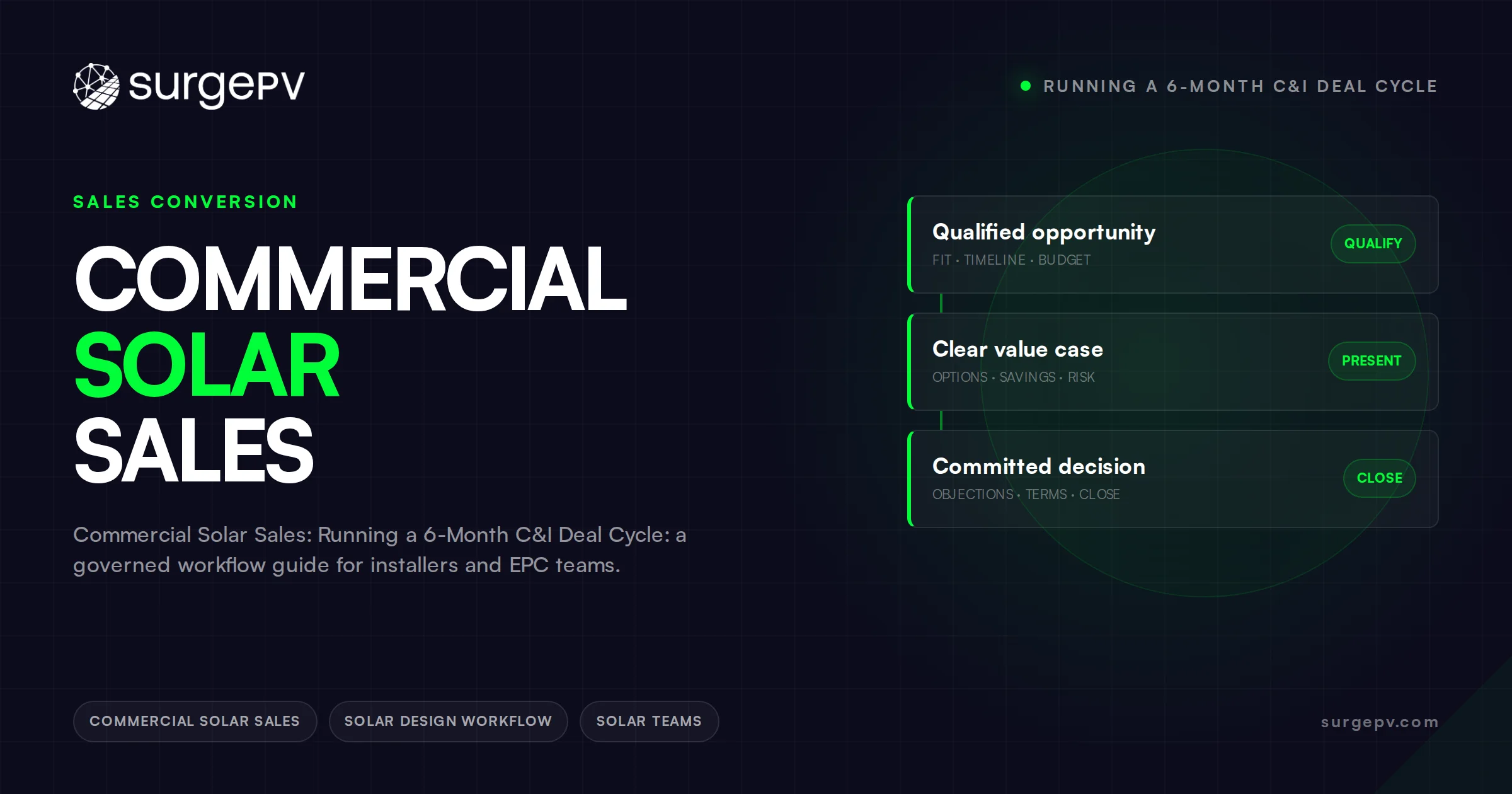
A practical set of gates has four moments. First, qualify the opportunity: what is known about the site, load, decision process, and project objective? Second, review the preliminary design: can the layout, roof geometry, access, setbacks, and electrical approach support the concept? Third, review the commercial proposal: do the production, financial, scope, and exclusions describe the same project as the design? Fourth, release the handoff: has every customer-facing promise that affects delivery been transferred to the delivery team?
Each gate should have a purpose rather than a generic approval. For example, a preliminary-design gate is not an instruction to redraw every project. It is a check that the roof model and constraints are suitable for the level of certainty being represented. A commercial-review gate is not an accounting exercise. It is a check that a savings scenario uses the correct tariff, consumption period, escalation assumption if one is used, and finance terms supplied by the provider.
Review the Design Before You Trust the Numbers
Panel count is only one output. Review the roof planes, obstructions, access paths, setbacks, usable area, module orientation, stringing assumptions, and any required electrical or structural review. When a design is generated from imagery or an early site survey, label the confidence level. A later measurement may change the usable roof area or reveal equipment that is not visible in the first data set.
Shading deserves the same discipline. A model should name its source data and method, then make clear whether vegetation, near objects, horizon effects, and future construction are represented. The Shadow Analysis product page is relevant when a team needs a structured way to examine shading as part of the project workflow. It is not a substitute for the site-specific review required by local rules or the project’s engineering standard.
The energy result depends on the recorded site, equipment, weather and loss assumptions. In a customer-facing context, avoid converting that relationship into certainty. State the modeled annual result, state its assumptions, and identify what can change it.
Keep Layout, BOM, and Proposal in Agreement
The bill of materials (BOM) should be tied to a revisioned design, not rebuilt from memory. At a minimum, compare module quantity, inverter quantity and rating, mounting approach, electrical accessories, and assumptions that change procurement or installation scope. If a substitution is proposed, record whether it changes electrical compatibility, layout, performance assumptions, warranty terms, or price.
Then compare the proposal to the same source record. The project name, system size, module count, expected production, scope, exclusions, financing scenario, and next step should tell one consistent story. A proposal that is visually polished but tied to a prior layout creates an avoidable customer-trust problem. Solar Proposals is designed around producing customer-facing materials from project work; teams should still retain a human review for customer commitments and local requirements.
Make Financial Scenarios Explainable
Financial scenarios should be treated as models, not sales scripts. Start with consumption data that has a known billing period. Record the applicable tariff and any demand or time-of-use structure that matters. Separate incentives, financing, and utility assumptions so that a reviewer can identify which source supports each value. If an incentive or tariff is not confirmed, mark it pending instead of presenting it as assured.
Use a range or sensitivity discussion when inputs are uncertain. A customer can make a better decision when they see what changes if consumption, export value, equipment cost, or financing terms differ from the base case. The Generation & Financial Tool supports project-level production and financial analysis; the final proposal should still explain the assumptions in ordinary language. For technical context, see the site’s definition of financial modeling in solar.
Assign Owners for Exceptions, Not Just Tasks
Most problems appear in exceptions: a roof-plane measurement differs from imagery, the customer changes usage assumptions, an equipment item is unavailable, or a utility requirement changes. A task list alone does not resolve these cases. The record needs an owner, a due date, the decision required, and the project artifact affected. That lets the team decide whether to revise the layout, the financial model, the proposal, or all three.
Set an escalation rule as well. Questions involving code compliance, structural capacity, interconnection, electrical design, contractual scope, or a material production assumption should go to the qualified person designated by your organization. No checklist can turn a non-engineering review into engineering approval.
Measure Process Quality Without Inventing a Benchmark
Measure whether the control is being used, not whether a generic industry target has been met. Useful internal measures include the share of proposals tied to a current design revision, the number of open items at handoff, the time between a material change and a customer update, and the categories that drive rework. These are team diagnostics. They should not be portrayed as a promise of commercial outcomes.
A monthly review can be small. Select a handful of completed and delayed projects, inspect the record, and ask where an assumption became invisible. If the same issue repeats, add a field, gate, or owner to the workflow. Investigate whether an unused control is required by safety, contract or authority obligations before simplifying it. The goal is a record that supports real decisions, not a longer form.
A Field-Ready Checklist
- Confirm the current site and customer data source, including its date.
- Identify which inputs are confirmed, estimated, pending, or changed.
- Record the current design revision and its reviewer.
- Check layout, shading, access, equipment, and electrical assumptions for consistency.
- Tie the BOM and proposal to that same revision.
- Label production, tariff, incentive, and financing assumptions clearly.
- Assign an owner and due date to each exception.
- Escalate code, engineering, utility, and contract questions to the qualified reviewer.
- Save the approved customer-facing version and the delivery handoff record.
- Review recurring exceptions and improve the workflow at the next operating review.
Conclusion: Make Fast Work Reviewable
- Build one project record before the team produces multiple versions of the same information.
- Review the design, BOM, financial model, and proposal as connected artifacts.
- Treat exceptions as owned decisions and preserve the reason for each change.
Gate record
For each gate retain project/revision, intended decision, evidence source/date, reviewer responsibility, outstanding condition and next action. Sales approval cannot substitute for qualified technical review or external permission. DOE commercial provider-selection guidance discusses procurement preparation; it is not a prescribed sales duration. For broader lead-to-contract management, see the commercial sales-cycle guide.
Frequently Asked Questions
What is the purpose of a commercial solar deal review?
It gives installers and EPCs a repeatable way to document inputs, verify assumptions, assign ownership, and resolve exceptions before they create downstream rework.
How should a solar team use this checklist?
Use it at a defined project gate, retain the record with the project, and treat unresolved items as decisions that need an owner rather than silent assumptions.
What should be reviewed before a customer-facing solar proposal is sent?
Review the layout, production assumptions, financial inputs, scope, exclusions, and the source and date of the information shown to the customer.
Sources
Primary research and reference material used for this desk-research article.
Where this fits
This article is part of SurgePV's Solar Business & Operations hub, which works through the topic from first principles to the decisions a project team actually has to make.