

Back to Blog
solar business 15 min read

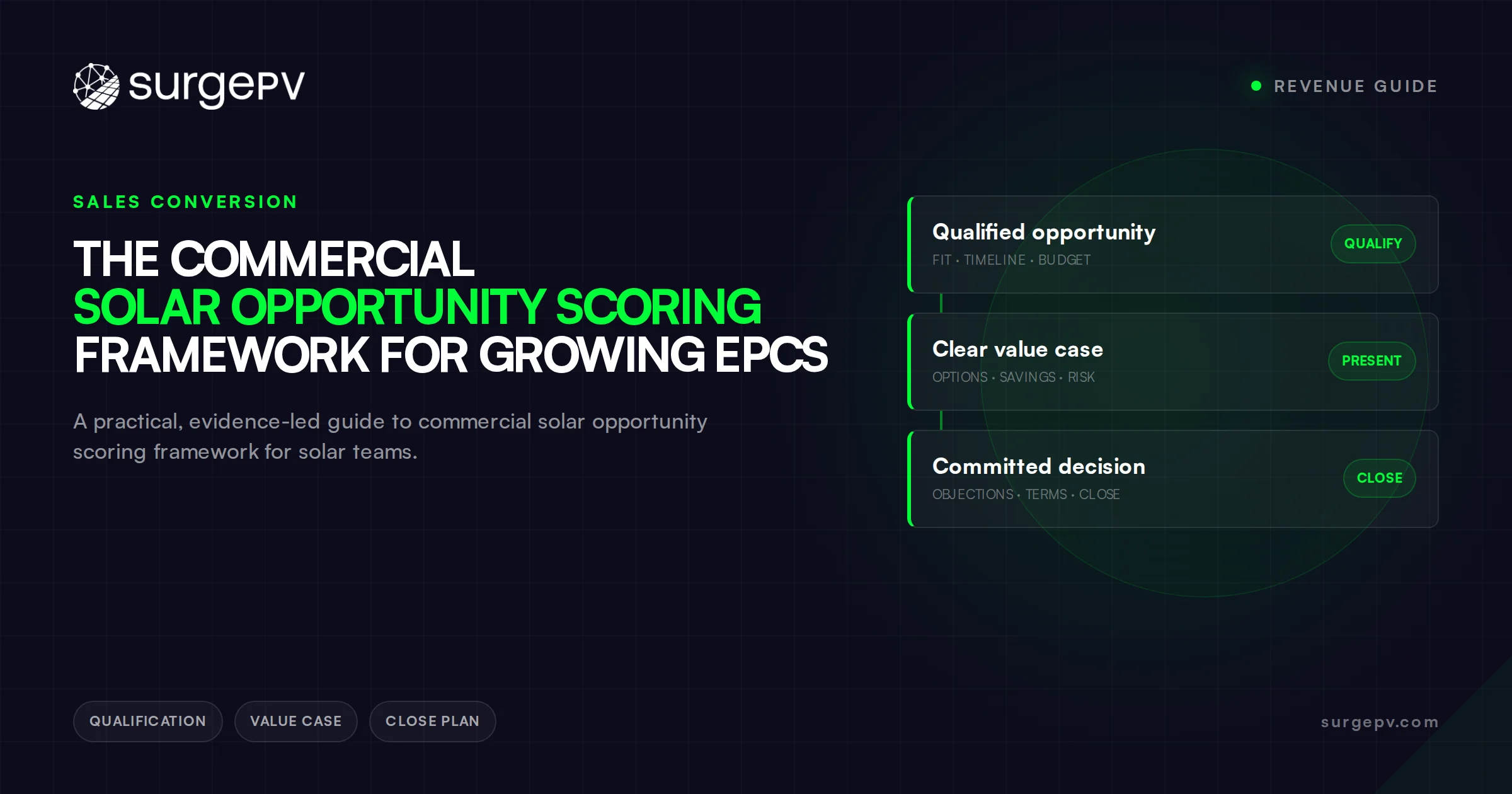
The Commercial Solar Opportunity Scoring Framework for Growing EPCs

A practical, evidence-led guide to commercial solar opportunity scoring framework for solar teams.

Nirav Dhanani

Written by

Nirav Dhanani

Co-Founder · SurgePV

Rainer Neumann

Edited by

Rainer Neumann

Content Head · SurgePV

Published ·Updated

Quick Answer

To commercial solar opportunity scoring framework, make the next decision explicit, preserve the source evidence, label assumptions, and assign a responsible review before an output becomes a customer or project commitment.

The Commercial Solar Opportunity Scoring Framework for Growing EPCs means qualify commercial opportunities by the evidence needed for the next investment of time, not by enthusiasm alone. For commercial EPC teams deciding which early opportunities deserve design, survey, and financial-analysis capacity, the aim is not to remove professional judgment or make promises from incomplete information. It is to make everyday decisions easier to inspect: what is known, what is assumed, what output is appropriate now, and who must check the next release.

This is a desk-research process guide. It is not engineering advice for a particular site and it does not establish a project’s design, performance, safety, permitting, utility, financing, or contractual position. The National Renewable Energy Laboratory’s photovoltaic research is useful background on PV technology, but it cannot validate inputs for an individual opportunity.

Direct Answer

Use a decision record, not a memory test: state the decision, cite the source materials, separate verified facts from planning assumptions, record what could change the result, and give a named reviewer authority to release or return the work.

Start With the Decision, Not the Tool

The Commercial Solar Opportunity Scoring Framework for Growing EPCs is most useful when a team can examine a decision back to its evidence. In this context, the practical move is to define the next investment decision. That is not administrative ceremony: it changes whether a person can make a responsible next decision without reopening the whole project record. A common failure is a large stated energy bill without usable consumption detail. The appropriate response is to name the uncertainty, attach the evidence available today, and assign the person who can resolve it; it is not to hide the gap behind a confident-looking output.

The Commercial Solar Opportunity Scoring Framework for Growing EPCs is most useful when a team can separate a decision back to its evidence. In this context, the practical move is to identify site, ownership, and access questions early. That is not administrative ceremony: it changes whether a person can make a responsible next decision without reopening the whole project record. A common failure is a savings expectation presented before tariff and load assumptions are understood. The appropriate response is to name the uncertainty, attach the evidence available today, and assign the person who can resolve it; it is not to hide the gap behind a confident-looking output. In a commercial solar opportunity scoring framework workflow, the boundary must be visible to the customer and to the next internal role. Work may move quickly when the current output is explicitly preliminary, but a commercial solar opportunity scoring framework release affecting price, scope, technical selection, compliance, or site work requires relevant evidence and a qualified review. This commercial solar opportunity scoring framework guide does not replace local code, utility rules, manufacturer instructions, engineering judgment, field verification, or contractual review.

For commercial solar opportunity scoring framework, the U.S. Department of Energy Solar Energy Technologies Office describes solar technology and deployment resources. Those sources provide context; they do not turn a site note, a customer statement, or an older drawing into verified project evidence. The team must still decide what is sufficient for the output it is preparing.

Build a Small Record That Survives a Handoff

The Commercial Solar Opportunity Scoring Framework for Growing EPCs is most useful when a team can challenge a decision back to its evidence. In this context, the practical move is to score evidence quality separately from deal attractiveness. That is not administrative ceremony: it changes whether a person can make a responsible next decision without reopening the whole project record. A common failure is a landlord or tenant relationship that is unresolved. The appropriate response is to name the uncertainty, attach the evidence available today, and assign the person who can resolve it; it is not to hide the gap behind a confident-looking output.

The Commercial Solar Opportunity Scoring Framework for Growing EPCs is most useful when a team can document a decision back to its evidence. In this context, the practical move is to label preliminary scenarios as preliminary. That is not administrative ceremony: it changes whether a person can make a responsible next decision without reopening the whole project record. A common failure is a large stated energy bill without usable consumption detail. The appropriate response is to name the uncertainty, attach the evidence available today, and assign the person who can resolve it; it is not to hide the gap behind a confident-looking output. In a commercial solar opportunity scoring framework workflow, the boundary must be visible to the customer and to the next internal role. Work may move quickly when the current output is explicitly preliminary, but a commercial solar opportunity scoring framework release affecting price, scope, technical selection, compliance, or site work requires relevant evidence and a qualified review. This commercial solar opportunity scoring framework guide does not replace local code, utility rules, manufacturer instructions, engineering judgment, field verification, or contractual review.

CheckpointWorking questionEvidence to retain
1Define the next investment decisionName the evidence, owner, and decision boundary
2Score evidence quality separately from deal attractivenessName the evidence, owner, and decision boundary
3Ask for interval data when load timing mattersName the evidence, owner, and decision boundary
4Identify site, ownership, and access questions earlyName the evidence, owner, and decision boundary
5Label preliminary scenarios as preliminaryName the evidence, owner, and decision boundary
6Set an escalation path for unusual technical riskName the evidence, owner, and decision boundary
7Review lost and stalled opportunities for qualification lessonsName the evidence, owner, and decision boundary

Treat Assumptions as Work Items

The Commercial Solar Opportunity Scoring Framework for Growing EPCs is most useful when a team can trace a decision back to its evidence. In this context, the practical move is to ask for interval data when load timing matters. That is not administrative ceremony: it changes whether a person can make a responsible next decision without reopening the whole project record. A common failure is a project timeline that ignores authority and site-access dependencies. The appropriate response is to name the uncertainty, attach the evidence available today, and assign the person who can resolve it; it is not to hide the gap behind a confident-looking output.

The Commercial Solar Opportunity Scoring Framework for Growing EPCs is most useful when a team can review a decision back to its evidence. In this context, the practical move is to set an escalation path for unusual technical risk. That is not administrative ceremony: it changes whether a person can make a responsible next decision without reopening the whole project record. A common failure is a landlord or tenant relationship that is unresolved. The appropriate response is to name the uncertainty, attach the evidence available today, and assign the person who can resolve it; it is not to hide the gap behind a confident-looking output. In a commercial solar opportunity scoring framework workflow, the boundary must be visible to the customer and to the next internal role. Work may move quickly when the current output is explicitly preliminary, but a commercial solar opportunity scoring framework release affecting price, scope, technical selection, compliance, or site work requires relevant evidence and a qualified review. This commercial solar opportunity scoring framework guide does not replace local code, utility rules, manufacturer instructions, engineering judgment, field verification, or contractual review.

An assumption is not a mistake when it is visible and proportionate to the stage. It becomes a problem when an indicative input silently turns into a customer promise, procurement instruction, or technical release. Use three labels: confirmed for identifiable evidence, planning assumption for a scenario input, and required before release for an item that must be resolved before the specified output can be relied upon.

See a Connected Solar Workflow in Practice

Explore how SurgePV helps teams keep project inputs, design work, analysis, and customer-facing outputs connected while their own review responsibilities remain clear.

Book a Demo

Use an active workflow question in a live product walkthrough.

Make the Review Proportionate to the Risk

The Commercial Solar Opportunity Scoring Framework for Growing EPCs is most useful when a team can separate a decision back to its evidence. In this context, the practical move is to identify site, ownership, and access questions early. That is not administrative ceremony: it changes whether a person can make a responsible next decision without reopening the whole project record. A common failure is a savings expectation presented before tariff and load assumptions are understood. The appropriate response is to name the uncertainty, attach the evidence available today, and assign the person who can resolve it; it is not to hide the gap behind a confident-looking output.

The Commercial Solar Opportunity Scoring Framework for Growing EPCs is most useful when a team can reconcile a decision back to its evidence. In this context, the practical move is to review lost and stalled opportunities for qualification lessons. That is not administrative ceremony: it changes whether a person can make a responsible next decision without reopening the whole project record. A common failure is a project timeline that ignores authority and site-access dependencies. The appropriate response is to name the uncertainty, attach the evidence available today, and assign the person who can resolve it; it is not to hide the gap behind a confident-looking output. In a commercial solar opportunity scoring framework workflow, the boundary must be visible to the customer and to the next internal role. Work may move quickly when the current output is explicitly preliminary, but a commercial solar opportunity scoring framework release affecting price, scope, technical selection, compliance, or site work requires relevant evidence and a qualified review. This commercial solar opportunity scoring framework guide does not replace local code, utility rules, manufacturer instructions, engineering judgment, field verification, or contractual review.

Not every commercial solar opportunity scoring framework task requires the same scrutiny. A preliminary discussion may appropriately carry more assumptions than a permit-ready or customer-contract output. The useful commercial solar opportunity scoring framework question is not “has somebody looked at it?” It is “does the reviewer have the authority, source material, and defined scope to assess this particular release?” That question avoids both careless speed and blanket bureaucracy.

Use Exceptions to Improve the Standard

The Commercial Solar Opportunity Scoring Framework for Growing EPCs is most useful when a team can document a decision back to its evidence. In this context, the practical move is to label preliminary scenarios as preliminary. That is not administrative ceremony: it changes whether a person can make a responsible next decision without reopening the whole project record. A common failure is a large stated energy bill without usable consumption detail. The appropriate response is to name the uncertainty, attach the evidence available today, and assign the person who can resolve it; it is not to hide the gap behind a confident-looking output.

The Commercial Solar Opportunity Scoring Framework for Growing EPCs is most useful when a team can explain a decision back to its evidence. In this context, the practical move is to define the next investment decision. That is not administrative ceremony: it changes whether a person can make a responsible next decision without reopening the whole project record. A common failure is a savings expectation presented before tariff and load assumptions are understood. The appropriate response is to name the uncertainty, attach the evidence available today, and assign the person who can resolve it; it is not to hide the gap behind a confident-looking output. In a commercial solar opportunity scoring framework workflow, the boundary must be visible to the customer and to the next internal role. Work may move quickly when the current output is explicitly preliminary, but a commercial solar opportunity scoring framework release affecting price, scope, technical selection, compliance, or site work requires relevant evidence and a qualified review. This commercial solar opportunity scoring framework guide does not replace local code, utility rules, manufacturer instructions, engineering judgment, field verification, or contractual review.

For commercial solar opportunity scoring framework, exceptional projects often teach the most. Record the condition, the decision, the evidence used, and whether the exception should become a formal route next time. Avoid turning a single unusual commercial solar opportunity scoring framework result into a universal rule. Local requirements, project contracts, equipment, and site conditions can differ substantially.

Keep Customer Language Aligned With Evidence

The Commercial Solar Opportunity Scoring Framework for Growing EPCs is most useful when a team can review a decision back to its evidence. In this context, the practical move is to set an escalation path for unusual technical risk. That is not administrative ceremony: it changes whether a person can make a responsible next decision without reopening the whole project record. A common failure is a landlord or tenant relationship that is unresolved. The appropriate response is to name the uncertainty, attach the evidence available today, and assign the person who can resolve it; it is not to hide the gap behind a confident-looking output.

The Commercial Solar Opportunity Scoring Framework for Growing EPCs is most useful when a team can test a decision back to its evidence. In this context, the practical move is to score evidence quality separately from deal attractiveness. That is not administrative ceremony: it changes whether a person can make a responsible next decision without reopening the whole project record. A common failure is a large stated energy bill without usable consumption detail. The appropriate response is to name the uncertainty, attach the evidence available today, and assign the person who can resolve it; it is not to hide the gap behind a confident-looking output. In a commercial solar opportunity scoring framework workflow, the boundary must be visible to the customer and to the next internal role. Work may move quickly when the current output is explicitly preliminary, but a commercial solar opportunity scoring framework release affecting price, scope, technical selection, compliance, or site work requires relevant evidence and a qualified review. This commercial solar opportunity scoring framework guide does not replace local code, utility rules, manufacturer instructions, engineering judgment, field verification, or contractual review.

For commercial solar opportunity scoring framework, customer-facing copy needs the same discipline as the underlying workflow. Say what the team has modeled, what it has not verified, and what will happen next. Do not convert modeled production, an indicative cost, or a provisional timeline into a guarantee. A clear commercial solar opportunity scoring framework qualification gives the customer a useful action; vague caveats merely move confusion to a later stage.

Connect the Process Without Overclaiming Automation

The Commercial Solar Opportunity Scoring Framework for Growing EPCs is most useful when a team can reconcile a decision back to its evidence. In this context, the practical move is to review lost and stalled opportunities for qualification lessons. That is not administrative ceremony: it changes whether a person can make a responsible next decision without reopening the whole project record. A common failure is a project timeline that ignores authority and site-access dependencies. The appropriate response is to name the uncertainty, attach the evidence available today, and assign the person who can resolve it; it is not to hide the gap behind a confident-looking output.

The Commercial Solar Opportunity Scoring Framework for Growing EPCs is most useful when a team can assign a decision back to its evidence. In this context, the practical move is to ask for interval data when load timing matters. That is not administrative ceremony: it changes whether a person can make a responsible next decision without reopening the whole project record. A common failure is a landlord or tenant relationship that is unresolved. The appropriate response is to name the uncertainty, attach the evidence available today, and assign the person who can resolve it; it is not to hide the gap behind a confident-looking output. In a commercial solar opportunity scoring framework workflow, the boundary must be visible to the customer and to the next internal role. Work may move quickly when the current output is explicitly preliminary, but a commercial solar opportunity scoring framework release affecting price, scope, technical selection, compliance, or site work requires relevant evidence and a qualified review. This commercial solar opportunity scoring framework guide does not replace local code, utility rules, manufacturer instructions, engineering judgment, field verification, or contractual review.

Generation & Financial Tool can support a connected record across relevant stages of a commercial solar opportunity scoring framework workflow. It does not replace field observations, local-rule checks, qualified engineering review, or accountable customer communication. Teams should configure their commercial solar opportunity scoring framework controls around the decisions that matter to them, then verify the output before relying on it. For teams using AI-assisted steps, Solar Designing provides a relevant connected-design context while reviewers retain responsibility for release decisions.

A 30-Minute Improvement Exercise

The Commercial Solar Opportunity Scoring Framework for Growing EPCs is most useful when a team can explain a decision back to its evidence. In this context, the practical move is to define the next investment decision. That is not administrative ceremony: it changes whether a person can make a responsible next decision without reopening the whole project record. A common failure is a savings expectation presented before tariff and load assumptions are understood. The appropriate response is to name the uncertainty, attach the evidence available today, and assign the person who can resolve it; it is not to hide the gap behind a confident-looking output.

The Commercial Solar Opportunity Scoring Framework for Growing EPCs is most useful when a team can examine a decision back to its evidence. In this context, the practical move is to identify site, ownership, and access questions early. That is not administrative ceremony: it changes whether a person can make a responsible next decision without reopening the whole project record. A common failure is a project timeline that ignores authority and site-access dependencies. The appropriate response is to name the uncertainty, attach the evidence available today, and assign the person who can resolve it; it is not to hide the gap behind a confident-looking output. In a commercial solar opportunity scoring framework workflow, the boundary must be visible to the customer and to the next internal role. Work may move quickly when the current output is explicitly preliminary, but a commercial solar opportunity scoring framework release affecting price, scope, technical selection, compliance, or site work requires relevant evidence and a qualified review. This commercial solar opportunity scoring framework guide does not replace local code, utility rules, manufacturer instructions, engineering judgment, field verification, or contractual review.

Choose one recently delayed project. Reconstruct only the decision path: when did the question appear, which evidence was available, who owned the next action, and what release happened before the answer was known? Then change one thing—the intake prompt, evidence field, review trigger, or version label—and apply it to the next comparable project. Small, observed changes are more reliable than a large process rewrite that no one adopts.

Frequently Asked Questions

What is the first step to commercial solar opportunity scoring framework?

Start by defining the next decision and the evidence that would make it responsible. A generic checklist is less useful than a short record tied to the actual project stage.

Can software replace review in commercial solar opportunity scoring framework?

No. A connected commercial solar opportunity scoring framework workflow can preserve inputs, versions, and outputs, but appropriate people remain responsible for site verification, technical judgment, local requirements, and customer commitments.

How should a team improve commercial solar opportunity scoring framework over time?

Log returned commercial solar opportunity scoring framework work, changed assumptions, and escalation reasons. Review patterns periodically, then change the specific rule, intake question, or release check that caused the repeat issue.

Ready to Make commercial solar opportunity scoring framework More Reviewable?

Book a SurgePV demo to discuss how a connected design, analysis, and proposal workflow can support your team’s controls.

Book a Demo

About the Contributors

Author
Nirav Dhanani
Nirav Dhanani

Co-Founder · SurgePV

Nirav Dhanani is Co-Founder of SurgePV and Chief Marketing Officer at Heaven Green Energy Limited, where he oversees marketing, customer success, and strategic partnerships for a 1+ GW solar portfolio. With 10+ years in commercial solar project development, he has been directly involved in 300+ commercial and industrial installations and led market expansion into five new regions, improving win rates from 18% to 31%.

Editor
Rainer Neumann
Rainer Neumann

Content Head · SurgePV

Rainer Neumann is Content Head at SurgePV and a solar PV engineer with 10+ years of experience designing commercial and utility-scale systems across Europe and MENA. He has delivered 500+ installations, tested 15+ solar design software platforms firsthand, and specialises in shading analysis, string sizing, and international electrical code compliance.

Get Solar Design Tips in Your Inbox

Join 2,000+ solar professionals. One email per week - no spam.

No spam · Unsubscribe anytime

Book Free Demo

