


If you design commercial rooftops and carports in the UAE, start with HelioScope. It documents carport design and inputs for dust (soiling) and heat losses. It also documents P90 values, a yearly yield level expected to be met or exceeded in 90% of years. It has a utility-rate editor with net metering, which gives you credit for power you send to the grid. Its Pro plan includes all of these. PVsyst is the pick for lender-style P50 to P90 yield checks. OpenSolar is the pick for a free core app with a tariff builder. A tariff is the price list for electricity. Aurora is the pick for custom rates with export and true-up settings. A true-up settles your credits and charges over a set period. SurgePV documents roof modeling through to proposals. Pick by the situation below, then check the vendor links.
This is a desk comparison of what each vendor publishes, checked October 2026. We have not run side-by-side tests. Tool facts come from each vendor’s own site. Local rules come from DEWA, Etihad Water and Electricity (a utility for the northern emirates) and the Abu Dhabi Department of Energy. For the wider rules, see our UAE solar compliance guide.
Criteria used: soiling and heat inputs, tariff and export-credit inputs, carport design, P50 to P90 yield, price shown.
Want to see SurgePV on your own UAE project?
Book a guided demo and bring a real site. We walk through design, yield, finance and the proposal in one platform.
Book a Free DemoChecking cost first? See the SurgePV pricing page.
Best-For Picks for the UAE
- Commercial rooftops and carports with net-metering inputs: HelioScope. It lists rooftop, carport and ground-mount design on all plans. It also lists soiling by month and two models for how hot the panel cells get. On Pro it adds a utility-rate editor with a net-metering toggle and P90, P95 and P99 values.
- Lender-style yield evaluation in a hot, dusty climate: PVsyst. Its documentation describes monthly soiling factors, a model for heat losses and P50 to P90 evaluations. It does not make proposals.
- Custom tariff with export and true-up settings: Aurora. Its help centre lets admins set an export rate and a true-up period of one year or one month. They can also set tiers (prices that change with how much you use) and time-of-use periods (prices that change with the time of day). Aurora publishes no UAE price.
- Tiered tariffs and credit carryover with a free core app: OpenSolar. Its tariff builder lists tiered rates and a net billing with credit carryover setting. Credit carryover means unused credits move to the next bill. The core app is free for solar professionals. API Access and connectors are charged from 16 April 2026.
- Roof model to bill of materials and proposal in one product, priced per user: SurgePV. It documents roof modeling, shading, yield, financial modeling, bill of materials (BOM, the parts list) and proposals. Ask for the UAE outputs you need in a demo. Its published scope does not state soiling or temperature inputs, tariff presets or carport design.
Comparison Table
Listed alphabetically. This is not a ranking. Pick by the situation above. Prices checked October 2026 on each vendor’s own page. None of the pages we read shows an AED price.
| Tool | Best for | Price | Free or paid | Decisive scope fact |
|---|---|---|---|---|
| Aurora Solar | Custom tariffs, export and true-up | Basic $159 per user per month billed monthly, or $135 billed annually (USD; no AED price) | Paid | No UAE price or coverage stated |
| HelioScope | Commercial rooftops and carports | $1,620 per license per year (Basic); $2,640 (Pro) | Paid | Utility-rate editor and P90 values are Pro only |
| OpenSolar | Free core app with tiered tariffs | Core app free; API Access and connectors charged from 16 April 2026 | Free core app, paid API and connectors | Carport and P50 to P90 not stated |
| PVsyst | Lender-style yield | CHF 700 per year (Professional) | Paid | Windows only; no proposals stated |
| SurgePV | Roof model to BOM and proposal, per user | $1,899 per user per year (1 user) | Paid, guided demo | BOM and proposal generation in scope; soiling and tariff inputs not stated |
UAE Criteria Matrix
Each cell is Documented, Partial or Not stated, based on the vendor pages we read in October 2026. Documented means the vendor states it on a page we read. Partial means the vendor states part of it, as noted. Not stated means we did not find it on those pages. It does not mean the tool lacks it. There are no scores or weights.
| Tool | Soiling and heat inputs | Tariff and export-credit inputs | Carport design | P50 to P90 yield | Price shown |
|---|---|---|---|---|---|
| Aurora Solar | Documented | Documented | Partial (shortcut in an old help article) | Partial (P50 estimates; no native P90) | USD |
| HelioScope | Documented | Documented (Pro) | Documented | Documented (P90, P95, P99 on Pro) | USD |
| OpenSolar | Partial (soiling in SAM losses) | Documented | Not stated | Not stated | Core app free |
| PVsyst | Documented | Partial (feed-in tariff and self-consumption economy documented; net-metering credits not named) | Not stated | Documented | CHF |
| SurgePV | Not stated (energy-yield modeling listed) | Not stated (financial modeling listed) | Not stated | Not stated | USD |
Two things stand out. Only HelioScope and PVsyst document both the loss inputs and P90 output. Aurora documents P50 estimates only. None of the five shows an AED price. A UAE buyer should ask each vendor for one worked project. It should show soiling, the DEWA tariff and the export credit.
Tool Entries
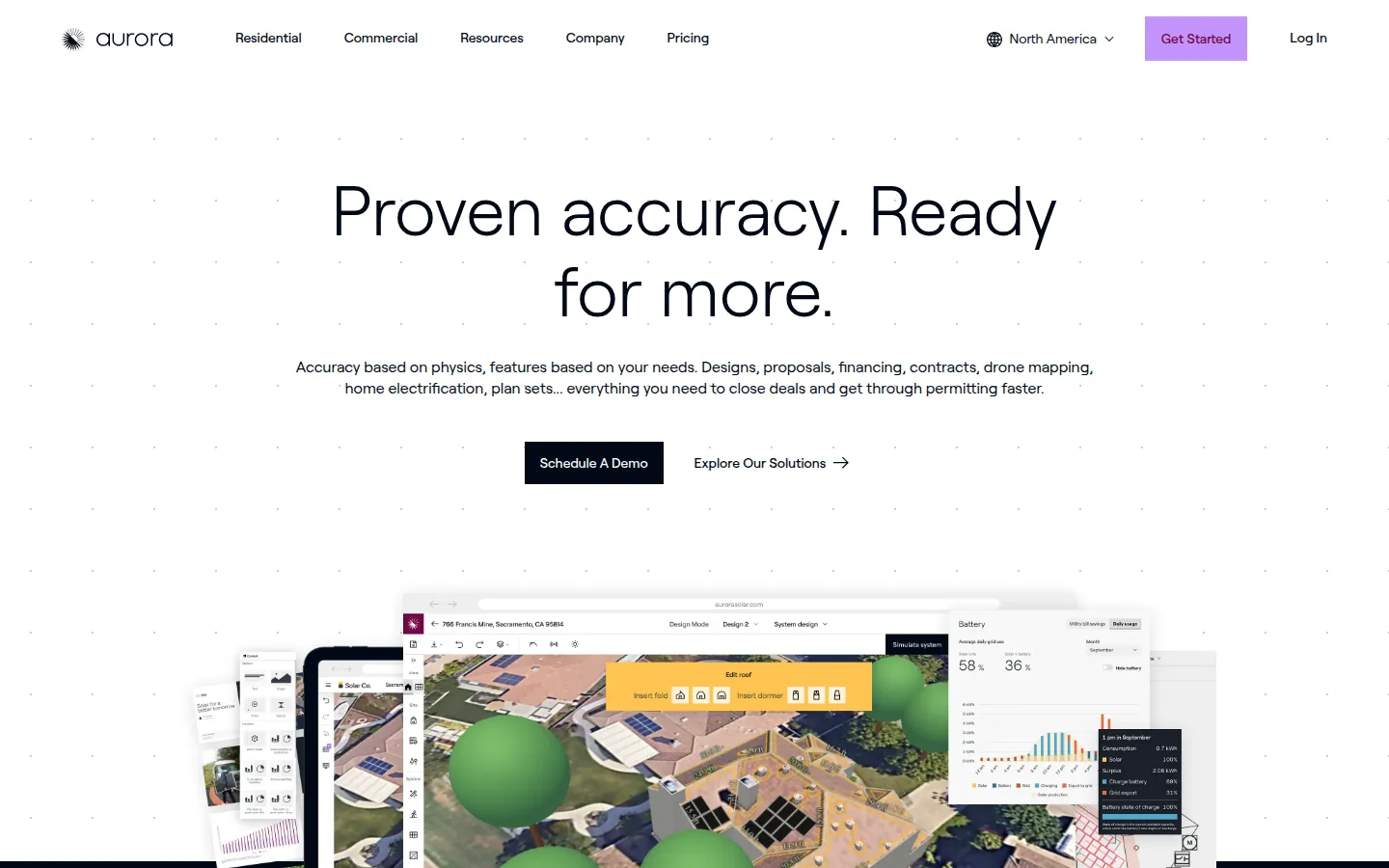
Aurora Solar
Best for: teams that need a custom tariff with export-rate, true-up and tier settings in an online design platform.
Not the right choice if: you need a published UAE price or documented UAE coverage. Neither is stated on the pages we read. You may also need a P90 value for solar output. Aurora’s PXX help article says its estimates are P50 values and that it does not natively output P90. Finally, its help article says custom rates do not support time-of-use export rates.
What the vendor documents: soiling as an annual or monthly loss with a 2% default, per its System Losses article. It also documents an hourly circuit simulation that adjusts for irradiance (the strength of the sunlight) and temperature, per its loss diagram article. Its custom rates article lists residential or commercial rates and an export rate (retail, reduced retail or fixed). It also lists a monthly or annual true-up period, a net surplus compensation value, tiers and time-of-use periods. A keyboard-shortcut list in an older design article mentions adding a ground mount or carport.
Price (checked October 2026): the pricing page lists US dollars. Basic is $159 per user per month billed monthly, or $135 per user per month billed annually. Premium is $259 or $220. It does not say whether those prices apply in the UAE.
Limitations: the pages we read do not state UAE imagery or tariff coverage or a Shams Dubai preset. The PXX article says P90 is not natively output for solar production.
Vendor link: aurorasolar.com.
HelioScope
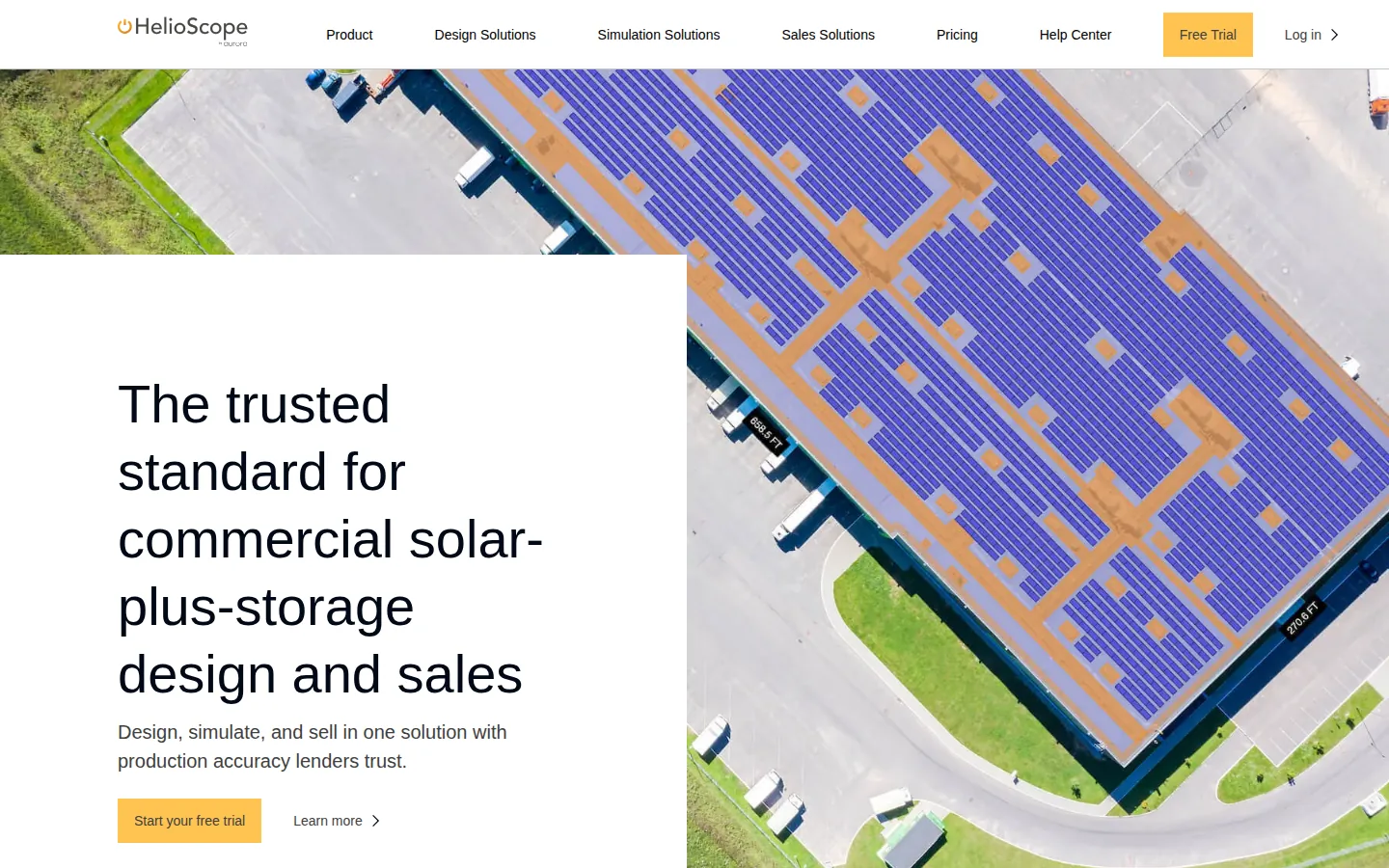
Best for: commercial designers who want rooftop, carport and ground-mount layouts with loss assumptions. On Pro, they also get financials and P90 values.
Not the right choice if: you need the utility-rate editor or P90 values on the lowest plan. Both are Pro features. It is also not right if you need a design above 5 MW DC without an Enterprise plan. The same goes for a residential-focused tool, since the plans are described for commercial solar-plus-storage.
What the vendor documents: on its pricing page, rooftop, carport and ground-mount design on all projects. It also lists CAD export and single-line diagrams (SLDs, simple drawings of how the system is wired). It lists designs up to 1.25 MW DC (Basic), 5 MW (Pro) and 30 MW (Enterprise). On Pro it adds financial modeling, sales proposals and P90, P95 and P99 values. Soiling is set in the Condition Set with a 2% default, per its typical loss factors article. The Condition Sets article mentions monthly soiling factors. Its cell temperature article describes a Sandia model and a diffusion model, with carports as a racking option. Its utility-rate article covers a net-metering toggle and an annual true-up with a net export rate. It also covers tiers and time-of-use schedules.
Price (checked October 2026): Basic is $159 USD per license per month or $1,620 USD per license per year. That covers 1 user and 120 projects a year on annual. Pro is $259 per month or $2,640 per year. Enterprise is custom per-project pricing. HelioScope describes itself as an Aurora Inc. company.
Limitations: its OpenEI rate library is described as currently available for certain US rates only. So you would create a UAE tariff as a custom rate. The pages we read state no UAE-specific preset.
Vendor link: helioscope.aurorasolar.com.
OpenSolar
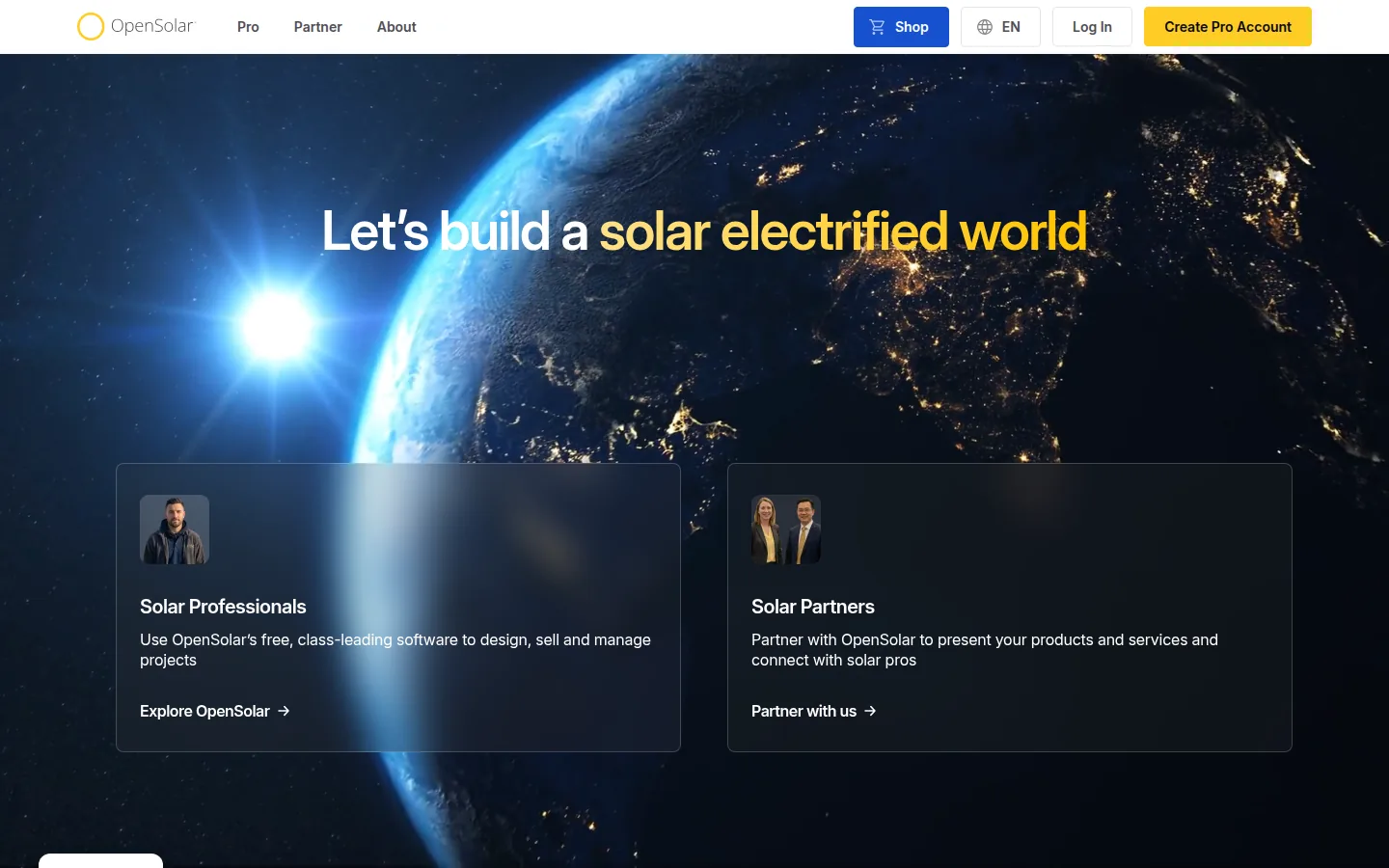
Best for: small teams that want a free tool with tiered tariffs and credit carryover options.
Not the right choice if: you need documented carport design or P50 to P90 yield evidence. Neither is stated on the pages we read. It is also not right if you need a documented temperature input.
What the vendor documents: its tariff article covers flat, time-of-use, tiered and demand-charge rates. It also covers ways to pay or credit exported power, including net energy metering, net billing and net billing with credit carryover. Its simulation settings article lists soiling among the System Advisor Model loss fields and says OpenSolar uses regional weather files. The SLD generator lists region templates for AU, US, UK, DE, IT and ES. Its help article lists AU, NZ, US, CA, UK, FR, DE, IT, ES and IN, not the UAE.
Price (checked October 2026): the core app is free of charge for solar professionals, per the vendor. From 16 April 2026 the vendor charges for two things. API Access, which lets other software connect to OpenSolar, costs a per-project fee. The per-project API fee is on OpenSolar’s API page. Supported connectors cost a monthly fee per organization. The 16 February 2026 post says accounting connectors are billed as a monthly fee per organization. Optional paid Enterprise Services are Support at US$500 per month and Customize at US$1,350 per month. Enterprise is at a custom price. See the Enterprise Services page. Premium imagery is pay per image, and the app shows the price.
Limitations: the pages we read state no UAE tariff presets, no DEWA-specific compensation mechanism and no UAE-specific SLD template.
Vendor link: opensolar.com.
PVsyst
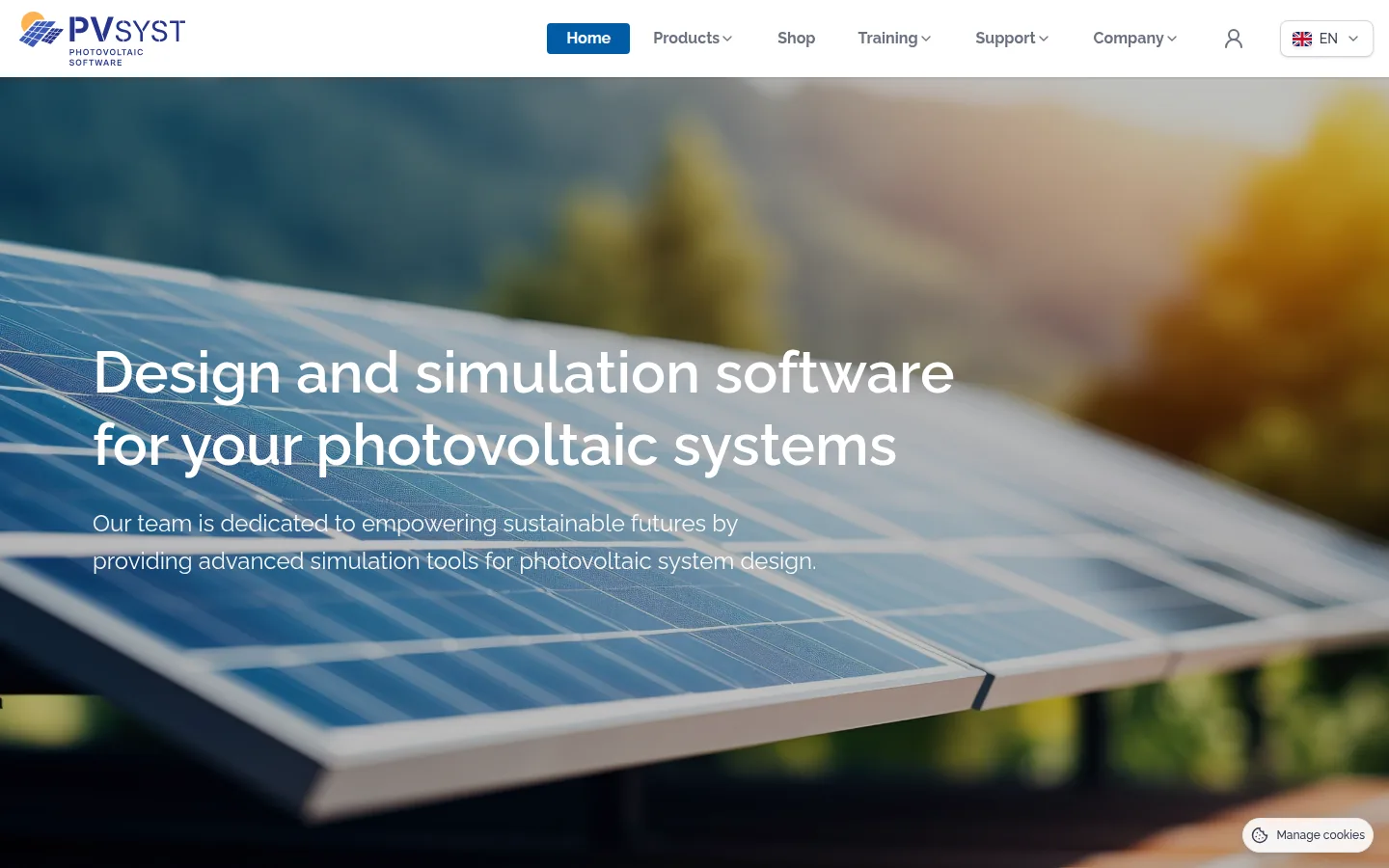
Best for: yield simulation and P50 to P90 reporting where a lender or investor wants a simulation report.
Not the right choice if: you need proposals or automated layouts from the same tool. It is also not right if you work on a Mac or in a browser. The requirements page says it runs under Windows.
What the vendor documents: a P50 to P90 evaluation. It also documents soiling factors that can be set by month and treated as an irradiance loss (soiling loss). It has an array thermal loss model and an economic evaluation that uses tariffs to estimate profitability. Its feed-in tariff and self-consumption page covers a fixed feed-in tariff over a contract period, annual variation and hourly feed-in. A feed-in tariff is a set price paid for power you send to the grid. The page also covers a self-consumption economy with a consumption tariff and an overproduction tariff. The pages we read do not name net-metering credits.
Price (checked October 2026): CHF 700 per year for PVsyst 8 Professional, with grouped-order discounts. These are 5% for 2 to 4 licences, 15% for 5 to 9 and 20% for 10 or more. No AED price is published.
Limitations: the pages we read describe no proposal or carport output. Its single line diagram page says the editor covers grid-connected systems only and leaves out storage. It also says the editor is still work in progress.
Vendor link: pvsyst.com.
SurgePV
SurgePV is our product.
Best for: teams that want roof modeling, shading, yield, financial modeling, bill of materials and proposals in one product. It is priced per user. They should confirm UAE-specific outputs in a demo.
Not the right choice if: you want a self-serve trial (SurgePV offers a guided demo). It is also not right if you need an AED price in writing before talking to sales. For visitors outside India the pricing page lists US dollars. Finally, it is not right if you need documented soiling and temperature inputs. The same goes for a custom export-credit setting or P50 to P90 values. HelioScope Pro and PVsyst document them. Outputs support design and documentation. They do not replace approval by the responsible engineer, authority, lender or utility. SurgePV’s published product scope does not list a CRM. It is also not a monitoring or ERP product (ERP is software that runs a company’s back office).
What the vendor documents: 3D roof modeling, array layout, shading analysis and energy-yield modeling. It also documents financial modeling, electrical workflow support, bill-of-materials output and proposal generation. See solar design software for the product page.
Price (checked October 2026): $1,899 per user per year for 1 user, $1,499 per user for 3 seats, $1,299 per user for 5 seats. These are US dollars.
Limitations: results depend on source data, assumptions and equipment models. The pricing page and published scope do not state soiling or temperature inputs. They do not state DEWA or other emirate tariff presets, carport design or P50 to P90 outputs.
Vendor link: surgepv.com.
UAE Rules That Shape the Choice
Dubai (DEWA). DEWA’s Shams Dubai FAQ says the installed capacity must not exceed the applicable share of the Total Connected Load. It also says DEWA can set a lower limit for technical reasons. Exported energy is credited on future bills. The credit is carried forward with an indefinite rollover, which means no set end date. Exports and credits are deducted from imports before the slab tariff (prices that rise in steps) is applied. Under the resolution it quotes, the producer is not paid for surplus energy. The same FAQ mentions parking-lot rooftops. It also says ground-mounted panels are not envisaged under Shams Dubai. Our Shams Dubai guide covers the application steps.
Northern emirates (Etihad Water and Electricity). The Distributed Solar Systems conditions (version 1, September 2024) allow phase 1 connections. These are for residential local, industrial and agricultural customers, rooftop only. Maximum capacity is 10% of the hosting account’s connected load. It cannot exceed 1,000 kW. Each monthly invoice subtracts generation from consumption, using readings from two meters. Remaining export credits are lost when the hosting account is disconnected. An annual limit applies. Approved requests above it connect in the next calendar year, first come, first served.
Abu Dhabi. The Department of Energy launched its Solar Energy Self-Supply Policy on 5 February 2026 for farms, rest houses and ranches. The second phase on 31 March 2026 extended it to villas and residential buildings. The announcements describe self-supply with optional battery storage. Self-supply means customers make and use their own power, for example with solar panels. The announcements do not describe a net-metering credit. So check the latest terms with the Department and your utility before modelling export income.
Other emirates. This page does not cover Sharjah (SEWA) or other utilities. Ask the serving utility for its connection conditions before you build a financial model.
What this means for tool choice. Export credit rules differ between Dubai and the northern emirates. Abu Dhabi has moved to a self-supply policy. So a tool that only offers a fixed export rate may need workarounds. HelioScope Pro, Aurora and OpenSolar document net-metering or true-up settings. DEWA’s mention of parking-lot rooftops makes carport support worth checking.
Not Compared on This Page
PV*SOL, PVcase and other tools are not compared here. This page covers five tools. We did not research free or open-source tools beyond OpenSolar, and we did not read Sharjah’s SEWA rules. Aurora’s pages we read do not state UAE coverage, so test its imagery for your site.
How We Ordered These Tools
SurgePV publishes this page and is a vendor on this list. Its entry uses the same vendor-page sources and template as every other tool here.
We did not rank these tools. They are listed alphabetically, and the best-for picks come from the matrix above.
- Soiling and heat inputs: UAE sites run hot and dusty. PVsyst’s documentation says soiling depends strongly on rainfall and environment. We did not assess whether any tool’s default values suit the UAE.
- Tariff and export-credit inputs: DEWA credits exports on the next bill. The northern emirates net each month. So the credit setting changes the savings figure. We did not assess whether any calculation matches a utility’s bill.
- Carport design: DEWA’s FAQ names parking-lot rooftops, and ground mounts are not envisaged under Shams Dubai. We did not assess design quality.
- P50 to P90 yield: larger projects need a yield report a lender will read. We did not assess acceptance by any lender.
- Price shown: the price and currency show what a UAE buyer pays. We did not assess discounts or negotiated quotes.
Sources and Dates
Vendor pages were read on 28 October 2026: Aurora (pricing), HelioScope (pricing), OpenSolar (core app page, pricing post, Enterprise Services), PVsyst (shop) and SurgePV (pricing). Regulator sources: DEWA, Etihad Water and Electricity and the Abu Dhabi Department of Energy, linked above. The DEWA pages and the Aurora, HelioScope and OpenSolar help centres blocked our command-line requests with a 403 error. So we read them in a browser. The ADDC website blocked our requests, so we did not read it.
See SurgePV on your own UAE project
Book a guided demo and ask for the UAE outputs you need.
Book a Free DemoGo Deeper on a Category
- Design software options for UAE installers
- How UAE teams build proposals
- Solar software for Saudi Arabia and Qatar, the nearest country lists
- Best solar software in the US
Frequently Asked Questions
What is the best solar software in the UAE?
It depends on the job. From what the vendors publish, HelioScope documents carport design, soiling and heat inputs. On its Pro plan it also documents a utility-rate editor with net metering and P90 values. PVsyst documents monthly soiling and P50 to P90 evaluations. OpenSolar’s core app is free and has a tariff builder with credit carryover options. API Access and connectors are charged from 16 April 2026. Aurora documents custom rates with export and true-up settings. SurgePV documents roof modeling, shading, yield, financial modeling, bill of materials and proposals in one product. It is priced per user.
Is there free solar software for the UAE?
OpenSolar’s core app is free of charge for solar professionals. The vendor charges for API Access and supported connectors from 16 April 2026. The OpenSolar pages we read do not state carport design or P50 to P90 yield. Check those against your project before you rely on it.
Can solar software show AED and DEWA Shams Dubai savings?
None of the vendor pages we read show an AED price or name Shams Dubai. DEWA credits exported energy against future bills with an indefinite rollover. So you need a tool that takes custom tariff and export-credit inputs. HelioScope Pro, Aurora and OpenSolar each document such inputs. Check the result against DEWA’s own rules before you quote.
Does solar software work outside Dubai?
The rules differ by emirate. Etihad Water and Electricity publishes distributed solar conditions for the northern emirates. They set a monthly net of consumption and generation and a 1,000 kW ceiling. Abu Dhabi’s Department of Energy launched a solar self-supply policy in February 2026. It extended the policy to homes on 31 March 2026. Vendor pages we read do not name emirate-specific presets.
Which tool handles dust and heat losses for UAE projects?
PVsyst takes monthly soiling factors and documents an array thermal loss model. HelioScope sets soiling by month in a condition set and offers two cell temperature models. Aurora takes annual or monthly soiling and simulates temperature effects hourly. OpenSolar lists soiling among its SAM loss fields. SurgePV lists energy-yield modeling but does not state soiling or temperature inputs.
Which software can design carport solar in the UAE?
HelioScope lists rooftop, carport and ground-mount design on all its plans. DEWA’s FAQ mentions parking-lot rooftops and says ground-mounted panels are not envisaged under Shams Dubai. The Aurora, OpenSolar, PVsyst and SurgePV pages we read do not clearly describe carport design. So ask each vendor to show one.
