


This page is for installers and EPC teams in Montenegro choosing solar proposal software. Short answer: for a Montenegrin quote with a custom tariff, and no Montenegrin template, pick OpenSolar; for montenegrin commercial financing comparisons, pick Energy Toolbase.
A Montenegrin quote carries three things: the customer’s actual tariff, an array no larger than the building’s connection power, and the sequence of steps after signature. OpenSolar documents custom tariffs with demand charges, on a free core app. Energy Toolbase lists PPA and lease financing; a PPA (power purchase agreement) has the customer pay for the energy a system produces rather than buy the system. SurgePV documents roof modeling through to proposals, priced per user, and states no Montenegro output.
What follows is a desk comparison built from vendor pages as they stood in October 2026. No side-by-side trials were run. Tool facts come from each vendor’s own site. The Montenegro section relies only on the market operator’s December 2024 guide and the CEDIS pages, read in November 2026. No tariff level is claimed here, and the unsourced market figures from the earlier version are gone.
Criteria applied: custom tariff entry, demand or capacity charge fields, Montenegrin proposal language, lease or PPA financing, US dollar price, free tier.
Solargraf is out of this update. Automated tools could not read solargraf.com in October 2026, so nothing about it can be sourced, and it is not compared here.
Want to see SurgePV quote a Montenegro project?
Book a guided demo and bring a real Montenegro site. We walk through design, yield, finance and the proposal in one platform.
Book a Free DemoChecking cost first? See the SurgePV pricing page.
Best-For Picks for Montenegro
- Montenegrin quote, custom tariff, no Montenegrin template: OpenSolar. Flat, time-of-use, tiered and demand-charge rates are all listed in its help article, along with fixed and minimum charges. The core app costs nothing, though API Access and connectors carry charges from 16 April 2026. Montenegrin is absent from its language list.
- Commercial financing comparisons for Montenegrin clients: Energy Toolbase. The FAQ names cash, PPA, loan and lease structures. The price is given on a demo call.
- Tablet in the customer’s living room: Aurora Solar. Basic includes tablet-friendly sales proposals. Rates can be edited per project, or built as a custom rate with demand charges.
- Home quote straight from the roof model: SurgePV. Roof modeling, shading, yield, financial modeling, bill of materials and proposals are in its documented scope. In a demo, ask how it treats a Montenegro tariff and a capacity charge, since its scope names neither.
Montenegro Solar Proposal Software Comparison Table
Alphabetical order, not a ranking. Choose by the situation in the picks above. Prices were read on each vendor’s own page in October 2026, in the vendor’s published currency.
| Tool | Best for | Price | Free or paid | Decisive Montenegro fact |
|---|---|---|---|---|
| Aurora Solar | Tablet-friendly proposals | $159 or $259 per user per month (monthly billing); $135 or $220 billed annually | Paid | Pricing page lists North America and Europe regions; Montenegro not named |
| Energy Toolbase | PPA and lease modeling for commercial deals | Price given on a demo call | Paid | Montenegro not named on the pages we read |
| OpenSolar | Custom tariffs with demand charges | Core app free of charge; API Access and connectors charged from 16 April 2026 | Free core app, paid API and connectors | 13 proposal languages; Montenegrin is not on that list |
| SurgePV | Roof model to BOM and proposal, per user | $1,899 per user per year (1 user), in US dollars | Paid, guided demo | BOM and proposal generation in scope; no Montenegro item stated |
Montenegro Criteria Matrix
Cell values are Documented, Partial or Not stated. Documented: the vendor’s own page says so. Partial: the page covers a related feature but not the whole item. Not stated: the October 2026 pages are silent. No scores or weights are used.
| Tool | Custom tariff entry | Demand or capacity charge fields | Montenegrin proposal language | Lease or PPA financing | US dollar price | Free tier |
|---|---|---|---|---|---|---|
| Aurora Solar | Documented (configure your own rates) | Documented (help article on custom rates adds demand charges) | Not stated | Documented (loan, lease, PPA or cash product in Sales Mode) | Partial ($ shown, currency not named) | Not stated |
| Energy Toolbase | Documented (help center: create your own custom rate schedules) | Partial (FAQ: models demand charge reduction with storage) | Not stated | Documented (cash, PPA, loan, lease) | Not published for ETB Developer (demo call) | Not stated |
| OpenSolar | Documented (custom tariff form) | Documented (demand charges in the form) | Partial (13 languages; Montenegrin is not on that list) | Partial (options depend on market and provider) | Documented (core app free; paid services in US$) | Documented |
| SurgePV | Not stated | Not stated | Not stated | Not stated | Documented ($1,899 per user per year, 1 user) | Not stated (guided demo) |
Two points. First, none of the pages names a Montenegro tariff. Second, the OpenSolar and Aurora help articles each describe custom rates with demand charges. Silence on a page is not proof a tool lacks the feature, so give each vendor one real Montenegro bill and watch what it does.
Tool Entries
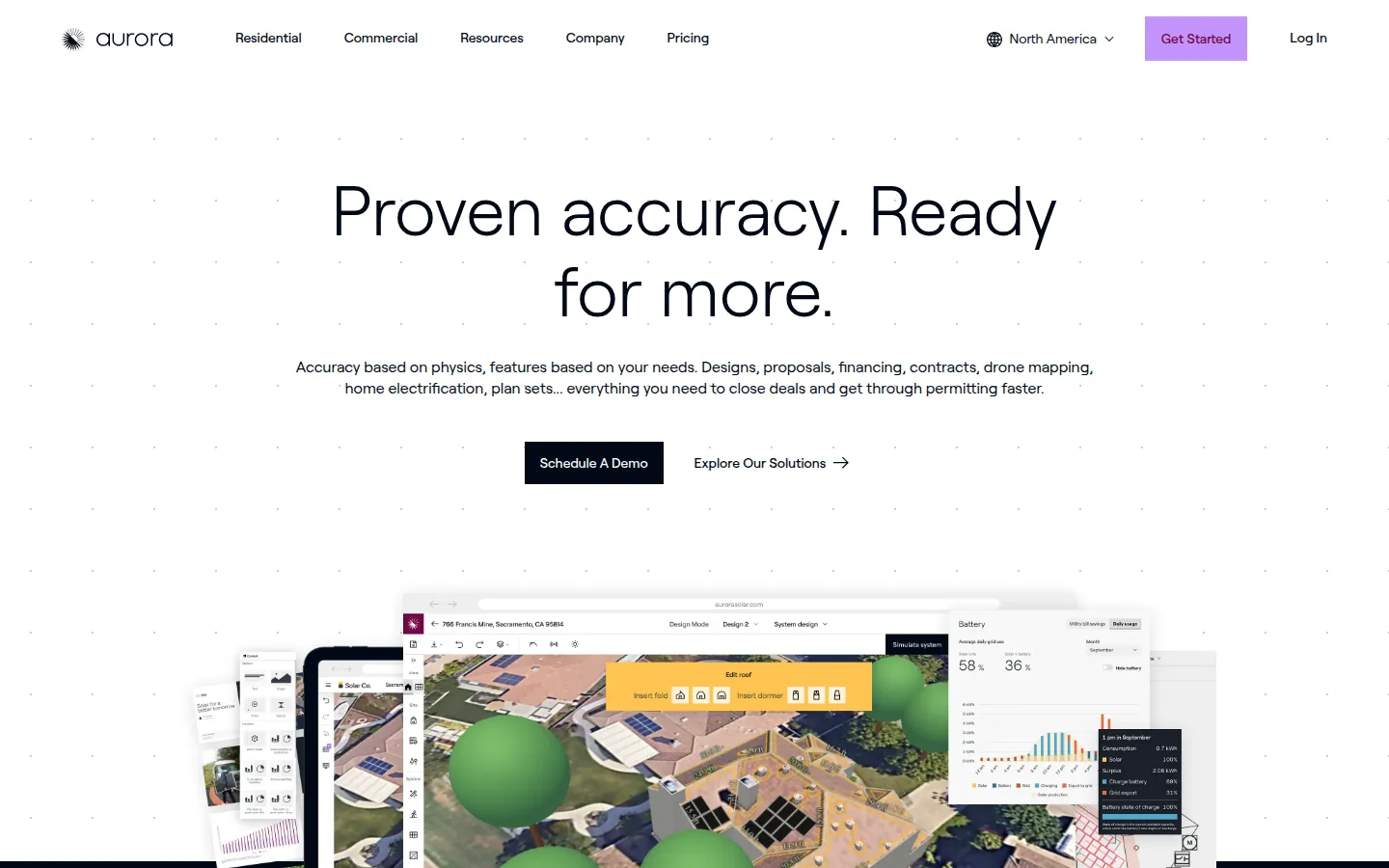
Aurora Solar
Best for: a Montenegrin sales team visiting homes with a tablet, wanting proposals on the spot and rates that can be edited per job.
Not the right choice if: a Montenegro rate must arrive preloaded or the proposal must be printed in Montenegrin. The pricing page and help articles checked do not name Montenegro or list Montenegrin.
What the vendor documents: the pricing page lists 3D roof modeling, performance simulation, adders, discounts and incentives, and a utility rate database where you “configure your own rates or use rates from Genability and Aurora”. Premium adds LIDAR-assisted modeling, bankable shade reports and battery modeling. Its help article on editing rates says you can change the import rate, export rate, rate details and compensation policy for a project. Its help article on custom rates lets an admin create a rate with tiers, time-of-use periods and demand charges. Its financial analysis article says a loan, lease, PPA or cash product must be chosen in Sales Mode.
Price (checked October 2026): Basic $159 per user per month billed monthly, or $135 per user per month billed annually ($1,620 billed annually); Premium $259 per user per month, or $220 billed annually ($2,640 billed annually). Enterprise is custom, per project. The page shows “$” and does not name the currency.
Limitations: the pricing page names North America and Europe as regions, not Montenegro, and no Montenegro rate appears on any page consulted.
Vendor link: aurorasolar.com.
Energy Toolbase
Best for: commercial Montenegrin deals that weigh PPA, lease or loan against purchase, with storage, once the connection power cap is known.
Not the right choice if: a published price matters or Montenegro must be named. The pricing page asks you to book 30 minutes and get a demo and a quote on that call.
What the vendor documents: its ETB Developer FAQ says the platform supports cash purchases, power purchase agreements, loans and leases. It says the platform has a built-in database of utility rates, incentives and tariffs, and that it models demand charge reduction with battery storage. It also says ETB Developer is web-based. The product page counts 120,000+ tracked utility rates and describes a fully custom proposal template builder.
Price (checked October 2026): no ETB Developer figure is published on the pricing page. The page also lists implementation and support packages with no price.
Limitations: neither Montenegro nor the countries behind its rate database are named in the pages consulted. Its rate schedules help page says users can build custom rate schedules, and that the rates database spans 50 states and 42 international territories.
Vendor link: energytoolbase.com.

OpenSolar
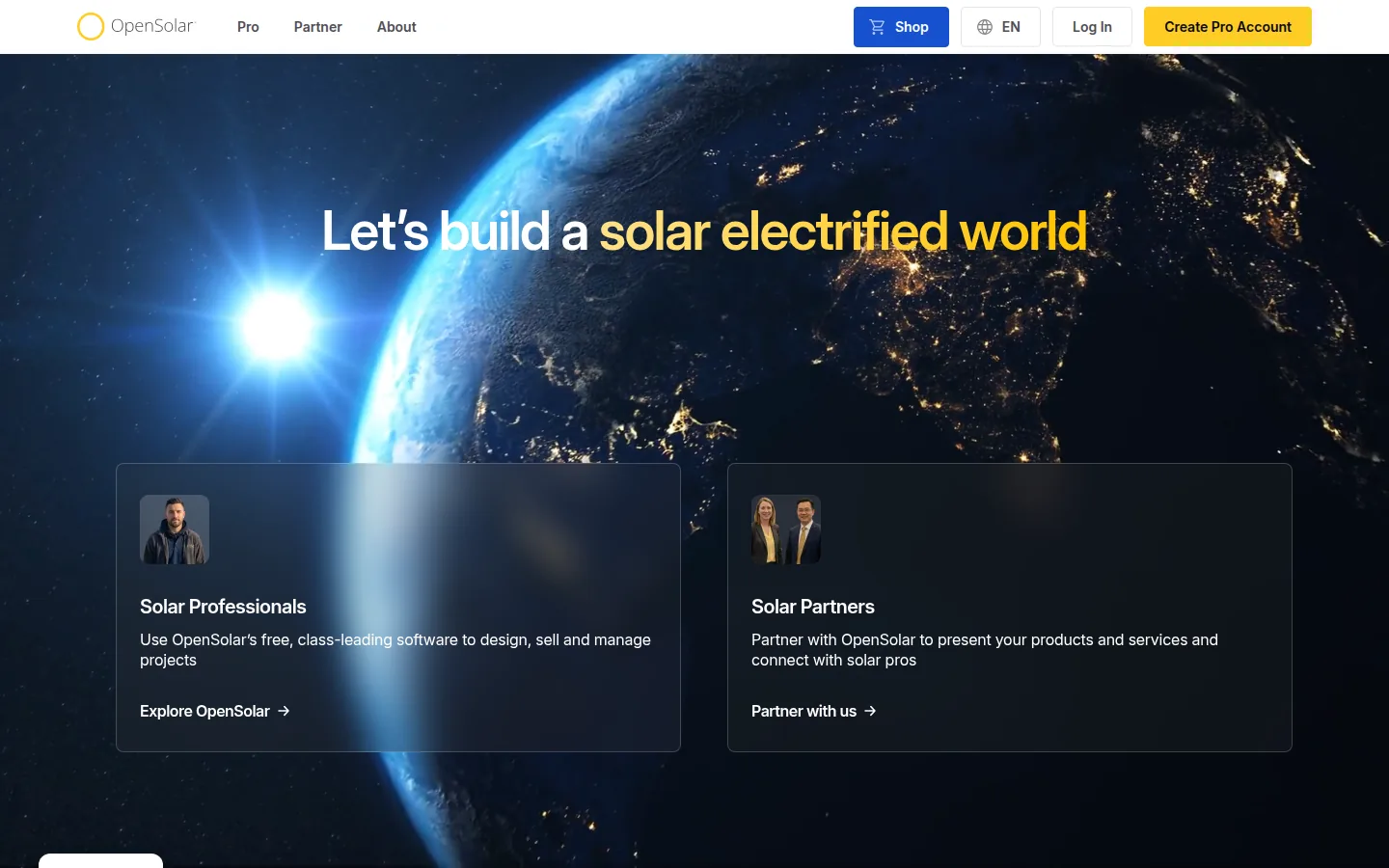
Best for: Montenegrin installers who need a custom tariff with demand charges on a free core app and are willing to translate the template.
Not the right choice if: proposals have to go out in Montenegrin. The language article lists 13 languages, and Montenegrin is not one of them.
What the vendor documents: its tariff article says you can create a custom tariff with a tariff type and compensation mechanism. The rate structures are flat, time-of-use, tiered and demand charges. You can add fixed and minimum charges. Its integrated finance page says the options depend on your market and provider, and may include loans, leases, PPAs and third-party ownership.
Price (checked October 2026): the core app is free of charge for solar professionals, per the vendor. From 16 April 2026 the vendor charges for API Access, which lets other software connect to OpenSolar, and for supported connectors. This comes from its 16 February 2026 post.
Limitations: a Montenegro tariff has to be built by hand, and the pages consulted name none.
Vendor link: opensolar.com.
SurgePV
SurgePV is our product.
Best for: Montenegrin home quotes that run from roof model to proposal. In a demo, ask whether a connection power cap and the 7-day post-connection report can appear as steps.
Not the right choice if: you need a self-serve trial, since SurgePV offers a guided demo. It also falls short if a tariff form, demand charge fields or Montenegrin output must be confirmed before a sales call; its published scope states none. Outputs support design and documentation, and do not replace sign-off by the responsible engineer, authority, lender or utility. A CRM (a tool to track customers and sales) is not in its published scope, and monitoring and ERP (business management software) sit outside it. OpenSolar documents a custom tariff form that SurgePV’s published scope lacks.
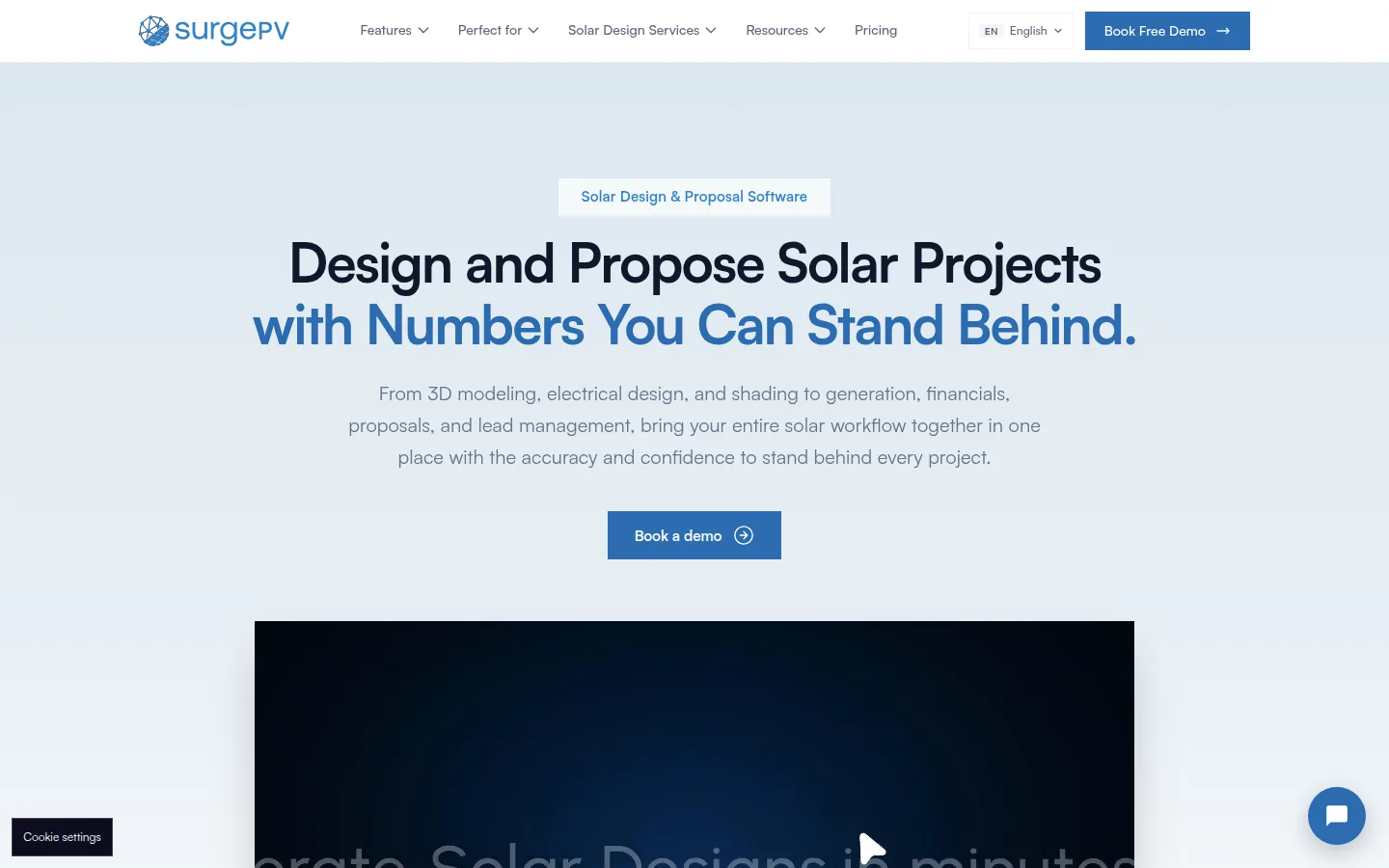
What the vendor documents: 3D roof modeling, array layout, shading analysis, energy-yield modeling, financial modeling, electrical workflow support, bill-of-materials output and proposal generation. See solar proposal software for the product page.
Price (checked October 2026): $1,899 per user per year for 1 user, $1,499 per user for 3 seats, $1,299 per user for 5 seats, in US dollars.
Limitations: results depend on source data, assumptions and equipment models. No tariff form, capacity charge field, Montenegrin output or PPA modeling appears in the published scope.
Vendor link: surgepv.com.
Steps and Papers a Montenegrin Solar Quote Has to Cover
A Montenegrin quote is a timeline as much as a price. The CEDIS page on connection to the distribution system describes four steps. First, technical conditions that fix the connection point and the metering point. Second, an opinion on the main project, positive or negative, where a negative one lists the deficiencies. Third, a contract on connection infrastructure and connection, where the applicant picks whether CEDIS or the applicant builds the infrastructure. Fourth, connection after a positive internal technical inspection, when CEDIS installs the meter and seals the metering point, and the applicant signs a supply contract with a supplier. Source: the CEDIS connection page. That page covers facilities in general and gives no separate generation or customer-producer rules, so ask CEDIS before you print these steps as the rule for a rooftop plant.
Two deadlines on that page belong in a quote. CEDIS must connect the facility within 7 days after the supplier’s notice, and the applicant must submit a technical report from an authorised organisation within 7 days after connection. The page says CEDIS suspends electricity delivery if the report is missing.
Next, what the quote may promise. The COTEE guide to permitting renewable plants and customer-producer installations (December 2024) says the plant of a customer-producer may not exceed the connection power of the customer’s building, so a proposal should cap array size at that figure rather than at the roof area. It also separates the incentive routes: a market premium through auctions, and a feed-in tariff for small plants or demonstration projects through a public call, each with an incentive period up to 12 years. Both depend on government quotas, so an ordinary rooftop quote should not assume either.
How this shapes the tool choice. The proposal needs a field for the connection power cap, a payback model that works without a support scheme, and a language the customer reads. OpenSolar’s list of 13 proposal languages does not include Montenegrin, and the Aurora Solar, Energy Toolbase and SurgePV pages we read list none for Montenegro. Prepare a translated template or send the proposal in English with a local summary.
What to Ask a Vendor Before Buying
Bring one real Montenegrin electricity bill to each vendor and request a sample proposal. Check four things. Can the tariff and any fixed or capacity charge be keyed in? Can the output be in Montenegrin if the customer wants it? Do the finance options match how your customers pay? Is the price in the currency of your invoice? Where a vendor’s pages are silent, the matrix says so, and a demo is where to settle it. Permit and grid-connection rules sit with the Montenegrin authorities, which the vendor pages do not address.
How We Ordered These Tools
Methodology: nothing here is ranked. Tools are listed alphabetically and the picks follow from the matrix. SurgePV publishes this page and is a vendor on this list. It follows the same rules as the rest and is not placed first.
- Custom tariff entry: Montenegrin bills seldom resemble a US rate. How well a tool calculates a tariff you type in was not assessed.
- Demand or capacity charge fields: larger customers can pay on capacity as well as energy. The arithmetic of each tool was not assessed.
- Montenegrin proposal language: many customers read proposals in their own language. Translation quality was not assessed.
- Lease or PPA financing: commercial buyers weigh purchase against paying for output. Whether any tool models a Montenegro deal was not assessed.
- US dollar price: a published figure allows planning before a call. Discounts and negotiated quotes were not assessed.
- Free tier: a free plan lets a small team try the workflow. Limits beyond what the page states were not assessed.
Sources and Dates
Vendor pages were read in October 2026 and the headline prices were rechecked on 3 November 2026. They are Aurora (pricing and three help articles), Energy Toolbase (pricing, FAQ and product page), OpenSolar (free page, 16 February 2026 post, and the tariff, language and finance pages linked above) and SurgePV (pricing). Screenshots are captures of each vendor’s public website from 29 October 2026.
Country sources, read November 2026:
See SurgePV on your Montenegro project
Book a guided demo and ask how it handles a Montenegro tariff and capacity charge.
Book a Free DemoMore Solar Software Guides to Compare
- Best solar software in Montenegro
- Solar design software for Montenegro
- Best solar proposal software, all markets
- Solar proposal software features and SurgePV pricing
Frequently Asked Questions
What steps come after a Montenegrin customer signs a solar quote?
The CEDIS connection page describes technical conditions, an opinion on the main project, a connection contract, then connection after an internal technical inspection, with a supply contract signed with a supplier. That page is general for facilities, so check generation rules with CEDIS.
How big can a Montenegrin customer-producer array be in a quote?
The COTEE guide to permitting renewable plants and customer-producer installations (December 2024) says installed power may not exceed the connection power of the customer’s building. Cap the proposal at that figure.
Should a Montenegrin rooftop quote assume a feed-in tariff or market premium?
No. The guide describes both routes as dependent on government quotas, with a market premium through auctions and a feed-in tariff for small plants or demonstration projects through a public call. Model the payback without a scheme.
Can proposal software enter a Montenegrin tariff and print Montenegrin?
OpenSolar and Aurora Solar help articles describe custom rates with demand charges. OpenSolar’s 13 proposal languages do not include Montenegrin. Enter the rate from the customer’s bill and check the printed language.
How much does solar proposal software cost for an installer in Montenegro?
Prices are in US dollars. OpenSolar’s core app is free. Aurora lists $159 per user per month for Basic billed monthly, or $135 billed annually. SurgePV lists $1,899 per user per year for one user. Energy Toolbase gives its price on a demo call.
