


Jordanian installers and EPC contractors choosing quoting software will find four tools weighed below. Where the job needs custom tariffs with demand charges on a free core app, OpenSolar leads; where a commercial client wants PPA, lease or loan comparisons, Energy Toolbase leads.
Jordan quotes sit on top of a monthly net-metering settlement, so the proposal has to show the customer’s own tariff and any capacity charge, in a language the reader uses. Arabic is the obvious one, and OpenSolar’s list of 13 proposal languages leaves it out. OpenSolar documents custom tariffs with demand charges on a free core app, and Energy Toolbase lists PPA and lease financing. A PPA (power purchase agreement) has the customer paying for the output of a system instead of owning it. SurgePV documents roof modeling through proposals at a per-user price and states no Jordan tariff output. No vendor here names Jordan, so run one real Jordan bill through each.
This is a desk comparison of vendor-published material read in October 2026, with no side-by-side trials. Tool facts come from the vendors’ own sites. Jordan’s billing rules come from one regulator document, covered in its own section further down. Tariff levels and incentive programs are not claimed, and the unsourced market figures from the earlier version of this page are gone.
Criteria applied: custom tariff entry, demand or capacity charge fields, Arabic proposals, lease or PPA financing, a US dollar price, and a free tier.
Solargraf is left out of this update because solargraf.com could not be opened by automated tools in October 2026. With nothing to source, no claim about it appears here.
Want to see SurgePV quote a Jordan project?
Book a guided demo and bring a real Jordan site. We walk through design, yield, finance and the proposal in one platform.
Book a Free DemoChecking cost first? See the SurgePV pricing page.
Best-For Picks for Jordan
- Free core app with demand-charge tariffs: OpenSolar. Its help article covers flat, time-of-use, tiered and demand-charge rates plus fixed and minimum charges. The core app is free; API Access and connectors are charged from 16 April 2026. Arabic is absent from the 13-language list. Since a Jordan quote turns on monthly net kWh, ask whether a custom tariff can carry that.
- Commercial PPA, lease or loan modeling: Energy Toolbase. Its FAQ names cash, PPA, loan and lease structures and the price comes on a demo call. These suit commercial buyers, though Jordan’s net-metering carry-forward works differently from a PPA.
- Proposals shown on a tablet: Aurora Solar. The Basic plan is listed with tablet-friendly sales proposals. Rates can be edited per project, or built as custom rates with demand charges. Its per-project rate and compensation policy come closest to a net-metering credit, so request a Jordan sample.
- Roof model through bill of materials to proposal, per-user price: SurgePV. The vendor documents roof modeling, shading, yield, financial modeling, a bill of materials and proposals. Its published scope mentions neither a Jordan tariff nor a capacity charge, so ask for a demo quote where exports offset imports kWh for kWh.
Jordan Solar Proposal Software Comparison Table
In alphabetical order, which is not a ranking. Choose from the situations above. Prices were read in October 2026 on each vendor’s page and appear in that vendor’s currency.
| Tool | Best for | Price | Free or paid | Decisive Jordan fact |
|---|---|---|---|---|
| Aurora Solar | Tablet-friendly proposals | $159 or $259 per user per month (monthly billing); $135 or $220 billed annually | Paid | Pricing page lists North America and Europe regions; Jordan not named |
| Energy Toolbase | PPA and lease modeling for commercial deals | Price given on a demo call | Paid | Jordan not named on the pages we read |
| OpenSolar | Custom tariffs with demand charges | Core app free of charge; API Access and connectors charged from 16 April 2026 | Free core app, paid API and connectors | 13 proposal languages; Arabic is not on that list |
| SurgePV | Roof model to BOM and proposal, per user | $1,899 per user per year (1 user), in US dollars | Paid, guided demo | BOM and proposal generation in scope; no Jordan item stated |
Jordan Criteria Matrix
Each cell says Documented, Partial or Not stated. Documented: the vendor’s page states it. Partial: a related feature is stated, not the whole item. Not stated: the pages read in October 2026 say nothing. No scores or weights are used.
| Tool | Custom tariff entry | Demand or capacity charge fields | Arabic proposal language | Lease or PPA financing | US dollar price | Free tier |
|---|---|---|---|---|---|---|
| Aurora Solar | Documented (configure your own rates) | Documented (help article on custom rates adds demand charges) | Not stated | Documented (loan, lease, PPA or cash product in Sales Mode) | Partial ($ shown, currency not named) | Not stated |
| Energy Toolbase | Documented (help center: create your own custom rate schedules) | Partial (FAQ: models demand charge reduction with storage) | Not stated | Documented (cash, PPA, loan, lease) | Not published for ETB Developer (demo call) | Not stated |
| OpenSolar | Documented (custom tariff form) | Documented (demand charges in the form) | Partial (13 languages; Arabic is not on that list) | Partial (options depend on market and provider) | Documented (core app free; paid services in US$) | Documented |
| SurgePV | Not stated | Not stated | Not stated | Not stated | Documented ($1,899 per user per year, 1 user) | Not stated (guided demo) |
Two observations. No page names a Jordan tariff, and the OpenSolar and Aurora help articles both describe custom rates with demand charges. A blank cell may still hide a working feature, so have each vendor model one real Jordan bill before you commit.
Tool Entries
Aurora Solar
Best for: teams wanting tablet-friendly proposals plus a rate database to edit or extend. For Jordan, base the quote on kWh netted each month, not on a US export rate.
Not the right choice if: you need a Jordan rate already loaded or Arabic proposals. Neither the pricing page nor the help articles read here name Jordan or list Arabic.
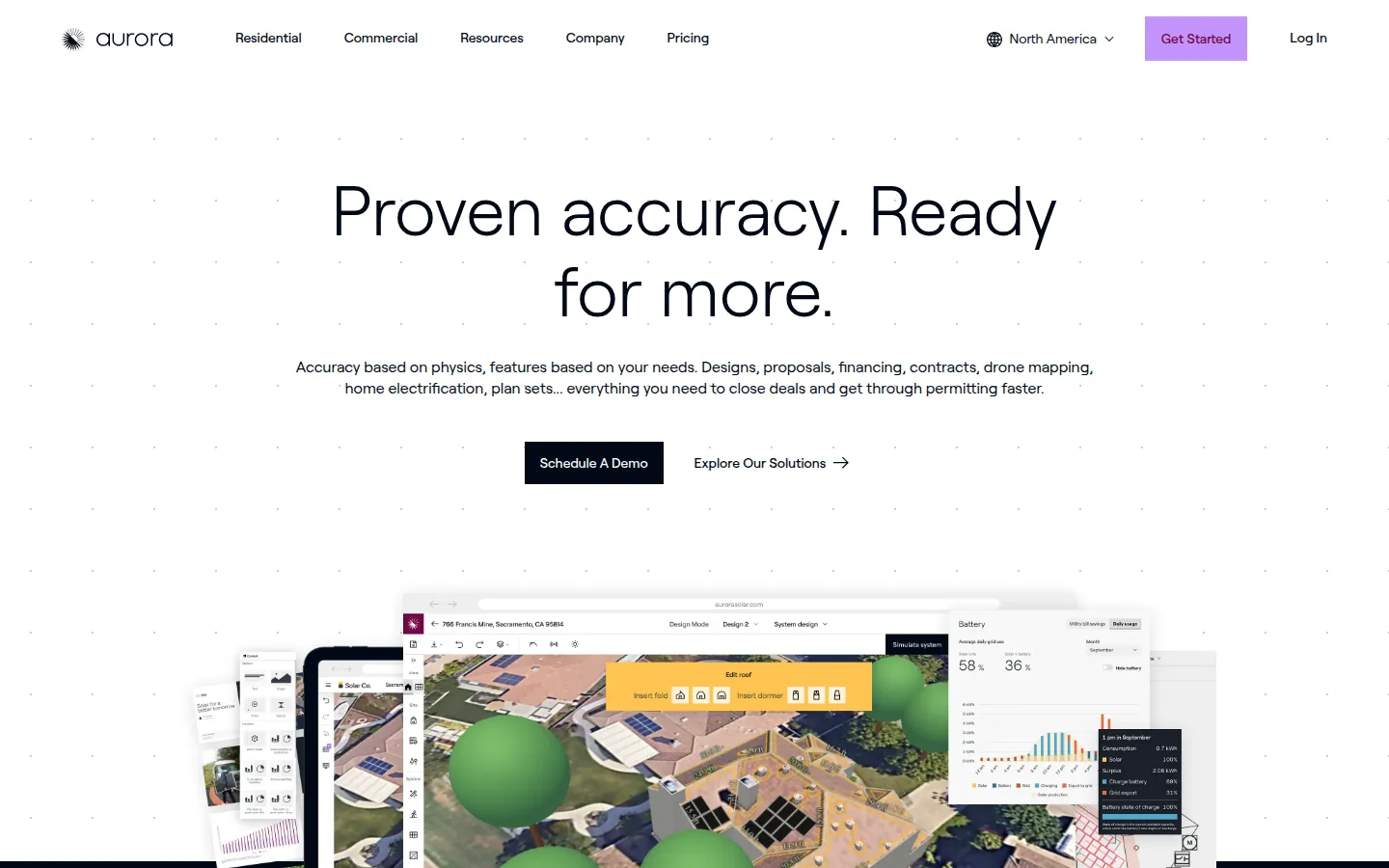
What the vendor documents: the pricing page lists 3D roof modeling, performance simulation, adders, discounts and incentives, and a utility rate database where you “configure your own rates or use rates from Genability and Aurora”. Premium adds LIDAR-assisted modeling, bankable shade reports and battery modeling. Its help article on editing rates says you can change the import rate, export rate, rate details and compensation policy for a project. Its help article on custom rates lets an admin create a rate with tiers, time-of-use periods and demand charges. Its financial analysis article says a loan, lease, PPA or cash product must be chosen in Sales Mode.
Price (checked October 2026): Basic $159 per user per month billed monthly, or $135 per user per month billed annually ($1,620 billed annually); Premium $259 per user per month, or $220 billed annually ($2,640 billed annually). Enterprise is custom, per project. The page shows “$” and does not name the currency.
Limitations: the pricing page names North America and Europe as regions and says nothing of Jordan, and no Jordan rate shows up in the pages read.
Vendor link: aurorasolar.com.
Energy Toolbase
Best for: developers modeling PPA, lease or loan offers with storage for commercial clients. For Jordan, see whether a PPA or lease can sit alongside net-metering credits.
Not the right choice if: a published price is a must, or Jordan must be named. The pricing page has you book 30 minutes and receive the demo and price on the call.
What the vendor documents: its ETB Developer FAQ says the platform supports cash purchases, power purchase agreements, loans and leases. It says the platform has a built-in database of utility rates, incentives and tariffs, and that it models demand charge reduction with battery storage. It also says ETB Developer is web-based. The product page counts 120,000+ tracked utility rates and describes a fully custom proposal template builder.
Price (checked October 2026): no ETB Developer figure is published on the pricing page. The page also lists implementation and support packages with no price.
Limitations: Jordan and the countries covered by the rate database are not named in the pages read. The rate schedules help page says users can create custom rate schedules and that the rates database covers 50 states and 42 international territories.
Vendor link: energytoolbase.com.

OpenSolar
Best for: installers wanting a free core app and a custom tariff with demand charges. In Jordan, check an Arabic proposal sample first.
Not the right choice if: proposals must go out in Arabic. The language article lists 13 supported languages, and Arabic is not among them.
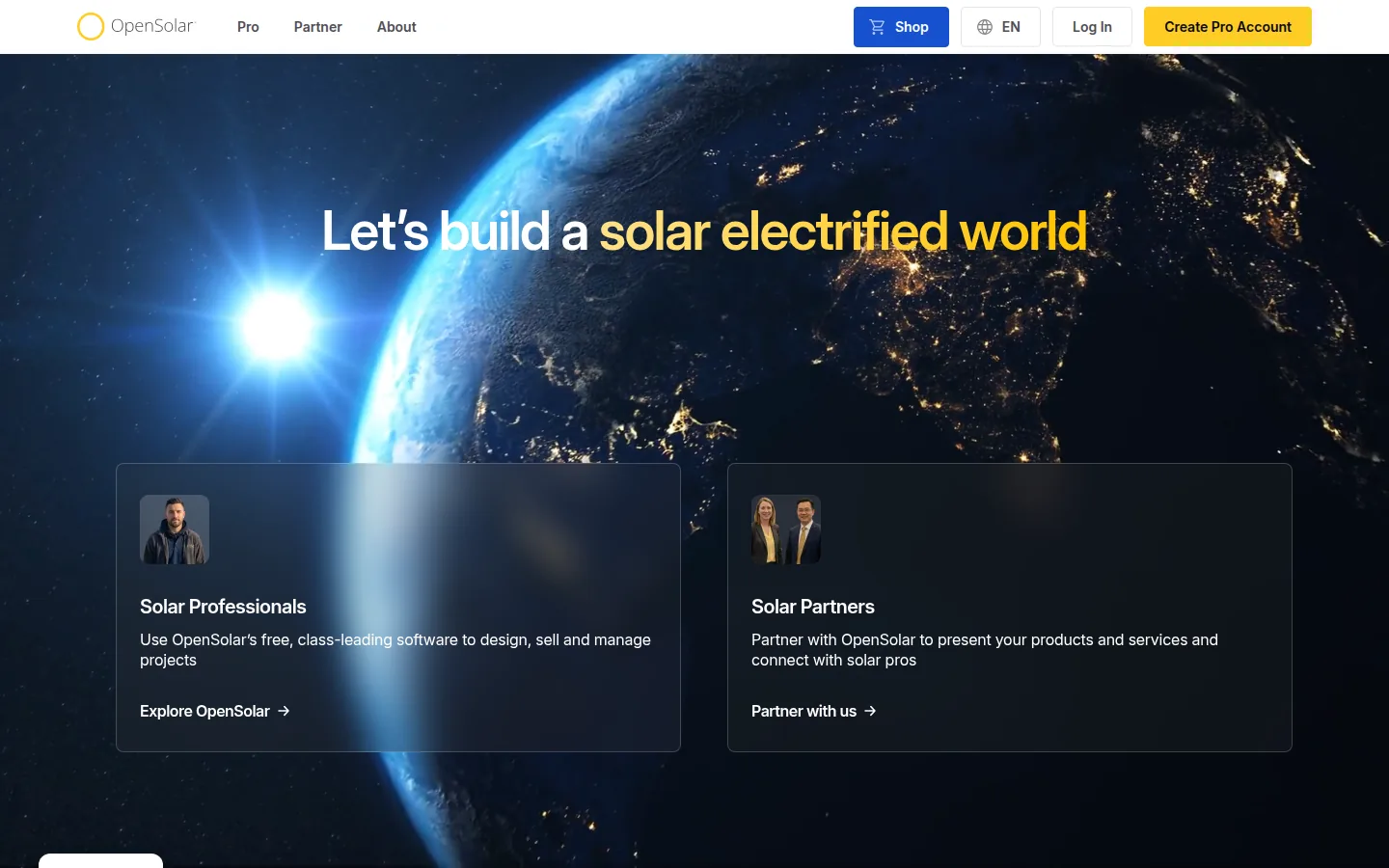
What the vendor documents: its tariff article says you can create a custom tariff with a tariff type and compensation mechanism. The rate structures are flat, time-of-use, tiered and demand charges. You can add fixed and minimum charges. Its integrated finance page says the options depend on your market and provider, and may include loans, leases, PPAs and third-party ownership.
Price (checked October 2026): the core app is free of charge for solar professionals, per the vendor. From 16 April 2026 the vendor charges for API Access, which lets other software connect to OpenSolar, and for supported connectors. This comes from its 16 February 2026 post.
Limitations: a Jordan tariff has to be built by hand, and the pages read name none.
Vendor link: opensolar.com.
SurgePV
SurgePV is our product.
Best for: teams wanting roof modeling, shading, yield and financial modeling in one product, with a bill of materials (the parts list) and proposals at a per-user price. Jordan items get checked in a demo, with a Jordan electricity bill walked through start to finish.
Not the right choice if: you need a self-serve trial, since the offer is a guided demo, or a custom tariff form, demand charge fields and Arabic confirmed in writing before a sales call. The published scope states none. Its outputs support design and documentation but do not replace sign-off by the responsible engineer, authority, lender or utility. No CRM (customer and sales tracking tool) is listed, and monitoring and ERP (business management software) sit outside the scope. OpenSolar documents a custom tariff form where SurgePV’s scope is silent.
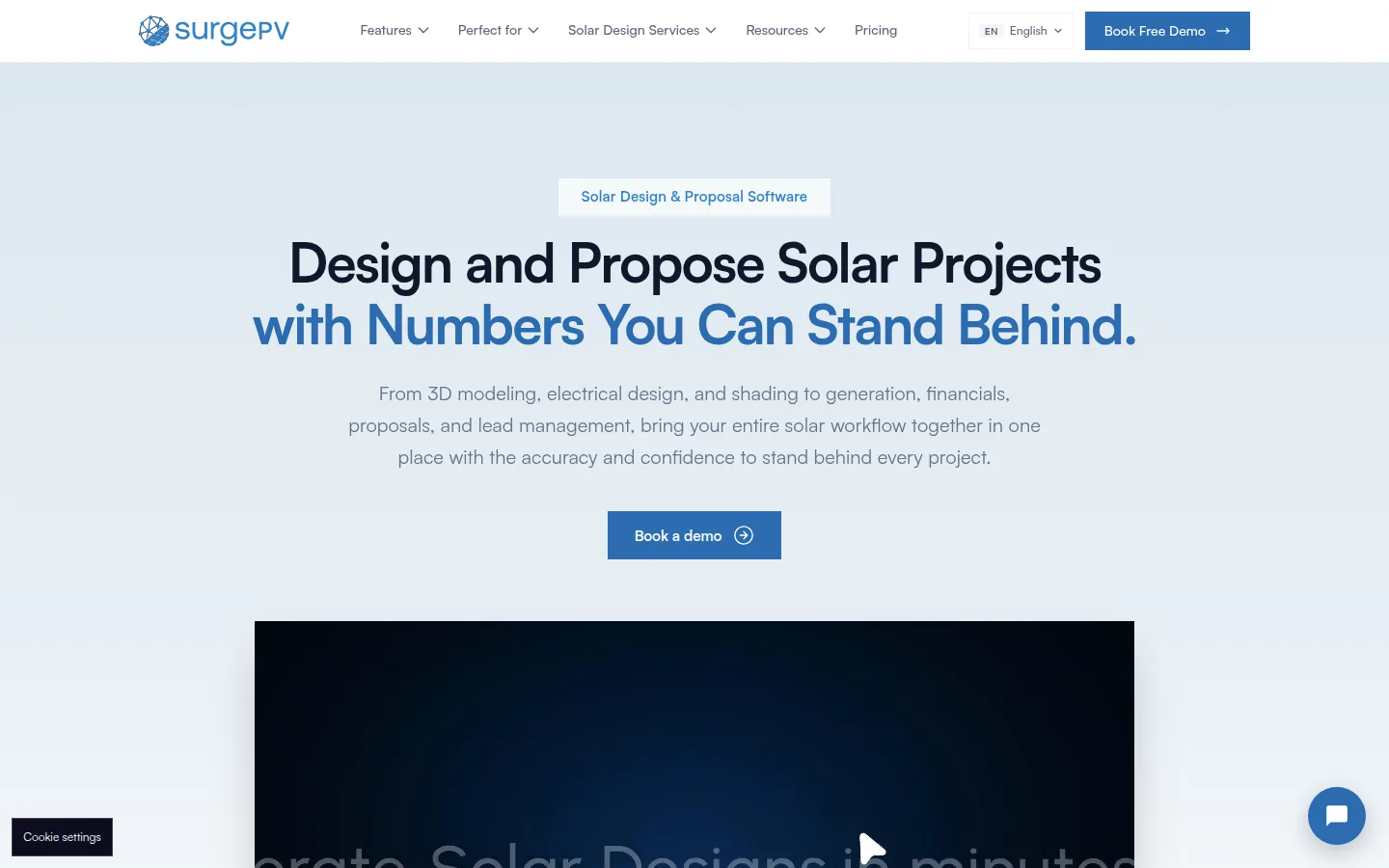
What the vendor documents: 3D roof modeling, array layout, shading analysis, energy-yield modeling, financial modeling, electrical workflow support, bill-of-materials output and proposal generation. See solar proposal software for the product page.
Price (checked October 2026): $1,899 per user per year for 1 user, $1,499 per user for 3 seats, $1,299 per user for 5 seats, in US dollars.
Limitations: results depend on source data, assumptions and equipment models, and the published scope lists no tariff form, capacity charge field, Arabic or PPA modeling.
Vendor link: surgepv.com.
How EMRC Net-Metering Billing Shapes a Jordan Quote
A Jordan proposal has to explain a billing mechanism, not an export price. The EMRC guideline for connecting renewable energy systems with net metering meters on the distribution network sets it out in Arabic. We read it in November 2026. The same legislation list includes a 2024 amended law and regulation we did not read in full, so use the items below as the guideline text and ask the distribution company about later changes.
- Monthly reading and settlement. The distribution company reads the renewable energy meter every month and bills the user for the kWh exported to its network and the kWh drawn from it. A meter that measures both directions is required, and the company replaces an unsuitable meter at its own cost.
- Net kWh decides the bill. If the user drew more than was exported, the user pays for the net energy each month. If more was exported, the surplus kWh roll over to the next month.
- Carry-forward. At the end of the financial year the user may roll the surplus into the next year, for a maximum of three years, or request a financial settlement.
- Settlement dates. A user can ask for settlement of the surplus up to the December billing. From 1 March of the following year a clearance and settlement request can be filed, and the distributor has 30 days to settle. Unclaimed surplus after May is posted onto the bill.
- Tariff and fixed charges. The EMRC electricity tariff applies to the net energy drawn. Meter charges and the rural electrification fee (fils al-reef) continue on the energy drawn from the grid. The selling tariff set in EMRC instructions applies to the carried-over balance as of the December billing.
- Application fee. The guideline charges JOD 30 for a single-phase and JOD 90 for a three-phase connection request, refunded after the system is operating, within a month.
- Ending net metering. The scheme ends on request with 30 days written notice, and the distributor may end it if the user keeps the system disconnected for more than 120 days.
- Extra connection charge. A World Bank document on Jordan’s electricity sector says a 2022 EMRC regulation set a fee of about JOD 2 per month per installed kW for residential self-generation customers. Ask the distributor whether it applies to your customer.
For tool choice, the quote needs to model kWh netted per month with a carry-forward balance and fixed charges that keep running, which differs from a US-style export rate. OpenSolar lists flat, time-of-use, tiered and demand-charge rates, and Aurora lets you set an export rate and a compensation policy per project. Neither page states a three-year carry-forward, so ask each vendor to build one Jordan bill with exports, a rolled-over balance and the fixed charges.
What to Ask a Vendor Before Buying
Give every vendor the same real Jordan electricity bill and ask for a finished sample proposal. Look for a place to enter the tariff and any fixed or capacity charge, Arabic output if the customer needs it, financing that matches how Jordanian customers pay, and a price in the invoicing currency. Where the pages read are silent, the matrix says so and a demo settles it. Jordan’s billing rules are outside what the vendors publish; the EMRC section above summarizes the net-metering settlement, and the distribution company can say whether a later amendment changed it.
How We Ordered These Tools
Ordering method: nothing here is ranked. The tools run alphabetically and the best-for picks come out of the matrix. SurgePV publishes this page and is one of the vendors on the list. It is listed by the same rules as the others and is not placed first.
- Custom tariff entry: a Jordan bill rarely looks like a US rate, so the question is whether one can be keyed in. Modeling accuracy was not assessed.
- Demand or capacity charge fields: large customers may be billed on capacity as well as energy. The tools’ arithmetic was not assessed.
- Arabic proposal language: buyers often want to read a proposal in their own language. Translation quality was not assessed.
- Lease or PPA financing: commercial clients weigh owning against paying for output. Whether any tool can model a Jordan deal was not assessed.
- US dollar price: a stated price allows planning before a call. Discounts and negotiated quotes were not assessed.
- Free tier: a free plan lets a small team try the workflow. Limits beyond what the page states were not assessed.
Sources and Dates
Vendor pages were read in October 2026 and the headline prices were rechecked on 3 November 2026. They are Aurora (pricing and three help articles), Energy Toolbase (pricing, FAQ and product page), OpenSolar (free page, 16 February 2026 post, and the tariff, language and finance pages linked above) and SurgePV (pricing). Screenshots are captures of each vendor’s public website from 29 October 2026. Regulator and institution sources read in November 2026: the EMRC distribution net-metering guideline and a World Bank document on Jordan’s electricity sector.
See SurgePV on your Jordan project
Book a guided demo and ask how it handles a Jordan tariff and capacity charge.
Book a Free DemoMore Solar Software Guides to Compare
- Best solar software in Jordan
- Solar design software for Jordan
- Best solar proposal software, all markets
- Solar proposal software features and SurgePV pricing
Frequently Asked Questions
What is the best solar proposal software in Jordan?
It depends on the job. OpenSolar documents custom tariffs with demand charges, and its core app is free. Energy Toolbase lists PPA and lease financing. Aurora Solar lists tablet-friendly proposals. SurgePV documents roof modeling through proposals but states no Jordan output. No tool here names Jordan on the pages we read, so ask each vendor to model one real Jordan electricity bill.
Can proposal software handle electricity tariffs in Jordan?
OpenSolar and Aurora Solar help articles describe custom rates with demand charges, and OpenSolar lists flat, time-of-use and tiered rates too. Energy Toolbase’s help center says users can create custom rate schedules. None of these pages names a Jordan tariff, so enter the rate from the customer’s bill and check the result.
Is there free solar proposal software for Jordan?
OpenSolar says its core app is free for solar professionals. From 16 April 2026 it charges for API Access and supported connectors. The other tools here are paid or priced on request.
Does solar proposal software support Arabic proposals?
OpenSolar lists 13 proposal languages: English, Dutch, Swedish, Spanish, French, Norwegian, Thai, German, Polish, Portuguese, Italian, Danish and Finnish. For Jordan, Arabic is not on that list. The Aurora, Energy Toolbase and SurgePV pages we read do not list proposal languages for Jordan. Ask each vendor if you must send proposals in Arabic.
How much does solar proposal software cost for an installer in Jordan?
Prices are in US dollars, as each vendor shows them. OpenSolar’s core app is free. Aurora lists $159 per user per month for Basic billed monthly, or $135 per user per month billed annually. SurgePV lists $1,899 per user per year for one user. Energy Toolbase gives its price on a demo call.
How is excess solar energy credited to a customer in Jordan?
Under the EMRC distribution net-metering guideline, the distribution company reads the meter monthly and bills the net kWh. A surplus rolls to the next month and, at year end, can roll over for up to three years or be settled financially. Meter charges and the rural electrification fee continue on energy drawn from the grid. A 2024 amended law and regulation exist, so ask the distributor whether the rules changed.
