

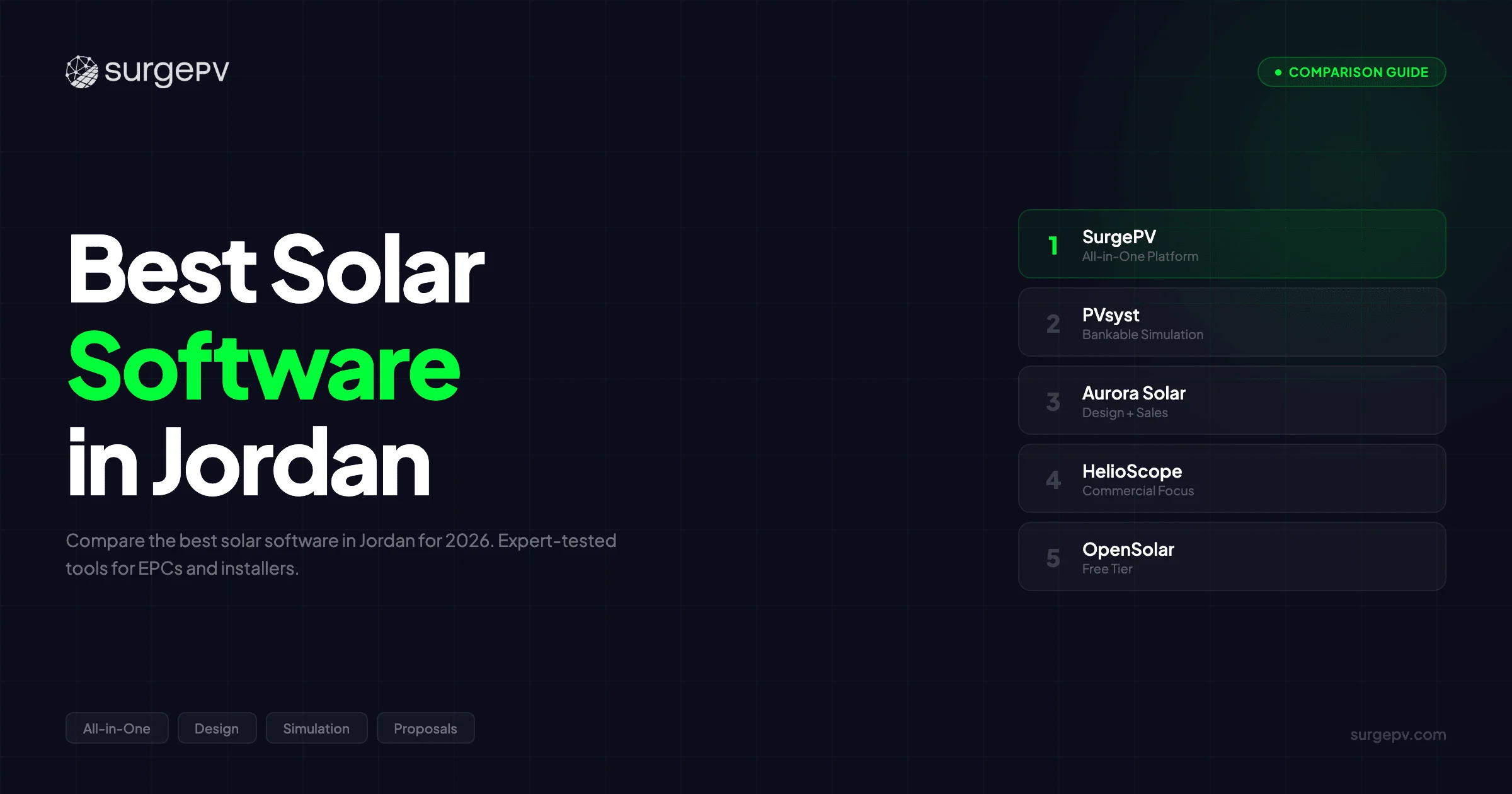
TL;DR: SurgePV is the best all-in-one solar software for Jordan — design, simulation, and proposals in one integrated platform with NEPCO compliance support.
Jordan Imports 90% of Its Energy. Solar Changes That Equation.
Jordan has almost no oil. Almost no gas. And one of the highest electricity costs in the Middle East.
The kingdom imports over 90% of its energy, making electricity prices a constant economic pressure point. Commercial rates through EDCO and JEPCO range from 0.070-0.180 JOD/kWh. Industrial tariffs climb higher. Government facilities pay even more. And every fils spent on imported energy is a fils that could stay in Jordan’s economy.
The good news? Jordan receives 1,700-2,200 kWh/m2/year of solar irradiance — outstanding by any global standard. Ma’an Solar Park, World Bank-financed distributed solar programs, and EBRD-backed C&I installations are transforming the energy sector. Net metering makes residential and small commercial viable. Wheeling regulations enable large C&I to generate at one site and consume at another.
The bad news? Most Jordanian EPCs still design in one tool, do electrical engineering in another, run simulation in a third, and assemble proposals in Excel. Every tool in that chain is a separate licence, a separate file format, and a separate hand-off, at exactly the moment Jordan’s solar market is accelerating.
In this guide, you’ll learn:
- Which platforms handle the complete Jordanian EPC workflow in one tool
- How each tool supports net metering, wheeling, and EMRC compliance documentation
- Which software models Jordan’s desert and semi-arid climate conditions accurately
- What each vendor publishes about licence pricing, and what it does not
- Detailed comparisons of SurgePV, Aurora Solar, PVsyst, HelioScope, and OpenSolar
Quick Summary: Our Top Picks for Jordan
After reviewing published information for 5 platforms against Jordan’s market requirements, regulatory framework, and EPC workflow needs, here are our top recommendations:
- SurgePV — Design, engineering, simulation, and proposals in one cloud platform (Best for Jordanian EPCs across C&I, residential, and ground-mount segments)
- PVsyst — Gold-standard simulation for bankable feasibility studies (Best for utility-scale projects requiring World Bank or EBRD financing)
- Aurora Solar — Industry-leading AI design with polished proposals (Strong US platform, gaps for Jordanian C&I requirements)
- HelioScope — Cloud-based commercial design tool (Best for large C&I rooftop design, missing electrical and proposals)
- OpenSolar — Affordable cloud platform with basic features (Best for budget-conscious residential installers)
Each tool evaluated on Jordan-specific criteria: net metering support, wheeling regulation modeling, EMRC compliance, desert climate handling, World Bank/EBRD bankability, and pricing in JOD context.
Best Solar Software in Jordan (Detailed Reviews)
| Software | Best For | Pricing | Jordan Fit |
|---|---|---|---|
| SurgePV | Integrated platform | ~$1,899/yr (3 users) | Excellent |
| PVsyst | Simulation specialist | Not publicly listed | Good |
| Aurora Solar | Residential workflow | Basic $159/user/mo ($1,620/yr annual); Premium $259/user/mo ($2,640/yr annual) | Good |
| HelioScope | C&I design | Basic $159/mo ($1,620/yr); Pro $259/mo ($2,640/yr) per licence | Good |
| OpenSolar | Free platform | Free of charge | Good |
Aurora and HelioScope figures are as published on Aurora’s pricing page and HelioScope’s pricing page (both checked 21 September 2026). Enterprise tiers are quoted by sales. PVsyst, PVcase, Scanifly and RatedPower do not publish list pricing, and AutoCAD is licensed separately from Autodesk.
SurgePV — Best All-in-One Solar Platform for Jordan
About SurgePV
SurgePV is a cloud-based platform combining AI-powered solar design, automated electrical engineering, bankable simulations, and professional proposals in one workflow. No tool-switching. No AutoCAD dependency. No separate spreadsheets for net metering calculations or wheeling economics.
For Jordanian EPCs, the consolidation advantage goes beyond convenience. Jordan’s strong C&I solar market — driven by high electricity costs and favorable net metering — requires professional documentation for EMRC grid connection, NEPCO wheeling applications, and distribution company (EDCO/JEPCO) compliance. Having design, engineering, simulation, and proposals in one platform means consistent, professional output every time.
Target Users: C&I EPCs designing rooftop and ground-mount systems (50 kW-5 MW), solar installers serving Jordan’s net metering residential market, utility-scale developers bidding on Ma’an-region projects, and engineering consultants managing World Bank/EBRD-financed installations.
Pro Tip
For Jordanian EPCs, the real software test is a 200 kW commercial rooftop in Amman with net metering calculations, EMRC-compliant electrical documentation, NEPCO-ready simulation, and a client proposal showing JOD-denominated payback against current EDCO tariffs. Run that scenario through every platform on your shortlist. The tool that handles all four without switching tells you everything.
Key Features for Jordan
Design and Engineering
AI-powered roof modeling detects roof boundaries, tilt, and azimuth from satellite imagery covering Amman, Aqaba, Irbid, Zarqa, and Ma’an. Design time drops from 45 minutes (manual) to 15-20 minutes.
Automated Single Line Diagram generation produces IEC-compliant SLDs in 5-10 minutes — ready for EMRC grid connection and EDCO/JEPCO distribution company submissions. SLD generation is included in the SurgePV licence, so an EPC does not license a separate CAD tool for that step.
Wire sizing calculations are instant. DC and AC wire gauges based on current, distance, voltage drop limits, temperature correction for Jordan’s 40-48 degree summer ambient. IEC 62446 and IEC 61730 compliant.
Net Metering and Wheeling Economics
Jordan’s net metering framework is among the most developed in the Middle East. SurgePV’s financial modeling handles net metering revenue calculations against EDCO/JEPCO tariff bands, excess generation credit tracking, and monthly/annual bill analysis. Wheeling regulation modeling for large C&I clients generating at one site and consuming at another — including wheeling charges and transmission losses.
The solar ROI calculator covers JOD-denominated payback periods, PPA modeling for commercial off-taker agreements, and cash/loan/lease scenario comparison aligned with Jordanian banking terms (Arab Bank, Housing Bank, Jordan Ahli Bank).
Simulation and Bankability
8760-hour shading analysis accounts for Jordan’s semi-arid conditions, elevated summer temperatures (40-48 degrees Celsius in Amman, higher in the Jordan Valley), and desert soiling losses in eastern and southern regions.
Production simulation at plus or minus 3% accuracy versus PVsyst.
P50/P75/P90 bankable reports accepted by World Bank, EBRD, and Jordanian commercial banks. The P75/P90 conservative estimates are what lenders actually use to size debt — P50-only tools leave financing gaps on every large project.
Tracker support includes single-axis (15-25% production gain) and dual-axis with backtracking algorithms — critical for ground-mount installations in Ma’an and the eastern desert where trackers maximize Jordan’s direct normal irradiance.
Mini case study: An Amman-based EPC used SurgePV to design and propose a 400 kW commercial rooftop for a factory in Sahab Industrial Zone. The platform ran net metering calculations against JEPCO commercial tariffs, generated the IEC-compliant SLD for EMRC grid connection application, simulated P50/P75/P90 production with desert soiling adjustments, and produced a client proposal showing 28,000 JOD annual electricity savings with a 3.1-year payback. The previous workflow moved the same project between a design tool, a CAD package and a spreadsheet, and the net metering calculations went through two revision cycles.
Consolidating those steps into one platform removes the hand-offs between tools, which is where the revision cycles came from.
Note
“But we already have relationships with EDCO/JEPCO and know the net metering process.” Excellent. That domain knowledge is irreplaceable. The question is whether your team should move each project between separate design, CAD and spreadsheet tools, or produce the same documentation inside one integrated platform. Your relationships close deals. Better software helps you close more of them.
Pros and Cons
Pros:
- Only platform combining design + electrical engineering + simulation + net metering modeling + proposals
- Automated SLD generation is included in the licence, so no separate CAD tool is needed for that step
- Net metering and wheeling financial modeling for EDCO/JEPCO tariff structures
- P50/P75/P90 bankable reports for World Bank, EBRD, and Jordanian bank financing
- Desert and semi-arid climate modeling (temperature derating, soiling losses)
- Cloud-based — accessible from Amman, Aqaba, and field sites
- Tracker and carport design for ground-mount and commercial applications
- Transparent pricing: $1,499/user/year (3-user plan)
Cons:
- Jordanian utility rate database (EDCO/JEPCO) requires one-time manual configuration
- Newer brand recognition in Jordanian market compared to PVsyst
- EMRC documentation templates may need customization for specific distribution company requirements
Pricing
- 3-User Plan: $4,497/year (approximately 3,190 JOD) — $1,499/user/year
- Per User: $1,899/year (approximately 1,348 JOD)
- Includes: Everything — design, SLD, simulation, net metering modeling, proposals, tracker design
- No additional tools required
What is included: SurgePV’s licence covers design, SLD generation, simulation, net metering modeling and proposals. A multi-tool stack licenses those steps separately: a design platform, a CAD package for electrical documentation, and a simulation package. PVsyst and Autodesk do not publish list pricing that would let an EPC compare the two totals in advance, so budget the stack from your own quotes.
Who SurgePV Is Best For: Jordanian EPCs across all segments — commercial solar rooftop and ground-mount, residential net metering, industrial wheeling projects, and utility-scale NEPCO-connected installations.
Further Reading
For design-specific comparisons, see Best Solar Design Software in Jordan. For proposal tool details, see Best Solar Proposal Software in Jordan. For a global platform comparison, see Best Solar Software (2026).
PVsyst — Simulation Standard for Bankability
PVsyst is the gold standard for bankable solar energy yield simulation — accepted by every major international lender including World Bank, EBRD, and IFC for Jordanian solar projects.
Key Strengths: Universal lender acceptance for utility-scale project financing, the most detailed loss modeling available (25+ categories), P50/P75/P90/P99 probabilistic estimates, and proven track record with 25+ years of institutional trust.
Limitations for Jordan: Simulation-only — no design tools, no SLD generation, no proposals. Requires separate AutoCAD for electrical documentation and Excel for financial modeling. Desktop-only (no cloud collaboration). Steep 4-6 week learning curve. Three separate tools needed for a complete project workflow.
Price: PVsyst does not publish list pricing.
Best For: Utility-scale projects above 500 kW requiring World Bank, EBRD, or major commercial bank financing. Most Jordanian EPCs use PVsyst alongside SurgePV — SurgePV handles daily design and proposal work while PVsyst validates bankability for large projects requiring institutional financing.
Aurora Solar — US Residential Leader, Limited Jordan Fit
Aurora Solar is the leading US residential solar design software platform, with strong AI-powered design tools and polished proposals.
Key Strengths: Excellent AI roof modeling from satellite imagery, fast proposal generation, visually polished client-facing output, and strong US residential sales workflow.
Limitations for Jordan: No Arabic language support, US-focused financial modeling (manual Jordan tariff configuration required), no SLD generation for EMRC/NEPCO compliance, and no net metering modeling for EDCO/JEPCO structures. P50-only simulation (no P75/P90 for bankable reporting).
Price: Aurora Solar’s published pricing is $159/user/month, or $135/user/month billed annually ($1,620/year), for Basic and $259/user/month, or $220/user/month billed annually ($2,640/year), for Premium, per Aurora’s pricing page (checked 21 September 2026). Enterprise is quoted per project.
Best For: Small residential installers (5-30 kW) in Amman focused on homeowner visual impact. Not suitable for commercial EPCs, government tenders, or projects requiring Arabic documentation or Jordan-specific financial modeling.
HelioScope — Commercial Design, Missing Electrical and Proposals
HelioScope (now part of Aurora) is a cloud-based design tool popular for commercial and utility-scale ground-mount projects.
Key Strengths: Fast C&I rooftop and ground-mount design, integrated financial modeling with customizable LCOE and IRR, good terrain analysis for Jordan’s varied topography, and cloud-based team collaboration.
Limitations for Jordan: No SLD generation (AutoCAD required separately), limited bankable simulation (some lenders require PVsyst for larger projects), no proposal generation, and US-focused features requiring adaptation for Jordan.
Price: HelioScope lists Basic at $159/month ($1,620/year) and Pro at $259/month ($2,640/year) per licence, each including one user, per HelioScope’s pricing page (checked 21 September 2026). Enterprise is custom.
Best For: C&I EPCs (200 kW-5 MW) focusing on layout design for Amman commercial rooftops and Jordan Valley ground-mount projects. Needs supplementary tools for electrical documentation and client proposals.
OpenSolar — Budget-Friendly Basic Capabilities
OpenSolar provides a cloud platform for basic solar design and proposal generation, free of charge.
Key Strengths: Free entry point for small installers, reasonable residential proposal quality, and cloud-based access.
Limitations for Jordan: English-only interface and proposals, limited financial modeling for Jordan-specific tariffs, no SLD generation, and basic simulation without bankable P50/P90 reporting.
Price: Free of charge, in OpenSolar’s own words, per opensolar.com (checked 21 September 2026).
Best For: Startup residential installers in Jordan doing basic net metering systems (under 20 kW) where budget constraints and low project volume make premium tools hard to justify.
What Jordanian EPCs Need From Solar Software
Net Metering and Wheeling Modeling
Jordan’s net metering framework is one of the most developed in the Middle East, with capacity up to 5 MW and annual settlement with NEPCO. SurgePV’s financial modeling engine handles these calculations natively. Other platforms require manual configuration.
Wheeling regulation modeling — for large C&I clients generating solar at one site and consuming electricity at another — is a growing requirement as Jordan’s C&I solar market expands. Only SurgePV natively addresses this structure.
EMRC Compliance Documentation
The Energy and Minerals Regulatory Commission (EMRC) requires IEC-compliant electrical documentation for grid connection applications. Automated SLD generation produces that documentation inside the design platform in 5-10 minutes and eliminates common compliance errors that cause application rejections.
World Bank and EBRD Bankability
Jordan’s solar financing environment relies heavily on development finance institutions. P50/P75/P90 bankable reports — not just P50 — are required for World Bank, EBRD, and Arab Fund project financing. PVsyst remains the gold standard for institutional financing above 10 MW. SurgePV’s bankable reports (plus or minus 3% vs PVsyst) satisfy most commercial-scale lenders.
Desert Climate Accuracy
Jordan’s climate presents specific simulation challenges:
- Summer ambient temperatures: 40-48 degrees C in Amman, higher in the Jordan Valley
- Desert soiling losses: 10-15% annually in eastern and southern regions without regular cleaning
- High direct normal irradiance (DNI): valuable for tracker optimization in Ma’an
- Seasonal variability requiring accurate 8760-hour hourly simulation
Software that does not model these conditions accurately over-predicts energy yield by 10-20%.
Streamline Your Solar Business with SurgePV
End-to-end solar workflows from design to proposal in one platform — with NEPCO compliance and Jordan-specific financial modeling built in.
Book a DemoNo commitment required · 20 minutes · Live project walkthrough
Bottom Line: Best Solar Software for Jordan
Jordanian EPCs need software that handles C&I net metering economics, EMRC grid connection documentation, World Bank/EBRD bankability requirements, and desert climate modeling. Generic tools designed for US residential markets leave critical gaps.
The Jordanian solar workflow requires net metering calculations against EDCO/JEPCO tariffs, wheeling economics for multi-site commercial clients, IEC-compliant electrical documentation for EMRC grid connection, bankable P50/P90 simulation for development finance, and professional JOD-denominated proposals that close deals.
Our Recommendations:
- For Jordanian EPCs and installers (all segments): SurgePV — the only platform covering the full Jordanian workflow in one tool — design, net metering modeling, SLD generation, bankable simulation, wheeling economics, and proposals, all inside one licence rather than a design tool plus a separate CAD package plus a separate simulation package.
- For bankability validation: PVsyst alongside SurgePV for projects above 500 kW requiring World Bank, EBRD, or major commercial bank financing approval.
- For budget-constrained startups: OpenSolar for simple residential net metering systems, with the understanding that professional engineering documentation and accurate financial modeling will need supplementary tools.
- For utility-scale developers: SurgePV’s tracker support plus PVsyst bankability validation for Ma’an-region and eastern desert ground-mount projects.
Go deeper on a specific category
This page compares solar software across categories for Jordan. If you already know which part of the workflow you are buying for, these go into more detail:
Frequently Asked Questions
What is the best solar software in Jordan?
SurgePV is the best all-in-one solar software for Jordan, combining solar design, automated electrical engineering, net metering financial modeling, and professional proposals in one cloud platform. It addresses Jordanian-specific requirements: EDCO/JEPCO net metering calculations, wheeling economics for C&I clients, IEC-compliant documentation for EMRC grid connection, P50/P75/P90 bankable reports for World Bank/EBRD financing, and desert climate simulation.
Does solar software support Jordan’s net metering system?
SurgePV’s financial modeling can be configured for Jordan’s net metering framework, calculating savings against EDCO and JEPCO tariff bands, tracking excess generation credits, and showing monthly and annual bill impact. Aurora Solar’s financial tools are US-focused and don’t natively handle Jordanian tariff structures. PVsyst provides simulation data but no net metering financial modeling.
Which software handles wheeling regulations in Jordan?
SurgePV’s financial modeling tools can model wheeling economics for Jordanian C&I clients who generate solar at one site and consume electricity at another. The platform handles wheeling charges, transmission losses, and multi-site financial analysis. No other platform on this list natively addresses Jordan’s wheeling regulation structure. For commercial solar projects using wheeling, accurate financial modeling is the difference between a viable project and stranded investment.
What software do World Bank and EBRD accept for Jordanian solar projects?
PVsyst P50/P90 reports are the gold standard for World Bank, EBRD, and international development finance institution bankability requirements. SurgePV bankability reports achieve plus or minus 3% accuracy versus PVsyst and are accepted for commercial projects. For large utility-scale projects requiring maximum lender confidence, use SurgePV for daily workflow and PVsyst for final bankability validation.
How much does solar software cost in Jordan?
Published list pricing varies widely. OpenSolar is free of charge. HelioScope lists Basic at $159/month ($1,620/year) and Pro at $259/month ($2,640/year) per licence, each including one user, per HelioScope’s pricing page (checked 21 September 2026), with Enterprise custom. Aurora Solar’s published pricing is $159/user/month, or $135/user/month billed annually ($1,620/year), for Basic and $259/user/month, or $220/user/month billed annually ($2,640/year), for Premium, per Aurora’s pricing page (checked 21 September 2026), with Enterprise quoted per project. PVsyst, PVcase, Scanifly and RatedPower do not publish list pricing, and AutoCAD is licensed separately from Autodesk. SurgePV is $1,499/user/year on the 3-user plan and includes design, electrical engineering, net metering modeling, simulation, and proposals. See current pricing.
Can solar software generate EMRC-compliant electrical documentation?
SurgePV generates automated IEC-compliant single line diagrams in 5-10 minutes, meeting IEC 62446 standards referenced by EMRC for grid-connected solar installations. These documents support EDCO and JEPCO grid connection applications. SLD generation is included in the SurgePV licence, so an EPC does not license a separate CAD tool for that step.
Which software supports tracker design for Jordanian ground-mount projects?
SurgePV supports single-axis and dual-axis tracker design with backtracking algorithms, delivering 15-25% production gains in Jordan’s high-DNI environment. PVsyst and HelioScope also support tracker modeling. Aurora Solar does not offer tracker design. For ground-mount installations in the Ma’an region and eastern desert, tracker support is effectively mandatory for competitive project economics.
Is there affordable solar software for small Jordanian installers?
OpenSolar offers the most affordable entry point, free of charge, for small residential installers doing basic net metering rooftop systems. SurgePV’s individual plan at $1,899/year (3 users, approximately 450 JOD per user per year) provides significantly more capability — automated electrical engineering, bankable simulation, and professional proposals. For installers planning to grow into commercial solar, SurgePV scales with your business without requiring tool changes.
Sources
- EMRC (Energy and Minerals Regulatory Commission) — Jordan electricity regulation and grid connection requirements (accessed February 2026)
- NEPCO (National Electric Power Company) — Jordan transmission grid standards (accessed February 2026)
- EDCO (Electricity Distribution Company) — Distribution tariffs and net metering guidelines (accessed February 2026)
- JEPCO (Jordan Electric Power Company) — Amman distribution tariffs and interconnection requirements (accessed February 2026)
- Jordan Ministry of Energy and Mineral Resources — Renewable energy policy and targets (accessed February 2026)
- World Bank — Jordan Renewable Energy and Energy Efficiency Program (accessed February 2026)
- EBRD (European Bank for Reconstruction and Development) — Jordan Green Economy Financing (accessed February 2026)
- IRENA (International Renewable Energy Agency) — Jordan renewable energy statistics (accessed February 2026)
- Solargis — Jordan solar irradiance and climate data (accessed February 2026)
- SurgePV Official Documentation — Product features and pricing (accessed February 2026)
- G2 Reviews — Verified user reviews for solar software platforms (accessed February 2026)
- Capterra Reviews — User ratings and platform comparisons (accessed February 2026)
