


A Colombian quote lives or dies on how it treats exports, and that is the lens for this comparison. Pick Aurora Solar if you want to enter one fixed export rate, and Energy Toolbase if the client is choosing between cash, loan, lease and PPA structures.
Colombia is not named on any vendor page, which leaves the entry options as the real test. OpenSolar pairs a free core app with a custom tariff. Aurora Solar offers a fixed export rate field. Energy Toolbase sets cash, loan, lease and PPA (power purchase agreement) offers next to each other. SurgePV generates proposals from its roof model in a per-user product. No vendor lists a price in pesos.
Treat this as a desk comparison of what vendors publish, current to October 2026, rather than a trial run. SurgePV publishes this page and is one of the four tools on it. Vendor facts are taken from vendor sites. Colombian rules come from the two documents linked in the Colombia section, a distributor guide to CREG 174 of 2021 and a UPME registration guide, so other tariffs and incentives should be checked with your network operator or regulator.
Solargraf featured in an earlier edition but is no longer compared, because solargraf.com returned HTTP 403 to automated reads in October 2026.
Five columns frame the comparison: tariff entry, export-credit setting, local-language proposals, price in a stated currency and free start.
Want to see SurgePV quote a Colombia project?
Book a guided demo and bring a real Colombia site. We walk through design, yield, finance and the proposal in one platform.
Book a Free DemoChecking cost first? See the SurgePV pricing page.
Best-For Picks for Colombia
- A fixed export rate: Aurora Solar. Its help article includes a “Fixed export rate” field, with the unit shown as “$ per kWh”, so ask how pesos are treated. A flat rate does not mirror Colombia’s hourly spot valuation of surplus, so ask whether an hourly price can be entered.
- Cash, loan, lease and PPA structures: Energy Toolbase. Its FAQ says the platform supports “cash purchases, power purchase agreements (PPAs), loans, and leases”, and no price is published. Its utility-rate focus becomes relevant above 100 kW, where exported surplus triggers a simplified connection study.
- Your own tariff in a free core app: OpenSolar. The tariff article describes flat, time-of-use, tiered and demand rates plus several export-credit methods. The core app is free, with API Access and connectors charged from 16 April 2026, which makes it a cheap way to practice crediting imports against exports.
- Roof model to bill of materials to proposal, per user: SurgePV. It lists roof modeling, shading, yield, financial modeling, bill of materials and proposals. Its published scope names no Colombian tariff and no peso price, so ask for a proposal that lists monthly export kWh, the figure the UPME form requests.
Colombia Solar Proposal Software Comparison Table
The rows follow alphabetical order, so nothing here is ranked. Choose the row that matches your quote. Prices were read from each vendor’s own page in October 2026.
| Tool | Best for | Price | Free or paid | Decisive scope fact |
|---|---|---|---|---|
| Aurora Solar | Fixed export rate and custom rates | Basic $159 per user per month (monthly billing); $135 billed annually | Paid | Compensation policy: net billing or feed-in tariff |
| Energy Toolbase | Cash, loan, lease and PPA comparisons | Not published (book a demo) | Paid | Works with partner design tools |
| OpenSolar | Custom tariff, free core app | Core app free of charge; API Access and connectors charged from 16 April 2026 | Free core app, paid API and connectors | 13 proposal languages |
| SurgePV | Roof model to BOM and proposal, per user | $1,899 per user per year (1 user), in US dollars | Paid, guided demo | BOM and proposal generation in scope |
Colombia Criteria Matrix
A cell reads Documented when the vendor’s page states it, Partial when the page states only a portion or states it for other markets, and Not stated when the pages read in October 2026 say nothing. No scores or weights apply.
| Tool | Tariff entry | Export-credit setting | Local-language proposals | Price in a published currency | Free start |
|---|---|---|---|---|---|
| Aurora Solar | Documented (custom rates, or Genability and Aurora rates) | Documented (fixed export rate; net billing or feed-in tariff) | Not stated | Partial (dollar figures; currency not named) | Not stated |
| Energy Toolbase | Partial (utility rates team described; Colombia not named) | Not stated | Not stated | Not published for ETB Developer | Not stated |
| OpenSolar | Documented (custom tariff) | Partial (several credit options; none named for Colombia) | Partial (13 proposal languages; see the entry) | Documented (core app free) | Documented |
| SurgePV | Partial (financial modeling; no tariff entry described) | Not stated | Not stated | Partial (USD only) | Not stated (guided demo) |
Two takeaways. No vendor page read here mentions Colombia, and the largest gap between tools is whether you can enter a tariff and an export rate yourself. Not stated does not prove a feature is missing, so request one real Colombian quote, including monthly exports, from each vendor before buying.
Tool Entries
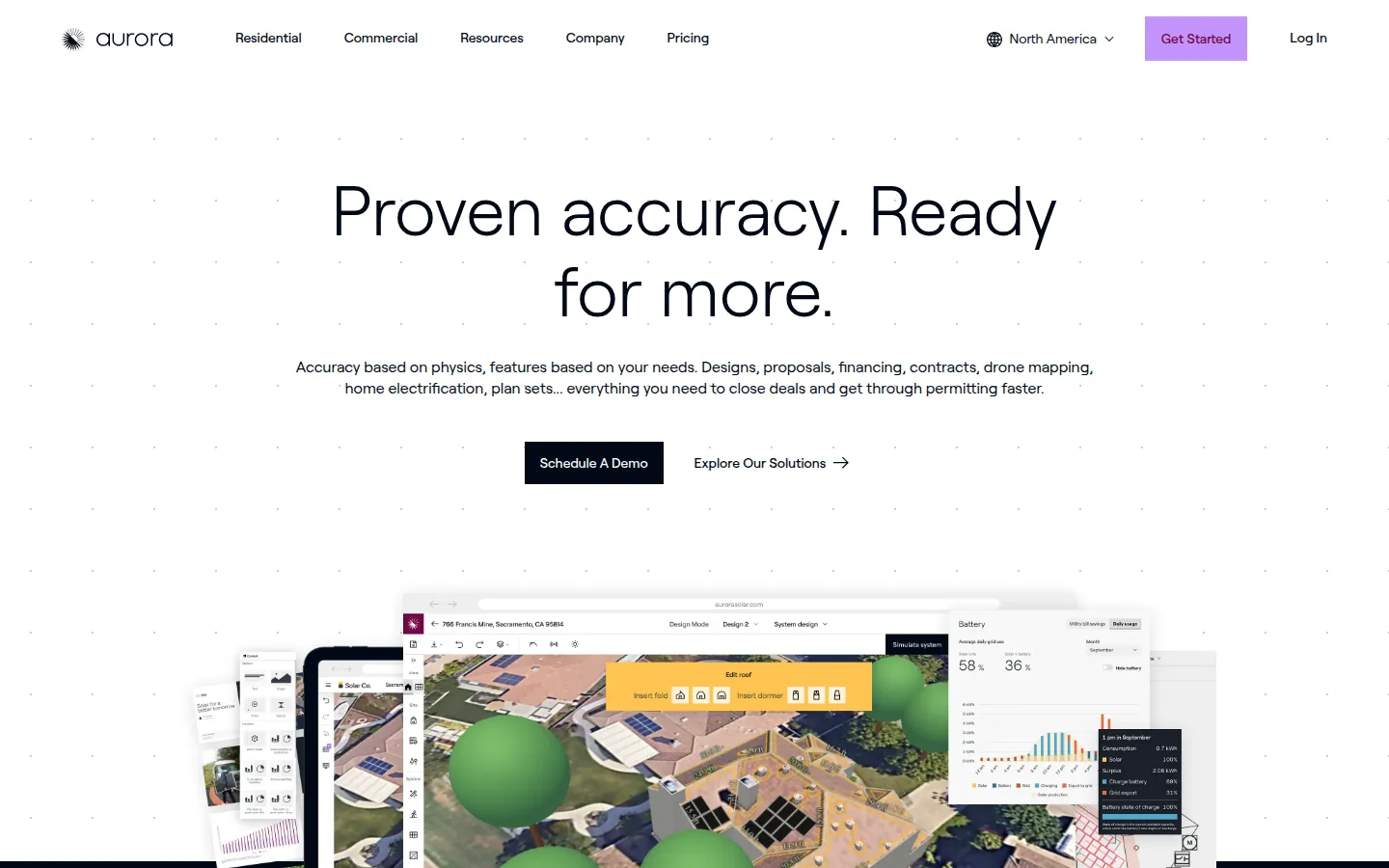
Aurora Solar
Colombia quote check: Ask whether exports can be valued at an hourly price instead of a flat rate.
Best for: teams that prefer one fixed export rate and a switch between net billing and a feed-in tariff in a single design tool.
Not the right choice if: the quote must carry a peso price or a Spanish template backed by vendor documentation, which the pages read do not show, or if a free plan is a must. The pricing page shows paid plans and a custom Enterprise option. A flat rate also cannot mirror hourly spot valuation.
What the vendor documents: the pricing page puts 3D roof modeling, proposal templates, custom pricing methods and a utility rate database into every plan, and says “Configure your own rates or use rates from Genability and Aurora”. Web and PDF proposals and financing comparisons are listed, with battery modeling and bankable shade reports reserved for Premium. The help article says: “With Feed-in tariff, Aurora credits all the energy the system produces at a tariff rate”.
Price (checked October 2026): Basic $159 per user per month billed monthly, or $135 per user per month billed annually ($1,620 billed annually). Premium $259 per user per month, or $220 per user per month billed annually ($2,640 billed annually). Enterprise is custom, per project. The page shows a dollar sign and does not name the currency.
Limitations: its fixed export rate is labeled “$ per kWh”. Regions named on the pricing page are North America and Europe, and Colombia is not mentioned.
Vendor link: aurorasolar.com
Energy Toolbase
Colombia quote check: Ask how it models energy credits swapped for imports plus spot-priced surplus.
Best for: sellers who present cash, loan, lease and PPA structures to a commercial client, or who need solar-plus-storage modeling.
Not the right choice if: you want a price on the page, since the pricing page directs you to book a demo, or want to know that roof layout is built in. The ETB Developer page refers to “PV design partnerships with leading design software tools”, so ask where design happens.
What the vendor documents: according to the ETB Developer page, the product offers proposals, quick financial analysis, “up-to-date utility rates” and lead management, tracking “120k+” utility rates. The FAQ lists “cash purchases, power purchase agreements (PPAs), loans, and leases”. Access is through the web.
Price (checked October 2026): not published for ETB Developer. The pricing page says “Book 30 minutes” for a demo and pricing for your team size. Dollar figures on that page belong to its ETB Controller and ETB Monitor products.
Limitations: Colombia and peso pricing go unmentioned, as do the countries covered by the rate database.
Vendor link: energytoolbase.com

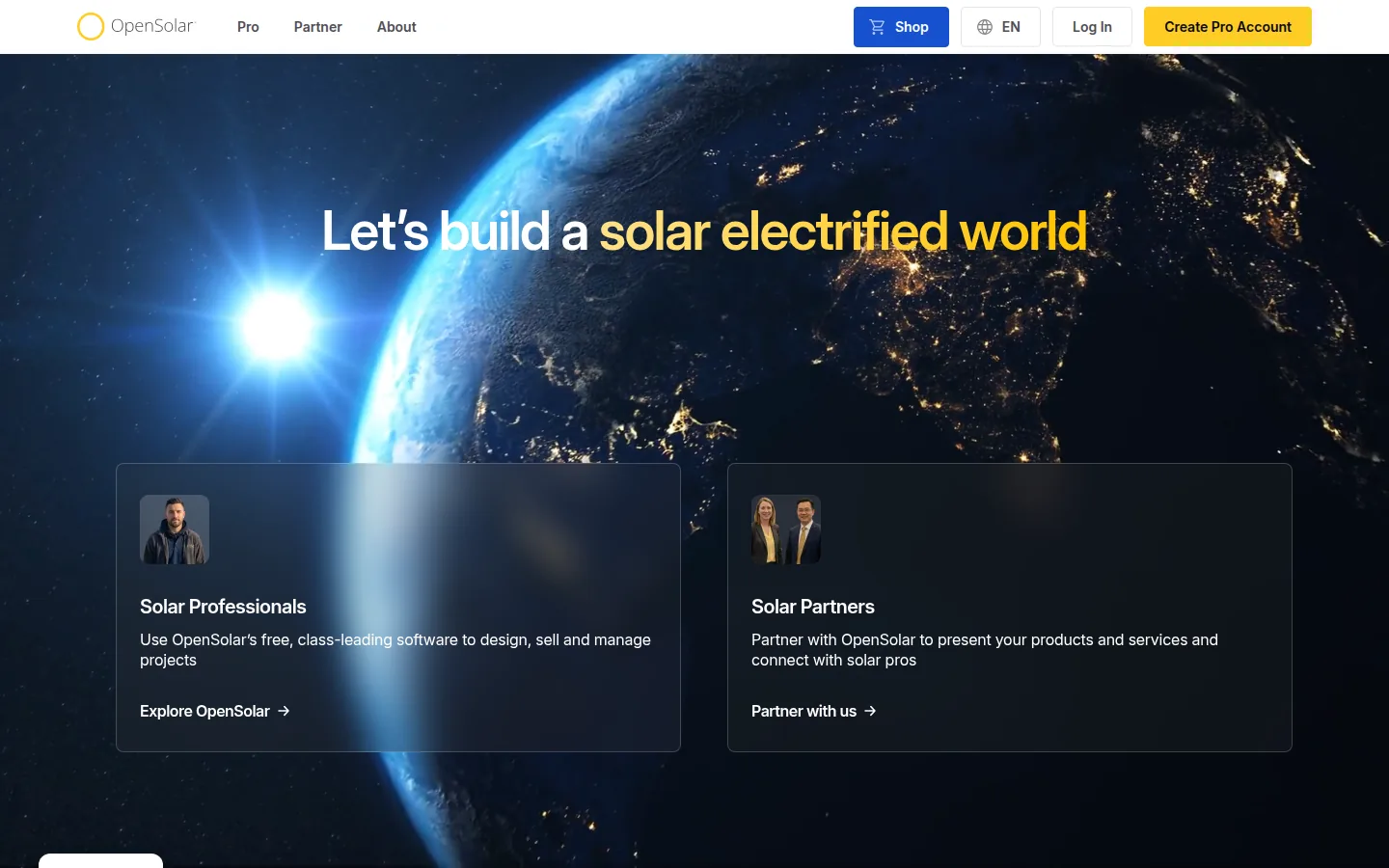
OpenSolar
Colombia quote check: Ask whether a Spanish proposal and a custom export price are available on the free plan.
Best for: small installers who want a free core app and are willing to type in a Colombian retailer’s tariff.
Not the right choice if: your client’s language is missing from the vendor’s list. The language article names English, Dutch, Swedish, Spanish, French, Norwegian, Thai, German, Polish, Portuguese, Italian, Danish and Finnish, and notes that a proposal template is translated manually. Spanish appears on it.
What the vendor documents: tariffs may be flat, time-of-use, tiered or demand-based. Export crediting is selectable as Net Billing, Net Billing with Credit Carryover, Buy All, Sell All or Net Energy Metering, though the article does not map any of these to a national program.
Price (checked October 2026): the core app is free of charge for solar professionals, per the vendor. From 16 April 2026 the vendor charges for API Access, a per-project fee, and for supported connectors, a flat monthly subscription. Source: its 16 February 2026 post and its API page.
Limitations: Colombia and peso pricing are not named on the pages read.
Vendor link: opensolar.com
SurgePV
Colombia quote check: Ask for monthly export kWh in the proposal, as the UPME registration needs it.
SurgePV is our product.
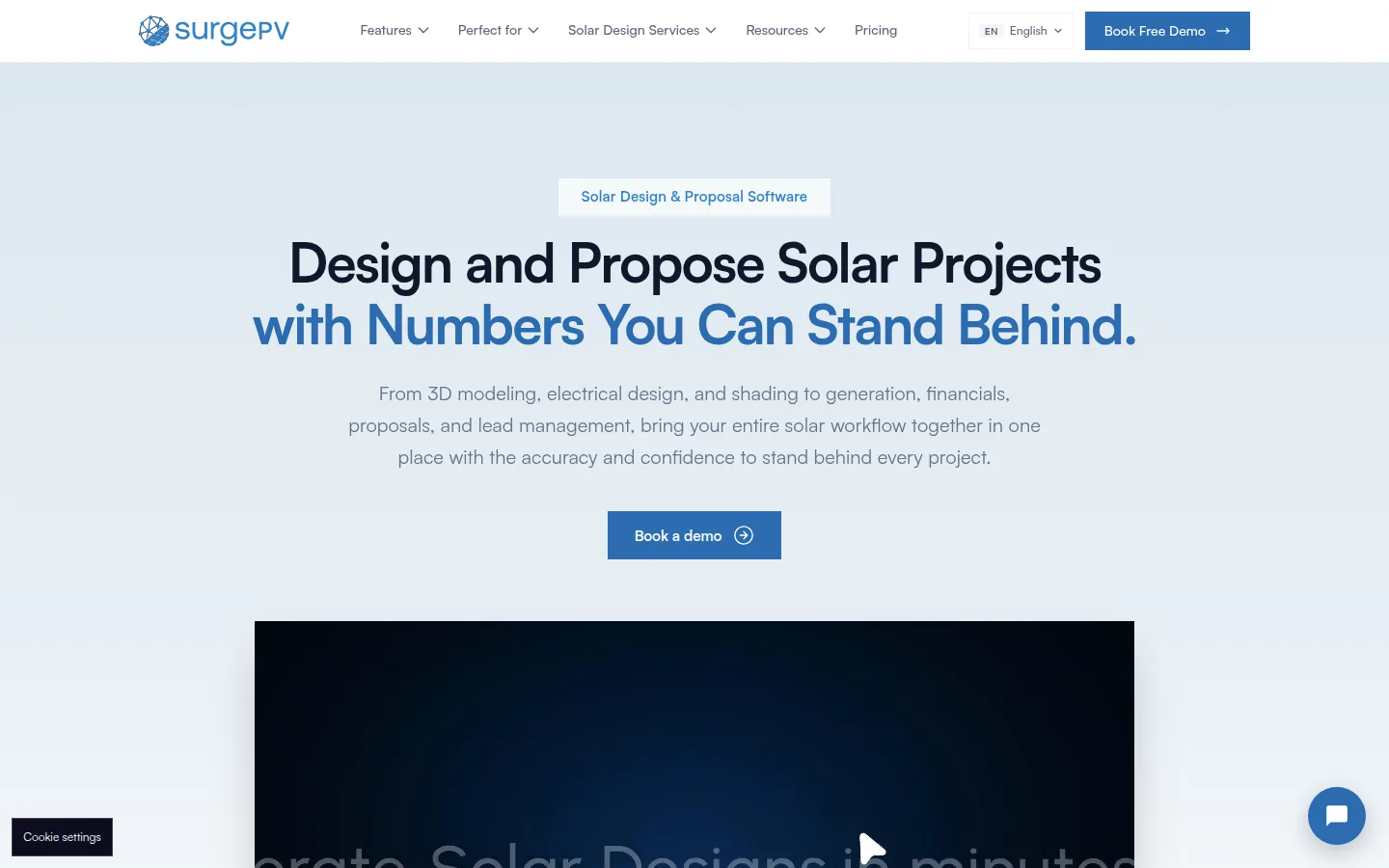
Best for: teams after roof modeling, array layout, shading analysis, energy-yield modeling, financial modeling, electrical workflow support, bill-of-materials output and proposal generation in one per-user product, who will raise the Colombian items in a demo. See solar proposal software for the product page.
Not the right choice if: a self-serve trial is required (SurgePV runs a guided demo) or a peso figure must be in writing before any sales conversation. Outputs aid design and documentation but do not stand in for approval by the responsible engineer, authority, lender or utility.
What the vendor documents: 3D roof modeling, array layout, shading analysis, energy-yield modeling, financial modeling, electrical workflow support, bill-of-materials output and proposal generation.
Price (checked October 2026): $1,899 per user per year for 1 user, $1,499 per user for 3 seats, $1,299 per user for 5 seats, in US dollars. Confirm any local-currency amount and taxes in a written quote.
Limitations: results depend on source data, assumptions and equipment models. Nothing in the published scope names a Colombian tariff, an export-credit setting, local-language proposals or a design size limit.
Vendor link: surgepv.com.
What a Colombian Solar Quote Must Reflect
Colombia’s rules for small self-generators are in CREG Resolution 174 of 2021. This section uses a distributor’s guide to that resolution and the national planning unit’s registration guide. Source: Electrohuila, Cartilla para el procedimiento de conexión de proyectos AGPE, AGGE y GD (Resolución CREG 174 de 2021). Source: UPME, Guía para el registro de información de solicitudes de proyectos, Resolución CREG 174 de 2021. The distributor is Electrohuila, one of several network operators, so the portal steps described here are Electrohuila’s own, while the resolution itself is national.
Size class. The guide defines a small-scale self-generator (AGPE) as one with installed capacity of 1 MW or less. It splits AGPE into projects under 100 kW and projects from 100 kW up to 1 MW. A project that exports surplus above 100 kW needs a simplified connection study, which changes the quote timeline and cost.
How surplus is valued. At the end of each billing period, exported energy that matches imported energy is recognized as energy credits swapped for imports. Surplus above imports is valued at the spot (bolsa) price, hourly, and becomes a peso amount in the customer’s favor. A “billable consumption” exists only when imports exceed exports, and depending on stratum and service class the customer may receive a subsidy or pay a contribution. A quote that values every exported kWh at the retail rate would not match this.
How the customer is paid. The guide lists three options: use the peso balance against later invoices, accumulating up to six billing periods with cuts in June and December; be paid the month after billing; or be paid twice a year, in June and December, the balance of up to six monthly periods (three bimonthly). The customer can also pick a different retailer for the surplus than the one that supplies them.
Meter and contract items. A project that exports needs a bidirectional meter, arranged with the retailer. An installation of 100 kW or more needs a grid backup capacity contract. A connection contract is signed only if the operator supplies the connection assets or must expand the network.
Quote validity. The guide says an approval for an AGPE is valid for six months, extendable by three months, with the extension requested at least one month before expiry. A quote should not promise a start date beyond that window.
Data the registration asks for. UPME’s form asks for estimated surplus kWh for each month of the year, entered as zero when none is exported, and for generator type, such as AGPE, with solar listed as photovoltaic, with or without storage. A proposal that holds monthly export estimates can fill that field.
What to ask a proposal vendor. Can the proposal show monthly export kWh? Can it value exports at an entered hourly price rather than a flat rate? Can it show a peso balance across billing periods? Can the quote be in Spanish? None of the vendor pages we read states Colombian output, so run a real invoice through a trial.
How We Ordered These Tools
Tools are listed in alphabetical order without ranking, and the picks come from the matrix. The criteria, with what was left unassessed:
- Tariff entry: a quote should reflect the client’s tariff class. Pricing of time-of-use or tiered rates in any tool was not assessed.
- Export-credit setting: exports may be paid as a flat rate or a credit. Whether any tool can recreate Colombia’s credit-swap and hourly spot valuation of surplus was not assessed.
- Local-language proposals: clients read quotes best in a familiar language. Translation quality was not assessed.
- Price in a published currency: a stated currency tells a buyer the true cost. Discounts and negotiated quotes were not assessed.
- Free start: a free plan lets a small team try the workflow. Plan limits beyond the page text were not assessed.
Methodology and Disclosure
SurgePV is published by SurgePV, which is also one of the vendors on this list. Its entry follows the same layout and draws on the same kind of source as the others, public vendor pages read in October 2026. Every vendor, SurgePV among them, has open questions on the Colombian items, and any feature a page omits is marked Not stated.
Sources and Dates
Vendor pages were read in October and November 2026, and each tool entry links its own sources. SurgePV details come from its pricing page and proposal software page.
- electrohuila.com.co: Electrohuila, Cartilla para el procedimiento de conexión de proyectos AGPE, AGGE y GD (Resolución CREG 174 de 2021) (read November 2026)
- docs.upme.gov.co: UPME, Guía para el registro de información de solicitudes de proyectos, Resolución CREG 174 de 2021 (read November 2026)
See SurgePV on your Colombia project
Book a guided demo and ask for the Colombia items you need in the quote.
Book a Free DemoMore Solar Software Guides to Compare
- Solar software in Colombia
- Solar design software for Colombia
- Best solar proposal software, all markets
- Aurora Solar alternatives
Frequently Asked Questions
What size is a small-scale self-generator in Colombia?
The distributor guide to CREG 174 of 2021 defines an AGPE as having installed capacity of 1 MW or less, and splits projects at 100 kW.
How are exported kWh valued for a Colombian solar customer?
Exports matching imports are recognized as energy credits swapped for imports. Surplus above imports is valued at the hourly spot (bolsa) price and becomes a peso amount in the customer’s favor, per the guide.
How long is a connection approval valid in Colombia?
Six months for AGPE and distributed generation projects, extendable by three months, with extension requests at least one month before expiry, per the distributor guide.
What does the UPME registration ask for about exports?
An estimated surplus energy in kWh for each month of the year, using zero where none is exported, in the Section 2 surplus delivery information.
How much does solar proposal software cost for Colombia installers?
No vendor on this page lists a Colombia price on the pages we read. Aurora Solar Basic is $159 per user per month billed monthly, or $135 per user per month billed annually. Energy Toolbase does not publish a price for ETB Developer. OpenSolar’s core app is free. SurgePV Individual is $1,899 per user per year. Ask each vendor for a written quote.
