

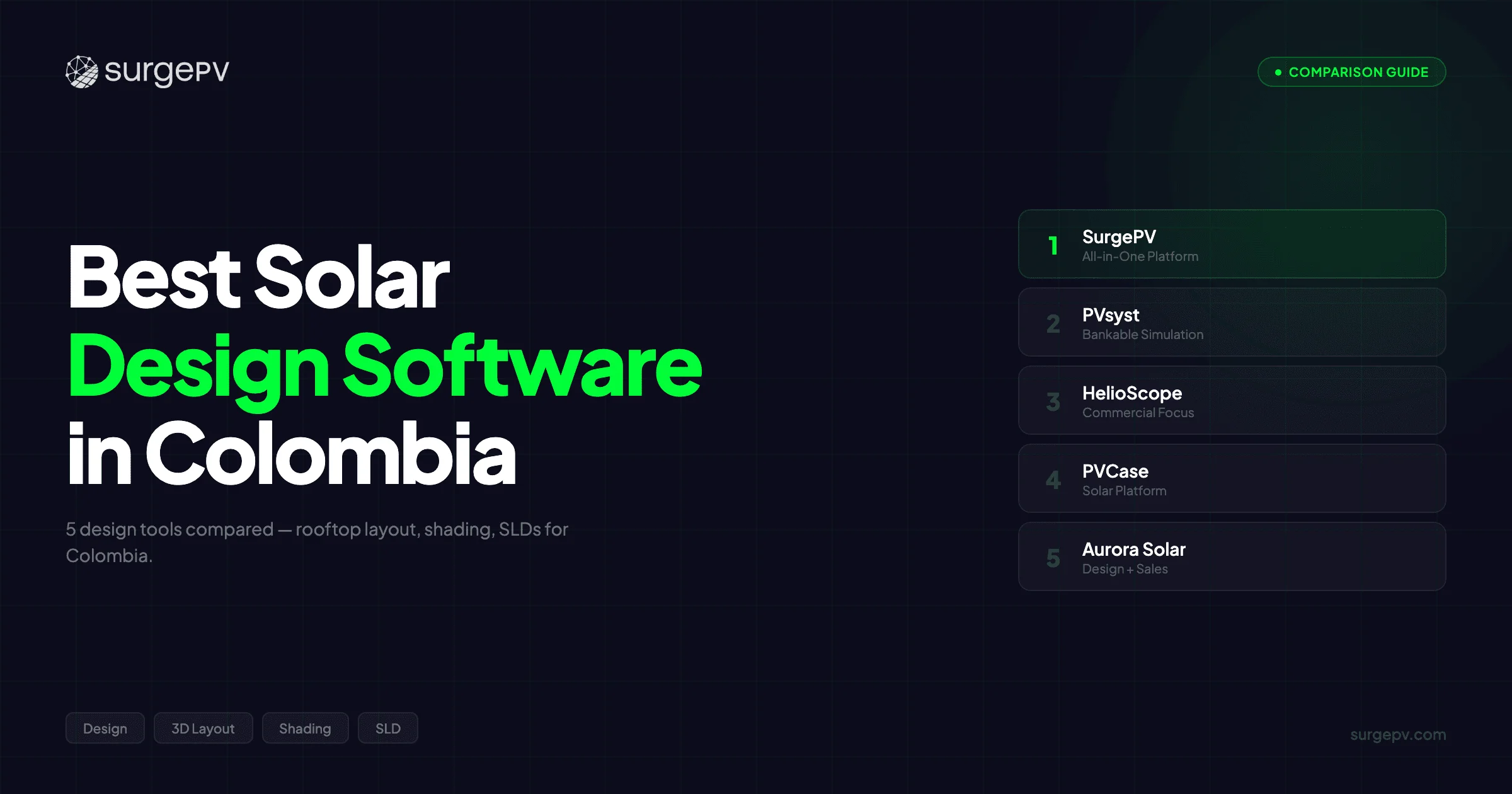
TL;DR: SurgePV is the only cloud platform combining XM Codigo de Redes-compliant SLD generation, UPME-grade bankability (P50/P75/P90), and Resolution 030/2018 distributed generation support - without AutoCAD. PVsyst remains the gold standard for bankability validation that conservative international financiers expect by name. HelioScope works for UPME utility-scale EPCs with existing AutoCAD workflows. PVCase suits CAD-experienced engineering firms on large La Guajira projects. Aurora Solar fits urban distributed generation in Bogota and Medellin.
Colombia’s solar sector has moved from ambition to action. UPME auctions have contracted 2.8+ GW of renewable energy. La Guajira projects are under construction. Distributed generation under Resolution 030/2018 is growing 30%+ annually in Bogota, Medellin, and Cali.
But the solar software hasn’t kept up with the market.
Most Colombian EPCs piece together their workflow from PVsyst (simulation), AutoCAD (electrical diagrams), Excel (financial modeling), and Word (proposals). Four tools. Hours of manual data transfer. And when XM (Expertos en Mercados) requests your Codigo de Redes-compliant single line diagram, you spend another 2-3 hours in AutoCAD creating it from scratch.
Here’s what that costs: on a competitive UPME tender where 10-20 bidders are fighting over a 100 MW La Guajira project, the EPC that produces bankable documentation fastest has the edge. On distributed generation projects where Bogota C&I customers expect proposals within 48 hours, 3-hour manual workflows lose deals to faster competitors.
The right solar PV design software for Colombia must handle UPME-grade bankability (P50/P90), XM Codigo de Redes-compliant SLD generation, Resolution 030/2018 distributed generation sizing, La Guajira high-irradiance modeling (2,000-2,200 kWh/m2), and ZNI off-grid design - without requiring AutoCAD or multiple disconnected tools.
In this guide, you’ll find:
- Which platforms generate XM Codigo de Redes-compliant electrical documentation automatically
- How each tool meets UPME tender bankability requirements (P50/P90 reports)
- Which software supports Resolution 030/2018 net billing for distributed generation
- La Guajira high-irradiance accuracy across 5 platforms
- Total cost of ownership in COP for Colombian EPC teams
Quick Summary: Our Top Picks for Colombia
After reviewing published information for 5 platforms with EPCs and installers across Colombia (Bogota, Medellin, and La Guajira regions), here are our top recommendations:
- SurgePV - Complete design with XM-compliant SLDs, UPME bankability, and Resolution 030/2018 support (Best for EPCs doing both UPME tenders and distributed generation)
- PVsyst - Gold-standard simulation for UPME bankability reports (Best for bankability validation that international financiers require, not a design tool)
- HelioScope - Cloud-based utility-scale simulation and layout (Best for UPME EPCs who have separate AutoCAD for SLDs)
- PVCase - CAD-based layout tool for utility-scale engineering (Best for engineering firms with existing AutoCAD workflows)
- Aurora Solar - Cloud-based residential and commercial design (Best for urban distributed generation in Bogota and Medellin)
Each tool evaluated on XM Codigo de Redes compliance, UPME bankability, Resolution 030/2018 support, La Guajira accuracy, pricing in COP, and workflow efficiency.
| Software | Best For | Pricing | Colombia Fit |
|---|---|---|---|
| SurgePV | End-to-end workflows | ~$1,899/yr (3 users) | Excellent |
| PVsyst | Bankable simulation | Not published | Good |
| HelioScope | Commercial rooftop arrays | $159/mo Basic, $259/mo Pro (list) | Good |
| PVCase | Utility-scale terrain | Not published | Good |
| Aurora Solar | Residential proposals | $159/user/mo list ($1,620/user/yr annual) | Good |
Best Solar Design Software in Colombia (Detailed Reviews)
SurgePV - Best End-to-End Solar Platform for Colombia
SurgePV is the only cloud-based platform combining AI-powered design, automated electrical engineering, bankable simulations, and professional proposals - without tool-switching or AutoCAD dependency.
For Colombian EPCs, that matters more than it does anywhere else. Colombia’s dual market structure - 65% UPME utility-scale auctions and 30% Resolution 030/2018 distributed generation - demands a platform that handles both. SurgePV designs a 150 MW La Guajira tracker field with UPME-grade accuracy, generates XM Codigo de Redes-compliant single line diagrams automatically, produces P50/P75/P90 bankability reports, and builds professional proposals - all in the same platform.
For ZNI (Non-Interconnected Zones) projects in the Amazon and Pacific coast regions, SurgePV’s off-grid solar+storage design handles diesel replacement sizing that most platforms can’t touch.
Target Users: UPME auction EPCs (50-200 MW La Guajira projects), distributed generation installers (Resolution 030/2018 projects under 1 MW), C&I sales teams in Bogota and Medellin, ZNI off-grid developers.
Pro Tip
Before choosing design software for Colombia, test two scenarios: a 100 MW La Guajira utility-scale project (UPME bankability) AND a 200 kW Bogota commercial rooftop (Resolution 030/2018 net billing). If the platform handles both, it fits Colombia’s market. If it only works for one, you’ll be buying a second tool within months.
Key Features for Colombia
XM Codigo de Redes Compliance
XM (Expertos en Mercados) requires detailed connection studies with single line diagrams, protection system specifications, and grid code compliance for every interconnection. For projects above 20 MW, STN (National Transmission System) studies are mandatory. Below 20 MW, SDL (Local Distribution System) requirements apply.
SurgePV generates IEC/IEEE-compliant SLDs automatically - 5-10 minutes versus 2-3 hours of manual AutoCAD work. The output meets international standards (IEC 61727, IEEE 1547) that form the basis of Colombia’s Codigo de Redes requirements. Wire sizing calculations apply to RETIE (Colombian electrical safety code, Resolution 90708/2013) standards.
The alternative? Purchase AutoCAD (licensed separately), hire CAD-trained engineers, and spend 2-3 hours per project drafting SLDs manually. Most Colombian EPCs - around 60% - still do exactly this.
UPME Bankability and La Guajira Accuracy
UPME tenders require bankable production forecasts accepted by international financiers (IDB, World Bank, commercial banks). SurgePV’s 8760-hour shading analysis achieves plus or minus 3% accuracy compared to PVsyst - meeting the threshold that UPME financiers require.
La Guajira’s Caribbean coast solar resource ranges from 2,000-2,200 kWh/m2 annually, among the highest in Latin America. The platform models seasonal variations (bimodal rainfall: dry January-March, wet September-November), soiling effects, and high-irradiance conditions that generic European tools undermodel.
P50/P75/P90 metrics and bankability reports support UPME tender documentation requirements. While PVsyst remains the gold standard that conservative financiers expect by name, SurgePV’s accuracy at plus or minus 3% makes it viable for many Colombian financing scenarios - and eliminates the need for a separate design tool.
Resolution 030/2018 Distributed Generation
Colombia’s distributed generation framework (Resolution 030/2018, issued by CREG) covers systems up to 1 MW with monthly compensation at wholesale rate (approximately 0.6-0.7x retail tariff). Simplified interconnection applies for systems under 100 kW. SurgePV handles distributed generation sizing, net billing calculations, and financial modeling for the 8-12 year payback periods typical of Colombian C&I projects.
Tracker design supports single-axis (15-25% production gain) and dual-axis (25-35% gain) configurations with backtracking - relevant for UPME utility-scale projects in La Guajira, Cesar, and Atlantico. Carport solar design covers Bogota and Medellin commercial parking lots and industrial facilities. East-West racking (20-40% higher density) optimizes urban rooftop constraints.
For ZNI regions - 52% of Colombia’s territory, covering the Amazon, Orinoquia, and Pacific coast - off-grid solar+storage design replaces diesel generators with properly sized solar and battery systems. IPSE (Institute of Energy and Electricity Planning) subsidized projects use these designs.
Further Reading
See our best solar design software global comparison for a broader view across 10+ platforms.
Pros:
- Only cloud platform combining XM-compliant SLDs + UPME bankability + Resolution 030/2018
- Automated SLD generation removes the separate AutoCAD licence and 2-3 hours per project
- Plus or minus 3% accuracy vs PVsyst for La Guajira irradiance (2,000-2,200 kWh/m2)
- P50/P75/P90 bankability for UPME tender financing
- Resolution 030/2018 net billing sizing for distributed generation (under 1 MW)
- Tracker design for UPME utility-scale (single/dual-axis with backtracking)
- ZNI off-grid solar+storage design (Amazon, Pacific coast)
- Transparent pricing: $1,899 per user per year on the individual plan (approximately 8.2M COP/year)
- Cloud-based - accessible from Bogota, Medellin, La Guajira without installation
Cons:
- Newer platform than PVsyst (conservative UPME financiers may still request PVsyst validation)
- Learning curve for complete platform (2-3 weeks vs 1 week for single-purpose tools)
- Spanish interface evolving (English-language platform with Spanish proposal support)
Pricing
| Plan | Price | Users |
|---|---|---|
| Individual | $1,899/year (approx. 8.2M COP) | 3 users |
| For 3 Users | $1,499/user/year ($4,497/year total, approx. 19.3M COP) | 3 users |
| For 5 Users | $1,299/user/year ($6,495/year total) | 5 users |
| Enterprise | Custom pricing | Multiple |
Total Cost of Ownership (3-year, 3-user Colombian EPC):
- SurgePV: approximately $5,700 (24.5M COP) - everything included
- PVsyst + AutoCAD: neither vendor publishes list pricing, so both are quoted separately
- HelioScope + AutoCAD: HelioScope publishes from $1,620/year per licence, plus a separately licensed AutoCAD seat
- SurgePV saves 34-76% over 3 years depending on competitor combination
Who SurgePV Is Best For: UPME EPCs building La Guajira utility-scale projects who need integrated bankability and XM-compliant SLDs. Distributed generation installers in Bogota, Medellin, and Cali doing Resolution 030/2018 projects. ZNI developers sizing off-grid solar+storage for Amazon and Pacific regions.
PVsyst - Industry Standard for UPME Bankability
PVsyst remains the gold standard for solar simulation and bankability reports. When international financiers (IDB, World Bank, commercial banks) evaluate UPME tender projects, they expect PVsyst format. That reputation is earned - PVsyst’s simulation engine and detailed loss modeling are the most trusted in the industry.
Key Strengths: Highest credibility with UPME financiers. Excellent simulation accuracy with deep meteorological database. Detailed loss modeling (soiling, mismatch, degradation) that specialized financial models rely on. Proven track record on La Guajira utility-scale projects. Transparent pricing (CHF 700-1,200/year, approximately $900-1,500).
Where PVsyst Falls Short for Colombia: Not a design platform - no roof modeling, no module layout tools, no electrical engineering. Desktop software requiring Windows installation (no cloud access for distributed teams in Bogota and La Guajira). Steep learning curve (6-8 weeks typical). No SLD generation (requires AutoCAD for XM Codigo de Redes compliance). No Resolution 030/2018 support. No proposal generation. No off-grid design for ZNI regions.
Best For: Large UPME projects (50-200 MW) where international financiers specifically require PVsyst validation. Many Colombian EPCs use PVsyst as a validation checkpoint alongside their primary design platform.
Read our full PVsyst review for detailed analysis.
Did You Know?
Colombia’s solar irradiance ranges from 1,400-1,900 kWh/m²/year in most regions, rising to 2,000-2,200 kWh/m²/year on the Caribbean coast. Accurate simulation software is essential for bankable energy yield predictions. Lenders generally ask for simulation output from a recognised tool rather than manual calculations.
HelioScope - Utility-Scale Simulation Platform
HelioScope is a cloud-based solar design tool focused on commercial and utility-scale projects. Owned by Aurora Solar, it provides reasonable simulation accuracy and straightforward layout tools for UPME-class projects.
Key Strengths: Cloud-based access (multi-user collaboration across Bogota and La Guajira). Good simulation accuracy for UPME utility-scale projects. Decent C&I design tools for Bogota and Medellin commercial rooftops. Used by some international EPCs for Colombian UPME tenders.
Where HelioScope Falls Short for Colombia: No SLD generation - Colombian EPCs still need AutoCAD (licensed separately) for XM Codigo de Redes compliance. Contact sales pricing model (estimated $3,000-6,000/year) creates budget uncertainty in a COP-volatile environment. Limited Resolution 030/2018 distributed generation support. No off-grid design for ZNI projects. Limited financial modeling for Colombian tariff structures.
Best For: International EPCs with existing UPME relationships who need cloud-based simulation and have separate AutoCAD workflows for XM electrical documentation.
Read our full HelioScope review for detailed analysis.
PVCase - CAD-Based Engineering for UPME Projects
PVCase runs as an AutoCAD plugin, providing deep terrain analysis, cable routing optimization, and detailed engineering for utility-scale ground-mount projects. Used by large EPCs on La Guajira UPME projects where terrain complexity justifies the investment.
Key Strengths: Most detailed terrain analysis for ground-mount La Guajira projects. Advanced cable routing that saves 5-10% on BOS costs for large installations. AutoCAD integration provides SLD capability through the CAD environment. Strong for large UPME utility-scale layouts (50-200 MW).
Where PVCase Falls Short for Colombia: Requires AutoCAD (licensed separately) plus PVCase licensing (EUR 2,000-4,000/year). Desktop-only - no cloud access. Steep learning curve (10-14 weeks). No Resolution 030/2018 distributed generation support. No proposal generation. No financial modeling for Colombian tariffs. Overkill and overpriced for distributed generation projects. Total 3-year TCO: approximately 51.6-77.4M COP for a 3-user team.
Best For: Engineering firms with existing AutoCAD expertise working on large UPME La Guajira utility-scale projects (100+ MW) where detailed terrain modeling justifies the cost.
Read our full PVCase review for detailed analysis.
Aurora Solar - Distributed Generation for Urban Markets
Aurora Solar is the global market leader for residential solar proposal software, offering AI-powered roof modeling and polished proposals. In Colombia, it has some adoption for urban distributed generation projects in Bogota and Medellin under Resolution 030/2018.
Key Strengths: AI-powered roof detection (fastest residential modeling). Beautiful customer-facing proposals for C&I clients. Cloud-based platform accessible anywhere. CRM integrations for managing sales pipelines. Some Resolution 030/2018 support for distributed generation sizing.
Where Aurora Falls Short for Colombia: No SLD generation - XM Codigo de Redes compliance requires AutoCAD (licensed separately). Limited utility-scale features - poor fit for UPME projects (65% of Colombian market). No tracker support (needed for La Guajira). Expensive at approximately $135-259/user/month ($1,620-3,108/year) - significant burden with COP devaluation (34% increase in USD costs 2020-2024). No off-grid design for ZNI regions. Limited P75/P90 bankability for UPME financing.
Best For: Urban distributed generation installers in Bogota and Medellin doing small commercial net billing projects under 100 kW, with budget for premium pricing.
Read our full Aurora Solar review for detailed analysis.
Comparison Table: Solar Design Software for Colombia
| Feature | SurgePV | PVsyst | HelioScope | PVCase | Aurora Solar |
|---|---|---|---|---|---|
| Best For | UPME + distributed gen | UPME bankability | Utility-scale sim | CAD engineering | Urban distributed gen |
| XM SLD Compliance | Automated (IEC/IEEE) | No | No | Yes (via CAD) | No |
| UPME Bankability | Yes (plus/minus 3%) | Gold standard | Yes | Limited | Limited |
| Resolution 030/2018 | Yes | No | Limited | No | Yes |
| La Guajira Accuracy | 8760-hr analysis | Meteonorm (strong) | Good | Manual | Limited |
| Tracker Support | Single + Dual axis | Simulation only | Yes | Yes | No |
| ZNI Off-Grid | Solar+storage | Manual | Manual | No | Limited |
| Cloud-Based | Yes | No (desktop) | Yes | No (desktop) | Yes |
| Pricing (USD/yr) | $1,899 (3 users) | $900-1,500 | $3,000-6,000 | $4,000-6,000 | $1,620-3,108/user |
| COP Approx (annual) | 8.2M | 4-6.5M | 13-26M | 17-26M | 7-13M/user |
| AutoCAD Required | No | N/A (sim only) | Yes (for SLD) | Yes (mandatory) | Yes (for SLD) |
| SLD generation | Yes (automated) | No | No | No | No |
| P50/P90 reports | Yes | Yes (gold standard) | Limited | Yes | P50 only |
| Carport design | Yes (only platform) | No | No | Limited | No |
| Wire sizing | Yes (automated) | No | No | No | No |
Design Colombian Solar Projects End-to-End
Automated XM-compliant SLDs, UPME bankability reports, and Resolution 030/2018 net billing - one platform, no AutoCAD needed.
Book a DemoNo commitment required · 20 minutes · Live project walkthrough
What Makes the Best Solar Design Software for Colombia
Five Colombia-specific factors determine whether design software works for this market:
1. XM Codigo de Redes Compliance
XM (Expertos en Mercados) operates Colombia’s wholesale electricity market and manages grid interconnection approvals. Every project needs Codigo de Redes-compliant SLDs, whether it’s STN (above 20 MW) or SDL (below 20 MW). IEC 61727, IEEE 1547 standards apply. RETIE (Resolution 90708/2013) governs electrical safety. Software that generates XM-compliant SLDs automatically eliminates AutoCAD dependency and 2-3 hours per project.
2. UPME Auction Bankability
UPME has contracted 2.8+ GW across 15 solar projects in La Guajira and the Caribbean coast. International financiers (IDB, World Bank) require P50/P90 bankability reports with plus or minus 3% simulation accuracy. While PVsyst is the recognized name, any software meeting this accuracy threshold satisfies bankability requirements. UPME doesn’t legally mandate specific software.
3. Resolution 030/2018 Net Billing Support
CREG’s distributed generation framework covers systems up to 1 MW with monthly compensation at wholesale rate. Bogota, Medellin, and Cali drive 60% of distributed generation demand. Software must calculate net billing economics accurately - wholesale rate at approximately 0.6-0.7x retail tariff, varying by region and month. This is where UPME-focused tools like PVsyst fail completely.
4. La Guajira High-Irradiance Accuracy
Colombia’s Caribbean coast (La Guajira, Cesar, Atlantico) delivers 2,000-2,200 kWh/m2 annually. Bimodal rainfall (dry January-March, wet September-November) affects soiling models. IDEAM (Colombian meteorological service) and NASA POWER provide the most accurate local data. Software using generic European databases introduces 5-10% uncertainty for Colombian locations.
5. COP Pricing Transparency
Colombia’s peso fluctuates 5-10% annually versus USD (approximately 4,300 COP/USD in early 2026). The 34% COP devaluation from 2020-2024 made USD-priced software significantly more expensive in local terms. Transparent, predictable pricing matters. Contact-sales models create budget uncertainty that Colombian SMEs can’t afford.
Colombia Solar Market Context
Colombia has 575 MW of operational solar PV with 2.8+ GW contracted through UPME auctions. The country targets 28% non-hydro renewable energy by 2030, up from approximately 5% today.
The market splits into three segments:
- UPME Utility-Scale (65%): Large La Guajira and Caribbean coast projects (50-200 MW each), PPA-based, internationally financed
- Distributed Generation (30%): Resolution 030/2018 net billing, C&I focus in Bogota, Medellin, Cali, growing 30%+ annually
- ZNI Off-Grid (5%): Solar+storage for Non-Interconnected Zones (Amazon, Pacific coast, islands), IPSE-subsidized
Key challenges include Colombia’s 70% hydro generation creating dispatch challenges for solar (curtailment risk during wet season), Caribbean coast transmission bottlenecks limiting La Guajira project delivery, and an installer base that’s growing fast but still developing advanced tool proficiency.
With approximately 500-800 active solar companies in Colombia, the market is competitive enough that software advantages translate into real project wins - especially on UPME tenders where 10-20 bidders compete for each contract.
| Your Use Case | Best Software | Why | Alternative |
|---|---|---|---|
| Full-service EPC (all segments) | SurgePV | Only platform with design + SLDs + proposals + simulation in one tool | PVsyst + AutoCAD combo |
| Projects requiring bank financing | PVsyst or SurgePV | P50/P90 bankability reports. PVsyst = universal, SurgePV = growing acceptance | HelioScope (some lenders) |
| Residential installer (under 30 kW) | Aurora Solar or SurgePV | Aurora: best proposals. SurgePV: proposals + engineering depth | OpenSolar (free tier) |
| Utility-scale developer (above 1 MW) | HelioScope or PVCase | Fast ground-mount design. Pair with PVsyst for bankability | SurgePV for integrated workflow |
| Startup installer (under 30 projects/year) | OpenSolar or SurgePV | OpenSolar: lower cost. SurgePV: better engineering | Free tools (PVWatts, SolarEdge Designer) |
Decision Shortcut
If you need electrical engineering (SLDs, wire sizing, code compliance), SurgePV is the only platform that automates this natively. If you’re simulation-only, PVsyst is the gold standard. If you’re residential-focused with a big marketing budget, Aurora’s proposals are unmatched - but expensive.
How We Reviewed and Ranked These Tools
We evaluated 5 platforms against Colombian market requirements using weighted criteria:
| Criteria | Weight | What We Reviewed |
|---|---|---|
| Accuracy and Bankability | 30% | Simulation vs NREL/IDEAM data, UPME financier acceptance |
| Ease of Use | 25% | Onboarding time, daily workflow speed, Colombian EPC feedback |
| Colombia Applicability | 20% | XM compliance, Resolution 030/2018, La Guajira accuracy |
| Features and Functionality | 15% | Design, SLD generation, utility-scale, distributed gen, ZNI |
| Pricing and Value | 10% | COP affordability, transparent pricing, ROI |
research conducted November 2025 through January 2026 with Colombian EPCs in Bogota, Medellin, and Cali.
Bottom Line: Best Solar Design Software for Colombia
Colombian EPCs face a dual market reality: UPME utility-scale projects demand bankable solar simulation software accuracy and XM compliance, while distributed generation under Resolution 030/2018 requires fast turnaround and accurate net billing calculations. Most tools handle one or the other. Few handle both.
Our Recommendations:
- For UPME EPCs doing both utility-scale and distributed gen: SurgePV. The only cloud platform with automated XM-compliant SLDs, UPME-grade bankability, Resolution 030/2018 support, and ZNI off-grid capabilities - at $1,899 per user per year on the individual plan (approximately 8.2M COP).
- For bankability validation on large UPME projects: PVsyst remains the gold standard that international financiers recognize. Use it alongside SurgePV for projects where financiers specifically require PVsyst reports.
- For UPME utility-scale with separate CAD workflows: HelioScope provides cloud-based simulation, but you’ll need AutoCAD for XM SLDs.
- For CAD-experienced engineering firms on large UPME projects: PVCase offers deepest terrain modeling, but requires AutoCAD and significant investment.
- For urban distributed gen in Bogota and Medellin: Aurora Solar provides AI roof modeling and polished proposals, though expensive in COP terms and lacking XM compliance features.
Further Reading
For a broader comparison beyond this market, see our guide to the best solar design software globally.
Frequently Asked Questions
What is the best solar design software in Colombia?
SurgePV is the best all-in-one solar design software for Colombia, combining UPME-ready design (plus or minus 3% vs PVsyst), XM Codigo de Redes-compliant SLD generation, Resolution 030/2018 net billing sizing, and ZNI off-grid capabilities in one cloud platform - without requiring AutoCAD. For UPME bankability validation specifically, PVsyst remains the gold standard. Book a demo.
Do Colombian UPME projects require PVsyst?
PVsyst is widely accepted by UPME financiers, but it’s not legally required by UPME. Any software with plus or minus 3% simulation accuracy meets bankability requirements. SurgePV achieves this threshold. However, conservative international financiers (IDB, World Bank) may specifically request PVsyst reports for large projects. Many EPCs use SurgePV for design and PVsyst for validation. See our PVsyst review.
What software meets XM Codigo de Redes requirements?
XM requires detailed single line diagrams and connection studies compliant with IEC 61727 and IEEE 1547 standards. SurgePV generates automated IEC/IEEE-compliant SLDs in 5-10 minutes. PVCase generates SLDs through AutoCAD integration. PVsyst, HelioScope, and Aurora Solar do not generate SLDs - requiring separate AutoCAD (licensed separately).
Which solar software supports Resolution 030/2018 net billing?
SurgePV and Aurora Solar both support Resolution 030/2018 distributed generation net billing calculations for systems up to 1 MW. PVsyst and HelioScope do not support Resolution 030/2018. PVCase is design-only with no financial modeling. For distributed generation projects in Bogota, Medellin, and Cali, SurgePV offers the most complete workflow with design, net billing calculations, and proposals integrated.
How much does solar design software cost in Colombia (COP)?
SurgePV costs approximately 8.2M COP/year (3 users) at the current 4,300 COP/USD rate. PVsyst runs approximately 4-6.5M COP/year (desktop only). Aurora costs approximately 7-13M COP/user/year. HelioScope approximately 13-26M COP/year. PVCase + AutoCAD approximately 17-26M COP/year. COP prices fluctuate with the USD exchange rate. See SurgePV pricing.
Can solar software design ZNI off-grid systems?
Yes. SurgePV includes solar+storage design for ZNI (Non-Interconnected Zones) covering the Amazon, Pacific coast, and island regions. Most other tools (PVsyst, HelioScope, Aurora) require manual off-grid calculations. ZNI projects typically replace diesel generators with solar+battery systems - SurgePV sizes both components in one workflow.
What solar irradiation data is accurate for La Guajira?
Best data sources are IDEAM Atlas Solar Colombia (2,000-2,200 kWh/m2/year for La Guajira) and NASA POWER. Software must account for bimodal rainfall patterns (dry January-March, wet September-November) affecting soiling. SurgePV’s 8760-hour shading analysis uses validated weather data achieving plus or minus 3% accuracy.
Do I need AutoCAD for Colombian solar projects?
XM requires SLDs for grid interconnection. SurgePV generates automated IEC/IEEE-compliant SLDs - no AutoCAD needed. Other platforms (Aurora, PVsyst, HelioScope) require separate AutoCAD (licensed separately) for XM Codigo de Redes compliance. SurgePV eliminates that cost and saves 2-3 hours per project.
Sources
- IRENA Renewable Energy Statistics - Colombia 575 MW solar capacity (accessed February 2026)
- UPME Official Website - 2.8+ GW renewable energy auction documentation (accessed February 2026)
- XM (Expertos en Mercados) - Codigo de Redes grid interconnection requirements (accessed February 2026)
- CREG Resolution 030/2018 - Distributed generation regulation (accessed February 2026)
- Law 1715 - Colombian renewable energy promotion framework (accessed February 2026)
- IDEAM Atlas Solar - Colombian solar irradiation data (accessed February 2026)
- Colombian Ministry of Mines and Energy - NDC targets and renewable energy policy (accessed February 2026)
- SurgePV Official Documentation - Product features and pricing (accessed February 2026)
- PVsyst, Aurora Solar, HelioScope, PVCase - Official documentation (accessed February 2026)
- G2 Reviews - Verified user reviews (accessed February 2026)
- Capterra - User ratings and feedback (accessed February 2026)
